

Saved Bookmarks
This section includes 7 InterviewSolutions, each offering curated multiple-choice questions to sharpen your Current Affairs knowledge and support exam preparation. Choose a topic below to get started.
| 2. |
Broadly speaking there are four types of stereisomers namely conformational isomers geometrical isomers, enantiomers and diastereomers.Although conformational isomers , have same configuration geometrical isomers have different atoms attached to each of the doubly bonded carbon atom, and enantiomers are due to chirality in the molecule Enantiomers are also known as optical isomers and diastereomers are those stereoisomers which are not enantiomers.In simple compound, number of stereoisomers.In chiral molecule is given by the reaction 2^n, where n is the number of dissimilar chiral carbon. Observe the following structures and answer the questions given below : The correct names for the above structure is : |
|
Answer» (2S, 3E)-3-penten-2-ol |
|
| 3. |
Briquettes used in modern vertical retort process are made up of _________. |
|
Answer» `ZnSO_(4) (40%) ` + CLAY (60%) |
|
| 4. |
Bring out the following conversions: a. Toluene to Benzaldehyde b. Acetylene to acetaldehyde c. Formaldehyde to Methyl alcohol d. Propanoic acid to Acetic acid. |
Answer» Solution :The conversions are CARRIED out as under:  B. `underset("Acetylene")(HC-=CH)+H_(2)Ounderset(HgSO_(4))overset(H_(2)SO_(4))(to)CH_(3)-underset("Acetaldehyde")overset(O)overset(||)(C)-H` c. `underset("Formaldehyde")(HCHO)overset(LiAlH_(4))(to)underset("Methyl alcohol")(CH_(3)OH)` 
|
|
| 5. |
Bring out the following conversion: a. Acetyl chloride to Acetaldehyde b. Ethanol to Acetaldehyde c. Acetic acid to Acetaldehyde d. 2-Butanol to 2-Butanone. |
|
Answer» Solution :The conversions are achieved as under: a. `UNDERSET("Acetyl chloride")(CH_(3)COCl)+H_(2)underset("Xylene")overset(Pd-BaSO_(4))(to)underset(.Acetaldehyde")(CH_(3)CHO)+HCl` B. `underset("ETHANOL")(CH_(3)CH_(2)OH)underset(573K)overset(Cu)(to)CH_(3)-underset("Acetaldehyde")overset(O)overset(||)(C)-H+H_(2)` c. `underset("Acetic ACID")(CH_(3)COOH)overset(LiAlH_(4))(to)underset("Ethanol")(CH_(3)CH_(2)OH)underset(573K)overset(Cu)(to)CH_(3)-underset("Acetaldehyde")overset(O)overset(||)(C)-H` d. `CH_(3)-underset(2-"Butanol")overset(OH)overset(|)(CH)-CH_(2)-CH_(3)underset(573K)overset(Cu)(to)CH_(3)-underset(2-"Butanone")overset(O)overset(|)(C)-CH_(2)-CH_(3)+H_(2)` |
|
| 6. |
Bring about the following conversions : Nitrobenzene to benzoic acid |
Answer» SOLUTION :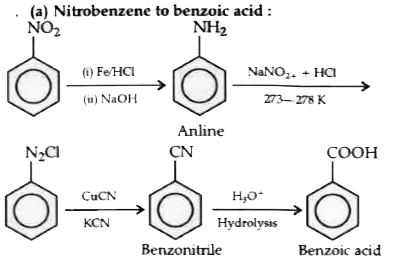
|
|
| 7. |
Bring about the following conversions : Benzyl chloride to 2-phenyl ethanamine |
Answer» SOLUTION :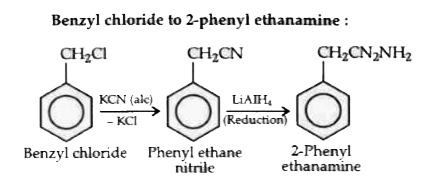
|
|
| 8. |
Brine solutionon electrolysiswill give |
|
Answer» `NAOH ` |
|
| 9. |
Brine is electrolysed by using inert electroldes. The reaction at anode is |
|
Answer» `Cl^(-)(AQ) to 1//2 Cl_(2)(g) +e^(-), E_("Cell")^(@) =1.36 V` |
|
| 10. |
Brine is electrolysed by using inert electrodes. The reaction at anode is ........ |
|
Answer» `Cl_((aq))^(-) to 1/2 Cl_(2(g)) - e^(-) , E_(("CELL"))^(Theta) = 1.36 V` |
|
| 11. |
Brine is electrolysed by using inert electrodes. The reaction at anode is……………. |
|
Answer» `Cl^(-) (a) to (1)/(2) Cl_(2)(g) +e^(-), ""E_("cell")^(0) = 1.36V` |
|
| 12. |
Brineiselectrolysedby usinginertelectrodes.The reaction atanodeis ........ |
|
Answer» ` C l^(-)(aq)to(1)/(2) Cl_ 2(g)+e ^(- ) ,E^(@ )""_("Cell") =1.36 V` |
|
| 13. |
Brine is electrolysed by using inert electrodes. The reaction at anode is _____. |
|
Answer» `Cl^(-)(aq) to (1)/(2) Cl_(2)(G) +E^(-), "" E_("CELL")^(@)=1.36V` |
|
| 14. |
Brine helps in food perservation by |
|
Answer» KILLING the germs |
|
| 15. |
Brine is chemically: |
|
Answer» CONC. SOLUTION of `Na_2CO_3` |
|
| 16. |
Briefly explain why electronic configuration of lanthanoids are not known with certainty ? |
| Answer» Solution :`4f 5d ` subshells are very CLOSE in ENERGY. +ve ELECTRONS can JUMP from 4f to 5d or vice-versa. | |
| 17. |
Briefly explain why electronic configuration of lanthanoids are not known with certainty. |
| Answer» Solution :In the lanhanoids, 4f and 5d subshells are very close in energy. The OUTERMOST 6s orbital remains filled with 2 electrons `( 6s^(2))`. The electron can easily JUMP from 4f to 5d or vice-versa. Further, irregularities in ELECTRONIC CONFIGURATION are also RELATED to the stabilities of `f^(0), f^(7)` and `f^(14)` occupacy of f-orbitals. Hence, their electronc configuration are not known with certainity. | |
| 18. |
Briefly explain why the following reaction does not occur |
| Answer» Solution :By itself, `(CH_(3))_(3)CO^(-)`is not a good enough LEAVING group to allow iodide to ATTACK the methyl carbon in an `S_(N)2`fashion. PROTONATION of the oxygen converts the leaving group to methanol `(CH_(3)OH)`, which is good enough to leave when iodide attacks. | |
| 19. |
Briefly explain the effects of temperature on the solubility of solids in liquids. |
|
Answer» SOLUTION :If the PROCESS of dissolution is exothermic, the SOLUBILITY decreases with the increase in TEMPERATURE. (ii) If the process of dissolution is endothermic, the solubility INCREASES with the increase in temperature. |
|
| 20. |
Briefly explain the acidic nature of phenols. |
Answer» Solution :The acidic nature of phenols can be explained on the BASIS of resonance.  Due to resonance in phenol the `O-` atom of `-O-H` group acquires slight `+ve` charge and `H-` atom is RELEASED as proton. ALSO phenoxide ion is more stabilised due to resonance. `therefore"The equilibrium (1) will shift towards R.H.S. giving more of "H^(+)" ions."` |
|
| 21. |
What is the name of the method that is used in manufacturing of sodium hydroxide? Explain the method.Write the equations of the reactions involved in this process |
|
Answer» |
|
| 22. |
Briefly discuss Schottky defects and give examples. |
|
Answer» SOLUTION :When imperfections or defects in a crystal are caused by a DEPARTURE from the periodic ARRANGEMENT in the VICINITY of an atom or a group of atoms, the imperfections are called point defects. The imperfections are caused either by missing or dislocations of a. constitutent particle to a position meant for ANOTHER particle or shifting to an interstitial position. Point defects are of two common types : 1. Schottky defects 2. Frenkel defects. 1. Schottky defects. This defect arises if some of the atoms or ions are missing from their normal lattice sites. The lattice sites which are unoccupied are called latrice vacancies or holes. Since the crystal is to remain electrically neutral, equal number of cations and anions are missing. The ideal AB crystal is shown in Fig. The existence of two holes, one due to a missing cation and the other due to a missing anion, is shown in Fig. Schottky defect is more common in strongly ionic compounds having a high coordination number. 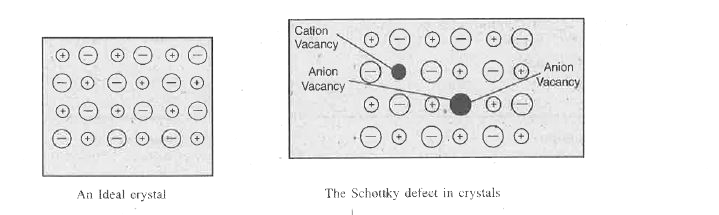 For example, NaCl and CsCl ionic solids have Schottky defects. Because of the presence of vacancies in crystals, its density is markedly lowered. 2. Frenkel defects. This defect arises when an ion is missing from its own position and occupies an interstitial site. The existence of one hole due to a missing cation its proper position and occupying an interstitial position is shown in Fig. In this case also, the crystal remains electrically neutral. Frenkel defects generally occur in 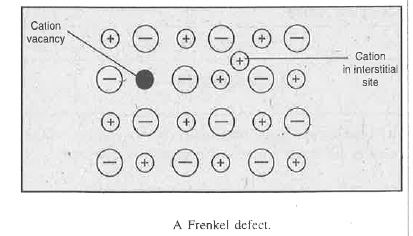 compounds in which anions are much larger than the cations and the co-ordination number is low. These defects can be found in silver halides because of the small size in the `Ag^(+)` ion. |
|
| 23. |
BrF_(5) undergoes hydrolysis then the products formed are |
|
Answer» `HBrO_(2),HF` |
|
| 24. |
BrF_3 is a liquid which considerably undergoes self ionization to form cationic and anionic species.Based on VSEPR theory, number of 90 degree F-Br-F bond angles is ……. In anionic species. 2BrF_3 hArr [BrF_2]^++ [BrF_4]^(-) |
Answer» 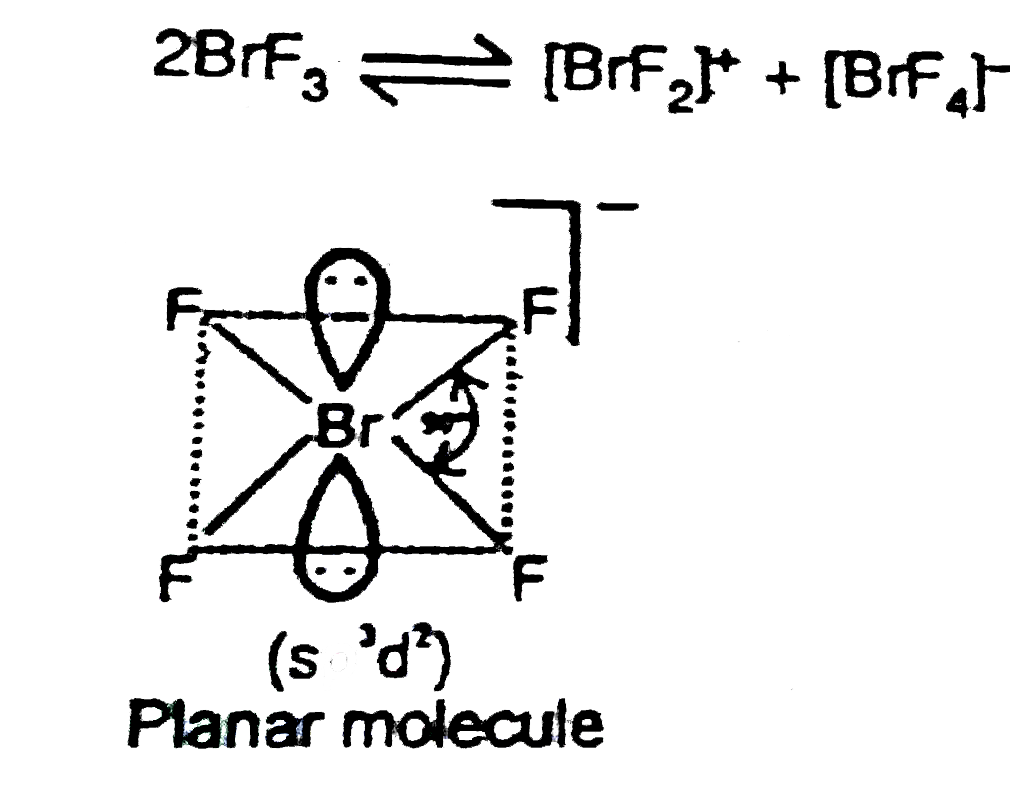
|
|
| 25. |
Brewery and sugar factory waste alter the quality of a water body by increasing |
|
Answer» pH |
|
| 26. |
Breding arc method cannot be used to prepare colloidal solutionof which of the following ? |
|
Answer» `Pt` `2AuCl_(3)+3SnCl_(2)rarrunderset("Gold sol")(2Au+3SnCl_(4))` |
|
| 27. |
Bredig's arcmethod cannot be used for the preparation of colloidal sol of : |
|
Answer» Cu |
|
| 28. |
Bredig's arc method involves |
|
Answer» Only DISPERSION of metal |
|
| 29. |
Bredig's arc method cannot be used to prepare colloidal solution of |
|
Answer» Pt |
|
| 31. |
Brass is an example of a the defect |
|
Answer» SCHOTTKY DEFECT |
|
| 33. |
Brass is an alloy of ___________ and ___________. |
|
Answer» ZN and Cu |
|
| 40. |
Brandy is distilled form fermented fruits, rum is distilled form molasses, Bourbon whisky form corn, rye whisky form rye, sotch whisky form barley, Irish whisky form potatoes, Saki form rice, and beer form…. |
|
Answer» Malt |
|
| 41. |
Bragg's law is given by the equation: |
|
Answer» `nlambda = 2 SIN theta` |
|
| 42. |
The PH of a solution is defined by the equation: |
|
Answer» `nlambda=2sintheta` |
|
| 43. |
Bragg's equation is: |
|
Answer» `nlambda=2thetasintheta` |
|
| 44. |
Bragg’s equation has no solution if: |
|
Answer» `nlambda=2d` |
|
| 45. |
Bragg’s equation is- (A) ngamma=20sin theta(B) ngamma=2d sin theta 2ngamma=d sin theta(D)gamma=(2d//n) sin theta |
| Answer» Solution :(B) BRAGG’s EQUATION is `ngamma` = `2d SIN THETA`. | |
| 46. |
Br_(2)(l) reacts with Cl_(2) (g) to form BrCl_(3) ,simultaneously .How many moles of Cl_(2)(g) reacts completely with 3 moles of Br_(2)(l) to form BrCl and BrCl_(3) in 5 :1 molar ratio . |
|
Answer» |
|
| 47. |
Br_(2) water in NaOH soin .Oxidises Mn(OH)_(2) to a…. Ppt due to theformationof MnO(OH)_(2) |
|
Answer» BLACK |
|
| 48. |
Br_2+NaOHrarrNaBrO_3+H_2O In the above balanced chemical equation, number of moles of Br_2 reduced to bromide is |
|
Answer» 1.5 |
|
| 49. |
Br_(2) reacts with O_(2) in either of the following ways depending upon supply of O_(2) Br_(2) + (1)/(2) O_(2) rarr Br_(2) O Br_(2) + (3)/(2) O_(2) rarr Br_(2) O_(3) If 4 moles of Br_(2) and 10 moles of O_(2) are taken in a container then calculate the number of moles of reactant left complete reaction. |
|
Answer» <BR> Solution :`{:(Br_(2),+,(3)/(2)O_(2),RARR,Br_(2)O_(3),),("Moles",4,,(3)/(2) xx 4,,),(,,,= 6 "moles",,):}`Moles of REACTANT `(O_(2))` left = 4 moles |
|