Saved Bookmarks
This section includes 7 InterviewSolutions, each offering curated multiple-choice questions to sharpen your Current Affairs knowledge and support exam preparation. Choose a topic below to get started.
| 1. |
An ether (A) C_(5)H_(12)O whenheated with excess HI produced two alkyl iodide, which on alkaline hydrolysis forms compound (B) and ( C) Oxidation of (B) gives acid and oxidation of (C ) gives ketone. What is compound (A) ? |
|
Answer» `CH_(3)OCH_(2)CH_(2)CH_(2)CH_(3)` |
|
| 2. |
An ether ‘A’ (C_(5)H_(12)O) when heated with excess of hot concentrated HI produced two alkyl halides which on hydrolysis from compounds B and C. Oxidation of B gives an acid D whereas oxidation of C gave a ketone E. Deduce the structures of A, B, C, D and E. |
Answer» SOLUTION :A: `CH_(3)CH_(2)`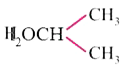 B: `CH_(3) CH_(2) OH` B: `CH_(3) CH_(2) OH` C: `CH_(3) CHOHCH_(3)`D: `CH_(3) COOH` E: `CH_(3) COCH_(3)` |
|
| 3. |
An ester which is used as a medicine |
|
Answer» ethyl ACETATE |
|
| 4. |
An ester used in medicine is : |
|
Answer» ETHYL acetate |
|
| 5. |
An ester used as medicine is |
|
Answer» ethyl benzoate |
|
| 6. |
An ester used as medicine is : |
|
Answer» ethyl acetate |
|
| 7. |
An Ester produces only one alcohol, on treatment with CH_(3)MgBr followed by hydrolysis and this ester has minimum molecular weight, find the number of carbon atoms present in ester which satisfies above conditions. |
Answer» 
|
|
| 8. |
An ester is subjected to hydrolyse. Product of hydrolysis will be tested for |
|
Answer» carboxylic acid and ALCOHOLIC GROUP |
|
| 9. |
An ester has a molecular weight of 102. On aqueous hydrolysis, it produces a monobasic acid and an alcohol, If 0.185g of the acid produced completely neutralises 25mL of 0.1N NaOH, find out the structural formulae of the produced alcohol, acid and the ester. |
|
Answer» Solution :Let the equivalent weight of the acid formed be E. m.e. of the acid= m.e. of NaOH `(0.185)/(E ) xx 1000= 0.1 xx 25` or `E=74` As the acid is monobasic, its MOLECULAR weight is 74. Thus the reaction sequence MAY be represented as `underset("ethyl propionate")(C_(2)H_(5)COOC_(2)H_(5)) overset("HYDROLYSIS")RARR underset("(mol. wt. =74)propionic acid")(C_(2)H_(5)COOH) + underset("ethyl alcohol")(C_(2)H_(5)OH)` |
|
| 10. |
An ester has a molecular mass of 102. On aqueous hydrolysis, it produces a monobasic acid and alcohol. If 0.185 g of the acid produced completely neutralises 25 mL of 0.1 N NaOH, find out the structural forulae of the alcohol produced and the ester with proper reasoning. |
|
Answer» Solution :(i) From the AVAILABLE data, 25 ML of 0.1 N NaOH NEUTRALISE acid =0.185 g 1000 mL of 1.N NaOH will neutralise acid `=overset(0.185xx1000)underset(25xx0.1)=74.0g` 1000 mL of 1 N NaOH contain gram equivalent of it and it and it must react with gram equivalent of acid. `THEREFORE`Equivalent mass of monobasic acid =74.0 Molecular mass of monobasic acid =74.0 (ii) The monobasic acid is represented as RCOOH and the molecular mass from the molecular formula is `=RCOOH=R+12+32+1+R+45` `therefore Now R+45=74 or R=74-45=29`. This indicates that R is ethyl group `(CH_(3)CH_(2))` and the acid is `CH_(3)CH_(2)COOH.` (Propanoic acid). (iii) The molecular mass of ester `(CH_(3)CH_(2)COOR)` is 102. Mass of alkyl group (R-)=(102-73)=29 This indicates that the alkyl group R is also `C_(2)H_(5)` group and the ester is `CH_(3)CH_(2)COOC_(2)H_(5).` `underset("Ethyl propionate")underset()(CH_(3)CH_(2)COOC_(2)H_(5))+H_(2)Ooverset(H^(+))rarrunderset("Propionic acid")underset()(CH_(3)CH_(2)COOH)+underset("Ethyl alcohol")underset()(C_(2)H_(5)OH)` |
|
| 11. |
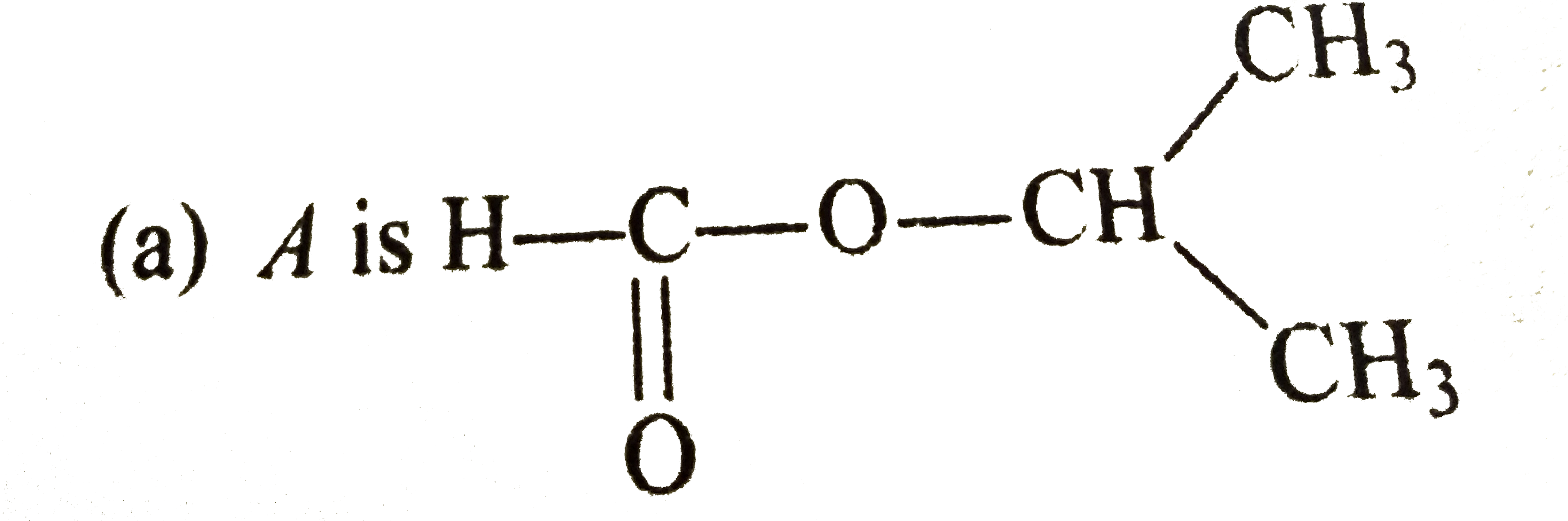
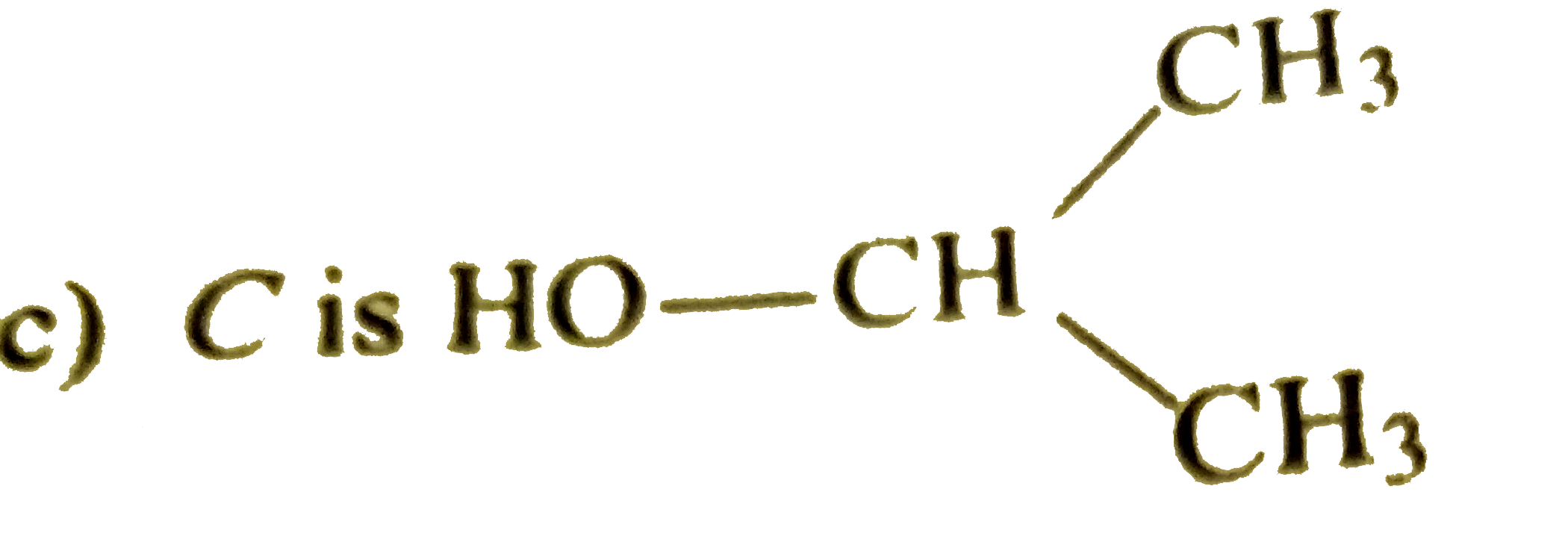
An ester C_(4)H_(8)O_(2)(A) on treatmentwith excess of methylmagneiumchloride followed by acidificationgivesan alcohol (B) as thesoleorganic product.Alcohol (B), onoxidation with NaOCl followedby acidificationgivesacetic acid. Deducethe structures of (A) and (B) and show the reactions involved . |
Answer» Solution :(i) Sincealcohol (B) on oxidation withNaOCl haloform reaction ) followed by acidificationgivesaceticacidthusit canbe eitherethyl alcohol or 2-propanol. 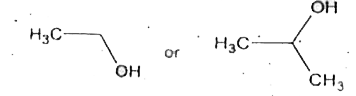 (II) Sincealcohol (B) is obtainedby addtion of excessof `CH_(3)MgCl`,on ester (A),thereforethe alcoholboththe methylgroupbecauseesters andtwo molecules of theGrignard REAGENT that isits (CH - OH) parthas comeform acidpart of ester . Thus (A) mustbe fomicester . (iv)Since molecular formula of ester (A) is `C_(4)H_(4)O_(2)`, thereforealkyl group of estermust containthree carbon atomseithern - propylgroup or isopropyl group. (v) Further , since2 - propanol (B) is thesoleorganicproductobtainedwhentwomolecules of `(CH_(3))_(3)`MgCl are added to ester(A). Therefore , the alkyl group of ester (A) must beisopropyl group. Thus , esteris isopropyl formate . 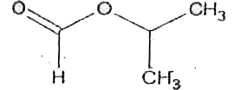
|
|
| 12. |
An estercan be obtained by the reaction of ethanol with _______ |
|
Answer» an ALDEHYDE |
|
| 13. |
An ester benzoic acid is used as an |
|
Answer» Ethyl banzoate |
|
| 14. |
An ester A(C_(9)H_(10)O_(2)) with excess of CH_(3)MgBr upon hydrolysis and then with conc. H_(2)SO_(4) gives an olefin (B). Ozonolysis of (B) gave a ketone (C_(8)H_(8)O) which gave +ve iodoform test. What is A? |
|
Answer»

|
|
| 15. |
An ester (A) with molecular formula C_(9)H_(10)O_(2) was treated with excess of CH_(3) MgBr and the complex so formed was treated with H_(2)SO_(4) to give an olefin (B). Ozonolysis of (B) gave a ketone with molecular formula C_(8)H_(8)O which shows positive iodoform test. The structure of (A) is |
|
Answer» `C_(6)H_(5)COOC_(2)H_(5)` 
|
|
| 16. |
An ester A of the formula C_(5)H_(8)O_(2) on acidic, hydrolysis gives an acid B, which reduces Tollen's reagent and an alcohol C, which gives iodoform test. Ester A can also be converted into alcohol B by reaction with excees of Grignard reagent D. |
|
Answer»
|
|
| 17. |
An essential constitution of a diet is: |
|
Answer» Starch |
|
| 18. |
An essential constituent of plant is : |
|
Answer» CELLULOSE |
|
| 19. |
An essential constituent of amalgam is : |
|
Answer» Au |
|
| 20. |
An essential amino acid is one that |
|
Answer» MUST be INCLUDED in the diet |
|
| 21. |
An equlibrium constant of 10^(-4) for a reaction means, the equlibrium is |
|
Answer» LARGELY towards backward direction |
|
| 22. |
An equlibrium mixture of the reaction 2H_(2)S_((g))hArr2H_(2(g))+S_(2(g))"had 0.5 mole"H_(2)S, 0.10 "mole" H_(2)and 0.4 "mole" S_(2) in one litre vessel. The vlaue of equlibrium constant (K) in mole "litre"^(-1) is |
|
Answer» `0.004` |
|
| 23. |
An equimolar mixture of toluene and chlorobenzene is treated with a mixture of conc. H_(2)SO_(4) and conc. HNO_(3) Indicate the correct statement from the following : |
|
Answer» p-nitrotoluene is FORMED in EXCESS |
|
| 24. |
An equimolar mixture of toluene and chlorobenzene is treated with a mixture of conc. H_(2)SO_(4) and conc. HNO_(3). Indicate the correct statement from the following: |
|
Answer» p-nitrotoluene is formed is EXCESS  both toluene and chlorobenzene can be nitrated under the reaction condition. However, `-CH_(3)` GROUP is more reactive or ACTIVATING as compared to `-Cl` atom. This means that p-nitrotoluene is formed in excess |
|
| 25. |
An equimolar mixture of Nitrogen gas and water vapours is taken in a 2 litre flask at 27^(@)C and 1.23 xx 10^(-2) atm. pressure. What is the mass of the gas at -27^(@)C? |
|
Answer» `2.8xx10^(-4)g` `=1 xx10^(-3)` moles As the mixture is equimolar. `THEREFORE .^nN_2=0.5xx10^(-3)` and `.^nN_2=0.5xx10^(-3)` moles At `-27^@C` water vapours CHANGES to water solid `therefore` mass of gas shall be only due to `N_2` gas `=28xx5xx10^(-4)=1.4xx10^(-2) g` |
|
| 26. |
An equimolar mixture of NaHC_(2)O_(4) and H_(2)C_(2)O_(4) consumes 20 ml 0.3 M NaOH solution for complete neutralization. The same mixture requires V ml. 0.05 M KMnO_(4) solution in acidic medium for oxidation. The value of V is : |
|
Answer» 160ml |
|
| 27. |
An equilibrium mixture of N_(2), H_(2), and NH_(3) at 700 K contains 0.036 M N_(2) and 0.15 M H_(2). At this temperature, K_(c) for the reaction N_(2)(g) + 3H_(2)(g)hArr2NH_(3) (g) is 0.29. What is the concentration of NH_(3) ? |
|
Answer» |
|
| 28. |
An equimolar mixture of CO_(2 (g)) and CF_(4 (g)) was taken in an empty flask at a particular temperature. These gases reacts as: CO_(2 (g)) + CF_(4 (g)) hArr 2 COF_(2 (g)) After this , mixture attains equilibrium and mole fraction of COF_(2 (g)) was found to be 0.2, then K_(P) for above reaction is : |
|
Answer» 4 `X_(COF_(2)) = (2y)/(2x - 2y + 2y) = (y)/(x) = 0.2` `y = 0.2 x` `n_(CO_(2)) = n_(CF_(4)) = x - 0.02x = 0.8 x` `n_(COF_(2)) = 0.4 x` Total Pressure not required as `(Delta N)_(g) = 0` `K_(P) = ((0.4x)^(2))/((0.8x) (0.8x)) = (0.4 xx 0.4)/(0.8 xx 0.8) = (1)/(4)` |
|
| 29. |
An equimolar mixture of CO_(2 (g)) and CF_(4 (g)) was taken in an empty flask at a particular temperature. These gases reacts as: CO_(2 (g)) + CF_(4 (g)) hArr 2 COF_(2 (g)) After this , mixture attains equilibrium and mole fraction of COF_(2 (g)) was found to be 0.2, then Which of the following will increase concentration of COF_(2 (g)) at equilibrium |
|
Answer» DECREASE in TEMPERATURE (A) Reaction is exothermic in FORWARD direction hence, decrease in temperature, increase concentration of `COF_(2 (g))` at equilibrium. (b) Total pressure increase, volume DECREASES and hence concentration increases. |
|
| 30. |
An equilibrium mixture for the reaction 2H_(2)S_((g))iff2H_(2(g))+S_(2(g)) had one mole of hydrogen sulphide, 0.2 mole of H_(2) and 0.8 mole of S_(2) in a 2 litre vessel. The value of K_(c ) in mole "litre"^(-1) is |
|
Answer» `0.004` |
|
| 31. |
An equimolar mixture of alkylbromide (A) and ammoniagives (B) which on treatmentwith NaNO_(2) " and " HCI gives (C) . Compound(C)on oxidation followed by decarboxylation gives . What (A) ? |
|
Answer» `CH_(3)CH_(2)CH_(2)Br` |
|
| 32. |
An equilibrium mixture forthe reaction 2H_2S(g) hArr 2H_2(g)+S_2(g) had 1 mole of hydrogen sulphide, 0.2 mole of H_2 and 0.8 mole of S_2 in 2 litre vessel. The value of K_c is: |
|
Answer» 0.004 |
|
| 33. |
An equilibriummixture for the reaction, 2H_2S(g) hArr 2H_2(g) + S_2(g) had0.5 mole H_2S, 0.10 mole H_2 and 0.4 mole S_2 in one litre vessel. K_c for the reaction is : |
|
Answer» 0.004 MOL /lit |
|
| 34. |
An equilibrium mixture of the reaction 2NO(g) +O_2(g) hArr 2NO_2(g) contains 0.120 mole of NO_2 , 0.080 mole of 0.640 mole of O_2 in a 4 litre flask at a constant temperature . The value K_c for the reaction at this temperature is : |
|
Answer» 14 |
|
| 35. |
An equilibrium mixture contains 0.5, 0.12 and 5 moles of SO_(2),O_(2)andSO_(3) respectively, in a one litre vessel at a certain temperature. How many mole of O_(2) must be forced into the reaction mixture in order to increase the conc. Of SO_(3) to 5.3 mole at the same temperature? (Given K_(c) for the reaction, 2SO_(2)+O_(2)iff2SO_(3) is 800) |
|
Answer» `0.506` Suppose .x. moles of `O_(2)` be introduced into the vessel in ORDER to increase the conc. of `SO_(3(g))` to 5.3 moles/litre. IMPLIES 0.3 mole `SO_(2)` and 0.15 mole `O_(2)` will be consumed ACCORDING to the above equation. Hence at equilibrium, `[SO_(2)]=0.2M` `[O_(2)]=(x-0.03)M,[SO_(3)]=5.3M` `implies K_(c)=([SO_(3)]^(2))/([SO_(2)]^(2)xx[O_(2)])=((5.3)^(2))/((0.2)^(2)xx(x-0.03))=800` (given) `implies x-0.03=0.878impliesx=0.908` moles |
|
| 36. |
An equilibrium reaction is endothermic if K_(1) and K_(2) are the equilibrium constants at T_(1) and T_(2) temperatures respectively and if T_(2) is greater than T_(1) then |
|
Answer» `K_(1)` is less than `K_(2)` |
|
| 37. |
An equilibrium mixture of PCl_(5), PCl_(3) and Cl_(2) at a certain temperature contains 8.3 x× 10^(-3) M PCl_(5), 1.5 x× 10^(-2) M PCl_(3), and 3.2 x× 10^(-2) M Cl_(2). Calculate the equilibrium constant K_(c) for the reaction PCl_(5)(g)hArrPCl_(3)(g) + Cl_(2)(g). |
|
Answer» |
|
| 39. |
An aqueous solution contains 0.10 M H_(2)S and 0.20 M HCl. If the equilibrium constants for the formation of HS^(–) from H_(2)S is 1.0xx10^(–7) and that of S^(2-) from HS^(–) ions is 1.2xx10^(–13) then the concentration of S^(2-) ions in aqueous solution is |
|
Answer» `3xx10^(-20)` `{:(H_(2)ShArrH^(+),+, HS^(-):Ka_(1)=10^(-7)),(0.1-x(0.2+x+y),,(x-y)),(HS^(-)hArrH^(+),+,S^(2-):K_(a_(2))=1.2xx10^(-13)):}` |
|
| 40. |
An equal volume of a reducing agent is titrated separately with 1 M KMnO_(4) in acid , neutral and alkaline media . The volumes of KMnO_(4)required are 20 mL in acid , 33.4 mL in neutral and 100 mL in alkaline media . Find out the oxidation state of manganesein eachreduction product . Givethe balanced equations , for all the three half reactions . Find out the volume of 1 M K_(2)Cr_(2)O_(7) consumed , if the same volume of the reducing agent is titrated in acid medium . |
Answer» Solution :Given that :  where `x_(1),x_(2) and x_(3)`are the oxidation STATES of Mn in the product in acidic , NEUTRAL and alkalinemedia respectively .Since equal volumes of the reducingagentis usedin each titration , ` :. ` ,.e of reducing agent = m.e of `KMnO_(4)` in acidic medium = m.e of `KMnO_(4)`in neutral medium = m.e of `KMnO_(4)`in ALKALINE medium or `1xx (7-x_(1)) xx 20 = 1 xx ( 7 - x_(2)) xx 33.4 ` ` = 1xx ( 7 - x_(3)) x 100` [ m.e = `N xx V` (mL) , N = M `xx` change in On] or ` (7-x_(1))/5 = (7-x_(2))/3 = (7-x_(3))/1 ` On inspection , we see that the equality EXISTS for `x_(1)= +2 , x_(2) = +4 and x_(3) = + 6 " as " x_(1),x_(2) and x_(3)` can never be greater than 7 . The balanced chemicalequations of all the three half reactions are `MnO_(4)^(-) +8H^(+) +5e to Mn^(2+) +4H_(2)O` (acidic medium ) `MnO_(4)^(-) 2H_(2)O+3e to MnO_(2)+4OH^(-)`(neutral medium ) `{:(MnO_(4)^(-)+e, to,MnO_(4)^(2-)),(,,+ 6):}`(alkaline medium) Further , in acidic medium , ` {:(Cr_(2)O_(7)^(2-) to ,2Cr^(3+),,"Change in ON =6"),(+12,+6,):}` ` :. ` normalityof `K_(2)Cr_(2)O_(7)` solution ` = 1 xx 6 =N ` Let the VOLUME of `K_(2)Cr_(2)O_(7)` solution be v mL . ` :. ` m.e of `K_(2)Cr_(2)O_(7)` = m.eof `KMnO_(4)` in acidic medium ` 6 xx v = 5 xx 20 ` ( normality of `KMnO_(4) ` = 5 N) ` v = 16.67 mL ` |
|
| 41. |
An equal volume of a reducing agent is titrated separately with 1 M KMnO_(4) in acid neutral and alkaline media. The volumes of KMnO_(4) required are 20 ml. in acid , 33.4 ml. in neutral and 100ml. in alkaline media. Find out the oxidation state of manganess in each reduction product. Give the balanced equations for all the three half reactions. Find out the voume of 1 M K_(2)Cr_(2)O_(7) consumed , if the same volume of the reducing agent is titrated in acid medium. |
|
Answer» |
|
| 42. |
An enzyme which brings about the conversion of starch into maltose is knows as: |
|
Answer» Maltase |
|
| 43. |
An engine operating between 150^(@)C and 25^(@)C takes 500 J heat from a higher temperature reservoir if there are no frictional losses, then work done by engine is |
|
Answer» 147.7 J Q=500 J `(W)/(Q)=(T_(2)-T_(1))/(T_(2)), W=500((423-298)/(423))=147.7 J`. |
|
| 44. |
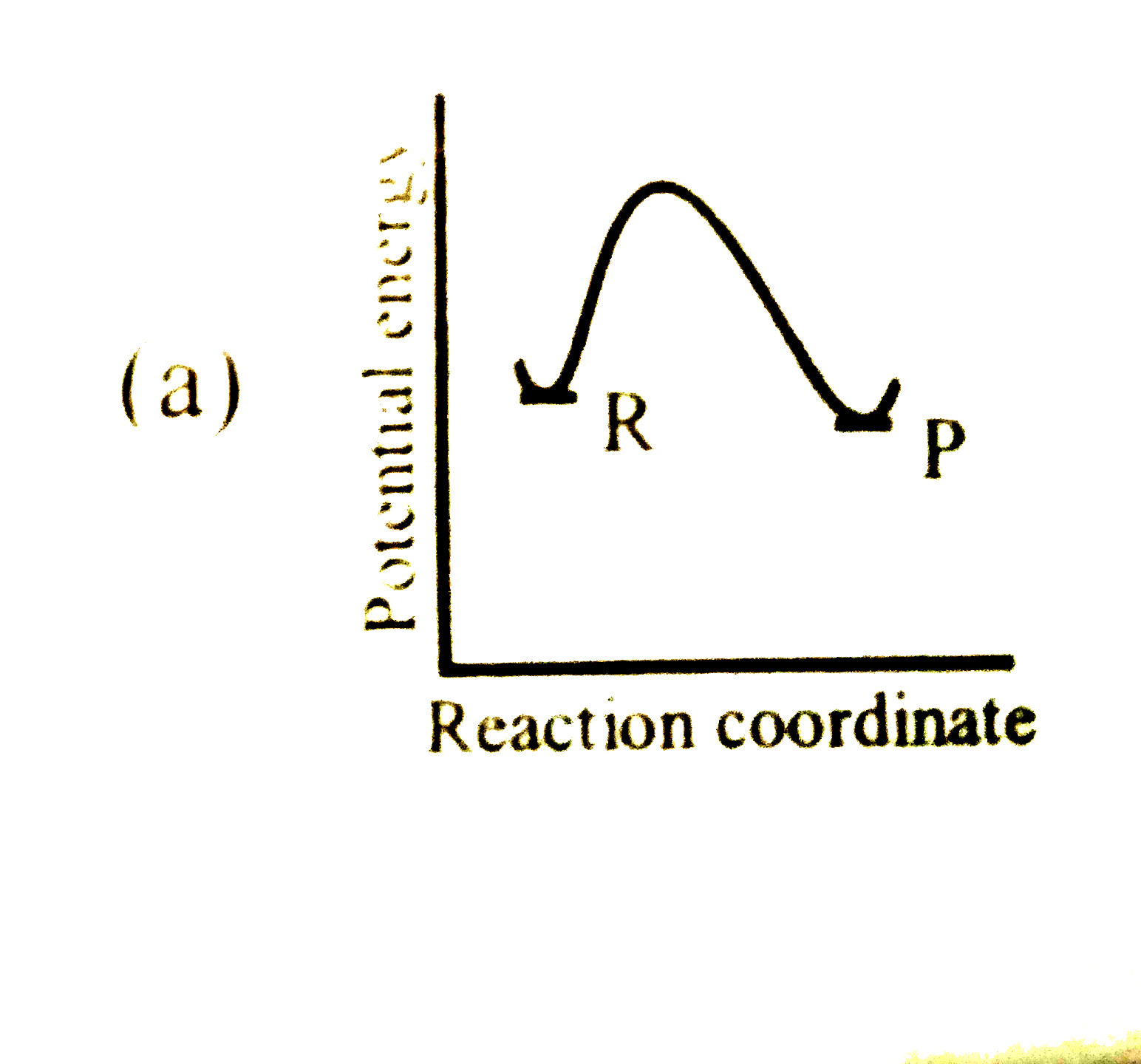
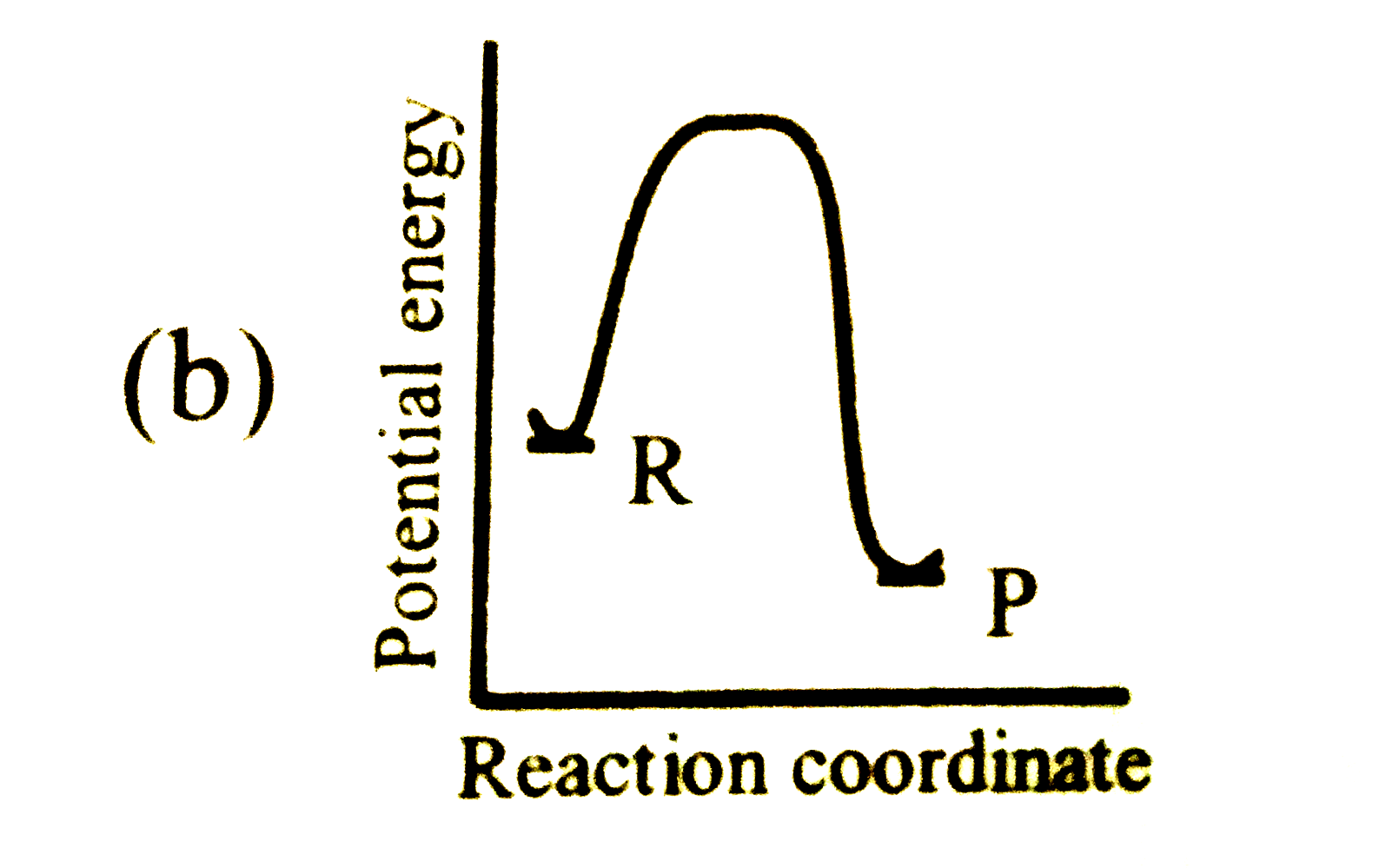
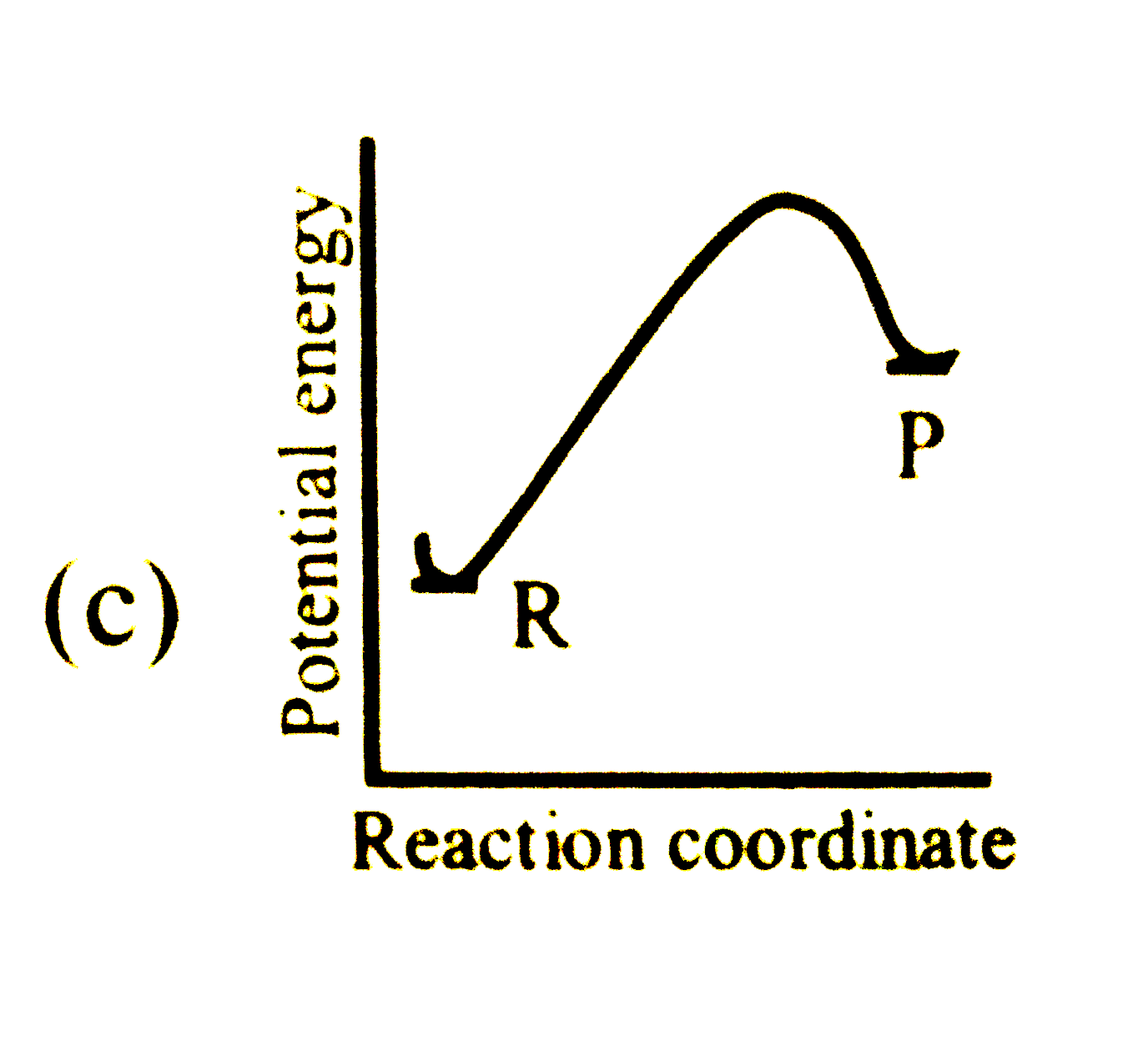
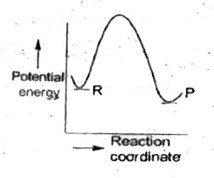
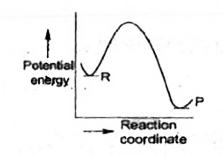
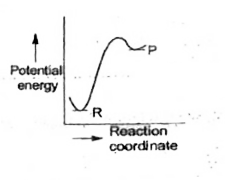
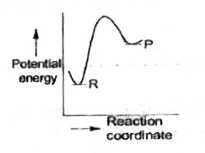
An endothermic reaction with high activation energy for the forward reaction is given by the diagram |
|
Answer»
|
|
| 45. |
An endothermic reaction with high activation energy for the forward reaction is given by the diagram : |
|
Answer»
|
|
| 46. |
An endothermic reaction is one in which |
|
Answer» HEAT is CONVERTED into electicity |
|
| 47. |
An endothermic reaction is found to have +ve entropy change. The reaction will be |
|
Answer» POSSIBLE at HIGH temperature |
|
| 48. |
An endothermic reaction is allowed to occur very rapidly in the air. The temperature of the surrounding air |
|
Answer» REMAINS constant |
|
| 49. |
An endothermic reaction has a positive internal energy change triangleU. In such a case, what is the minimum value that activation energy can have ? |
|
Answer» `TRIANGLEU` |
|
| 50. |
An endothermic reaction A to B has an activation energy as xx kJ mo1^(-1) of A. If energy change of the reaction is y kJ, the activation energy of the reverse reaction is : |
|
Answer» `-X`  OR `DeltaH=E_f-E_r:.y=x-Er:. EX = x-y` |
|