

Saved Bookmarks
This section includes 7 InterviewSolutions, each offering curated multiple-choice questions to sharpen your Current Affairs knowledge and support exam preparation. Choose a topic below to get started.
| 1. |
At a certain height above the earth.s surface, the gravitational acceleration is 4% of its value at the surface of the earth. Find the height. (R is the surface of the earth ) |
| Answer» ANSWER :B | |
| 2. |
A circular platform is free to ratate in a horizontal plane about a vertical axis passing through its centre. A tortoise is sitting at the edge of platform. Now the platform is given an angular velocity omega_(0) When the tortoise moves along the chord of the platform with a constant velocity (with respect to the platform), The angular velocity of platform omega(t)will vary with time 't' as |
|
Answer»
|
|
| 3. |
A bullet of mass 10 gm moving with a velocity .u. penetrates 4 cm in to a target before coming to rest. If the average resistance offered by the target is 200 N, the value of .u. is |
|
Answer» `20 ms^(-1)` |
|
| 4. |
What is Elastic Moduli? |
|
Answer» Solution :The ratio of stress and strain is called MODULUS of elasticity. It is dependent on the CHARACTERISTICS of the material, but dose not depends on the dimensions of MATERIALS. There are three types of modulus of elasticity : (i) Young.s modulus (Y) (II) (a) Bulk modulus (B) (b) Compressibility (k) (iii) Shear Modulus or (Modulus of rigidity) (G) |
|
| 5. |
The M.I. of a body is 1.2" kg m"^(2). Initially the body is at rest. In order to produce a rotational kinetic energy of 1500 J an angular acceleration of "25 rad s"^(-2) must be applied about the axis for a duration os |
|
Answer» 2s |
|
| 6. |
Two simple harmonic motions are represented by y_(1) = 10 sin"" (pi)/(4) (12t+1)" and " y_(2) = 5(sin"" 3pi t+ sqrt(3) cos 3pi t). Find out the ratio of their amplitudes. What are the time period of two motions. |
|
Answer» Solution :`y_(1) = 10sin (pi)/(4) (12t+ 1)` COMPARING `y_(1) = 10sin (3pi t+ (pi)/(4))` with `y= A_(1) SIN (omega_(1) t+phi)` Amplitude `A_(1) = 10 cm " and "omega =3pi RADS^(-1)` `T = (2PI)/(omega) = (2pi)/(3pi) = (2)/(3)s` and `y_(2) = 5 (sin 3pi t + sqrt(3) cos 3 pi t)` `= 5xx2 [(1)/(2) sin3pi t + sqrt((3)/(2)) (cos 3 pi t)]` `y_(2) = 2XX 5[cos phi sin 3 pi t +sin phi (cos 3pi t)]` Comparing `Y_(2) = 10 [sin (3pi + phi)]` with `y= A_(2) sin (omega_(2) t +phi)` Amplitude `A_(2) = 10 cm" and "omega_(2) 3pi rads^(-1)` `therefore T_(2) = (2pi)/(omega_2) = (2pi)/(3pi) = (2)/(3)" second "` Ratio of amplitudes `(A_1)/(A_2) = (10)/(10)= 1` and `T_(1) = T_(2) = (2)/(3)" second "`. |
|
| 7. |
What is an elastomer's ? Plot stress to strain curve for it and explain. |
|
Answer» Solution :"Materials which can be stretched to cause large values of strain are called elastomers". For examples: RUBBER, the elastic tissues of aorta. Rubber can be pulled to several times its length and still returns to its ORIGINAL shape. 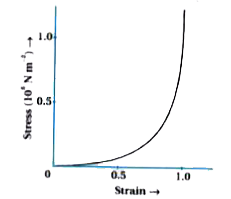 In figure, STRESS `to` strain curve for the elastic tissue of aorta, the large tube (vessel) carrying BLOOD from the heart. Note here that elastic region is very large, the material does not obey Hooke.s law over most of the region. Secondly, there is no well defined plastic regiun. |
|
| 8. |
A suitcase is gently dropped on a conveyor belt moving at 3 m/s. If the coefficient of friction between the belt and the suitcase is 0.5. Find the displacement of suitcase relative to conveyor belt before the slipping between the two is stopped |
|
Answer» 2.7m |
|
| 9. |
A light cable passes over a frictionless pulley support a 50 kg block as shown. Determine the velocity of the block after it has moved 5 m from rest. Neglect the inertia of the pulley. |
|
Answer» |
|
| 10. |
Two balloons of the same volume are filled with two gases at the same pressure, one with hydrogen and the other with helium. Which of the two experiences a greater upward force? |
|
Answer» SOLUTION :The upward FORCE for the hydrogen-filled balloon will be GREATER. Here, resultant upward force = upthrust - weight of GAS - filled balloon. SINCE, the volumes of both balloons are the same, the total weight of the air displaced by them is also the same. So the upthrust exerted by air on both of them is equal. But, under the same condition of temperature and pressure, the density of helium is more than that of hyrdogen. So, due to the lower weight of the hydrogen-filled balloon, the upward force on it will be greater. |
|
| 11. |
A steel wire has length of 12.0m and a mass of 2.10kg. What is the tension in the wire if speed of a transverse wave on the wire is 343ms^-1? |
|
Answer» SOLUTION :LINEAR DENSITY m = mass/length = 2.10/12 = `0.175kgm^-1` V = `sqrtT/m`, 343 = `sqrtT/(0.175)` = `T = 2.06xx10^4N` |
|
| 12. |
If under the external force, the chain in length Deltal occur in rod of length I then write the formula for longitudinal strain. |
| Answer» Solution :LONGITUDINAL STRAIN `epsi_(L) = (Delta l)/(l)` | |
| 13. |
The centripetal force required by a 1000 kg car travelling at 36 kmph to take a turn by 90^(@) in travelling along an arc of length 628 m is |
| Answer» ANSWER :A | |
| 14. |
Plot the corresponding reference circle for each of the following simple harmonic motions. Indicate the initial (t =0) position of the particle, the radius of the circle, and the angular speed of the rotating particle. For simplicity, the sense of rotation may be fixed to be anticlockwise in every case: (x is in cm and t is in s). |
|
Answer» SOLUTION :`x= 3sin (2pi t +(pi)/(4))` `= 3 cos [(pi)/(2) -(2pi t +(pi)/(4))]""[therefore sin theta = cos ((pi)/(2)-theta)]` `= 3cos (2pi t+(pi)/(4) -(pi)/(2))""[therefore cos (-theta)= cos theta]` `x=A cos (omega t+ phi)` `A= 3 cm, omega = 2pi rad s^(-1), phi = -(pi)/(4)rad` `therefore T = 1s`. Reference CIRCLE :  . .
|
|
| 15. |
A solid disc and a string, both of radius 0.10m are placed on a horizontal table simultaneously, with the initial angular speed equal to 10pi rad^(-1). Which of the two will start to roll earlier ? The coefficient of kinetic friction is mu_k=0.2 |
|
Answer» Solution :FRICTIONAL torque`=Iprop` but `mu_kmgR=-Iprop` ( since the MOTION is retarding) `:.prop=-(mu_kmgR)/(I)` for a disc `I=(mR^2)/2` and for a ring I=`MR^2" "prop=(-2mu_kmgR)/(mR^2)=-(2mu_kg)/R` for a disc and `prop=(-mu_kmgR)/(mR^2)=(-mu_kg)/(R)` for a ring. Applying `omega=omega_0+propt` for a ring We write `omega=omega_0-(mu_kg t_1)/(R)` but `omega=v/R=(mu_kg t_1)/R` where `a=mu_kg` `(mu_kg t_1)/R+(mu_kg t_1)/R=omega_0` i.e `2(mu_kg t_1)/R=omega_0" or "t_1=(omega_0R)/(2mu_1g)` Similarly for a disk `(mu_kg t_2)/R=omega_0-(2mu_g)/Rg t_2` `omega_0=(3mug t_2)/R` and `t_2=(omega_1R)/(3mu_kg)` we note that `t_2 lt t_1`. Hence the disc ROLLS down earlier than the ring. |
|
| 16. |
Moment of inertia of a uniform solid cylinder about as axis passing perpendicular to the length and passing through the center is |
|
Answer» `MR^(2)` |
|
| 17. |
Canwe changeK.E of a system without changing its momentum ? |
| Answer» Solution :YES , for example when a bombexplodes in AIR itsmomentum is converted but K.E of the FRAGMENTS changes . | |
| 18. |
A reversible heat engine converts one-sixth of heat, which it extracts from source, into work. When the temperature of the sink is reduce by 40^(@)C, its efficiency is doubled. Find the temperature of source. |
|
Answer» SOLUTION :Efficiency, `eta = (W)/(Q_(1)) = (1)/(6)` Again `eta = 1 - (T_(2))/(T_(1))` or `(1)/(6) = 1- (T_(2))/(T_(2)) rArr T_(2) = (5T_(1))/(6)` ….(i) finally, efficiency `= eta = (2 xx 1)/(6) = (1)/(3)` `:. (1)/(3) = 1 - (T_(2) - 40)/(T_(1))` or `(T_(2) - 40)/(T_(1)) = (1-(1)/(3)) = (2)/(3)` or `2T_(1) = 3T_(2) - 120` Put `T_(2) = (5T_(1))/(6)` (from (i)) or `2T_(1) = (3 xx (5T_(1)))/(6) - 120` or `2.5T_(1) - 2T_(1) = 120` or `T_(1) = (120)/(0.5) = 240 K`. |
|
| 19. |
Volume of the bulb of a thermometer is 1 cm^3. Each degree division of that thermometer should be 5 mm long. What will be the cross-sectional area of the thermometer tube? Coefficient of apparent expansion of mercury with respect to glass is 1.6 times 10^(-4@)C^(-1). |
|
Answer» |
|
| 20. |
In the formula P=(nRT)/(V-b)e^((-a)/(RTV)), Find the dimensions of length in b. (where P = pressure, n = no. of moles, T = temperature, V = volume and R = universal gas constant). |
|
Answer» |
|
| 21. |
Two identical conductors made of metals of coefficients of thermal conductivities K_(1), K_(2) such that (K_(1) lt K_(2) )are given Statement (A) : Under series connection the effective coefficient of thermal conductivity (K_(s) )is such that K_(1) lt K_(s) lt K_(2) Statement (B) : Under parallel connection the effective coefficient of thermal conductivity (K_(p)) is such that K_(p) = (K_(1) + K_(2))/(2) |
|
Answer» A is TRUE B is FALSE |
|
| 22. |
A body of mass 60kg is pushed with just enough force to start it moving on a rough surface with mu_(s)=0.5 and mu_(k)=0.4 and the force continues to act afterwards. What is the acceleration of the body ? |
|
Answer» SOLUTION :`0.98 m//s^(2)` |
|
| 23. |
Statement I: The centre of mass of an electron-proton system, when released moves faster towards proton. Statement II: Proton is heavier than electron. |
|
Answer» Statement I is true, statement II is true, statement II is a CORRECT explanation for statement I. |
|
| 24. |
At what displacement is the KE of a particle performing SHM of amplitude 10 cm, three times its PE ? |
|
Answer» 10cm |
|
| 25. |
(A): Rain is falling vertically downwards with velocity 6 km/hr. A man walks with a velocity of 8 km/hr. Relative velocity of rain w.r.t. the man is 10km/hr. (R): Relative velocity is the ratio of two velocities. |
|
Answer» |
|
| 26. |
A 30 kg projectile moving horizontally with a velocity vecv_(0)=(120m//s)hati explodes into two fragments A and B of masses 12 kg and 8 kg, respectively. Taking point of explosion as origin and knowing that 3s later position of fragment a is (300m, 24m, -48m), determine the position of fragment B at the instant. |
|
Answer» Solution :Initial corrdinates of `CM=(0,0,0)` `x` coordinates of `CM` after `3 s` `x_(CM)=120xx3=360m` `y` coordinates of `CM` after `3s`, `y_(CM)=-1/2"gt"^(2)=-45M` After `3s`, `(m_(1)+m_(2))x_(CM)=m_(1)x_(1)+m_(2)x_(2)` `x_(2)=(30xx360-12xx300)/18=400m` similarly `(m_(1)+m_(2))y_(CM)=m_(1)y_(1)+m_(2)y_(2)` `=-30xx45=12xx24+18xy_(2)` `y_(2)=-91m` and in `z` COORDINATE `m_(1)z_(1)+m_(2)z_(2)=0implies z_(2)=32M` |
|
| 27. |
What is the position of the centre of gravity of a uniform rectangular lamina? |
|
Answer» |
|
| 28. |
A sphere of mass 50 xx 10^(-3)kg moving with a velocity of 2ms^(-1) hits another sphere which is at rest. Assuming the collision to be head-on collision and if they stick together after collision and move in the same direction with a velocity of 0.5 ms^(-1), find the mass of the second sphere |
|
Answer» SOLUTION :`m_(1) = 50 xx 10^(-3) KG, u_(1)= 2ms^(-1), u_(2)= 0, v= 0.5 ms^(-1), v= v_(1)= v_(2)= 0.5 ms^(-1)` `m_(1)u_(1) + m_(2) u_(2)= (m_(1) + m_(2))v` `(50 xx 10^(-3))(2) + m_(2) (0) =[(50 xx 10^(-3))+ m_(2)] 0.5` `m_(2)= (50 xx 10^(-3) xx 2 - 50 xx 10^(-3) xx 0.5)/(0.5)` `=((100-25))/(0.5) xx 10^(-3)= 150 xx 10^(-3) kg` |
|
| 29. |
A glass window conducts out a certain quantity of heat per second when the inside temperature is 10^(@)C and the outside temperature is - 10^(@)C. The same quantity of heat will be conductued in through the window per second when the inside temperature is - 43^(@)C and the outside temperature is |
|
Answer» `43^(@)C` `theta = - 23^(@)C` 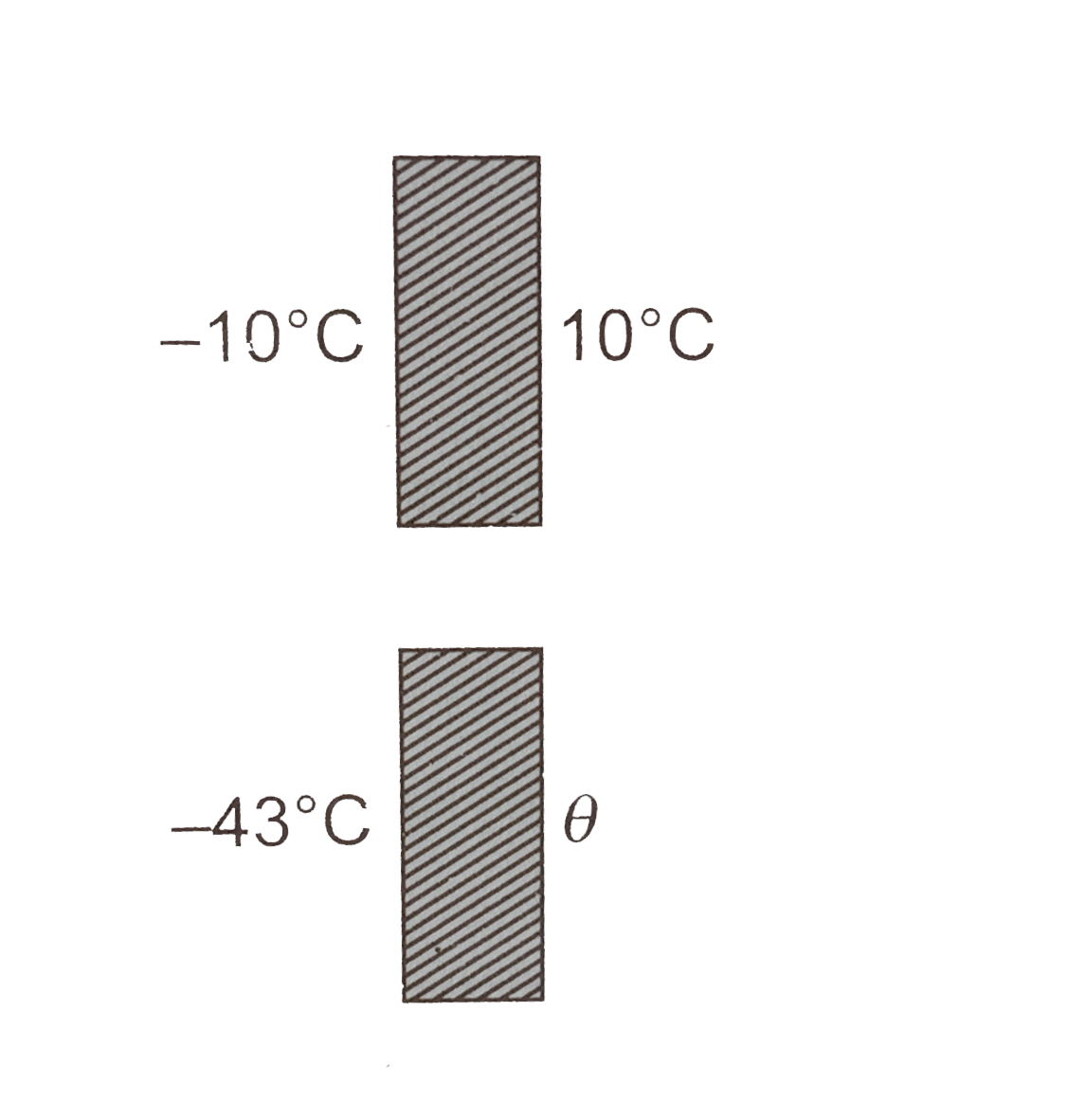
|
|
| 30. |
Two balls of masses 2M and 6M have radii 2R and 3R. Their centre of masses are separated by 10R. They move towards each other under their gravitational force. What is the distance moved by the centre of smaller sphere when the spheres touch each other ? |
|
Answer» |
|
| 31. |
In a physical balance working on the principle of moments, when 5 mg weight is placed on the left pan, the beam becomes horizontal. Both the empty pans of the balance are of equal mass. Which of the following statements is correct? |
|
Answer» LEFT ARM is shorter than the RIGHT arm |
|
| 32. |
Obtain the expression for excess pressure inside a soap bubble. |
|
Answer» Solution :Excess pressure inside a soap bubble Consider a soap bubble of radius R and the surface tension of the soap bubble be T as SHOWN. A soap bubble has two LIQUID surfaces ion contact with air, ONE inside the bubble and other outside the bubble. Therefore, the force on the soap bubble due to surface tension is `2xx2piRT`. The VARIOUS forces acting on the soap bubble are  (i) Force due to surface tension`F_(tau)=4piRT` towards right (ii) Force due to outside pressure, `F_(P_(1))=P_(1)pi R^(2)` towards right (III) Force due to inside pressure, `F_(P_(2))=P_(2)piR^(2)` towards left As the bubble is in equilibrium, `F_(P_(2))=F_(T)+F_(P_(1))` `P_(2)pi R^(2)=4piRT+P_(1)piR^(2)rArr (P_(2)-P_(1))piR^(2)=4piRT` Excess pressure is `DeltaP=P_(2)-P_(1)=(4T)/(R)`. |
|
| 33. |
A uniform sphere is placed on a smooth horizontal surface and a horizontal force F is applied on it at a distance 'h' above the surface. The acceleration of the centre |
|
Answer» is MAXIMUM when `H=0` |
|
| 34. |
Which of the following statements is /are not true ? |
|
Answer» v,a and s are VECTORS |
|
| 35. |
A 0.1 kg mass is suspended from a wire of negligible mass. The length of the wire is 1m and its cross-sectional area is 4.9xx10^(-7)m^(2). If the mass is pulled a little in the vertically downward direction and released, it performs simple harmonic motion of angular frequency 140rad/s. If the Young's modulus of the material of the wire is nxx10^(9)N*m^(-2), then find out the value of n. |
|
Answer» |
|
| 37. |
A car weighing 500 kg working against a resistance of 500 N accelerates from rest to 20 m s. in 10 s. The work done by the engine will be (Take g = 10 m s^(-2)) |
|
Answer» `1.05 XX 10^(5)J` or `a = 2 ms^(-2)` Force exerted by the engine, `F = ma + f = 500 xx 2 + 500 = 1.5 xx 10^(3) N` `s = ut + 1/2 at^2 = 0 + 1/2 xx 2(10)^(2) = 10^(2)` `W = Fs = 1.5 xx 10^(5) J` |
|
| 38. |
Tabulate the values of displacement, velocity and aceleration of particle executing S.H.M. |
Answer» SOLUTION :
|
|
| 39. |
What is conservative force ? State how it is determioned from potential energy ? |
Answer» SOLUTION :(i) A force is said to be a CONSERVATIVE force if the work done by or against the force in moving the body depends only on the initial and final positions of the body and not on the nature of the path followed between the initial and final positions. (ii) Consider an object at POINT A on the earth. It can be taken to another point B at a height h above the surface of the Earth by three paths as shown in Figure. (iii) Whatever may be the path, the work done against the gravitational force is the same as long as the initial and final positions are the same. (iv) This is the reason why gravitational force is a conservative force. (v) Conservative force is equal to the negative gradient of the potential energy. In ONE DIMENSIONAL case, `F_(x)=-(dU)/(dx)` |
|
| 40. |
A perfect gas is contained in a cylinder kept in vacuum. If the cylinder suddenly bursts, then the temperature of the gas . |
|
Answer» is increased |
|
| 41. |
A wheel having moment of inertia 2kgm^(2) about its vertical axis, rotates at the rate of 60 rpm about the axis. The torque which can stop the wheel.s rotation in one minute would be…………… |
|
Answer» `(pi)/(18)N/m` SPEED of wheel = 60 RPM `therefore v=("60 revolution")/("minute")` `=(60xx2pir)/(60 sec)` `v=2pir` but `omega=(v)/(r )` `omega=2pi` For stopping wheel, (Necessary moment of torque) = (angular momentum of wheel) `therefore TAU.Deltat=Iomega` `therefore tau(60)=(2 kg m^(2))(2pi)` `therefore tau=(4pi)/(60)N.m` `=(pi)/(15)N.m` |
|
| 42. |
According to Newton.s third law of motion, if the earth pulls a stone, the stone must also pull the earth. Thenwhy doesn.t the earth fall towards the stone ? |
| Answer» Solution :STONE also pulls the earth, with the same force as the earth pulls the stone, but DUE to the large MASS of the earth, its acceleration towards the stone is quite NEGLIGIBLE and we just can.t notice it. | |
| 43. |
What is impulse of force ? Write its unit and dimension. |
|
Answer» <P> Solution :FromNewtonsecondlaw of motion`f = (Delta p)/( Delta t )` Productof FORCEAND TIMEINTERVAL forforceisappliedis calledimpulseforce Thusimpulseof forceequalto changein momentum. in CASEOF impusiveforceit isdifficultto measuremagnitudeand timeintterval . Henceimpulseof forceisobtainedbymeasuringchangein momentum. |
|
| 44. |
If a given mass of a gas occupies a volume 100 cc at one atmospheric pressure and a temperature of 100^(@)C. What will be its volume at 4 atmospheric pressure, the temperature being the same? |
| Answer» Answer :C | |
| 45. |
The temperature of air varies with height linearly from T_(1) at the earth's surface to T_(2) at a height h. Calculate the time t needed for a sound wave produced at a height x to reach the earth's surface. The velocity of sound near the earth's surface is C. |
|
Answer» |
|
| 46. |
A wheel of moment of inertia 2.5 kg m^2 has an initial angular velocity of 40 rad s^(-1). A constant torque of 10 N m acts on the wheel. The time during which the wheel is accelerated to 60 rad s^(-1) is |
|
Answer» 4.5 s `tau = 10 N m , omega = 60 rad s^(-1)` As `tau = I alpha or alpha = (tau)/(I) = (10)/(2.5) = 4 rad s^(-2)` USING `omega = omega_(0) + alpha t, t = (omega - omega_(0))/(alpha)` Substituting the values , we GET `t = (60 - 40)/(4 ) = 5`s |
|
| 47. |
There rods of material X and there rods of material Y are connected as show in Fig. 7(e).21. All the rods are of identical length and cross-sectional area. If end A is maintained at 60^(@)C and junction E at 10^(@)C, Calculate the temperature of the junctions B,C and D. Given thermal conductivity of X is 0.92 cal cm^(-1) s^(-1) .^(@)C^(-1) and of Y is 0.46 cal cm^(-1) s^(-1) .^(@)C^(-1). |
|
Answer» Let l be the LENGTH each rod and A be the area of cross-section of each rod. At STEADY state, heat entering a junction per second is equal to heat leaving that junction per second. For junction B, Heat entering the junction B per second `=(K_(y)A(T_(A)-T_(B)))/(l)`.....(i) Heat leaving the junction B per second `(K_(x)A(T_(B)-T_(C)))/(l)+(K_(Y)A(T_(B)-T_(D)))/(l)`....(ii) Equating (i) and (ii), we have `(K_(Y)A(T_(A)-T_(B)))/(l)=(K_(X)A(T_(B)-T_(C)))/(l)+(K_(Y)A(T_(B)-T_(D)))/(l)` or `K_(Y)(T_(A)-T_(B))=K_(X)(T_(B)-T_(C))+K_(Y)(T_(B)-T_(D))` or `0.46(60-T_(B))=0.92(T_(B)-T_(C))+0.46(T_(B)-T_(D))` or `(60-T_(B))=2 (T_(B)-T_(C))+(T_(B)-T_(D))` or `4 t_(B)-2 T_(C)+T_(D)=-10`...(III) For the junction C, Proseeding as above, we get `K_(X)(T_(B)-T_(C))=K_(X)(T_(C)-T_(D))+K_(X)(T_(C)-T_(E))` or `T_(B)-3 T_(C)+T_(D)= -T_(E)` or `T_(B)-3 T_(C)+T_(D)= -10`.....(iv) For the junction D, Prosseding as above, we obtain `K_(Y) (T_(B)-T_(D))=K_(X)(T_(D)-T(C))+K_(Y)(T_(D)-T_(E))` or `0.46 (T_(B)-T_(D))=0.92(T_(D)-T_(C))+0.46(T_(D)-T_(E))` or `T_(B)-T_(D)=2(T_(D)-T_(C))+(T_(D)-T_(E)` or `T_(B)+2 T_(C) -4T_(D)= -10`.....(V) On solving the equation (iii), (iv) and (v), we get `T_(B)=30^(@)C, T_(C)=20^(@)C=T_(D)` |
|
| 48. |
If the coordinate axes (x, y, z) are drawn in anticlockwise direction then the coordinate system is known as |
|
Answer» CARTESIAN COORDINATE system |
|
| 49. |
The densities of wood and benzene at 0^(@)C are 880 kg m^(-3) and 900 kg m^(-3), respectively. The coefficient of volume expansion is 12 xx 10^(-3) C^(-10) for wood and 1.5 xx 10^(-30) C^(-1) for benzene. Then the temperature at which a piece of wood just sinks in benzene is |
|
Answer» `83^(@) C` |
|
| 50. |
Velocity of three particles A, B and C varies with time 't' as V_A = (2t hati +6hatj) ms^(-1), barV_B =(3hati+4hatj)ms^(-1), barVc = (6hati +4thati)ms^(-1) . Regarding the pseudo force match the entries of column - I with entries in column - II {:("Column-I"," Column-II"),(" A) On A as observed by B"," P) Along +ve x-direction"),(" B) On B as observed by C"," Q) Along - ve x-direction"),(" C) On A as observed by C"," R) Along +ve y-direction"),(" D) On C as observed by A"," S) Along - ve y-direction"),(," T) zero"):} |
|
Answer» |
|


