

Saved Bookmarks
This section includes 7 InterviewSolutions, each offering curated multiple-choice questions to sharpen your Current Affairs knowledge and support exam preparation. Choose a topic below to get started.
| 1. |
A light rod of length l is pivoted at the upper end. Two masses (each m), are attached to the rod, one at the middle and the other at the free end. What horizontal velocity must be imparted to the lower end mass, so that the rod may just take up the horizontal position? |
|
Answer» `SQRT(6lg)//5` |
|
| 2. |
Though friction opposes relative motion yet in certain cases friction is also the cause of motion In fact without friction , motion cannot be started , stopped or transferred from one body to the other . Read the above passage and answer the following questions (i) Give one example where friction cause motion (ii) Give the direction of friction on fornt wheel and rear wheel of a bicycle when it is pedalled and when peddalling is stopped (iii) frictions is a necessary evail What does this imply in day to day life ? |
|
Answer» Solution :(i) When a person pushes the ground backwards ROUGH surface of ground REACTS and exerts a forward force due to friction which causes motion (ii) When a bicycle is pedalled the rear wheel moves by the force communicated to it by pedalling while front wheel moves by itself Therefore force of friction on rear wheel is in forward direction and force of friction on front wheel is in the bacward direction However when pedalling is stopped both the wheels move by themselves Therefore force of friction on both the wheels is in the opposote direction (ii) Friction is a necessary evil because inspite of many disadvantages of frictions we cannot do without friction the same is TRUE in day to day life Mad rush to surge ahead of our peers gives rise to cut throat competiton which is an evil like frictions but is necessary for PROGRESS . |
|
| 3. |
Column - I shown some bodies rolling down an inclined plane and Column - II shown frictional force and acceleration of the body. If the coefficient of friction in each cas is 0.25 then match the following (Mass and radius of each of each body are m and R respectively) |
|
Answer» |
|
| 4. |
The height y and the distance x along the horizontal plane of a projectile on a certain planet (with no surrounding atmospehre) are given by y=(8t-5t^(2)) metre and x=6t metre, where t is in seconds. The velocity of projection is: |
|
Answer» 8m/s Now, `y=x tan THETA-(gx^(2))/(2U^(2)cos^(2)theta)` `U=10m//s` |
|
| 5. |
vec(P), vec(Q), vec(R), vec(S) are vector of equal magnitude. If vec(P) + vec(Q) -vec(R) = 0 angle between vec(P) and vec(Q) is theta_(1). If vec(P) + vec(Q) - vec(S) = 0 angle between vec(P) and vec(S) is theta_(2). The ratio of theta_(1) to theta_(2) is |
| Answer» ANSWER :B | |
| 6. |
A particle falls towards the earth from infinity. The velocity with which it reaches earth.s surface (g —> acceleration due to gravity on earth.s surface and R is the radius of the earth) |
| Answer» ANSWER :B | |
| 7. |
A particle is moving in a circular path of radius a under the action of an attractive potential U = -k/(2r^(2)) .Its energy is |
|
Answer» `k/(4a^(2))` ` :. (dU)/(dr) = k/2 (-2r^(-3) (dr)/(dr))` ` :. F = k/(r^(3))` Now particle is moving in CIRCULAR path of radius a instead of RADIUSR , the CENTRIPETAL force `(mv^(2))/a = k/(a^(3)) "" [ :. r =a]` ` :. 1/2 mv^(2) =k/(2a^(2))` ` :. k = k/(2a^(2))""...(2)` ` :. "Total energy " = U+k` ` = - k/(2a^(2) +k/(2a^(2))` `[ :. " from equ .(1) and (2) r =1"] ` = 0 |
|
| 8. |
For a planet moving around the sun in elliptical orbit, which of the following quantities remain constant ? (a) The total energy of the sun plus planet system (b) The angular momentum of the planet about the sun (c) The force of attraction between the two (d) The linear momentum of the planet |
|
Answer» only a & B are TRUE |
|
| 9. |
A person leans outof a train moving with uniform velocity and drops acoin. How does the path of motion of the coin appear to a co-passenger and a person standing outside the train near the rail tracks ? |
|
Answer» SOLUTION :When the coin is dropped fromthe train , due to inertia of MOTION it hasa horizontal component of velocity equal to that of the train. Simultaneously , it EXPERIENCES a vertical downward acceleration due to the FORCE of gravity. If the train.svelocity is v , the velocity of the co-passenger is also, v. Therefore, with respect to this person horizontal component of the velocity of the coin is , v-v=0. so, the passenger will see the coin dropvertically downwards due to the ACTION of gravity. With respect to any person standing outside the train near the rail tracks, the coin will have both horizontal and vertical movements. Thus , it is essentially aprojectile motion, and the coin follows a parabolic path. |
|
| 10. |
A block of weight 100 N is suspended (as shown) with the help of there strings. Find the tensions in the three strings). |
Answer» Solution :Free body diagram of block 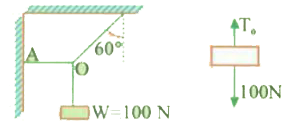 `RARR""T_(0)=100N` Free body diagram for POINT O From figure `T_(0)=T_(2)cos 60^(@)` `T_(2)=(100)/(cos60^(@))=(100)/(1//2)` 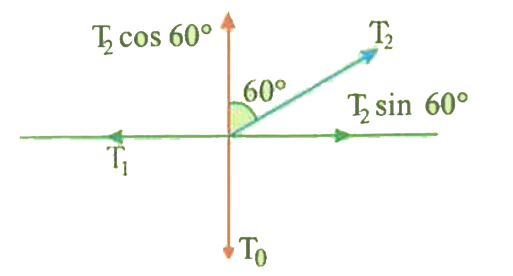 `T_(2)=200N` `T_(1)=T_(2)SIN 60^(@)=200xx(sqrt3)/(2)rArr T_(1)=100sqrt3" Newton"` |
|
| 11. |
What should be the percentage increase in the pressure so that the volume of a gas may decrease by 5% at constant temperature ? |
|
Answer» 0.05 |
|
| 12. |
What is the importance of measurement? |
| Answer» Solution :Any physical quantity is KNOWN better if ONE KNOWS its magnitude and expressed the same in STANDARD form with numbers. | |
| 13. |
On a foggy day two drivers spot each other when they are just 80 mts apart. They are travelling at 72 kmh^(-1)and 60 kmh^(-1), respectively . Both of them applied brakes retarding their cars at the rate of 5ms^(-2). Determine whether they avert collision or not . |
|
Answer» Solution :For the FIRST car : u =` 72 kmh^(-1)` `(72 xx 1000)/(3600) = 20 ms^(-1) , v = 0 , a = - 5 ms^(-2)` As `v^(2) - u^(2) = 2as` `:. 0^(2) - 20^(2) = 2 (-5) s, = 10 s` Distance COVERED by first car , `s_(1) = 40 m,` For the second car : `u = 60 kmh^(-1) = (60 xx 5)/(18)` ` = (50)/(3) ms^(-1) , v = 0, a = - 5 ms^(-2)` As`v^(2) - u^(2) = 2as` `:. 0^(2) - ((50)/(3))^(2) = 2 (-5) s` Distance covered by second car, `s_(2) = (2500)/(9 xx 10) = 27 . 78` Total distance covered by the two cars `rArr s_(1) +s_(2) = 40 + 27 . 78 = 67 . 78 m ` As this distance is less than the initial distance (-80m) between the two cars,so the collision will be averted . |
|
| 14. |
The one which is not the unit of length is |
|
Answer» ANGSTROM UNIT |
|
| 15. |
A solid cylinder of mass M and radius .R. is mounted on a frictionless horizontal axle so that it can freely rotate about this aris. A string of negligible mass is wrapped round the cylinder and a body of mass .m.is hung from the string. The mass is released from rest. Find the tension in the string and the angular speed of cylinder as the mass falls a distance h. |
|
Answer» Solution :The acceleration .a. of the falling body is GIVEN by `mg-T ma ""…(1)` Torque on the cylinder is `tau=TR=I alpha` `:.T=(IALPHA)/(R )=(MR^(2))/(2)((a)/(R^(2))) "" [ :. alpha=(a)/(R )]` or `T=(Ma)/(2) ….(2)` from (1) and (2) `T=(mMg)/((M+2m))` from CONSEVATION of energy, we have `mgh=(1)/(2) mv^(2)+(1)/(2)I omega^(2)` `=(1)/(2) m (R omega)^(2)+(1)/(2) ((MR^(2))/(2)) omega^(2)` on solving `omega =[(4 mgh)/((M+2m)R^(2))]^((1)/(2))` 
|
|
| 16. |
Explain that angular velocity is a vector and its direction is given by right hand screw rule. |
Answer» Solution :Angular velocity is a VECTOR, its direction is known by the right hand SCREW rule.  When the HEAD of a right HANDED screw rotates with the body, the screw advances in the direction will be the direction of angular velocity. The angular velocity of a body rotating about a fixed axis is parallel to the axis. It is shown in about figure. If a rigid body rotating in clockwise direction, then its angular velocity is negative and if rotating in anti-clockwise direction its angular velocity is positive. |
|
| 17. |
Which of the following statements are true ? (i) A uniform wooden plank of mass 150 kg and length 8 m is floating on still water with a man of 50 kg at one end of it. The man walks to the other end of the plank and stops. The distance covered by the plank is 2 m. (ii) A kid of mass 15 kg is sitting in a boat of mass 45 kg in a lake. The distance of kid from the bank of lake is 12 m. Now the body moves inside the boat at a distance 4m towards the bank and stops. The distance of the kid from the bank (there is no friction between the water and the boat ) is 11 m. (iii) Two persons of masses 40 kg and 60 kg are sitting at the midpoint of a 12 -m- long boat (140 kg) standing still in water. Now they move to opposite ends of the boat. Neglecting the friction between boat and water, the distance traveled by the boat in water is 50 cm. (iv) In a gravity free space , a man of mass m standing at a height h above the floor, throws a ball of mass m_(0) straight down with a speed v_(0). When the ball reaches the floor, the distance of the man above the floor is (1 + (m_(0))/(m))h. |
|
Answer» `(i),(ii)` (i) Let the distance covered by the PLANK is `d`. `m_(1) x_(1) = m_(2) x_(2)` `50 (8 - d) = 150 d rArr d = 2m` `(i) is O.K.` (ii) Let the distance travelled by boat is `d`. `15(4 - d) = 45 d rArr d = 1m` Distance of boy from the bank of the river is `(12 - 4) + d = 8 + 1 = 9 m` `(ii)` is incorrect. (iii) Let the distance travelled by the boat be `d`. `60(6 -d) = 40( 6 + d) + 140 d` `rArr d = (1)/(2) m = 50 CM` `(iii) is O.K`. (iv) `m_(0) h = mh' rArr h' = (m_(0))/(m) h` Distance of man above the floor is `h + h' = (1 + (m_(0))/(m))h` `(iv) is O.K`. |
|
| 18. |
What is Calculus ? What are the types of Calculus ? |
| Answer» SOLUTION :CALCULUS is the branch of mathematics USED to ANALYSE the change of any QUANTITY . | |
| 19. |
If a spring extends by x on loading, then energy stored by the spring is (if T is the tension in the spring and k is the spring constant) |
|
Answer» `(T^(2))/(2x)` |
|
| 20. |
Assume that earth is a spherical planet of uniform density rho , radius R_emass M_eand acceleration due to gravity g. Then the gravitational constant G can be written as a) (3g)/(4pirhoR_e) b) (gR_e^2)/(M_e) c) (3g)/(4piR_e^2)d) (12g)/(4pirhoR_2) |
|
Answer» only a & B are TRUE |
|
| 21. |
A rectangular film of liquid is extended from (4cmxx2cm) to (5cmxx4cm). If the work done is 3xx10^(-4)J, the value of the surface tension of the liquid is |
|
Answer» `0.025Nm^(-1)` |
|
| 22. |
A body executing shm completes 120 oscillations per minute. If the amplitude of oscillations is 6 cm, find the velocity and acceleration of the particle when it is at a distance of 4 cm from the mean position? |
|
Answer» |
|
| 23. |
The displacement of a particle is given by x=(t-2)^2where x is in metres and t in seconds. The distance covered by the particle in first 4 seconds is |
|
Answer» 4m |
|
| 24. |
For a moving body at any instant of time |
|
Answer» If the BODY is not moving, the acceleration is necessarily zero. |
|
| 25. |
Which of the following is not dimensionless? |
|
Answer» RELATIVE permittivity |
|
| 26. |
A block of mass 25 kg is raised by a 50 kg man in two different ways as shown in Fig.What is the action on the floor by the man in the two cases ?If the floor yields to a normal force of 700 N, which mode should the man adopt to lift the block without the floor yielding ? |
| Answer» Solution :Consider the forces on the MAN in equilibrium : his weight, force due to the rope and normalforce due to the FLOOR. (a)750 N (B)250 N, MODE (b)should be adopted. | |
| 27. |
A uniform disc of mass M and radius R is supported vertically by a pivot at its centre as shown. A small dense object of mass M is attached to the rim and raised to the highest point above the centre The unstable system is then released. The angular speed of the system when the attached object passes directly beneath the pivot is sqrt(("xg")/(3R)) where 'x' is |
|
Answer» |
|
| 28. |
A solid sphere is rotating about an axis as shown in the figure. An insect follows the dotted path on the circumference of sphere as shown. Match the following. {:("Column-I","Column-II"),("(A) moment of inertia","(P) will remain constant"),("(B) angular velocity","(Q) will first increase then decrease"),("(C) angular momentum","(R) will first decrease then increase"),("(C) angular momentum ","(R) will first decrease then increase"),("(D) rotational kinetic energy","(S) will continuously decrease"),(,"(T) will continuously increase"),(,"(U) data is insufficient"):} |
|
Answer» |
|
| 29. |
A ball is thrown with velocity 8ms^(-1) making an angle 60^(@) with the horizontal. Its velocity will be perpendicular to the direction of initial velocity of projection after a time t. Then find t.(g=10ms^(-2)) |
|
Answer» |
|
| 30. |
Assuming the sun to have a sphericakl outer surface of radius r radiating like a black body at temperature t^(0)C, the power received by a unit surface, (normal to the incident rays) at distance R from the centre of the sun is (where sigma is the Stefan.s constant) |
|
Answer» `(4PI R^(2)SIGMA t^(4))/(R^(2))` |
|
| 31. |
A passenger sitting in a car at rest, pushes the car from within. The car doesn't move, why? |
| Answer» SOLUTION : For MOTION, there should be EXTERNAL FORCE. | |
| 32. |
From the top of a tower a body A is thrown up vertically with velocity u and another body B is thrown vertically down with the same velocity u. If v_(A) and v_(B) are their velocities when they reach the ground and t_(A) and t_(B) are their times of flight, then |
|
Answer» `v_(A)=v_(B) and t_(A)=t_(B)` |
|
| 33. |
A pull of 15 N is applied on a rope attached to a block of mass 7 kg lying on a smooth horizontal surface. Exerted on the rope by the block ? |
|
Answer» Solution :Here ` F_(1) = 15 N , ` ` m_(1) = 7 kg , m_(2) = 0.5 kg F = ` ? ACCELERATION produced , ` a = (F_(1))/(m_(1) + m_(2) )=(15 )/((7 +0 .5 ) )= 2 m//s^(2) ` Force exerted by rope on the black , ` F = m_(1) a = 7 xx 2 = 14 N ` As a REACTION , force exerted on the rope by the block = 14 N ` (##PR_XI_V01_C03_S01_062_S01##) ` . |
|
| 34. |
In a U-tube of diameter 1.4 cm, 837 g mercury is poured. If the density the time period of vertical oscillation of the mercury column. |
|
Answer» |
|
| 35. |
In the above problem the displacement after 2s is _____ |
|
Answer» `30sqrt(3)hat(i) + 30 hat(j)` |
|
| 36. |
Discuss the force - displacement graph for a spring. |
|
Answer» Solution :Since the restoring SPRING force and displacement are LINEARLY related as F = - kx, and are opposite in direction, the graph between F and x is a STRAIGHT line with dwelling only in the second and fourth quadrant as shown in Figure. The elastic potential energy can be EASILY calculated by drawing a F - X graph. The shaded area (triangle) is the work DONE by the spring force. `Area =1/2(base)(height)=1/2xx(x)xx(kx)=1/2kx^(2)` 
|
|
| 37. |
A spherical ball of mass M and radius R is projected along a rough horizontal surface so that initially(t=0) it slides with a linear speed v_(o), but does not rotate. As it slides, it begins to spin and eventually rolls without slipping. How long does it take to begin rolling without slipping? |
| Answer» SOLUTION :`t_(o)=(2V_(0))/(7mu_(K)G)` | |
| 38. |
A vector having unit magnitude is called . . . . Vector. |
|
Answer» like |
|
| 39. |
What is beat? Obtain the equation of no. of beats produced in unit time. |
|
Answer» Solution :Beat is an interesting phenomenon produced by interference of two harmonic waves of close frequency values. The phenomenon of wavering of sound intensity when two waves of nearly same frequencies and amplitudes travelling in the same direction are superimposed on each other is called BEATS. Beat is produced due to increase in intensity of sound once and decrease once. No. of beats in one second (unit time) is called frequency. Frequency of beat is difference of two rearer frequencies. Mathematical method of beat : Equation of transverse harmonic wave is, ` y (x,t) = a sin [kx - omega t + phi]` Harmonic waves are required for beat hence by taking s in PLACE of `y (x,t)` and by taking `x =0 and phi = (pi)/(2) ,` then `s = a sin (k xx 0 - omega t + (pi)/(2))` `therefore s = a cos omega t [ because sin "" (pi)/(2) - THETA = cos theta ]` Displacement of two harmonic waves of equal displacement are similar angular frequencies `omega _(1) , omega _(2) (omega _(1) gt omega _(2)) ` are , `s _(1) = a cos omega _(1) t ""...(1)` `s _(2)= a cos omega _(2) t ""...(2)` From the principle of superposition, displacement of resultant wave, `s = s _(1) +s _(2)` `therefore s = a cos omega _(1) + a cos omega _(2) t ` `=a [ 2 cos ((omega _(1)- omega _(2))/( 2 )) t (cos "" (omega _(1) + omega _(2))/(2))t]` `[ because 2 cos C cos D = cos "" (C -D)/( 2 ) cos "" (C+D)/( 2)] = 2 a cos omega _(B) t cos omega _(a) t""...(3)` where `omega _(a) = (omega _(1) + omega _(2))/(2) and omega _(b) = (omega _(1) - omega _(2))/(2)` `omega _(b)` is angular frequency of beat and `omega _(a)` is angular frequency of amplitude. If we take `|omega _(1) - omega _(2) | lt lt omega _(1) or omega _(2) and omega _(1) gt gt omega _(b),` thne it can be considered that resultant wave is oscillating with AVERAGE angular frequency `omega _(a).` Amplitude of resultant wave `cos omega _(b) t ` varies with time. For maximum amplitude `|cos omega _(b) t| =1.` Hence, intensity of resultant wave increases and decreases as per `2 omega _(b) = omega _(1) -omega _(2),` But `omega = 2 pi v,` Frequency of beat can be as below, `2pi v _("beat") = 2pi v _(1) - 2pi v _(2)` `therefore v _("beat") = v _(1) -v _(2)` Thus, amplitude of beat becomes maximum and zero for `v _(1) - v _(2)` times. For clear feel of beat of sound `v _(1) - v _(2)` shoudl not be greater then, 6 to 7. Becaue if increase and decrease is more than 6 to 7 times, then that sound will be heard but beat will not be felt. |
|
| 40. |
The amplitude of a body executing shm is 2 cm. Its mass is 20 g and the frequency of vibration is 20 Hz. Find its (i) maximum velocity (ii) energy ? |
|
Answer» |
|
| 41. |
A jet engine works on the principal of |
|
Answer» CONSERVATION of linear MOMENTUM |
|
| 42. |
The temperature at the bottom of a 40 m deap lake is 12^(@)C and that at the surface is 35^(@)C. An air bubble of volume 1.0cm^(3) rises from the bottom to the surface. Find its volume. (atmospheric pressure = 10 m of water) |
|
Answer» Solution :Let `P_(1),V_(1) and T_(1)` be the PRESSURE, bubble volume and absolute temperature at the BOTTOM of the LAKE and let `P_(2), V_(2) and T_(2)` be the corresponding QUANTITIES at the surface. Then `(P_(2)V_(2))/(T_(1)) rArr V_(2)=(P_(1)T_(2))/(P_(2)T_(1))V_(1)` `V_(2)=((10+40)/(10))((273+35)/(273+12))xx1=(5xx308)/(285)` `V_(2)=5.4cm^(3)` |
|
| 43. |
Frequency of a particle executing SHM is 10 Hz. The particle is suspended from a vertical spring. At the highest point of its oscillation the spring is unstretched. Find the maximum speed of the particle: (g=10m//s^(2)) |
|
Answer» Solution :Mean POSITION of the PARTICLE is `(mg)/k` distance below unstretched position of spring. Therefore, AMPLITUDE of oscillation is `A=(mg)/k""omega=sqrt(k/m)=2pif=20pi` `:.m/k=1/(400pi^(2))` Therefore the maximum SPEED of particle will be `v_("MAX")=A omega=(g/(400pi^(2)))(20pi)=1/(2pi)m//s` |
|
| 44. |
A uniform wire of length 6.28cm is bent in the form of a circle. The shift in its centre of mass is |
| Answer» ANSWER :A | |
| 45. |
Which of the following parameters does not characterize the thermodynamic state of matter? |
|
Answer» Temperature |
|
| 46. |
Calculate the stress developed inside a tooth cavity filled with copper when hot tea at temperature of 57^(@)C is drunk. You can take body (tooth) temperature to be 37^(@)C and alpha=1.7xx10^(-5)//""^(@)C, bulk modulus for copper =140xx10^(9)N//m^(2). |
|
Answer» SOLUTION :Increase in temperature `DeltaT=57-37=20^(@)C` or 20 K Coefficient of linear expansion of CAVITY, `alpha=1.7xx10^(-5)" "^(@)C^(-1)` Bulk modulus of cavity `K=140xx10^(9)" N/m"^(2)` Coefficient volume expansion of copper, `gamma=3alpha` `=3xx1.7xx10^(-5)` `=5.1xx10^(-5)" "^(@)C^(-1)` Suppose the original volume is V and the increase in volume is `DeltaV` DUE to increase in temperature `DeltaT`. We know that, `DeltaV=gammaVDeltaT` `:.(DeltaV)/(V)=gammaDeltaT` THERMAL stress = Bulk modulus `xx` volume strain `=Kxx(DeltaV)/(V)` `=KxxgammaDeltaT` `=140xx10^(9)xx5.1xx10^(-5)xx20` `=1.428xx10^(8)" N/m"^(2)` ATMOSPHERIC pressure is `P=1.01xx10^(5)" N/m"^(2)` |
|
| 47. |
State and explain work energy principle. Mention any three examples for it. |
|
Answer» SOLUTION :(a) Work and energy are equivalents. This is true in the case of kinetic energy ALSO. To prove this, let us consider a body of mass· m at rest on a frictionless horizontal surface. The work (W) done by the constant force (F) for a displacement (s) in the same direction is, ` W = Fs`...(1) The constant force is given by the equation, F = ma....(2) The third equation of motion can be written as, ` v^2 = u^2 + 2as` ` a = (v^2 - u^2)/(2s)` Substituting for a in equation (2), ` F = m ( (v^2 - u^2) /(2s) )`....(4) Substituting equation (3) in (I) `w = m ( (v^2)/(2s) s ) - m ( (u^2)/(2s) s )` ` W = 1/2 mv^2 - 1/2 mu^2`....(5) (b) (i) If the work done by the force on the body is positive then its kinetic energy INCREASES(ii) If the work done by the force on the body is NEGATIVE then its kineticenergy decreases . (iii) If there ·is no work done by the force on the body then then there is nochange inits kinetic energy, which means that the body has moved .at constant speed provided its mass remains constant. (iv) When a particle moves with constant speedin a circle, there is no change in the kinetic energy of the particle . So according to work energy principle, the work done by centripetal force is zero. |
|
| 48. |
potential energy stored in the spring depends on |
|
Answer» SPRING constant |
|
| 49. |
A cylinder of height 1m is floating in water at 0^(@)C with 20cm height in air. Now the temperature of water is raised to 4^(@)C, the height of the cylinder in air becomes 21cm. The ratio of density of water at 4^(@)C to that at 0^(@)C is (Consider expansion of the cylinder is negligible) |
|
Answer» 1.01 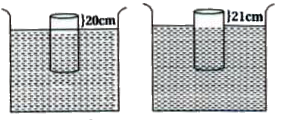 `:. MG= A L RHO g` where L= length of cylinder in water m,g, A are same `:. L rho`= constant `:. L_(4) rho_(4)= L_(0) rho_(0)` `:. (rho_(4))/(rho_(0)) = (L_(0))/(L_(4)) = ((100-20))/((100-21))` `:. (rho_(4))/(rho_(0)) = (80)/(79) = 1.01265` `:. (rho_(4))/(rho_(0))= 1.01` |
|
| 50. |
A barometer kept inan elevator accelerating downwards with acceleration Q . The most liekly pressure inside the elevator is ? |
|
Answer» Solution :The resultant ACCELERATION of elevator in downwards direction =g-a `THEREFORE` The pressure in elevator `=hrho(g-a)` `=(76xx13.6xx(g-a))/(13.6xxg)` This pressure is GREATERTHAN the ATMOSPHERICPRESSURE 76 CM Hg . |
|