

Saved Bookmarks
This section includes 7 InterviewSolutions, each offering curated multiple-choice questions to sharpen your Current Affairs knowledge and support exam preparation. Choose a topic below to get started.
| 1. |
A body is projected at 60° with the horizontal with velocity of 10sqrt(3) ms^(-1) . The velocity of the projectile when it moves perpendicular to its initial direction is |
|
Answer» `30 MS^(-1)` |
|
| 2. |
Calculate the temperature at which rms velocity of a gas is half it's value at 0^@C , pressure remainingconstant |
|
Answer» SOLUTION :Here, `T_1=0^@C = (0+273)K=273K` `T_2=? V_2=1/2V_1` As `V_2/V_1=sqrt((T_2)/T_1)=1/2` `T_2=sqrt(T_1/4)=273/4=68.25A` `=(68.25-273)^@C` `=-(204.75)^@C` |
|
| 3. |
If p is the momentum of the particle then its kinetic energy is |
|
Answer» `sqrt(2Mp)` |
|
| 4. |
Two concentric spherical shells have masses M_1, M_2 and radii R_1, R_2 (R_1 lt R_2). The force exerted by this system on a particle of mass m. If it is placed at a distance ((R_1+R_2)/2) from the centre. |
|
Answer» SOLUTION :The GRAVITATIONAL force on .m. DUE to the shell of `M_2` is zero. The gravitational force on .m. due `=(GM_1m)/((R_1+R_2)/2)^2 =(4GM_1m)/(R_1+R_2)^2` 
|
|
| 5. |
A mass m = 8kg is attached to a spring as shown in figure and held in position so that the spring remains unstretched. The spring constant is 200 N//m. The mass m is then released and begins to undergo small oscillations. Find the maximum velocity of the mass (g =10 m//s^(2)) |
|
Answer» SOLUTION :Mean position will be at K , x= mg or `x= (mg)/(k)= (8 xx 10)/(200)= (2)/(5) = 0.4m` This is also the AMPLITUDE of oscillation i.e., A= 0.4m Now `v_("max")= Aomega= Asqrt((k)/(m))= (0.4)sqrt((200)/(8))= 2m//s` |
|
| 6. |
A ball of mass in collides horizontally with a stationary wedge on a rough horizontal surface, in the two orientations as shown. Neglect friction between the ball and the wedge. The students comment on the system of ball and wedge in these situations Saurav: Momentum of the system in x-direction will change by significant amount in both the cases. Rahul: There are no impulsive external forces in x-direction in both cases, hence the total momentum of the system in x-direction can be treated as conserved in both cases. |
|
Answer» Saurav is incorrect and RAHUL is CORRECT |
|
| 7. |
Foure particles each of mass m placed at foure corner of a square of edge .a. move with speed V along a circle which circumscribe the square under the influence of mutual gravitational force find V. |
|
Answer» `SQRT((GM)/(a)[(1 + 2sqrt(2))/(3)])` |
|
| 8. |
Jupiter has a mass 318 times that of the earth and its radius is 11.2 times the earth's radius. Estimate the escape velocity of a body from Jupitor's surface. |
|
Answer» LINEAR momentum |
|
| 9. |
Match the following columns. {:("Column I","Column II"),("(A) Force of friction","(p) Oppose motion"),("(B) Normal reaction on a block kept on horizontal ground","(q) Oppose relative motion"),(,"(r) Is always mg"),(,"(s) May be equal to mg"),(,"(t) None"):} |
Answer» 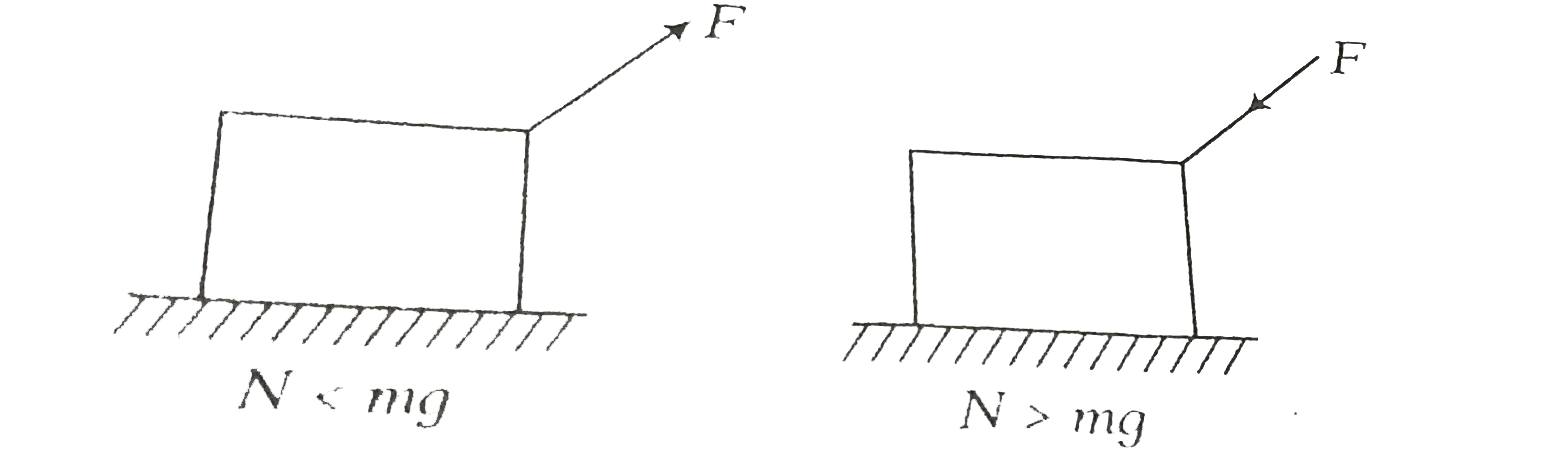
|
|
| 10. |
A cylinder containing water up to height 25 cm has a hole of cross-section 0.25 cm^(2) at its bottom. It is counter possed in a balance. What is the initial change in the balancing weight when water begins to flow out? |
|
Answer» Solution :Here, `a = 0.25 cm^(2) = 0.25 xx 10^(-4)m^(-2)`, . `h = 25 cm = 0.25 m` Initial velocity of water flowing out of hole `upsilon = sqrt(2gh)` When wate emerges out from the hole. The weight of water decrease. The decrease in weight is equal to the rate of change of linear momentum. Initially velocity of LIQUID flowing out `upsilon` be taken constant for a SMALL interval of TIME `Delta t`. then `F = (Delta p)/(Delta t) = (Delta (m upsilon))/(Delta t) = upsilon (Delta m)/(Delta t)` `=(upsilonDelta(V rho))/(Delta t) = upsilon rho (Delta V)/(Delta t)` Where, `(Delta V)/(Delta t)` = VOLUME flowing out per SECOND `=aupsilon` `F = upsilon rho.(a upsilon) = a upsilon^(2) rho` `=a(2gh) rho = 2 a gh rho` `= 2 xx (0.25 xx 10^(-4)) xx 9.8 xx 0.25 xx 10^(3)` ltrgt `=12.5 xx 9.8 xx 10^(-3) N = 12.5 xx 10^(-3)kg f`. |
|
| 11. |
An artificial satellite of the moon revolves in a circular orbit whose radius exceeds the radius of the moon n times. In the process of motion, the satellite experiences a slight resistance due to cosmic dust. Assuming the resistance force to depend on the velocity of the satellite as F=alpha v^2 , where a is a constant, find how long the satellite will stay in orbit until it falls onto the moon.s surface. |
|
Answer» Solution : The energy of the satellite in ORBIT of radius R, E ` = (-GMm)/(2r)` Here m is the mass of satellite and M is the mass of the moon. If dE/dt is the instantaneous rate of decrease of energy of the satellite, then we have `((dE)/(dt)) = Fv` Given `F = alpha v^2 THEREFORE (d[(-GMm)/(2r)])/(dt)= (alpha v^2)v " or " (GMm)/(2r^2) dr= - alpha v^3 dt` Orbital velocity of satellite, v=`sqrt((GM)/(r )) therefore (GMm)/(2r^2) dr =- alpha [ (GM)/(r )]^(3//2) dt " or" (mr^(-1//2))/(2) dr = - alpha (GM)^(1//2) dt` Integrating above expression , we get`m/2 int_(eta R)^( R) r^(-1//2) dt =- alpha (GM)^(1//2) int_0^t dt ` `m |sqrtr|_(eta R)^(R ) = - alpha sqrt(GMt) " or " m [sqrt(eta R) - sqrtR] = alpha sqrt(GM) t` ` therefore t = m/alpha ([sqrt(eta R) - sqrtR])/(sqrt(GM)) = m/alpha (sqrtn - 1) sqrt((R)/(GM))` |
|
| 12. |
The diameter of a sphere is 4.24m. Calculate its surface area with due regard to significant figures. |
|
Answer» Solution :Deameter `d=4.24m` RADIUS`r=d/2=(4.24)/2=2.12` surface area of SPHERE `=4pir^(2)=4xx3.1428xx2.12xx2.12` In the above multiplication `2.12`has 3 significant figures. It becomes `3.143`. Surface area `=4xx3.143xx2.12xx2.12=56.50` `56.50` this to be rounded off to have 3 significant figures. `:".Area is" 56.5` |
|
| 13. |
A bar with a crack at its centre buckles as a result temperature rise of 32^(0)C. If the fixed distance L_(0) is 3. 77m and the coefficient of linear expansion of the bar is 25 xx 10^(-6)//^(0) C find the rise x of the centre.(##AKS_NEO_CAO_PHY_XI_V01_PMH_C12_SLV_017_Q01.png" width="80%"> |
|
Answer» Solution :Consider one half of the BAR, its initial length `l_(0)= (L_(0))/(2)` Its length after increase in temperature `DELTA`t, `l = l_(0) (1 + alpha Delta T)` By PYTHOGORAS theorem `x^(2) = l^(2) - l_(0)^(2)` `l^(2) = l_(0)^(2) (1 + 2 alpha Delta T ) ` or x = `l_(0) sqrt(2 alpha Delta T)` = ` (3.77)/(2) sqrt(2(25 xx 10^(-6) xx 32)) = 7.5 xx 10^(-2) `m |
|
| 14. |
Two particles of masses m_1, m_2 move with initial velocities u_1 and u_2. On collision , one of the particles get excited to higher level , after absorbing energy epsilon. If final velocities of particles be v_1 and v_2 then we must have |
|
Answer» `1/2 m_1 u_1^2 + 1/2 m_2u_2^2 - EPSILON = 1/2 m_1v_1^2 + 1/2 m_2v_2^2` |
|
| 15. |
Volume coefficient of expansion of water is |
|
Answer» MAX. at `4^(@)` C |
|
| 16. |
Four moles of a perfect gas heated toincrcrease its temperature by 2^(@)Cabsorbes heat of 40 cal at constant volume. If the same gas is heated at constant pressure the amount of heat supplied is, (R=2 cal/mol K) |
| Answer» Answer :B | |
| 17. |
A 20 kg block is originally at rest on a horizontal surface for which the coefficient of friction is 0.6 . A horizontal force F is applied such that it varies with time as shown in the figure (a) and (b) . If the speed of the block after 10 s is 8 v then find v . (Take g = 10 m// s^(2)) |
|
Answer» The equation for the applied force is F = 40 t= 200 , `""` for `t LE 5 , "" 5 le t le 10` The limiting friction acts as `t ge 3` SECOND. Using impulse equation , `overset(t) underset(0)(int) F "dt" = (p_(f) - p_(i))` `overset(5)underset(3)(int)(40 t - 120) "dt" + overset(10)underset(5)(int) (200 - 120) "dt" = 20 v_(1)` `(40)/(2) (25-9) - 120 (2) + 80 xx (10- 5) = 20 v_(1)` `320 - 240 + 400 = 20 v_(1)` `therefore "" v _(1) = 24 = 8v` `therefore "" v = 3` |
|
| 18. |
A lift of mass 1000 kg which is movingwith an acceleration of1 ms^(-2) in upward direction , then the tension developed in stringwhich is connectedto lift is ___________ |
|
Answer» SOLUTION :Tension T= mg + ma = m(g +a) = 1000 (10+1 ) T = 11000 N |
|
| 19. |
A solid cylinder rolls down an inclined plane from a height h. At any moment the ratio of rotational kinetic energy to the total kinetic energy would be |
|
Answer» `1:2` |
|
| 20. |
Two wires of same material , having cross-sectional areas in the ratio 1 : 2 and lengths in the ratio 1 : 4 are stretched by the same force. The ratio of the stresses in the wires will be ………….. . |
| Answer» SOLUTION :STRESS = `F/A , (("Stress")_1)/(("Stress")_2) = (A_2)/(A_1) = 2/1` | |
| 21. |
The significant figures in 300.500 are |
|
Answer» 6 |
|
| 22. |
In the baove problem the displacement after 2 s is |
|
Answer» `30sqrt(3)HAT(i)+30hat(J)` |
|
| 23. |
A planet of mass .m. is in a elliptical orbit about the sun (m lt lt M)with an orbital time period "T.. If .A. be the area of the orbit then its angular momentum is |
|
Answer» `(2MA)/T` |
|
| 24. |
(A): During rapid pumping of air in tyres, air inside the tyre is hotter than atmospheric air.(R ): Adiabatic process occurs at very high rate. |
|
Answer» Both (A) and(R ) are TRUE and (R ) is the CORRECT explanation of (A) |
|
| 25. |
In the system shown in fig when both masses are moving with the same acceleration the extension in the spring, if its spring constant is 100 N//m is: |
|
Answer» 40 cm `T=kx=15xxa` |
|
| 26. |
For particle of a purely rotating body, v = romega so correct relation will be - |
|
Answer» `OMEGA prop (1)/(R)` |
|
| 27. |
A car of weight W is on an inclined road that rises by 100 m over a distance if 1 k and applies a constant frictional force (W)/(20) on the car. While moving uphill on the road at a speed of 10 ms^(-1), the car needs power P. It it needs power (P)/(2) while moving downhill at speed upsilon then value of upsilon is: |
|
Answer» `20MS^(-1)` |
|
| 28. |
A bomb at rest at the summit of a cliff breaks into two equal fragments. One of the fragments affains a horizontal velocity of20 sqrt(3)ms^(-1). The horizontal distance between the two fragments, when their displacement vectors is inclined at 60^(@)relative to each other is (g=10ms^(-2)) |
|
Answer» `40 sqrt(3)m` |
|
| 29. |
When a body moves on a horizontal direction the amount of work doneby the gravitatioal force is |
|
Answer» positive |
|
| 30. |
A vehicle is movingalong the positivex direction if sudden brakeis appliedthen |
|
Answer» FRICTIONAL force ACTING on the VEHICLE is along negative x direction |
|
| 31. |
The centripetal force on a body in circular motion is given by F=(mv^2)/r. Write the dimension of force |
| Answer» SOLUTION :`[MLT^-2]` | |
| 32. |
While we catch a cricket ball, we catch it at the front and make the hands move with the ball backwards. Why is that ? |
|
Answer» To reduce the IMPULSE |
|
| 33. |
A body is projected vertically up with certain velocity. At a point .P in its path, the ratio of its potential to kinetic energies is 9 : 16. The ratio of velocity of projection to velocity at .P. is, |
|
Answer» `3:4` |
|
| 34. |
Take v = velocity given to satellite in its orbit v_(0) = sqrt((GM)/(R )), v_(e ) = escape velocity {:("Column-I",,"Column-II"),((A) v= V_(0),,"(P) Elliptical path"),((B) v_(0) lt v lt v_(e),,"(Q) Hyperbolic path"),((C) v = v_(e),,"(R) Circular path"),((D) v gt v_(e ),,"(S) Parabolic path"):} |
|
Answer» |
|
| 35. |
A body having a surface area of 5.0" cm"^(2), radiates 300 J of energy per minute at a temperature of 727^(@)C. The emissivity of the body is (Stefan.s constant =5.67xx10^(-8)W//m^(2)//K^(4)) |
|
Answer» 0.09 |
|
| 36. |
Motion of a ball bearing inside a smooth curved bowl, when released from a point slightly above the lower point is |
|
Answer» simple harmonic motion Here, in motion of ball, small angular displacement OCCUR and hence it has angular simple harmonic motion. According to figure (b), when the angle between TWO maximum displacement is `theta` then restoring force acts on it is, `F= -mg sin theta` `THEREFORE ma= -mg sin theta` `therefore a= -G sin theta` `therefore (d^(2)x)/(dt^(2)) = -g sin theta` `= -gxx (x)/(R )""[therefore sin theta approx theta = (x)/(R )]` `therefore a = -(g)/(R )*x` Motion of ballis simple harmonic motion so its acceleration `a= -omega^(2) x` comparing with it, `omega^(2) = (g)/(R )` `therefore omega = sqrt((g)/(R ))` and `(2pi)/(T)= sqrt((g)/(R ))` `therefore T= 2pi sqrt((g)/(R ))` So, motion of the ball is SHM and periodic. 
|
|
| 37. |
Match the physical quantities given here under having same units and dimensions {:(,"SECTION-A",,"SECTION -B"),("a)","Kinametic viscosity","e)",(1)/(2)rho(v_(2)^(2)-v_(1)^(2))A),("b)","Dynamic lift","f)",(eta)/(rho)),("c)","Bernoullie's theorem","g)","a v = constant"),("d)","Equation of continuity","h)",p+(1)/(2)rhov^(2)+rhogh=" const."):} |
|
Answer» a-f, b-e, c-h, d-g |
|
| 38. |
A machine gun is mounted on a flat rail road car. The gun is firing bullets at the rate of 20 bullets per second each of mass 10 g. The bullets come out with velocity 500 ms^(-1). Calculate the acceleration of the car at the instant when its mass is 200 kg. Also calculate the force at that instant. |
|
Answer» |
|
| 39. |
The ratio of the radii of gyration of a hollow sphere and a solid sphere of the same radii about a |
|
Answer» `sqrt((7)/(3))` Solid sphere, `K_(S)=sqrt((I)/(m))=sqrt(((2)/(5)mR^(2)+mR^(2))/(m))=sqrt((7)/(5))R` `:. (K_(H))/(K_(S))=sqrt((25)/(21))=(5)/(sqrt(21))`. |
|
| 40. |
A gas is expanded from volume V_(0) to 2V_(0) under three different processes, as shown in the figure. Process 1 is isobaric process, process 2 is isothermal and process 3 is adiabatic. Let Delta U_(1), Delta U_(2) and DeltaU_(3) be the change in internal energy of the gas in these three processes. Then |
|
Answer» `Delta U_(1) gt Delta U_(2) gt Delta U_(3)` Hence temperature of gas will increase, `Delta U_(1)` = positive Process 2 is an ISOTHERMAL process, `Delta U_(2) = 0` Process 3 is an adiabatic expansion. Hence temperature of gas will fall. `:. Delta U_(3)` = negative `:. Delta U_(1)gt Delta U_(2) gt Delta U_(3)` |
|
| 41. |
In the above problem if the first ball reaches the ground at a horizontal distance d, the second ball reaches the ground at a horizontal distance |
|
Answer» 6d |
|
| 42. |
Calculate the resultant of the following forces at a point , making use of resolution process. (i) 100 sqrt(2) dyne along north-eastii) 980sqrt(2)dyne along north-west(iii) 1960 dyne along south. |
|
Answer» |
|
| 43. |
For a given material, young's modulus is 2.6 times the rigidity modulus. The poisson's ratio is |
|
Answer» 0.5 |
|
| 44. |
Calculate heat required to convert 3 kg of water at 0^(@)C to steam at 100^(@)C. Given specific heat capacity of H_(2)O = 4186 "J kg"^(–1)k^(–1) and latent heat of steam = 2.256 xx 10^(6) J/kg. |
|
Answer» Solution :HEAT REQUIRED to CONVERT `H_(2)O` at `100^(@)` to steam at`100^(@)` C is = ML `=3xx2.256 xx10^(6)` =6768000 j Total heat = 8023800 J |
|
| 45. |
Four objects with the same mass and radius are spinning freely about a diameter with the same angular speed. Arrange the work required to stop them in the decreasing order(a) Solid sphere(b) Hollow sphere(c ) Disc(d) Hoop |
|
Answer» d, B, C, a |
|
| 46. |
Sound whose frequency is 50 Hz? |
|
Answer» has a RELATIVELY short wavelength. |
|
| 47. |
If the specific heat capacity of air at constant pressure is 993 J kg ^(-1) K ^(-1)calculate specific heat capacity at constant volume ? Density of air at N.T.P. is 1.293 Kg //m ^(3). [E.Q.) |
|
Answer» Solution :Specific heat of air at constatn pressure `= C _(p) = 993 j KG ^(-1) K^(-1)` From the unit of we can SEE that the mass in kg. So the equation to be used in `C_(p) - C _(V) = r ` `PV = rT, r = (PV)/(T)` Nrmal temperature `= T = 273 K` Normal pressure `= P =1` atmosphere `= 101325 Nm ^(-2)` Volume of air `= V = ?` Mass of air `= m = 1 kg` Density of air `= p = 1. 293 kg//m ^(3)` `thereforeV = (m)/(p) = (1)/(1.293) m ^(3)` `THEREFORE r = (PV)/(T) = ( 101325)/(273) xx (1)/(1.293) = 287.04 J kg ^(-1) K ^(-1)` `therefore C _(V) = C _(p) -r = 993 - 287.04 = 705.96JKg ^(-1) K ^(-1)` |
|
| 48. |
When force is exerted on a body what is necessary for work done ? |
| Answer» SOLUTION :The DISPLACEMENT should be in the DIRECTION of FORCE . | |
| 49. |
Two metal plates of length l_(0) and width x are joined together at temperature t by rivetting them in such a way that the edges of the plates coincide. The coefficients of linear expansion of the materials of the plates are alpha_(1) " and " alpha_(2)(alpha_(1) gt alpha_(2)). When the bimetallic strip is heated to (t+deltat) it bends and forms an arc of a circle. Find the radius of curvature of the strip. |
|
Answer» Solution :A BIMETALLIC strip bends on heating due to the DIFFERENCE in values of `alpha` for the two metal plates forming the strip. With the increases in temperature, SUPPOSE the lengths of the metal plates AB and CD change to `l_(1) " and " l_(2)`, and the radii of curvature are `r_(1) " and " r_(2)` respectively [Fig. 5.9]. Let the angle subtended at the centre by the arc be `phi`.  `therefore "" l_(1)=l_(0)(1+a_(1)deltat)=r_(1)phi "...(1)"` and `"" l_(2)=l_(0)(1+a_(2)deltat)=r_(2)phi "...(2)"` `therefore "" phi(r_(1)-r_(2))=l_(0)(alpha_(1)-alpha_(2))deltat` `therefore "" phi=(l_(0)(alpha_(1)-alpha_(2))deltat)/(r_(1)-r_(2))=(l_(0)(alpha_(1)-alpha_(2))deltat)/(2x) "...(3)"` `""[therefore r_(1)-r_(2)=2x]` Adding (1) and (2), `(r_(1)+r_(2))phi=2l_(0)+l_(0)(alpha_(1)+alpha_(2))deltat` Let the average RADIUS of curvature be r. `therefore"" r=(r_(1)+r_(2))/2=(2l_(0)+l_(0)(alpha_(1)+alpha_(2))deltat)/(2phi)` `""=(2l_(0)+l_(0)(alpha_(1)+alpha_(2))deltat)/(2l_(0)(alpha_(1)-alpha_(2))deltat) times 2x=({2+(alpha_(1)+alpha_(2))deltat}x)/((alpha_(1)-alpha_(2))deltat).` |
|