Saved Bookmarks
This section includes 7 InterviewSolutions, each offering curated multiple-choice questions to sharpen your Current Affairs knowledge and support exam preparation. Choose a topic below to get started.
| 1. |
A tunnel is dug along the diameter of the earth. There is a particle of mass m at the centre of the tunnel. Find the minimum velocity given to the particle so that is just reaches to the surface of the earth. (R = radius of earth ) |
|
Answer» `sqrt((GM)/(R ))` |
|
| 2. |
A batsman deflects a ball by an angle of 45^(@) without changing its initial speedwhich is equal to 54 km h^(-1) What is the impulse imparted to the ball ? Mass of the ball is0.15 g . |
|
Answer» Solution :Here, ` m = 0.15 kg upsilon_(i) = 54 km//h =54 XX (5)/(18) ms^(-1) = 15 ms^(-1)` `upsilon_(f) = 54 km//h = 15ms^(-1)` Impulse imparted to the ball along X- axis ` J_(x)` = change in momentum of ball along X-axis ` = m upsilon_(fx) - (- m upsilon_(IY)) = 0.15 (15 sin 45^(@) - 0) = 1.59 kg ms^(-1)` Net impulse imparted to the ball ` J = sqrt(J_(x)^(2) + J_(y)^(2)) = sqrt(3.84^(2) + 1.59^(2)) = sqrt(17 .27) = 4.16 kg ms^(-1) (or N_(-s))` 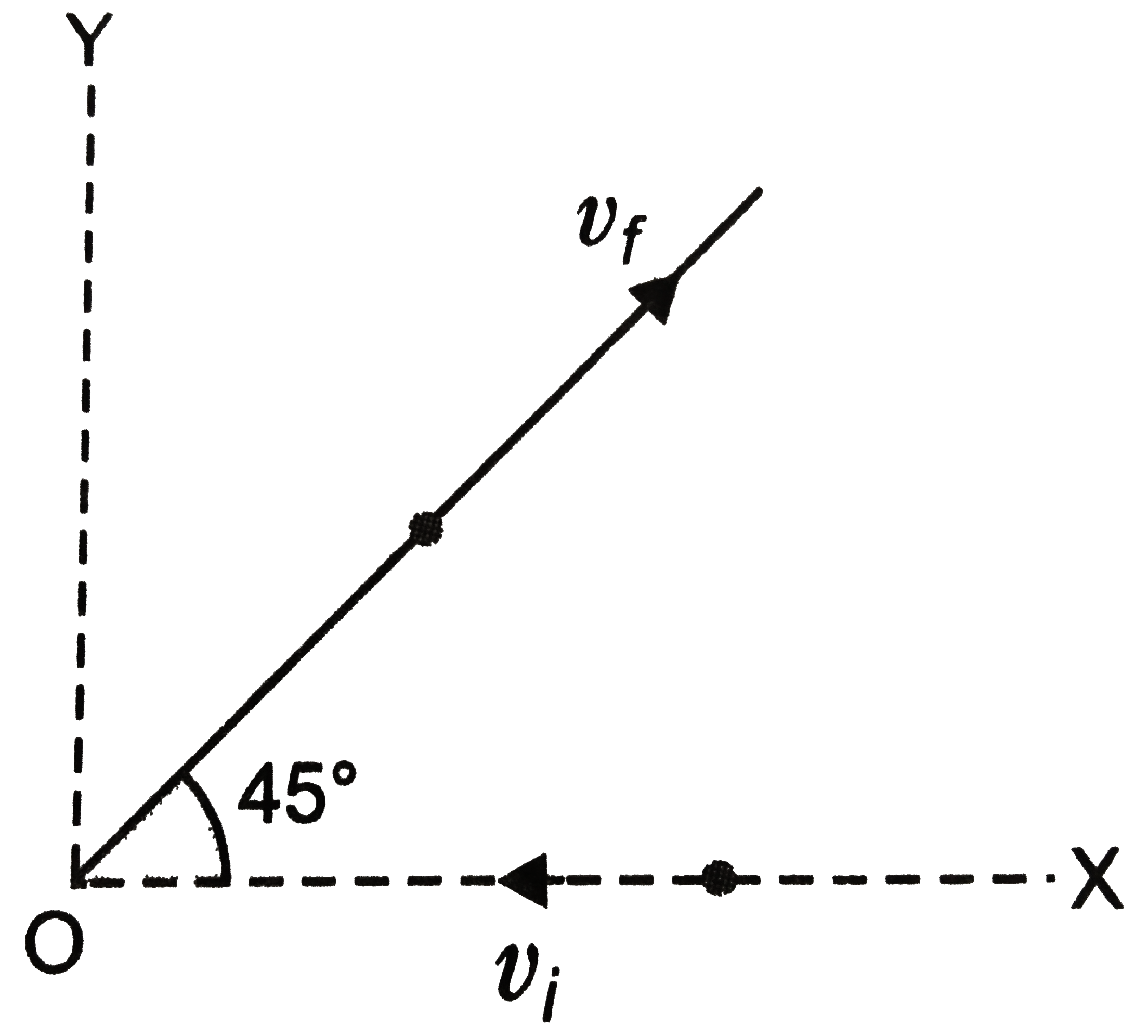 . .
|
|
| 3. |
Which of the curves in figure represents the relation between Celsius and Fahrenheit temperatures ? |
|
Answer» a |
|
| 4. |
A gas occupies a volume of 12 litre under a pressure of 75 cm of Hg. What volume does it occupy under the same temperature when the pressure becomes 72 cm of Hg? |
|
Answer» Solution :`P_(1)=75cm` of G Hg , `V_(1)=12` litres , `P_(2)=72` cm of Hg , `V_(2)=?` From Boyle.s LAW, `P_(1)V_(1)=P_(2)V_(2)RARR V_(2)=(P_(1)V_(1))/P_(2)=(75 times 12)/72=12.5` litres. |
|
| 5. |
When the object is moving at constant velocity on the rough surface |
|
Answer» net force on the OBJECT is zero |
|
| 6. |
A rifle bullet loses 1//20th of its velocity in passing through a plank. What willbe the least number of such planks required to just stop the bullet? |
|
Answer» Solution :For one plank `u=u,V=u-(u)/(20)=(19)/(20)u` `((19v)/(20))^(2)-v^(2)=2ax.......(1)` For n planks `u=u, v=0` `0^(2)-v^(2)=2anx…..(2)` Dividing (2), (1) `n=(-v^(2))/(((19)/(20)v)^(2)-v^(2))=(1)/(1-((19)/(20))^(2))` `=(20xx20)/((20+19)(20-19))=(400)/(39)=10.3` implies so, 11 planks are REQUIRED. The BULLET shall stop in 11 th plank |
|
| 7. |
State in the following cases, whether the motion is one, two or three dimensional: A train moving along a straight track. |
| Answer» SOLUTION :ONE DIMENSIONAL | |
| 8. |
A wire of length l and area of cross-section A has thermal resistance R. What will be its thermal resistance if it is symmetrically folded n times ? |
|
Answer» `( R )/(N^(2))` |
|
| 9. |
A sphere of mass 2 kg moving at 36 km/hrcollides head on with another sphere of mass 3 kg kept at rest . If after collisionboth spheres moves together then kinetic energy decreases by collision will be ………. |
|
Answer» 40 J ` :.M_(1)v_(1) =m_(2)v_(2)=(m_(1)+m_(2))V` Where V = combine velocity of SPHERES ` 2XX 10 +3 + 3 xx 0 = (2 + 3)V` ` :. 5V = 20` ` :. V = 4` m/s Initial kinetic of system`K_(1)=1/2m_(1)v_(1)^(2) [ :. v_(2) = 0 ] ` ` = 1/2 xx2xx100` ` = 100 J ` Final kinetic energy `K_(2) =1/2 (m_(1)+m_(2))V^(2)` `=1/2 (2+3)(4)^(2)` ` =(5xx16)/2` = 40 J ` :. ` Kinetic energy decreases = `100 J - 40 J ` = 60 J |
|
| 10. |
Obtain the equation of speed of transverse wave on tensed (stretched) string. |
|
Answer» Solution :The speed of transverse waves on a string is determined by two factors, (i) the linear mass DENSITY or mass PER unit length `mu` and (ii) the TENSION T. The linear mass density, `mu` of a string is the mass m of the string divided by its length l. Therefore its dimension is `[M^(1) L ^(-1)].`The tension T has the dimension of force - namely `[M^(1) L ^(1) T ^(2)].` We have to combine `mu` and T in such a way as to generate v [dimension `(LT ^(-1) )].` It can be seen that tghe ratio `T/mu` has the dimension `[ L ^(2) T ^(-2)].` `[(T)/(mu) ] = ([ M^(2) L ^(1) T ^(-2)])/( [ M ^(1) L ^(-1)]) = [L^(2) T ^(-2)]` Therefore, if v depends only on T anad `mu,` the relation between them must be, `v = C sqrt ((T)/(mu))` Here C is a dimensionless constant and constnat C is INDEED equal to unity. The speed of transverse waves on the stretched string is therefore given by. `v = sqrt ((T)/(mu))` The speed of a wave along a stretched ideal string depends only on the tension and the linear mass density of the streing and does not DEPEND on the frequency of the wave. |
|
| 11. |
A particle falls from a height h on a fixed horizontal plane and rebounds. If e is the coefficient of restitution, the total distance travelled by the particle on rebounding has stopped |
|
Answer» (a) `(h(1+e)^(2))/((1-e)^(2)` `s=h+2E^(2)h+2e^(2)h+2e^(6)h+.....` `s=h+2h(e^(0)+e^(4)+e^(6)+...)` By using BINOMIAL expansion we can write it as `S=h+2h(e^(2)/(1-e^(2)))=h(1+(2e^(2))/(1-e^(2)))=h((1-e^(2)+2e^(2))/(1-e^(2)))rArr s=h(1+e^(2))/(1-e^(2))` |
|
| 12. |
Blackbody Radiation is |
|
Answer» Black |
|
| 13. |
A grinding machine whose wheel has a radius of 1/piis rotating at 2.5 rev/sec. A tool to be sharpened is held against the wheel with a force of 40N. If the coefficient of friction between the tool and wheel is 0.2, power required is |
|
Answer» 40W |
|
| 14. |
Two linear simple harmonic motions of equal amplitude and frequency are imposed on a particle along x and y axis respectively. The initial phase difference between them is (pi)/(2) The resultant path followed by the particle is: |
| Answer» Answer :A | |
| 15. |
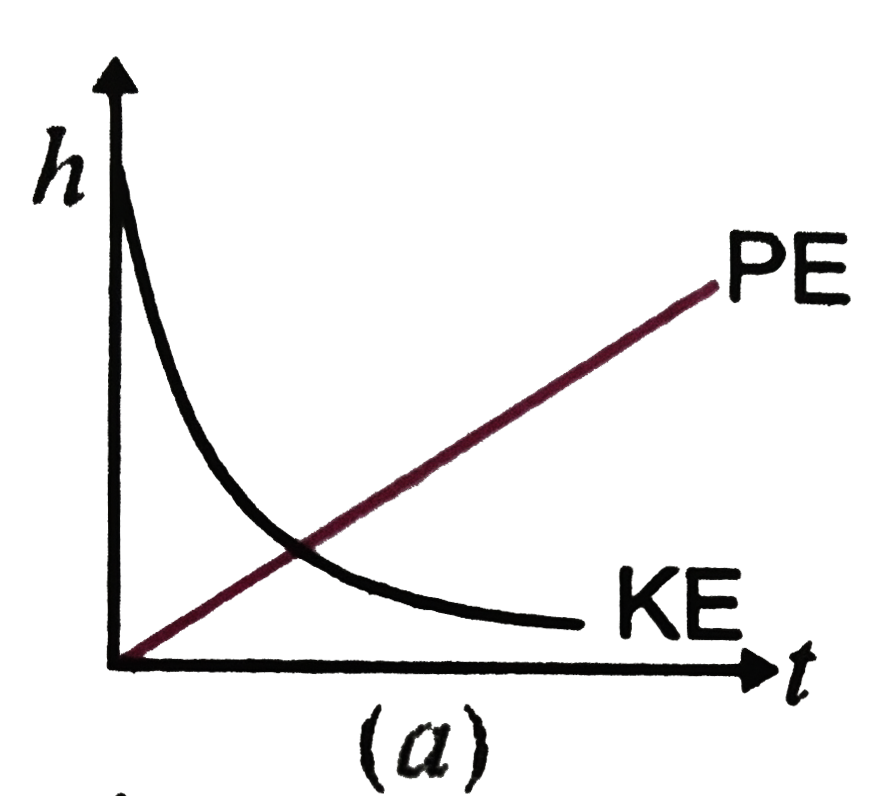
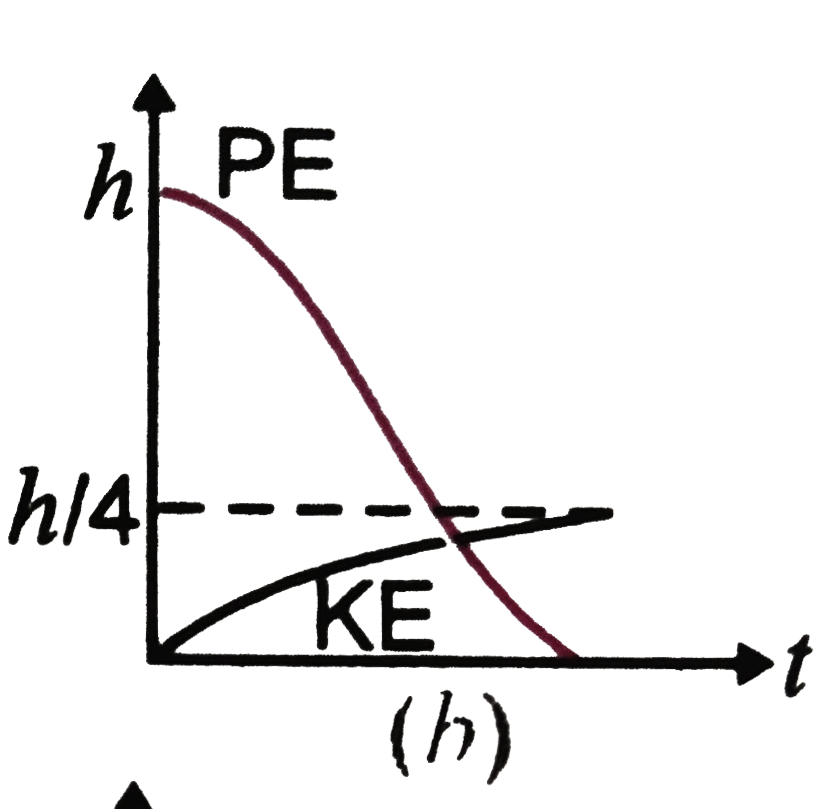
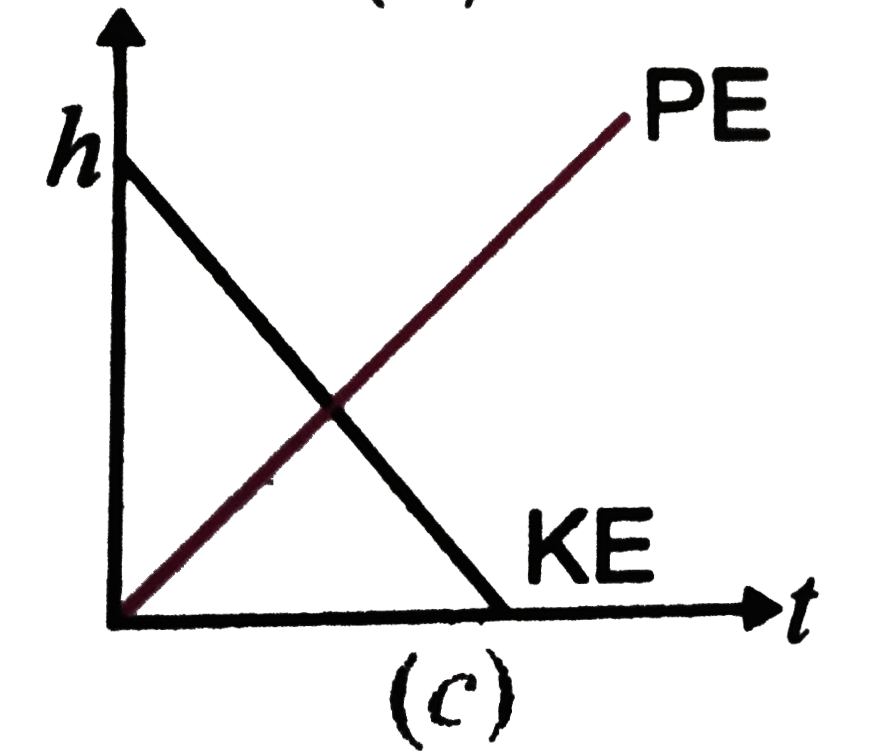
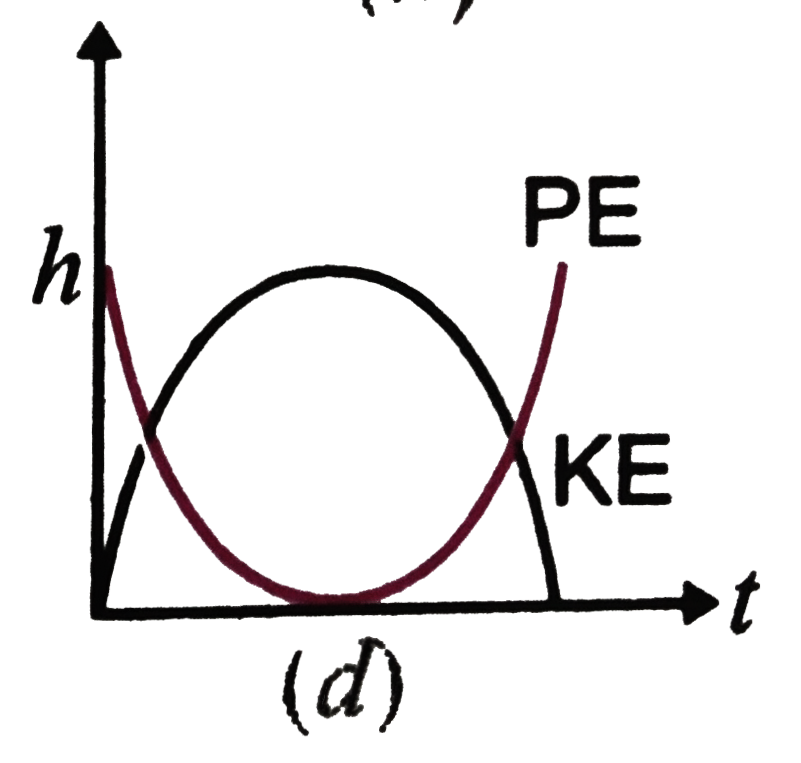
A raindrop falling from a height h above ground, attains a near terminal velocity when it has fallen througha height(3//4)h. Which of the diagrams shown the change in kinetic and potential energy of the drop during its fall up to the ground ? |
|
Answer»
|
|
| 16. |
A particle is executing simple harmonic motion with a time period T. At time t = 0, it is at its position of equilibrium. The kinetic energy-time graph of the particle will lock like. |
|
Answer»
`KE=1/2momega^(2)A^(2)cos^(2)omegat=(KE)_(max)cos^(2)omegat` 
|
|
| 17. |
A stone of mass 0.25 kg tied to the end of a string is whirled round in a circle of radius 1.5 m with a speed of 40 rev./min in a horizontal plane. What is the tension in the string ? What is the maximum speed with which the stone can be whirled around if the string can withstand a maximum tension of 200 N ? |
|
Answer» Solution :M =0.25 kgr = 1.5m = `(40 xx 2 pi)/(60) l "rad" //s` Foruniformcircularmotioncentripetal FORCE= TENSION `(mv^(2))/(R ) = T` `(0.25 xx 4pi^(2))/(1.5)= T` if200 Ntensionis provided in thestringspeedshouldbesuchthatstringdo notbreak `:. (mv^(2))/(r ) =T ` `v^(2)= (1.5 xx 200)/( 0.25) ` `:.v= 34.64 ms^(-1) ` |
|
| 18. |
Time period of a particle in shm depends on the force constant k and mass m of the particle T = 2pisqrt(m/k) A simple pendulum executes shm approximately. Why then is the time period of a pendulum independent of a mass of the pendulum? |
| Answer» Solution :In the CASE of simple pendulum the force constant k = MG/l. THUS k depends on m. Substituting this value in the equation for period `T= 2pisqrt((ML)/(mg))=2pisqrt(l/g)`. This mass CANCELS out and hence T is independent of mass m. | |
| 19. |
Two particles of masses 2 m and 3 m are at a distance .d. apart. Under their mutual gravitational force, they start moving towards each other. The accelaration of their centre of mass when they are d/2 apart is |
| Answer» Answer :D | |
| 20. |
The magnitude of the force of gravity between two identicalobjects is given by F_(0). If the mass of each object is doubled but the distance then is halved, then the new force of gravity between the objects will be |
| Answer» Answer :A | |
| 21. |
Two balls are projected simultaneously with the same speed from the top of a tower-one upwards and the other downwards.If they reach the ground in 6s and 2s ,the height of the tower is |
|
Answer» 120m |
|
| 22. |
Two balls with masses m_(1)=3 and m_(2)=5kg have initial velocities v_(1)=v_(2)=5m//s in the directions shown in figure. They collide at the origin. a. find the velocioty of the CM 3s before the collision. b. Find the position of the CM 2s after the collision. |
|
Answer» Solution :a. GIVEN time is of no consequence SINCE `v_(CM)` is fixed for all times `v_(CM)(x)=(m_(1)v_(1x)+m_(2)v_(2x))/(m_(1)+m_(2))` `=((3)(-5cos37^(@))+(5)(0))/(8kg)=-1.5m//s` `v_(CM)(y)=(m_(1)v_(1)y+m_(2)y_(2))/(m_(1)+m_(2))` `=(3)(-5sin37^(@))+(5xx5)/(8kg)=+2m//s` `:. vecv_(CM)=1.5hati+2hatjm//s` b. Since the collision occurs at the origin `(vecr_(1)=0)`, the position of the centre of mass `2s` later is `vecr_(CM)=vecr_(1)+vecv_(CM^(t))` `=vecv_(CM^(t))=-3hati+4hatjm` |
|
| 23. |
It is easier to draw up a wooden block along an inclined plane than haul it up vertically because |
|
Answer» the friction is reduced `therefore ` The force to be applied to draw it UPWARDS `= MG sin theta` While for lifting it upwards, the force to be applied is mg. `therefore mg gt mg sin theta` Thus on the inclined plane, only a part of the weight has to be overcome. |
|
| 24. |
Let vec(F) be the force acting on a particle having position vector vec(r ) and vec(tau) be the torque of this force about the origin. Then |
|
Answer» `vec(r ).vec(F)=0` and `vec(r ).vec(tau)NE0` |
|
| 25. |
A wheel which is initially at rest is subjected to a constant angular acceleration about its axis It rotates through an angle of 15^(0) in time t secs. The increase in angle through which it rotates in the next 2t secs is |
|
Answer» `90^(0)` |
|
| 26. |
The paressure at the bottom of a tank containing a liquid does not depend on ….. |
|
Answer» acceleration due to gravity. |
|
| 27. |
An object is placed at a distance u from a simple microscope of focal length f. The angular magnification obtained depends |
|
Answer» on F but not on U |
|
| 28. |
(i) Define orbital velocity and establish an expression for it. (ii) Calculate the value of orbital velocity for an artifical satellite of earth orbiting at a height of 1000km (Mass of the earth =6xx10^(24)kg, radius of the earth =6400km). |
|
Answer» Solution :`(i)` `(i)` Definition : It is the HORIZONTAL velocity that has to be imported to a satellite at the determined height so that it makes a circular orbit around the planet is called orbital velocity. `(ii)` Let us assume that a satellite of mass `'m'` moves around the earth in a circular orbit of radius `'r'` with uniform speed `'v'`. Let the satellite be at a height `'b'` from the surface of the earth. Here `r-R+h`, where `'R'` is the radius of the earth. `(III)` The centripetal force required to KEEP the satellite in circular orbit is `F=(mv^(2))/(r )` `=(mv_(0)^(2))/(R+h)` `(IV)` The gravitational force between the earth and the satellite is `F=(GMm)/(r^(2))=(GMm)/((R+h)^(2))` for stable motion. `(mv_(0)^(2))/(R+h)=(GMm)/((R+h)^(2))` `v_(0)=sqrt((GM)/(R+h))` `:'g=(GM)/(R )impliesv_(0)=sqrt((GR^(2))/(R+h))` If satellite is at a height of few hundred kilometers (i.e. say `200km`) `R+h` will be `R`. `:.v_(0)=sqrt(gR)` `(ii)` Given : height `h=1000km` Mass of Earth `M=6xx10^(2)kg` Radius of Earth `R=6400km` Orbital velocity `v_(0)=?` Formula : `v_(0)=sqrt((GM)/(R+h))` `v_(0)=sqrt((6.67xx10^(-11)xx6xx10^(24))/(6400+1000))` `=sqrt((40.02xx10^(13))/(7400))` `=sqrt((40.02xx10^(13))/(7.4xx10^(3)))=sqrt((40.02xx10^(10))/(7.4))` `v_(0)=sqrt((40.02)/(7.4))xx10^(5)=(6.32613xx10^(5))/(2.7202)` `=232561.209` `=2.325xx10^(5)km//s` `=2.325xx10^(5)xx10^(3)m//s` `=2.325xx10^(8)m//s`. |
|
| 29. |
A simple pendulum of length l is suspended to the ceiling of a lilft moving upward with an accelerationof (g//6). Find the time period of its oscillation? |
|
Answer» SOLUTION :As LIFT is moving upwards, time PERIOD is given by `T=sqrt(2PI)sqrt(L/(g+a))=2pisqrt(l/(g+g/t))=2pisqrt((6l)/(7g))` |
|
| 30. |
(a) A child stands at the centre of a turntable with his two arms outstretched. The turntable is set rotating with an angular speed of 40 rev/min. How much is the angular speed of the child if he folds his hands back and thereby reduces his moment of inertia to (2)/(5) times the initial value? Assume that the turntable rotates without friction. (b) Show that the child.s new kinetic energy of rotation is more than the initial kinetic energy of rotation. How do you account for this increase in kinetic energy? |
|
Answer» Solution :(a) Suppose a child folds and back his hands then his moment of inertia are `I_(1)andI_(2)` RESPECTIVELY and angular speed are `omega_(1) and omega_(2)` respectively. `therefore I_(2)=(2)/(5)I_(1)` given `omega_(1)=40` revolution/MIN `=(40xx2pi)/(60)=(4)/(3)pi` RAD `s^(-1)` From the law of conservation of angular momentum `I_(1)omega_(1)=I_(2)omega_(2)` `therefore omega_(2)=(I_(1))/(I_(2))omega_(1)` `therefore omega_(2)=(5)/(2)omega_(1)` `=(5)/(2)xx40("rotation")/("min")=("100 rotation")/("min")` `=(10pi)/(3)` rad `s^(-1)` (b) Initial rotational kinetic energy `K_(1)=(1)/(2)I_(1)omega_(1)^(2)` and new rotational kinetic energy `K_(2)=(1)/(2)I_(2)omega_(2)^(2)` `:.(K_(2))/(K_(1))=(I_(2)omega_(2)^(2))/(I_(1)omega_(1)^(2))` `=(2)/(5)xx((10pi)/(3)xx(3)/(4pi))^(2)` `=(5)/(2)` `:. K_(2)=2.5K_(1)` Hence, child down (back) his hand, rotational kinetic energy increases by 2.5 times to when child fold his hand. The increase in the rotational kinetic energy is attributed to the internal energy of the body. |
|
| 31. |
Now-a-days we are familiar with satellites Name any two satellites. |
|
Answer» |
|
| 32. |
Three rods of equal length at 0^(@)C, are connected with one another to form an equilateral triangle ABC [Fig. 5.10]. Coefficient of linear expansion for the rod ABis alpha and that for the other two rods is beta. What will be the increment in the measure of the angle at C if the triangle is heated to t^(@)C? |
|
Answer» SOLUTION :At `0^(@)C, angleC=60^(@)=pi/3.` Suppose due to rise in temperature to `t^(@)C, angle C=2phi` where `phi=pi/6+theta` (assuming that `angle C` has increased by `2theta,theta` is very small) If L is the LENGTH of each rod at `0^(@)C`, then at `t^(@)C` the lengths of AC and BC become `l(l+betat)` and the length of AD becomes `1/2(1+alphat)`. So for `DeltaACD` in Fig. 5.10, `""(l//2(1+alphat))/sinphi=(l(1+betat))/(sin90^(@))` or, `"" sinphi=(l//2(1+alphat))/(l(1+betat))` or, `"" sin(pi/6+theta)=(1+alphat)/(2(1+betat))` or, `"" sin""pi/6costheta+cos""pi/6sintheta=(1+alphat)/(2(1+betat))` or, `"" 1/2costheta+sqrt(3)/2sintheta=1/2((1+alphat)/(1+betat))` or, `""1/2+sqrt(3)/2*theta=1/2((1+alphat)/(1+betat))` `""[therefore theta` is small, `sintheta=theta, costheta=1]` or, `"" sqrt(3)/2theta=1/2((1+alphat)/(1+betat)-1)` or, `"" theta=1/sqrt(3)((1+alphat-1-betat)/(1+betat))=((alpha-beta)t)/(sqrt(3)(1+betat))` `therefore` Increases in `angleC` is `2theta=(2(alpha-beta)t)/(sqrt(3)(1+betat)).` 
|
|
| 33. |
Two particles of same mass are projected simultaneously with same speed 20 ms^(-1) from the top of a tower of height 20 m. One is projected vertically upwards and other projected horizontally. The maximum height attained by centre of mass from the ground will be (g=10 ms^(-2)) |
|
Answer» `10sqrt(2)m` |
|
| 34. |
A motor cyclist is going in a vertical circle. What is the necessary condition so that he may not fall down ? |
| Answer» Solution :The necessary condition that the motor cyclist may not fall down is `(mv^2)/(R) ge mg`. i.e. `ge sqrt(rg)` at the highest POINT and `V ge sqrt(5gr)` at the lowest point. | |
| 35. |
A gas is compressed at a constant pressure of 50N//m^(2) from a volume 4m^(3). Energy of 100 J is then added to the gas by heating. Its internal energy is ………….. . |
|
Answer» INCREASED BY400 J |
|
| 36. |
A cheetah , weighing 150 kg , chases a deer , weighing 30 kg , in a straight path . The speed of the cheetah is 20 m/s and that of the deer is 25 m/s . The approximate speed of the centre of mass of the pair is |
|
Answer» SOLUTION :Here `m_(1) = 150` KG , `m_(2) = 30` kg `v_(1) = 20` m/s , `v_(2) = 25` m/s Speed of the centre of mass is `v_(CM) = (m_(1) v_(1) + m_(2) v_(2))/(m_(1) + m_(2))` `= ((150 kgxx 20 m//s)+ (30 kg xx 25 m//s))/(150 kg + 30 kg)` `= (3750 kg m//s)/(180 kg) = 21` m/s |
|
| 37. |
Which of the following quantity is conserved in all collision prosess ? |
| Answer» Answer :B | |
| 38. |
A body is revolving with a constant speed along a circular path. If the direction of its velocity is reversed, keeping speed unchanged, then |
|
Answer» the centripetal FORCE does not suffer any CHANGE in magnitude and DIRECTION both |
|
| 39. |
A metal bar of length l is well lagged with some non-conducting material to prevent loss of heat from its surface and the two ends are maintained at steady temperatures theta_(1) and theta_(2)(theta_(1)gt theta_(2)), then in steady state the temperature theta of the section of the bar at a distance x from the hot end varies according to which figure ? |
|
Answer»
|
|
| 40. |
From a disc of mass m and radius r, a circular portion of radius (r )/(3) is removed from the edges. Find the M.O.I of the remaining system about a normal through center of original disc |
|
Answer» Solution :Let `I_(2)` be the M.I. of remaining poriton. M.I of the removed partion about a normal axis through centre of the original disc is `I_(1)=((m)/(9)((r )/(3))^(2))/(2)+(m)/(9)((2r)/(3))^(2)`or `I_(1)=(MR^(2))/(18)` Hence, M.I. of the remaining portion is `I_(2)=I-I_(1)=(mr^(2))/(2)-(mr^(2))/(18)` or `I_(2)-(4mr^(2))/(9)` |
|
| 41. |
A cyclist moving on level circular path of radius 4 m with speed of 4.9 m/s takes sharp turn. Co-efficient of friction between tyre and road will b e ....... |
|
Answer» 0.51 ` mu = tan THETA= (v^(2))/(rg )` `mu = 0.61` |
|
| 42. |
A body is in motion and it is stopped by applying retarding force. Initial speed magnitude of force applied are as given below {:("Speed force","Speed force"),((1)V,F),((2)2V,F//2),((3)V//2,2F):} If S_(1),S_(2),S_(3) are the distances travelled before coming to rest, those can be arranged in ascending order as given below |
|
Answer» `S_(1),S_(2),S_(3)` |
|
| 43. |
Two sides of a triangle are given by hati+hatj+hatj and -hati+2hatj+3hatk then area of triangle is |
|
Answer» `sqrt(26)` |
|
| 44. |
In the question number 51 , the potential at the centre is |
|
Answer» `-2(GM)/(l)` `OA=OB=OC=OD` `=(SQRT(l^(2)+l^(2)))/(2)=(lsqrt(2))/(2)=(l)/(2)` Potential at centre O due to given mass configuration is `V=(-(Gm)/(OA))+(-(Gm)/(OB))+(-(Gm)/(OC))+(-(Gm)/(OD))` ` = -(4GM)/(lsqrt(2))=-4sqrt(2)(Gm)/(l)` 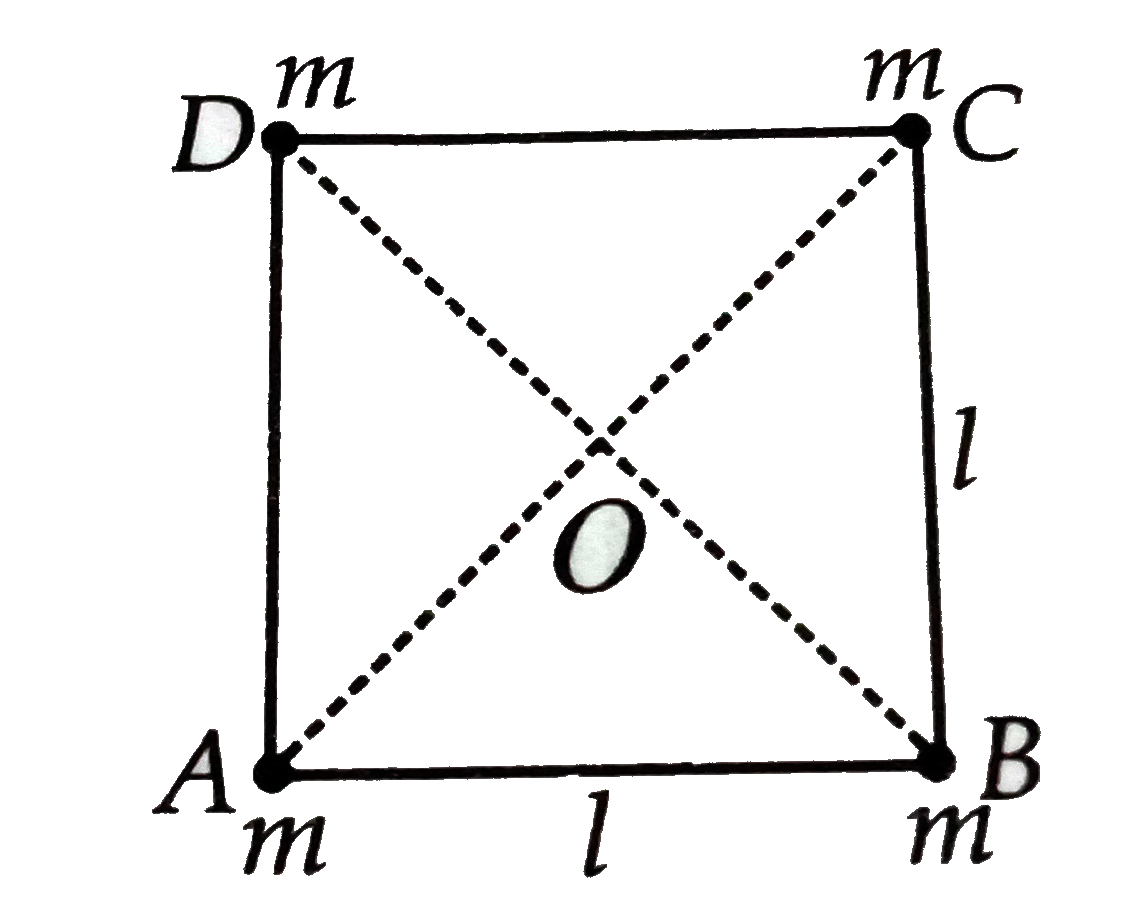
|
|
| 45. |
Two simple pendulums of lengths 100 cm and 101 cm are set into oscillation at the same time. After what time does one pendulum gain one complete oscillation over the other? |
|
Answer» Solution :Length of the first pendulum is comparatively less, and hence, its time period is also less, thus the first pendulum oscillates faster. By the time the second-pendulum executes n oscillations, SUPPOSE the first one completes (n + 1) oscillations. Hence, if `T_(1)andT_(2)` are time periods of the first and the second pendulums, `(n+1)T_(1)=nT_(2)or,T_(2)/T_(1)=(n+1)/n=1+1/n""...(1)` Again, `T_(2)/T_(1)=sqrt(L_(2)/L_(1))=sqrt(101/100)=(1+1/100)^(1//2)` `=1+1/2xx1/100=1+1/200""...(2)` From equations (1) and (2) `1/n=1/200or,n=200,i.e.,n+1=201` Thus, the REQUIRED time = time of 201 COMPLETE oscillations of the first pendulum = `201xxT_(1)` `=201xx2pisqrt(L_(1)/g)` `=201xx2xxpisqrt(100/980)~~403s=6 min43s`. |
|
| 46. |
A professional diver of mass 60 kg performs a dive from a platform 10 m above the water surface. Find the magnitude of the average impact force experienced by him if the impact time is 1s on collision with water surface. Assume that the velocity of the diver just after entering the water surface is 4ms^(-1).(g=10ms^(-2)) |
|
Answer» 240N |
|
| 47. |
A particle is projected from a point O with velocity u in a direction making an angle alpha upward with the horizontal. At P it is moving at right angle so its initial direction of projection. Its velocity at P is |
Answer» SOLUTION :`V COS (90-ALPHA)=v SIN alpha=u cos alpha,v=ucotalpha` 
|
|
| 48. |
Two mercury droplets of radii 0.1 cm . And 0.2 cm . Collapse into one single drop .What amount of energy is released ? The surface tension of mercury T=435.5xx10^(-3)Nm^(-1) |
Answer» Solution : `r_(1)=0.1cm=10^(-3)m` `r_(2)=0.2cm=2xx10^(-3)m` Surface tension `S=435.5xx10^(-3)N//m` Suppose radius of larger drop is R. VOLUME of large drop =Volume of two small drops `therefore(4)/(3)piR^(3)=(4)/(3)pir_(1)^(3)+(4)/(3)pir_(2)^(3)` `thereforeR^(3)=r_(1)^(3)+r_(2)^(3)` `R^(3)=(0.1)^(3)+(0.2)^(3)` `=(0.001)+(0.008)` `=0.009` `thereforeR=0.21cm=2.1xx10^(-3)cm` Change in area, `DeltaA=` (surface area of large drop)-(surface area of two small drops) `DeltaA=4piR^(2)-(4pir_(1)^(2)+4pir_(2)^(2))` `=4pi[R^(2)=(r_(1)^(2)+r_(2)^(2))]` `therefore` The energy increased `DeltaU=W=SDeltaA` `thereforeDeltaU=S(4pi)[R^(2)-(r_(1)^(2)-r_(2)^(2))]` `DeltaU=435.5xx4xx3.14[(2.1xx10^(-32))-(1xx10^(-6)+4xx10^(-6))]` `=435.5xx4xx3.14(4.41-5)xx10^(-6)xx10^(-3)` `=-32.23xx10^(-7)` NEGATIVE sign INDICATES energy is absorbed Hence , energy absorbed is `3.22xx10^(-6)J`. Hence same amount of energy increases. |
|
| 49. |
Energy required in moving a body of mass m from a distance 2R to 3R from centre of earth of mass M is |
|
Answer» `(GMM)/(12 R^(2))` `DeltaU=GMm[(1)/(r_(1))-(1)/(r_(2))]=GMm((1)/(2R)-(1)/(4R))=(GMm)/(4R)` |
|
| 50. |
The correctness of equations can be checked using the principle of homogeneity.If percentage errors of measurement in velocity and mass are2%and4%respectively, tvhat.is the percentage error in kinetic energy? |
| Answer» Solution :KINETIC energy `K-1/2mv^2(DeltaK)/Kxx100=(DELTAM)/mxx100+2xx(DELTAV)/vxx100=4+2xx2=8%` | |