

Saved Bookmarks
This section includes 7 InterviewSolutions, each offering curated multiple-choice questions to sharpen your Current Affairs knowledge and support exam preparation. Choose a topic below to get started.
| 1. |
A wheel is rotating with a speed of 500 rpm on a shaft. Second identical wheel, initially at rest is suddenly coupled on the same shaft. What is the speed of the resultant combination? Assume that the moment of inertia of the shaft is negligible. |
|
Answer» SOLUTION :`I_(1)omega_(1)=I_(2)omega_(2)""I_(1)n_(1)=I_(2)n_(2)` `I_(1)(500)=2I_(1)n_(2)"":.n_(2)=250` rpm. |
|
| 2. |
The magnifying power of a microscope with an objective of 5mm focal length is 400. The length of its tube is 20cm. Then the focal length of the eye piece is |
|
Answer» 2.23cm |
|
| 3. |
Find the speed of a body at the ground when it fall freely at height 2m . ( g = 10 ms^(-2)) |
|
Answer» |
|
| 4. |
A circular table with smooth horizontal surface is rotating at an angular speed omega about its axis. A groove is made on the surface along the radius and a small particle is gently placed inside the groove at a distance I from the centre. Find the speed of the particle with respect to the table as its distance from the centre becomes L. |
| Answer» Answer :A | |
| 5. |
Surface tension is due to |
|
Answer» COHESIVE FORCES between molecules |
|
| 6. |
The acceleration due to gravity on the surface of moon is 1.7 m s^(-2). What is the time period of a simple pendulum on the surface of moon if its time period on the surface of earth is 3.5 s ? (g on the surface of earth is 9.8 m s^(-2)) |
|
Answer» SOLUTION :Suppose the time PERIOD of a simple pendulum on earth `T_(e ) = 3.5s` and on MOON is `T_m` and length l of simple pendulum is same. Time period of simple pendulum, `T= 2pi sqrt((l)/(g))`, here `2pi` and l are constant `therefore T propto (1)/(sqrt(g))` `therefore (T_m)/(T_e)= sqrt((g_e)/(g_m))` `therefore T_(m)= T_(e ) xx sqrt((g_e)/(g_m))` `therefore T_(m)= 3.5xx sqrt((9.8)/(1.7)) = 3.5xx sqrt(5.76)` `= 3.5xx 2.4 ""` [Here `T_(m) lt T_(e )`, hence pendulum CLOCK works very slowly] `= 8.4s`. |
|
| 7. |
In stretching a wire , workmhas to be done . What happens to this work ? |
| Answer» SOLUTION :WHWN a AWIRE is stretched . Inter - atomic force oppose the change . Hence work has to be done against these forces . This work is stored In the wire in form of ELASTIC potential energy . | |
| 8. |
Define centre of gravity. |
| Answer» SOLUTION :The center of gravity of a body is the point at which the entire weight of the body ACTS, irespectivee of the POSITION and ORIENTATION of the body. | |
| 9. |
When body of mass m is suspended from a spiral spring and spring gets stretched through a distance 20 cm if it is stretched below 20 cm and leave then what is period of oscillation? |
|
Answer» Solution :`T= 2pi sqrt((l)/(G))` `= 2pi sqrt((20)/(980))= 2pi xx sqrt((1)/(49))` `THEREFORE T = (2xx22)/(7) xx (1)/(7) = (44)/(49)s`. |
|
| 10. |
Shearing strain is expressed by |
|
Answer» SHEARING force |
|
| 11. |
A ray of light passes normally through a slab of thickness t. IF the speed of light in vaccum be C, then time taken by the ray to go across the slab will be |
|
Answer» `t/C` |
|
| 12. |
A motorcyclist covers 1/3 of a given distance with a speed of 10 kmh ^(-1) , the next 1/3 at 20 kmh ^(-1) and the last 1/3 at of 30 kmh^(-1). What is the average speed of the motorcycle for the entire journey ? |
|
Answer» Solution :Suppose the tota DISTANCE is x. `THEREFORE` Time taken to cover distance `x/3` is `t _(1) = (x //3)/( 10) = (x)/(30) ` hour. Also time taken to cover next-distance `x/3 is t _(2) = (x//3)/(20) = (x)/(60)` hour, time for remaining distance `x/3` is `t _(3) = (x//3)/(30) = (x)/(90)` hour. `therefore` Total time to covered distance x. `t = t _(1) + t _(2) + t _(3)` `t = (x)/(30) + (x)/(60) + (x)/(90) = (6x + 3x + 2x )/(180) = (11x)/(180)` `therefore` Average speed `LT v gt = (x)/(t) = (x xx 180)/(11x)= (180)/(11) kmh^(-1)` `therefore lt v gt = (180 xx 1000)/(11 xx 3600) = (50)/(11) ms ^(-1)` |
|
| 13. |
In above question 37 : |
|
Answer» VELOCITY of BLOCK at O will be maximum |
|
| 14. |
Four holes of radius R are cut from a thin square plate of side 4R and mass M. Then moment of inertia of the remaining portion about z axis is |
|
Answer» Solution :M is the mass of the square plate before CUTTING the holes. Mass of one HOLE `m=[(M)/(16R^(2))] pi R^(2)=(pi)/(16)M` `:.`MOMENT of INERTIA of remaining portion. `I_("square")-4I_("nole")` `I=(M)/(12)[16R^(2)+16R^(2)]-4[(mR^(2))/(2)+m(2R^(2))]` `=(8)/(3)MR^(2)-18mR^(2) "" I=((8)/(3)-(10pi)/(16)) MR^(2)` 
|
|
| 15. |
A LCR circuit behaves like a damped harmonic oscillator. Comparing it with a physical spring- mass damped oscillator having damping constant b, mass m and oscillating with a force constant k, the correct equivalence will be |
|
Answer» `L harr k, C harr b, R harr m` `-kx- BV- ma` `:. ma + bv- kx = 0` `:. m= (d^(2)x)/(dt^(2)) + (dx)/(dt) + kx = 0` …(1)  Now, for LCR circuit, according to Kirchoff.s second law, `-L (dI)/(dt) - RI -(q)/(c )= 0` `I= (dq)/(dt) " hence" (dI)/(dt) = (d^(2) q)/(dt^(2))` `:. L (d^(2) q)/(dt^(2)) + R (dq)/(dt) + (q)/(a) = 0`...(2) By comparing equation (1) and (2) `L harr m, R harr b, (1)/(C ) harr k` |
|
| 16. |
Explain with graphs the difference between work done by a constant force and by a variable force. |
|
Answer» Solution :Workdoneby aconstantforce: whena constantforceF acts on a body, thesmallworkdone(dW )by theforceinproducinga smalldisplacement drgivenbytherelation. ` dW= (fcos theta)dr ` The totalworkdonein producinga displacementfrominitialposition`r_i`to finalposition` r_f `is , `W=int_( r_i )^( r_f) dW` `W= int_(r_i )^(r_f)( F costheta )dr = ( f cos theta )int_(r_i )^(r_f)dr= (Fcos theta)( r_(f)- r_i)` Thegraphicalreprentationof hteworkdonebyaconstantforceis SHOWNIN FIGUREGIVEN belowtheareaunderthe graphshowsthe workdoneby theconstantforce.  workdoneby avariableforce: whenthe componantof avariableforceF actson abodythe smallworkdone(dW )by theforcein producinga smalldisplacementdrisgivenbythe relation  dW =`Fcos thetadr ` [ F cos` theta`is thecomponentof thevariableforceF ] whereFand ` theta`arevariables. thetotaldonefor adisplacementfrominitialposition`r_i`to finalposition`r_f `isgivenby therelation , ` W= int_( r_i )^(r_f)dW = int_(r_i)^(r_f)F costhetadr ` A graphicalrepresentationof theworkdoneby avariableforceis shownin figuregivenbelow, theareaunderthegraphis theworkdoneby thevariableforce. |
|
| 17. |
(A): Relative velocity of A w.r.t. B is greater than the velocity of either, when they are moving in opposite directions. (R): The relative velocity between any two bodies is equal to the sum of the velocities of the two bodies. |
|
Answer» |
|
| 18. |
Two particles execute SHM of the same amplitude and frequency on parallel side by side. They cross each another when moving in opposite directions each time their displacement is half their amplitude What is the difference between them ? |
|
Answer» `y_2 = A"in" (OMEGA t + phi) , y_1 + y_2 = A//2` From this `phi = (2PI //3)` RADIAN |
|
| 19. |
A solid sphere of copper weighs 1kg, Find the increase in its surface area when its temperature rises from 15^(@)C" to "500^(@)C. Relative density of copper at 0^(@)C is 8.39. alpha=16.07xx10^(-6)//""^(0)C |
|
Answer» Solution :`r_(0) = [ (1000)/(4//3 pi) ]^(1//3)= 2.99 cm , r_(15) " at " 15^(0)C` `r_(15) = r_(0) ( 1 + alpha Delta THETA) = 2.99 (1 + 16.07 xx 10^(-6) xx 15) =2.99 1` cm `therefore ` Area at `15^(@)C = A_(15) = 4 pi r_(15)^(2) = 112.4cm^(2)` At `500^(0)` the radius is `r_(500)` = 2.99 `(1 + alpha xx 500)` = 3.014 `A_(500) = 4 pi r_(500)^(2) = 114.2cm^(2)` HENCE increase in surf ace area `Delta A = A_(500) - A_(15)114.2 - 112.4 = 1.8cm^(2)` |
|
| 20. |
In the previous problem , if 15.0 cm of water and spirit each are further poured into the respective arms of the tube , what is the difference in the levels of mercury in the two arms ? (Specific gravity of mercury =13.6) |
|
Answer» <P> SOLUTION : Let density of water `rho_(1)=1g cm^(-3)` , densityofspirit `rho_(2)=0.8gcm^(-3)` , density of MERCURY`rho_(3)=13.6g cm^(-3)` , height of water column `h_(1)=25cm` , height of spirit column `h_(2)=27.5`cm and let `h_(3)` be the DIFFERENCE between the levels of mercury in the two arms. Since pressure at A and B are same, `thereforeP_(0)+h_(1)rho_(1)g=P_(0)+h_(2)rho_(2)g+h_(3)rho_(3)g` where `P_(0)=` atmospheric pressure. `thereforeh_(1)rho_(1)=h_(2)rho_(2)+h_(3)rho_(3)`....(1)  `thereforeh_(3)rho_(3)=h_(1)rho_(1)-h_(2)rho_(2)` `thereforeh_(2)xx13.6=25xx1-27.5xx0.8` `thereforeh_(3)=(25-22)/(13.6)` `thereforeh_(3)=(3)/(13.6)=0.221cm` Hence , the difference between the levels of mercury in the two arms is 0.221 cm |
|
| 21. |
One steel wire of mass 4.0 xx 10 ^(-3) kgand length 0.64m is kept under 60 N tension. Find the speed of transverse wave, propagating on this wire. |
| Answer» SOLUTION :`V = 97.97ms ^(-1) ~~98 MS ^(-1)` | |
| 22. |
The weight of a body in air is 100 N. How much will it weight in water, if it displaces 400 cc of water ? |
|
Answer» 96 N APPARENT weight = `100 - 3.92 = 96.08 N` |
|
| 23. |
A man of mass 60 kg lifts a 15 kg mass to the top of a building of height 10m in 5 minutes. H is efficiency is |
| Answer» ANSWER :B | |
| 24. |
(A): A ball connected to a string is in circular motion on a frictionless horizontal table and is in equilibrium (R): .Magnitude of the centripetal force is equal to the magnitude of the tension in the string |
|
Answer» Both .A. and .R. are TRUE and .R. is the CORRECT EXPLANATION of .A. |
|
| 25. |
What are the different ways of increasing the number of molecular collisions per unit time in a gas? |
|
Answer» by INCREASING the TEMPERATURE |
|
| 26. |
Which of the following statements is incorrect with reference to angular momentum? Angular momentum of the particle rotating with a central force is constant due to: |
|
Answer» CONSTANT force |
|
| 27. |
Two resistors of resistances R_(1)=100pm3 ohm and R_(2)=200pm4 ohm are connected (a) series , (b) in parallel. Find the equivalent resistance of the (a) series combination, (b) parallel combination. Use for (a) the relation R = R_(1)+R_(2)and for (b) (1)/(R') = (1)/(R_(1))+(1)/(R_(2)) and (DeltaR')/(R'^(2)) = (DeltaR_(1))/(R_(1)^(2))+(DeltaR_(2))/(R_(2)) |
|
Answer» Solution :(a)The equivalent resistance of series COMBINATION `R = R_(1)+R_(2) = (100 pm 3)` OHM + `(200 pm4)` ohm ` = 300pm7` ohm (b) The equivalent resistance of parallel combination `R. = (R_(1)R_(2))/(R_(1)+R_(2)) = (200)/(3) = 66.7` ohm Then, from `(1)/(R.) = (1)/(R_(1))+(1)/(R_(2))` We GET, `(DeltaR.)/(R.^(2)) = (DeltaR_(1))/(R_(1)^(2)) +(DeltaR_(2))/(R_(2)^(2))` `DeltaR. = (R.^(2))(DeltaR_(1))/(R_(1)^(2))+(R.^(2))(DeltaR_(2))/(R_(2)^(2))` `=((66.7)/(100)^(2))3+((66.7)/(200)^(2))4` 1.8 Then, R. = `66.7pm1.8` ohm (Here, `DeltaR` is expressed as 1.8 INSTEAD of 2 to keep in confirmity with the rules of significant figures.) Error in case of a measured quantity raised to a power Suppose Z = `A^(2)`, Then, `DeltaZ//Z=(DeltaA//A)+(DeltaA//A)=2(DeltaA//A)`. Hence, the relative error in `A^(2)` is two times the error in A. In general , if `Z=A^(p)B^(q)//C^(r)` Then, `DeltaZ//Z = p(DeltaA//A)+q(DeltaB//B)+r(DeltaC//C)`. |
|
| 28. |
A solid sphere of copper weighs 1 kg, Find the increase in its surface area when its temperature rises from 15^(0)C to 500^(0)C. Relative density of copper at 0^(0)C is 8.93. alpha=16.07xx10^(-6)//""^(0)C |
|
Answer» Solution :`r_(0)=[(1000)/(4//3pi)]^(1//3)=2.99cm, r_(15)" at " 15^(0)C` `r_(15)=r_(0) (1+alpha Delta THETA)=2.99(1+16.07xx10^(-6)xx15)=2.991cm therefore " AREA at " 15^(0)C=A_(15)=4PI r_(15)^(2)=112.4cm^(2)`. At `500^(0)` the radius is `r_(500)=2.99(1+alpha xx 500)=3.014` `A_(500)=4pi r_(500)^(2)=114.2 cm^(2)` Hence increase in surface area `DeltaA=A_(500)-A_(15)=114.2-112.4=1.8cm^(2)` |
|
| 29. |
A piece of wood is floating in water kept in a bottle. The bottle is connected to an air pump. Neglect the compressibility of water. When more air is pushed into the bottle from the pump, the piece of wood will float with (HC) |
|
Answer» LARGER PART in the water |
|
| 30. |
Answer the following : In Fig.6.13. (i) the man walks 2m carrying a mass of 15kg on his hands. In Fig. 6.13. (ii), he walks the same distance pulling the rope behind him. The rope goes over a pulley, and a mass of 15 kg hangs at its other end. In which case is the work done greater? |
| Answer» SOLUTION :In the SECOND CASE. | |
| 31. |
A metal sphere of radius rand specific heat S is rotated about an axis passing through its centre at a speed of n rotations per second. It is stopped and 50% of its energy is used in increasing its temperature, then the raise in temperature of the sphere is |
|
Answer» ` (2)/(5) (pi^(2) n^(2) R^(2) )/( S)` |
|
| 32. |
The melting point of ice is 0^(@)C at 1 atm. At what pressure it will be -1^(@)C ? |
|
Answer» Solution :Here `DeltaT=(-1-0)=-1,T=273+0=273K` and `V_(2)-V_(1)=(1-1/0.9)xx10^(-3)m^(3)` (GIVEN) L = 80 cal/g We have, `(DeltaP)/(DeltaT)=L/(T(V_(2)-V_(1)))` or `(DeltaP)/((-1))=(80xx4.2xx10^(3))/(273(1-1/0.9)xx10^(-3))` `thereforeDeltaP=132xx10^(5)N//m^(2)=132atmorP_(2)-P_(1)=132atm`. `thereforeP_(2)=132+P_(1)=133atm`. |
|
| 33. |
Two particles of same mass fall down on to the surface of the earth one from infinity and the other from an altitude 3R. The ratio of velocities on reaching the earth is: |
|
Answer» `2:3` |
|
| 34. |
The least count of a veriner callipers is (1)/(100)cm. The value of one division on the main scale is 1mm. The, the number of divisions on the main scale that coincide with N divisions of the vernier is |
| Answer» Answer :C | |
| 35. |
A bob of mass 100 g tied at the end of a string of length 50 cm is revolved in a vertical circle with a constant speed of 1 ms^(-1). When the tension in the string is 0.7 N, the angle made by the string with the vertical is (g=10 ms^(-2)) |
|
Answer» `0^(@)` |
|
| 36. |
In the above problem, the maximum length of the hanging part to prevent the chain from sliding down the incline is |
|
Answer» Solution :`m_(1)g SIN 30 = m_(2)g+mu m_(1)g COS 30` `(L-x)g.(1)/(2)=xg+mu(L-x)g SQRT(3)//2` `(L-x)(1)/(2)=x+mu (L-x)(sqrt(3))/(2)` `therefore x = ((1-sqrt(3)mu)L)/((3-sqrt(3)mu))` |
|
| 37. |
The variables which determine the thermodynamic behaviour of a system are called thermodynamic variables.(b) What happens to the internal energy of a gas during………………(i) isothermal expansion? (ii) adiabatic expansion? |
| Answer» SOLUTION :(i) REMAINS the same (II) DECREASES | |
| 38. |
the barral of a common pump (pump for warer ) is 50 cm long and its bottom is 6 m from the surface of water. If the cross - section of the cross - section of the thinner pipe joining the barrel with water in well 3/14 of that of the barrel, find the height of the water in the pipe after the first stoke. (water barometer is 9 m of water . A xx 1/2 + 3/14Axx (6-x) A(24/14 - 3/14x)A/14(25-3x) final pressure =(9-x)m of water , now use P_(1) V_(1) = P_(2) V_(2)] |
|
Answer» |
|
| 39. |
The dimensions of the quantities in one (or more) of the following pairs are the same. Identify the pair (s) : |
|
Answer» TORQUE and Work |
|
| 40. |
The water level in a vertical glass tube 1.0 m long can be adjusted to any position in the tube . A tuning fork vibrating at 660 Hz is held just over the open top end of the tube . At what positions of the water level will there be resonance . Speed of sound is 330 m//s. |
|
Answer» Solution :Resonance corresponds to a pressure ANTINODE at closed end and pressure node at open end. Further , the distance between a pressure node and a pressure antinodesis `lambda//4` , the condition of resonance would be , length of air column ` l = n (lambda)/(4) = n((v)/( 4 F))` Here , ` n = 1 , 3, 5 ,....` `l_(1) = (1) (( 330)/( 4 xx 660)) = 0.125 m` and `l_(2) = 3 l_(1) = 0.125 m` `l_(3) = 5l_(1) = 0.625 m` and `l_(4) = 7 l_(1) = 0.875 m` `l_(3) = 9l_(1) = 1.125 m` Since `l_(5) gt m` ( the length of tube), the length of air columns can have the values from `l_(1) to l_(4)` only. Therefore , level of water at resonance will be `( 1.0 - 0.125 ) m = 0.875 m` `( 1.0 - 0.375)m = 0.625 m` `( 1.0 - 0.625)m = 0.375 m` and `( 1.0 - 0.875) m = 0.125 m` In all the four cases shown in Fig . 7.68, the resonance frequency is `660 HZ` but the first one is the fundamental tone or first harmonic . The second is first overtone or the THIRD harmonic and so on. 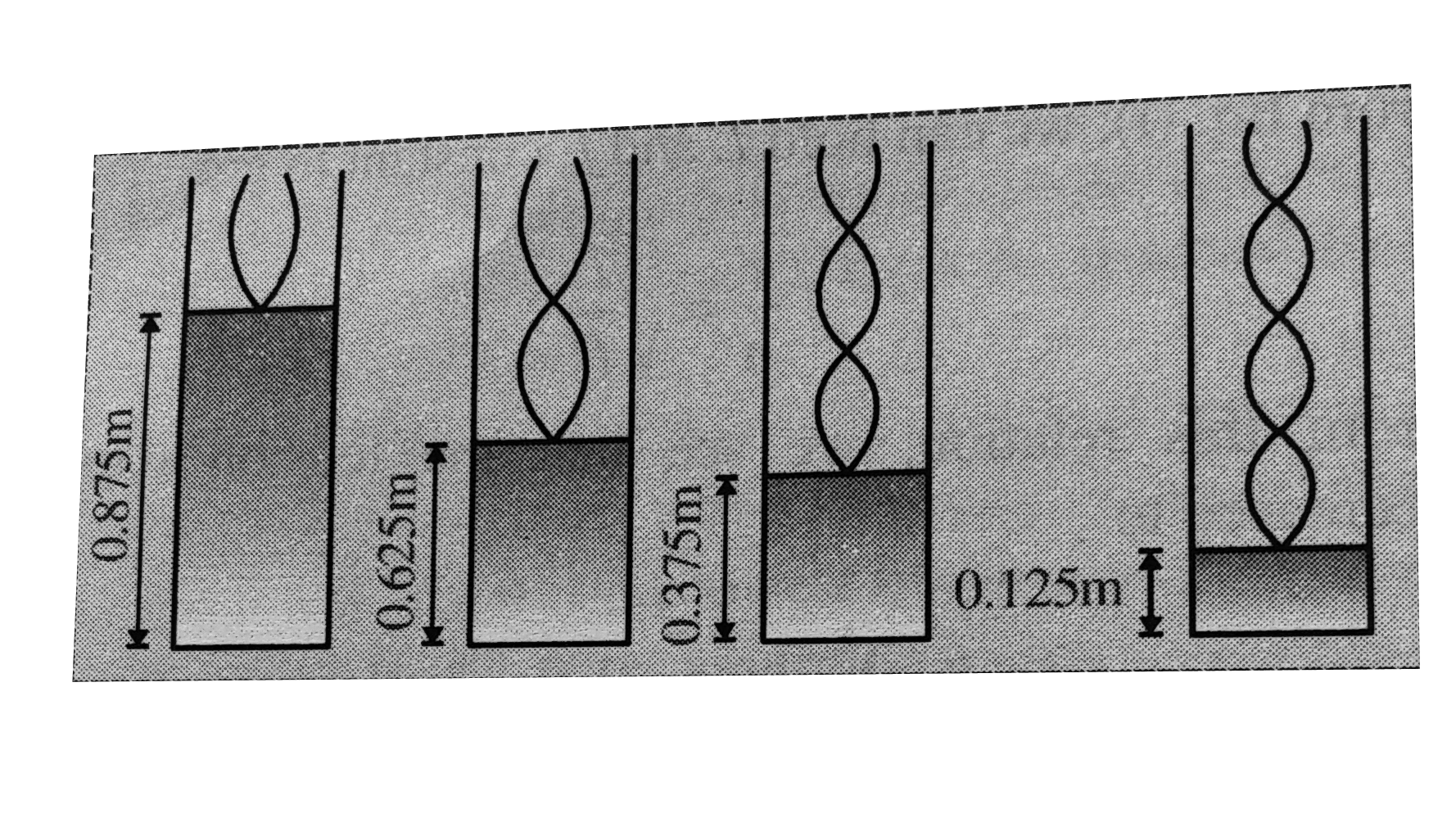
|
|
| 41. |
A motor vehicle travelled the first third ofa distance s at a speed of v_(1)=10 kmph, the second third at a speed of v_(2)=20 kmph and the last third at a speed of v_(1)=60 kmph. Determine the mean speed of the vehicle over the entire distance s. |
|
Answer» 15 kmph |
|
| 42. |
A particle of mass m moves on a straight line with its velocity varying with the distance travelled according to the equation v=asqrt(x), where a is a constant. Find the totla workdone by the all forces during a displacement from x=0 to x=d? |
|
Answer» `("MAD")/2` |
|
| 43. |
A spring is stretched by 2 cm by an object attached to It near the surface of earth. How much extension of the same spring take place by the same object when taken to a point 3,200 km above the surface of earth (Radius of earth = 6,400 km) |
|
Answer» 0.5 cm At a height of 3, 200 KM above earth.s surface `mg. = k (y)` As `g = (GM)/(R^(2))` `g. = (GM)/((R+h)^(2))` `(g.)/(g) = (k y)/(k (2)) = (R^(2))/((R+h)^(2))` `y = (2 cm)((R )/((R+h)))^(2)` `= 2cm ((6,400 km)/(6,400 km + 3,200 km))^(2)` `= 2((6,400)/(9,600))^(2) = 0.9 cm` |
|
| 44. |
Give the expression for the frequency of vibration on a stretched string in a transversemode of vibration along with the meanings of the symbols used. |
| Answer» Solution :The fundamental FREQUENCY of VIBRATION `f = (1)/(2L) SQRT((T)/( mu ))`.Where 'I'is the LENGTHOF the segement. | |
| 45. |
A block of mass 4 kg is kept over a rough horizontal surface. The coefficient of riction between the block and the surface is 0.1 At t = 0, (3hat(i))(m)/(s) velocity is imparted to the block and simultaneously (-2hat(i))N force starts acting on it. Its displacement in first 5s is |
|
Answer» `8hat(i)` |
|
| 46. |
The range of a projectile, when launched at an angle of 15^@with the horizontal is 1.5 km. The additional horizontal distance the projectile would cover when projected with same velocity at 45^@is |
|
Answer» 3km |
|
| 47. |
If a cyclist takes one minute to complete half revolution on a circular path 120 m radius. What is the average velocity? |
|
Answer» 1m/s |
|
| 48. |
A piston divides a closed gas cylinder into two parts. Initially the piston is kept pressed such that one part has a pressure P and volume 5V and the other part has pressure 8P and volume V, the piston is now left free. Find the new pressure and volume for the isothermal and adiabatic process. (gamma=1.5). |
|
Answer» Solution :FINAL pressure will be same on both SIDES. Let it be P., with volume V., in the left side and (6V - V.) in the right side. (A) If the change is isothermal : For the gas ENCLOSED in the left chamber, `P xx 5V = P.V. ….(1)` while for the gas in right chamber, `8P xx V = P. (6V -V.) .....(2)` Solvingthese for V, and P., we get `V.=(30)/(13)V and P.=(13)/(6)P and (6V-V.) =(48)/(13)V`  (B) If the change is adiabatic : For thegas in the left chamber. `P(5V)^(gamma) =p P.(V.)^(gamma)............(3)` and for the gas in the right chamber, `8P(V)^(gamma) = P.(6V-V.)^(gamma)........(4)` DIVIDING (4) by (3), `((6iV-V.)/(V.))^(3//2) = (8)/(5^(3//2))` or `(6V)/(V.) = 1+(4)/(5) ( :. gamma=(3)/(2))` i.e., `V.=(10)/(3)V` Substituting it in Eqn. (3), `P. = P((5V xx 3)/(10V))^(3//2) = (3sqrt(3))/(2sqrt(2))P=1.84P` So `P. = 1.84 P, V. =(10)/(3)V and ` `(6V-V.)=(8)/(3)V`. |
|
| 49. |
A gas is contained in a metallic cylinder fittedwith a piston. The piston is suddenly moved in to compress the gas and is maintained at this position. As time passes the pressure of the gas in the cylinder |
|
Answer» Increases |
|
| 50. |
Why are small drops of water in air spherical in shape? |
| Answer» Solution :Due to surface TENSION, the liquid surface ALWAYS tries to contract itself to minimize its surface area. Among all objects of equal volume, the surface area of a sphere is the minimum and hence in AIR EVERY small DROP of water takes the shape of a sphere. | |