

Saved Bookmarks
This section includes 7 InterviewSolutions, each offering curated multiple-choice questions to sharpen your Current Affairs knowledge and support exam preparation. Choose a topic below to get started.
| 1. |
The surface tension of a liquid is 80 dyne/cm. Its relative density is 0.8. If the angle of contact between the liquid and glass is 60^(@), find the height to which the liquid rises in a glass capillary tube of radius 1 mm. (Assume g=10ms^(-2)) |
|
Answer» Solution :Radius of the capillary tube `r=1mm=0.1cm` density `rho=0.8gm//c.c` acceleration DUE to GRAVITY `g=10ms^(-2)=1000cms^(-2)` surface tension `S=80` dynes/cm ANGLE of contact `theta=60^(@)` The HEIGHT of liquid column in capillary tube `h=(2Scostheta)/(rgrho)impliesh=(2xx80xxcos60^(@))/(0.1xx1000xx0.8)=1cm` |
|
| 2. |
A ball is projected obliquely with a velocity 49ms^(-1) strikes the ground at a distance of 245m from the point of projection . It remained in air for |
|
Answer» 10 SEC |
|
| 3. |
By a surface of a liquid we mean |
|
Answer» a geometrical plane x=0 |
|
| 4. |
Two bullets are fired at an angle of theta and ( 90 - theta ) to the horizontal with same speed. The ratio of their times of flight is |
|
Answer» `1:1` `t_(f)propsintheta` `:.(t_(f_(1)))/(t_(f_(2)))=(SINTHETA)/(sin(90-theta))=(sintheta)/(costheta)=tantheta,t_(f_(1)):t_(f_(2))=tantheta:1` |
|
| 5. |
Which of the following combination of properties would be most desirable for a cooking pot : |
|
Answer» HIGH SPECIFIC heal ano low thermal CONDUCTIVITY |
|
| 6. |
When a body moves with constance speed in a circuluar path, them |
|
Answer» WORK DONE will be zero |
|
| 7. |
(A): A metal ball and a wooden ball of same radius are dropped from the same height in vacuum reach the ground same time. (R) : In vacuum all the bodies dropped from same height take same time to reach the ground. |
|
Answer» Both (A) and (R) are TRUE and (R) is the CORRECT EXPLANATION of (A) |
|
| 8. |
Show that the coefficient of area expansion , (Delta A//A)//Delta T, of a rectangular sheet of the solid is twice its linear expansivity , alpha_(1). |
Answer» SOLUTION : Consider a rectangular sheet of the solid material of length a and breadth b (FIG. 11.8). When the temperature increases by`Delta T, a `Increases by `Delta a = alpha_(1) a Delta T` andbincreases by `Delta b = alpha_(1), b Detla T`. From Fig. 11.8, the increase in area `Delta A = DeltaA_(1) + DeltaA_(2) + DeltaA_(3)` `DELTAA = a Deltab + b Delta a + (Delta a) (Deltab)` ` = a alpha_(1) b DeltaT + b alpha_(1) a DeltaT + (alpha_(1))^(2) ab (Delta T)^(2)` ` = alpha_(1) ab DeltaT (2 +alpha_(1) DeltaT) = alpha_(1) A DeltaT (2 + alpha_(1) DeltaT)` Since `alpha_(1) approx 10^(-5) K^(-1)`,from Table 11.1 , the product `alpha_(1) Delta T ` for fractional temperature is small in comparision with 2 and MAY be neglected. Hence, `((Delta A)/A) 1/(Delta T) approx 2alpha_(L) ` |
|
| 9. |
A bullet is fired from a rifle which recoils after firing. The ratio of kinetic energy of the rifle to that of the bullet is: |
|
Answer» LESS than one |
|
| 10. |
What is the workdone by centripetal forcein movinga bodythrough half cycle on the circular path of radius 35m |
| Answer» SOLUTION :Zerobecausecentripetalforce isperpendicularto thedirectionof MOTION | |
| 11. |
One end of a horizontal oil pipe is closed using a valve and the reading of the barometer attached to the pipe is 2 xx 10^(5) Pa. When the valve in the pipe is opened the reading of the barometer falls to 10^(5) Pa. The velocity of oil flowing through the pipe will be (density of oil = 800 "kg m"^(-3)) in "ms"^(-1) |
| Answer» ANSWER :D | |
| 12. |
Bulletss are fired from a machine gun. Each bullet has mass 50 g and is fired at the velocity of 1000 mcdot s(-1). Average force applied against recoil of the gun is 200 N. find the maximum number of bullets fired per minute. |
|
Answer» |
|
| 13. |
A body, immersed in a liquid, is suspended from the left arm of a hydrostatic balance, and is balanced by putting measuring weights on the scale pan at the right arm. If the liquid with the body in it is heated, will the equillibrium be disturbed? |
|
Answer» Solution :The left arm of the BALANCE will go down. With RISE in temperature, DENSITY of the body as well as that of the liquid decreases. But the decrease in density of the liquid is GREATER than that of the solid body, because the volume expansion coefficient of a liquid is much higher. Hence, the value of the upthrust decreases, i.e., the apparent weight of the body increases. Now more counterpoising weights should be put on the right PAN to balance the beam. |
|
| 14. |
A person of mass M=90kg standing on a smooth horizontal plane of ice throws a body of mass m=10kg horizontally on the same surface. If the distance between the person and body after 10 seconds is 10 metres, the K.E of the person (in Joules) is |
|
Answer» `0.45` |
|
| 15. |
If vec(P) = hat(i) + hat(j) + hat(k), its direction cosines are |
|
Answer» 1,1,1 |
|
| 16. |
Density of Hydrogen at N.T.P is 0.89 Kg m^(-3). Find the constant. |
|
Answer» |
|
| 17. |
A triangular block mass m rests on a fixed rough inclined plane having friction coefficient mu with the block. A horizontal force F is applied to it as shown in figure below, then the correct statement is : |
|
Answer» FRICTION force is zero when `F COS theta = mg sin theta` |
|
| 18. |
A vehicle of mass m is moving on a rough horizontal road with kinetic energy 'E'. If the co-efficient of friction between the tyres and the road be mu. Then the stopping distance is, |
|
Answer» `(E )/(2MU mg)` |
|
| 19. |
A body projected electrically from the earth reaches a height equal to earth's radius before retruning to the earth. The power exerted by the gravitational force is greatest |
|
Answer» at the highest position of the body |
|
| 20. |
If v_0be the orbital velocity of a satellite in a circular orbit close to the earth's surface and v_eis the escape velocity from the earth, then relation between the two is ......... |
|
Answer» `v_e =v_o` `:.sqrt 2 v_o =v_e` |
|
| 21. |
A boat is sent across a river with a velocity of8 kmh^-1 If the resultant velocity of the boat is 10 kmhr^-1, then the velocity of river is |
|
Answer» `12.8kmh^-1` |
|
| 22. |
Some current carrying wires are given in Table-1 and graph of variation of magnetic field versus position of point P are given in Table-2. Match the graph given in Table-2 for the current carrying wire in Table-2. |
|
Answer» <P> |
|
| 23. |
Which one of the following is dimensionally incorrect? |
|
Answer» Capacitance `C = [M^(-1)L^(-2)T^(4)A^(2)]` `[B]= ([F])/([I][l])= ([MLT^(-2)])/([A][L])= [ML^(0)T^(-2)A^(-1)]` `[L]= (epsilon)/((DI)/(dt))= ([(W)/(q)][t])/([i])= [(ML^(2)T^(-2))/(AT)]([T])/([A])= [ML^()T^(-2)A^(-2)]` `[rho]= ([R][A])/([L])= ([ML^(2)T^(-3)A^(-2)][L^(2)])/([L])= [ML^(3)T^(-3)A^(-2)]` option (c) is dimensionally WRONG. |
|
| 24. |
The frequency of an open organ pipe is V. If half part of organ pipe is dipped in water then its frequency is |
|
Answer» `V` |
|
| 25. |
A ball falls freely form a height onto and smooth inclined plane forming an angle a with the horizontal. Find the ratio of the distance between the points at which the jumping ball strikes the inclined plane. Assume the impacts to be elastic. |
|
Answer» `a_(x)=gsina`, `a_(y)=-gcosa` Component of velocity along the plane is `v_(0) sinalpha` and component perenducilar to plane is` v_(0)cosalpha`. Collision is elastic HENCE `v_(0)sinalpha` remains uchanged while `v_(0)cosalpha` reverses its direcions. When it stirkes at `B`, its component perpendicular to plane i.e., `v_(0)cosalpha` and hence the time of flight `T` for each collision remains unchanged while component parallel to pane BECOMES `v_(0)sinalpha+(gsinalpha)T` 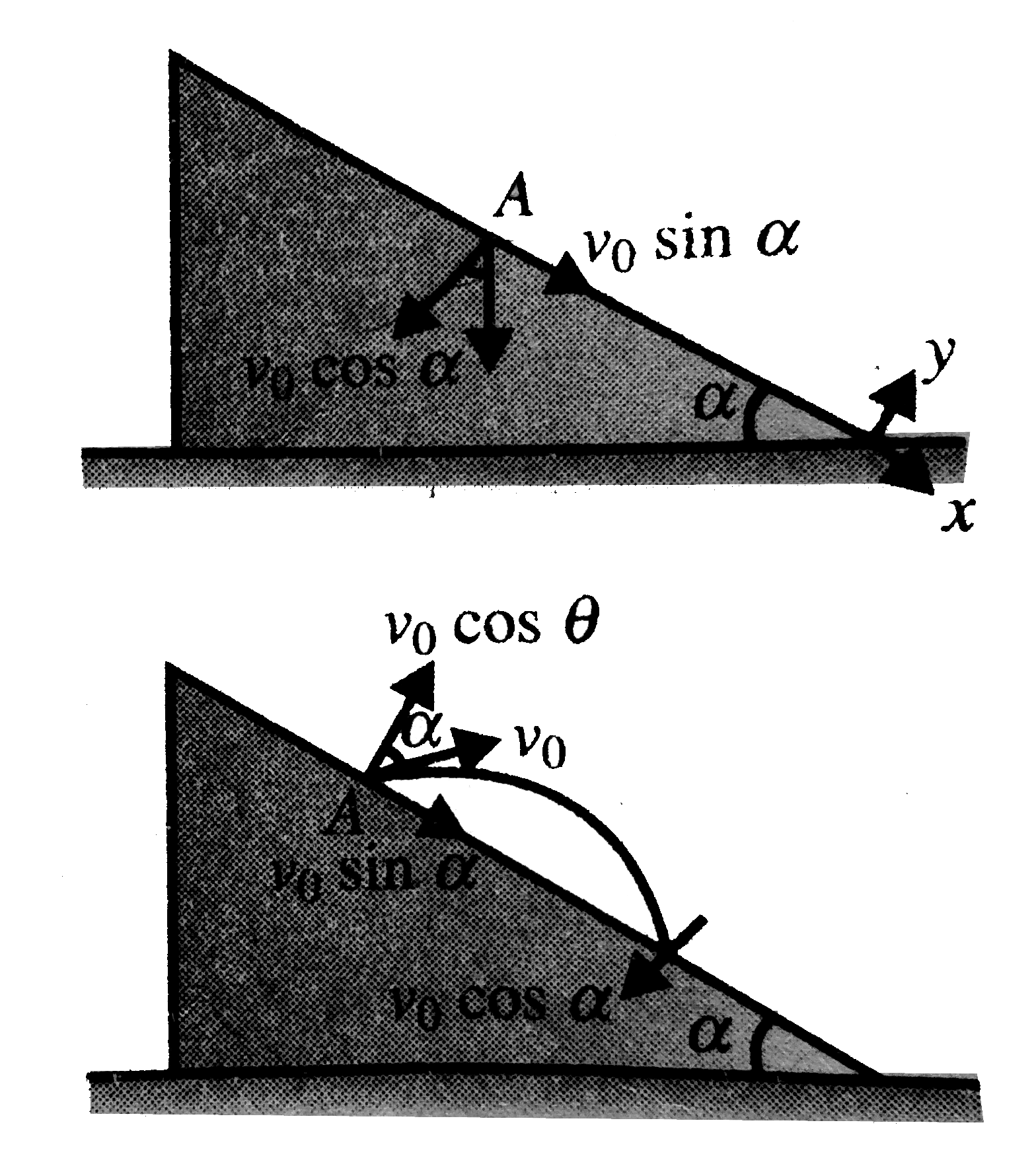 `{v_(x)=u_(x)+a_(x)t}` Here `T=(2v_(0)cosalpha)/(gcosalpha)=(2v_(0))/g` and `R_(1)=AB=s-x=u_(x)T+1/2a_(x)T^(2)` `=(v_(0)sinalpha)(2v_(0))/g+1/2(gsinalpha)((2v_(0))/g)^(2)` `R_(1)=(40^(2)sinalpha)g` Next time `R_(2)=s_(x)={v_(0)sinalpha.T}T+1/2(gsinalph)T^(2)` substituting the values `R_(2){v_(0)sina+gsinalpha.(2v_(0))/g}{(2v_(0))/v}+12(gsinalpha)((2v_(0))/g)^(2)` `=(8v_(0)^(2)sinalpha)/g` SIMILARLY we can show that `R_(3)=((12v_(0)^(2)sinalpha))/g` or `R_(1):R_(2):R_(3)=1:2:3` |
|
| 26. |
A piece of ice balls from a height 'h' so that it melts completely .Only one quarter of the heat produced is absorbed by the ice and all energy . Of ice gets convertedin to heat during its fall. The value of h is : [" latent heat of ice is " 3.4 xx 10^(5) "J/kg and " g = 10 N/(kg) ] |
|
Answer» 544 KM ` :. H = (4L)/G` `= (4xx3.4 xx10^(5))/(10)` = 136 km |
|
| 27. |
The acceleration of a particle is increasing linearly with time t as bt. The particle starts from origin with an initial velocity v_(0). The distance travelled by the particle in time t will be |
|
Answer» `v_(0)t+1/3bt^(2)` |
|
| 29. |
A satellite of the earth is revolving in a circular orbit with a uniform speed v. If gravitational force suddenly disappears, the satellite will |
|
Answer» continue to MOVE speed `v` along the original orbit |
|
| 30. |
Reason for increase in the intensity of sound during night time is ...... |
|
Answer» greater density of air |
|
| 31. |
A ball of mass m collides with a wall with speed v and rebounds on the same line with the same speed. If mass of the wall is taken as infinite, then the work done by the ball on the wall is |
|
Answer» `mv^2` |
|
| 32. |
The radius of mercury drop at 20^(@)C is 3mm. If the surface tension of mercury at this temperature is 4.65xx10^(-1)Nm^(-1). Find the excess pressure inside the liquid drop. |
|
Answer» SOLUTION :Excess PRESSURE `(P)=(2S)/(r )` SURFACE tension `(S)=4.6xx10^(1)Nm^(-1)` radius of the mercury drop = `r=3mm=3xx10^(-3)m` `THEREFORE P=(2S)/(r)=(2xx4.65xx10^(-1))/(3xx10^(-3))=310Nm^(-2)` |
|
| 33. |
In figue k=100Nm^-1 M=1kg and F=10N. a. Find the compression of the spring in the equilibrium position. b. A sharp blow by some xternal agent imparts a speed of 2ms^-1 to the block towards left. Find the sum of the potential energy of the spring and the kinetic energy of the block at ths instant. c. find the time period of the resulting simple harmonic motion. d. Find the ampitude. e. Write the potential energy of the spring when the block is at the left extreme. f. Write teh potential energy of the spring when teh block is at the right extreme. The anwer of b, e, and f are different. Explain why this does not violate the principle of conservation of energy. |
|
Answer» a. In the equilibrium position `Compression `=delta=F/k=10/100` `=0.1m=10cm` b. The below imparts a speed of 2 m/s to the block towards left. `:.+P.E.+K.E.=1/2kdelta^2+1/2Mv^2` `=1/2x100xx(0.1)^2+1/2x1xx4` `=0.5+2=2.5J` `c. Time period `2pisqrt(M/k)` `=2pi SQRT(M/100)=pi/5 sec` d. LET the amplitude be X whigh means the distasnce betwen the mean position and the extreme position. So in the extreme position, compression of the spring is `(x-K)` Since in SHM the TOTL energy remains constant, `1/2k(x+delta)^2=1/2kdelta^2+1/2mv^2+Fx` `=2.5+10x [because 1/2kdelta^2+1/2mv^2=2.5]` so, `50(x+0.1)^2=2.5+10x` `:. 50x^2+0.5+10x=2.5+10x` `=:. 50x^2=2` `rarr x^2=2/50=4/100` `rarr x=2/50x=20m` e. potential energy at the left extreme is given by `P.E. =1/2k(x+delta)^2` `=1/2x100xx(0.1+0.2)^2` `=50xx(0.09)=4.5J` f. Potential energy at the RIGHT extreme is given by `P.E. 1/2k(x+delta)^2-F(2x)` `[2x`=distance between two extreme)` `=4.5-10(0.4)=0.5J` The different values is b, e, and f do not violate law of conservastion of energy as the work is done by the exterN/Al force 10 N. |
|
| 34. |
A stone tied to the end of a string is whirled in a horizontal circle. The mass of the stone is 1.0 kg and the string is 0.50 m long. If the stone revolves at a constant speed for 10 times in 15.71 s, (a) what is the tension in the string ? (b) What would happen to the tension in the string if the mass was doubled and all the other quanities remained the same ? (c ) What would happen to the tension in the string if the period was doubled and all the other quantities remain the same ? |
|
Answer» Solution :The angular velocity, `omega = (2pi N)/(t)=(2pi XX 10)/(15.71)=(31.42xx2)/(15.71)=4.0 rad s^(-1)` (a) The TENSION on the STRING `= mr omega^(2)` `=1.0xx0.5xx(4.0)^(2)=8.0 N`. (b)Keeping r and `omega` constant if m was doubled, the tension on the string would be doubled i.e., tension = 16.0 N. (c ) Keeping m and r constant if TIME period was doubled then the the tension in the string is : `T=mr((2pi)/(2T))^(2)=(1)/(4)[mr((2pi)/(T))^(2)]=(8)/(4)=2N`. |
|
| 35. |
The resultant of x N force and 5N force is found to be 5N force and perpendicular to the 5N force. Find the angle between the forces. xN,5N |
|
Answer» |
|
| 36. |
During an adiabatic process, the pressure of a gas is found to be proportional to the cube of its absolute temperature. The ratio C_(P)//C_(V) for gas is |
|
Answer» `4//3` For an adiabatic CHANGE, `PT^((GAMMA)/(1-gamma))` = constant `:. (gamma)/(1-gamma) = -3` or `-3+3 gamma = gamma` or `2gamma =3` or `gamma = (3)/(2)` |
|
| 37. |
A small sphere of radius 2 cm falls from rest in a viscous liquid. Heat is produced due to viscous force. The rate of production of heat when the sphere attains its teminal velocity is proportional to: |
|
Answer» `2^(2)` `v_(t)propr^(2)` The rate of production of heat is `(DeltaH)/(Deltat)=Fv_(t)^(2)` `F=6pietar` `THEREFORE(DeltaH)/(Deltat)=6pietar[(2(rho-sigma)R^(2)g)/(9eta)]^(2)` `=6pietar[(4(rho-sigma)^(2)r^(4)g^(2))/(81eta^(2))]` `=(24pieta(rho-sigma)^(2)g^(2)r^(5))/(81eta^(2))` `=[(8pi(rho-sigma)^(2)g^(2))/(27eta)]r^(5)` `therefore(DeltaH)/(Deltat)propr^(5)` But r = 2 cm `therefore(DeltaH)/(Deltat)prop2^(5)` |
|
| 38. |
In the question number 66, the tension in the string is |
|
Answer» 30N |
|
| 39. |
An engineer claims to have made an engine delivering 10 kW power with fuel consumption of 1g/sec. The calorific value of the fuel is 2 kcal/g. The claim of the engineer |
|
Answer» is valid OUTPUT energy `= 10 kW = 10 kJ//s = (10)/(4.2) "kcal/sec"` `:. eta = ("Output energy")/("Input energy") = (10)/(4.2 xx 2) gt 1` |
|
| 40. |
Match the following columns for a planet of mass m revolving around the sun is an elliptical oribt of semi-major axis a and semi-minor axis b. T is time period of planet. {:("Column-I",,"Column-II"),((A) T^(2)propa^(3),,"(P) Kepler.s first law"),("(B) Areal velocity is constant",,"(Q) Kepler.s second law"),("(C) Orbit of planet is elliptical",,"(R) Kepler.s third law"),((D)(2pimab)/(T) = "constant",,"(S)none of the above"):} |
|
Answer» |
|
| 41. |
Two resistances of values 150 pm 2 Omega" and "250 pm 5 Omega are connected in series. Find their equivalent resistance. |
|
Answer» Solution :GIVEN, `R_(1)= 150 pm 2 Omega, R_(2)-250 pm 5 Omega` Equivalent resistance `R= R_(1)+R_(2)= (150+250)pm (2+5)` `=(400 pm 7) Omega`. |
|
| 42. |
A source emitting sound of frequency 1000 Hz is moving towards an observer at speed v_s=0.90 v,(where v is the velocity of sound) . What frequency will be heard by the observer ? |
|
Answer» |
|
| 43. |
Two particles are in SHM with the same amplitude and frequency along the same line and about the same point. If the maximum separation between them is sqrt(3) times their amplitude, what is the phase difference between them? |
|
Answer» |
|
| 44. |
A screw gauge with a pitch of 0.5 mm and a circular scale with 50 divisions is used to measure the thickness of a thin sheet of Aluminium. Before starting the measurement, it is found that when the two laws of the screw gauge are brought in contact, the 45^(th) division coincides with the main scale is barely visible. What is the thickness of the sheet is the main scale reading is 0.5 mm and the 25^(th) division coincides with the main scale line ? |
|
Answer» `0.50 MM` ZERO ERROR `=-5xx0.01=0.05 mm` Reading `=0.5+(25)/(100)=0.75 mm` `:.` Thickness `=0.75-(-0.05)=0.80 mm` |
|
| 45. |
The acceleration due to gravity on moon is 1/6 th of that on the earth. If the length of the seconds pendulum is 96 m on the earth, what is its length on the moon? |
|
Answer» Solution :For SECONDS PENDULUM, time period is 2S `T=2pisqrt(l/g)` for simple pendulum time REMAINS constnat in both the planets `l/g="constant" "" :. (l_(m))/(g_(m))=(l_(e))/(g_(e))` (or) `(l_(m))/(((g_(e))/6))=96/(g_(e))` |
|
| 46. |
Anvils made of single crystals of diamond, with the shape as shown in figure, are used to investigate behaviour of materials under very high pressures. Flat faces at the narrow end of the anvil have a diameter of 0.50 mm, and the wide ends are subjected to a compressional force of 50,000 N. What is the pressure at the tip of the anvil? |
|
Answer» SOLUTION : Area of the tip `A=(pi D^(2))/(4)=2XX10^(-7)m^(2)` Force, `f=5xx10^(4)N`, Pressure at the tip, `P=(F)/(A)=2.5xx10^(11)PA` |
|
| 47. |
An acrobat standing on a spinning table with his hands outstreched suddenly lowers his hands. Then |
|
Answer» ANGULAR VELOCITY increases |
|
| 48. |
A man of mass 100 kg gets into a car. If the centre of gravity of the car system is depressed by 5mm. Spring constant of the system is --- |
|
Answer» `1.96xx10^(5) Nm^(-1)` |
|
| 49. |
If area (A), density (D) and force (F) are taken as fundamental quantities, find the dimensional formula for young's modulus. |
|
Answer» SOLUTION :Young.s modulus `Y=A^(x)D^(y)F^(z)` Taking dimensions `ML^(-1)T^(-2)=L^(2x)(ML^(-3))^(y)(MLT^(-2))^(z)=L^(2x-3y+z)M^(y+z)T^(-2z)` Using the principle of homogeneity of dimensions `-2z=-2,z=1,y+z-1,y=1-z=1-1=0` `2x-3y+z=-1,2x=-1-z=-2,x=-1` `Y=A^(-1)D^(0)F`. |
|
| 50. |
A man throws a stone up into air at an angle '0' with the horizontal. Draw the path of the projectile and mark directions of velocity and acceleration at the highest position. |
Answer» SOLUTION :
|
|