

Saved Bookmarks
| 1. |
A ball falls freely form a height onto and smooth inclined plane forming an angle a with the horizontal. Find the ratio of the distance between the points at which the jumping ball strikes the inclined plane. Assume the impacts to be elastic. |
|
Answer» `a_(x)=gsina`, `a_(y)=-gcosa` Component of velocity along the plane is `v_(0) sinalpha` and component perenducilar to plane is` v_(0)cosalpha`. Collision is elastic HENCE `v_(0)sinalpha` remains uchanged while `v_(0)cosalpha` reverses its direcions. When it stirkes at `B`, its component perpendicular to plane i.e., `v_(0)cosalpha` and hence the time of flight `T` for each collision remains unchanged while component parallel to pane BECOMES `v_(0)sinalpha+(gsinalpha)T` 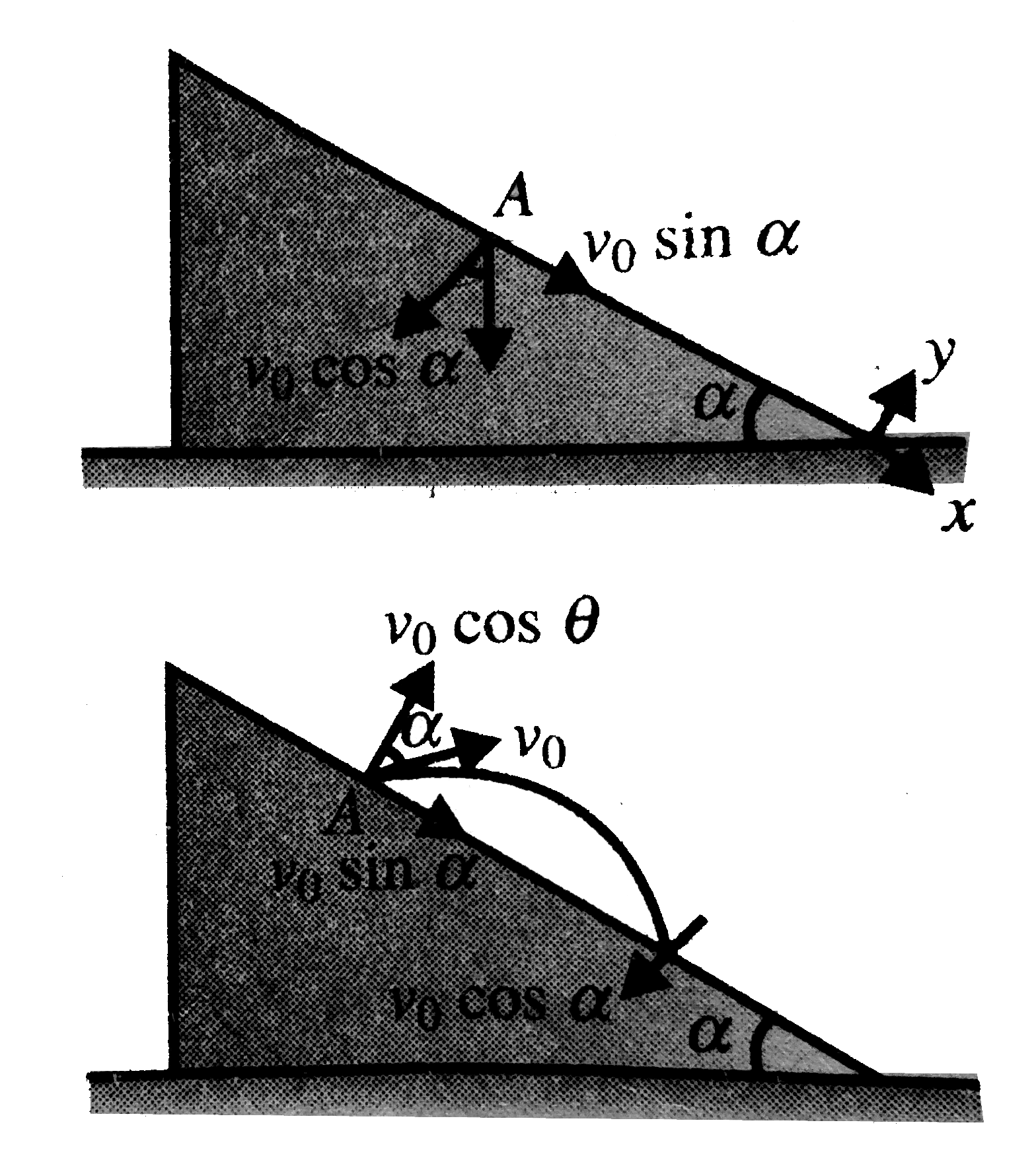 `{v_(x)=u_(x)+a_(x)t}` Here `T=(2v_(0)cosalpha)/(gcosalpha)=(2v_(0))/g` and `R_(1)=AB=s-x=u_(x)T+1/2a_(x)T^(2)` `=(v_(0)sinalpha)(2v_(0))/g+1/2(gsinalpha)((2v_(0))/g)^(2)` `R_(1)=(40^(2)sinalpha)g` Next time `R_(2)=s_(x)={v_(0)sinalpha.T}T+1/2(gsinalph)T^(2)` substituting the values `R_(2){v_(0)sina+gsinalpha.(2v_(0))/g}{(2v_(0))/v}+12(gsinalpha)((2v_(0))/g)^(2)` `=(8v_(0)^(2)sinalpha)/g` SIMILARLY we can show that `R_(3)=((12v_(0)^(2)sinalpha))/g` or `R_(1):R_(2):R_(3)=1:2:3` |
|