

Saved Bookmarks
This section includes 7 InterviewSolutions, each offering curated multiple-choice questions to sharpen your Current Affairs knowledge and support exam preparation. Choose a topic below to get started.
| 4. |
Chemical equilibrium is a dynamic equilibrium because |
|
Answer» EQULIBRIUM is maintained RAPIDLY |
|
| 5. |
Chemical equilibrium is: |
|
Answer» STATIONARY |
|
| 6. |
Chemical equations convey quantivaive information on the |
|
Answer» Type of atoms/molecules taking PART in the reaction |
|
| 7. |
Chemical equation is balanced according to the law of: |
|
Answer» MULTIPLE proportion |
|
| 8. |
Chemical composition of malachite is 'X'. Then the composition of azurite is |
|
Answer» `CuCO_3+X` |
|
| 9. |
Chemical bonding between two atoms is necessarily with an electrical moment arising out of the difference in electronegativity of two atoms. This means that every bond carries with it an electrical moment called the bond moment.The dipole moment of a molecule is really the vectorial sum of the individual bond moment present in it. To compute the dipole moment it is necessary to find out the values of various bond moment in the moment of different bonds are as given. {:("Bond",oversetto(H-C), " ",oversetto(C-Cl)," ",oversetto(C=O)),("Bond moments",0.4 D ," ", 1.5 D, " ", 2.5D):} The group moments of few groups as given {:("Group",NO_2,OH,CN,CH_3),("direction of dipole","toward N","towards O","towards N","away from" CH_2),("Dipole moment",4D,1.6D,3.8 D,0.4D):} In the acetone molecule considering the normal planar structure, the observed dipole moment of acetone molecule is - |
|
Answer» 2.9 D  `mu_("net")=2.5+mu_(CH_3)=2.5+0.4=2.9 D` |
|
| 10. |
Chemical bonding between two atoms is necessarily with an electrical moment arising out of the difference in electronegativity of two atoms. This means that every bond carries with it an electrical moment called the bond moment.The dipole moment of a molecule is really the vectorial sum of the individual bond moment present in it. To compute the dipole moment it is necessary to find out the values of various bond moment in the moment of different bonds are as given. {:("Bond",oversetto(H-C), " ",oversetto(C-Cl)," ",oversetto(C=O)),("Bond moments",0.4 D ," ", 1.5 D, " ", 2.5D):} The group moments of few groups as given {:("Group",NO_2,OH,CN,CH_3),("direction of dipole","toward N","towards O","towards N","away from" CH_2),("Dipole moment",4D,1.6D,3.8 D,0.4D):} In CH_3C Cl_3 (I), CHCl_3 (II) and CH_3Cl (III) the normal tetrahedral bond angle is maintained.Also give cos 70.5^@=1/3 Therefore dipole moments of the given compounds are (given due to -I effect of Cl, the Bond moment of H-C bond directedtoward the H in CHCl_3) |
|
Answer» I=1.9 D, II-1.9 D, III=1.7 D `mu_(II)=3mu_(C-Cl)xxcos70.5mu_(C-H)=1.5-0.4=1.1 D` `mu_(III)=3mu_(C-H)xxcos70.5+mu_(C-Cl)=1.9 D` 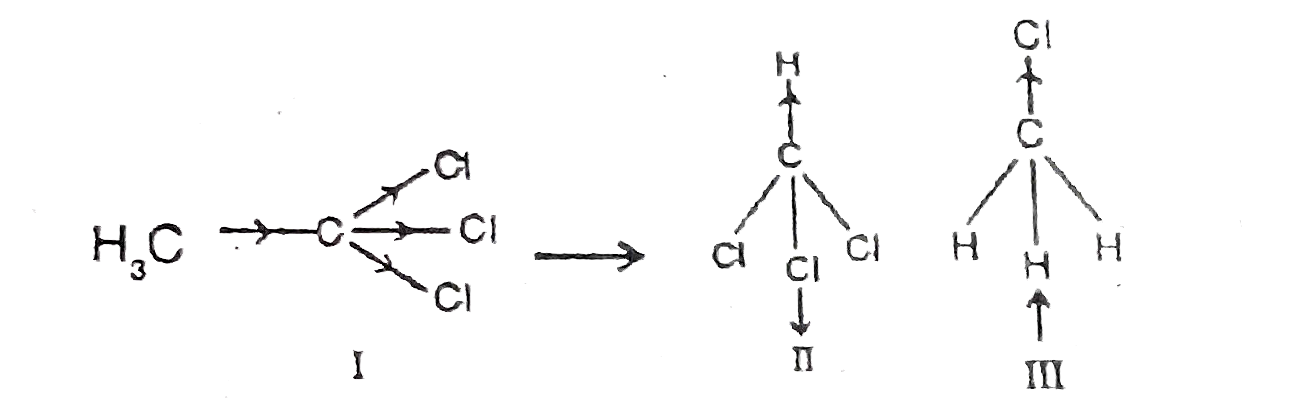
|
|
| 11. |
Chemical bonding between two atoms is necessarily with an electrical moment arising out of the difference in electronegativity of two atoms. This means that every bond carries with it an electrical moment called the bond moment.The dipole moment of a molecule is really the vectorial sum of the individual bond moment present in it. To compute the dipole moment it is necessary to find out the values of various bond moment in the moment of different bonds are as given. {:("Bond",oversetto(H-C), " ",oversetto(C-Cl)," ",oversetto(C=O)),("Bond moments",0.4 D ," ", 1.5 D, " ", 2.5D):} The group moments of few groups as given {:("Group",NO_2,OH,CN,CH_3),("direction of dipole","toward N","towards O","towards N","away from" CH_2),("Dipole moment",4D,1.6D,3.8 D,0.4D):} The bond angle in H_2S is 97^@ and its dipole moments is 1.5 D.The S-H bond distance is 0.15 nm.There fore approximate percentage ionic character of S-H bond is (neglect the effect of dipole moment of lone pair on sulphur atom in H_2S).(Given [cos 97^@=-0.12] and sqrt0.88=0.94) |
|
Answer» `32 %` 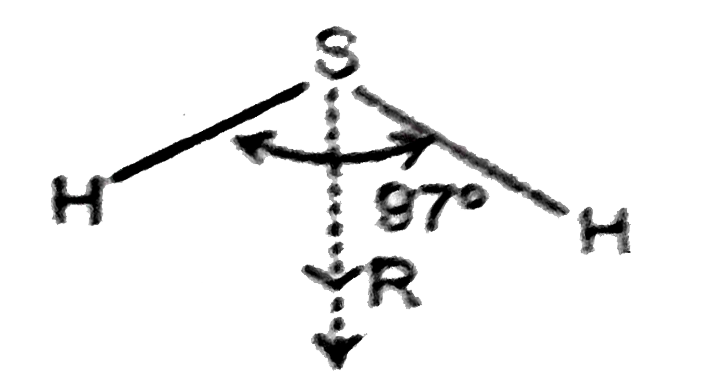 `mu_R=sqrt(2mu_(S-H)^2+2mu_(S-H)^2xxcos97^@)` `mu_R=sqrt2xxmu_(S-H)xxsqrt(1-0.12)` `mu_R=sqrt2xxmu_(S-H)xxsqrt(0.88)` `mu_(S-H)=1.5/(sqrt2xx0.94)D` `(mu_(S-H))_(Cal)=(0.15xx10^(-9)xx1.6xx10^(-19))/(10/3xx10^(-30))` `(mu_(S-H))_(Cal)=3xx0.15xx1.6xx10D` So % Ionic character `=15/(sqrt2xx0.94)XX[1/(0.15xx16xx3)]xx100=16%` |
|
| 12. |
Chemical bonding between two atoms is necessarily associated with an electrical moment arising out of the difference in electroegativity of two atoms. This means that every bond carries with it an electricalmoment called the ''bond moment''. The dipole moment of a molecule is really the vectorial sum of the individual bond moment present in it. To compute the dipole moment it is necessary to find out the values of various bond moment. In the following table, dipole moment of different bonds are as given. {:(,rarr,rarr,rarr),("Bond",H-C,C-Cl,C=0),("Bond moments",0.4 D,1.5 D,2.5 D):} The group moments of few groups as given {:("Group",NO_(2),OH,CN,CH_(3)),("Direction of dipole","Towards N","Towards O","Towards N","Away from "CH_(3)),("Dipole moment",4D,1.6D,3.8D,0.4D):} In CH_(3)"CCl"_(3)" (I)", CHCl_(3) (II) and CH_(3)Cl (III) the normal tetragedral bond angle is maintained. Also given cos70.5^(@)=(1)/(3). Therefore dipole moments of the given compounds are : (given due to -I effect of Cl. The bond moment of H-C bond directed towards the H in CHCl_(3)) |
|
Answer» I = 1.9D, II = 1.9 D, III = 1.7 D  `mu_(CHCl_(3)ltCH_(3)Cl` `mu_(CHCl_(3)ltCH_(3)Cl` `Irarr1.9D"(LEAST)"` (given in options) Hence, no CALCULATIONS required. |
|
| 13. |
Chemical bond implies |
|
Answer» attraction and repulsion |
|
| 14. |
Chemical adsorption is an exothermic process. Justify this statement. |
| Answer» Solution :In chemical adsorption, GAS molecules are held to the surface by the formation of STRONG bond. Due to this 400kJ/mole is GIVEN out as heat of adsorption. Since heat is evolved, it is an exothermic PROCESS. | |
| 15. |
Chemical adsorption : |
|
Answer» Is exothermic |
|
| 16. |
Chemical A is used for water softening to remove temporary hardness. A reacts with sodium carbonate to generate caustic soda. When CO_2 is bubbled through A, it turns cloudy. What is the chemical formula of A ? |
|
Answer» `CaCO_3` |
|
| 17. |
Cheilosis is caused due to deficiency of …………………. |
|
Answer» VITAMIN `B_(12)` |
|
| 18. |
Cheilosis and digestive disorders are due to the deficiency of |
|
Answer» ASCORBIC ACID |
|
| 19. |
Checking of radiating heat by atmospheric dust, water vapour, ozone, CO_(2) etc., is known as: |
|
Answer» GREENHOUSE EFFECT |
|
| 21. |
Check, which of the following statements is false ? |
|
Answer» A catalyst does not DIFFERENTIATE between forward and backward reaction |
|
| 22. |
CH,COOH -overset(Cl_2.P)(rarr)A underset(C_2H_5OH//H^+)overset("esterification")(rarr)B overset(alc. KCN)(rarr)C underset(H_2O//H^(+))overset(hydrolysis)(rarr)D underset(-CO_2)overset("heat" 150^@C)(rarr)E.Name the functional isomer of compound E in the above sequence. |
|
Answer» |
|
| 23. |
CHCl_(3)+Cl_(2) to CCl_(4)+HCl Rate law for above reactionl will be Rate=K[CHCl_(3)][Cl_(2)]^(1)/(2) On the basis of information provided which of the following option will be correct? |
|
Answer» RATE law for any chemical REACTION can be PREDICTED accurately by LOOKING at balanced chemical equation. |
|
| 24. |
CHCl_3 can be obtained from: |
|
Answer» METHANOL |
|
| 25. |
CHCl_(3) and HF lead to the formation of a compound of fluorine of molecular weight 70. the compound is |
|
Answer» Fluoroform |
|
| 26. |
Chargoff's rule states that in an organism : |
|
Answer» amount of ADENINE (A) is equal to that of thymine (T) and the amount of GUANINE is equal to that of cytosine (C ). |
|
| 27. |
Charle's law is applicable under |
|
Answer» ISOBARIC process |
|
| 28. |
Charge to mass ratio of electron was determined by |
|
Answer» JAMES Chadwick |
|
| 31. |
Charge on cation in product formed when BeCl_2 reacts with concentrated diethyl ether solution. |
Answer» 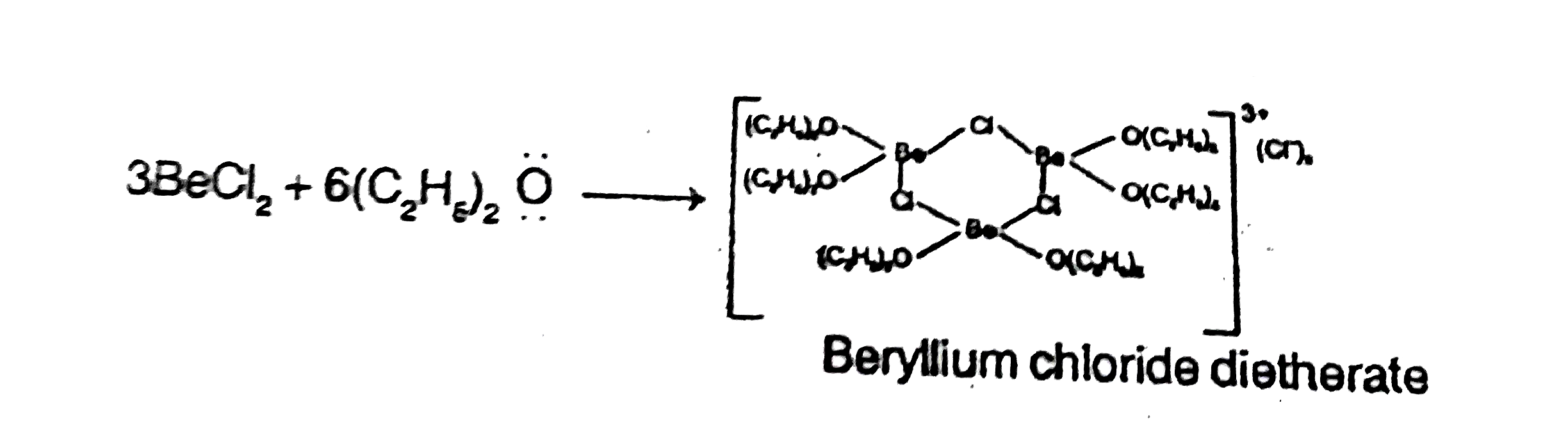
|
|
| 32. |
Charge distribution in iodine monochloride is best represented as : |
|
Answer» `I^(+)Cl^(-)` |
|
| 33. |
Charge distribution in iodine monochloride is best represented as |
|
Answer» `I^+CL^-` |
|
| 34. |
Charge carried by 1 mole of electrons is ________. |
| Answer» SOLUTION :`1.6 xx 10^(-19) C xx6.023 xx 10^(23) =9.65 xx10^4C =96500C` | |
| 35. |
Chargaff's rule states that in an organism. |
|
Answer» AMOUNT of adenine (A) is equal to that of THYMINE (T) and the amount of thymine (T) is equal to that of cytosine (C). |
|
| 36. |
Charcoal is activated |
|
Answer» by COOLING it from `623^@C` to `127^@C` in vacuum |
|
| 37. |
Chargaff's rule states that in an organism |
|
Answer» amount of adenine (A) is EQUAL to that of thymine (T) and amount of guanine (G) is equal to that of CYTOSINE (C) |
|
| 38. |
Characterstic feature of alkali metals is |
|
Answer» GOOD conductor of heat and electricity |
|
| 39. |
Characters are transferred from parents to offspring through : |
|
Answer» gametes |
|
| 41. |
Characteristicreaction of aldehydes and ketonesis oneof nuclephilicadditionwhile Acyl comppoundyield Nucelophilicsubstitiution product . Explain. |
Answer» SOLUTION :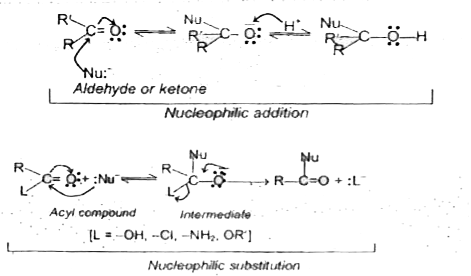
|
|
| 42. |
Characteristic of transition element is that its …….. Is in complete : |
|
Answer» d' orbital |
|
| 43. |
Changes in a system from an initital state to the final state were made by a different manner that DeltaH remains same but q changes because |
|
Answer» `DELTAH` is a path FUNCTION and q is a state function |
|
| 44. |
Changes in enthalpy for the reaction : 2H_(2)O_(2)(g) rarr 2H_(2)O (l) + O_(2)(g) if heat of formation of H_(2)O_(2)(l) and H_(2)O(l) are -188 kJ mol^(-1) and -286 kJ mol^(-1) respectively is |
|
Answer» `-196 KJ MOL^(-1)` |
|
| 45. |
Change of catalyst changed products CO + 3H_2 overset(N i)(rarr) X + H_2O CO + 2H_2 underset(Cr_2O_3)overset(Cu//ZnO)(rarr)Y CO + H_2 overset(Cu)(rarr)Z. The magnitude of the algebraic sum of the oxidation state of carbon in X, Y and Z is _____ |
|
Answer» `CO + H_2 overset(Cu)(rarr)Hoverset(0)(C)HO ,` total OXIDATION no - 4 - 2 = -6 |
|
| 46. |
Changing the volume of the system does not after the number of moles in which of the following equilibrium. |
|
Answer» `N_(2(g))+O_(2(g))hArr2NO_((g))` |
|
| 47. |
Change in optical rotation of sucrose solution due to hydrolysis is called |
|
Answer» SPECIFIC ROTATION |
|
| 48. |
Change in internal energy, when 4 kJ of work is done on the system and 1 kJ of heat is given out by the system, is |
|
Answer» SOLUTION :CHANGE in internal ENERGY is given by the relation, `DeltaE=q+w` `DeltaE=-q+w` (as heat is given out by the system) `DeltaE=-1+4` `DeltaE=+3kJ`. |
|
| 49. |
Change in entropy is negative for: |
|
Answer» `Bromine(l)rarrBromine(G)` |
|
| 50. |
Change in entropy for a reaction is given by: |
|
Answer» 2.303 NR `log_10(v_2)/(v_1)` |
|