

Saved Bookmarks
| 1. |
Chemical bonding between two atoms is necessarily with an electrical moment arising out of the difference in electronegativity of two atoms. This means that every bond carries with it an electrical moment called the bond moment.The dipole moment of a molecule is really the vectorial sum of the individual bond moment present in it. To compute the dipole moment it is necessary to find out the values of various bond moment in the moment of different bonds are as given. {:("Bond",oversetto(H-C), " ",oversetto(C-Cl)," ",oversetto(C=O)),("Bond moments",0.4 D ," ", 1.5 D, " ", 2.5D):} The group moments of few groups as given {:("Group",NO_2,OH,CN,CH_3),("direction of dipole","toward N","towards O","towards N","away from" CH_2),("Dipole moment",4D,1.6D,3.8 D,0.4D):} In CH_3C Cl_3 (I), CHCl_3 (II) and CH_3Cl (III) the normal tetrahedral bond angle is maintained.Also give cos 70.5^@=1/3 Therefore dipole moments of the given compounds are (given due to -I effect of Cl, the Bond moment of H-C bond directedtoward the H in CHCl_3) |
|
Answer» I=1.9 D, II-1.9 D, III=1.7 D `mu_(II)=3mu_(C-Cl)xxcos70.5mu_(C-H)=1.5-0.4=1.1 D` `mu_(III)=3mu_(C-H)xxcos70.5+mu_(C-Cl)=1.9 D` 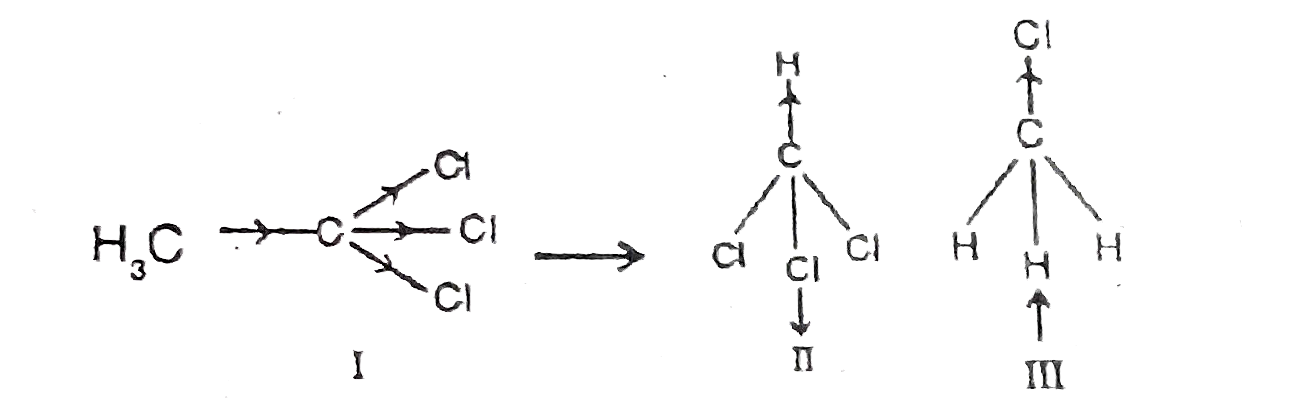
|
|