

Saved Bookmarks
| 1. |
Chemical bonding between two atoms is necessarily with an electrical moment arising out of the difference in electronegativity of two atoms. This means that every bond carries with it an electrical moment called the bond moment.The dipole moment of a molecule is really the vectorial sum of the individual bond moment present in it. To compute the dipole moment it is necessary to find out the values of various bond moment in the moment of different bonds are as given. {:("Bond",oversetto(H-C), " ",oversetto(C-Cl)," ",oversetto(C=O)),("Bond moments",0.4 D ," ", 1.5 D, " ", 2.5D):} The group moments of few groups as given {:("Group",NO_2,OH,CN,CH_3),("direction of dipole","toward N","towards O","towards N","away from" CH_2),("Dipole moment",4D,1.6D,3.8 D,0.4D):} The bond angle in H_2S is 97^@ and its dipole moments is 1.5 D.The S-H bond distance is 0.15 nm.There fore approximate percentage ionic character of S-H bond is (neglect the effect of dipole moment of lone pair on sulphur atom in H_2S).(Given [cos 97^@=-0.12] and sqrt0.88=0.94) |
|
Answer» `32 %` 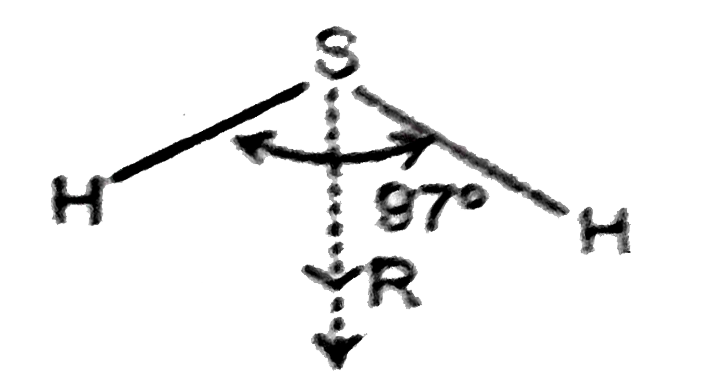 `mu_R=sqrt(2mu_(S-H)^2+2mu_(S-H)^2xxcos97^@)` `mu_R=sqrt2xxmu_(S-H)xxsqrt(1-0.12)` `mu_R=sqrt2xxmu_(S-H)xxsqrt(0.88)` `mu_(S-H)=1.5/(sqrt2xx0.94)D` `(mu_(S-H))_(Cal)=(0.15xx10^(-9)xx1.6xx10^(-19))/(10/3xx10^(-30))` `(mu_(S-H))_(Cal)=3xx0.15xx1.6xx10D` So % Ionic character `=15/(sqrt2xx0.94)XX[1/(0.15xx16xx3)]xx100=16%` |
|