Saved Bookmarks
This section includes 7 InterviewSolutions, each offering curated multiple-choice questions to sharpen your Current Affairs knowledge and support exam preparation. Choose a topic below to get started.
| 1. |
By which reaction phenol can be converted to O-hydroxy benzaldehyde ? |
|
Answer» Kolbe-Schmitt |
|
| 2. |
By which reaction haxane can be prepared from 1 - chloropropane ? |
|
Answer» Wurtz reaction |
|
| 3. |
By which reaction between monomer, the polymers are obtained ? |
|
Answer» Condensation |
|
| 4. |
By which reaction. Best yield of H_(2) gas forms : Temperature of container is more than 100^(@)C |
| Answer» Answer :D | |
| 5. |
By which reaction best yield of H_(2) gas forms: temperature of all flask More then 100^(@)C |
|
Answer» Only By D |
|
| 6. |
By which reaction formation of hard water takes place : (a) Ca(CH)_(2)+2HCl (b) NaOH+HCl (c) KOH+HCl (d) NaOH+H_(2)CO_(3) |
|
Answer» By only d |
|
| 7. |
By which process phenyl acetate can be converted in to hydroxy acetophenone ? |
|
Answer» FRIES REARRANGMENT |
|
| 8. |
By which of the following reactions, chlorine gas will not be obtained as the product ? |
|
Answer» Oxidation of HCl by `MnO_(2)` |
|
| 9. |
By which one among the following mechanism , soap removes dirt (soil) from cloth ? |
|
Answer» Soap dissolves the soil as such |
|
| 10. |
Bywhichof thefollowingreagents , butanoicacidcan beconvertedintobutane ? |
|
Answer» RED p/HI |
|
| 11. |
By which of the following reactions, ether compound will be obtained easily ? |
|
Answer» `(CH_(3))_(3)CONA+CH_(3)CL to` |
|
| 12. |
By which of the following reactions can MIC (methyl isocyante) be obtained? |
|
Answer» `CH_(3)-OVERSET(o+)(N)-= overset(ɵ)C + HGO rarr` |
|
| 13. |
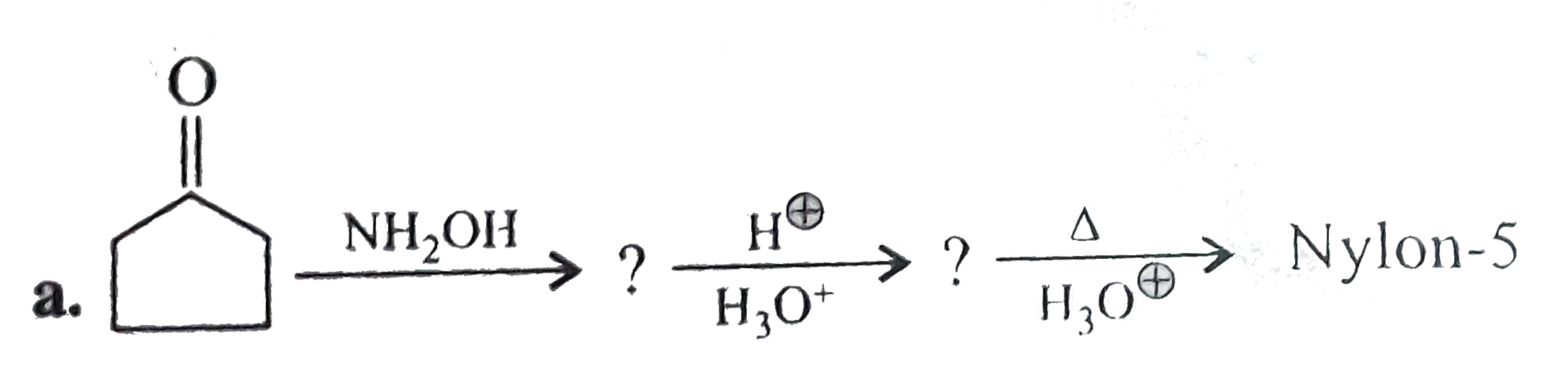
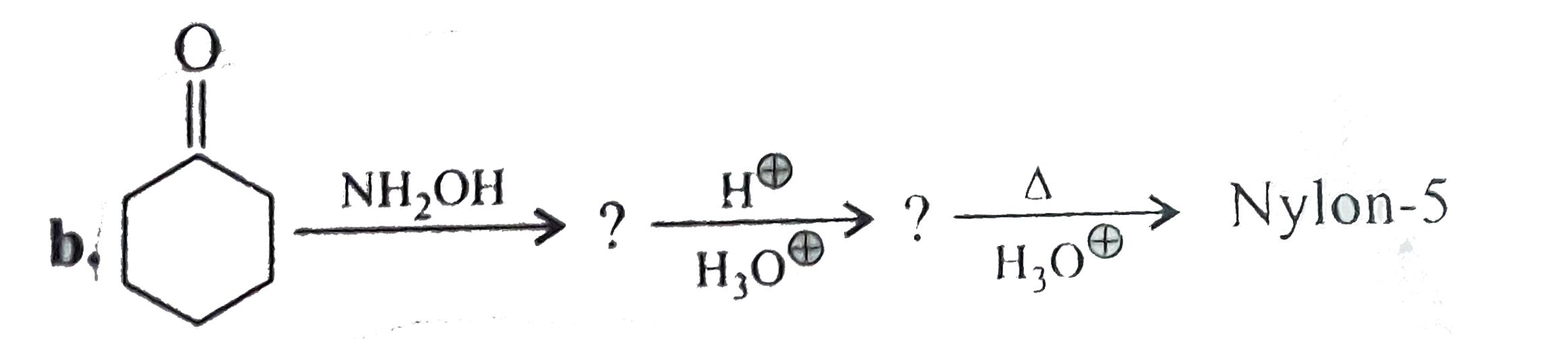
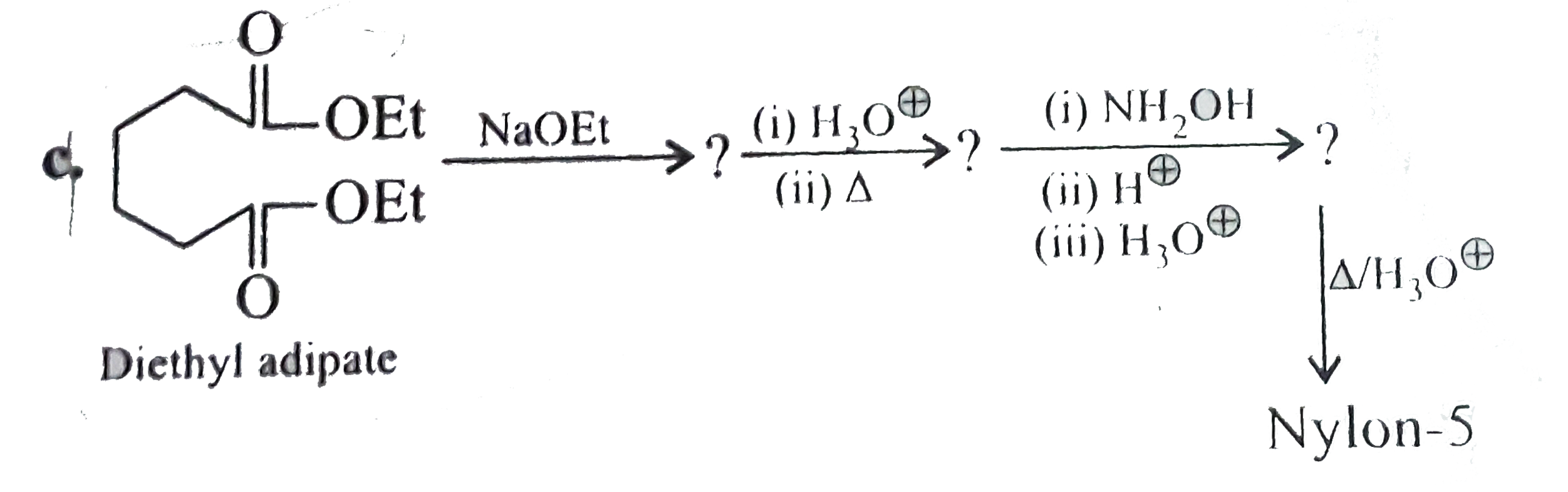
By which of the following reaction seequence can nylon-5be prepared? |
|
Answer»
|
|
| 14. |
By which of the following methods, sulphur sol can be prepared ? |
|
Answer» Oxidation |
|
| 15. |
By which of the following methods, H_(2)O_(2) can't be synthesised? |
|
Answer» LEWIS ADDITION of ice cold `H_(2)SO_(4)` on `BaO_(2)` `H_(2)SO_(4)+BaO_(2) to BaSO_(4) darr+H_(2)O_(2)`  `(NH_(4))_(2)SO_(4) hArr 2NH_(4)^(+)+SO_(4)^(2-)` At anode: `2SO_(4)^(2-) overset("Electrolysis")toS_(2)O_(8)^(2-)+2e^(-)` Peroxo SULPHATE hydrolysis, produces `H_(2)O_(2)` |
|
| 16. |
By which of the following PHBV will degrade ? |
|
Answer» ENZYMES |
|
| 17. |
By which of the following method, H_2O_2 cannot be synthesised? |
|
Answer» ADDITION of `H_2SO_4` on `BaO_2` |
|
| 18. |
By which of the following blue colour is obtained while adding hydrogen paroxide (H_(2)O_(2)) in acidic potassium dichromate? |
|
Answer» `CrO_(3)` |
|
| 19. |
By which method oxygen and nitrogen present in the form of impurities in Zirconium are removed ? |
|
Answer» VAN Arkel |
|
| 20. |
By which method phosphorous colloid can be prepared? |
|
Answer» DECOMPOSITION |
|
| 21. |
By which law, energy produced in nuclear reaction is given |
|
Answer» GRAHAM's law |
|
| 22. |
By which mechanism (C_(6)H_(5))_(2) CHCl will undergo hydrolysis? |
| Answer» Solution :Since `(C_(6)H_(5))_(2)CHCL` can form were stable carboncation, it will UNDERGO hydrolysis by `SN^(1)` mechanism. | |
| 23. |
By which enzyme, the lactose is hydrolysed ? |
| Answer» Solution :Emulsin | |
| 24. |
By which bond, the polypeptide chains are joined in tertiary structure of protein ? [P] Van der Waal's attraction [QI H-bond [R] Ionic bond [S] Disulphide bond |
|
Answer» <P>P and Q |
|
| 25. |
By what type of reaction do the common antacids destroy the excess acid of the stomach ? |
| Answer» SOLUTION :By acid-base NEUTRALISATION REACTION. | |
| 26. |
By what fraction the Ea should be decreased in orderto increase the rate by 10 times at 300 K (initial Ea=8.314kJ/mol) by use of a catalyst? |
|
Answer» 0.79 `to` Not cat: ` (10r)/r=(A.e^(epsilona_(2)//RT))/(A.e^(-epsilona_(1)//RT)),2.303xxlog_(10)^(10)=In[e^(((-epsilona_(2)+epsilona_(1))/(RT)))]` `2.303xx1=(-epsilon_(a_(2))+epsilon_(a_(1)))/(RT),(DeltaE_(a))/(epsilon_(a_(1)))=(2.303xx8.314xx300)/(8.314xx1000)=0.6909,(DeltaE_(a))/(epsilon_(a_(1)))=0.6909` `25^(@)Cto35^(@)Cto45^(@)Cto55^(@)C` |
|
| 27. |
By using the following data draw an appropriate enthalpy cycle & Calculate the enthalpy change of hydration of (i) the chloride ion , (ii) the iodide ion. Comment on the difference in their values. {:(**,,"enthalpy change of solution of "NaCl(s)=-2" kJ/mol."),(**,,"enthalpy change of solution of "NaI(s)=+2" kJ/mol."),(**,,"enthalpy change of hydration of "Na^(+)(g)=-390" kJ/mol."),(**,,"lattice anthalpy of "NaCl=-772" kJ/mol."),(**,,"lattice enthalpy of "NaI=-699" kJ/mol."):} |
|
Answer» `x=-384" KJ MOL"^(-1)` (ii) `2=699-390+x""`[x= Ethalpy change of hydration of iodide ion] `x=-307" kJ mol"^(-1)` |
|
| 28. |
By using the following data draw an appropriate energy cycle & calculate the enthalpy change of hydration of (i) the chloride ion , (ii) the iodide ion. comment on the difference in their values. M enthalpy change of solution of NaCl(s) = – 2 kJ/ mol enthalpy change of solution of Nal (s) = +2 kJ/mol enthalpy change of hydration of Na+(g) = –390 kJ/mol lattice energy of NaCl = – 772 kJ/mol lattice energy of NaI = –699 kJ/mol. |
| Answer» SOLUTION :for `CL^(-) - 384 KJ mol^(-1)` , for `I^(-) - 307 kJ mol^(-1)` | |
| 29. |
By warming a paste of bleaching powder with a solution of ammonia we get: |
|
Answer» `H_2` |
|
| 30. |
By treating acetic acid with an etheral solution of diazomethane, it forms |
|
Answer» methyl acetate |
|
| 31. |
By use of which free radical reactive intermediate, emulsion type SBR is obtained ? |
|
Answer» Alkyl MERCAPTAN and water |
|
| 32. |
By the reaction of carbon and oxygen , a mixture of CO and CO_(2) is obtained . What is the composition (% by mass)of the mixture obtained when 20 gm of O_(2) reacts with 12 gm of carbon ? |
|
Answer» |
|
| 33. |
By the overall order of a reaction , we mean |
|
Answer» The number of concentration terms in the equation for the reaction |
|
| 34. |
By the reaction between 3 mole ethanol and 1 mole PBr_(3) the product obtained are 3 mole bromo ethane and 1 mole X, What is X ? |
|
Answer» `H_(3)PO_(4)`<BR>`H_(3)PO_(2)` |
|
| 35. |
By the order of reaction we mean __________ |
|
Answer» the sum of powers to which the concentration terms are raised in the rate equation |
|
| 36. |
By the catalytic combination of ammonia and carbon monoxide under high pressure, it forms: |
|
Answer» `CH_(3)CONH_(2)` |
|
| 37. |
By the additionof 3% to 10% sulphurin rubber |
|
Answer» SOFT rubber is OBTAINED |
|
| 38. |
By the action of enzymes, the rate of biochemical reaction |
|
Answer» Decreases |
|
| 39. |
By the action of malonic acid in ethanolic ammonia on benzaldehyde in the presence of pyridine, it forms : |
| Answer» Answer :C | |
| 40. |
By the action of concentrated hydrochloric acid on potassium chlorate we get this mixture of gases: |
|
Answer» `CO_2 + Cl_2` |
|
| 41. |
By the action of concentrated sodium hydroxide on benzaldehyde, the benzyl alcohol and sodium benzoate is obtained. The reaction is knownas |
|
Answer» Perkin's reaction |
|
| 42. |
By the action of CH_3I on sodium ethoxide, we get |
|
Answer» `CH_3COOCH_3` |
|
| 43. |
By the action of bromine and caustic potash on propionamide we get: |
|
Answer» METHYL amine |
|
| 44. |
By reaction with which reagent phenol will convert into salicyldehyde ? |
|
Answer» `CHCl_(3)+ NaOH` |
|
| 45. |
By reaction of propene with which of the following, propane 1-ol can be obtained ? |
|
Answer» `H_(3)BO_(3)` |
|
| 46. |
By passing X-rays through copper sulphate crystals diffraction band is obtained. It was first observed by |
|
Answer» MAX VAN Laue |
|
| 47. |
By passing water gas (CO + H_2) through an electric discharge at low pressure, we get : |
|
Answer» HCHO |
|
| 48. |
By passing H_(2)S gas in acidified KMnO_(4) solution, we get |
|
Answer» `K_(2)S` |
|
| 49. |
By passing SO_2 in solution of K_2Cr_2O_7. It turns green due to the formation of: |
|
Answer» `K_2CrO_4` |
|
| 50. |
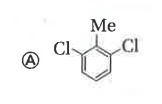
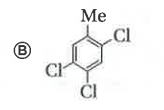
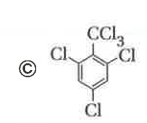
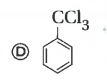
Only which one of the following compounds is obtained whwn excess of Cl_2(g) is passes through boiling toluene |
|
Answer»

|
|