

Saved Bookmarks
This section includes 7 InterviewSolutions, each offering curated multiple-choice questions to sharpen your Current Affairs knowledge and support exam preparation. Choose a topic below to get started.
| 1. |
By passing electric current,NaClO_3, is converted into NaClO_4, according to the following equation: NaClO_3 + H_2O rarr NaClO_4 + H_2 How many moles of NaClO_4,, will be formed when three Faradays of charge ispassed through NaCIO_3? |
|
Answer» 0.75 or `NaClO_(3)-2e^(-) to NaClO_(4)` This is CLEAR that 2 MOLES of electrons or 2 faradays CHARGE PRODUCE 1 mole of `NaCIO_(4)`. Thus, 3 faradays charge will produce `= (1)/(2) xx 3 "moles of" NaClO_(4) = 1.5 "moles of" NaClO_(4)` |
|
| 2. |
By passing a charge of 1930 through an aqueous solution of gold chloride, 1.314 g of gold was deposited. Find the oxidation state of gold. (Given atomic mass of Au =197 amu). |
|
Answer» SOLUTION :1.314 g of gold is DEPOSITED on passing charge=1930 C 197 g of gold is deposited on passing charge`=((1930C))/((1.314g))xx(197 g)=289353 C=(289353)/(96500)=3F`. OXIDATION state of gold is `=+3` |
|
| 3. |
By passing acetic acid vapours over calcium oxide at 600 K, the compound obtained is: |
|
Answer» ACETONE |
|
| 4. |
By passing a certain amount of cahrge through NaCl solution 9.2 litre of Cl_(2) wre liberated at STP. When the same charge is passed through a nitrate solution of a metal M, 7.467 g of the metal was deposited. If the specific heat of the metal is 0.216 cal g^(-1), what is the formula of metal nitrate? |
|
Answer» SOLUTION :By dulong and Petit's LAW, Sp, heat`xx`Atomic mass=6.4 `therefore`Atomic mass of the metal`=(6.4)/("Sp. Heat")=(6.4)/(0.216)=29.63` SUPPOSE the valency of the metal in 'n'. The equivalent wt. of the metal `=(29.63)/(n)` `22.4L` of `Cl_(2)` have mass=71g `therefore9.2L` of `Cl_(2)` will have mass`=(71)/(22.4)xx9.2=29.161g` Applying faraday's second laaw of electrolysis `("Mass of metal DEPOSITED")/("Mass of "Cl_(2)" Liberated")=("Eq. wt. of metal")/("Eq. at. of chlorine")` `(7.467)/(29.161)=(29.64//n)/(35.5)` or `(29.63)/(n)=(35.5xx7.467)/(29.161)` or `n=(29.63xx29.161)/(35.5xx7.467)=3.25`. Taking the nearest WHOLE number, valency of metal=3. Hence, the formula of metal nitrate will be `M(NO_(3))_(3)`. |
|
| 5. |
By passing 0.1 Faraday of electricity through fused sodium chloride, the amount of chlorine liberated is |
|
Answer» 35.45 G |
|
| 6. |
By passageof 1 F of electricity |
|
Answer» 1 mol of Cu is deposited |
|
| 7. |
By passage of 1 F of electricity: |
|
Answer» 1 mol of Cu is deposited |
|
| 8. |
By passage of 1 F of electricity, which is not obtained? |
|
Answer» 1 MOL of CU |
|
| 9. |
By means of the given analytical results show that law of multiple proportions is true: {:("Mercurous chloride","Mercuric chloride"),("Mercury"=84.92%,"Mercury"=73.80%),("Chlorine"=15.08%,"Chlorine"=26.20%):} |
| Answer» SOLUTION :The MASSES of MERCURY which combine with 1 part of chlorine are in the ratio of 2:1, which is a SIMPLER atio. Hence law of multiple proportions is illustrated. | |
| 10. |
By means of suitable chemical test, how will you distinguish acetophenone and benzophenone. |
Answer» SOLUTION : It MUST be noted that carbonyl COMPOUNDS containing at least one `-CH_(3)` group at `alpha` position to `-underset(O)underset(||)C-` group give this TEST. |
|
| 11. |
By means of a suitable chemical test, how will you distinguish an aldehyde from that of a ketone ? |
Answer» SOLUTION : Schiff.s REAGENT is a solution of p-resoaniline HYDROCHLORIDE which is decolourised by PASSING `SO_(2)` into it. |
|
| 12. |
By how much will the potential of half cell M^(2+)|M change if the solution is diluted 100 times at 298 K ? |
|
Answer» INCREASES by 2 V |
|
| 13. |
By how much will the potential of a hydrogen electrode change when its solution, initially at pH = 0 is neutralized to pH= 7 ? |
|
Answer» INCREASE by `0.059` V |
|
| 14. |
By how much is the oxidizing power of the MnO_4//Mn couple decreased if the H^+ concentration is decreased from 1 M to 10^(-4)" M at "25^@C? Assume other species have no change in concentration. |
|
Answer» |
|
| 15. |
By how much is the oxidizing power of MnO_(4)//Mn^(2-) decreased if the H^(+) ion concentration is decreased from 1 M to 10^(-1) M at 25^(@) C. Assume other species have no change in concentration. |
|
Answer» |
|
| 16. |
By how many folds the temperature of a gas would increase when the rms velocityof the gas molecules in a container of fixed volume is increased from 5 xx 10^4 cm/s to 15 xx 10^4cm/s? |
| Answer» SOLUTION :9 TIMES | |
| 17. |
By heating phenyl bromide and methyl iodide with sodium in dry ether .we get. |
|
Answer» XYLENE |
|
| 18. |
By heating phenol with chloroform in alkali, it is converted into |
|
Answer» SALICYLIC acid 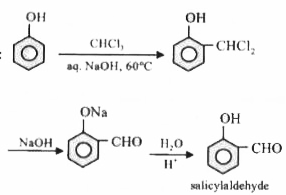 This REACTION is known as Reimer - Tiemann reaction. |
|
| 19. |
By heating ammonium chloride with two equivalents of formaldehyde it forms: |
|
Answer» dimethylamine |
|
| 20. |
Byheatingalkyl halidewithalcoholicammoniain asealedtubea mixtureof threeaminesare formedand thisreactionis know as |
|
Answer» Hofmann'sbromidereaction |
|
| 21. |
By giving three examples explain that "the exponenets of the concentration terms are same or not as their stoichiometric coefficients in the balanced chemical reaction. |
|
Answer» Solution :In the following balanced equation the stoichiometric co-efficient are expressedas EXPONENTS of the concentration. Reaction (i)is the formation of `NO_(2)` `2NO_((g))+O_(2(g))to2NO_(2(g))` The differential form of this rate expression is given as Rate =`-(d[R])/(dt)=k[NO]^(2)[O_(2)]` The rate law is not theoretically but must be determined experimentally.So ,in the following reaction the VALUE of exponent is different and it is determined by experimental method. (i)Reaction:`CHCl_(3)+Cl_(2)toCCl_(4)+HCl` The differential form of this rate expression is Rate =`-(d[R])/(dt)=k[CHCl_(3)][Cl_(2)]^((1)/(2))` and `(1)/(2)` is exponent of `[Cl_(2)]` but it is not coefficient of `Cl_(2)` in reaction . (ii)Reaction :`CH_(3)COOC_(2)H_(5)+H_(2)OtoCH_(3)COOH+C_(2)H_(5)OH` In this reaction the rate expression is according on the base of experimental value as given Rate=`-(d[R])/(dt)=k[CH_(3)COOC_(2)H_(5)][H_(2)O]^(0)` So ,rate law for any reaction cannot be predicted by merely looking at the balanced chemical equation i.e. theoretically but must be determined experimentally. |
|
| 22. |
By distilling glycol with fuming sulphuric acid, which of following is obtained |
|
Answer» Glycerol 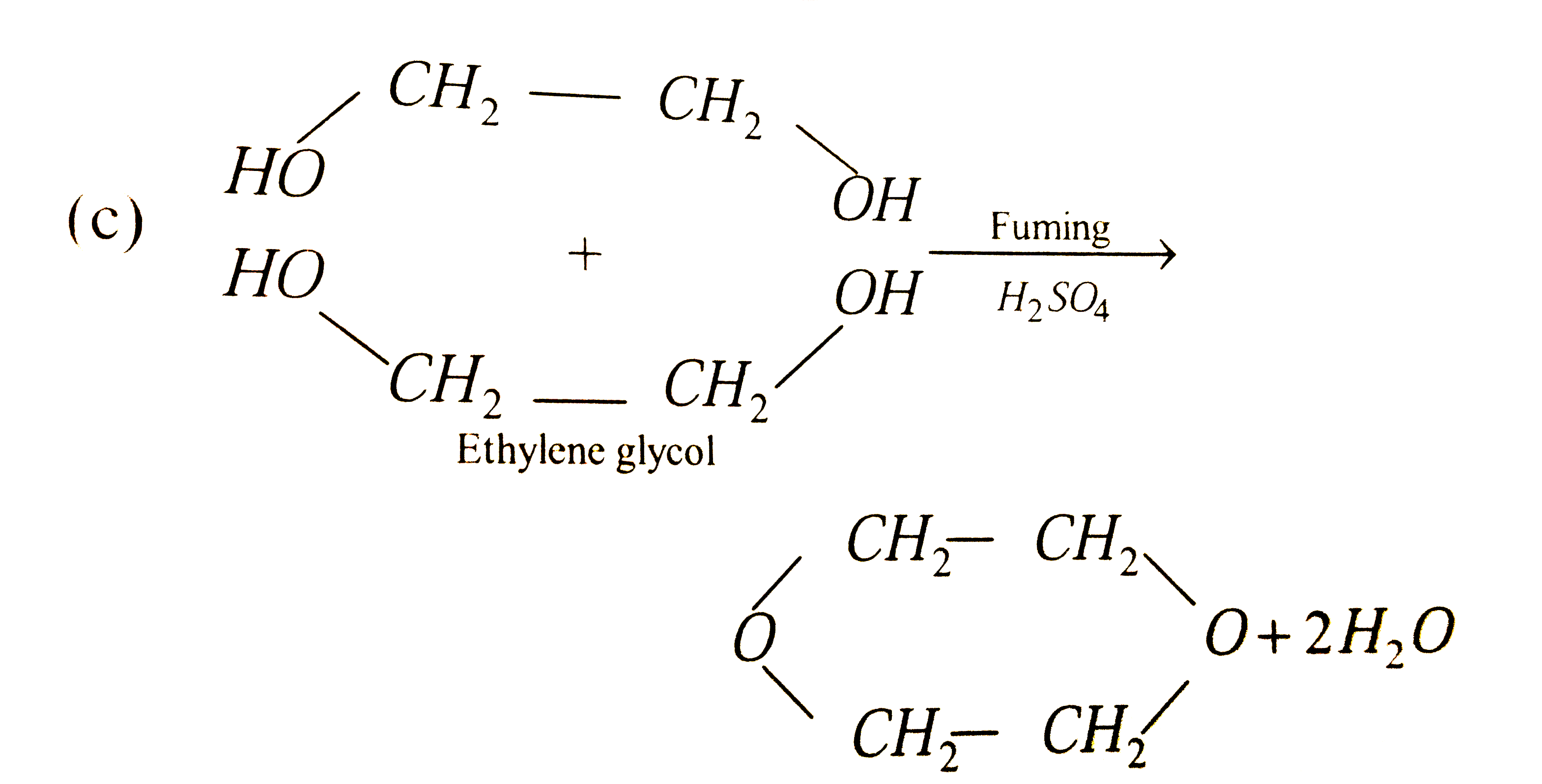
|
|
| 23. |
By distilling glucine with braium hydroxide, it gives: |
|
Answer» ethylamine |
|
| 24. |
By dissolving 5 g substance in 50 g of water, the decrease in freezing point is 1.2^(@)C. The gram molal depression is 1.85^(@)C. The molecular weight of substance is |
|
Answer» `105.4` Here, `Delta T=1.2^(@)C, K_(f)=1.85^(@)` `w=5g, W=50 g` `m=(1000xx1.85xx5)/(1.2xx50)=154.2`. |
|
| 25. |
By dissolving 0.517 g of nitrogen sulphide in 18.25 g of chloroform, the b.p. raised by 0.6^@C . Nitrogen sulphide contains 30.5% S. Find the molecular weight and molecular formula of nitrogen sulphide. |
| Answer» SOLUTION :`184 , N_2S_4` | |
| 26. |
By deficiency of which vitamin, pernicious anaemia is caused ? |
|
Answer» CYANOCOBALAMINE |
|
| 27. |
By coaltar distillation, which is not obtained |
|
Answer» LIGHT oil |
|
| 28. |
By chlorinating carbon disuophide with chlorine in presence of aluminium chloride, we get: |
|
Answer» CARBON tetrachloride |
|
| 29. |
By burning NH_(3) in oxygen, it gives __________and H_(2)O. |
|
Answer» NO |
|
| 30. |
By adding which one of the following oil in water emulsion containing potassium soap can be converted into water in oil emulsion? |
|
Answer» `AlCl_3` |
|
| 31. |
By adding water to the solution, its: |
|
Answer» CONCENTRATION REMAINS same |
|
| 32. |
By adding water to the solution, its |
|
Answer» concentration remains same |
|
| 33. |
By adding a strong acid to the buffer solution, the pH of the buffer solution |
|
Answer» REMAINS constant |
|
| 34. |
By adding a strong acid to the buffer solution, the pH of the buffer solution ……………… |
| Answer» Solution :remains constant | |
| 35. |
By adding 20 ml of 0.1 N HCl to 20 ml 0.1 N KOH, the pH of the obtained solution will be |
|
Answer» 0 |
|
| 36. |
By a proper choice of reagent, both symmetrical and unsymmetrical ethers can by prepared by williamson synthesis which involves the reaction between an alkyl halide and an alkoxide ion. The reverse process involving the cleavage of etehrs to give back the original alkyl halide and the alcohol can be carried out by heating the ether with HI at 373K. Q. Which of the following ethers is not cleaved by HI? |
|
Answer» Dicyclohexyl ether 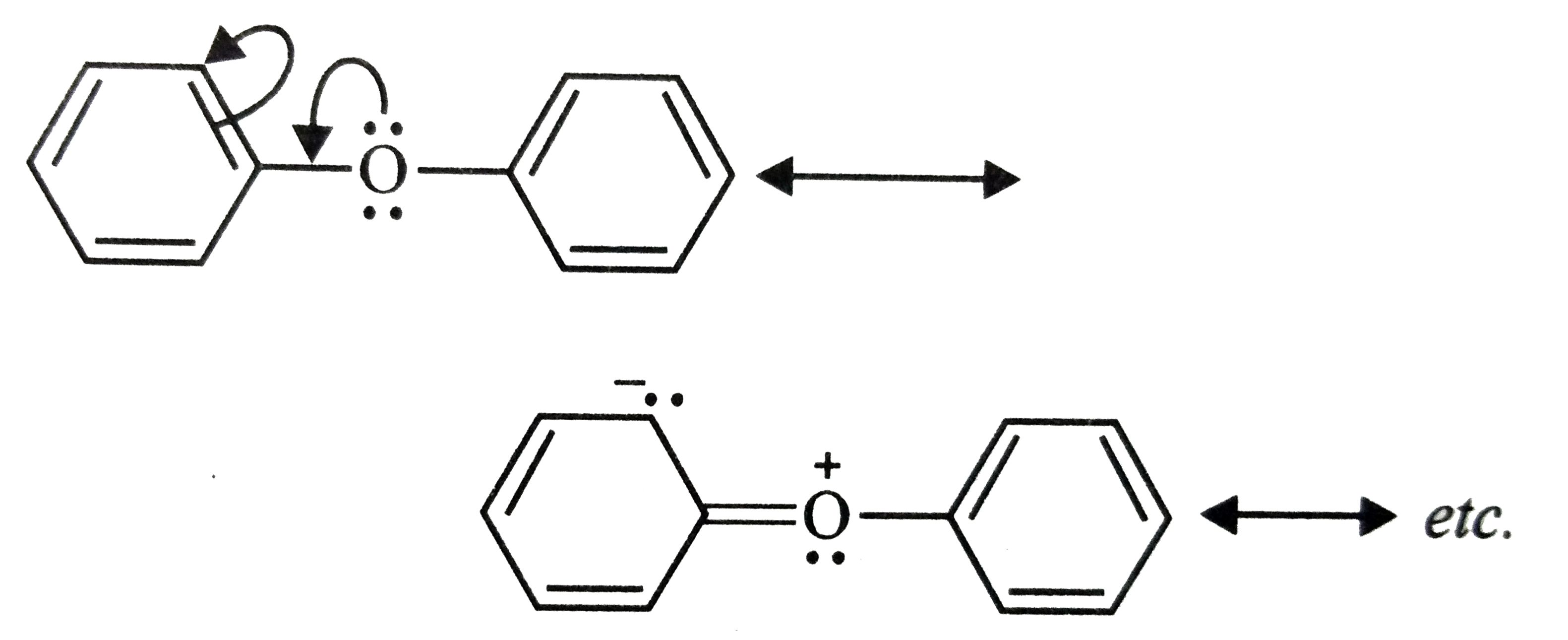 DUE to resonance C-O BOND has some double bond CHARACTER and hence is not cleaved by HI. |
|
| 37. |
By adding 20 ml 0.1 N HCL to 20 ml 0.001 N KOH, the pH of the obtained solution will be |
|
Answer» 2 20 ml. of 0.001 KOH `= (0.001)/(1000) xx 20` GM eq. `= 2 xx 10^(-5)` g eq. `:.` HCl left unneutralised `= 2(10^(-3) - 10^(-5))` `= 2 xx 10^(-3) (1- 0.01) = 2 xx 0.99 xx 10^(-3) = 1.98 xx 10^(-3)` g eq. Volume of solution = 40 ml. `:. [HCl] = (1.98 xx 10^(-3))/(40) xx 1000 M = 4.95 xx 10^(-2)`. `:. pH = 2 - LOG 4.95 = 2 - 0.7 = 1.3`. |
|
| 38. |
By a proper choice of reagent, both symmetrical and unsymmetrical ethers can by prepared by williamson synthesis which involves the reaction between an alkyl halide and an alkoxide ion. The reverse process involving the cleavage of etehrs to give back the original alkyl halide and the alcohol can be carried out by heating the ether with HI at 373K. Q. Benzyl ethyl ether reacts with HI to form |
|
Answer» p-iodotoluene annd ethyl alcohol |
|
| 39. |
By a proper choice of reagent, both symmetrical and unsymmetrical ethers can by prepared by williamson synthesis which involves the reaction between an alkyl halide and an alkoxide ion. The reverse process involving the cleavage of etehrs to give back the original alkyl halide and the alcohol can be carried out by heating the ether with HI at 373K. Q. Allyl phenyl ether can be prepared by heating |
|
Answer» `C_(6)H_(5)Br+CH_(2)=CH-CH_(2)ON a` |
|
| 40. |
BX_(3)+NH_(3) overset(B.T.) to BX_(3) *NH_(3)+Heat of adduct formation (DeltaH) The numberical value of DeltaH is found to be maximum for: |
|
Answer» `BF_(3)` |
|
| 41. |
Butyric acid undergoes mild oxidation with dilute hydrogen peroxide at: |
|
Answer» `ALPHA`-POSITION |
|
| 42. |
Butyric acid and isobutyric acid are |
|
Answer» CHAIN isomers |
|
| 43. |
Butyric acid contains only C, H and O. A 4.24 mg sample of butyric acid is completely burned. It gives 8.45 mg of CO_(2) and 3.46 mg og H_(2)O. The molecular mass of butyric acid was determined by experiment to be 88 amu. What is molecular formula? |
|
Answer» `"i.e.,44 g "CO_(2)" contains C= 12 g"` `THEREFORE 8.45 MG CO_(2)" will contain C"=(12)/(44)xx8.45mg` This is present in 4.24 mg of the compound. `therefore %" of C in the compound "=(12)/(44)xx(8.45)/(4.24)xx100=54.4%` `"or use the formula directly"%" of C"=(12)/(44)xx("Mass of CO"_(2))/("Mass of compound")xx100` `"Similarly, "%" of H"=(2)/(18)xx("Mass of "H_(2)O)/("Mass of compound")xx100=(2)/(18)xx(3.46)/(4.24)xx100=9.1%` `therefore""%" or O"=100-(54.4+9.1)=36.5%` CALCULATE E.F. Its comes out to be `C_(2)H_(4)O`. E.F. mass = 44 u, Mol mass = 88 u. Hence, n = Mol. mass/E.F mass = 2 `therefore"Mol. formula"=2xxE.F.=C_(4)H_(8)O_(2)` |
|
| 44. |
Butyne-1 and butyne-2 can be distinguished by: |
|
Answer» `Br_2` water |
|
| 45. |
Butyne-2, on heating with sodalime in an inert solvent, gives : |
|
Answer» Butyne-1 |
|
| 46. |
Butylated hydroxytoluene (BHT) contains two bulky tert-butyl groups. Can it still work as an antioxidant if these two tert-butyl groups are removed ? Explain |
Answer» Solution :The fat in the food gets oxidised by `O_2` forming free radicals which spoil the food. BHT COMBINES with these free radicals to form a new very stable free RADICAL which does not react with fat molecules. As a RESULT, chain is broken and hence the food is preserved . 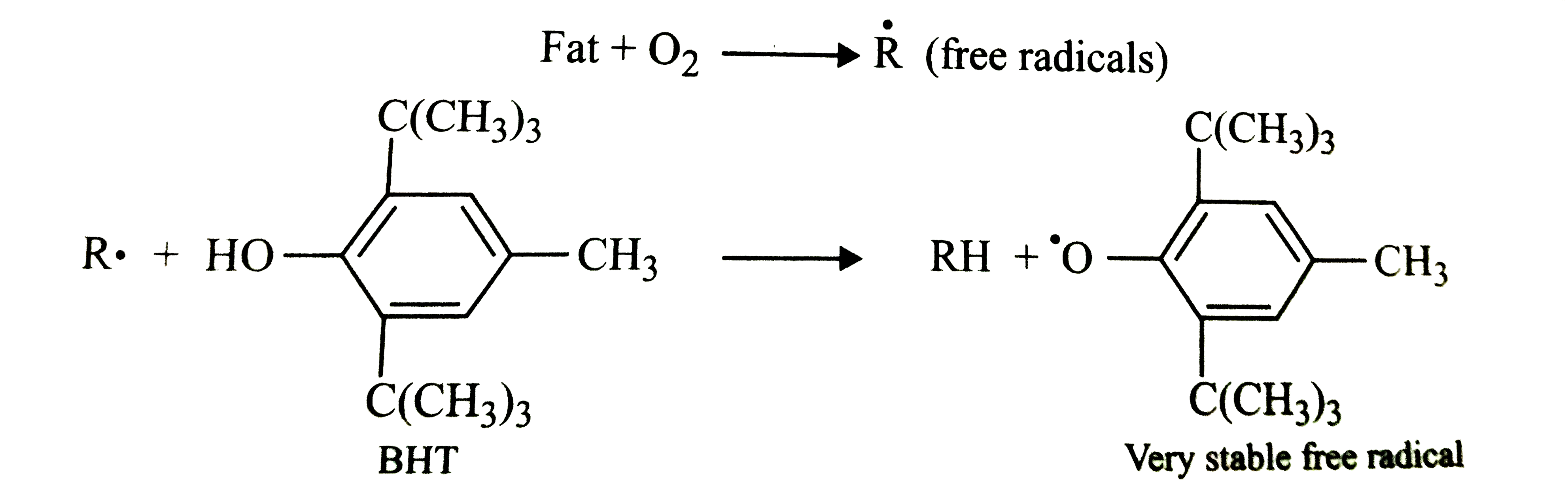 If the tert-butyl groups are removed , the phenols would SIMPLY couple when exposed to air or `O_2`. 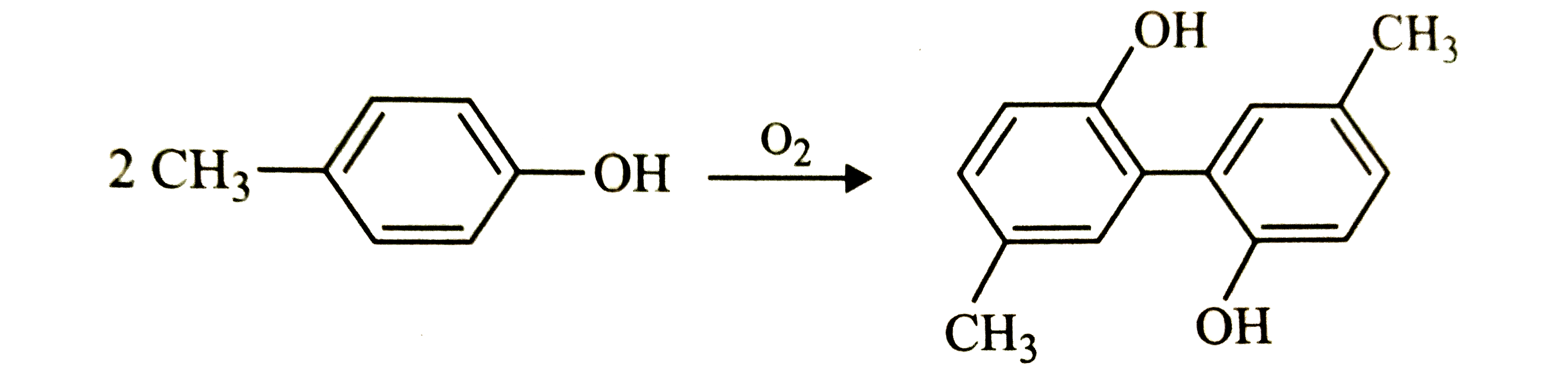 When the bulky tert-butyl groups are present , the rings cannot come closeenough together for coupling. They are then free to trap free radicals produced by the oxidation of fats thereby preserving food. |
|
| 47. |
Butylated hydroxytoluene as a food additive acts as |
|
Answer» antioxidant |
|
| 48. |
Butylated hydroxyl toluene as a food additive acts as____. |
|
Answer» antioxidant |
|
| 49. |
Butylated hydroxy toluene as a food additive acts as |
|
Answer» ANTIOXIDANT |
|
| 50. |
Butylated hydroxy toluene as a food additive acts as :antioxidant,flovouring agent,colouring agent,emulsifier. |
|
Answer» antioxidant |
|