

Saved Bookmarks
This section includes 7 InterviewSolutions, each offering curated multiple-choice questions to sharpen your Current Affairs knowledge and support exam preparation. Choose a topic below to get started.
| 1. |
Bond energies of N-=N, H-H and N-H bonds are 945,463 & 391 kJ mol^(-1) respectively, the enthalpy of the following reactions is : N_(2)(g)+3H_(2)(g)rarr2NH_(3)(g) |
|
Answer» |
|
| 2. |
Bond energies of F_(2) and Cl_(2) are respectively 36.6 and 58.0 kcal per mole. If the heat liberated in the reaction F_(2)+Cl_(2) to 2FCl is 26.6 kcal , calculate the bond energy of F-Cl bond. |
|
Answer» SOLUTION :Given that, `F_(2)+Cl_(2) to 2FCl`, `DeltaH=-26.6` kcal For reactants Bond energy of 1 mole of `F-F` bonds `=36.6 ` kcal Bond energy of 1 mole of Cl-Cl bonds `=58.0` kcal For PRODUCT Energy of formation of 2 moles of F-Cl bond `=2XX x` (where x is the bond formation energy of F-Cl bonds in kcal/mole) Adding all the HEAT changes , we get `DeltaH` of the given reaction i.e., `36.6+58+2xx x=-26.6` `x=-60.6`kcal Thus, the bond energy of `F-Cl` bonds is `+60.6` kcal per mole. |
|
| 3. |
Bond dissociation enthalpy of the halogens shows the trend |
|
Answer» `F-F LT Cl - Cl GT Br - Br gt I - I ` |
|
| 4. |
Bond dissociation enthalpy of H_(2), Cl_(2) and HCl are 434, 242 and 431 kJ mol^(-1) respectively. Enthalpy of formation of HCl is |
|
Answer» `- 93 KJ mol^(-1)` `DeltaH=(1)/(2)xx434+(1)/(2)xx242-431` `=217+121-431=-93 kJ//"MOLE"`. |
|
| 5. |
Bond dissociation enthalpy of F_(2) is less than that of Cl_(2). Explain why ? |
| Answer» Solution :`F_(2)` is having HIGHER electron-electron repulsion DUE to its smaller size, as COMPARED to `Cl_(2)`. | |
| 6. |
Bond dissociation enthalpy of E-H (E = element) bonds is given below. Which of the compounds will act as strongest reducing agent? |
|
Answer» `NH_3` |
|
| 7. |
Bond dissociation enthalpy of E-H(E = element) bonds is given below: {:("Compound",NH_3,PH_3,AsH_3,SbH_3),(Delta_("diss")"(E-H)",,,,),(kjmol^(-1),389,322,297,255):} Which of the following compounds will act as strongest reducing agent ? |
|
Answer» `NH_3` |
|
| 8. |
Bond dissociation enthalpy of E - H (E = element) bonds is given below. Which of the compounds will act as strongest reducing agent ? |
|
Answer» `NH_(3)` |
|
| 9. |
Bond dissociation enthalpy of E-H (E = element) bonds is given below. Which of the compounds will act as strongest reducing agent? {:("Compound",NH_(3),PH_(3),AsH_(3),SbH_(3)),(Delta_(diss)(E-H)//kJ mol^(-1),389,322,297,255):} |
|
Answer» `NH_(3)` |
|
| 10. |
Bond dissociation energy of F_(2) is less than that of CI_(2). Explain. Or F_(2) has lower bond dissociation enthalpy than CI_(2). Why ? |
| Answer» Solution :Due to SMALLER SIZE, the LONE pairs of ELECTRONS on the F-atoms repel the bond pair of the F-F bond. In CONTRAST, because of comparatively large size of CI atoms, the lone pairs on the CI atoms do not repel the bond pair of CI-CI bond. As a rsult, F-F bond energy is lower than that of CI-CI bond energy. | |
| 11. |
Bond dissociation energies of HF, HCl, HBr follow the order |
|
Answer» `HClgtHBrgtHF` |
|
| 12. |
Bond dissociation energies, of HF,HCI, HBr follow the order |
|
Answer» `HCl gt HBR gt HF` |
|
| 13. |
Bond dissociation energies of HF, HCl , HBr follow the order |
|
Answer» `HCL gt HBR gt HF` |
|
| 14. |
{:("Bond" ,"Bond dissociation energy" ("kJ mole"^(–1))),( C-I ,240 ""to "Element A"),( C-II ,328 ""to "Element B"), (C-III, 276 ""to "Element C"),( C-IV ,485 ""to "Element D"):} Elements A, B, C and D, which element has the smallest atom ? |
| Answer» ANSWER :D | |
| 15. |
Bond angles in SCl_(2) and OF_(2) respectively are |
|
Answer» `107^(0), 101.5^(0)` |
|
| 16. |
Bond angle is the highest in the molecule |
|
Answer» `XeO_4` |
|
| 18. |
Bond angle is minimum for |
|
Answer» `H_2O` |
|
| 19. |
Bond angle in PH_(4)^(+)is higher than that in PHz. Why? |
Answer» Solution : Both `PH_4^+`and `PH_3`involve `sp^3`hybridisation of P atom. In `PH_4^+`all the four orbitals are BONDED, WHEREAS in PH, there is a lone pair of electrons on P. In `PH_4^+` , the HPH bond angle is TETRAHEDRAL angle of `109.5^@`. But in `PH_3` , lone pair-bond pair repulsion is more than bond pair-bond pair repulsion so that bond angles becomes LESS than normal tetrahedral angle of `109.5^@`. The bond angle in `PH_3`has been found to be about `93.6^@`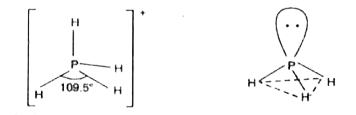
|
|
| 20. |
Bond angle in PH_4^(+) is higher than that in PH_3. Why? |
Answer» Solution :P in `PH_3` is `sp^(3)`-hybridised. It has three bond pairs and one lone pair around P. Due to stronger lone pair-bond pair repulsions than bond pair-bond pair repulsions, the tetrahedral angle decreases from `109^(@)28. to 93.6^(@)`. As a result, `PH_3` is pyramidal. HOWEVER, when it REACTS with a PROTON, it forms `PH_4^(+)` ion which has four bond pairs and no lone pair. Now, there are no lone pair-bond pair repulsions. Only four identical bond pair-bond pair interactions exist. `PH_4^(+)` therefore assumes tetrahedral geometry with a bond angle of `109^(@)28.`. This explains why the bond angle in `PH_4^(+)` is higher than in `PH_3` 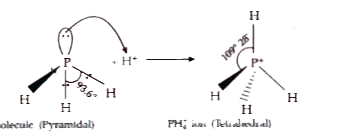
|
|
| 21. |
Bond angle in PH_(4)^(+) is higher than that in PH_(3). Why ? |
Answer» Solution :P in `PH_(3)` is `SP^(3)`-hybridized. It has three bond pairs and one lone PAIR around P. Due to stronger lone pair-bond pair repulsions than bond pair-bond pair repulsions, the tetrahedral angle decreases from `109^(@)`- 28' to `93.6^(@)`. As a result, `PH_(3)` is pyramidal. However, when it REACTS with a proton, it forms `PH_(4)^(+)` ion which has four bond pairs and no lone pair. Due to the absence of lone pair-bond pair repulsions and presence of four identical bond pair-bond pair interactions, `PH_(4)^(+)` assumes tetrahedral geometry with a bond angle of `109^(@)`-28'. This explains why the bond angle in `PH_(4)^(+)` is higher than in `PH_(3)`. 
|
|
| 22. |
Bond angle in PH_3 si closer to 90^(@) while that in NH_3 is 104.5^(@).Which of the following best explains this structural feature? |
|
Answer» Due to larger size of the LONE pair electron cloud, there is larger lone pair - bond pair REPULSION in `PH_3` compared to `NH_3` |
|
| 23. |
Bond angle in PH_(3) is : |
|
Answer» 1. GREATER than in `PF_(3)` |
|
| 24. |
Bond angle in PH4+ is higher that in PH_(3). Why? |
| Answer» Solution : In both `PH_(4)^(+) and PH_(3)` , atom phosphorus is in `SP^(3)`.hybridised state. `PH_(4)^(+)`is TETRAHEDRAL in shape and bond angle is `109^(@) 28^(1)`In `PH_(3)`due to the presence of one lone pair of electrons bond angle deceases from tetrahedral angle. | |
| 26. |
Bond angle in is PH_4^+ higher than that inPH_3 |
|
Answer» <P> Solution :The HYBRIDISATION of P in both `PH_3` and `PH_4^+` is `sp^3.PH_3`CONTAINS THREE bond pairs and one lone pair of electrons. DUE to lone pair-bond pair repulsion, the bond angle is less than the tetrahedral angle in `PH_3`. But in `PH_4^+`there are four bond pairs and no lone pair. So its bond ,angle is almost the same as that of tetrahedral angle. |
|
| 27. |
Bond angle in (CH_(3))_(3) N is little more than the bond angle in NH_(3) . Explain. |
| Answer» SOLUTION :In ammonia bond angle is `107^(@)` . In `(CH_(3))_(3)` N it is nearly `108^(@)` it is due to presence ofthree bulky -`CH_(3)` GROUPS . | |
| 30. |
Bond angle, bond length and hybridisation in SO_(3) molecule respectively are |
|
Answer» `119.5^(0), 143 nm, SP^(2)` |
|
| 31. |
Bombardment of aluminum by alpha-particle leads to its artificial disintegration in two ways. (I) and (II) as shown. Products X, Y and Z respectively are, {:(._(13)^(27)Aloverset((ii))rarr ._(15)^(30)P + Y),((i) darr "" darr),(._(14)^(30)Si+ X"" ._(14)^(30)Si + Z):} |
|
Answer» Proton , neutron, positron |
|
| 32. |
Bombardment of aluminium of alpha- particle leads to its artificial disintegration in two ways (i) and (ii) as shown below. Product X,Y, and Z, respectively, are ._(14)Si^(30)+Xoverset((i))larr._(13)Al^(27)overset((ii))rarr._(15)P^(30)+Y rarr ._(14)Si^(30)+Z |
|
Answer» Proton, neutron, positron `._(14)SI^(30)+._(1)p(x)^(1)``._(14)Si^(30)+._(1)e^(+0)(Z)` `:. x:` Protons, `y:` neutron, `z:` positron |
|
| 33. |
Bombardment of aluminium by alpha-particles lead to its artificial disintegration in two ways, (and (it) as shown. Products X, Y and Z respectively are: |
|
Answer» proton, neutron, positron `""_(13)^(27)Al+""_(2)^(4)alphato""_(15)^(30)P+""_(0)^(1)n[Y]` `""_(15)^(30)Pto""_(14)^(30)Si+""_(+1)^(0)beta[Z]` |
|
| 34. |
Bombardment of aluminium by alpha- particles leads to its artificial disintegration in two ways , (i) and (ii) as shows . Product X , Y and Z respectively are . |
|
Answer» proton , neutron , positron `""_(15) P^(30) to ""_(14) Si^(1) + ""_(+1) Z^(0) (""_(+1) Z^(0)= ""_(+) e^(0))` |
|
| 35. |
Bombardment of aluminiumby alpha - particle leads to its artificial disintegration in two way (i) and (ii) as shown.Products X, Y and Z respectively are, |
|
Answer» proton, neutron, positron Applying nuclear charge & mass NUMBER balance `z=1,A=1` `:. X=rArr ._(1)H^(1)` or `._(1)P^(1)` `._(15)^(27)Al+._(2)He^(4) rarr ._(15)^(30)P+._(Z)^(A)Y` Applying nuclear charge and mass number balance Z=0, A=1 `:. Y rArr ._(0)n^(1)` `._(15)^(30)P rarr ._(14)^(30)Si +Z` Applying nuclear charge and mass number balance `Z rArr ._(+1)e^(0)` |
|
| 36. |
Boiling points of the alkyl halides decrease in the order : |
|
Answer» `RI GT RBR gt RVl gt RF` |
|
| 37. |
Boilingpointsof the followingcompoundsfollowthe order |
|
Answer» `CH_(3) CH_(3) lt CH_(3) NH_(2)lt CH_(3) lt HCOOH` |
|
| 38. |
Boiling points of nitroalkanes are much higher than those of hydrocarbons of comparable mass - give reasons. |
| Answer» Solution :NITROALKANES are POLAR in nature `(mu = 3 - 4D)` and thus have greater dipolar attraction than hydrocarbons. This results in HIGHER values of b.p. `(mu =" DIPOLE moment")` | |
| 39. |
Boiling points of isomeric amines follow the order : |
|
Answer» PRIMARY `GT` SECONDARY `gt` Tertiary |
|
| 40. |
Boiling points of carboxylic acids are: |
|
Answer» LOWER than corresponding ALCOHOLS |
|
| 41. |
Why B.P. of aldehydes and ketones are lower than corresponding alcohols ? |
| Answer» Solution :The ALDEHYDES and KETONES are polar compounds having sufficient intermolecular dipole-dipole Interactions between the opposite ends of `C=O` dipoles . But these dipole-dipole interactions are weaker than the intermolecular hydrogen bonding in alcohols and carboxylic ACID. SO, their B.P. are lower than CORRESPONDING alcohols and acids. | |
| 42. |
Boiling points of aldehydes and ketones are higher than that of ethers of comparable molar masses due to |
|
Answer» PRESENCE of intermolecular H-bonding |
|
| 43. |
Boiling points of alcohols are generally high. This is due to |
|
Answer» hydrogen-bonding INTERMOLECULAR ATTRACTIONS |
|
| 44. |
Boiling point of water is defined as the temperature at which: |
|
Answer» VAPOUR PRESSURE of water is equal to that on ONE atmospheric pressure |
|
| 45. |
Boiling point of water at 750 mm Hg is 99.63^(@)C. How sucrose is to be added to 500 g of water such that it boils at 100^(@)C. Molal elevation constant for water is 0.52 K kg mol^(-1). |
|
Answer» Solution :Here, elevation of boiling POINT `DELTA T_(b)=(100+273)-(99.63+273)=0.37 K` Mass of water, `w_(1)=500 g` Molar mass of sucrose `(C_(12)H_(22)O_(11))`, `M_(2)=11xx12+22xx1+11xx16=34 g mol^(-1)` Molal elevation constant, `K_(b)=0.52 " K KG mol"^(-1)` We know that : `Delta T_(f)=(K_(b)xx1000xx w_(2))/(M_(2)xx w_(1))` `w_(2)=(Delta T_(b)xx M_(2)xx w_(1))/(K_(b)xx1000)=(0.37xx342xx500)/(0.52xx1000)` = 121.7 (approximately) HENCE, 121.67 g of sucrose is to be added. |
|
| 46. |
Boiling point of water at 750mm Hg is 99.63^@C How much sucrose is to be added to 500g of water such that it boils at 100^@C K_b(water)= 0.52K kg mol^(-1) |
|
Answer» Solution :ELEVATION of boiling point,`Delta T_b =100-99.63 = 0.37^@` `K_b` of water = 0.5 K kg`MOL^(-1)` Molar MASS of sucrose `C_12H_22O_11= 342g mol^(-1)` `Delta T_b = (1000K_bW_2)/(M_2W_1)` `thereforeW_2` (mass of SOLUTE)=`(Delta T_b M_2 W_1)/(1000K_b)= (0.37xx342xx500)/(1000K_b)`=121.67g |
|
| 47. |
Boiling point of water at 750 mm is 99.63^@ C. How much of sucrose is to be added to 500 g of water so that it boils at 100^@ C. (K_b =0.052 ) |
|
Answer» Solution :`DELTA T_b = 100-99.63 =0.37K` `K_b= 0.52 ` ` M_B ` for `(C_(12) H_(22) O_(11)) =342 ` `W_A=500 g` ` W_B=(Delta T_b xxM_b xx W_A )/(1000 xx K_b)` `=(0.37 xx342 xx 500 )/(1000 xx 0.52 )` `=( 0.37 xx 171 )/( 0.52 )` `= 121.7`g |
|
| 48. |
Boiling point of water at 750 mm Hg is 99.63^@C . How much sucrose is to be added to 500 gof water such that it boils at 100^@C ? [Molal elevation constant of water is 0.52 K kg "mol"^(-1) ] |
|
Answer» Solution : Elevation in BOILING point required `(Delta T_b) = 100 - 96.63^@ = 3.37^@ ` Mass of solvent (water), `w_1`= 500 g MOLAR mass of solvent, `M_1 = 18 g "mol"^(-1)` Molar mass of solute, `C_12H_22O_11 = 342 g "mol"^(-1)` APPLYING the formula, `M_2= (1000 K_b w_2)/(w_1 Delta T_b) " or " w_2 = (M_2 xx w_1 xx Delta T_b)/(1000 xx K_b)` Substituting the values, we get `w_2 = (342 g"mol"^(-1) xx 500 g xx 0.37 K)/(1000 g kg^(-1) xx 0.52 K kg "mol"^(-1)) = 121.67 g ` |
|
| 49. |
Boiling point of water at 750 mm Hg is 99.63^(@)C. How much sucrose is to be added to 500 g of water such that it boils at 100^(@)C? Molal elevation constant for water is "0.52 K kg mol"^(-1). |
|
Answer» Solution :Elevation in boiling point required `(DeltaT_(b))=100-99.63^(@)=0.37^(@)` Mass of solvent (water), `w_(1)=500g` `"Molar mass of solvent, "M_(1)="18 g mol"^(-1),"Molar mass of solute, "C_(12)H_(22)O_(11)="342 g mol"^(-1)` `"Applying the formula, "M_(2)=(1000K_(b)w_(2))/(w_(1)DeltaT_(b))` `"or"w_(2)=(M_(2)xxw_(1)xxDeltaT_(b))/(1000xxK_(b))=("342 g mol"^(-1)xx500 g xx0.37K)/("1000 g kg"^(-1)xx0.52"K kg mol"^(-1))=121.7g.` |
|