

Saved Bookmarks
This section includes 7 InterviewSolutions, each offering curated multiple-choice questions to sharpen your Current Affairs knowledge and support exam preparation. Choose a topic below to get started.
| 1. |
Boiling point of diethyl ether is less than that of |
|
Answer» ETHANE |
|
| 2. |
Boiling point of ethanol is greater than isomeric ether is due to |
|
Answer» hydrogen BONDS are MUCH stronger than dipole-dipole altraction |
|
| 3. |
Boiling point of ethanol is higher than methoxy methane, why? |
Answer» Solution :This is BECUASE in ethanol there are stronger H - bonds but in METHANE, there are WEAK van der Waal.s forces of attraction. 
|
|
| 4. |
Boiling point of an aqueous solution is 100.1^(@)C. Latent heat of fusion and latent heat of vaporisation of water are "80 cal g"^(-1) and "540 cal g"^(-1) respectively. Calculate the freezing point of the solution. |
|
Answer» Solution :`DeltaT_(b)=K_(b)xxm` `DeltaT_(F)=K_(f)xxm` `therefore""(DeltaT_(b))/(DeltaT_(f))=(K_(b))/(K_(f))` `"Putting"K_(b)=(RT_(B)^(2))/(1000l_(v))"and"K_(f)=(RT_(f)^(2))/(1000l_(f))` `(DeltaT_(b))/(DeltaT_(f))=(T_(b)^(2)xxl_(f))/(T_(f)xxl_(v))"or"(0.1)/(DeltaT_(f))=((100+273)^(2)xx80)/((0+273)^(2)xx540)"or"DeltaT_(f)=0.362^(@)` `therefore""T_(f)=0-0.362^(@)C=0.362^(@)C` |
|
| 5. |
Boiling point of alkyl halides in influenced by |
|
Answer» London FORCE of ATTRACTION |
|
| 6. |
Boiling point of alcohol is more than that of ether of corresponding molecular weight , because |
|
Answer» ALCOHOL being more SOLUBLE in water |
|
| 7. |
Boiling point of a solvent is 80.2^(@)C. When 0.419g of the solute of molar mass 252.4 g mol- is dissolved im 75 g of the above solvent, the boiling point of the solution is found to be 80.256^(@)C. Find the molal elevation constant. |
|
Answer» |
|
| 8. |
Boilingpointof a solventis 80.2.^(@)CWhen0.419 g of thesoluteof molarmass252 .4 g mol^(-1) is dissolvedin 75g of theabovesolventthe boilingpoint of thesolutionis foundto be80. 256 .^(@)C Finalthe molalelevationconstant |
| Answer» SOLUTION :`K_(B)= 2.53K KG mol^(-1)` | |
| 10. |
Boiling point of a solution is independent of |
|
Answer» amount of solution |
|
| 11. |
Boiling point of a liquid is 50 K at 1 atm and triangleH_vap=460.6 calmol^-1 What will be its boiling point at 10 atm. |
|
Answer» 150 K |
|
| 12. |
Boiling point of a Compound does not depend on : |
|
Answer» HYDROGEN BONDING in the COMPOUND |
|
| 13. |
Boiling point is least for |
| Answer» Solution :`HF lt HI lt HBr lt HCl, HF` has INTERMOLECULAR hydrogen bonding. | |
| 14. |
Boiling point is highest for which compound? |
|
Answer» Pentane |
|
| 15. |
Boiling point elevation is : |
|
Answer» ADDITIVE PROPERTY |
|
| 16. |
Boiling point and solubility of phenol is more than that of other arenes and haloarene with same molecular weight, because |
|
Answer» PHENOL can FORM intermolecular H-bond |
|
| 17. |
Boiling of dil HCl acid solution doesnot increase its concentration beyond 20.2% because, hydrochloric acid |
|
Answer» is extremelysoluble in water |
|
| 18. |
Boiling of dil. HCl acid does not increases its concentration beyond 22.2 per cent because hydrochloric acid. |
|
Answer» Is very volatile |
|
| 19. |
Boiling of C_2H_5NCO + NaOH leads to the formation of : |
|
Answer» `C_2H_5COOH+NH_3` |
|
| 20. |
Boiling CuCl_(2) with Cu in conc. HCl gives: |
|
Answer» `CuCl` |
|
| 21. |
Bohr's periodic table has seven horizontal rows called periods and eighteen vertical columns called groups. Alternatively, the elements of the Bohr's table are divided into four blocks namely S- and f-blocks. Group, period and block of given element can be predicted with the help of its electronic configuration. (I) The principle quantum number of valence shell refers to period of elements (II) The nature of subshell (S. p or d) having last electron refers the block to which the element belongs. (III) The number of electrons present in outermost or penultimate shell predicts the group of element. For s-block, the group number = No. of valence electron For p-block, the group number =10 + numbers of valence electron For d-block, the group number =2 +(n-1) d electrons An element with atomic number 24 is an example of |
|
Answer» ALKALI metal |
|
| 22. |
Bohr's periodic table has seven horizontal rows called periods and eighteen vertical columns called groups. Alternatively, the elements of the Bohr's table are divided into four blocks namely S- and f-blocks. Group, period and block of given element can be predicted with the help of its electronic configuration. (I) The principle quantum number of valence shell refers to period of elements (II) The nature of subshell (S. p or d) having last electron refers the block to which the element belongs. (III) The number of electrons present in outermost or penultimate shell predicts the group of element. For s-block, the group number = No. of valence electron For p-block, the group number =10 + numbers of valence electron For d-block, the group number =2 +(n-1) d electrons Number of groups of s- block elemtn, possible in a period is/are |
|
Answer» 1 |
|
| 23. |
Bohr's periodic table has seven horizontal rows called periods and eighteen vertical columns called groups. Alternatively, the elements of the Bohr's table are divided into four blocks namely S- and f-blocks. Group, period and block of given element can be predicted with the help of its electronic configuration. (I) The principle quantum number of valence shell refers to period of elements (II) The nature of subshell (S. p or d) having last electron refers the block to which the element belongs. (III) The number of electrons present in outermost or penultimate shell predicts the group of element. For s-block, the group number = No. of valence electron For p-block, the group number =10 + numbers of valence electron For d-block, the group number =2 +(n-1) d electrons Number of groups possible for s + p + d block elements in a period are |
|
Answer» 6 |
|
| 24. |
Bohr's periodic table has seven horizontal rows called periods and eighteen vertical columns called groups. Alternatively, the elements of the Bohr's table are divided into four blocks namely S- and f-blocks. Group, period and block of given element can be predicted with the help of its electronic configuration. (I) The principle quantum number of valence shell refers to period of elements (II) The nature of subshell (S. p or d) having last electron refers the block to which the element belongs. (III) The number of electrons present in outermost or penultimate shell predicts the group of element. For s-block, the group number = No. of valence electron For p-block, the group number =10 + numbers of valence electron For d-block, the group number =2 +(n-1) d electrons The element with atomic number 58 belongs to |
|
Answer» s-block |
|
| 25. |
Bohr's periodic table has seven horizontal rows called periods and eighteen vertical columns called groups. Alternatively, the elements of the Bohr's table are divided into four blocks namely S- and f-blocks. Group, period and block of given element can be predicted with the help of its electronic configuration. (I) The principle quantum number of valence shell refers to period of elements (II) The nature of subshell (S. p or d) having last electron refers the block to which the element belongs. (III) The number of electrons present in outermost or penultimate shell predicts the group of element. For s-block, the group number = No. of valence electron For p-block, the group number =10 + numbers of valence electron For d-block, the group number =2 +(n-1) d electrons The element of atomic number 36 belongs to |
|
Answer» `3 ^(RD)` PERIOD and p- block |
|
| 27. |
Bohr's model can explain |
|
Answer» the spectrum of hydrogen ATOM only |
|
| 28. |
B(OH)_(3) will accept how many OH^(-) ions? |
|
Answer» 1 |
|
| 29. |
B(OH)_(3)+NaOH to Na[B(OH)_(4)] (aq). Then addition of which of the following proceeds the reaction in the forward direction ? |
|
Answer» Cis-`1,2` diol The added compound must be a cis-diol, to enhance the acid properties.The cis-diol forms very STABLE complex with the `[B(OH)_(4)]^(-)`, thus removing it from solution.The reaction is reversible and thus removal of one of the products swift the equilibrium in the forward direction and thus all the `B(OH)_(3)` REACTS with `NaOH`, in effect it ACTS as a strong acid in the presence of the cis-diol. `B(OH)_(3)+NaOH to Na[B(OH)_(4)]+NaBO_(2)+2H_(2)O`. 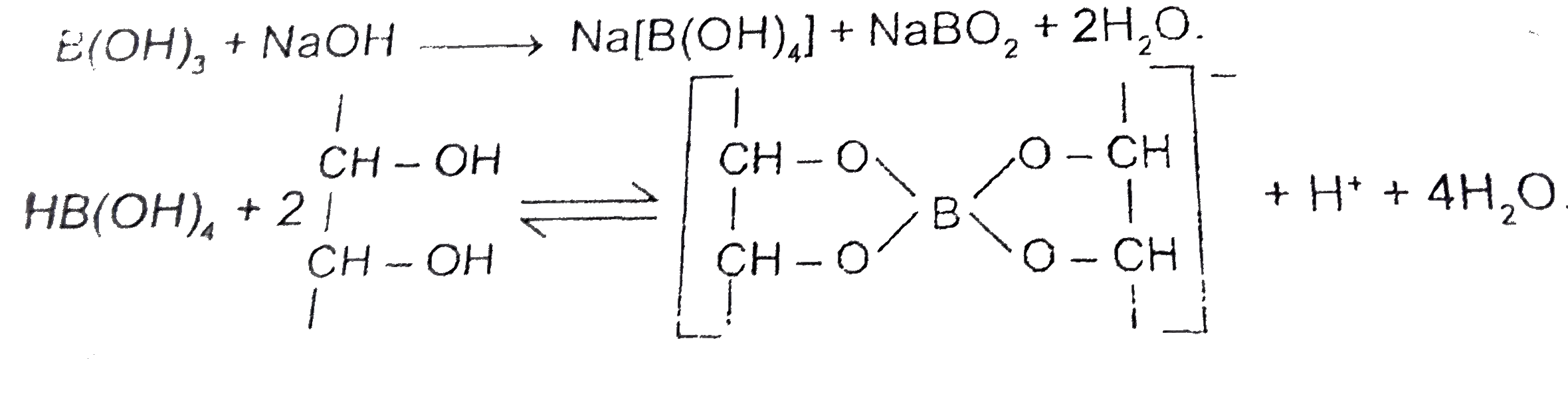
|
|
| 30. |
B(OH)_(3) +NaOH hArr NaBO_(2)+Na[B(OH)_(4)]+H_(2)O How can this carbon is made to proceed in forward direction |
|
Answer» Addition of CIS 1,2 diol |
|
| 31. |
B(OH)_3 is a: |
|
Answer» MONOBASIC acid |
|
| 32. |
Body diagonal of a cube is 866 pm. Its edge length would be |
|
Answer» <P>408pm `:. a = ( 866)/( 1.732) = 500 p m` |
|
| 33. |
Body centred cubic lattice has a coordination number of |
|
Answer» 4 |
|
| 34. |
Body -centred cubic lattice has a corrdination number of |
|
Answer» 4 |
|
| 35. |
B.O.D. test or biochemical oxygen demand test is made for measuring |
|
Answer» NOISE pollution |
|
| 36. |
BOD stands for |
|
Answer» BIOLOGICAL ORGANISM death |
|
| 37. |
BOD. is connected with |
|
Answer» Organic matter |
|
| 38. |
BOD is connected with |
|
Answer» MICROBES and organic matter |
|
| 39. |
BOD is connected with : |
|
Answer» ORGANIC matter |
|
| 40. |
BODis a measureof |
|
Answer» OZONEDEPLETION in THESTRATOSPHERE due totoo manyfree radicals. |
|
| 41. |
BOD is : |
|
Answer» bilogical OXYGEN deficit |
|
| 42. |
BO_(3)^(3-) + Conc. H_(2)SO_(4) + CH_(3) - CH_(2) - OH overset("ignite") to underset("Green flame")((A)) . What is the oxidationnumber ofcentral atomthatisresponsiblefor greenin compound (A) ? |
|
Answer» |
|
| 45. |
B("mojor") underset("Ethanoic")overset("Zn dust")(rarr)C. The final product ‘C’ is |
|
Answer»
|
|
| 46. |
B.M is equal to |
|
Answer» `(eh)/(2pimc)` |
|
| 47. |
Blueprint papers have a coating of: |
|
Answer» MIXTURE of potassium FERRICYANIDE and ammonium ferric citrate |
|
| 49. |
Blue vitriol is ______ . |
| Answer» SOLUTION :`CuSO_45H_2O` | |


