Saved Bookmarks
This section includes 7 InterviewSolutions, each offering curated multiple-choice questions to sharpen your Current Affairs knowledge and support exam preparation. Choose a topic below to get started.
| 1. |
Arrhenius equation may be represented as |
|
Answer» `ln.(A)/(k)=(E_(a))/(RT)` |
|
| 2. |
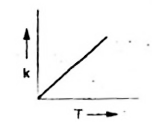
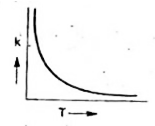
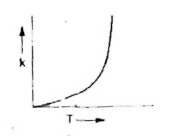
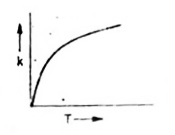
Arrhenius equation is : k=Ae^(-E//RT) Which of the following graphs represents the variation of rate constant k against temperatureT ? |
|
Answer»
|
|
| 5. |
Arrhenius equation is |
|
Answer» `k=Ae^(-1//RT)` |
|
| 6. |
Arreange the following towards their reactivity for ESR |
|
Answer» `IgtIVgtIIgtIII` |
|
| 7. |
Arrannge the following is order of decreasing acid strength: CH_(3)OH,H_(2)O,C_(6)H_(5)OH |
|
Answer» Solution :DUE to +I-effect of the `CH_(3)` group, the electron density is the O-H BOND of `CH_(3)OH` is more than that in water, H-OH. Therefore, O-H bond in `CH_(3)OH` is stronger and hence more difficult to break than O-H bond in `H_(2)O` and hence `CH_(3)OH` is a weaker aciid than `H_(2)O`. In contrast, phenoxdie ion (left after the removal of a proton) is stabilized by resonance, whereas methoxide ion (left the removal of a proton from `CH_(3)OH`) is not. therefore, `C_(6)H_(5)OH` is a stronger acid than `CH_(3)OH`. thus, the overal acidic STRENGTH decreases in the order: `C_(6)H_(5)OH gt H_(2)O gt CH_(3)OH`. |
|
| 8. |
Arrannge the followin compounds in the increasing order of the property indicated against each. Givereasons for your answer. (i) CH_(3)CH_(2)OH,CF_(3)CH_(2)OH,C Cl_(3)CH_(2)OH- acid strength. (ii) 2-methyl-2-propanol, 1-butanol and 2-butanol-Reactivity towards sodium. |
|
Answer» Solution :(i) Due to -I-effect of the halogen, the electron density in the O-H bond decreases. As a result of this electron-deficiency, the O-H bond weakens and thus facilitates the release of PROTON as cojmpared to `CH_(3)CH_(2)OH`. Further,s ince F has stronger -I-effect than Cl, therefore, `CH_(3)CH_(2)OH` is a stronger ACID than `C Cl_(3)CH_(2)OH` while `CH_(3)CH_(2)OH` is the weakest acid. thus, acid strength increases in the order: `CH_(3)CH_(2)OH lt C Cl_(3)CH_(2)OH lt CF_(3)CH_(2)OH`. (ii) It is an acid-base reaction since alcohols are acidic in nature and sodium is a strong base. such, the REACTIVITY of these alcohols towards sodium increases as the acidic character of alcohols increases. Now since the acidic character of alcohols increases in the order: `3^(@) lt 2^(@) lt 1^(@)`, therefore, the reactivity of NA towards alcohols increases in the same order, i.e., `underset(("least reactive"))("2-methyl-2-propanol "(3^(@))) lt underset(("more reactive"))("2-butanol "(2^(@))) lt underset(("most reactive"))("1-butanol "(1^(@)))` |
|
| 9. |
Arrange thhe following compounds in increasing order of S_(N)1 reactivity. (a) ClCH_(2)CH=CHCH_(2)CH_(3),CH_(3)C(Cl)+CHCH_(2)CH_(3),CH_(3)CH=CHCH_(2)CH_(2)Cl (b) CH_(3)CH_(2)Br,CH_(2)=CHCH(Br)CH_(3),CH_(2)=CHBr,CH_(3)CH_(3)CH(Br)CH_(3). |
|
Answer» SOLUTION :(a) `CH_(3)C(Cl) = CHCH_(2)CH_(3), CH_(3)CH = CHCH_(2)CH_(2)Cl, ClCH_(2)CH = CHCH_(2)CH_(3)` (b) `CH_(2) = CHBr, CH_(3)CH_(2)Br, CH_(3)CH(Br)CH_(3), CH_(2) = CHCH(Br)CH_(3)` (c) `CH_(3)CH_(2)CH_(2)Cl, (CH_(3))_(2)CHCL, (CH_(3))_(3)C Cl, C_(6)H_(5)C(CH_(3))_(2)Cl` |
|
| 10. |
Arrange water, ethanol and phenol in increasing order of acidity and give reason for your answer. |
| Answer» Solution :Due to +I-effect of `CH_(3)CH_(2)` group electron density in the O-H BOND of `CH_(3)CH_(2)OH` is HIGHER than that of O-H bond in `H_(2)O`. THEREFORE, `H_(2)O` is a stronger acid than ethanol. Further, due to greater stabilization of phenoxide ion over phenol, phenol is a stonger acid than water. thus, acidity of these three compounds increases in the ORDER: | |
| 11. |
Arrange water, ethanol and phenol in increasing order of a acidity and give reason for your answer. |
|
Answer» SOLUTION :`"Ethanol" lt "Water" lt "Phenol"` Due due +I effect of `-C_(2)H_(6)` GROUP makes the ethanol LESS acidic than water. Due due greater resonance stabilisation of phenoxide IONS, phenol in more acidic that water. |
|
| 12. |
Arrange the wavelengths (a) of the following emission lines of H-atom in an increasing order. (1) n = 3 overset(lambda_(1))ton = 1 (2) n = 5 overset(lambda_(2))to n = 3 (3)n = 12 overset(lambda_(3))to n = 10(4) n = 22 overset(lambda_(4)) to n = 20 |
|
Answer» `lambda_(4) lt lambda_(3) lt lambda_(2) lt lambda_(1)` |
|
| 13. |
Arrange the steps according to the order followed in the free radical polymerisation. (i) Chain initiating step (ii) Chain terminating step (iii) Free radical formation (iv) Chain propagation step |
|
Answer» IV, III, I, ii |
|
| 14. |
Arrange the solutions : true solution, colloidal solution and suspension in the decreasing order of their particle size. |
| Answer» SOLUTION :SUSPENSION > COLLOIDAL solution > TRUE solution. | |
| 15. |
Arrange the polymers in increasing order of their intermolecular forces : Nylon - 6,6, Polythene, Buna-S. |
|
Answer» SOLUTION :The increasing ORDER of their intermolecular FORCES of attraction follows the order : Buna - S, POLYTHENE, Nylon - 6, 6. |
|
| 16. |
Arrange the MnO_(4)^(-), Cr_(2)O_(7)^(2-)and Votions in the increasing order of their oxidising power. |
| Answer» Solution :Order of the OXIDATION ability : `VO_(2)^(+) lt Cr_(2)O_7^(2-) lt MnO_(4)^(-)` . This is DUE to the increasing stablility of the lower species to which they are reduced. | |
| 17. |
Arrange the MnO_(4)^(-) and VO_(2)^(+) ions in the increasing order of their oxidising power. |
|
Answer» Solution :Order of the oxidation ability: `VO_(2)^(+) lt Cr_(2)O_(7)^(2-) lt MnO_(4)^(-)`. This is due to the increasing stability of the lower species to which they are REDUCED. |
|
| 18. |
Arrange the melting points of following compounds in decreasing order 1. n - butane 2. cis - 2- butene 3. trans -2- butene 4. 1 - butyne |
|
Answer» `1 gt 2 gt 3 gt 4` |
|
| 19. |
Arrange the hydrides of group 15 in the order of increasing boiling points. |
|
Answer» `PH_3 lt AsH_3lt SbH_3 lt BiH_3lt NH_(3)` |
|
| 20. |
Arrange the halogens F_(2),Cl_(2),Br_(2),I_(2) in order of their increasing reactivity with alkanes |
|
Answer» `I_(2) LT Br_(2) lt Cl_(2) lt F_(2)`<BR>`Br_(2) lt Cl_(2) lt F_(2) lt I_(2)` |
|
| 21. |
Arrange the halogens F_(2), Cl_(2), Br_(2), I_(2), in order of their increasing reactivity with alkanes. |
|
Answer» `I_(2) LT Br_(2) lt Cl_(2) lt F_(2)` <BR>`Br_(2) lt Cl_(2) lt F_(2) lt I_(2)` |
|
| 22. |
Arrange the halogen family in their decreasing order of electronegativity. |
| Answer» SOLUTION :`FGT CL gtBrgtI` | |
| 23. |
Arrange the haloacids in the increasing order of acid strength. |
| Answer» SOLUTION :`HF LT HCl GT HBR lt HI` | |
| 24. |
Arrange the given set of compounds in order of increasing boiling points. I. 1-chloropropane II. Isopropyl chloride III. 1-chlorobutane |
|
Answer» `II lt III lt I` THUS, OPTION (c), i.e., IIltIltIII is correct. |
|
| 25. |
Arrange the given halogens in increasing order of boiling points. |
|
Answer» Solution :Boiling POINTS increase with the size of the molecules because the VAN der Waals. attractive forces increase with the size of the molecules. Thus, the increasing ORDER of boiling points is : `F_2 lt Cl_2 lt Br_2 lt I_2` |
|
| 26. |
Arrange the given compounds in decreasing order of boiling points. underset("I")(CH_(3)CH_(2)CH_(2)CH_(2)Br underset("II")(CH_(3)-underset(" "CH_(3))underset(|)overset(" "CH_(3))overset(|)C-Br) underset("III")(CH_(3)-CH_(2)-underset(CH_(3))underset("|")(CH)-Br) |
|
Answer» I `GT` III `gt` II<BR>II `gt` I `gt` III `CH_(3)CH_(2)CH_(2)CH_(2)Br gt CH_(3)CH_(2)-underset(CH_(3))underset("|")(CH)-Br gt underset(""CH_(3))underset("|")OVERSET(""CH_(3))overset("|")(CH_(3)-C-Br)` |
|
| 27. |
Arrange the four isomeric butyl alcohols in order of decreasing boiling points. |
|
Answer» Solution :Amongst isomeric alcohols, boiling points decrease as BRANCHING increases on the carbon atom carrying the OH GROUP due to a corresponding decrease in surface area. Among isomeric `1^(@)` alcohols, the branched CHAIN alcohol has LOWER boiling point than the corresponding n-alcohols. thus, te boiling points of the four isomeric alcohols decrease in the order, butan-1-olgt2-methylpropan-1-olgtbutan-2-olgt2-methylpropan-2-ol. |
|
| 28. |
Arrange the followng in the increasing order of reducing character. H_(3), PO_(3), H_(3)PO_(4), H_(3)PO_(2) |
Answer» Solution :The structure of these oxoacids of P are :  The REDUCING CHARACTER of these oxoacids depends upon the number of P-H BONDS. Since `H_(3)PO_(2)` has two, `H_(3)PO_(3)` has one and `H_(3)PO_(4)` has no P-H bonds, therefore, their recucing character decreases in the order : `H_(3)PO_(2)""H_(3)PO_(3) gt H_(2) PO_(4)` In FACT, `H_(3)PO_(4)` does not act as a reducing agent. |
|
| 29. |
Arrange the four isomeric butyl alcohols in order of increasing solubility in water. |
|
Answer» SOLUTION :As branching increases, the SURFACE area of the non-polar hydrocarbon part decreases and hence the solubility in water increases with branching. Thus, the solubility of the four ISOMERIC BUTYL ALCOHOLS in water increases in the order: butan-1-ollt2-methylpropan-1-olltbutan-2-ollt2-methylpropan-2-ol. |
|
| 30. |
Arrange the following : Xe, He, Kr, Rn, Ne in decreasing order of their electron gain enthalpy. |
|
Answer» Solution :All the occupied subshells of noble gases are completely filled. Therefore, the additional electron has to be placed in an orbital of next higher shell. In other WORDS, ENERGY has to be supplied to add an additional electron and hence, electron gain enthalpy of all the noble gases is positive. Further, as we move down the group, the sizes of the atoms increase and hence the hence the MAGNITUDE of their positive electron gain enthalpies decrease from Ne to Rn. However, due to SMALLEST size, He has the highest tendency to accept an additional electron and hence it has the lowest positive electron gain enthalpy. Thus, the electron gain enthalpy of noble gases decreases in the order : `Ne GT Ar = Kr gt Xe gt Rn gt He`. Surprisingly, the electron gain enthalpy of Kr is equal to that of Ar. |
|
| 31. |
Arrange the following w.r.t their B.P (I) 0.2 m ethylene glycol(II) 0.12 M K_(2) SO_(4) (III) 0.1 m MgCl_(2)(IV) 0.12m KBr |
|
Answer» `I LT IV lt III ltII` |
|
| 32. |
Arrange the following towards their reactivity for hydration ? |
|
Answer» `IIgtIgtIIIgtIV` |
|
| 33. |
Arrange the following substances in order of increasing ability to coagulate i) negative change sol and ii) a positively change sol: X) ZnSO_4, Y) AlCl_3 and Z) Na_3PO_4. |
|
Answer» |
|
| 34. |
Arrange the following species in the increasing order of long pairs of electrons.(A) CO ""(B) NO_(2)^(-) (C ) NF_(3)"" (D) CO_(3)^(-2) |
|
Answer» `A lt B lt C lt D` HENCE, the CORRECT order is A `lt B lt D lt C.` THUS, option (d) is correct. 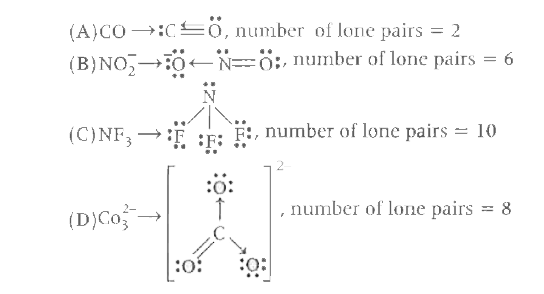
|
|
| 35. |
Arrange the following species in increasing order of acidic strength : Al_(2) O_(3) , ClO_(2) , NO_(2) , SiO_(2) . |
| Answer» Solution :`Al_(2)O_(3) LT SiO_(2) lt NO_(2) lt ClO_(2)` | |
| 36. |
Arrange the following species accordingto theirbondangle order. (I) O_(3) (II) NO_(2)^(+) (III) FNO |
|
Answer» `I GT II gt III` |
|
| 37. |
Arrange the following solutions in the increasing order of their osmotic pressure a) 34.2 g/lit sucrose (b) 60g/lit urea (NH_(2)CONH_(2)) (c) 90 g/lit glucose (d) 58.5 g/lit sodium chloride Give reason in support of your answer |
|
Answer» Solution :MOLAR mass of sucrose `(C_(12)H_(22)O_(11))="342 g mol"^(-1)` Molar mass of urea `(NH_(2)CONH_(2))="60 g mol"^(-1)," Molar mass of glucose "(C_(6)H_(12)O_(6))="180 g mol"^(-1)` Molar mass of `NaCl="58.8 g mol"^(-1),` Molar conc. Of sucrose `=(34.2)/(342)=0.1M,"Molar conc of urea "=(60)/(60)=1M,` Molar conc of glucose `=(90)/(180)=0.5M,"Molar conc. of NaCl"=(58.5)/(58.5)=1M,` However, as NaCl is an electrolyte and one formula unit of NaCl dissociates to give two ions (`Na^(+) and Cl^(-)`) therefore, molar concentration of particles in the solution = 2M. Thus, the ORDER or increasing concentration is `UNDERSET("(0.1 M)")("Sucrose")""lt""underset("(0.5 M)")("Glucose")""lt""underset("(1 M)")("Urea")""lt""underset("(2 M)")("NaCl")` As osmoticpressure (or any colligative property) is directly proportional to the number of particles in the solution, hence increasing order of osmotic pressure will be : `"Sucrose" lt"Glucose"lt"Urea"lt "NaCl"` Note. If the above solutions are to be arranged in order of their decreasing freezing points, the depression in freezing points `(DeltaT_(F))` will be in the order : `"Sucrose "lt "Glucose"lt"Urea"lt"NaCl"` Thus, sucrose will have MINIMUM depression i.e., its actual freezing point will be maximum. Hence, the order of decreasing freezing points will be : `"Sucrose"gt "Glucose"gt "Urea"gt"NaCl"` |
|
| 38. |
Arrange the following solutions in the decreasing order of specific conductance. i) 0.01 M KCl "" ii) 0.005 M KCl iii) 0.1 M KCl "" iv) 0.25 M KCl v) 0.5 M KCl |
|
Answer» SOLUTION :Specific conductivity decreases with decrease in concentration of the solution. So the DECREASING order of specific conductance is 0.5 M KCL `gt` 0.25 M KCl `gt` 0.1 M KCl `gt` 0.01 M KCl `gt` 0.005 M KCl. |
|
| 39. |
Arrange the following solutions in increasing order of their van't Hoff factor : 0.1M CaCl_(2), 0.1 M KCl, 0.1 M Al_(2)(SO_(4))_(3), 0.1 M C_(12)H_(22)O_(11) |
|
Answer» Solution :GREATER the number of ions produced on DISSOCIATION, greater is the van't Hoff FACTOR. Hence, the ORDER is `0.1M C_(12)H_(22)O_(11) LT 0.1 M KCl lt 0.1 M CaCl_(2) lt 0.1 M Al_(2)(SO_(4))_(3)` |
|
| 40. |
Arrange the following solution solutions in the decreasing order of specific conductance. (i) 0.01 M KCl (ii) 0.005 M KCl (iii) 0.1 M KCl (iv) 0.25 M KCl (v) 0.5 M KCl |
|
Answer» Solution :`0.05MKCl gt 0.01 M KCL gt 0.1 M KCl gt 0.25 KCl gt 0.5 KCl.` SPECIFIC CONDUCTANCE and concentration of the electrolyte. So if concentration decreases, specific conductance increases. |
|
| 41. |
Arrange the following sets of compounds in order of their increasing boiling points : Pentan-1-ol, n-butane, pentanal, ethoxyethane. |
| Answer» SOLUTION :n-Butane, ETHOXYETHANE, pentanal and pentan-1-ol. | |
| 42. |
Arrange the following sets of compounds in order of their increasing boiling points : Pentan-1-ol, butan-1-ol, butan-2-ol, ethanol, propan-1-ol, methanol. |
| Answer» SOLUTION :METHANOL, ETHANOL, propan-1-ol, butan-2-ol, butan-1-ol, pentan-1-ol. | |
| 43. |
Arrange the following sets of compounds in order of their increasing boiling points. I) (a) Pentonol-1: (b) Butanol-1, (c) Butanol-2, (d) Ethanol, (e) Propanol and (f Methanol II) (p) Pentanol - 1 , (q) n - Butane , (r ) Pentanoil and (s) ethoxyethane. |
|
Answer» Solution :BOILING POINTS of Set I compounds increase in the order: `f < d < e < C,b < a` Increasing order of boiling points of Set Il COMPOUND is : `q < s < r < p` |
|
| 44. |
Arrange the following in increasing order of basic strength: Aniline,p-Nitroaniline and p-toluidine |
| Answer» SOLUTION :p-nitroaniline `LT`ANILINE `lt` p-Toluidine | |
| 45. |
Arrange the following sets in order of their basic strength: Ethylamine, ammonia and triethylamine. |
| Answer» SOLUTION :`NH_3ltEtNH_2lt Et_3 N` | |
| 46. |
Arrange the following sets in order of their basic strength: Aniline, p-nitroaniline and p-toluidine. |
| Answer» SOLUTION :p-nitroaniline `LT`ANILINE `lt` p-Toluidine | |
| 47. |
Arrange the following set of compounds in order of their increasing boiling points Pentan-1-ol, butan-1-ol, butan-2-ol, ethanol propanI-ol and methanol |
| Answer» SOLUTION : Increasing ORDER of BOILING points: METHANOL, ethanol, propan-1-ol, butan-2-ol, butan-1-ol, pentan1-ol | |
| 48. |
Arrange the following set of compounds in order of increasing boiling points(i) Bromomethane, Bromoform, Chloromethane, Dibromomethane(ii) 1-Chloropropane, Isopropylchloride,1-Chlorobutane. |
|
Answer» Solution :The boiling points of the compound depends on : (i) van DAR Waal.s FORCES (ii) Dipole-Dipole interactions The strength of these molecular forces depend on : (i) Molacular Mass of the compound (ii) Surface area of the compound Boiling point INCREASES with the increase in contact surface area and molecular mass of the molecule. Therefore, the correct order is : CHLOROMETHANE `LT` Bromomethane `lt` Dibromomethane `lt` Bromoform The branched compounds have lower surface area and thus boiling points get lowered. Isopropyl chloride `lt` 1-chloropropane `lt` 1-chlorobutane |
|
| 49. |
Arrange the following polymers in the order of increasing intermolecular forces : Nylon-6, Neoprene, Polyvinyl chloride |
| Answer» SOLUTION :NEOPRENE < POLYVINYL CHLORIDE < Nylon-6 | |