

Saved Bookmarks
This section includes 7 InterviewSolutions, each offering curated multiple-choice questions to sharpen your Current Affairs knowledge and support exam preparation. Choose a topic below to get started.
| 1. |
Aryl halide undergoes electrophilic substitution reaction slowly as comparred to benzene why ? |
|
Answer» more RESONENCE stabilization |
|
| 2. |
Aryl halide are less reactive towards nucleophilic substitution reaction as compared to alkyl halie due to |
|
Answer» The formation of less stable carbonium ion (e) `sp^(2)`-hybridized carbon attached to the halogen. 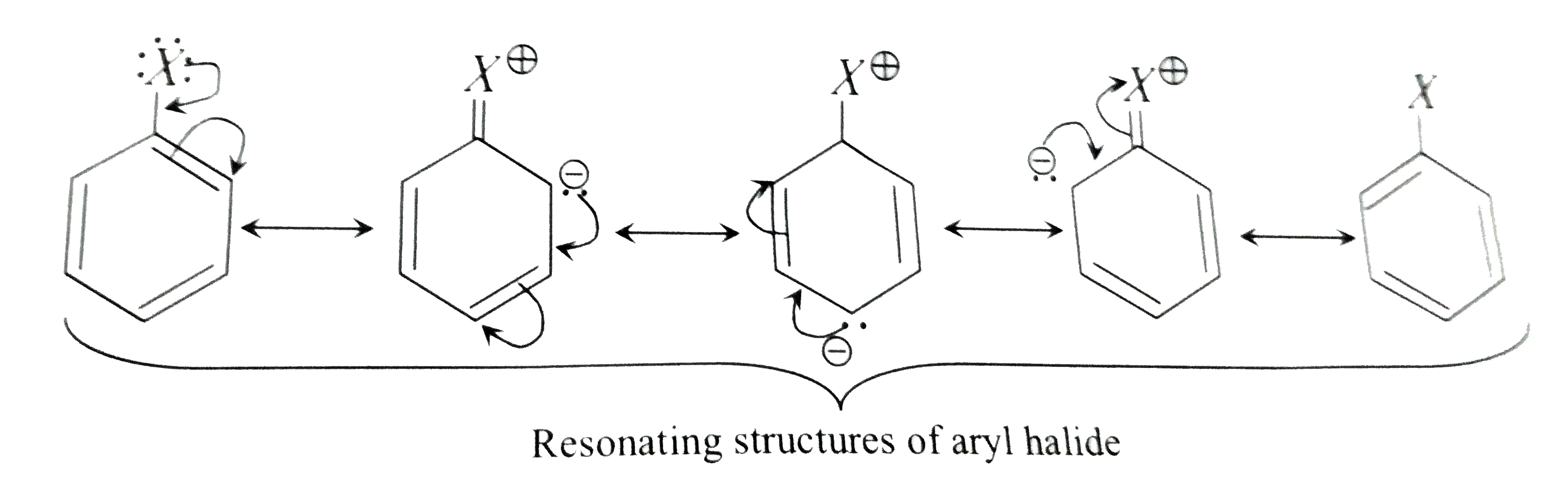 . .
|
|
| 3. |
Aryl halide is less reactive than alkyl halide towards nucleophilic substitution because |
|
Answer» Less stable carbonum ion |
|
| 4. |
Aryl fluoride may be prepared from arene diazonium chloride using : |
|
Answer» `HBF_(4)"/"DELTA` 
|
|
| 5. |
Aryl halides are extremely less reactive towards nucleophilic substitution. Predict and explain the order of reactivity of the following compounds towards nucleophilic substitution. |
|
Answer» Solution : The decreasing order of reactivity `(III) gt (II) gt (I)` Explanation: Nitro `(-NO_(2))` groups are electron WITHDRAWING in nature. They deactivate the ring and ALSO reduce the electron density on the carbon atom of C-X bond. As a result, the NUCLEOPHILE ATTACK becomes easier. this is related to the number of these `-NO_(2)` groups PRESENT in the ring and also their relative position. |
|
| 6. |
Aryl chloridesand bromides can be easily prepared by electrophilic substitution of arenes with chlorine and bromine respectively in the presence of Lewis acid catalysts. But why does preparation of aryl iodides requires presence of an oxidizing agent ? |
Answer» Solution :Iodination REACTIONS are reversible in nature. To CARRY out the reaction in the forward direction, the HI formed during the reaction is removed by OXIDIZING AGENT such as `HIO_(3)`.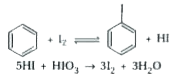
|
|
| 7. |
Aryl chlorides and bromides can be easily prepared by electrophilic substitution of arenes with chlorine and bromine respectively in the presence of Lewis acid catalysts. But why does preparation of aryl iodides requires presence of an oxidising agent ? |
| Answer» Solution :Iodination reactions are reversible in nature. To carry out the REACTION in the forward DIRECTION, HI formed during iodination is removed by oxidation. `HIO_(4)` is USED as an oxidising agent. | |
| 8. |
Aryl _________ and _________ cannot be prepared by direct halogenation. |
|
Answer» |
|
| 9. |
Aryl chlorides and bromides can be easily prepared by electrophilic substitution of arenes with chlorine and bromine respectively in the presence of Lewis acid catalysts. But why does preparation of aryl iodides require presence of an oxidising agent? |
|
Answer» SOLUTION :Iodination reactions are reversible in nature. To carry out reaction in the forward direction, HI formed during the reaction is removed by oxidation using iodic acid `(HIO_(3))` or NITRIC acid `(HNO_(3))` as the oxidising agent `5HI+HIO_(3)to3I_(2)+3H_(2)` `2HI+2HNO_(3)toI_(2)+2NO_(2)+2H_(2)O` |
|
| 10. |
Arylaminesare lessbasicthanalkyl amineandammoniawhich is due to |
|
Answer» In ARYL aminelonepairof electronon NITROGENIS conjugationwithbenzensringand thusmakinglessavaiblefor PROTONATION |
|
| 11. |
Aryl halides are less reactive towards nucleophilic substitution reaction as compared to alkyl halides due to |
|
Answer» The formation of less stable carbanion |
|
| 12. |
Arun a classXII student remarked that diesel is being used worldwide for running trucks, buses, boats, ships, trains, etc. due to the presence of nitrogen and sulphur compounds in it, the exhaust gases contain oxides of nitrogen and sulphur which are the major pollutants in our environement. he discussed this problem with his teacher and suggested that in place of diesel, we can use biodiesel which is non-toxic as well as biodegradable. After reading the above passage, answer the following questions: (i) What is biodiesel andhow can it be prepared? (ii) What is the by-product of the above process and how can it be used? (iii) What values are expressed by Arun by Suggesting theuse of biodiesel in place of diesel? |
Answer» Solution :(i) Biodiesel is actually a mixture of ethyl esters of higher fatty acids. It can be prepared by trans-esterification of triglycerides present in oils and fats with ethanol in presence of NaOH or KOH at low temperature.  (ii) The by-product of the above process is glycerol which can be used in SOAPS and other industrial products. (iii) The following environmental and economic concerns are displayed by ARUN. * It is made from renewable biological resources such as vegetable oils (primarily soyabea and Jatropha, waste vegetable oils from restaurants and soe animal fats). * Since biodiesel has extremely low sulphur content, it does not contribute to the formation of oxides of sulphur that produce acid rain. * Less dependence an IMPORTED petroleum DIESEL thereby improving the economy of our country. * The energy produced by combustion of biodiesel is ALMOST the same as energy produced by petroleum diesel. |
|
| 13. |
Artificial sweetner used in soft drinks is |
|
Answer» ASPARTAME |
|
| 14. |
Artificial sweetner which is stable under cold conditions only is : |
|
Answer» Saccharine |
|
| 15. |
Artificial sweetening agent is prepared from the below strategy. Identify the structure of final product |
|
Answer»
|
|
| 16. |
Artificial sweetener which is stable under cold conditions only is |
|
Answer» Saccharine |
|
| 17. |
Artificial sweetener which is not stable at cooking temperature is : |
|
Answer» Aspartame |
|
| 18. |
Artificial sweetener which is 600 times sweeter than sucrose is |
|
Answer» Asparatame |
|
| 19. |
Artificial sweetener used in soft drink is : |
|
Answer» GLUCOSE |
|
| 20. |
Artificial sweetener used by diabetic patients is : |
|
Answer» ASPARTAME |
|
| 22. |
Artificial radioactivity was first discovered by |
|
Answer» Seaberg |
|
| 23. |
Artificial elements have been prepared by bombardment reactions in high energy accelerators. What is the mass number of the element X produced in the following nuclear reaction ._(95)^(249)Cf + ._(7)^(15)N rarr ._(105)X + 4 ._(0)^(1)n |
|
Answer» 261 |
|
| 24. |
Artificial gens was first synthesised by: |
|
Answer» Khorana |
|
| 25. |
Artificial gene was first synthesised by: |
|
Answer» Khorana |
|
| 26. |
Articles made of copper and bronze slowly tarnish in air and turn geen. The green colour is due to the formation of: |
|
Answer» COPPER oxide |
|
| 27. |
Articles made of copper and bronze slowly tarnish in air and turn green. The green colour is due to the formation of: |
|
Answer» COPPER oxide |
|
| 28. |
Arsenous sulphide sol is prepared by passing H_2S through asenous oxide solution the charge developed on the particles is due to adsorption of |
|
Answer» `H^(+)` |
|
| 29. |
Arsine decomposes on heating to give As and H_(2). The decomposition studied at constant volume and temperature gives the following data. {:("T in hr.",0,5.5,6.5,8),("P in atm.",0.9654,1.06,1.076,1.1):} Calculate velocity constant, assuming first-order reaction. |
|
Answer» |
|
| 30. |
Arsine is a: |
|
Answer» SOLID |
|
| 31. |
Arsenic sulphide colloid is prepared by .............. |
|
Answer» hydrolysis |
|
| 32. |
Arsenic sulphide colloid can be prepared by ........... method. |
| Answer» SOLUTION :doubledecomposition | |
| 33. |
Arsenic (III) sulphide forms a sol with a negative charge. Which of the following ionic substances should be most effective in coagulating the sol? |
| Answer» Solution :More the charge on cation, more the effectiveness of the electrolyte. | |
| 34. |
Arsenic (III) sulphide forms a sol with a negative charge which of the following ionic substances should be most effective in coagulating the sol |
|
Answer» KCL |
|
| 35. |
Arsenic (III) sulphide form a sol with a negative charge which of the following ionic substances should be most effective in coagulating the sol |
|
Answer» KCI |
|
| 36. |
Arsenic drugs are mainly used in the treatment of |
|
Answer» JAUNDICE |
|
| 37. |
Arsenic drugs are mainly used in the treatment of : |
|
Answer» JAUNDICE |
|
| 38. |
Arsenic containing medicine used for tratment of syhillis is |
|
Answer» olfaxacin |
|
| 39. |
Arsenic containing medicine used for treatment of syphillis is |
|
Answer» ERYTHROMYCIN |
|
| 40. |
Arsenic containing medicine used for the treatment of syphilis, is |
|
Answer» crythromycin |
|
| 41. |
Arsenic containing medicine used for the treatment of syphilis is… |
|
Answer» Erythromycin |
|
| 43. |
Arrhenius studied the effect of temperature on the rate of a reaction and postulated that rate constant varies with temperature exponentially ask=Ae^(-E_(a)//RT). For most of the reactions it was found that the temperature coefficient of the reaction lies between 2 to 3. The method is generally used for finding the activation energy of a reaction. Keeping temperature constant, the effect of catalyst on the activation energy has also been studied by studying how much the rate of reaction changes in the presence of catalyst. In most of the cases, it is observed that catalyst lowers the activationenergy barrier and increases the rate of reaction. If the rate oc reaction grwos 15.6 times on increasing the temperature by 30 K the temperature coefficient of the reaction will be nearly |
|
Answer» 2 `r""MU^(1)r""mu^(2)r""mu^(3)r=r_(2)` `(r_(2))/r=mu^(3)=16.5,mu~=2.5` |
|
| 44. |
Arrhenius studied the effect of temperature on the rate of a reaction and postulated that rate constant varies with temperature exponentially ask=Ae^(-E_(a)//RT). For most of the reactions it was found that the temperature coefficient of the reaction lies between 2 to 3. The method is generally used for finding the activation energy of a reaction. Keeping temperature constant, the effect of catalyst on the activation energy has also been studied by studying how much the rate of reaction changes in the presence of catalyst. In most of the cases, it is observed that catalyst lowers the activationenergy barrier and increases the rate of reaction. Which of the following plot will be linear? |
|
Answer» In K VERSUS T with -ve slope |
|
| 45. |
Arrhenius studied the effect of temperature on the rate of a reaction and postulated that rate constant varies with temperature exponentially ask=Ae^(-E_(a)//RT). For most of the reactions it was found that the temperature coefficient of the reaction lies between 2 to 3. The method is generally used for finding the activation energy of a reaction. Keeping temperature constant, the effect of catalyst on the activation energy has also been studied by studying how much the rate of reaction changes in the presence of catalyst. In most of the cases, it is observed that catalyst lowers the activationenergy barrier and increases the rate of reaction. The pre-exponential factor in the Arrhenius equation of a second order reaction has the units |
|
Answer» MOL`L^(-1)s^(-1)` |
|
| 46. |
Arrhenius studied the effect of temperature on the rate of a reaction and postulated that rate constant varies with temperature exponentially as k=Ae^(-E_(a)//RT). For most of the reactions, it was found that the temperature coefficient of the reaction lies between 2 to 3. The method is generally used for finding the activation energy of a reaction. Keeping temperature constant, the effect of catalyst on the activation energy has also been studied by studying how much the rate of reaction changes in the presence of catalyst. In most of the cases, it is observed that catalyst lowers the activation energy barrier and increases the rate of reaction. If x is the fraction of molecules having energy greater than E_(a), it will be given by |
|
Answer» `X=-(E_(a))/(RT)` |
|
| 47. |
Arrhenius studied the effect of temperature on the rate of a reaction and postulated that rate constant varies with temperature exponentially as k=Ae^(-E_(a)//RT). For most of the reactions, it was found that the temperature coefficient of the reaction lies between 2 to 3. The method is generally used for finding the activation energy of a reaction. Keeping temperature constant, the effect of catalyst on the activation energy has also been studied by studying how much the rate of reaction changes in the presence of catalyst. In most of the cases, it is observed that catalyst lowers the activation energy barrier and increases the rate of reaction. If the rate of reaction doubles for 10^(@) rise of temperature from 290 K to 300 K, the activation energy of the reaction will be approximately |
|
Answer» `40" KJ mol"^(-1)` |
|
| 48. |
Arrhenius studied the effect of temperature on the rate of a reaction and postulated that rate constant varies with temperature exponentially as k=Ae^(-E_(a)//RT). For most of the reactions, it was found that the temperature coefficient of the reaction lies between 2 to 3. The method is generally used for finding the activation energy of a reaction. Keeping temperature constant, the effect of catalyst on the activation energy has also been studied by studying how much the rate of reaction changes in the presence of catalyst. In most of the cases, it is observed that catalyst lowers the activation energy barrier and increases the rate of reaction. If the rate of reaction grows 15.6 times on increasing the temperature by 30 K, the temperature coefficient of the reaction will be nearly |
|
Answer» 2 |
|
| 49. |
Arrhenius studied the effect of temperature on the rate of a reaction and postulated that rate constant varies with temperature exponentially as k=Ae^(-E_(a)//RT). For most of the reactions, it was found that the temperature coefficient of the reaction lies between 2 to 3. The method is generally used for finding the activation energy of a reaction. Keeping temperature constant, the effect of catalyst on the activation energy has also been studied by studying how much the rate of reaction changes in the presence of catalyst. In most of the cases, it is observed that catalyst lowers the activation energy barrier and increases the rate of reaction. Which of the following plot will be linear ? |
|
Answer» LN k VERSUS T with - ve slope |
|
| 50. |
Arrhenius studied the effect of temperature on the rate of a reaction and postulated that rate constant varies with temperature exponentially as k=Ae^(-E_(a)//RT). For most of the reactions, it was found that the temperature coefficient of the reaction lies between 2 to 3. The method is generally used for finding the activation energy of a reaction. Keeping temperature constant, the effect of catalyst on the activation energy has also been studied by studying how much the rate of reaction changes in the presence of catalyst. In most of the cases, it is observed that catalyst lowers the activation energy barrier and increases the rate of reaction. The pre-exponential factor in the Arrhenus equation of second order reaction has the units |
|
Answer» `"mol L"^(-1)s^(-1)` |
|


