Saved Bookmarks
This section includes 7 InterviewSolutions, each offering curated multiple-choice questions to sharpen your Current Affairs knowledge and support exam preparation. Choose a topic below to get started.
| 1. |
Change in Amino acid sequence leads to |
|
Answer» mutation |
|
| 2. |
Chalk powder is added to hydrolysed solution of starch during the manufacture of glucose |
|
Answer» for HYDROLYSIS it is necessary |
|
| 3. |
Chalgogens are also called as ……………… . |
|
Answer» Ore forming ELEMENTS |
|
| 4. |
Chald power is added to the hydrolysed solution of starch, in the manufacture of glucose. Give reasons. |
|
Answer» Solution :In the manufacture of glucose, STARCH is HYDROLYZED by dilute sulphuric acid. To neutralize EXCESS of acid, chalk powder is added. Chalk power is calcium carbonate `(CaCO_(3))` which reacts and neutralizes excess acid and forms precipitate of calcium sulphate which can be removed by filtration. `H_(2)SO_(4)+CaCO_(3)overset("Neutralization")rarr CaSO_(4) darr +H_(2)O+CO_(2)` |
|
| 5. |
Chalcogens belongs to p - block. Give reason. |
| Answer» Solution :Chalcogens are ore forming ELEMENTS. Most of the ores are OXIDES and sulphides, therefore oxygen, sulphur and other group 16 elements are called Chalcogens. In O, S, Se, TE and `P_(o)` LAST electron enters to p - orbital. Therefore Chalcogens BELONGS to p - block. | |
| 6. |
Chalcogens belongs to p-block. Give reason. |
| Answer» SOLUTION :Chalcogens are ore FORMING elements. Most of the ores are oxides and SULPHIDES, therefore oxygen, sulphur and other group 16 elements are called Chalcogens. In `O, Te and P_(o)` last electron enters t o p - orbital. Therefore Chalcogens BELONGS to p - block. | |
| 7. |
Chalcogens are |
|
Answer» Oxide FORMING ELEMENT |
|
| 8. |
Chalcogens are : |
|
Answer» HYDROCARBONS |
|
| 9. |
Chair form of S_(6) rings are present in |
|
Answer» `alpha` - SULPHUR |
|
| 10. |
Chair form of cyclohexane is more stable than boat form because : |
|
Answer» In CHAIR form carbons are in staggered form and in boat form carbons are in eclipsed form |
|
| 12. |
Chain initiation and chain propagation steps are involved in |
|
Answer» all |
|
| 13. |
Chain growth polymerization may proceed by the following mechanism |
|
Answer» Condensation polymerization Free radical mechanism Initiation `R-overset(O)overset(||)(C)-O-O-overset(O)overset(||)(C)-R overset(DELTA)2R -underset(O)underset(||)(C)-O^(.)` `R-underset(O)underset(||)(C)-O^(.) to R^(.) +CO_(2)` Propagation, `R^(.)+ nCH_(2) =CH_(2) to R-CH_(2)-CH_(2)` `(-CH_(2)-CH_(2)-)_(n) CH_(2) overset(.)(C)H_(2)` Termination, `overset(.)(R)+overset(.)(R) to R-R ` `2R-CH_(2)CH_(2)-(CH_(2)-CH_(2)-)_(n) CH_(2) overset(.)(C)H_(2) to R-CH_(2)CH_(2)-(-CH_(2)-CH_(2)-)_(n) CH_(2)CH_(2)R` Ionic These are initiated by `CuSO_(4).HF` in `H_(2)O` for cationic polymerization . Initiation `H_(2)SO_(4)H^(+) +F^(-)` `H^(+) +CH_(2) =CH_(2) to CH_(3) CH_(2) -(CH_(2)-CH_(2)-)_(n)CH_(2)-overset(o+)(C)H_(2)` Termination  Hence choices (b),(c) and (d) are correct while (a) is incorrect. |
|
| 14. |
Chain growth polymerisation is important reaction for ? |
|
Answer» PTFE |
|
| 15. |
CH_(4) underset(hv)overset(Cl_(2))rarr A overset(Na)rarr B underset(hv)overset(Cl_(2))rarr C underset(NaOH)overset("aqueous")rarr D overset((O))rarrE underset(K_(2)O_(2)O_(7)//H^(+))overset((O))rarr F overset(Ca(OH)_(2))rarr G overset("Heat")rarr H. What is the functional isomer of the product 'H'. |
| Answer» SOLUTION :`C_(2)H_(5)CHO` | |
| 16. |
CH_(4) rarr C Cl_(4). In the above conversion what happens to the oxidation number of carbon |
|
Answer» |
|
| 17. |
CH_4 is formed when |
|
Answer» SODIUM acetate is heated with sodalime `underset"Iodomethane"(CH_3I)+2Hunderset"reduction"to CH_4+HI` `underset"Aluminium carbide"(Al_4C_3 + 6H_2O)to 3CH_4 + 2Al_2O_3` |
|
| 18. |
CH_4 gas is obtained in :- (a)Hydrolysis of Al_4C_3 (b)Hydrolysis of Be_2C (c )Hydrolysis of Mg_2C_3 (d) Hydrolysis of CaC_2 |
|
Answer» only a, B, C `Be_2C + 4H-OH to 2Be(OH)_2+CH_4` |
|
| 19. |
CH_(4) (g) and O_(2) (g) react according to the given equation: CH_(4) (g) + 2O_(2) (g) rarr CO_(2) (g) + 2H_(2) O (l) Assuming that reaction take placed and goes to completion.If valve is opened then [Assume temperature remains constant 300 K throughout ] |
|
Answer» `CH_(4)` gas is left after the reaction `n_(O_(2)) = (1 xx 1)/(R xx 300) = (1)/(300 R)` `{:(,CH_(4) (g),+,2O_(2) (g),RARR,CO_(2) (g),+,2H_(2) o (l),),("Mole initially",(1)/(300R),,(1)/(300 R),,-,,-,):}` `O_(2)` is LR `CH_(2)` will be left after the reaction `{:("Mole at",(1)/(600 R),0,(1)/(600 R),-,),("Completion",,,,,):}` Total moles after completion `= n_(CH_(4) + n_(CO_(2))` `= (1)/(600 R) + (1)/(600 R)` `(1)/(300 R)` `P = (nRT)/(V) = (1)/(300 R) xx (R xx 300)/(3) = (1)/(3)` atm |
|
| 20. |
CH_4+ Cl_2 underset(-HCl)overset(hv)(rarr) A underset(-HCl)overset(+Cl_2)(rarr)B underset(-HCl)overset(+Cl_2)(rarr) C C underset(-HCl)overset(+Cl_2)(rarr) D Correct order of Dipole moments is |
|
Answer» ` D GT C gt B gt A ` |
|
| 21. |
CH_(4)+Cl_(2)overset(hv)(to)CH_(3)Cl+HCl the order of this reaction is |
| Answer» ANSWER :A | |
| 22. |
CH_3underset(CH_3)underset(|)oversetoverset(CH_3)|C-undersetunderset(OH)|CHCH_3 overset(HBr)to A(predominant), A is |
|
Answer» `(CH_3)_3C oversetoverset(BR)|CHCH_3` |
|
| 23. |
CH_(3)overset(O)overset(||)(C)-Cl overset(x)rarr CH_(3)CHO. CH_(3)-overset(O)overset(||)(C)-Cl overset(y)rarr CH_(3)-overset(O)overset(||)(C)-CHO What are x and y ? |
|
Answer» PD-`BaSO_(4)`/Quinoline, `(CH_(3))_(2)CD` |
|
| 24. |
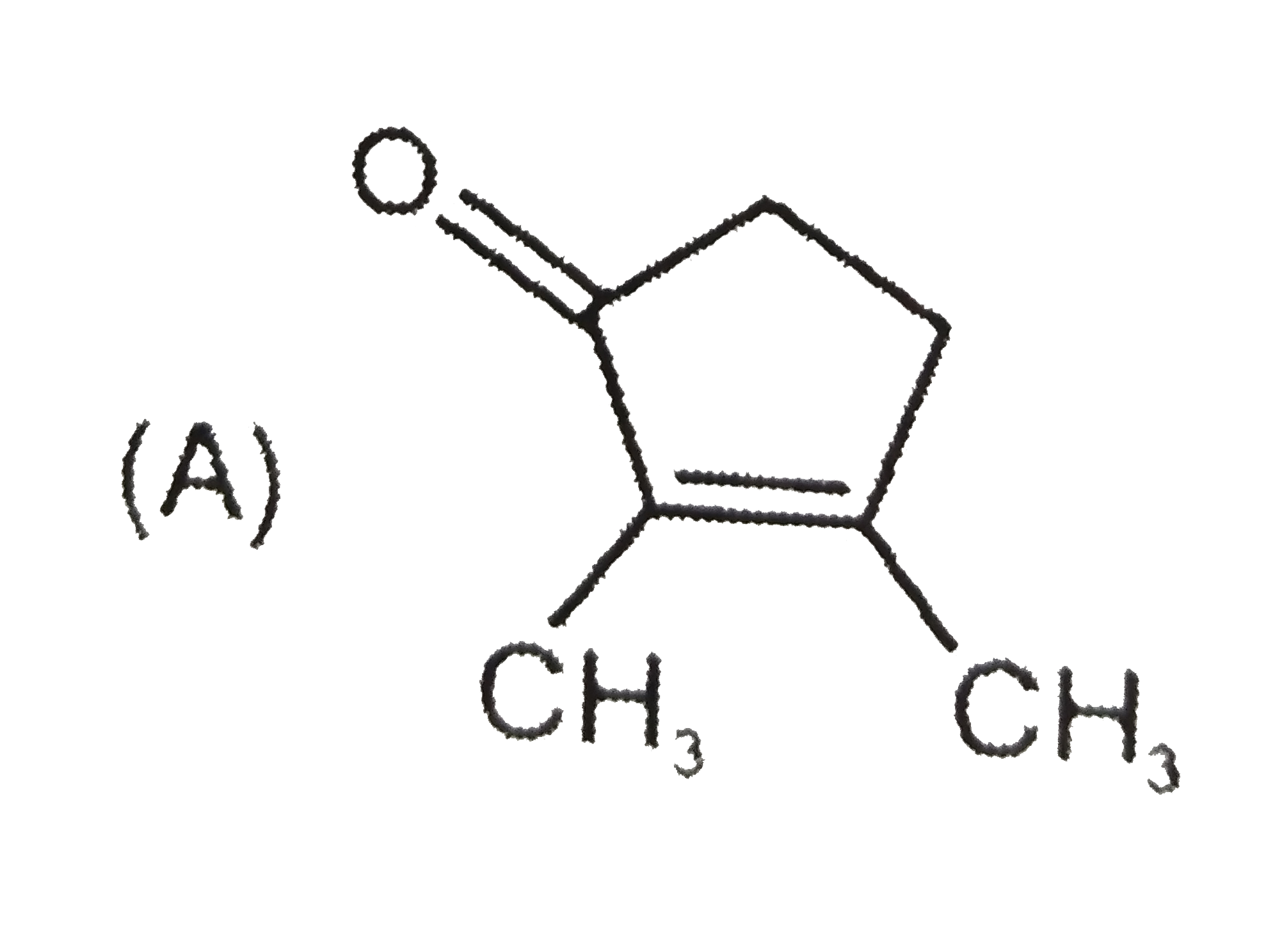
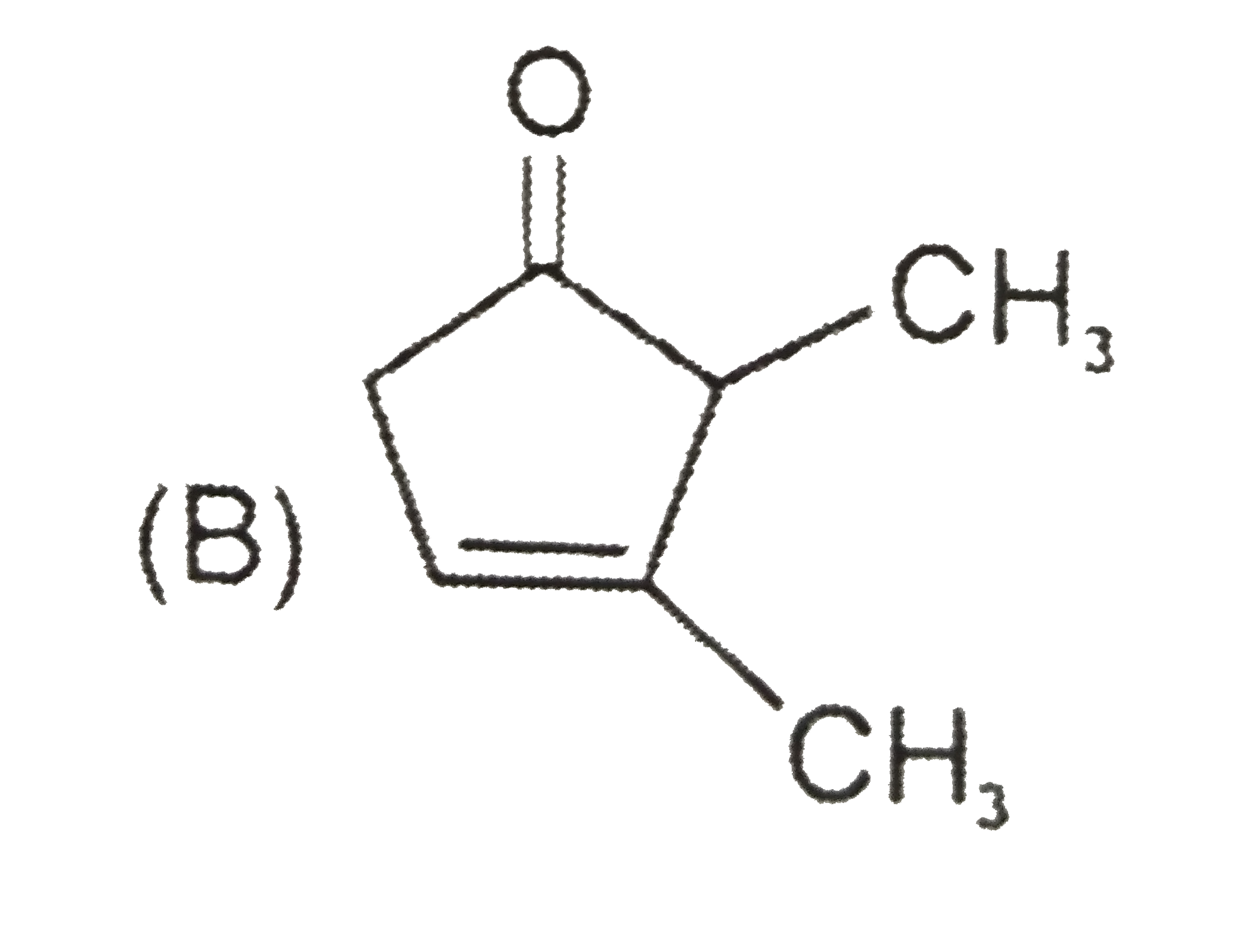
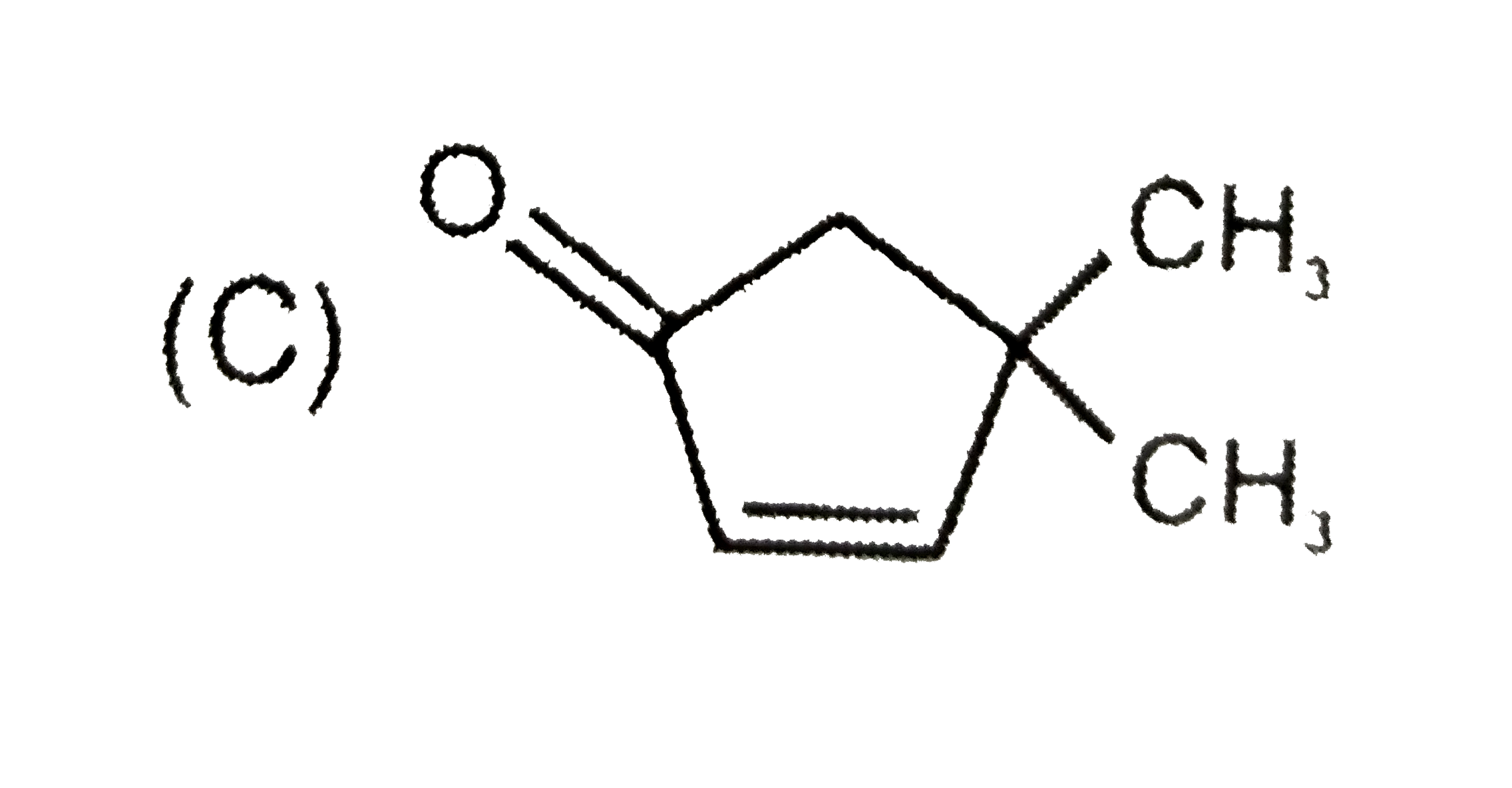
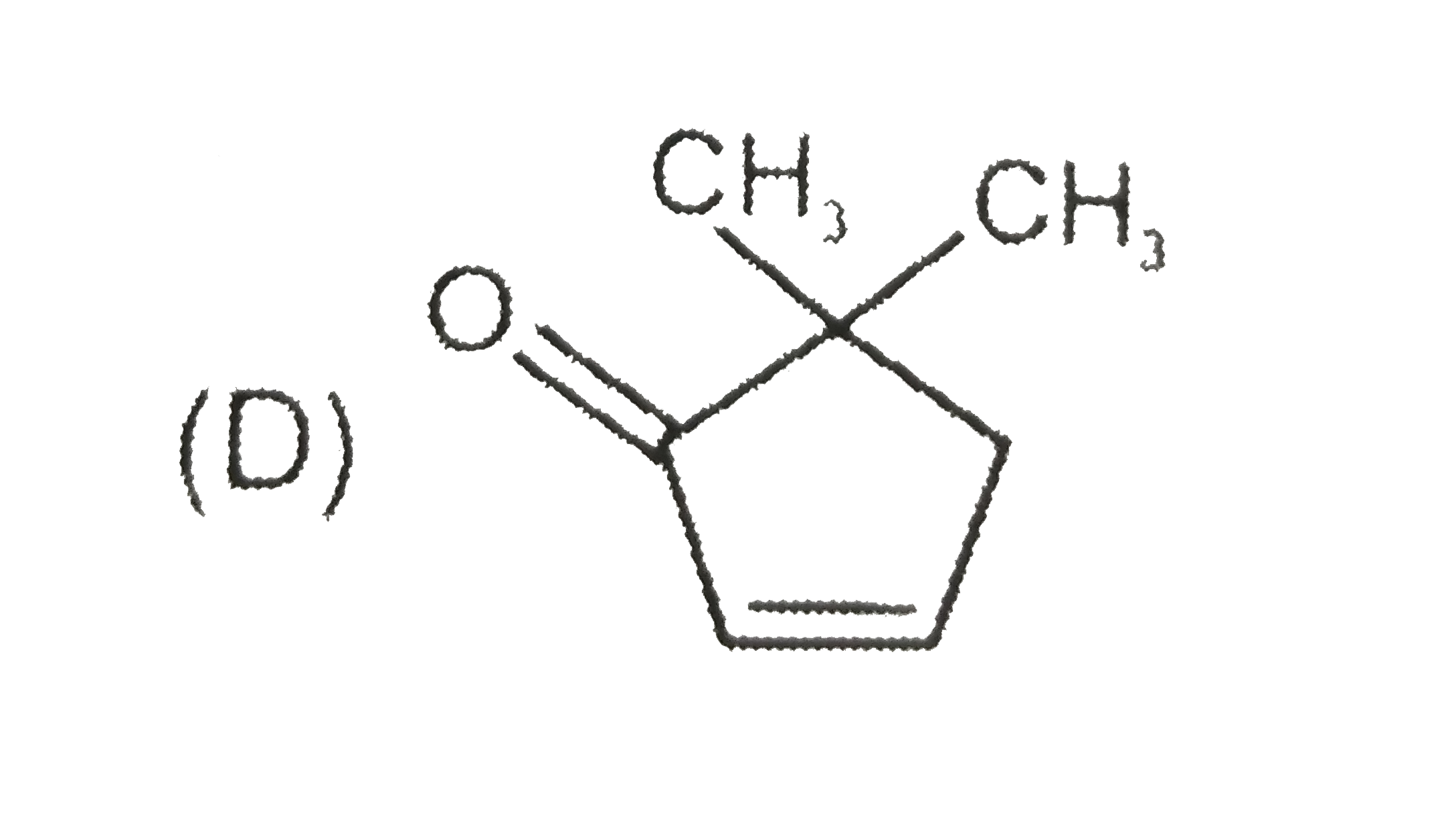
CH_(3)overset(O)overset(||)(C)CH_(2) overset(CH_(3))overset(|)underset(CH_(3))underset(|)(C)CHO overset(KOH,H_(2)O)underset(Delta)to product (C_(7)H_(10)O) : |
|
Answer»
|
|
| 25. |
CH_(3)-overset(CH_(2)CH_(3))overset(|)(CH)CH=CHCH_(3)overset(H_(3)O^(+))rarr Major product of the reaction |
|
Answer» is an potical isomer 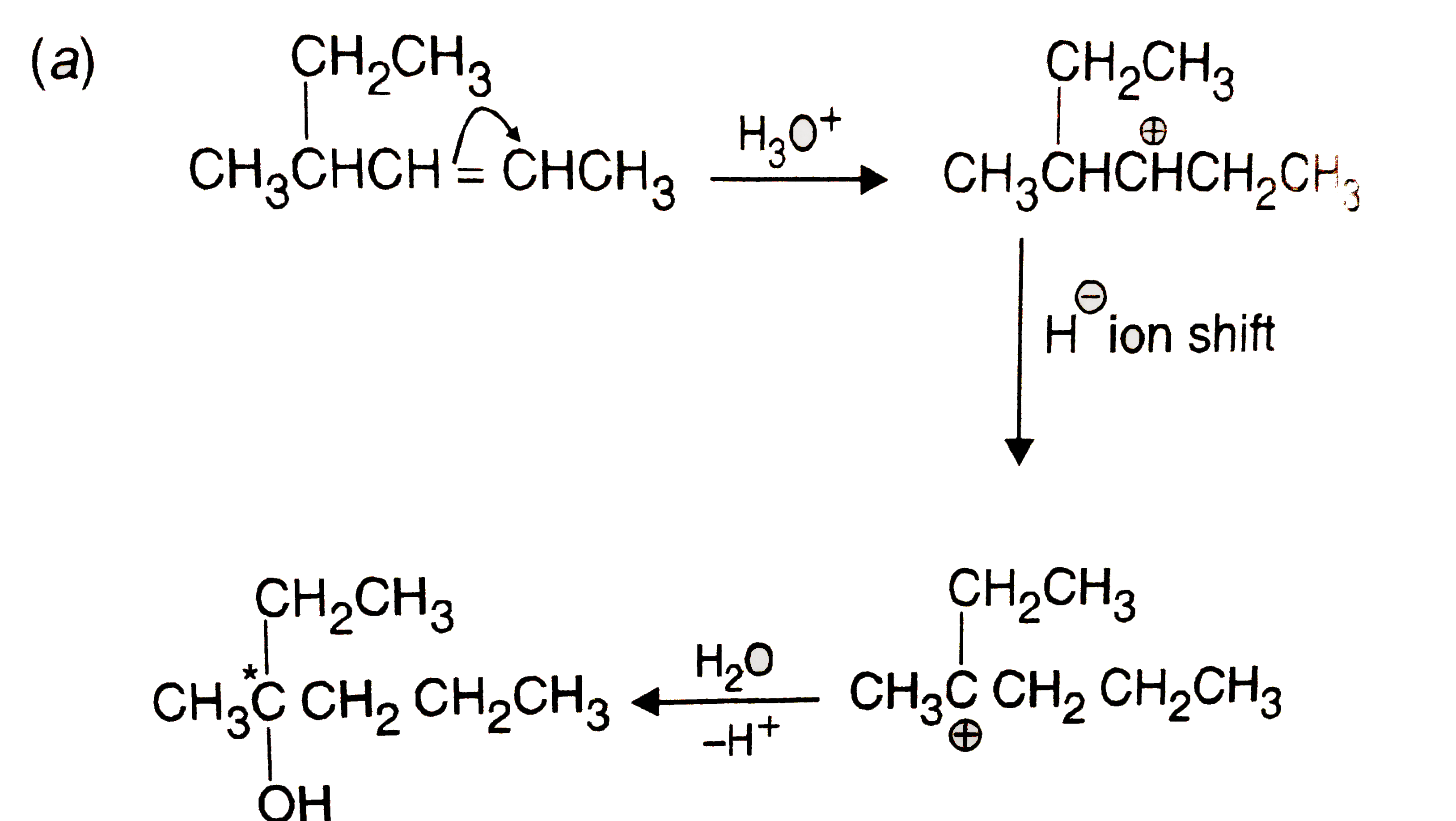 The alcohol FORMED is: Optically ACTIVE Gives white turbidity with Lucas reagent immediately as it is a tertiary alcohol is dehydrated easily |
|
| 26. |
CH_(3)OH+ C_(6)OH+ C_(6)H_(5)COOH overset(H^(+)) hArr X+ H_(2)O : What is X? |
|
Answer» Phenyl methanol |
|
| 27. |
CH_3OCH_2CH_3 overset(+HI)(to) CH_3I + CH_3CH_2OHIt follows which mechanism ? |
|
Answer» `S_N1` |
|
| 28. |
CH_(3)OC_(2)H_(5) and (CH_(3))_(3)COCH_(3) are treated with hydriodic acid. The fragments after reaction obtained are: |
|
Answer» `CH_(3)I+HOC_(2)H_(5), (CH_(3))_(3)C-I+HOCH_(3)` |
|
| 29. |
CH_(3)O-CH=CH_(2)underset(H^(+))overset(CH_(3)OH)rarrproduct formed is |
|
Answer» Aceta |
|
| 31. |
CH_(3)NO_(2)overset(Sn_(+)HCl)rarrCH_(3)X, the 'X' contain |
|
Answer» `-NH_(2)` |
|
| 32. |
CH_(3)NO_(2) overset(300^(@)C)rarr X + Y + Z In this sequence X + Y + Z are |
|
Answer» METHANE `+N_(2) + CO_(2)` |
|
| 33. |
CH_3NO_2+6[H] overset(X?)(to)CH_3NH_2+2H_2O. 'X' is |
|
Answer» `Sn"/"HCl` |
|
| 34. |
CH_(3)NH_(2) overset((CH_(3))_(2)O)to (A) What is (A)? Explains why (A) is less reactive than methylamine? |
Answer» SOLUTION :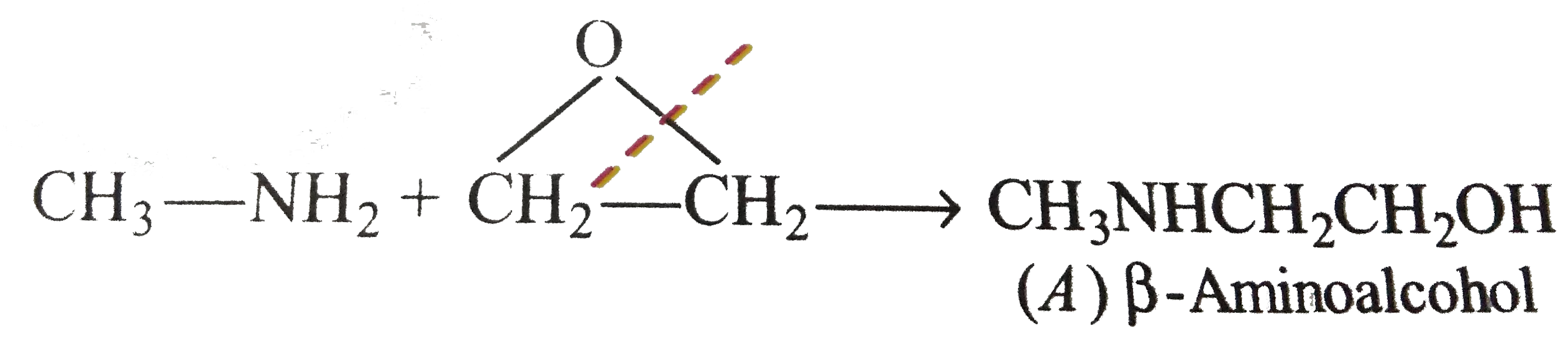 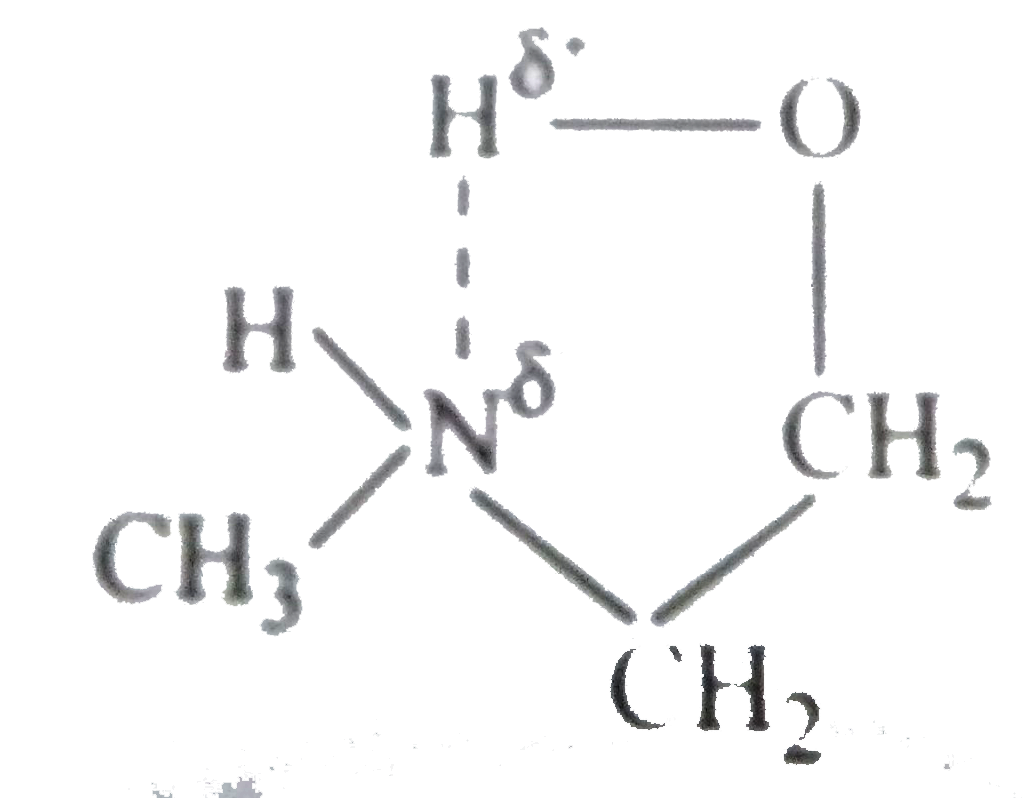
|
|
| 36. |
CH_3NH_2 reacts with CH_3MgX to give: |
|
Answer» Acetone |
|
| 37. |
CH_(3)NH_(2) is obtained fromNH_(3) by |
|
Answer» Hoffmansreaction |
|
| 38. |
CH_3NH_2+CHCl_3 + KOH to "Nitrogen containing compound" + KCl + H_2O The nitrogen containing compound is |
|
Answer» `CH_3-C-=H` |
|
| 39. |
CH_(3)NH_(2)+CHCI_(3)+KOHrarr nitrogen containing compound + KCI+H_(2)O . Nitrogen containing compound is |
|
Answer» `CH_(3)-C-=N` This is known as carbylamine reaction . |
|
| 40. |
CH_3NH_2 + CH_3COCl rarr _____ + HCl |
| Answer» SOLUTION :`CH_3CONHCH_3` | |
| 41. |
CH_(3)I overset(DMSO)rarr[X]. The major product [X] is |
|
Answer» `"["Me _(3)overset(+)S=O"]"I^(-)` `:.` Methylation of DMSO with Mel gives two isomers (A) and (B) from S-methylation and from O-methylation, respectively. Since .S. is better nucleophilic site ( because .O. is more electronegative than .s. ), (A) is the major product 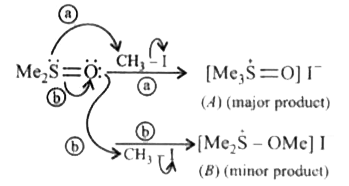
|
|
| 42. |
CH_(3)COONH_(2) is a weaker base than CH_(3)CH_(2)NH_(2). Why? |
| Answer» SOLUTION :Due to resonance, the lone pair of electrons on the nitrogen atom in `CH_(3)CONH_(2)` is delocalised over the keto group. There is no such EFFECT IP `CH_(3)CH_(2)NH_(2)`. Due to reduction in electron density on N-atom of `CH_(3)CONH_(2)` It is a weaker BASE than `CH_(3)CH_(2)NH_(2)`. | |
| 43. |
CH_(3)COOHoverset(LiAlH_(4))(to)X underset(300^(@)C)overset(Cu)(to) Y underset(NaOH)overset("dilut")(to)Z In the above reactionZ is |
|
Answer» Aldol `underset(Y)(CH_(3)CHO)overset(dil.NaOH)(to)CH_(3)-underset(Z)underset(OH)underset(|)(CH)-CH_(2)CHO` Acetaldehyde (Y) UNDERGOES aldol condensation in presence of dilute caustic alkali to form aldol. |
|
| 44. |
CH_(3)COOH underset(P_(2)O_(5))overset(Delta)toX. Identify X |
|
Answer» `CH_(3)COCH_(3)` |
|
| 45. |
CH_(3)"COOH" underset(Br_(2))overset("AgOH")(rarr)"[A]" overset("AgCN") [B] overset("HOH")(rarr) [ C] + [D], in reaction [C] & [D] are |
|
Answer» `(CH_(3))_(2) NH + H_(2)`O |
|
| 46. |
CH_3COOH reacts rapidly with : |
|
Answer» `CH_3CH_2OH` |
|
| 47. |
CH_(3)COOH overset(LiAlH_(4))toA A+CH_(3)COOH overset(H_(3)O^(+))to B+H_(2)O In the above reaction 'A' and 'B' respectively are |
|
Answer» `CH_(3)COOC_(2)H_(5),C_(2)H_(5)OH` |
|
| 48. |
CH_(3)COOH overset(Delta)rarr CH_(3)COCl, What is A? |
|
Answer» `PCl_(5)` `therefore` A is `PCl_(5)`. It can also be `SOCl_(2)`. |
|
| 49. |
CH_(3)COOH overset((i) PCl_(3)+Cl_(2) ("excess"))underset((ii) O_(2))to (X) overset(SOCl_2) to (Y) overset(H_(2)//Pd//BaSO_(4))to(Z) overset(OH^(-))to W+S Write the structure of X,Y,Z , W and S |
|
Answer» |
|
| 50. |
CH_(3)COOH is weaker acid than H_(2)SO_(4). It is due to |
|
Answer» More IONIZATION |
|