Saved Bookmarks
This section includes 7 InterviewSolutions, each offering curated multiple-choice questions to sharpen your Current Affairs knowledge and support exam preparation. Choose a topic below to get started.
| 1. |
An unknown substance that uses gas at room temperature can be condensed to a solid at –80^(@)C. As a solid, it is found to have cubic unit cell, 5.15 Å on each side, containing four molecules. The density of solid is 0.73 g/cm3. What is the density of the substance as a gas at 27(@)C and at a pressure of 1.00 atmopshere ? |
|
Answer» Solution :For a cubic unit CELL: DENSITY `(rho)=(nM)/(N_(A)a^(3))` Where, n : No. of molecules per unit cell, M = Molar mass NA = Avogadro's constant, a = Edge length of unit cell.`IMPLIES` 0.73 g//cm^(3)=(4xxm)/(6.023xx10^(23)(5.15xx10^(-6)cm)^(3))` M=15 g/mol M Molar mass of a SUBSTANCE is independent of state. `impliesAs a gas ,Density `(rho)=(pM)/(RT)=(1.05xx15)/(0.082xx300)` 0.6097 g/L |
|
| 2. |
An unknown substance (P) functions as weak base in water. It produces silver mirror test. It reacts with dilute HCl to produce (Q) which turns blue litmus red (P) may be: |
|
Answer» `NH_(3)` |
|
| 3. |
An unknown substance (P) shows optical activity. This optical activity disappears on treatment of (P) with acidified KMnO_(4) (which produces Q), or with heated copper (which produces R). (P) Produces silver mirror with Tollen's reagent, thereby producing (S). (S) is chiral. Based on this information, answer the following questions : Number of stereoisomers possible for (P) is- |
|
Answer» 2 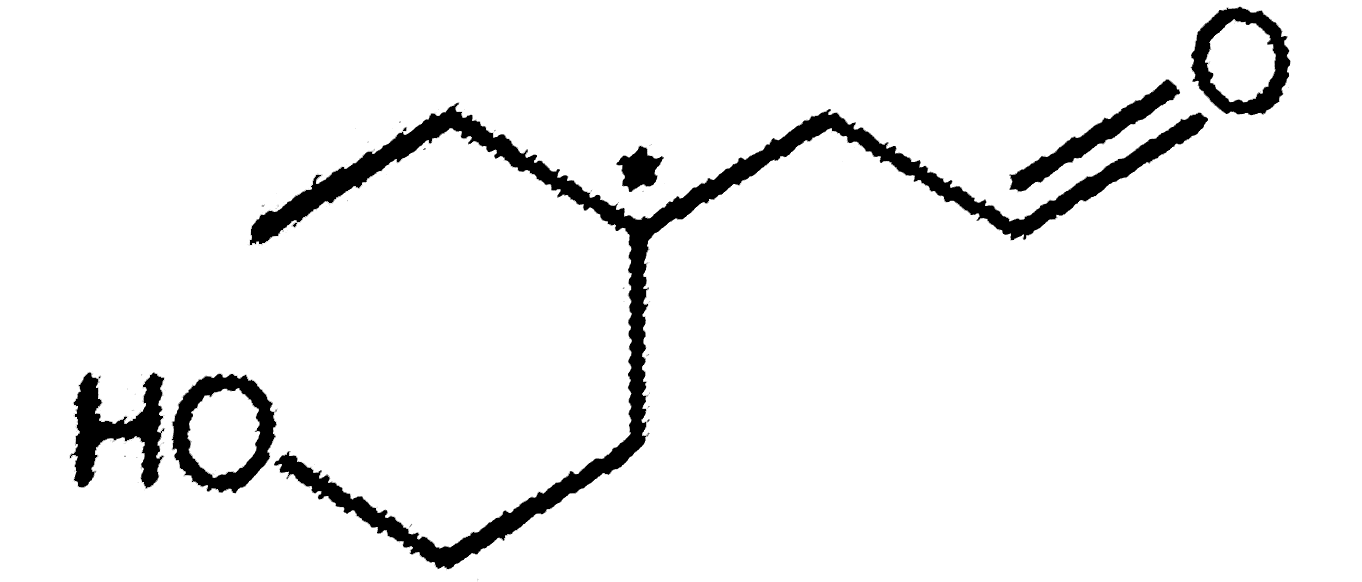 ONE chiral center MAY have(R) or (S) configuratoin. HENCE, two STEREOISOMERS. |
|
| 4. |
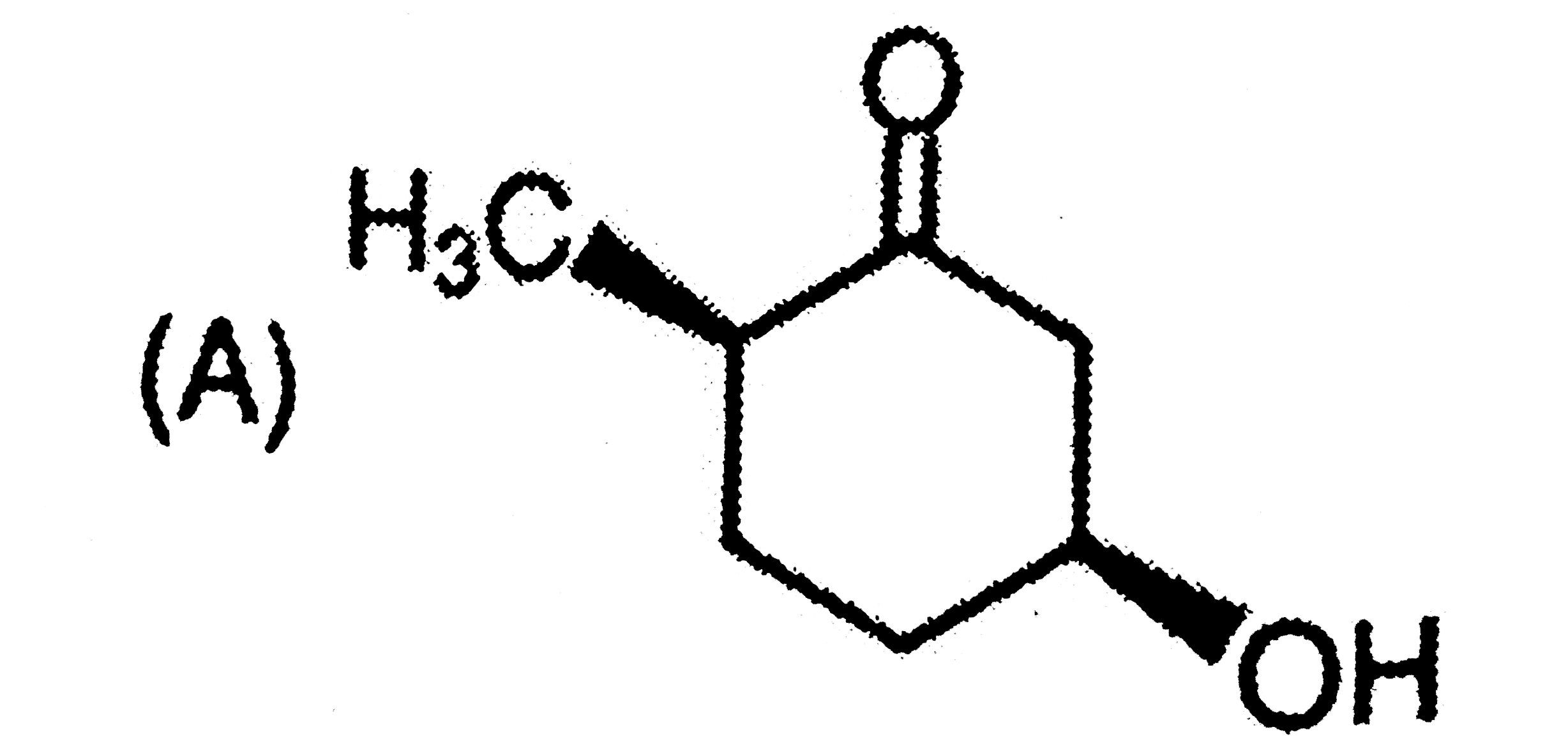
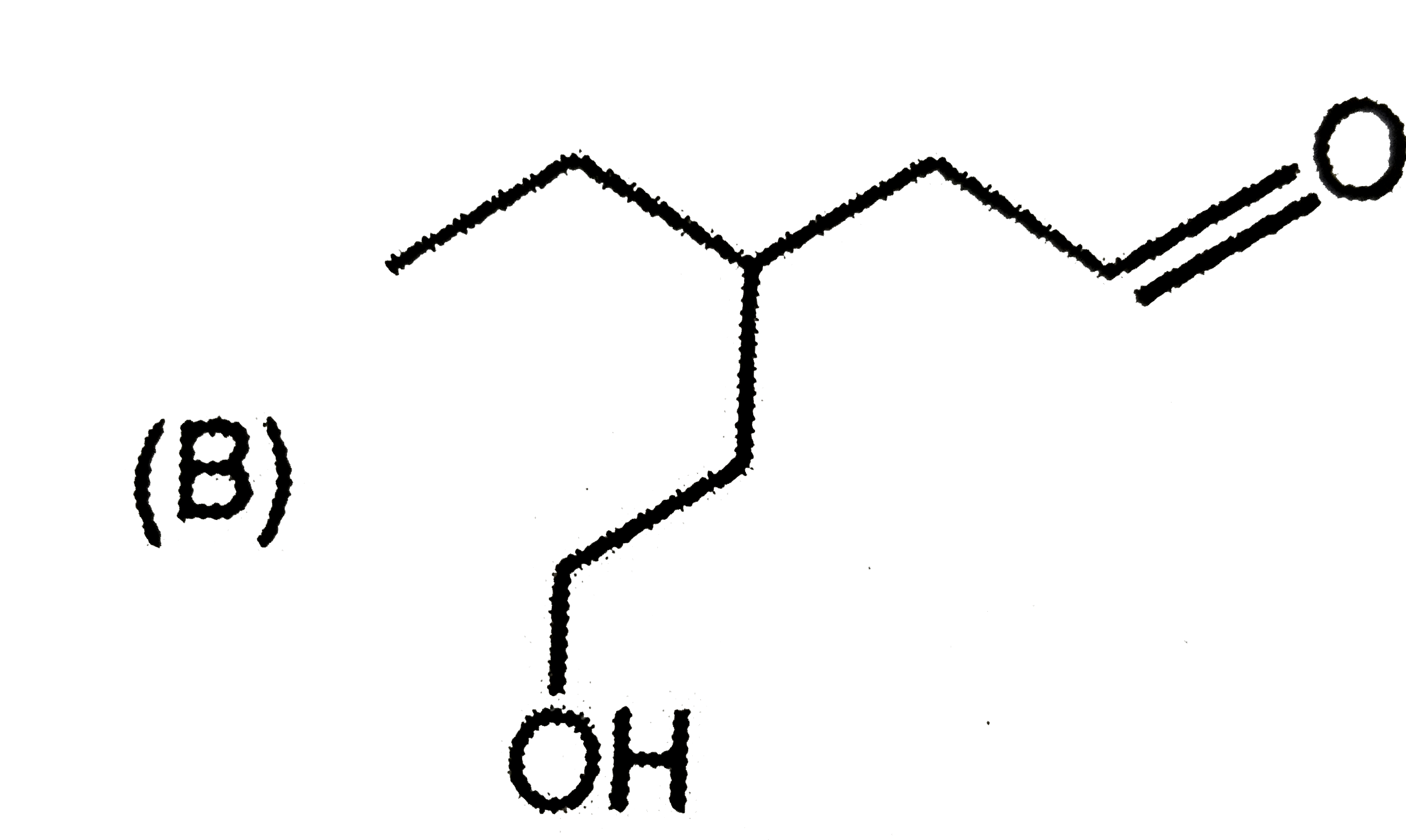
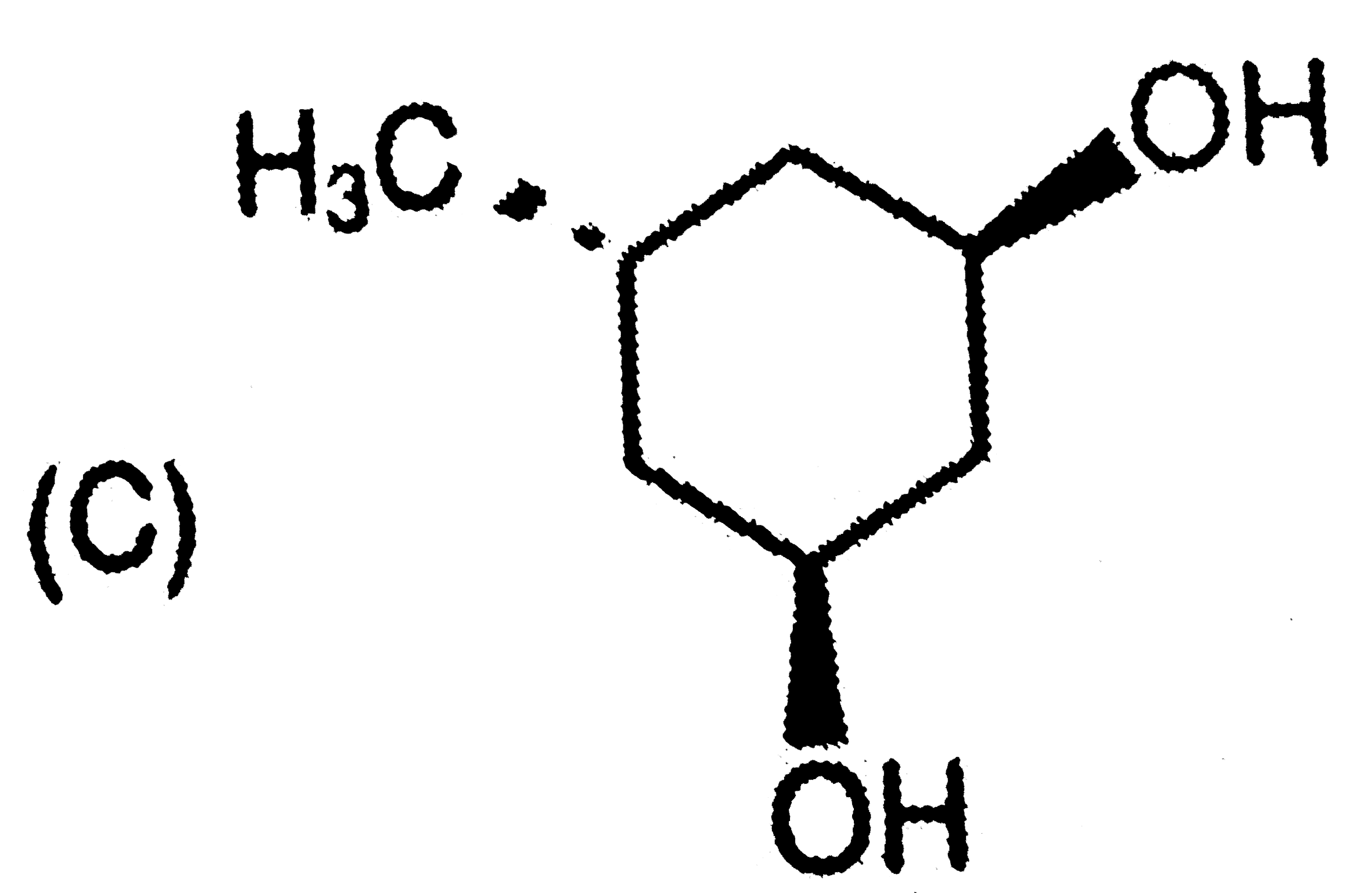
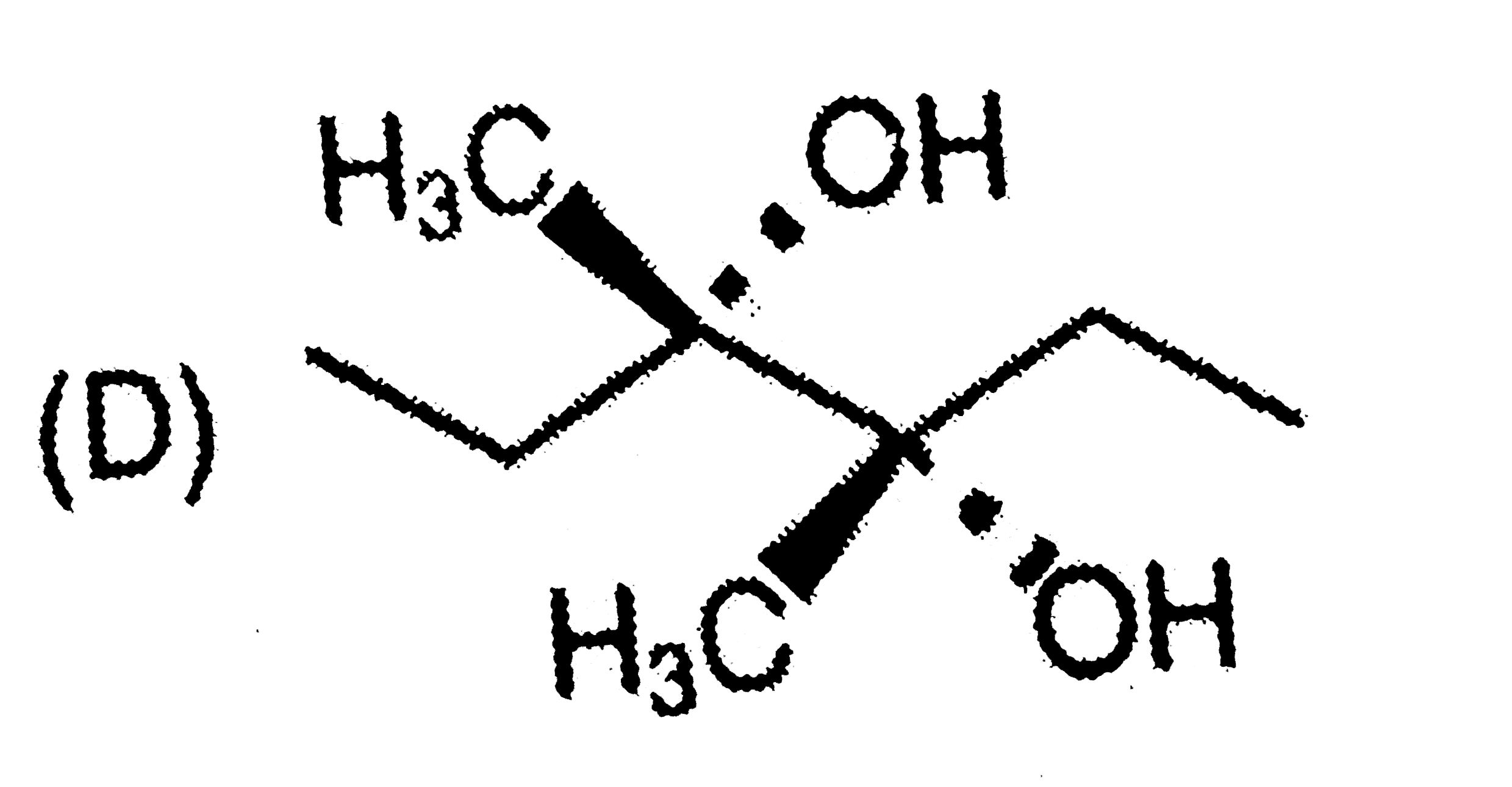
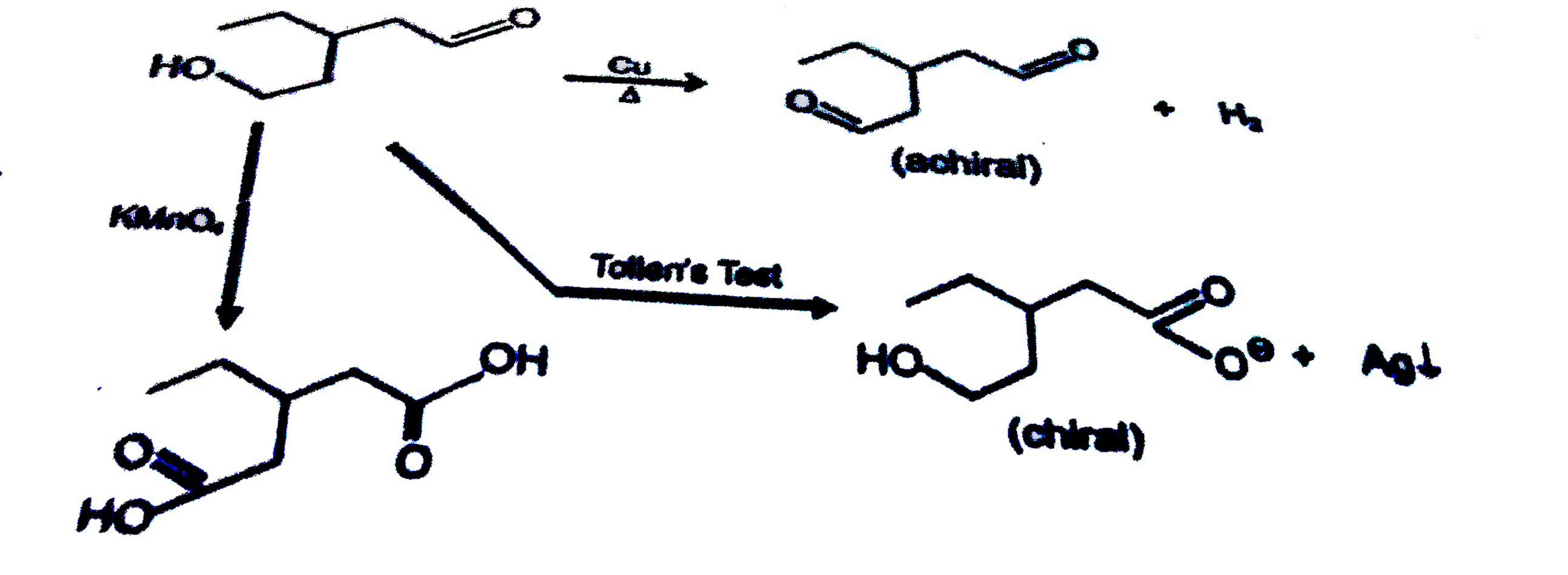
An unknown substance (P) shows optical activity. This optical activity disappears on treatment of (P) with acidified KMnO_(4) (which produces Q), or with heated copper (which produces R). (P) Produces silver mirror with Tollen's reagent, thereby producing (S). (S) is chiral. Based on this information, answer the following questions : (P) may be- |
|
Answer»
|
|
| 5. |
An unknown oxidising agent contains the element Y in + 5 state. If it takes 26.98 ml of 0.1326 N Na_2SO_3 to reduce 7.16x10^(-1) mole of YO(OH)_2, to a lower state, the final oxidation state of Y is- |
| Answer» Solution :(C) 26.98 mL. of 0.1326 N solution of `Na_2SO_3`, contains (26.98) (0.1326) miliequivalents of `Na_2SO_3`, By DEFINITION eq. wt. of `Na_2SO_3`, is that weight which would cause a one electron reduction of a oxidising agent USED is 7.16 `xx 10^(-1)` millimoles then the no. of electrons involved in the redox reaction is `(26.98 x 0.1326/7.16 x0.1)= 5` electrons`Y^(5+) +5e^(-) rarr Y^(0)` and the final oxidation state of Y is zero. | |
| 6. |
An unknown organic compound (A) having M.F. C_(3)H_(8)O_(3) reacts with an excess of acetyl chloride gives an acetyl derivative with M.Wt. 218. Then howmany hydroxyl groups are in 'A'. |
|
Answer» 2 |
|
| 7. |
An unknown organic compound is soluble in water. It gives negative test with 2. 4-DNP but positive test with Lucas reagent. Compound should have : |
| Answer» Solution :` - OH `group | |
| 8. |
An unknown mixture contains one or two of the following: CaCO_(3),BaCl_(2),AgNO_(3),Na_(2)SO_(4),ZnSO_(4) and NaOH. The mixture is completely soluble in water and solution gives pink colour with phenolphthalein. When dilute hydrochloric acid is gradually added to the solution, a precipitate is formed which dissolved with further addition of the acid. Q. The aqueous solution of mixture gives white precipitate with dil. HCl which dissolves in excess of dil HCl . it confirms. |
|
Answer» `BaCl_(2)+NaOH` `NaOH+ZnSO_(4) to underset("SOLUBLE")(Na_(2)ZnO_(2))+Na_(2)SO_(4)+2H_(2)O` `Na_(2)ZnO_(2)+2HCl to 2NaCl+Zn(OH)_(2)darr` `Zn(OH)_(2)+2HCl to underset("soluble")(ZnCl_(2))+2H_(2)O` |
|
| 9. |
An unknown mixture contains one or two of the following: CaCO_(3),BaCl_(2),AgNO_(3),Na_(2)SO_(4),ZnSO_(4) and NaOH. The mixture is completely soluble in water and solution gives pink colour with phenolphthalein. When dilute hydrochloric acid is gradually added to the solution, a precipitate is formed which dissolved with further addition of the acid. Q. The white precipitate is |
|
Answer» `ZnSO_(4)` `NaOH+ZnSO_(4) to underset("soluble")(Na_(2)ZnO_(2))+Na_(2)SO_(4)+2H_(2)O` `Na_(2)ZnO_(2)+2HCl to 2NaCl+Zn(OH)_(2)darr` `Zn(OH)_(2)+2HCl to underset("soluble")(ZnCl_(2))+2H_(2)O` |
|
| 10. |
An unknown mixture contains one or two of the following: CaCO_(3),BaCl_(2),AgNO_(3),Na_(2)SO_(4),ZnSO_(4) and NaOH. The mixture is completely soluble in water and solution gives pink colour with phenolphthalein. When dilute hydrochloric acid is gradually added to the solution, a precipitate is formed which dissolved with further addition of the acid. Q. Which of the following combination of compounds is soluble in water? |
|
Answer» `BaCl_(2) and AgNO_(3)` `NaOH+ZnSO_(4) to underset("soluble")(Na_(2)ZnO_(2))+Na_(2)SO_(4)+2H_(2)O` `Na_(2)ZnO_(2)+2HCl to 2NaCl+Zn(OH)_(2)darr` `Zn(OH)_(2)+2HCl to underset("soluble")(ZnCl_(2))+2H_(2)O` |
|
| 11. |
An unknown metal M displaces nickel from nickel (II) sulphate solution but does not displace magnese from magnese sulphate solution which order represents the correct order of reducing power? |
|
Answer» `MngtNigtM` `therefore` Order of O.P. is `NiltMltMn` More the O.P. ester to oxidise stronger is the reducing power. `therefore` Correct order of reducing power. `MngtMgtNi`. |
|
| 12. |
An unknown metal M displaces nickel from (II) sulphate solution but does not displace manganese from manganese sulphate solution . Which order represents the correct order of reducing power ? |
|
Answer» `Mn gt Ni gt M` GREATER the oxidation potential , greater is the reducing power. |
|
| 13. |
An unknown metal is found to have a specific gravity of 10.2 at 25°C. It is found to crystallize in a body-centred cubic lattice with a unit cell edge length of 3.147 A. Calculate the atomic weight. |
|
Answer» |
|
| 14. |
An unknown gas 'X' diffuses four times as quickly as oxygen. The molar mass of the unknown gas is : |
|
Answer» 2 `( 4x)/( x)= SQRT(( 32)/( M))` or M = 2 |
|
| 15. |
An unknown element X has atomic number 88 and mass number 228. This element is decaying by alpha"and"betaemission. Calculate the total number of ._-(1)^(""0) beta particles emitted by element. |
|
Answer» |
|
| 16. |
An unknown element forms an oxide. What will be the equivalent mass of the element if the oxygen content is 20% by mass? |
|
Answer» 16 `=(80)/(20)xx8=32` |
|
| 17. |
An unknown compound on ozonolysis to give acid C_(3)H_(6)O_(2) and a ketone C_(4)H_(8)O. From this information identify structure of unknown compound. |
|
Answer» `(CH_(3))_(2)C=CHCH_(2)-CH_(2)CH_(3)` |
|
| 18. |
An unknown compound of car bon, hydrogen and oxygen contains 69.77% carbon and 11.63% hydrogen and has a molecular weight of 86. It does not reduce Fehling solution, but forms a bisulphite addition compound and gives a positive iodoform test. How many possible structures can be drawn for the unknown compound? |
Answer»  `therefore` Empirical formula of compound is `C_5H_(10)O` and empirical formula wt. = 86. Also molecular wt. = 86. `therefore` Molecular formula of compound is `C_5H_(10)O`. (ii) Compound forms bisulphite addition compound and THUS has CARBONYL gp, i.e. aldehyde or ketone. (III) It does not reduce Fehling solution and thus it is not an aldehyde but a ketone. (iv) It gives positive iodoform test and thus it has unit, `CH_(3)-underset(O)underset(||)C-` (v) Above facts REVEAL that the compound is `underset("pentan-2-one")(CH_(3)CH_(2)CH_(2)COCH_(3))` or `underset("3-methylbutan-2-one")((CH_(3))_(2)CHCOCH_(3))` |
|
| 19. |
An unknown compound having molecular formula C_(8)H_(4)O_(2)Cl_(2) can give following set of reactions. Your Answer 1 to 4 on basic of this reaction sequence. Structure of D is (Stable one) |
|
Answer»
|
|
| 20. |
An unknown compound of C, H and O contains 69.77% C and 11.63% H and has a molecular weight of 86. It does not reduce Fehling's solution but forms a bisulphite addition compound and gives a positive iodoform test. What are the possible structures? |
Answer» SOLUTION :
|
|
| 21. |
An unknown compound having molecular formula C_(8)H_(4)O_(2)Cl_(2) can give following set of reactions. Your Answer 1 to 4 on basic of this reaction sequence. What could be the structure of B: |
|
Answer»
|
|
| 22. |
An unknown compound having molecular formula C_(8)H_(4)O_(2)Cl_(2) can give following set of reactions. Your Answer 1 to 4 on basic of this reaction sequence. Structure of C is |
|
Answer»
|
|
| 23. |
An unknown compound having molecular formula C_(8)H_(4)O_(2)Cl_(2) can give following set of reactions. Your Answer 1 to 4 on basic of this reaction sequence. What could be the structure of A: |
|
Answer»
|
|
| 24. |
An unknown compound 'D', first oxidised to aldehyde and then acetic acid by a dilute solution of K_(2)Cr_(2)O_(7) and H_(2)SO_(4) . The unknown compound 'D' is |
|
Answer» `CH_(3)CHO` |
|
| 25. |
An unknown compound dissolves in conc. Sulphuric acid,but does not decolurise bromine water and does not react with sodium. Which of the following classes of molecules would be have in this manner ? |
|
Answer» Alkene |
|
| 26. |
An unknown compound dissolves in conc. sulphuric acid, but does not declourise bromine water and does not react with sodium. Which of the following classes of molecules would behave in this manner ? |
| Answer» Answer :C | |
| 27. |
Anunknown compound AC_(8)H_(10)O_(3) on acetylation with CH_(3)COCl//Py formsacetyl derivative of A whose MW is 280. A on treat with CH_(2)N_(2) gives methyl etherof B having MW 182. If the number of phenolic hydroxyls and alcoholic hydroxyls in the compound A are X and Y respectively. Find the sum of X+Y here?, |
|
Answer» |
|
| 28. |
An unknown chlorohydrocarbon has 3.55% of chlorine. If each molecule of the hydrocarbon has one chlorine atom only, chlorine atoms present in 1 g of chlorohydrocarbon are : (Atomic wt. of C1 = 35.5 u, Avogador constant = 6.023xx10^(23) mol^(-1)) |
|
Answer» `6.023xx10^(21)` |
|
| 29. |
An unknown compound A has a molecular formula C_4H_6.When A is treated with an excess of Br_2 a new substance B with formula C_4H_6Br_4 is formed. A forms a white precipitate with ammoniacal silver nitrate solution. A may be |
|
Answer» Butyne-1 Since the molecule TAKES 2 moles of `Br_2`. THEREFORE it is alkyne. Also it gives WHITE ppt with Tollen's REAGENT therefore acidic H is PRESENT . Hence it is 1-Butyne |
|
| 30. |
Anunknowncarboxylicof their salton kolbe's electronlysis formcyclobutane , thecaboxylicacidcan be : |
|
Answer» ADIPIC ACID |
|
| 31. |
An unknown alkylhalide (A) reacts with alcoholic KOH to produce C_4H_8which on ozonolysis gives one mole of propanone and one mole of formaldehyde. The structure of ‘A’ is |
|
Answer» `(CH_3)_3CBr`<BR>`CH_3CH(Br)CH(Br)CH_3` 
|
|
| 32. |
An unknown alkyl halide (A) reacts with alcoholic KOH to produce a hydrocarbon (C_(4)H_(8)) as the major product. Ozonolysis of the hydrocarbon affords one mole of propanaldehyde and one mole of formaldehyde.Suggest which organic compound among the following is the correct structure of the above alkyl halide (A) ? |
|
Answer» `CH_(3)CHBrCH_(2)CH_(3)`<BR>`CH_(3)CH(Br)CH(Br)CH_(3)` 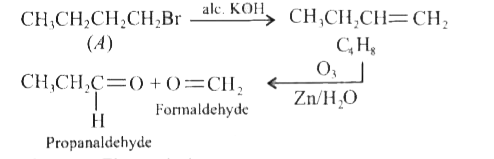
|
|
| 33. |
An unknown alkyl halide (A) reacts with alcoholic KOH to produce a hydrocarbon (C_4H_8). Ozonolysis of the hydrocarbon forms one mole of propionaldehyde and one mole of formaldehyde. Suggest which organic structure among the following is the correct structure of the above alkyl halide (A) ? |
|
Answer» `CH_3CH_2CH_2CH_2Br`<BR>`CH_3CH(Br)CH(Br)CH_3` |
|
| 34. |
An unknown aldehyde [A] on reacting with alkali gives beta-hydroxyaldehyde which loses water to form an unsaturated but-2-enal. Another aldehyde [B] undergoes disproportionation reaction in the presence of conc. Alkali to form products [C] and [D]. The compound [C] is an aryl alcohol with formula C_(7)H_(8)O. (i) Identify [A] to [B]. , (ii) Write the sequence of reactions involved. (iii) Name the proucts when , [B] reacts with zinc amalgam and hydrochloric acid. |
Answer» SOLUTION :From the available information, the unstaurated aldhyde but-2-enal `(CH_(3)CH = CHCHO)` has been formed from `beta`-hydroxyaldehyde by the loss of a molecule of `H_(2)O`. This means that the `beta`-hydroxyaldehyde is `CH_(3)CH(OH)CH_(2)CHO`. The compound [A] which GIVES thsi aldehyde on reacting with alkali, is expected to be ethanal `(CH_(3)CHO)`. The `beta`-hydroxyaldehyde hasbeen formed as a result of aldol condensation. The sequence of reactions is as follows :  SIMILARLY, aldehyde [B] undergoes disproportionation reaction in the presence of conc. alkali to form products [C] and [D]. The compound [C] with molecular formula `C_(7)H_(8)O` is an aryl alcohol. It is `C_(6)H_(5)CH_(2)OH` i.e, benzyl alcohol. The aldehyde [B] is expected to benzaldehyde `(C_(6)H_(5)CHO)`.It hasin fact undergoes cannizzaro's reaction in the presence of conc. alkali which is a disproportionation reaction in nature. The sequence ,may be given as follows : 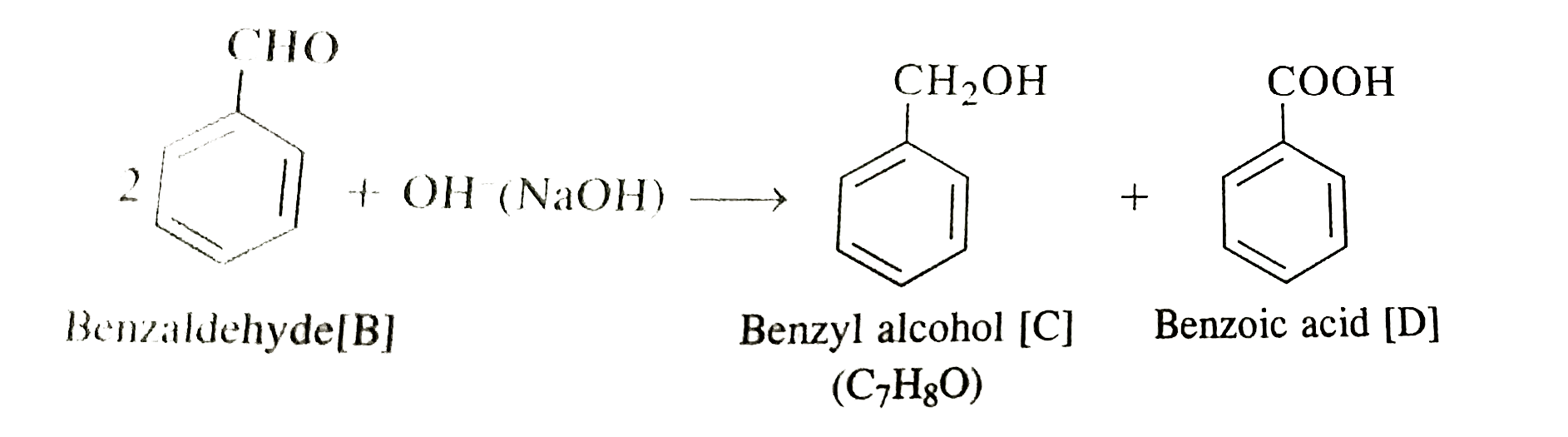 Benzaldehyde is reduced to toluene with `Zn//Hg` and `HCl` and the reaction is called Clemmensen's reduction. 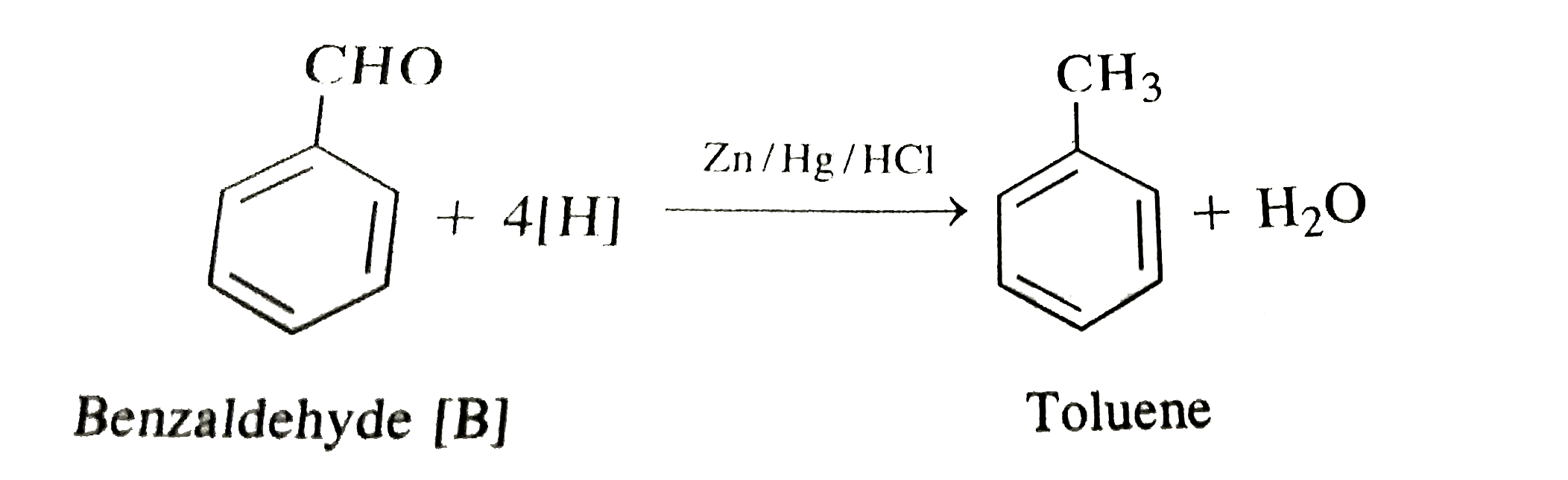
|
|
| 35. |
An unknown aldehyde 'A' on reacting with alkali gives a b-hydroxy-aldehyde, which loses water to form an unsaturated aldehyde, 2 - butenal. Another aldehyde 'B' undergoes disporportionation reaction in the presence of conc. alkali to form products C and D. C is an aryl alcohol with formula C_7H_8O . (i) Identify A and B. (ii) Write the sequence of reactions involved (iii) Name the product, when 'B' reacts with Zn amalgam and hydrochloric acid. |
Answer» SOLUTION :
|
|
| 36. |
An unknown alcohol is treated with the ''Lucas reagent'' to determine whether the alcohol is primary, secondary or tertiary. Which alcohol reacts fastest and by what mechanism: |
|
Answer» TERTIARY ALCOHOL by `S_(N)1` |
|
| 37. |
An unknown alcohol is treated with the "Lucas reagent" to determine whether the alcohol iis primary, secondary or tertiary. Which alcohol reaccts fastest ad by what mechanism? |
|
Answer» tertiary ALCOHOL by `S_(N)2` |
|
| 38. |
An unknow alkyl 'A' reacts with alcoholic KOH to produce C_(4)H_(8). Ozonolysis of the hydrocarbon gives one mole of propanal and onemole of methanal the correct structure of 'A' is |
|
Answer»
|
|
| 39. |
An underwater bubble with a radius of 0.5 cm at the bottom of a tank, where the temperature is 5^(@)C and the pressure is 3 atm., rises to the surface where the temperature is 25^(@)C and pressure is 1 atm. What will be the radius of the bubble when it reaches the surface ? |
|
Answer» |
|
| 40. |
An unit of charge is : |
|
Answer» Volt |
|
| 41. |
An stoichiometric mixture of hydrogen gas and the air at 25^(@)C and a total pressure of 1 atm, is exploded in a closed rigid vessel. If the process occurs under adiabatic condition then using the given data answer the question that follow: Given : (i) C_(P)=8.3" Cal deg"^(-1)" mol"^(-1), (ii) C_(P)=11.3" Cal deg"^(-1)" mol"^(-1), DeltaH_(f) [H_(2)O(g)]= -57.8 kCal [Take air as 80% N_(2), 20 % O_(2) by volume] What will be final pressure in atm ? |
|
Answer» <P>`cong 8.5` |
|
| 42. |
An stoichiometric mixture of hydrogen gas and the air at 25^(@)C and a total pressure of 1 atm, is exploded in a closed rigid vessel. If the process occurs under adiabatic condition then using the given data answer the question that follow: Given : (i) C_(P)=8.3" Cal deg"^(-1)" mol"^(-1), (ii) C_(P)=11.3" Cal deg"^(-1)" mol"^(-1), DeltaH_(f) [H_(2)O(g)]= -57.8 kCal [Take air as 80% N_(2), 20 % O_(2) by volume] What will be the maximum temperature attained if the process occurs in adiabatic container ? |
|
Answer» <P>` cong 2937 K` `C_(V_(H_(2)O))=C_(P)-R=11.3=9.3` `DeltaU=nC_(V_(N_(2))) (T_(2)-T_(1))+nC_(V_(H_(2)O)) (T_(2)-T_(1))` `T_(2)=2937 K` |
|
| 43. |
An stoichiometric mixture of hydrogen gas and the air at 25^(@)C and a total pressure of 1 atm, is exploded in a closed rigid vessel. If the process occurs under adiabatic condition then using the given data answer the question that follow: Given : (i) C_(P)=8.3" Cal deg"^(-1)" mol"^(-1), (ii) C_(P)=11.3" Cal deg"^(-1)" mol"^(-1), DeltaH_(f) [H_(2)O(g)]= -57.8 kCal [Take air as 80% N_(2), 20 % O_(2) by volume] The value of C_(P) of N_(2) & H_(2)O will be (in Cal."deg."^(-1)" mol"^(-1)) |
|
Answer» <P>8.3, 8.3 |
|
| 44. |
An SN^(2) reaction at on asymmetric carbon atom of a compound always gives |
|
Answer» an enantiomers of a substrate |
|
| 45. |
An S_(N)2 reaction at an asymmetric carbon of a compound always gives : |
|
Answer» an ENANTIOMER of the substrate |
|
| 46. |
An propanoyl chloride is formed when PCl_(5) reacts with an |
|
Answer» propanoic acid `3CH_(3)COOH + PCl_(5) to 3CH_(3)COCl + POCl_(3) + HCl`. Thus in this reaction `PCl_(5)` react with an acetic acid `(CH_(3)COOH)` to produce acetyl chloride. |
|
| 47. |
An prgamoc cp,[pimd C_(5)H_(9)Br(A) which readily decolourises bromine water and cold alkaline KMnO_(4) solution gives C_(5)H_(11)Br(B) on catalytic hydrogenation. The reaction of A with alcoholic KOH first and then with NaNH_(2) produces C with evolution of NH_(3). C reacts with Lindlar's catalyst to give D and on reaction with Na in liquid NH_(3) produces E. D and E are isomers. The compound A is |
|
Answer» `CH_(3)CH_(2)CH=OVERSET(BR)overset(|)C-CH_(3)` 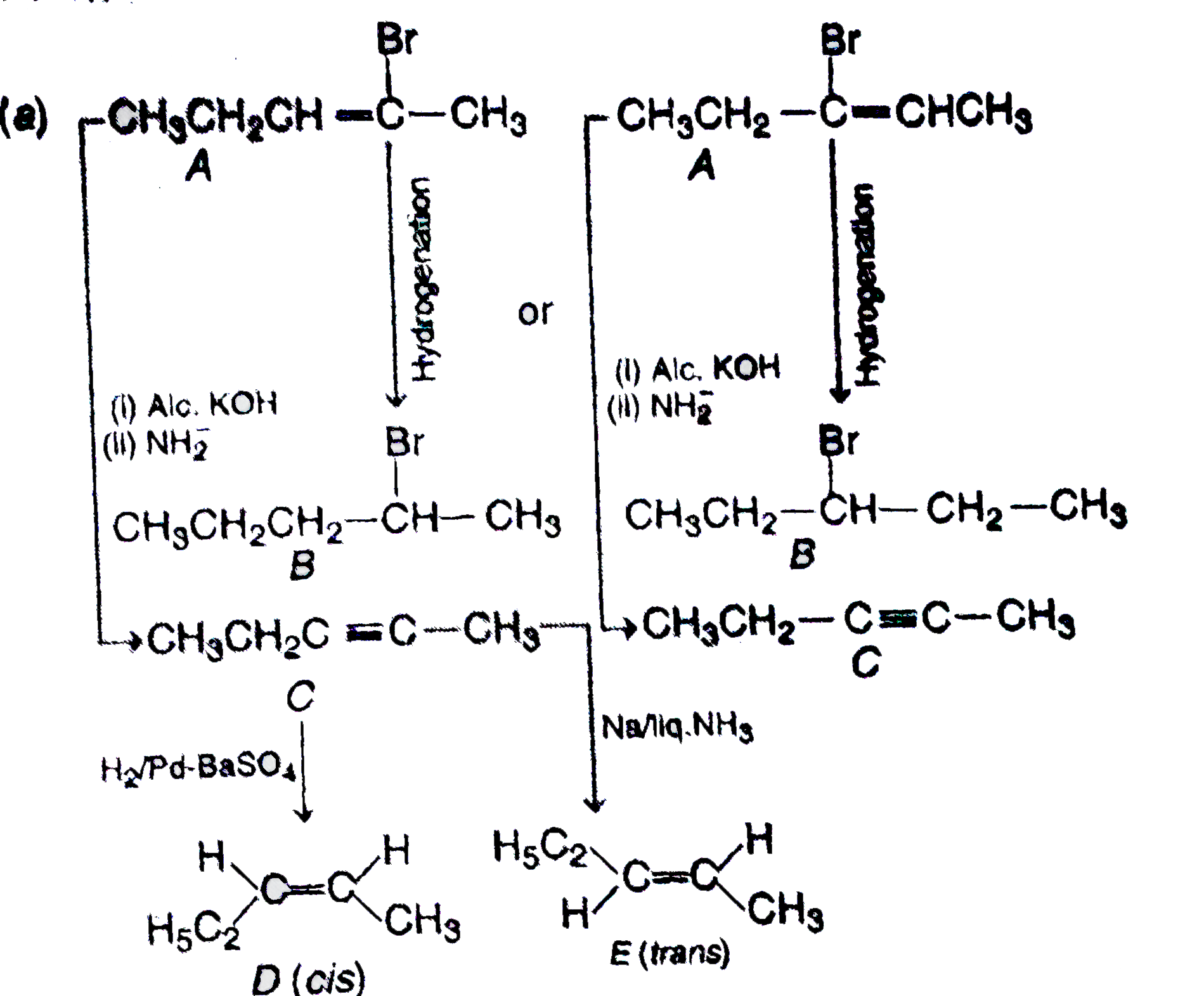
|
|
| 48. |
An oxygen containing organic compound was found to contain 52% carbon and 13% of hydrogen. Its vapour density is 23. The compound reacts with sodium metal to librate hydrogen. A functional isomer of this compound is |
|
Answer» Ethanol |
|
| 49. |
An oxygen containing organic compound was found to contain 52% carbon and 13 % of hydrogen . Its vapour density is 23 . The compound reacts with sodium metal to liberate hydrogen . A functional isomer of this compound is |
|
Answer» Ethanol Molecular mass = `2 xx 23= 46` 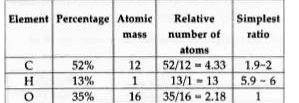 Empirical formula = `C_(2) H_(6) O` Empirical formula mass = `12 xx 2 + 6 xx 1 + 16 = 46` `n = ("empirical formula mass")/("molecular formula mass") = (46)/(46) = 1` Molecular formula = `C_(2) H_(6) O` Alcohols LIBERATE hydrogen on reaction with sodium METAL . The functional isomer of ethanol is methoxy methane . `UNDERSET("ethanol")(CH_(3) CH_(2)OH)"" underset("methoxy methane") (CH_(3)OCH_(3))` |
|
| 50. |
An oxygen containing organic compound upon oxidation forms a carboxylic acid as the only organic product with its molecular mass higher by 14 units. The organic compound is |
|
Answer» An aldehyde |
|