

Saved Bookmarks
| 1. |
An unknown aldehyde [A] on reacting with alkali gives beta-hydroxyaldehyde which loses water to form an unsaturated but-2-enal. Another aldehyde [B] undergoes disproportionation reaction in the presence of conc. Alkali to form products [C] and [D]. The compound [C] is an aryl alcohol with formula C_(7)H_(8)O. (i) Identify [A] to [B]. , (ii) Write the sequence of reactions involved. (iii) Name the proucts when , [B] reacts with zinc amalgam and hydrochloric acid. |
Answer» SOLUTION :From the available information, the unstaurated aldhyde but-2-enal `(CH_(3)CH = CHCHO)` has been formed from `beta`-hydroxyaldehyde by the loss of a molecule of `H_(2)O`. This means that the `beta`-hydroxyaldehyde is `CH_(3)CH(OH)CH_(2)CHO`. The compound [A] which GIVES thsi aldehyde on reacting with alkali, is expected to be ethanal `(CH_(3)CHO)`. The `beta`-hydroxyaldehyde hasbeen formed as a result of aldol condensation. The sequence of reactions is as follows :  SIMILARLY, aldehyde [B] undergoes disproportionation reaction in the presence of conc. alkali to form products [C] and [D]. The compound [C] with molecular formula `C_(7)H_(8)O` is an aryl alcohol. It is `C_(6)H_(5)CH_(2)OH` i.e, benzyl alcohol. The aldehyde [B] is expected to benzaldehyde `(C_(6)H_(5)CHO)`.It hasin fact undergoes cannizzaro's reaction in the presence of conc. alkali which is a disproportionation reaction in nature. The sequence ,may be given as follows : 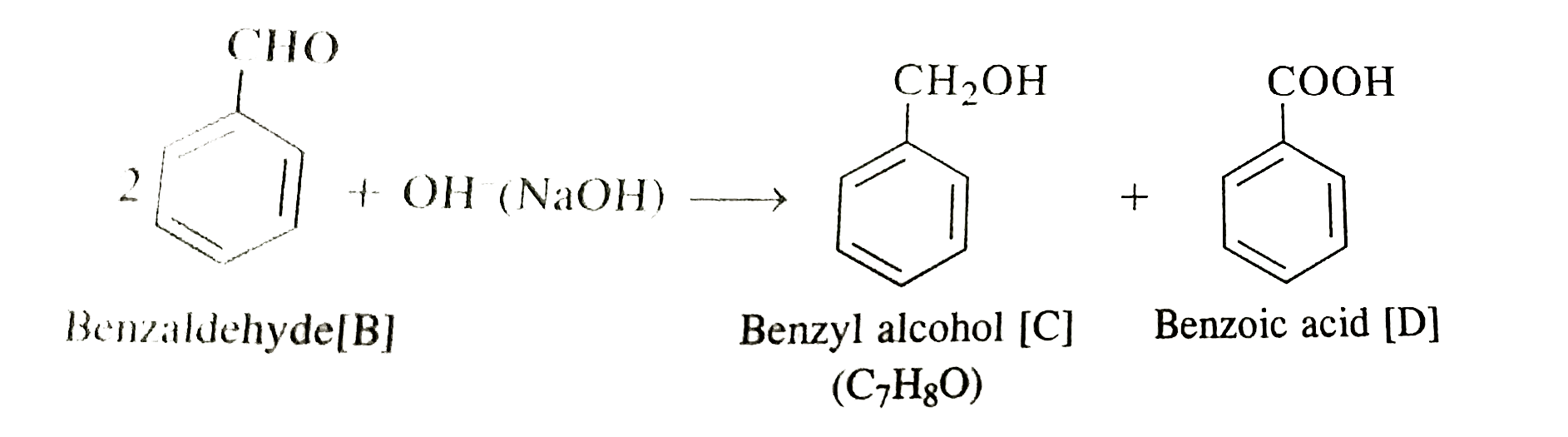 Benzaldehyde is reduced to toluene with `Zn//Hg` and `HCl` and the reaction is called Clemmensen's reduction. 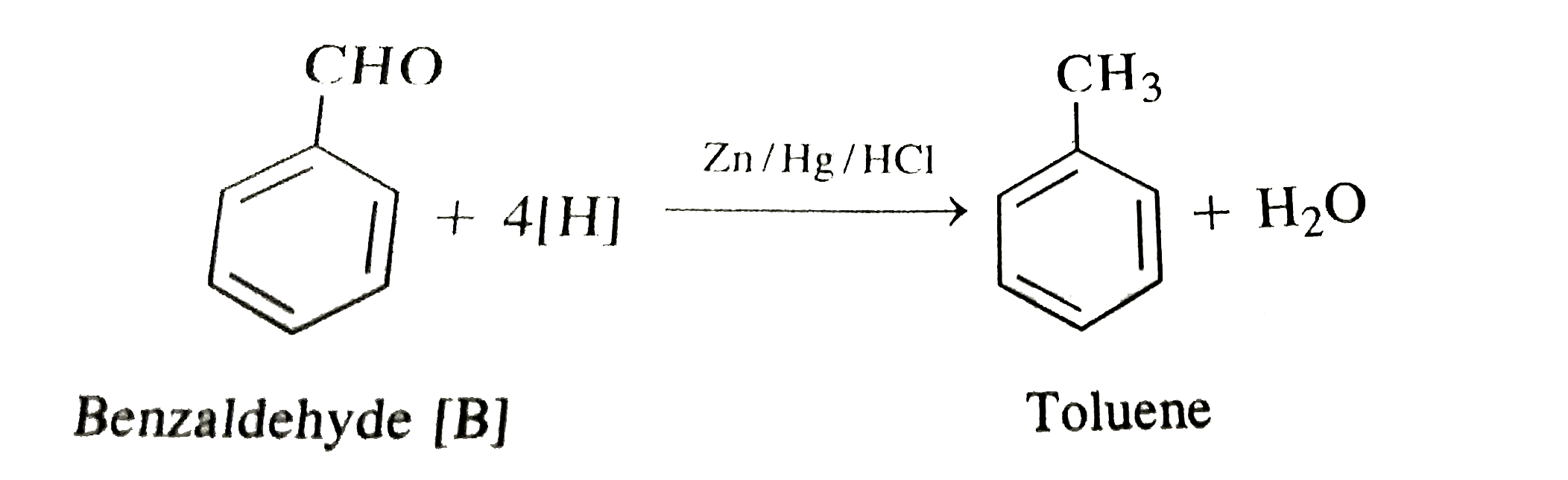
|
|