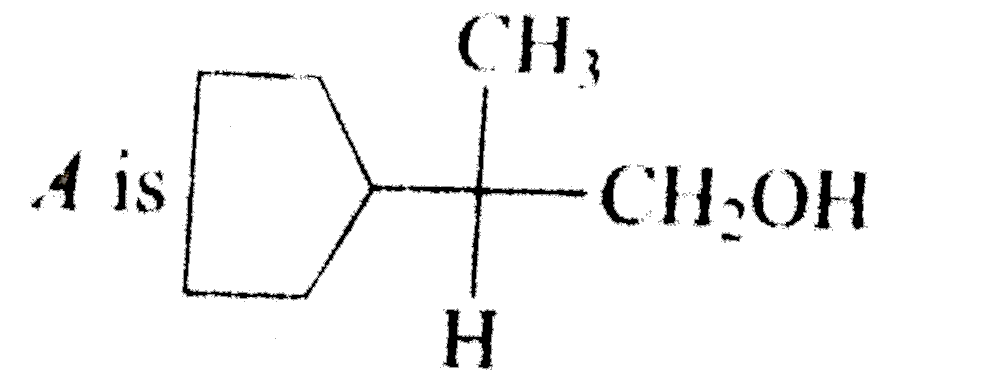
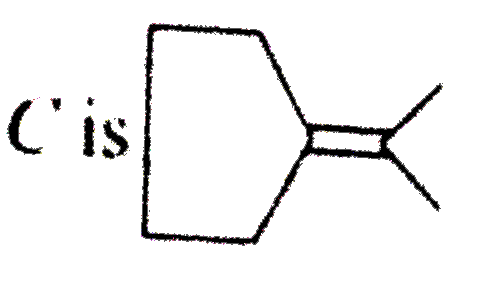
Saved Bookmarks
This section includes 7 InterviewSolutions, each offering curated multiple-choice questions to sharpen your Current Affairs knowledge and support exam preparation. Choose a topic below to get started.
| 1. |
An optically active compound having molecular formula C_6H_12O_6 is found in two isomeric forms (A) and (B) in nature. When (A) and (B) are dissolved in water , they show the following equilibrium. underset([alpha]_(D)=111^@)((A))hArr underset(52.2^@)"Equilibrium mixture"hArrunderset(19.2^@)((B)). (i) What are such isomers called ? (ii) Can they called enantiomers ? Justify your answer ? (iii) Draw the cyclic structure of isomer (A). |
|
Answer» Solution :The optically active COMPOUND having M.F. `C_6H_12O_6` is glucose. It exists in two stereoisomeric forms (A) and (B). For structure. (i) These two isomers which differ in configuration only at the glycosidic carbon are called anomers. The ANOMER (A) with `[alpha]_(D)=111^@` is called `alpha`-D-glucophyranose while the anomer (B) with `[alpha]_(D)=+19.2^@` is called `beta`-D-glucopyronase. Since `alpha`-form is less stable than the CORRESPONDING `beta`-form, therefore , equilibrium mixture consists of approx, `36%` of `alpha`-form and `64%` of the `beta`-form. (ii) Since these anomers are not mirror images of each other, they cannot be called as ENANTIOMERS. (iii) The anomer (A) with `[alpha]_(D)=111^@` is called `alpha`-D-glucopyranose. Its Fisher projection and Haworth structure are given. |
|
| 2. |
An optically active compound, having molecular formula C_6 H_12 O_6 is found in two isomeric forms. When isomers dissolved in water, they show the following equilibria underset(alpha=111^(n))("[A]") hArr underset(52.5^@)("equilibrium mixture") hArr underset(19.2)("[B]") Such isomers are called |
|
Answer» Anomers |
|
| 3. |
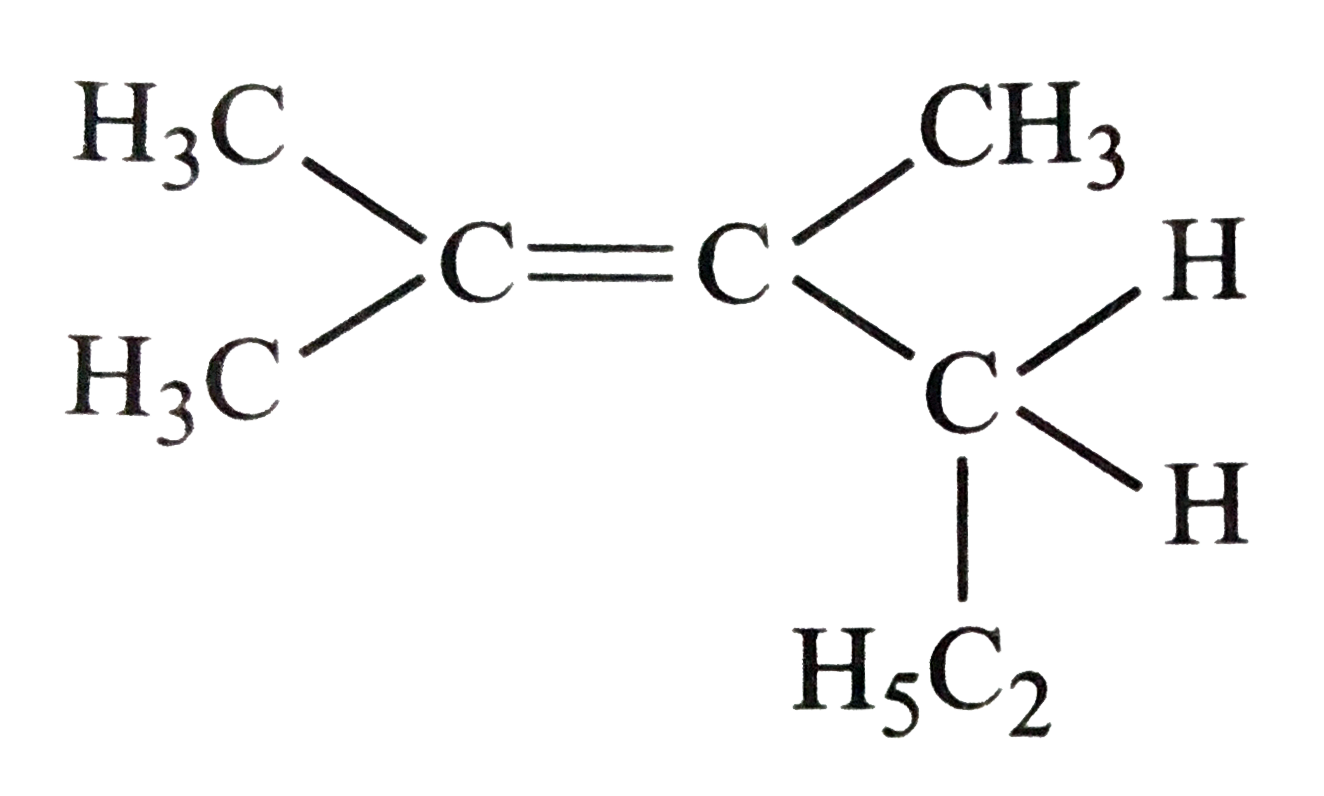
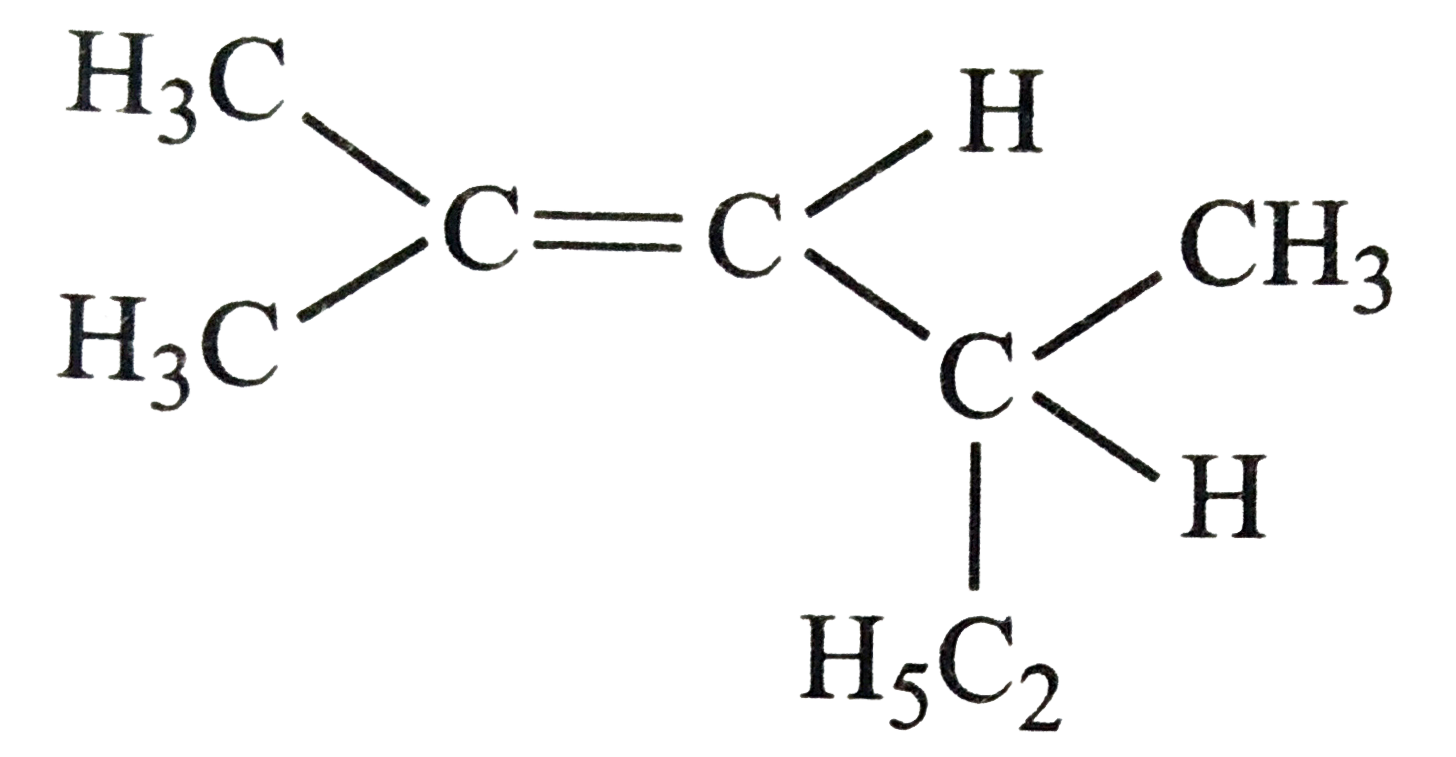
An optically active compound having molecular C_(8)H_(16) on ozonolysis gives acetone as one of the products. The structur of the compound is |
|
Answer»
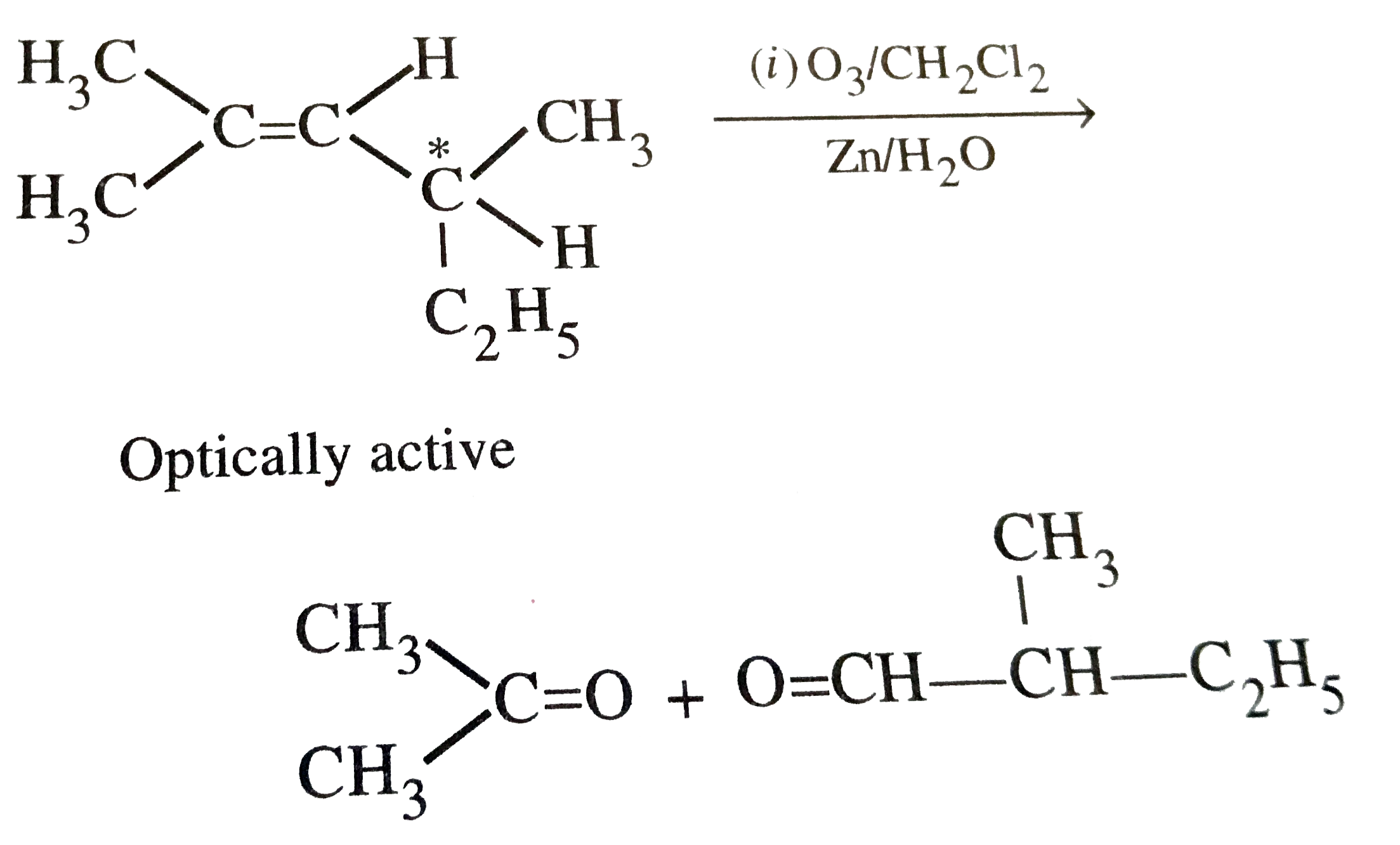
|
|
| 4. |
An optically active compound has 3 different asymmetric carbon atoms. The number of possible isomers are |
|
Answer» 8 |
|
| 5. |
An optically active compound A is hydrolysed by dilute acid to give two optically active compounds, B and C according to the following chemical equation, A+H_(2)O to 2B+C. The angle of rotation after 40 minutes was observed to be 26^(@) and that after completion of reaction was 10^(@) at 27^(@)C. Find the half-time of the reaction assuming it to follow pseudo first order kinetics. The observed rotation per mole of A, B and C are 60^(@) , 50^(@) and -80^(@). A plot of logarithm of rate constant of the above reaction vs T^(-1) give straight line with intercept equal to 15.046 on log k axis. Calculate at what temperature half-time of the reaction will be 31.1 min. |
|
Answer» |
|
| 6. |
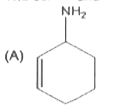
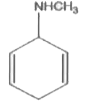
An optically active compound (A) decolourises Br_(2)//C Cl_(4) and releases N_(2) with nitrous acid The compound (A) is |
|
Answer»
|
|
| 7. |
An optically active compound A (C_6 H_(12 )O) gives positive test with 2,4-D NP, but negative test with Tollen's reagent. Compound A is |
|
Answer»
Negative testTollen.stest`implies ` Ketone`CH_3 - underset(O ) underset(||)C- overset(CH_3) overset(|) CH-CH_2-CH_3` |
|
| 8. |
An optically active amino acid (A) can exist in three forms depending on the pH of the medium. If the molecular formula of (A) is C_(3)H_(7)NO_(2)write. (i) structure of compound (A) in aqueous medium. What are such ions called ? (ii) in which medium will the cationic form of compound (A) exist ? (iii) in alkaline medium, towards which electrode will the compound (A) migrate in electric field ? |
|
Answer» Solution :(i)(A) is `CH_(3) - underset(NH_(2))underset(|)(CH) - COOH` In AQUEOUS MEDIUM, H of -COOH migrates to `- NH_(2)`, group giving dipolar form called zwitter ion. `CH_(3) -underset("zwitter ion")underset(+NH_(3)) underset(|)(CH) - COO^(-)` (ii) In acidic medium, the cationic form of (A) will exist. `CH_(3) -underset(+NH_(3)) underset(|)(CH) - COO^(-) + H^(+) to CH_(3)- underset("Ctionic form")underset(+NH_(3))underset(|)(CH) -COOH` (iii) In alkaline medium, it will be present in anionic form. `CH_(3) -underset(+NH_(3)) underset(|)(CH) - COO^(-) + OH^(+) to CH_(3)- underset("Anionic form")underset(NH_(2))underset(|)(CH) -COOH + H_(2)O` Therefore, in the ELECTRIC FIELD, the compound in the alkaline medium will migrate towards ANODE. |
|
| 9. |
An optically active amine (A) of molecular formula C_(4)H_(11) N is subjected to Hofmann 's exhaustive methylation process and following hydrolysis an alkene (B) is produced which upon ownolysis and subsequent hydrolysis yields fonnaldehyde and propanal. The amine 'A' is |
|
Answer» `underset(NH_(2))underset(|)(CH_(3)CHCH_(2)CH_(3))` `CH_(3)-CH_(2)-underset(NH_(3))underset(|)(CH)-CH_(3)` 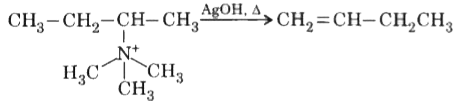
|
|
| 10. |
An optically active alkyl chloride having molecular formula 'A' (C_6H_13Cl)on dehydrohalogenation gave two isomeric alkenes B & C (C_6H_12) . Ozonolysis of B gave formaldehyde and D (C_5H_10O) , while ozonolysis of C gave acetone. Reduction A gave 2,2-dimethyl butane. Which of the following is not correct regarding B and C |
|
Answer» Both are ALKENES  B & C doesn.t exhibits geometrical isomerism as has `a_2C = CBD`TYPE and c is `a_2C = Ca_2` type B & C doesn.t exhibits geometrical isomerism as has `a_2C = CBD`TYPE and c is `a_2C = Ca_2` type
|
|
| 11. |
An optically active alkyl chloride having molecular formula 'A' (C_6H_13Cl)on dehydrohalogenation gave two isomeric alkenes B & C (C_6H_12) . Ozonolysis of B gave formaldehyde and D (C_5H_10O) , while ozonolysis of C gave acetone. Reduction A gave 2,2-dimethyl butane. The structure of 'D' is |
|
Answer» `CH_3 - undersetoverset(|)(CH_3)(C )H - CH_2CHO`  B & C doesn.t exhibits GEOMETRICAL ISOMERISM as has `a_2C = Cbd`type and c is `a_2C = Ca_2` type |
|
| 12. |
An optically active alkyl chloride having molecular formula 'A' (C_6H_13Cl)on dehydrohalogenation gave two isomeric alkenes B & C (C_6H_12) . Ozonolysis of B gave formaldehyde and D (C_5H_10O) , while ozonolysis of C gave acetone. Reduction A gave 2,2-dimethyl butane. The structure of A is |
|
Answer» 2- chloro-3,3-dimethyl BUTANE 
|
|
| 13. |
An optically active alky halide (A) C_(4)H_(9)X reacted with aq. KOH and gives a product (B) C_(4)H_(10)O. The compound (B) on oxdiation gives ethyl methyl ketone. What is the structure (A) and (B) ? |
|
Answer» `CH_(3) CH_(2) CH_(2)X and CH_(3) CH_(2) CH_(2)CH_(2)OH` |
|
| 14. |
An optically active alkene with the molecular fomula C_(6) CH_(12) which upon hydrogenation gives optically inactive alkane is |
|
Answer» 2 - hexane `CH_(2) = CH underset("optically active")overset(CH_(3))overset(.|)(- CH-) CH_(2) CH_(3) overset(H_(2)//Pl)(rarr )CH_(3) CH_(2) underset("optically inactive")overset(CH_(3))overset(|)(- CH - ) - CH_(2) CH_(3)` |
|
| 15. |
An optically active alcohol A(C_(8)H_(16)O) on oxidation gives B. A on acidic heating gives C(C_(8)H_(14)) as major product. C on ozonolysis produces D(C_(5)H_(8)O) and H_(3)-underset(O) underset(||)(C)-CH_(3). D on reduction with LiAIH_(4) gave Identify correct answer |
|
Answer»

|
|
| 16. |
An optically active alcohol A (c_(8)H_(16)O) on oxidation gives B. A on heating gives C (C_(8)H_(14)) as majorproduct. C on ozonlysis produces D(C_(5)H_(8)O) and CH_(3)-underset(O)underset(||)(C)-CH_(3). D on reduction with LiAlH_(4) gave . Identify correct answers. |
|
Answer»
|
|
| 17. |
An opticalinactiveamine(A) C_(4) H_(11) Non treatmentwithHNO_(2) giveanalcohol(B ) , TheCompound (B )on heatingwithconc. H_(2) SO_(4) at 453 Kgive an alkene( C ) . The Contreatmentwith HBrgive anopticalactivecompound(D )havingmolecularformula C_(4) H_(9) Br. Identify (A ) |
|
Answer» `CH_(3) CH_(2) CH(NH_(2) ) CH_(3)` ( D)must be `CH_(3) CH_(2) CHCH_(3)` `( C )" mustbe" CH_(3) CH_(2) CH= CH_(2)` ( b)must be `CH_(3) CH_(2)CH_(2) CH_(2) OH` |
|
| 18. |
An opticalinactiveamine (A) C_(4) H_(11) Non treatment with HNO_(2)givean alchol (B) . Thealcohol(B)on heatingwith conc. H_(2) SO_(4)at 453K 1- butene . Identify (A). |
|
Answer» `CH_(3)CH_(2)(NH_(2))CH_(3)` |
|
| 19. |
An optical active alcohol of formula C_(4)H_(10)O on oxidation given which of the following compound? |
|
Answer» `(CH_(3))_(2)CHCHO` butyl alcohol, t-butyl and on oxidation gives ethyl methyl ketone. `CH_(3)CHOHC_(2)H_(5) overset("oxidation") to CH_(3)COC_(2)H_(5) + H_(2)O` |
|
| 20. |
An open vessel at 37^(@)C is heated until 3//5 of the air in it has been expelled. Assuming that the volume of the vessel remains constant, the temperature to which the vessel is heated is |
|
Answer» `502^(@)C` |
|
| 21. |
An open vessel at 27^(@)C is heated until three-fifths of the air in it has been expelled. Assuming the volume of the vessle remains constant, find the temperature to which the vessle has to be heated. |
|
Answer» Solution :Suppose the volume of the vessel at `27^(@)C` is V containing N moles of the gas. LET the vessel be heated to T K when 2n/5 moles remain (as three-fifth has been EXPELLED). Since `(2n)/(5)` moles at T K OCCUPY a volume V, `therefore` n moles at T K should occupy `= (5V)/(2)`. Thus for n moles of the gas, `p_(1) = p ""p_(2) = p(p_(1) = p_(2) = p " as the vessel is open")` `V_(1) = V ""V_(2) = (5V)/(2)` `T_(1) = 300 K ""T_(2) = T K` `(pV)/(300) = (p xx (5V//2))/(T)` `T = 750 K = 477^(@)C`. |
|
| 22. |
An open vessel at 27^(@)C is heated until 3/8 of the air in it has been expelled. Assuming the value remains constant calculate the termperature at which the vessel was heated: |
|
Answer» `307^(@)C` |
|
| 23. |
An open vessel at 27^(@)C is heated until 3//5^(th) of the air in its has been expelled. Assuming that the volume of the vessel remains constant find (a) the temperature at which vessel was heated ? (b) the air escaped out if vessel is heated to 900 K? (c ) temperature at which half of the air escapes out ? |
|
Answer» Solution :ONE should clearly note the FACT that on heating a gas in a vessel there are the number of moles of gas which go out, the volume of vessel remains CONSTANT. Let initial moles of gas at 300 K be .n.. On heating 3//5 moles of air are escaped out at temperature T. `therefore` Moles of air left at temperature `T=(n-(3)/(5)n)=(2n)/(5)` (a) Under similar conditions of P and V `n_(1)T_(1)=n_(2)T_(2)` `nxx300=(2n)/(5)xxT` `T=750 K` (B) On heating vessel to 900 K, let `n_(1)` moles be left again `n_(1) T_(1)=n_(2)T_(2)` `n_(1)xx900=300xxn` `RARR n_(1)=(1)/(3)n` `therefore ` Moles escaped out `=n-(n)/(3)=(2)/(3) n` moles (c ) Let n/2 moles are escaped out at temperature T then `n_(1)T_(1)=n_(2)T_(2)` `(n)/(2)xxT =nxx300` `T=600 K` |
|
| 24. |
An open system |
|
Answer» can NEITHER lose nor gain energy |
|
| 25. |
An open flask contains air at 27°C.To what temperature it must be heated to expel one-fourth of the air? |
|
Answer» 225 K |
|
| 26. |
An open bulb containing air at 19^(@)C was cooled to a certain temperature at which the number of moles of the gaseous molecules increased by 25%. What is the final temperature ? |
|
Answer» Solution :Suppose the VOLUME of the bulb is V containing n moles at `19^(@)C`, i.e, 292 K. Let the temperature be T K when n moles increases to `1.25` n (i.e., by 25%). SINCE 1.25 n moles at T K occupy a volume V `therefore` n moles at T K should occupy `(V)/(1.24)`. Thus for n moles of the GAS, `T_(1) = 292 K ""T_(2) = T K` `V_(1) = V""V_(2) = (V)(1.25)` `p_(1) = p""p_(2) = p(p_(1) = p_(2) " as the bulb is OPEN")` `therefore (pV)/(292) = (p XX V//1.25)/(T)` `T = (292)/(1.25) = 233.6 K` `= -39.4^(@)C` |
|
| 27. |
An open bulb containing air at 19^(@)C was cooled to a certain temperature at which the no. of moles of gaseous molecules increased by 25% What is the final temperature? |
| Answer» SOLUTION :`-39.4^(@)C` | |
| 28. |
An oligosaccharide contains |
|
Answer» 1-6 MONOSACCHARIDES |
|
| 29. |
An oleum sample labelled as 104.5% in 10 g of this sample 90 mg water is added then which is/are correct for resulting solution. |
|
Answer» Solution contain 10.09 g `H_2SO_4` 100 g oleum sample requir 4.5 g `H_2O` to PRODUCED 104.5 g `H_2SO_4` So, for 10 g sample water required =0.45 g `SO_3+underset(0.45 g)(H_2O)toH_2SO_4` So, free `SO_3=80/18xx0.45=2 g` Now, 0.09 g `H_2O` is ADDED which react with `SO_3` `underset(2G)(SO_3)+underset(0.09 g)(H_2O)toH_2SO_4` MOLE `1/40 1/200(L.R.)` `{:("After reaction",0.02,0,0.005),("wt.",1.6g,0,0.49 g):}` Now wt. of `H_2SO_4=8+0.49=8.49 g` % of free `SO_3=(1.6xx100)/(8.49+1.6)=15.86%` |
|
| 30. |
An oleum sample is labelled as 118%, Calculate (i) Mass of H_(2)SO_(4) in 100 gm oleum sample (ii) Maximum mass of H_(2)SO_(4) that can be obtained if 30 gm sample is taken (iii) Composition of mixture (mass of components) if 40 gm water is added to 30 gm given oleum sample |
|
Answer» |
|
| 31. |
An open beaker containing a pure solvent and a seconf beaker containing a solution in the same solvent with a non-volatile solute are sealed in a container. Over the period of time |
|
Answer» the VOLUME of SOLUTION INCREASES and the volume of SOLVENT DECREASES |
|
| 32. |
An olefin X on ozonolysis gives, CH_3CH_2CHO + HCHO. The oletin is: |
|
Answer» 1-butene |
|
| 33. |
An olefinwas treatedwithozoneand the resultingproducton hydrolysis gave 2-pentanoneandacetaldehyde.Theolefin is : |
|
Answer» 2- Methyl-3- HEXENE |
|
| 34. |
An alkene gives two ,moles of HCHO, one mole of CO_2 and one mole of CH_3COCHO on ozonolysis . What is the structure ? |
|
Answer» `CH_ =C=CH-CH_2-CH_3 ` |
|
| 35. |
An oil in watrer emulsion containing potassium soap as emulsifying agent can be converted into water in oild emulsion by adding ........... or ............ |
| Answer» SOLUTION :`CaCl_2 , AlCl_3` | |
| 36. |
An octahedral complex with molecular composition M.5 NH_3 , Cl. SO_4 has two isomers, A and B. The solution of A gives a white precipitate with AgNO_3 solution and the solution of B gives white precipitate with BaCl_2 solution.The type of isomerism exhibited by the complex is : |
|
Answer» Linkage isomerism |
|
| 37. |
An octahedral complex of the type MX_(4)Y_(2) has |
|
Answer» 3 GEOMETRICAL ISOMERS |
|
| 38. |
An octahedral complex is prepared by mixing CoCl_3 and NH_3 in the molar ratio of 1 : 4 . 0.1 m solutioin of this complex was found to freeze at -0.372^(@) C. What is the formula of the complex ? Given the molal depression content (K_f) for water = 1.86^(@) cm |
|
Answer» Solution :Theoretical value of `deltaT_f` can be calculates as : Observed value is twice the theoretical value, this means that each MOLECULE of the COMPLEX dissociation is give two IONS. This can be possible in case the complexes has the FORMULA `[Co(NH_3)_(4)Cl_2]Cl` . |
|
| 39. |
An octahedral void is surrounded by how many spheres ? |
|
Answer» 6 |
|
| 40. |
An octahedral complex is formed when hybrid orbitals of the following type are involved |
|
Answer» `d^(2)SP^(3)` (i) Inner ORBITAL complex `(d^(2)sp^(3))to` formed under the influence of STRONG ligand. (ii) . OUTER orbital complex `(sp^(3)d^(2))to` formed under the inflience of weak ligands. |
|
| 41. |
An octahedral complex is formed when central metal atom undergoes hybridisation amongst the ……..orbitals: |
|
Answer» `sp^3` |
|
| 42. |
An octabedral complex is _____ formed when the central metal atom is hybridised. |
|
Answer» `sp^3d` |
|
| 43. |
An NH_(4)^(+) buffer is supposed to keep the pH of the solution constant within0.3 pH unit during the reaction CH_(3)COOH_(3)(aq)+2H_(2)O(aq)rarrCH_(3)COO^(-)(aq)+H_(3)O^(+)(aq)+CH_(3)OH(aq) If this solution had initial concentration :[NH_(4)^(+)]_(10)=0.1 M ,[NH_(3)]_(0)=0.06 M ,[CH_(3)COOH_(3)]_(0)=0.02Mdetermine the magnitude of pH change as a result of reaction. Multiply the magnitude by 10 & add 1 if it is a satisfactory buffer, otherwise subtract 1.Report the answer rounding it off to the nearest whole number. [K_(b)NH_(3)=1.8xx10^(-6)] |
|
Answer» Solution :`K_(B)(NH_(3)) = 1.8 xx 10^(-5)` `CH_(3)COOCH_(3) (aq)+2H_(2)O (aq) rarr CH_(3)COO^(-) (aq) + H_(3)O^(+) (aq) + CH_(3)OH(aq)` `[NH_(4)^(+)]_(0) = 0.1M, [NH_(3)] = 0.06M, [CH_(3)COOCH_(3)]_(0) = 0.02 M` `POH=pK_(b)+log(([NH_(4)^(+)])/([NH_(3)]))=4.74+log((0.1)/(0.06))` `(pOH)_("initial")=4.74+0.22=0.22=4.96:'(pH)_("intial")=9.04` `{:(NH_(3)(aq),+,H^(+)(aq.),rarr,NH_(4)^(+)(aq),),(0.06,,0.2,,0.1,"mole"),(0.04,,-,,0.12,"mole"):}` `(PoH)_("final")=4.74+log((0.12)/(0.04))=4.74+(log)((0.12)/(0.04))=4.74+log3=4.74+0.48=5.22` `:.(pH)_("final")=8.78` `DeltapH=9.04-8.76=0.26` YES this is satisfactory buffer. |
|
| 44. |
An LPG (liquefied petroleum gas) cylinder weighs 14.8 kg when empty. When full it weighs29.0 kg and shows a pressure of 2.5 atm. In the course of use at27^(@)C, the weight of the full cylinder reduces to 23.2 kg. Find out the volume of the gas in cubic metres used up at the normal usage conditions, and the final pressure inside the cylinder. Assume LPG to be n-butane with normal boiling point of 0^(@)C. |
|
Answer» <P> `rArr` During the course of use, weight of cylinder reduces to 23.2 kg `rArr` Weight of butane gas remaining now `= 23.2 - 14.8 = 8.4 kg` Also, during use, V (cylinder) and T REMAINS same. Therefore, `(p_(1))/(p_(2)) = (n_(1))/(n_(2)) rArr p_(2) = ((n_(2))/(n_(1))) p_(1) = ((8.4)/(14.2)) XX 2.5 ` [Here, `(n_(2))/(n_(1)) = (w_(2))/(w_(1))`] = 1.48 atm Also, pressure of gas outside the cylinder is 1.0 atm. p V = n R T `rArr V = (nRT)/(p) = ((14.2 - 8.4) xx 10^(3))/(58) xx (0.082 xx 30)/(1) L = 2460 L = 2.46 m^(3)` 1.48 atm, `2.46 m^(3)` |
|
| 45. |
An LPG cylinder weighs 14.8 kg when empty. When full, it weighs 29.0 kg and shows a pressure of 2.5 atm. In the course of use at 27^(@)C, the weight of the full cyliner is reduced to 23.2 kg. Find out the volume of n-butane in cubic meters used up at 27^(@)C and 1 atm.(Molecular weight of n-butane = 58). |
|
Answer» <P> SOLUTION :Mass of n-butane used up`=29.0-23.2=5.8kg``"No. of moles of n-butane used up"=(5.8xx1000g)/("58 g mol"^(-1))=100` To calculate volume of 100 moles of the gas at `27^(@)C` and 1 atm pressure, APPLY PV = nRT `"or"v=(nRT)/(P)=(100molxx0.0821" L atm K"^(-1)mol^(-1)xx300K)/("1 atm")="2463 L = 2.463 m"^(3)(1m^(3)=10^(3)L)` |
|
| 46. |
An known alcohol is treated with the "Lucas reagent " to determine whether the alcohol is primary, secondary or tertiary . Which alcohol reacts fastest and by what mechanism |
|
Answer» Secondary ALCOHOL by `S_(N)^(1)` |
|
| 47. |
An LPG cyfinder contains 15 kg of butane gas at 27^(@)C and 10 atmospheric pressure. It was leaking and its pressure fell down to 8 atmospheric pressure after one day. The gas leaked is |
|
Answer» 1 kg |
|
| 48. |
An isotope ._(Y)A^(X) undergoes a series of m alpha and n beta disintegrations to form a stable isotope ._(Y -10)B^(X -32). The value of m and n are respectively |
|
Answer» 6 and 8 Value of `m = (X -(X) -32)/(4) = 8` Value of `n = Y - Y - 10 - 2 xx 8 = 6` |
|
| 49. |
An isotope of postassium K^(40) undergoes two parallel type of decay, one by electron capture and other by beta decay with half lives as 1.3 xx 10^(9) year and (1.3)/(9) xx 10^(9) yearrespectively. If in a sample of a mineral mass ratio of K : Ar: Cais 5,1.5 & 16 then calculate age of the mineral if it known that all Ca^(40) in the mineral is not from the radioactive decay of potassium. [ Express youranswer in terms of 10^(7) year for eg. if you answer is 2 xx 10 ^(9) years fill 0200 in OMR sheet] |
Answer»  Assumed that all AR PRODUCED from K. `{:("K","Ar","Ca",,),("t=0","a",0,0,),("t=t","a-x-y","x","y prpduced",):}` `(x)/(y)=(lambda_(1))/(lambda_(2))=((t_(1//2))_(2))/((t_(1//2))_(1))=(1)/(9)` `y=9x` `x=(1.5)/(40) " " y=(9 xx1.5)/(40)` `a-x-y=(5)/(40)` `a=(5)/(40)+(1.5)/(40)+(9xx1.5)/(40)=(20)/(40)` `lambda t=ln (a)/(a-x-y)` `((LN2)/(1.3xx10^(9))+(ln2)/((1.3)/(9)xx10^(9)))t=ln.(20//40)/(5//40)` `t=26xx10^(7)` |
|
| 50. |
An isotope of potassium K_(40) undergoes two parallel types of decy, one by electron capture and other by beta decay with half lives as 1.3xx10^(9) years and (1.3)/(9)xx10^(9) years respectively If in a sample of a mineral, mass ratio of K : Ar Ca "is" 5"and" 16 then calculate age of the mineral if it is known that all Ca^(40) in the mineral is not from the radioactive decay of potassium. [Express your answer in terms of 10^(7) years for e.g. if you answer is 2xx10^(9) years fill 0200 in OMR sheet] |
|
Answer» |
|