

Saved Bookmarks
This section includes 7 InterviewSolutions, each offering curated multiple-choice questions to sharpen your Current Affairs knowledge and support exam preparation. Choose a topic below to get started.
| 1. |
An isotope of 'parent' is produced, when its nucleus loses |
|
Answer» One `ALPHA-`particle |
|
| 2. |
An isotope of oxygen has mass number 18. Other isotopes of oxygen will have the same |
| Answer» Solution :Isotopes differ in number of neutrons but have same number of protons. | |
| 3. |
An isotope of ""^(231)Th can be converted into ""^(227)Th by the emission of : |
|
Answer» one `BETA-`particle |
|
| 4. |
An isotope ""_(a)^(b)X undergoes x alpha and y beta disintegrations to from a stable isotope ""_(a-10)^(b-32)Y The values of x and y are : |
|
Answer» 6,6 |
|
| 5. |
An isotonic solution will produce an osmotic pressure of 10.00 atm measured against pure water at 37^@C. How many grams of NaCl must be dissolved in one litre of water to produce at isotonic solution |
|
Answer» 11.46 G |
|
| 6. |
An isotone of ._(32)^(76)Ge is (one or more are correct) |
|
Answer» `._(32)^(77)GE` |
|
| 7. |
An Isotone of ""_(32)^(76)Ge is : |
|
Answer» `""_(32)^(77)Ge` |
|
| 8. |
An isonitrile on reduction gives |
| Answer» Solution :`2^@`amine | |
| 9. |
An isonitrile on reduction gives: |
|
Answer» `3^(@)` AMINE |
|
| 10. |
An isomerr of the complex CoBrCl_(2)(en)_(2)(H_(2)O), on reaction with concentrated H_(2)SO_(4) (dehydrating agent), suffers no loss in weight and on reaction with AgNO_(3) solution it gives only white precipitate, which is soluble in NH_(3) solution. Q. The correct formula of the complex is: |
|
Answer» `[CoBrH_(2)O(en)_(2)]Cl_(2)` |
|
| 11. |
An isomer of the complex Co(en)_(2)(H_(2)O)IC l_(2), on reaction with concentrated H_(2)SO_(4), it suffers loss in weight and on reaction with AgNO_(3) solution gives a yellow precipitated which is isoluble in NH_(3) solution. Q. Total number of space isomers of the formula of the above complex is: |
|
Answer» 2 |
|
| 12. |
An isomerr of the complex CoBrCl_(2)(en)_(2)(H_(2)O), on reaction with concentrated H_(2)SO_(4) (dehydrating agent), suffers no loss in weight and on reaction with AgNO_(3) solution it gives only white precipitate, which is soluble in NH_(3) solution. Q. The incorrect statement about complex is: |
|
Answer» It can show geometrical isomerism |
|
| 13. |
An isomer of the complex Co(en)_(2)(H_(2)O)IC l_(2), on reaction with concentrated H_(2)SO_(4), it suffers loss in weight and on reaction with AgNO_(3) solution gives a yellow precipitated which is isoluble in NH_(3) solution. Q. If one mole of original is treated with excess Pb(NO_(3))_(2) solution, then the number of moles of white precipitate formed will be |
|
Answer» `2.0` |
|
| 14. |
An isomer of the complex Co(en)_(2)(H_(2)O)IC l_(2), on reaction with concentrated H_(2)SO_(4), it suffers loss in weight and on reaction with AgNO_(3) solution gives a yellow precipitated which is isoluble in NH_(3) solution. Q. If all the ligandsin the co-ordination sphere of the above complex are replaced by CN^(-) ion, then the magnetic moment of the complex ion will be: |
|
Answer» 0.0 BM |
|
| 16. |
An isomer of ethanol is: |
|
Answer» Methanol |
|
| 17. |
An isomer of C_(6)H_(14) forms three monochloro derivaties. The isomer may be- (Excluding stereo isomer) |
|
Answer» neo - pentane |
|
| 18. |
An isomer of C_(3)H_(6)Cl_(2) on boiling with aq. KOH give acetone. Hence, the isomer is , |
|
Answer» 2,2- dichloropane |
|
| 19. |
An isomer of C_(3)H_(6)Cl_(2) on boiling with aqueous KOH gives acetone. Hence, the isomer is |
|
Answer» 2,2-dichloropropane |
|
| 20. |
An isolated system is that system in which |
|
Answer» There is no EXCHANGE of ENERGY with the surroundings |
|
| 21. |
An isolated system is that system in which: |
|
Answer» There is no EXCHANGE of ENERGY with the surroundings |
|
| 22. |
An isocyanide on reduction with hydrogen in the presence of Pt gives: |
|
Answer» Amide |
|
| 23. |
An isolated system comprises the liquid in equilibrium with vapours . At this stage the molar entropy of the vapour is : |
|
Answer» LESS than that of liquid |
|
| 24. |
An irreversible process occuring isothermally in an isolated system leads to |
|
Answer» ZERO ENTROPY |
|
| 25. |
An iron cylinder contains helium at a pressure of 250 K P_(a) at 300 K. Then room in which cylinder is placed catches fire. Predict whether the cylinder will blow up before it melts or not (melting point of cylinder =1800 K) |
|
Answer» Solution :Given `P_(1)=250 K P_(a) T_(1)=300 K, P_(2)=1xx10^(6) P_(a), T_(2)=?` Since, Volume of cylinder remains CONSTANT. Therefore `(P_(1))/(T_(1))=(P_(2))/(T_(2))` `rArr (250xx10^(3))/(300) =(1xx10^(6))/(T_(2))` `rArr T_(2)=1200 K` The cylinder will blow up at 1200 K before its melting (m.pt. =1800 K) |
|
| 26. |
An iron cylinder contains helium at a pressure of 250 k pa and27^(@)C. The cylinder can withstand a pressure of 1 xx 10^(6) pa. The room in which cylinder is palced catches fire. Predict whether the cylinder will blow up before it melts or not. [melting point of cylinder =1800 k] |
|
Answer» |
|
| 27. |
An iron compound yielded C= 64.4%, H= 5.5% and Fe= 29.9%. What is the simple formula of the compound? |
| Answer» SOLUTION :`(C_(10)H_(10)FE)` | |
| 28. |
An iron catalyst is used in the Haber process in which process N_2 and H_2 react to produce NH_3 What is the role of this catalyst ? |
|
Answer» It provides a PATHWAY with a lower ACTIVATION energy |
|
| 29. |
An iorganic white crystalline compound (A) has a rock salt structure. (A) on reaction with conc. H_(2)SO_(4) and MnO_(2), evolves a pungent smelling, greenish-yellow gas (B). Compound (A) gives white ppt. of ( C) with AgNO_(3) solution. Compounds (A), (B) and (C) will be respectively: |
|
Answer» `NACL,Cl_(2)AGCL` |
|
| 30. |
An ionizing solvent has |
|
Answer» Low VALUE of dielectric constant |
|
| 31. |
An Ionic Solid A^(+)B^(-) Crstalise like rock salt if all atoms along one body diagonalare removed then what is the formula of substance ? |
|
Answer» `A_12B_15` |
|
| 32. |
An ionic solid PQ crystallises in rock salt structure with density 4.0 gm//cm^(3) . If the radius of cation and anion is 83 and 167 pm respectively, then the molar mass of solid is [N_(A) = 6 xx 10^(23)] |
|
Answer» `75 gm//mol` `d = (Z xx M)/(N_(A)XXA^(3)xx10^(-30))` `=(4xxM)/(6XX10^(23)xx[500]^(3)xx10^(-30))=4`. `M = 75 gm//"MOLE"`. |
|
| 33. |
An ionic solid is a poor conductor of electricity, because |
|
Answer» the charge on the ions is UNEQUALLY distributed |
|
| 34. |
An ionic solid AB crystallizes as a bcc structure . The distance between cation and anion in the lattice is 338 pm . Calculate the edge length of the unit cell . |
|
Answer» `195.15` PM |
|
| 35. |
An ionic crystal lattice has r+//r- radius ratio of0.524, its coordination number is |
|
Answer» 2 |
|
| 36. |
An ionic compound when dissolved in water has produced m A^(n-), n B^(m-) ions. What is the formula of the compound ? |
|
Answer» `A_(m)B_(n)` 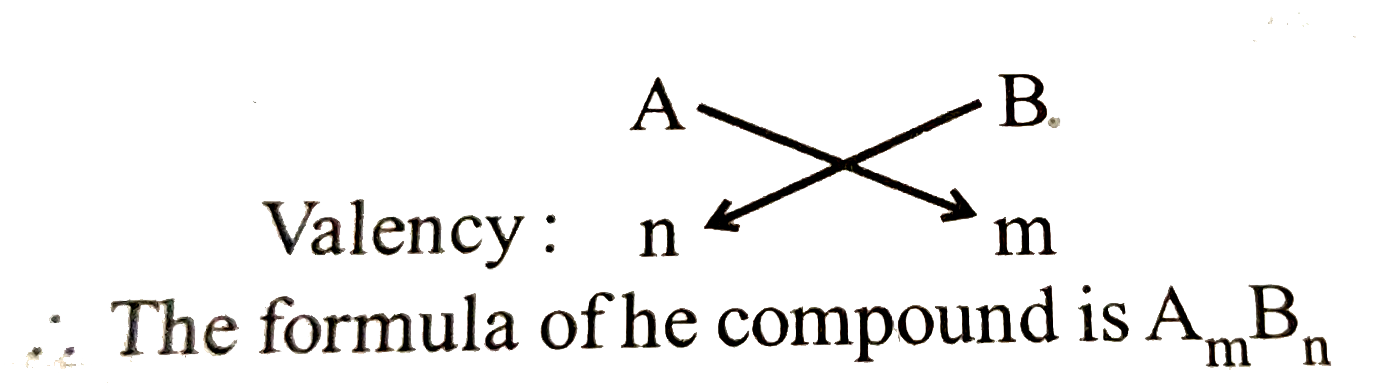 `THEREFORE` The FORMULA of he compound is `A_(m)B_(n)` |
|
| 37. |
An ionic compound MCl is simultaneously doped with 10^(-6) mole % NCl_2 and 10^(-7) mole % RCl_3.Calculate the concentration of cationic vacancies x. Express your answer as x/9xx10^14. (take N & R =divalent & trivalent cations) |
|
Answer» `=10^(-6)xx6xx10^(23)+10^(-9)xx6xx10^(23)xx2=6xx10^(15)+12xx10^(14)=(60+12)xx10^14=72xx10^(14)` |
|
| 38. |
An ionic compound is made up of A & B only. lons of A occupy all the corners and alternate face centers while that of B occupy body center and edge centers. If B contains -1 charge then charge on atom A will be |
|
Answer» 1 |
|
| 39. |
An ionic compound is made up of A cations and B anions. if A cations are present at the alternate corners and B anion is present on the body of the diagonal, what is the formula of the ionic compound ? |
|
Answer» Solution :(i) As cations A are present at alternate COMERS, i.e. 4 comers, the NUMBER of A cations in the UNIT cell = `4 xx 1/8 = 1/2` (ii) As anions B are present at the body centre, THEREFORE, the number of B ions in the unit cell = 1. Hence, the formula of the compound = `A_(0.5) B_1 ` or `AB_2` |
|
| 40. |
An ionic compound is made up of A & B only. lons A occupy all the corners and alternate edge centers while atoms B occupy all the face centers. The formula of compound will be |
|
Answer» `AB_2` |
|
| 41. |
An ionic compound has unit cell consisting A ions at the corners of a cube and B ions on the centres of the faces of cube. The empirical formula of compound would be .... |
|
Answer» `A_3B` Total number of B ions `= (6 xx 1/2) = 3` `THEREFORE A:B = 1:3` |
|
| 43. |
An ionic compound dissolves in water if …………. Energy is greater than……………energy. |
| Answer» SOLUTION :HYDRATION, LATTICE | |
| 44. |
An ionic compound crystallises in FCC type structure with 'A' ions at the centre of each face and 'B' ions occupying corners of the cube. The formula of compound is - |
| Answer» ANSWER :A::B::C | |
| 45. |
An ionic compound crystallises in FCC type structure with 'A' ions at the center of each face and 'B' ions occypying corners of the cube. The formula of compound is- |
| Answer» Answer :A::B::C | |
| 46. |
An ionic compound A_(x)B_(y) crystallizes in fcc type crystal structure with B ions at the centre of each face and A ion occupying centre of the cubic, the correct formula A_(x)B_(y) is ………….. |
|
Answer» AB `"Number of B ions "=((N_(f))/(2))=((6)/(2))=3" Simplest formula AB"_(3)` |
|
| 47. |
An ionic compound A^(+)B^(-) is most likely to be formed when : |
|
Answer» the ionization energy of A HIGH and electron AFFINITY of B is LOW |
|
| 48. |
An ion M^(2+) forms the complexes. [M(H_(2)O)_(6)]^(2+)""[M(en)_(3)]^(2+)""[MBr_(6)]^(4-) Match the complex with the appropriate colour respectively : |
|
Answer» Green, blue and red <BR>Blue, red and green  `Delta_(0)` for ligands : `en gt H_(2)O gt Br^(-)` 
|
|
| 49. |
An ion M^(2+), forms the complexes [M(H_(2)O)_(6)]^(2+),[M(en)_(3)]^(2+) and [MBr_(6)]^(4-), match the complex with the appropriate colour: |
|
Answer» GREEN, BLUE and RED |
|