

Saved Bookmarks
This section includes 7 InterviewSolutions, each offering curated multiple-choice questions to sharpen your Current Affairs knowledge and support exam preparation. Choose a topic below to get started.
| 1. |
Two identical ball bearings in contact with each other and resting on a frictionless table are hit head-on by another ball bearing of the same mass moving initially with a speed V. If the collision is elastic, which of the following (Fig. 6. 14) is a possible result after collision? |
|
Answer» |
|
| 2. |
(A) : A body roll down an inclined plane without slipping. The fraction of total energy asociated with its rotation will depend on its radius of gyration.(R ) : Total kinetic energy of rolling body is equal to addition of kinetic energy of rotation and kinetic energy of translation. |
|
Answer» Both (A) and (R ) are TRUE and (R ) is the correct EXPLANATION of (A) |
|
| 3. |
A vector makes angle with X,Y and Z axes that are in the ratio 1:2:1 respectively. The angle made by the vector with Y-axis is |
|
Answer» `pi//3` |
|
| 4. |
Find the vector sum of three vectors vecA, vecB and vecC, using analytical method. |
|
Answer» Solution :Let `vecA, vecB and vecC` be REPRESENTED in component from, `vecA=vecA_(x)hati+vecA_(y)hatj+vecA_(Z)hatk, vecB=vecB_(x)hati+vecB_(y)hatj+vecB_(z)hatk` `vecC=vecC_(x)hati+vecC_(y)hatj+vecC_(z)hatk` Let `vecD` be their SUMMATION vector, `vecD=(vecA+vecB+veccC)` `(vec(A_(x))hat(A_(y))hatj+vecA_(z)hatk)+(vec(B_(x))hati+vec(B_(y))hatj+vec(B_(z))hatk+vec(C_(x))hati+vec(C_(y))hatj+vec(C_(y))+vec(C_(z))hatk)` Addition of vecotrs obey the the commutative as well as associative laurs. `D=(A_(x)+B_(x)+C_(x))(2u sin theta)/(G)+(A_(y)+B_(y)+C_(y))hatj+(A_(z)+B_(z)+C_(z))hatk` `+(A_(x)+B_(x)+C_(x))hati+(A_(y)+B_(y)+C_(y))hatj+(A_(z)+B_(z)+C_(z))(2usintheta)/(g)` `D_(x)=A_(z)+B_(x)+C_(x), D_(y)=A_(y)+B_(y)+C_(y), D_(z)=A_(z)+B_(z)+C_(z)` |
|
| 5. |
If the centripetal force acting on a body revolving along a circular path of radius 25 m is 200 N, its KE is |
|
Answer» 2.5KJ |
|
| 6. |
The value of acceleration due to gravity on the surface of earth is x. At alttitude of .h. from the surface of earth, its value is y. If .R. is the radius of earth, then the value of h is |
|
Answer» `(SQRT(x/y)-1)R` |
|
| 7. |
Consider a spherical body A of radius R which is placed concentrically in a hollow enclosure H of radius 4R as shown in the The temperature of the body A and H are T_(A) and T_(H) respectively Emissivity transmittivity and reflactivity of two bodies A and H are (e_(a),e_(H)),?(t_(A),t_(H)), and (r_(A),r_(H)) respectively (Assume no absorption of the thermal energy by the space in between the body and enclosure as well as outside the enclousre and all radiations to be emitted and absorbed normal to the surface [Tske sigma xx 4pi r^(2) xx 300^(4) = betaJ//s] The twemperature of H is T_(H) =0K For H take e_(H) =0.5 and t_(H) =0.5 For this situation mark out the correct statements (s) . |
|
Answer» The rate at which A loses the energy is `betaJ//s` . So rate at which `A` loses energy is `beta J//s` and the rate at which `P` and `Q` receive energy are `beta//2J//s` and `betaJ//s` respectively This energy is received on the area of SPHERE passing through `P` and `Q` Now in this case each of incidence, refleaction absorption take place The rate at which energy has been lost by `A` is `P = - [P_(absorbed)-P_(emitted)]` `=-[(beta)/(8)+(beta)/(32)+...]+[(beta)/(2)+(beta)/(8)+(beta)/(32)+....]=(beta)/(2)` The rate a which energy is received by `P` is `P_(1) =0` The rate at which energy is receivedly `Q` is `P_(2)=[(beta)/(2)+(beta)/(8)+...]+[(beta)/(2)+(beta)/(8)+(beta)/(32)+.....]=(beta)/(2)` `=(beta)/(2)xx(4)/(3)+(beta)/(4)xx(4)/(3)=beta` `If beta = SIGMA 4piR^(2) xx 300^(4)` then `sigma xx 4pi (4R)^(2) xx 600^(4) = 256beta =GAMMA` Let `a_(H) =e_(H) = 0.5` and for `A` in `2nd` case `e_(A) = a_(A) = 0.5` For `1st` case, `P_("emitted") = beta J//s P_("absorbed") = (gamma)/(2) + (beta)/(2)` rate at which energy is lost `P=(beta-(gamma)/(2)-(beta)/(2))J//s` For `2nd` case `P_("emitted") = ((beta)/(2) + (beta)/(8) + (beta)/(32))J//s` For `2nd` case `P_("emitted")= ((beta)/(2)+(beta)/(8)+(beta)/(32)+....)+((gamma)/(4)+(gamma)/(16)+....)=(2beta)/(3)+(gamma)/(3)` `P_("absorbed")=((beta)/(2)+(beta)/(32)+...)+((gamma)/(4)+(gamma)/(16)+....)=(beta)/(6)+(gamma)/(3)` Rate at which HEAT is lost `P = (beta)/(2)` In these questions thermal equilibrium is not acheived and infinite no of reflection absorption can take place beforethermal equilibrium has been actived and it is because of very large SPEED of radiation 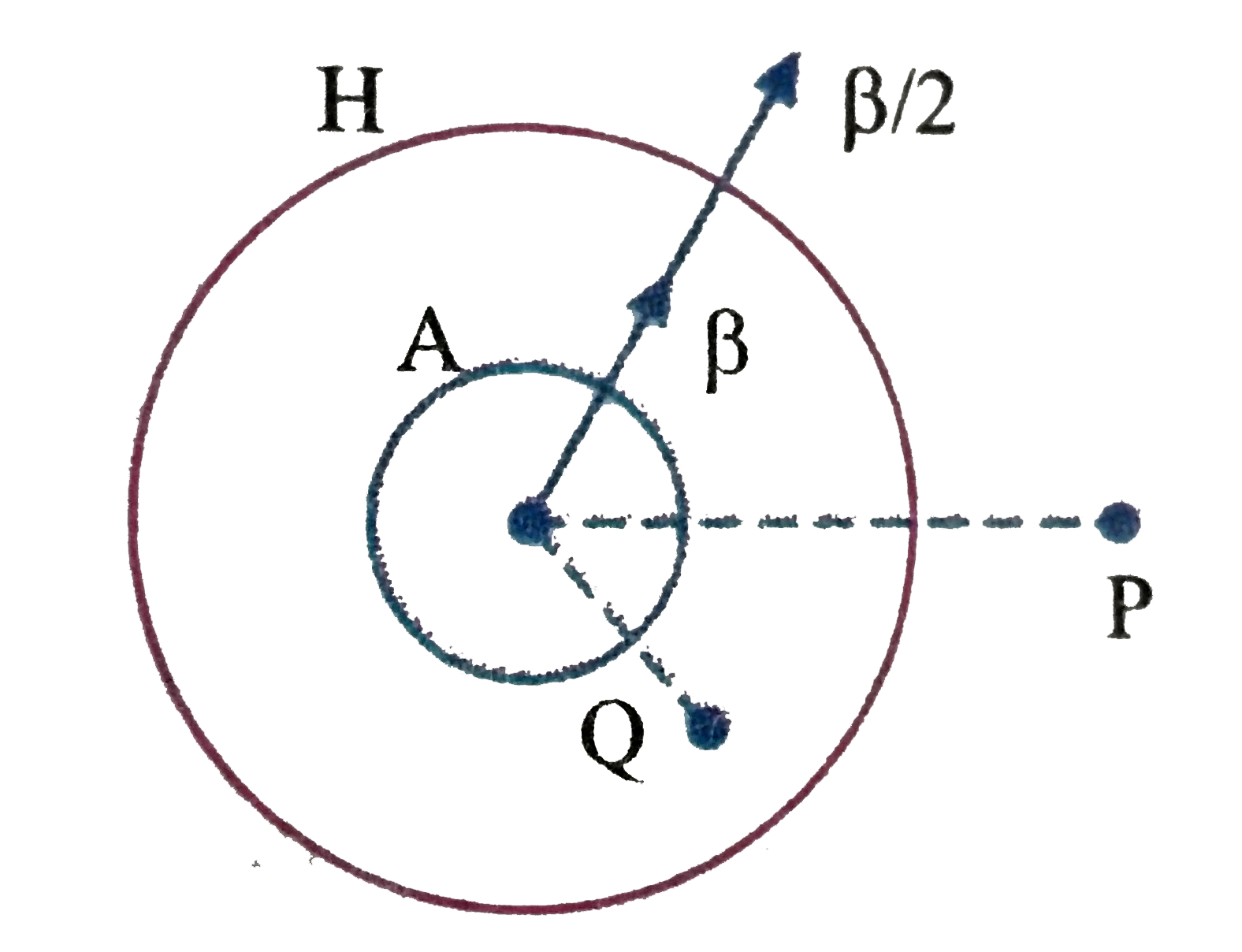 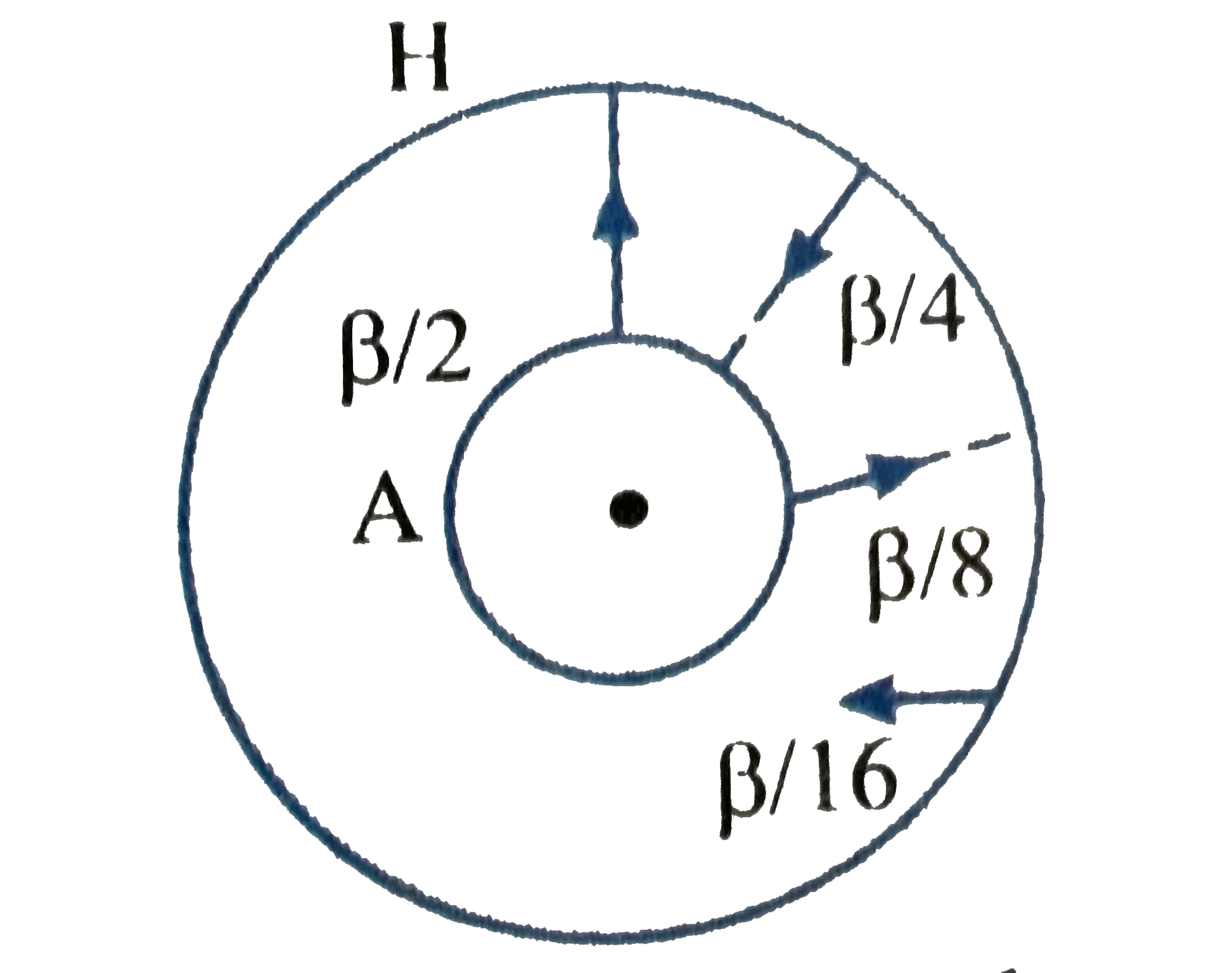 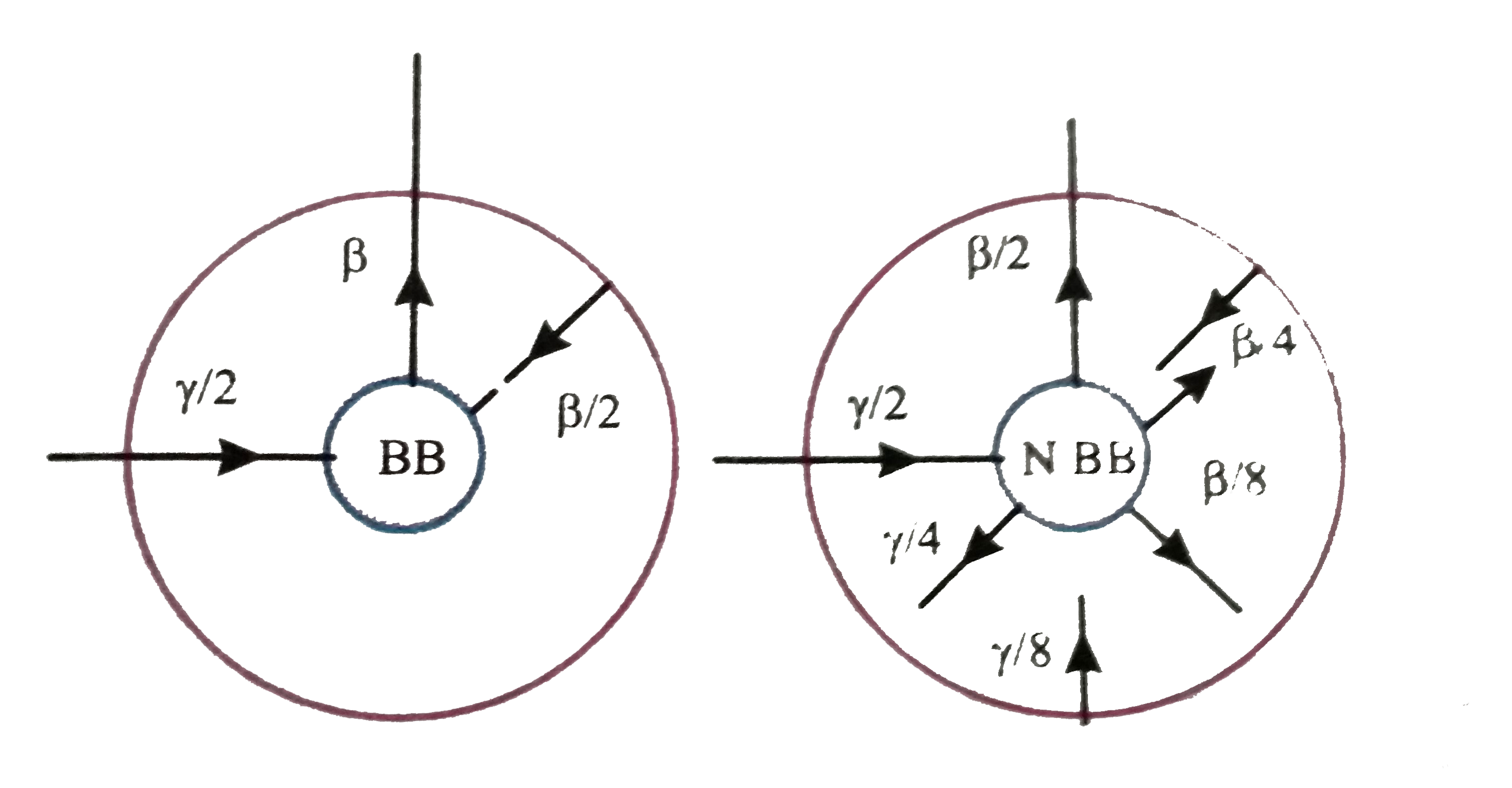
|
|
| 8. |
Two forces vec(P) and vec(Q) are acting at a point. If vec(P) is reversed, the new resultant becomes perpendicular to the initial resultant. Then: |
|
Answer» <P>P= Q |
|
| 9. |
In Cavendish's experiment, let each small mass be 20g and each large mass be 5kg. The rod connecting the small massess is 50 cm long, while the small and the large speres are separated by 10.0 cm. The torsion constant is 4.8 xx 10^(-8) kg m^(2)s^(-2) and the resulting angular deflection is 0.4^(@). Calculating the value of universal gravitational constant G from this data. |
|
Answer» Solution :Here, m = 20g = 0.02 kg, M = 5 kg `R = 10 CM, 0.1m, 1 = 50 cm = 0.5 m` `THETA = 0.4^(@) = (0.4^(@))(2pi//360^(@)) = 0.007` rad, `K = 4.8 xx 10^(-8) kg m^(2)s^(-2)` Thus from `G = (k theta r^(2))/(Mml)` On substituting `G = 6.72 xx 10^(-11) Nm^(2)kg^(-2)` |
|
| 10. |
What power is gained by a man when he eats 100 g ice in one minute ? Latent heat of fusion of ice is 80 cal/gm. |
|
Answer» Solution :`m=100g` `t=60` second Ice ate at each second `m.=m/t` `=(100)/(60)` `=(5)/(2)" Js"^(-1)` Power GAINED by a MAN `P=m.L` `=(5)/(3)xx80` `=(400)/(3)"CALS"^(-1)` `=(400)/(3)xx4.2" Js"^(-1)` `=400xx1.4=560W` |
|
| 11. |
Consider a spherical body A of radius R which is placed concentrically in a hollow enclosure H of radius 4R as shown in the The temperature of the body A and H are T_(A) and T_(H) respectively Emissivity transmittivity and reflactivity of two bodies A and H are (e_(a),e_(H)),?(t_(A),t_(H)), and (r_(A),r_(H)) respectively (Assume no absorption of the thermal energy by the space in between the body and enclosure as well as outside the enclousre and all radiations to be emitted and absorbed normal to the surface [Tske sigma xx 4pi r^(2) xx 300^(4) = betaJ//s] In the previous question if the enclosure is considered as perfect black body and is maintaind at same temperature as that of temperature of body A then in the two cases . |
|
Answer» the body A emits radiation at the same are So rate at which `A` loses energy is `beta J//s` and the rate at which `P` and `Q` receive energy are `beta//2J//s` and `betaJ//s` RESPECTIVELY This energy is received on the AREA of sphere passing through `P` and `Q` Now in this case each of incidence, refleaction absorption take place The rate at which energy has been lost by `A` is `P = - [P_(absorbed)-P_(emitted)]` `=-[(beta)/(8)+(beta)/(32)+...]+[(beta)/(2)+(beta)/(8)+(beta)/(32)+....]=(beta)/(2)` The rate a which energy is received by `P` is `P_(1) =0` The rate at which energy is receivedly `Q` is `P_(2)=[(beta)/(2)+(beta)/(8)+...]+[(beta)/(2)+(beta)/(8)+(beta)/(32)+.....]=(beta)/(2)` `=(beta)/(2)xx(4)/(3)+(beta)/(4)xx(4)/(3)=beta` `If beta = sigma 4piR^(2) xx 300^(4)` then `sigma xx 4pi (4R)^(2) xx 600^(4) = 256beta =gamma` LET `a_(H) =e_(H) = 0.5` and for `A` in `2nd` case `e_(A) = a_(A) = 0.5` For `1st` case, `P_("emitted") = beta J//s P_("absorbed") = (gamma)/(2) + (beta)/(2)` rate at which energy is lost `P=(beta-(gamma)/(2)-(beta)/(2))J//s` For `2nd` case `P_("emitted") = ((beta)/(2) + (beta)/(8) + (beta)/(32))J//s` For `2nd` case `P_("emitted")= ((beta)/(2)+(beta)/(8)+(beta)/(32)+....)+((gamma)/(4)+(gamma)/(16)+....)=(2beta)/(3)+(gamma)/(3)` `P_("absorbed")=((beta)/(2)+(beta)/(32)+...)+((gamma)/(4)+(gamma)/(16)+....)=(beta)/(6)+(gamma)/(3)` Rate at which heat is lost `P = (beta)/(2)` In these questions thermal equilibrium is not acheived and infinite no of reflection absorption can take place beforethermal equilibrium has been actived and it is because of very large speed of radiation 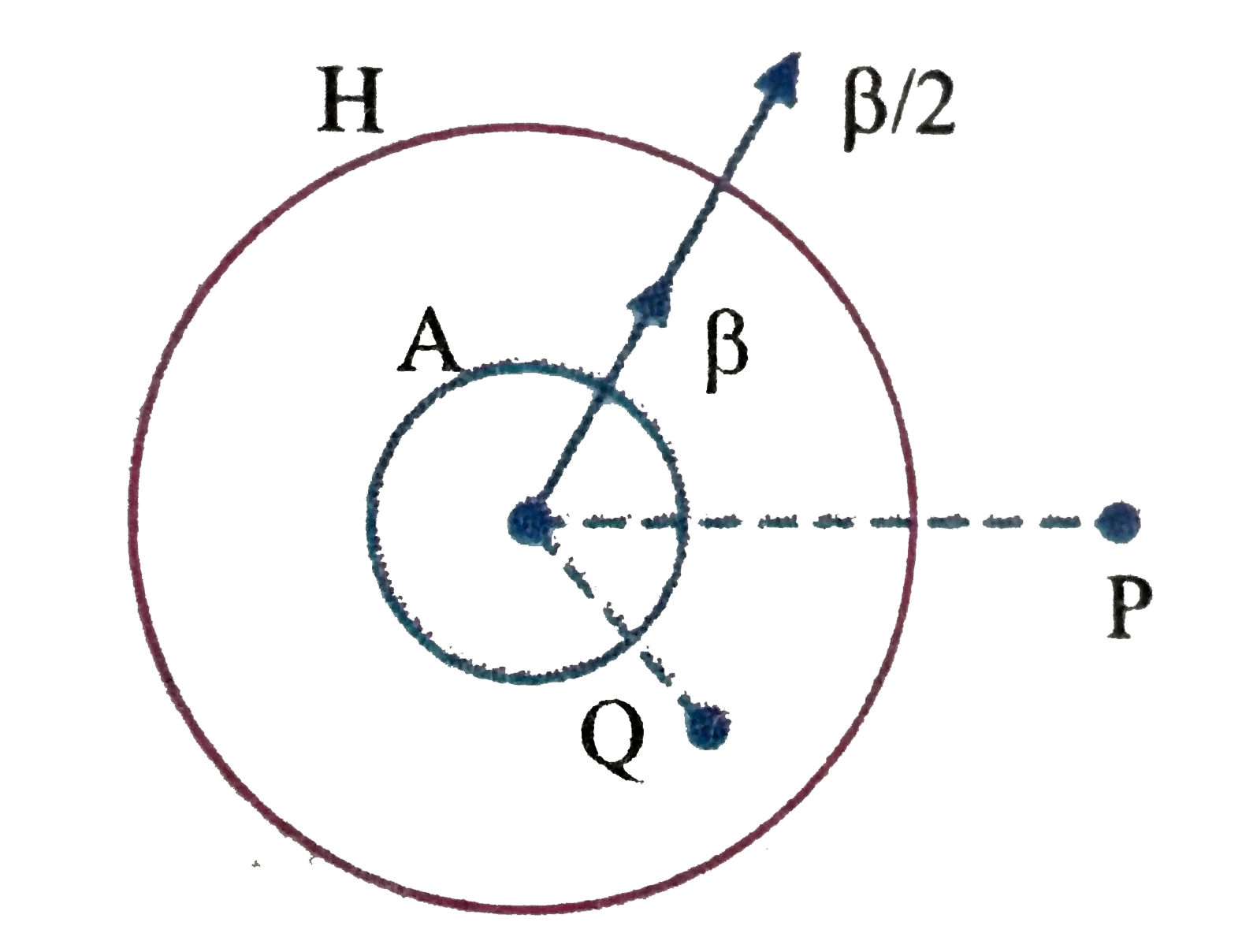 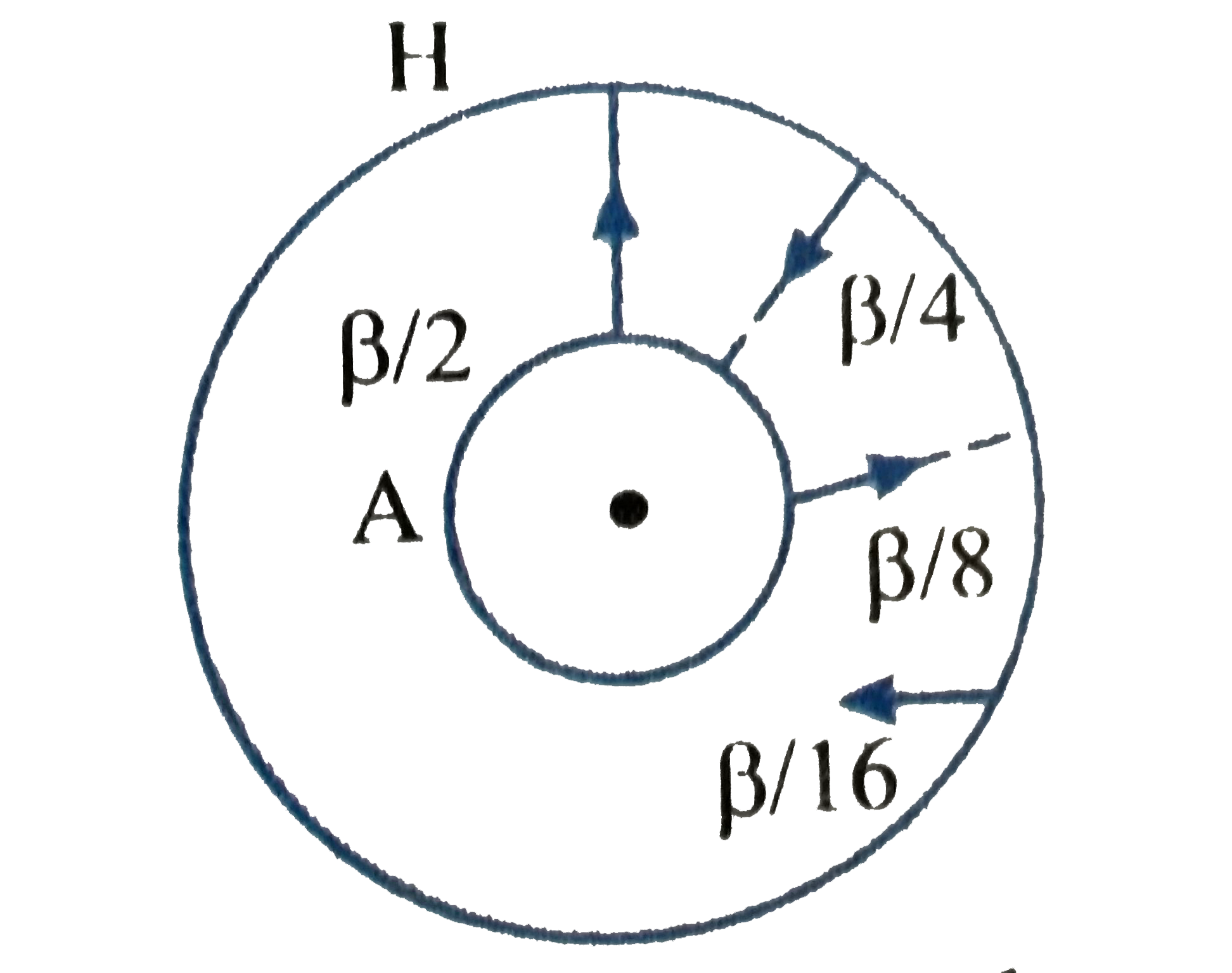 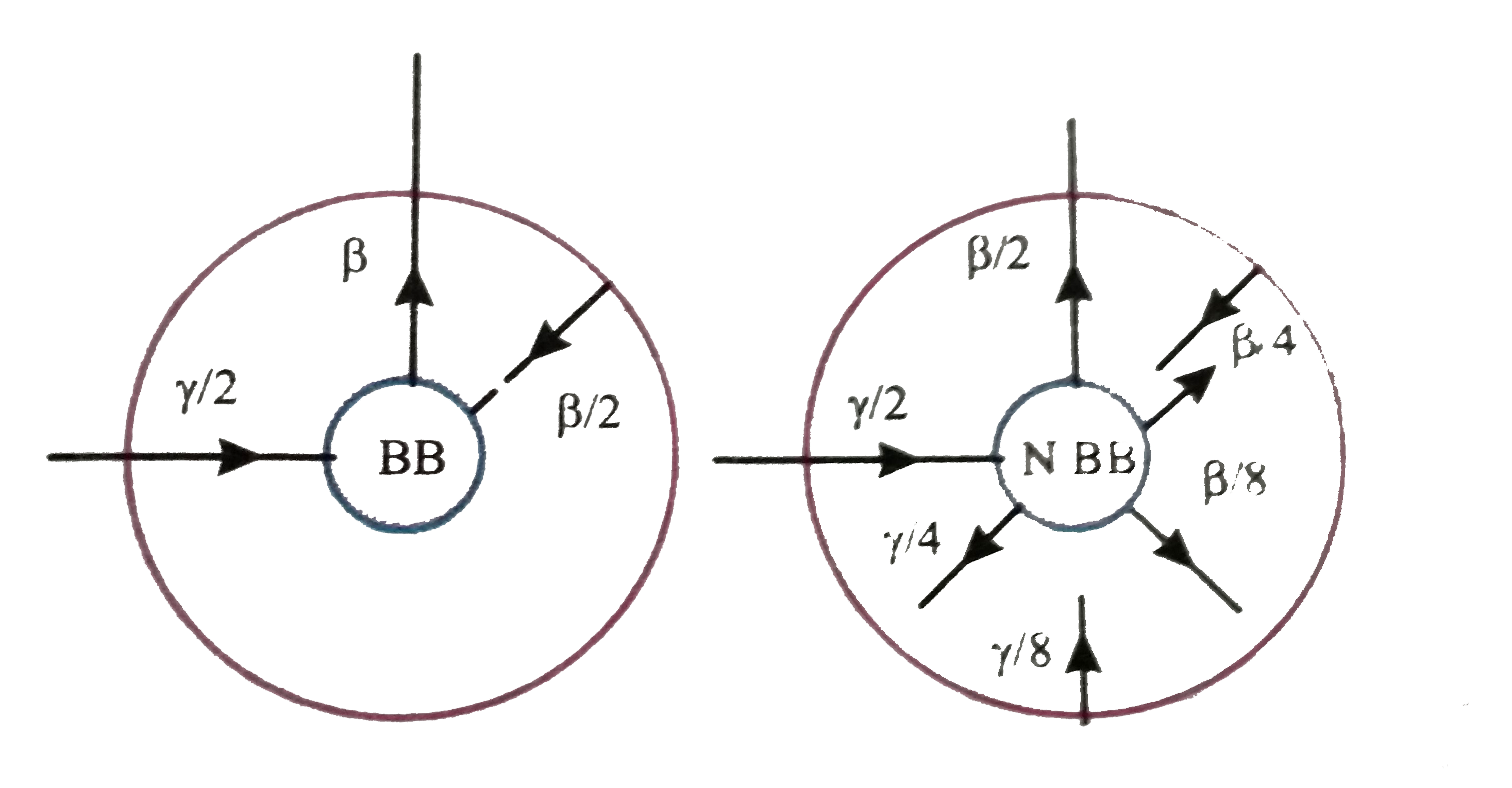
|
|
| 12. |
A lead bullet, of initial temperature 27^@Cand speed .v.kmph pnetrates into a solid object and melts. If 50% of the kinetic energy is used to heat it, the value of v in kmph is (for leads melting point = 600 K, latent heat of fusion = 2.5 xx 10^(4)J Kg^(-1), specific heat 125 J kg^(-1)K^(-1)) |
|
Answer» 1800 |
|
| 13. |
An electric heater is placed inside a room of total wall area 137m^(2) to maintain the temperature inside at 20^(@)C. The outside temperature is -10^(@)C. The walls are made of three composite materials. The inner most layer is made of wood of thickness 2.5 cm the middle layer is of cement of thickness 1 cm and the exterior layer is of thickness 25 cm. Find the power of electric heater assuming that there is no heat losses through the floor annd ceiling. The thermal conductivities of wood, cement and brick are 0.125W//m^(@)C,1.5W//m^(@)C and 1.0W//m^(@)C respectively, |
|
Answer» 7384 w |
|
| 14. |
Consider a spherical body A of radius R which is placed concentrically in a hollow enclosure H of radius 4R as shown in the The temperature of the body A and H are T_(A) and T_(H) respectively Emissivity transmittivity and reflactivity of two bodies A and H are (e_(a),e_(H)),?(t_(A),t_(H)), and (r_(A),r_(H)) respectively (Assume no absorption of the thermal energy by the space in between the body and enclosure as well as outside the enclousre and all radiations to be emitted and absorbed normal to the surface [Tske sigma xx 4pi r^(2) xx 300^(4) = betaJ//s] Consider two cases, first one in which A is a perfect black body and the second in which A is a non-black In both the cases temperature of boby A is same equal to 300K and H is at temperature 600K For H t = and a ne 1 For this situation mark out the correct statements (s) . |
|
Answer» The bodies lose their distinctiveness inside the enclosure and both of them EMIT the same RADIATION as that of the black body . So rate at which `A` LOSES energy is `beta J//s` and the rate at which `P` and `Q` receive energy are `beta//2J//s` and `betaJ//s` respectively This energy is received on the area of sphere passing through `P` and `Q` Now in this case each of incidence, refleaction absorption take place The rate at which energy has been lost by `A` is `P = - [P_(absorbed)-P_(emitted)]` `=-[(beta)/(8)+(beta)/(32)+...]+[(beta)/(2)+(beta)/(8)+(beta)/(32)+....]=(beta)/(2)` The rate a which energy is received by `P` is `P_(1) =0` The rate at which energy is receivedly `Q` is `P_(2)=[(beta)/(2)+(beta)/(8)+...]+[(beta)/(2)+(beta)/(8)+(beta)/(32)+.....]=(beta)/(2)` `=(beta)/(2)xx(4)/(3)+(beta)/(4)xx(4)/(3)=beta` `If beta = sigma 4piR^(2) xx 300^(4)` then `sigma xx 4pi (4R)^(2) xx 600^(4) = 256beta =gamma` Let `a_(H) =e_(H) = 0.5` and for `A` in `2nd` case `e_(A) = a_(A) = 0.5` For `1st` case, `P_("emitted") = beta J//s P_("absorbed") = (gamma)/(2) + (beta)/(2)` rate at which energy is lost `P=(beta-(gamma)/(2)-(beta)/(2))J//s` For `2nd` case `P_("emitted") = ((beta)/(2) + (beta)/(8) + (beta)/(32))J//s` For `2nd` case `P_("emitted")= ((beta)/(2)+(beta)/(8)+(beta)/(32)+....)+((gamma)/(4)+(gamma)/(16)+....)=(2beta)/(3)+(gamma)/(3)` `P_("absorbed")=((beta)/(2)+(beta)/(32)+...)+((gamma)/(4)+(gamma)/(16)+....)=(beta)/(6)+(gamma)/(3)` Rate at which heat is lost `P = (beta)/(2)` In these questions thermal equilibrium is not acheived and infinite no of reflection absorption can take place beforethermal equilibrium has been actived and it is because of very large speed of radiation 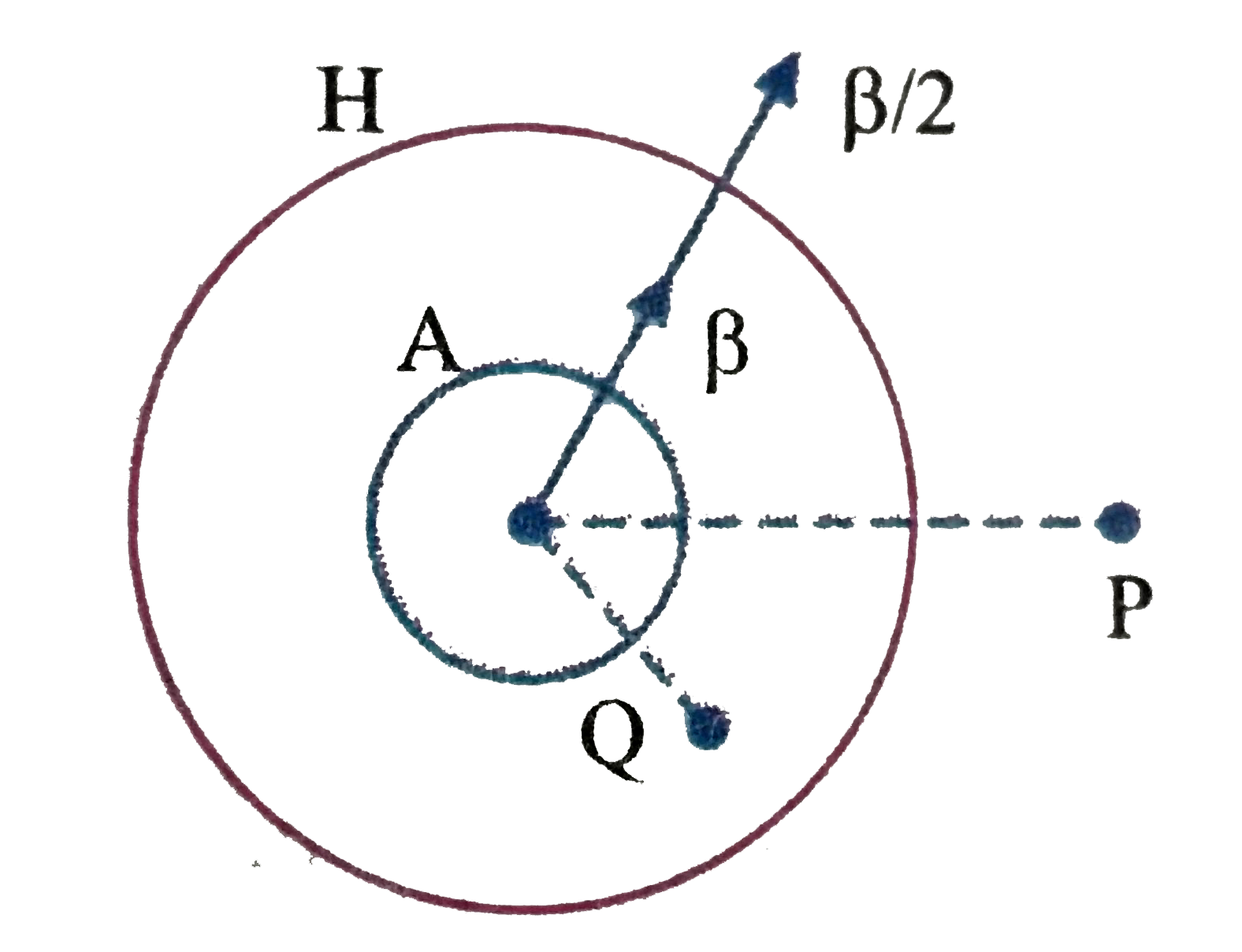 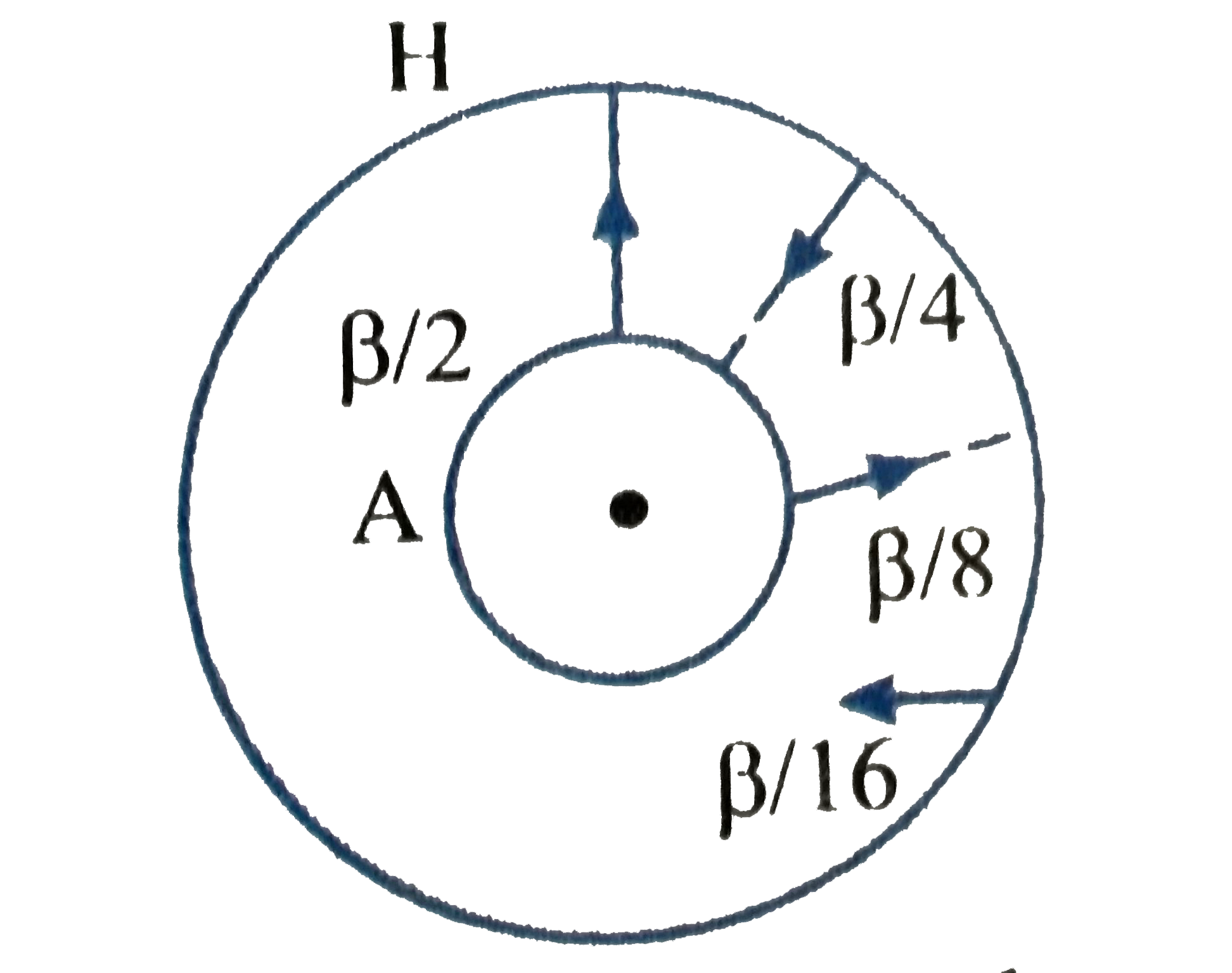 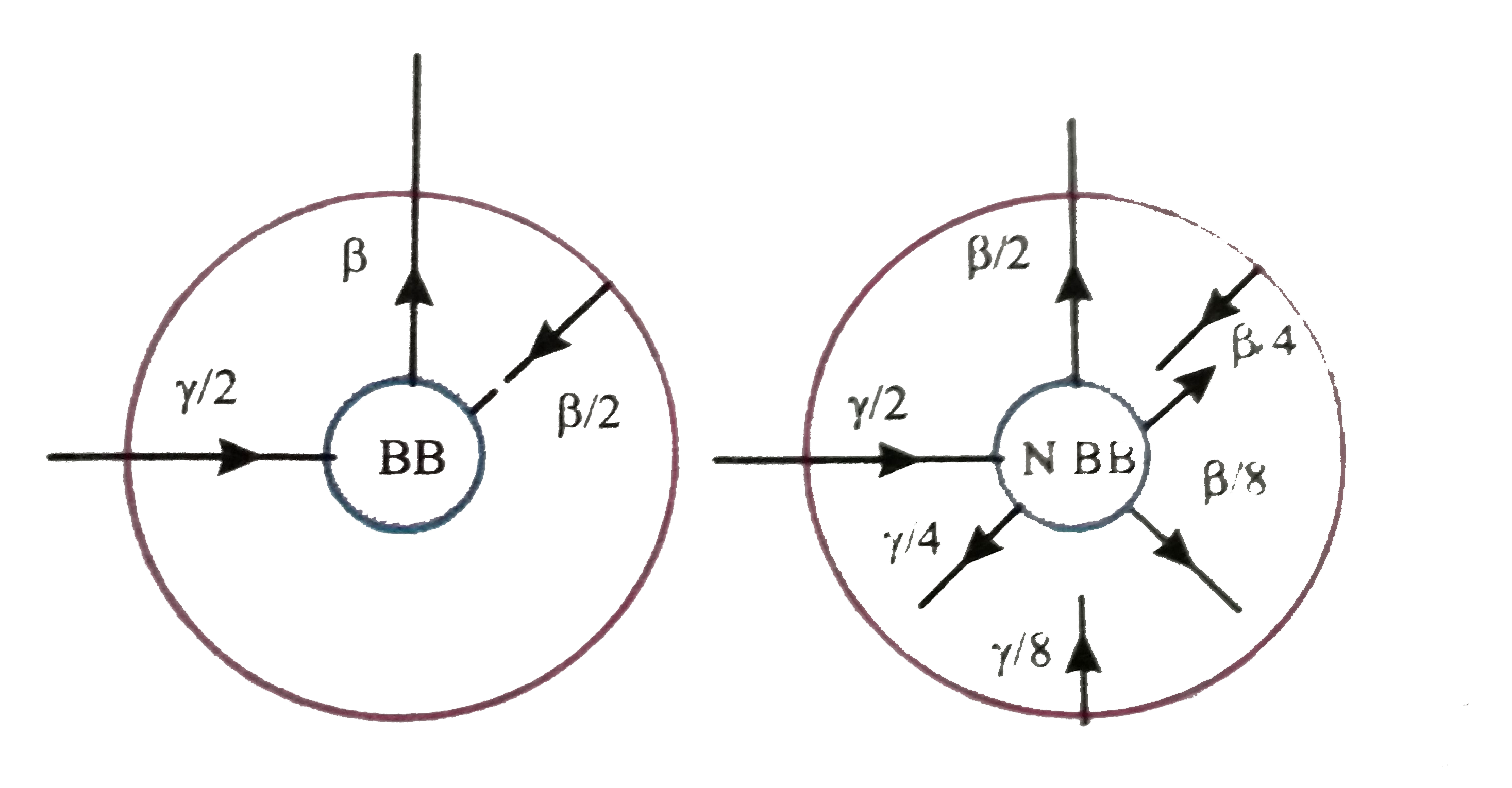
|
|
| 15. |
Consider a spherical body A of radius R which is placed concentrically in a hollow enclosure H of radius 4R as shown in the The temperature of the body A and H are T_(A) and T_(H) respectively Emissivity transmittivity and reflactivity of two bodies A and H are (e_(a),e_(H)),?(t_(A),t_(H)), and (r_(A),r_(H)) respectively (Assume no absorption of the thermal energy by the space in between the body and enclosure as well as outside the enclousre and all radiations to be emitted and absorbed normal to the surface [Tske sigma xx 4pi r^(2) xx 300^(4) = betaJ//s] In above quations if body A has then mark out the correct statements (s) . |
|
Answer» The RATE at which A loses the energy is `betaJ//s` . So rate at which `A` loses energy is `beta J//s` and the rate at which `P` and `Q` receive energy are `beta//2J//s` and `betaJ//s` respectively This energy is received on the area of sphere PASSING through `P` and `Q` Now in this case each of incidence, refleaction absorption take place The rate at which energy has been lost by `A` is `P = - [P_(absorbed)-P_(emitted)]` `=-[(beta)/(8)+(beta)/(32)+...]+[(beta)/(2)+(beta)/(8)+(beta)/(32)+....]=(beta)/(2)` The rate a which energy is received by `P` is `P_(1) =0` The rate at which energy is receivedly `Q` is `P_(2)=[(beta)/(2)+(beta)/(8)+...]+[(beta)/(2)+(beta)/(8)+(beta)/(32)+.....]=(beta)/(2)` `=(beta)/(2)xx(4)/(3)+(beta)/(4)xx(4)/(3)=beta` `If beta = sigma 4piR^(2) xx 300^(4)` then `sigma xx 4PI (4R)^(2) xx 600^(4) = 256beta =gamma` Let `a_(H) =e_(H) = 0.5` and for `A` in `2ND` case `e_(A) = a_(A) = 0.5` For `1st` case, `P_("emitted") = beta J//s P_("absorbed") = (gamma)/(2) + (beta)/(2)` rate at which energy is lost `P=(beta-(gamma)/(2)-(beta)/(2))J//s` For `2nd` case `P_("emitted") = ((beta)/(2) + (beta)/(8) + (beta)/(32))J//s` For `2nd` case `P_("emitted")= ((beta)/(2)+(beta)/(8)+(beta)/(32)+....)+((gamma)/(4)+(gamma)/(16)+....)=(2beta)/(3)+(gamma)/(3)` `P_("absorbed")=((beta)/(2)+(beta)/(32)+...)+((gamma)/(4)+(gamma)/(16)+....)=(beta)/(6)+(gamma)/(3)` Rate at which heat is lost `P = (beta)/(2)` In these questions thermal equilibrium is not acheived and infinite no of reflection absorption can take place beforethermal equilibrium has been actived and it is because of very large speed of radiation 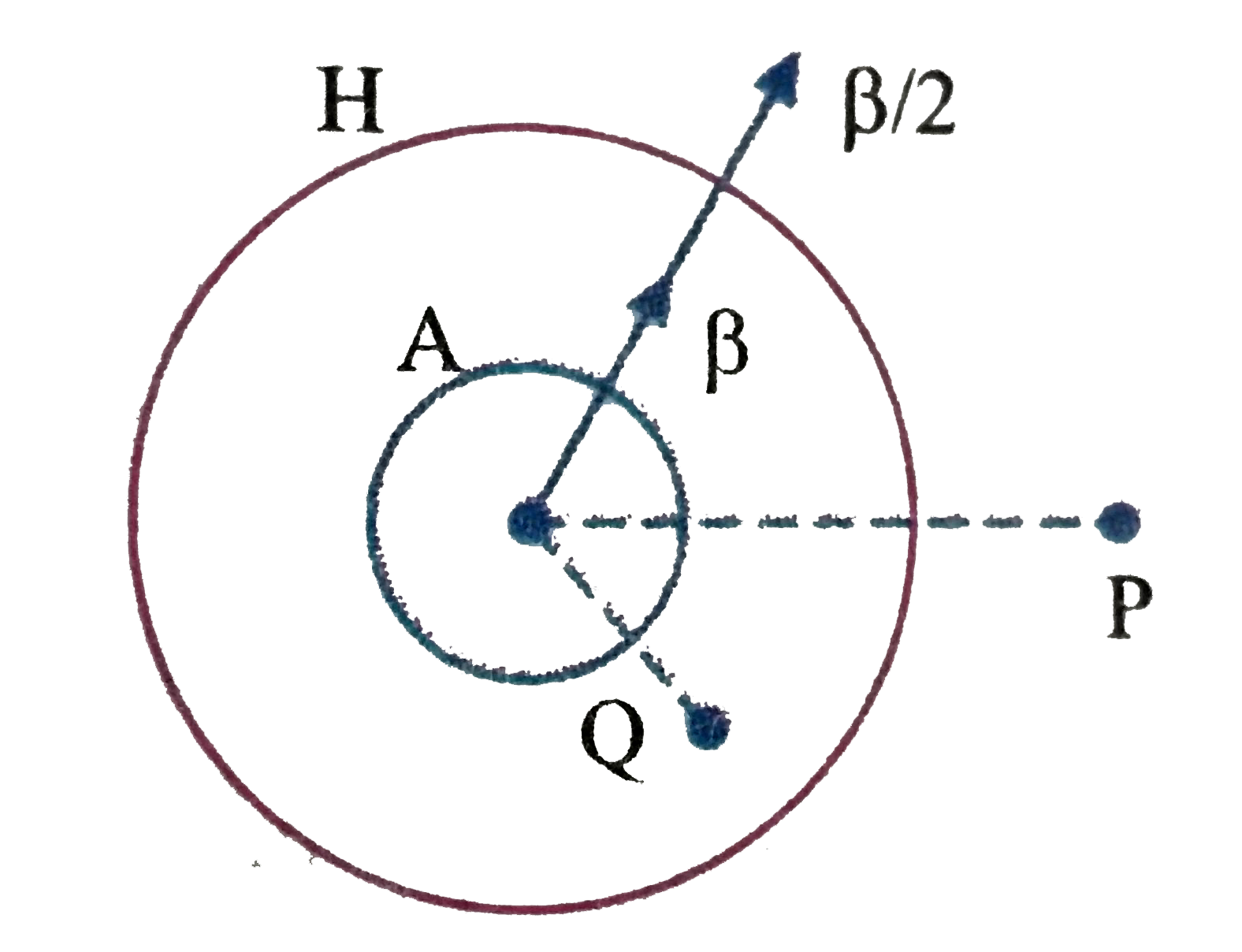 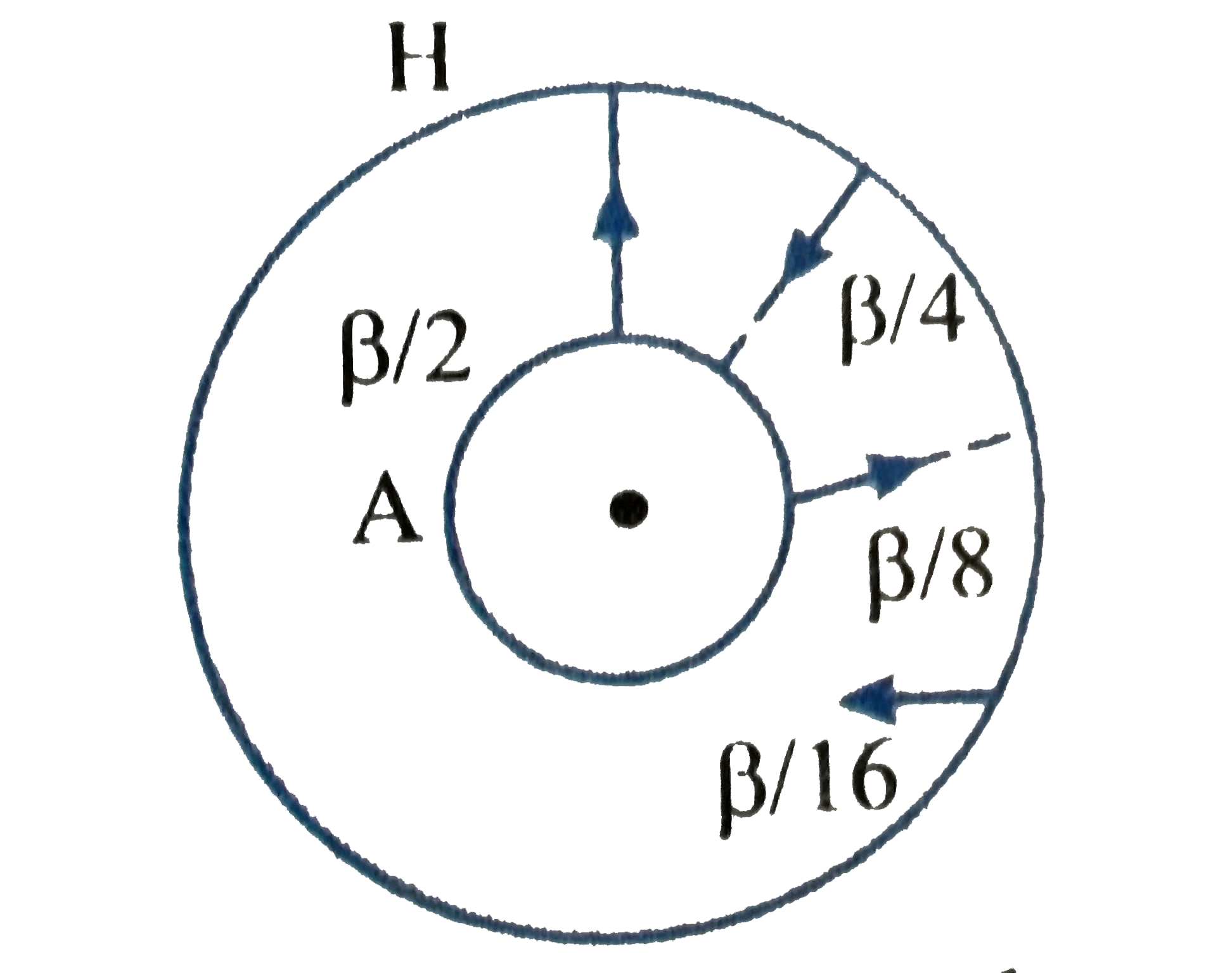 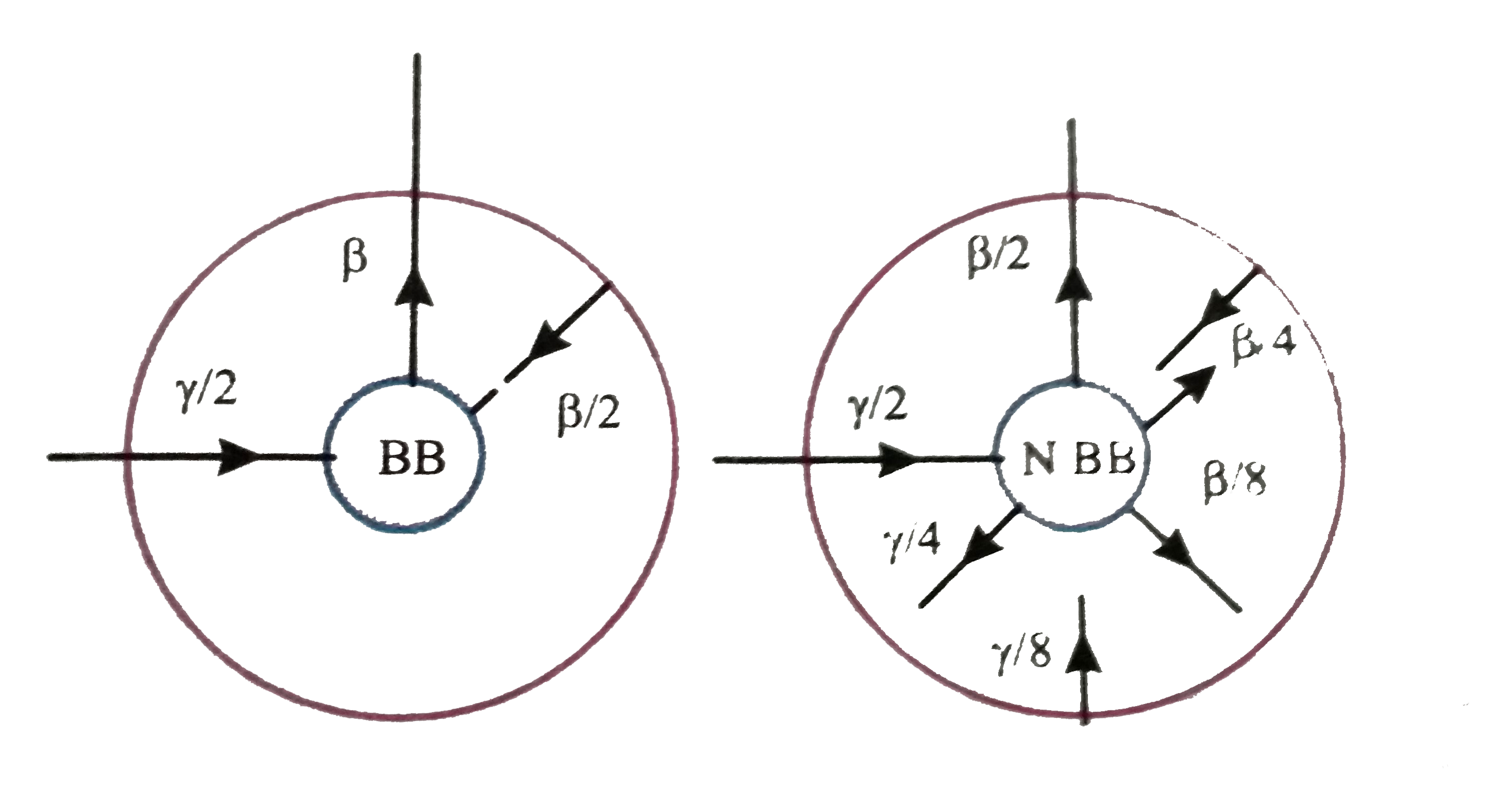
|
|
| 16. |
How we can find impulse of force when very small force act on body for very small time interval ? |
| Answer» SOLUTION :By usingchange in MOMENTUM | |
| 17. |
A particle is projected at an angle of theta with respect to the horizontal direction. Match the following for theabove motion. (a) V_(x)""-"decrease and increases" (b) V_(y)""-"remains constant" (c) "Acceleration - varies" (d) "Position vector "-" remains downward" |
|
Answer» `v_(x)`- DECREASES and INCREASES |
|
| 18. |
The motion of plants in the solar system is radius R coalesece to from a single large drop .The radius of the tatal surface energies before and after the change is |
|
Answer» mass `dA =` area of correct trangle `SAB` `= (1)/(2)(AB xx SA)` `= (1)/(2) (rd theta xx r) = (1)/(2) r^(2)dtheta` 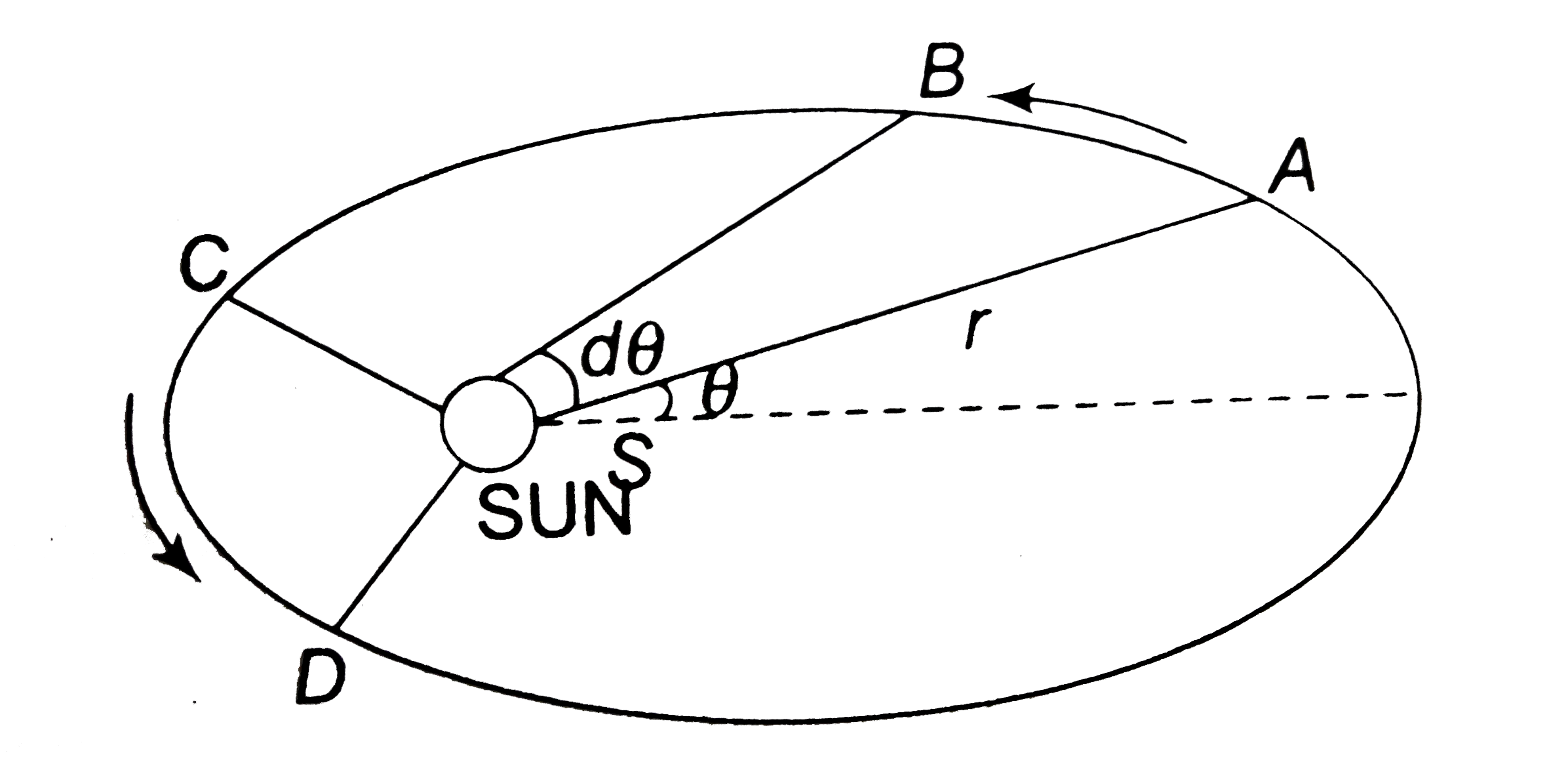 The instantanterms areal speed of the planet is `(dA)/(DT) = (1)/(2) r^(2) (d theta)/(dt) = (1)/(2) r^(2)omega,` where `omega` is angular speed. Let `j` be angular momentum of planet about sun `J = Iomega = mr^(2) omega` `(delta A)/(dt) = (J)/(2m)` From Kepler's has areal speed is constant therefore angular momentum J is constant Hence, kept's sound law is apilvalent its CONSERVATION of angular momentum. |
|
| 19. |
Oxygen and hyrdogen are at the same temperature T. The ratio of the mean kinetic energy of oxygen molecules to that of the hydrogen molecules will be |
|
Answer» `16:1` |
|
| 20. |
The dimension of the quantity (1)/(epsilon_(0)) (e^(2))/(hc)is (e = charge of electron, h = Planck's constant and c = velocity of light) |
|
Answer» `[M^(-1)L^(-3)T^(2)A]` or `[hc]= ["energy"][lambda]= ["force"]["distance"]^(2)` Also,`["force"]= ([e^(2)])/[(epsilon_(0))["Distance"]^(2)` or `([e^(2)])/([epsilon_(0)])= ["force"]["distance"]^(2)` `:. [hc]= ([e^(2)])/([epsilon_(0)])` or `[(e^(2))/(epsilon_(0)). (1)/(hc)]= [M^(0)L^(0)T^(0)A^(0)]` |
|
| 21. |
A solid sphere, a hollow sphere and a disc, all having same mass and radius, are placed at the top of an incline and released. The friction coefficients between the objects and the incide are same and not sufficient to allow pure rolling. Least time will be taken in reaching the bottom by |
|
Answer» the SOLID sphere |
|
| 22. |
A small water drop placed on a lotus leaf is spherical in shape. Why does the small water drop acquire a spherical shape? |
| Answer» Solution :Force of surface TENSION tends to reduce the surface AREA. For a given VOLUME, a sphere has the minimum surface area. So TINY DROPLETS are spherical. | |
| 23. |
Human heart pump 70 cc of blood at each beat against a pressure of 125 mm of Hg. If the pulse frequency is 72 minute, the power of the heart is nearly |
|
Answer» `1.2 W` |
|
| 24. |
Explain the formation of monsoons. |
|
Answer» Solution :These are convectional CURRENTS in air caused due to varation in temeprature in summer and winter seasons. In summer, the penisular mass of central Asia will be heated more than the water the Indian Ocean. The reason for this is specific heat of water is MUCH higher that that of land. Hot and LIGHTER air from the land rises up and moves towards the Indian Ocean. Air filled with moisture flows over the Indian Ocean towards the land. When obstructed by mountains, the moisture get cooled and CONDENSES which causes RAINFALL. |
|
| 25. |
Mark out the correct options |
|
Answer» the energy of any smal part of a string REMAINS constnt in a traveling wave |
|
| 26. |
Centre of mass of a body is ……… at with ………….is………… . |
| Answer» SOLUTION :a point , ENTIRE mass of body , SUPPOSED to be CONCENTRATED. | |
| 27. |
A weightless rod of length l with a small load of mass m at the end is hinged at point A as shown and occupies a strictly vertical position, touching a body of mass M. A light jerk sets the system in motion. a. For what mass ratio M//m will the rod form an angle alpha=pi//6 with the horizontal at the moment of the separation from the body? b. What will he the velocity u of the body at this moment? Friction should be neglected. |
|
Answer» At the TIME of separation For `M, SigmaF_(x)=0` and `a=0` 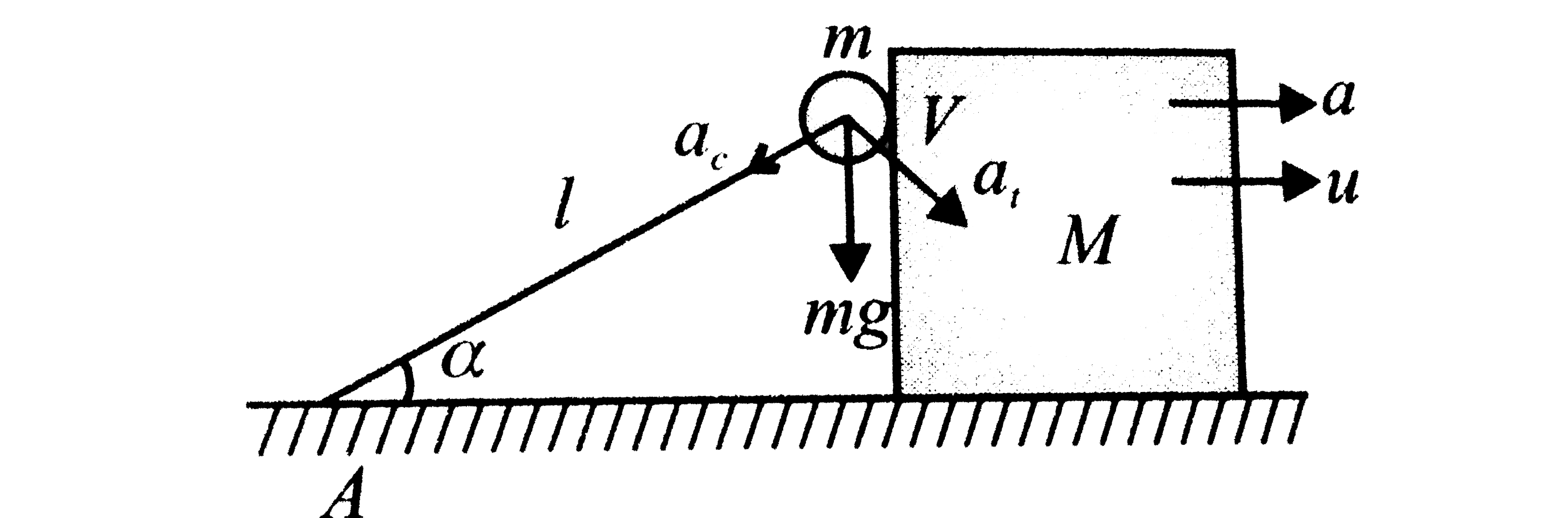 Acceleratin of the load in horizontal direction `a=0=a_(1)sinalpha-v^(2)/lcosalpha` `a_(t)sinalpha=(v^(2))/lcosalpha` But `a_(t)=gcosalpha` HENCE `v=sqrt(GL sin alpha)` `u=vsinalpha=sinalpha sqrt(gl sin alpha)` `mgl=mgl sin alpha+(mv^(2))/2+1/2Mv^(2)sinalpha` `M/m=(2-3sinalpha)/(sin^(3)alpha)=4` `u=vsinalpha=1/2sqrt((gl)/2)` |
|
| 28. |
The ratio of the apparent frequencies of the hom of a car when approching and receding a stationary observer is 11 : 9. What is the speed of the car, if the velocity of sound in air is 300 m//s? |
|
Answer» |
|
| 29. |
(A) : A solid sphere and a hollow sphere of same material are floating in a liquid. Radius of both the spheres are same. Percentage of volume immersed of both the spheres will not be same. (R ) : Upthrust depends on volume of liquid displaced. |
|
Answer» Both (A) and (R ) are TRUE and (R ) is the CORRECT explanation of (A) |
|
| 30. |
Identify the internal and external forces acting on the following systems. (a) Earth alone as a system (b) Earth and Sun as a system (c) Our body as a system while walking (d) Our body + Earth as a system |
Answer» Solution :(a) Earth ALONE as a system: Earth orbits the Sun due to gravitational attraction of the Sun. If we consider Earth as a system, FORCE exerted then Sun.s gravitational force is an by the sun external force. If we take the Moon into account, it also exerts an external force on Earth.  (b) (Earth+Sun) as a system: In this case, there are two internal FORCES which form an action and reactionpair-the gravitational force exerted by the Sun on Earth and gravitational System force exerted by the Earth on the Sun. (c) Our BODY as a system: While walking, we EXERT a force on the Earth and Earth exerts an equal and opposite force on our body. If our body alone is considered as a system, then the force exerted by the Earth on our body is external. (d) (Our body + Earth) as a system: In this case, there Our body as a system are two internal forces present in the system. One is the force exerted by our body on the Earth and the other is System the equal and opposite force exerted by the Earth on our body. |
|
| 31. |
vec(P), vec(Q), vec(R ), vec(S) are vectors of equal magnitude. If bar(P) + vec(Q) - vec(R )= O angle between vec(P) and vec(Q) " is " theta_(1). If bar(P) + bar(Q) - bar(S) = O angle between bar(P) and bar(S) " is " theta_(2). The ratio of bar(theta)_(1) " to " theta_(2) is |
| Answer» ANSWER :B | |
| 32. |
Four objects with the same mass and radius are spinning freely about a diameter with the same angular speed. Arrange the work required to stop them in the decreasing order (a) Solid sphere (b) Hollow sphere (c) Disc (d) Hoop |
| Answer» Answer :A | |
| 33. |
A force of 100 acts on a body of mass 5 kg at rest for 4s. If te body moves through 10m in a direction making an angle 60^(@) with the direction of force, the work done by the force is |
|
Answer» 80 J |
|
| 34. |
Find the radius of the soap bubble 44xx10^(-6)J of work of the done in blowing the soap, bubble. Surface tension of soap solution 7xx10^(-2) Nm^(-1) |
|
Answer» SOLUTION :Work done `W=44xx10^(-6)J` If r I the radius of the SOAP bubble SURFACE are of the soap bubble `=8pir^(2)` Work done in blowing soap bubble (W)= surface area of the bubble `xx` surface tension `W=8pir^(2).S` `:.r^(2)=W/(8piS)r=sqrt(W/(8piS))=sqrt((44xx10^(-6))/(8xx22/7xx7xx10^(-2)))` `=sqrt(1/4xx10^(-4)),r=0.005m` (or) 5mm |
|
| 35. |
An object is projected with a velocity of 20ms^(-1) making an angle of 45^(@) with horizontal. The equation for the trajectory is h = Ax - Bx^(2) where .h. is height, X is horizontal distance, A and B are constants. The ratio A and B is (g = 10 ms^(-2)) |
|
Answer» `1:5` |
|
| 36. |
At what height, the value of g is same as at a depth ofR/2 ? |
|
Answer» Solution :At depth ` = R/2` , value of acceleration due to gravity , ` G. = g (1 - ( R )/(2R) ) = g/2` At HIGHT X` g. = g (1 - (2x)/(R ) )` ` therefore g (1 - (2x)/( R) ) = g/2` ` 1/2 = (2x)/( R ) rArr x = R/4` |
|
| 37. |
A wheel has angular acceleration of 3.0 "rad" // s^(2) and an initial angular speed of 2.00 "rad" // s . In a time of 2 seconds it has rotated through an angle of (in radian) ......... . |
|
Answer» 10 |
|
| 38. |
Can there be any change in direction of the velocity of a body moving under a constant acceleration? |
| Answer» Solution :DIRECTION of velocity of a body may change even if the body has a constant ACCELERATION. In projectile motion, the path CHANGES at every POINT with the change in direction of the velocity. But at every point its acceleration is the acceleration due to gravity and hence, is a constant. | |
| 39. |
The resultent of two unlike parallel forces is 5N and acts at a distance of 20 cm and 40 cm from them. The forces are |
| Answer» Answer :B | |
| 40. |
A light vertical spring is stretched by 2 cm when a weight of 10 kg is attached to its free end. The weight is further pulled down by 1.0 cm and released. Find its time period and amplitude ? |
|
Answer» Solution :i) Force costant of the spring `k= ("Restoring Force")/("Increase in length")= ("MG")/("Increase in length")( :. F=mg)= (10 xx 10^(-3) xx 9.8)/(2.0 xx 10^(-2))= 4.9 Nm^(-1)` Time period of a spring, `T= 2pisqrt((m)/(k))= 2pisqrt((10 xx 10^(-3))/(4.9))` The frequency , `v= (1)/(T)= (1)/(2pi)SQRT((4.9)/(10^(-2)))= 3.523 HZ` (ii) The amplitude of motion =The distance through which the WEIGHT is further PULLED down = 1.0 cm i.e., A= 1.0 cm. |
|
| 41. |
If a ball is thrown vertically upwards with speed u, the distance covered during the last t seconds of its ascent is |
|
Answer» `UT-1/2 G t^2` |
|
| 42. |
Give one example of uniform motion even if object has acceleration. |
| Answer» SOLUTION :UNIFORM CIRCULAR MOTION. | |
| 43. |
Shown a vector vec(a) angle theta as shown in the figure column-2. Show its unit vector representation . |
|
Answer» |
|
| 44. |
A plane glass slab is kept over various coloured letters: the letter which appears least raised is |
|
Answer» blue |
|
| 45. |
A projectile is fired at a speed of 100 m/s at an angle of 37^(@) above the horizontal. At the highest point, the projectile breaks into two parts of mass ratio 1:3, the smaller piece coming to rest. Find the distance from the launching point to the point where the heavier piece lands. |
Answer» SOLUTION :Internal forces do not AFFECT the motion of the centre of mass, the centre of mass hits the ground at a position where the original projectile would have landed. The range of the original projectile is  `x_(CM)=(2u^(2)sinthetacostheta)/(g)=(2xx10^(4)xx(3)/(5)xx(4)/(5))/(10)m=960m` The centre of mass will hit the ground at this position. As the smaller BLOCK comes to rest after breaking, it falls down vertically and hits the ground at half of the range, i.e., at x = 480 m. If the heavier block hits the ground at `x_(2)`, then `x_(CM)=(m_(1)x_(1)+m_(2)x_(2))/(m_(1)+m_(2))implies960=((m)(480)+(3m)(x_(2)))/((m+3m))` `:.x_(2)=1120m` |
|
| 46. |
What is the velocity, wave length range of heat radiations in vaccum ? |
| Answer» SOLUTION :Heat radiations TRAVEL with the VELOCITY of LIGHT `i.e.,3 xx 10^(8) ms^(=1)` .The wavelenght range of thermal radiation is `1000 A^(@)` to `100000 A^(@)` | |
| 47. |
Find the change in internal energy in joule.When 10g of air is heated from 30^(@)C to 40^(@)C(Cv = 0.172 kcal/kg K, J = 4200 J/kcal) |
|
Answer» 62.24J |
|
| 48. |
Two isolated uniform spheres of masses m_1 and m_2and radii 2R and R respectively are released from rest from the given position. Find the distance from m_1where they meet. (Position of centre of mass does not change as gravitational force acting between them is an internal force) |
| Answer» SOLUTION :`((m_2)/(m_1+m_2))3R` | |
| 49. |
The radius of a metal sphere at room temperature T is R, and the coefficient of linear expansion of the metal is alpha. The sphere is heated a little by a temperature DeltaT so that its new temperature is T+DeltaT. The increase in the volume of the sphere is approsimately. |
|
Answer» `2pi" "Ralpha" "DeltaT`  Original volume of sphere `V_(0)=4/3piR^(3)` Coefficient of linear EXPANSION = `alpha` Coefficient of volume expansion `=3alpha` `:.(DeltaV)/(V DeltaT)=3alpha` `:.DeltaV=2alphaVDeltaT` But `V=4/3piR^(3)` `:.Delta=4piR^(3)alphaDeltaT` |
|
| 50. |
A spherical ball of radius R is floating at the interface of two liquids with densities rho and 2rho. The volumes of the ball immersed in two liquids are equal. Answer the following questions: Find the force exerted by the liquid with density 2rho on the ball |
|
Answer» `PIR^(2)rhog(H+(2R)/(3))` `2piR^(2)Hrhog+(4piR^(3)rhog)/(3)=F,2piR^(2)rhog(H+(2R)/(3))=F` |
|