Saved Bookmarks
This section includes 7 InterviewSolutions, each offering curated multiple-choice questions to sharpen your Current Affairs knowledge and support exam preparation. Choose a topic below to get started.
| 1. |
Which is grater mu_(s) or mu_(k) |
| Answer» SOLUTION :It isthe forceof reactionon thebodydue TOTHE surfaceon whichit isplaced. Italwaysactsperpendicularto THEPOINTOF CONTACT. | |
| 2. |
A freely falling body traveled xm in nth second distance travelled in a -1th second is |
|
Answer» x |
|
| 3. |
If the total surface area of human body is 1.2m^(2) and the surface temperature is 30^(0)C, find the net rate of radiation from the body if the suffounding is at a temperature of 20^(0)C. (Take emmisivity of human body = 1) |
|
Answer» 574 W |
|
| 4. |
A constant force acts on a body which is intially at rest. If a graph is drawn by plotting its kinetic energy along Y-axis and displacement along Xaxis, shape of the graph is |
|
Answer» STRAIGHT LINE PASSING through ORIGIN |
|
| 5. |
A turnips sits before a thin coverging lens,outside the focal point of the lens.Teh lens is filled with a transparent gel so that it is flexible by,by squeezing its ends towards its center [as indicated in figure(a)],you can change the curvature of its front and rear sides When you squeeze the lens,the image |
|
Answer» moves towards the LENS |
|
| 6. |
Two simple harmonic motions are represented by the equations: x_(1)=5sin(2pit+(pi)/(4)),x^(2)=5sqrt(2)(sin2pit+cos2pit) What is the ratio of their amplitudes? |
|
Answer» Solution :`x_(1)=5SIN(2pit+(pi)/(4))""[therefore A_(1)=5]` `x_(2)=5sqrt(2)(sin2pit+cos2pit)` `=10sin(sin2pitcos.(pi)/(4)+cos2pitsin.(pi)/(4))` `x_(2)=10sin(2pit+(pi)/(4))""[therefore A_(2)=10]` Hence, `(A_(1))/(A_(2))=(5)/(10)=1:2` `A_(1):A_(2)=1:2` |
|
| 7. |
What is the angular velocity of the hour hand of a clock ? |
| Answer» Solution :`OMEGA=(2PI)/(12)=(pi)/(6)radh^(-1)` | |
| 8. |
(A) Work done by frictional force is always negative (B) A body at rest can have mechanical energy (C ) Mechanical energy of freely falling body decrease gradually |
|
Answer» Only A is TRUE |
|
| 9. |
Check the following equation by dimensional analysis method: E = mc^(2) |
|
Answer» Solution :Let us assume that the Energy E depends on mass m and velocity of light c. `E prop m^(a) c^(B)` `E = km^(a) c^(b)` where K a CONSTANT DIMENSIONS of `E = [ML^(2)T^(-2)] ` Dimensions of m = [M] Dimensions of `c = [LT^(-1)] ` Substituting the VALUES in the above equation `[ML^(2)T^(-2)] =K [M]^(a)[LT^(-1)]^(b)` By equating the dimensions, a =1, b=2 ,-b=-2 `E = k.mc^(2)` The value of constant k = 1 `E= mc^(2)` This is Einstein .s mass energy RELATION. |
|
| 10. |
A square plate of 0.1 m side moves parallel to another plate with a velocity of 0.1 ms^(-1)both plates immersed in water. If the viscous force is 0.02 N and the coefficient of viscosity 0.01 poise, what is the distance apart? |
|
Answer» |
|
| 11. |
Find out the work done to expand an ideal gas isothermally to twice its initial volume. |
|
Answer» Solution :If 1 mol of an ideal gas is at a temperature T K. then `pV = RT or, p = (RT)/(V)` `:.` Work k done is isothermal PROCESS, `W = int_(V_i)^(V_f) pdV = int_(V_i)^(V_f) (RT)/V = dV = RT int_(V_i)^(V_f)(dV)/V = RT In(V_f)/(V_i)` [T = constant in isothermal process] Here, `(V_f)/(V_i) = 2 and R = 8.31 J cdot mol^(-1) cdot K^(-1)` `:. W = 8.31 XX T xx In2 = 8.31 xx 0.693 T` `= 5.76 T J`. |
|
| 12. |
Two objects of masses 1kg and 2kg separated by a distance of 1.2 m are rotating about their centre of mass. Find the moment of inertia of the system. |
|
Answer» Solution :When TWO objects of mass `m_(1)` and `m_(2)` are separated by a distance .d. the distance of mass `m_(1)` from the CENTRE of mass `=(m_(2)d)/(m_(1)+m_(2))` and the distance of mass `m_(2)` from the centre of mass `=(m_(1)d)/(m_(1)+m_(2))` Hence `I=m_(1)((m_(2)d)/(m_(1)+m_(2)))^(2)+m_(2)((m_(1)d)/(m_(1)+m_(2)))^(2)` On simplification `I=((m_(1)m_(2))/(m_(1)+m_(2)))d^(2)` Here `(m_(1)m_(2))/(m_(1)+m_(2))` is called reduced mass denoted by `mu`. Hence, for a SYSTEM of two particles rotating about their centre of mass moment of inertia `I=mud^(2)` In this problem, `mu=(m_(1)m_(2))/(m_(1)+m_(2))=(1xx2)/(1+2)=(2)/(3)kg` `I=mud^(2)=(2)/(3)(1.2)^(2)=0.96kgm^(2)` |
|
| 13. |
What is the point mass? Give the examples. |
|
Answer» SOLUTION :(i) The mass of any object be assumed to be concentrated at a point. (ii) Then this idealized mass is called "point mass". (III) Term "point mass" is a relative term. It has meaning only with respect to a reference frame and with respect to the kind of motion that we analyse. Examples : 1. To analyse the motion of Earth with respect to Sun, Earth can be treated as a point mass. 2. If we throw an IRREGULAR object like a SMALL stone in the air, to analyse its motion, it is simpler to consider the stone as a point mass as it moves in space. |
|
| 14. |
Write unit of mass in nuclear physics and write its unit. |
|
Answer» SOLUTION :In NUCLEAR physics mass of atom and nucleus is very small hence unified atomic mass unit (u) is ESTABLISHED for expressing mass. 1 unified atomic mass unit (1U) `(1)/(12)`of the mass of carbon - 12 isotope `(""_(6)^(12)C)` including mass of electron `=1.66xx10^(-27)kg` |
|
| 15. |
About which axis a uniform cube will have minimum moment of inertia? |
| Answer» Solution : It will be about an axis PASSING through the centre of the cribe and CONNECTING the OPPOSITE comers | |
| 16. |
State in the following cases, whether the motion is one, two or three dimensional: Earth revolving around the Sun. |
| Answer» SOLUTION :TWO DIMENSIONAL | |
| 17. |
If the linear density of a rod of length L varies as lamda=(kx^(2))/(L) where k is a constant and x is the distance of any point from one end, then find the distance of centre of mass from the end at x=0. |
Answer» Solution :Let the x-axis be ALONG the LENGTH of the rod and origin at one of its ends. As rod is along x-axis, for all points on it y and z co-ordinates are zero.  CENTRE of mass will be on the rod. Now CONSIDER an element of rod of length dx at a distance x from the origin, then `dm=lamdadx=(KX^(2))/(L)dx` so, `X_(CM)=(int_(0)^(L)xdm)/(int_(0)^(L)dm)=(int_(0)^(L)x(kx^(2))/(L)dx)/(int_(0)^(L)(kx^(2))/(L)dx)` `=(int_(0)^(L)x^(3)dx)/(int_(0)^(L)x^(2)dx)=((L^(4))/(4))/(L^(3)/(3))=(3L)/(4)` |
|
| 18. |
The sum of the given two numbers with regard to significant figures is (5.0xx10^(-8))+(4.5xx10^(-6)) = |
|
Answer» `4.55 XX 10^(-6)` |
|
| 19. |
The coefficient of static friction mus, between block A of mass 2 kg and the table as shown in the figure is 0.2. What would be the maximum mass value of block B, so that two blocks do not move ? The string and the pully are assumed to be smooth and massless. |
|
Answer» 4.0 KG |
|
| 20. |
The escape velocity of a body on the earth.s surface is V_(e ). A body is thrown vertically up with a speed of (kV_(e)) (k lt 1). The maximum height reached by the body above the earth is |
|
Answer» `R((K^(2))/(1-k^(2)))` |
|
| 21. |
Suppose the pressure at the surface of mercury in a barometer tube is P_(1) and the pressure at the surface of mercury in the cup is P_(2). |
|
Answer» `P_(1)=0,P_(2)=0` atmospheric PRESSURE |
|
| 22. |
According to Maxwell Boltzmann distribution of energy |
|
Answer» Solution :(i) All molecules in any gas move with different velocity in RANDOM direction . (ii) Each molecule collides with every other molecule and their speed is exchanged . (III) Let us calculate the rms speed of each molecule and not the speed of each molecule which is rather difficult. (iv) In general our interest is to find how MANY gas molecules have that range of speed from v to v + DV. (v) This is given by Maxwell's speed distribution function. `N_V=4piN(m/(2pikT))^(3//2)v^2e^((-mv^2)//2kT)` The above expression is graphically shown as follows  `implies` Maxwell's molecular speed distribution. (iv) For a given temperature the number of modules having lower speed increase parabolically but decreases exponentially after reaching most probable speed. The rmsspeed, average speed and most probable speedare indicted in the figure . (vii) it is found The rmsSpeed is greatest among the three. (viii) The areaunder the graph will given the total number of gas molecules in the system. (ix) From the speed distribution graph of two different temperature it is found that,as temperature increases,the peak of the curve is shifted to the right. (x) it is implied that the average speed of each molecule will increase.But the area under each graph is same . since it REPRESENTS the total number of gas molecules. |
|
| 23. |
A curve is drawn expressing the kinetic energy of a particle as a function of the distance traversed (on X-axis). The slope of this curve represents the instantaneous |
|
Answer» VELOCITY |
|
| 24. |
The volume of a gas at 20^(@)C is 100CC at normal pressure when it is heated to 100^(@)C, its volume is 125CC at the same pressure the volume coeficient of the gas is |
|
Answer» `(1)/(200)//^(@)C ` |
|
| 25. |
In the question number 62, the linear acceleration of the rope is |
|
Answer» `5 m s^(-2)` Linear acceleration, `a=alphaR=(25 rad s^(-2))(40 xx 10^(-2))=10ms^(-2)` |
|
| 26. |
Clothes are better cleaned with soap water than with pure water. Why/ |
| Answer» Solution :ADDITION of detergents decreases the surface TENSION. The low surface results in greater wetting. SOAP water has SMALL angle of CONTACT. | |
| 27. |
A particle of mass m is attached to an end of a light rigid rod of length a. The other end of the rod is fixed, so that the rod can rotate freely in vertical plane about its fixed end. The mass m is given a horizontal velocity u at the lowest point.(a) Prove that when the radius to the mass makes an angle theta with the upward vertical the horizontal component of the acceleration of the mass (measured in direction of u) is [g(2+3 cos theta)-u^(2)//a] sin theta (b) If 4ag ltu^(2) lt5ag, show that there are four points at which horizontal component of acceleration is zero. locate the points. |
|
Answer» `theta=-0, pi cos^(-1)((u^(2)-2ag)/(3ag))` and `[2pi-cos^(-1)((u^(2)-2ag)/(3ag))]` |
|
| 28. |
Ratio of the radius of a planet A to that of planet B is .r.. The ratio of acceleration due to gravity on the surface of the two planets is x. The ratio of the escape velocities from the two planets is |
|
Answer» `SQRT(RX)` |
|
| 29. |
A rigid body is in pure rotation, that is, undergoing fixed axis rotation. Then which of the following statement(s) is/are true |
|
Answer» you can find two points in the body in a plane perpendicular to the axis of rotation having same VELOCITY. |
|
| 30. |
If the accelaration due to gravity becomes 4 times its original value, then escape speed |
|
Answer» REMAINS same `v_(e ) = sqrt(2(4g)R_(E)) = sqrt(4)xxsqrt(2g R_(E))` `v_(e)=sqrt(2g R_(E)) , v_(e) = 2v_(e)` |
|
| 31. |
When n number of particles of masses m, 2m, 3m, …….. nm are at distances x_(1)=1, x_(2)=4, x_(3)=9, ………x_(n)=n^(2) units respectively from origin on the x-axis, then find the distance of their centre of mass from origin. |
|
Answer» Solution :`x_(CM)=(m(1)+2m(2)+3m(3)+……+(nm)n^(2))/(m+2m+3m+….+nm)` `=(m(1+2^(3)+3^(3)+…..+n^(3))/(m(1+2+3+….+n))` `=(((n(n+1))/(2))^(2))/((n(n+1))/(2))=(n(n+1))/(2)` |
|
| 32. |
When forces F_(1), F_(2), F_(3) are acting on a particle of mass m such that F_(2) and F_(3) are mutually perpendicular, then the particle remains stationary, If the forces F_(1) isnow removed then acceleration of the particle is |
|
Answer» `F_(1)//m` |
|
| 33. |
A convex lens of focal length 30 cm forms a real image three times larger than the object on a screen. Object and screen are moved until the image becomes twicethe size of the object. If the shift of the object is 6 cm. the shift of screen is (7x) cm. find value of x |
|
Answer» |
|
| 34. |
A wire A of length 1 mm and radius 1mm is welded to another wire B of length 2m and radius 2mm. The free end of A is clampled and a load of 5kg is applied at the free end of B. Find the total change in length of the compound wire if both are made of same material of Y=2xx10^(11)N//m^(2) |
|
Answer» |
|
| 35. |
(A) : The trajectory of projectile is quadratic in X and linear in y. ( R) : y component of trjectory is independent of x-component. |
|
Answer» Both (A) and ( R) are ture and ( R) is the correct explanation of (A) |
|
| 36. |
A body is intitially at rest. It undergoes one-dimensional motion with constant acceleration. The power delivered to it at time t is proportional to |
|
Answer» `t^(1/2)` |
|
| 37. |
A small body of superdense material , whose mass is twice the mass of the earth but whose size is very small compared to the size of the earth ,startsfrom rest at a height H lt lt R abovethe earth.s surface,and reaches the earth.s suface , and reaches the earth.s surface in time t. Then t is equal to |
|
Answer» `SQRT(2H//g)` |
|
| 38. |
Choosethe incorrectpair: |
|
Answer» Isobaricprocess- COOKING |
|
| 39. |
Earth revolves around the sun at 30 kms^(-1) calculated the kinetic energy of the Earth.What is the total energy of the Earth in that case? Is the total energy positive?Give reasons.(Potential energy of earth = -49.84xx10^32) |
|
Answer» Solution :MASS of the Earth`M_(E) = 5.9 xx10^(24 kg` Speedof the Earth rovolves around the sun `V_(E) = 30 " K ms"^(-1)` Kinectic energy of Earth `E_(K ) = 1/2 M_(E) V_(E)^(2)` `E_(K) = 1/2 xx 5.9 xx10^(24) xx (30 xx10^(3))^(2)` ` = 1/2 xx 5310 xx10^(30) = 2655 xx10^(30)` `E_(K) = 2.655 xx10^(33) ` joule (or)J TOTAL energyof theEarth , E = Kinetic energy + Potential energy ` = 1/2 MV^(2) (-(GM_(1)M_(2))/(R^(2)))` ` = 2.655xx10^(33)+(-4.985 xx10^(33))` ` = 2.655 xx10^(33) - 4.985 xx10^(33)` `E = - 2.33 xx10^(33) ` joule (or) J |
|
| 40. |
There are two displacement vectors , one of magnitude 3m and other of 4m . How should the two vecotrs be added so that the resultant vector be1 m and |
|
Answer» SOLUTION :As`R = sqrt(A^(2) + B^(2) + 2AB cos theta)` For 1 m both vectors must be antiparallel i.e., angle betweenthem should be`180^(@)`. |
|
| 41. |
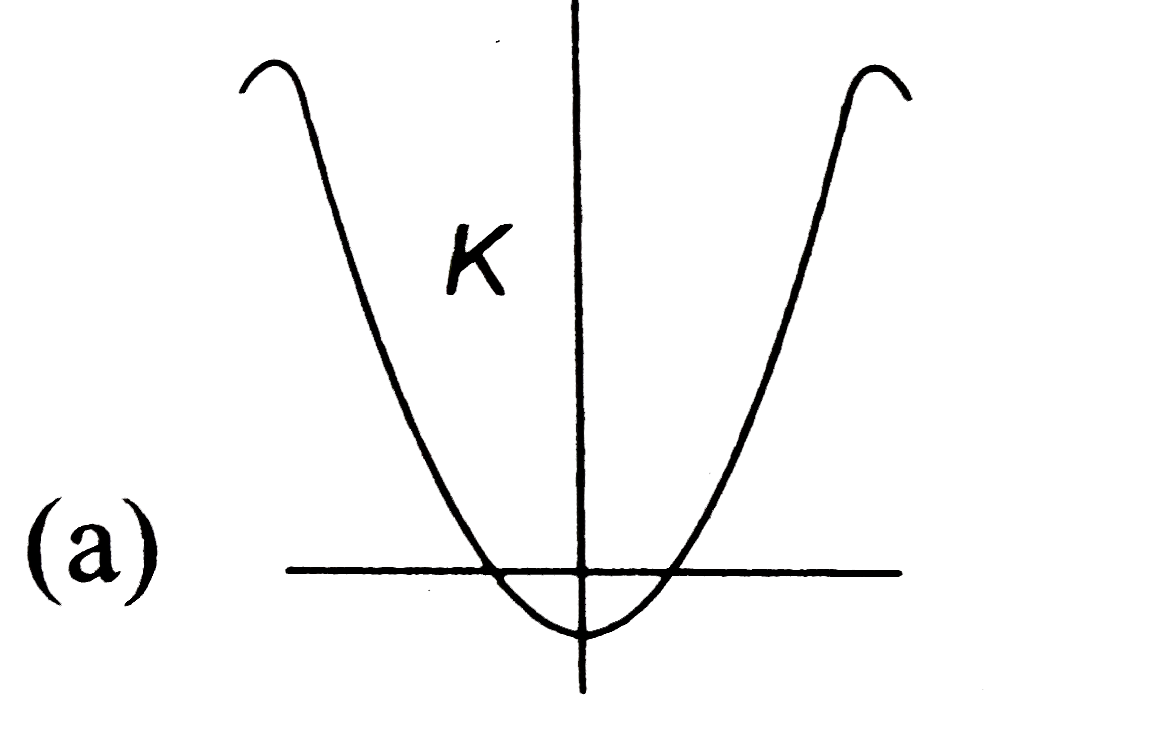
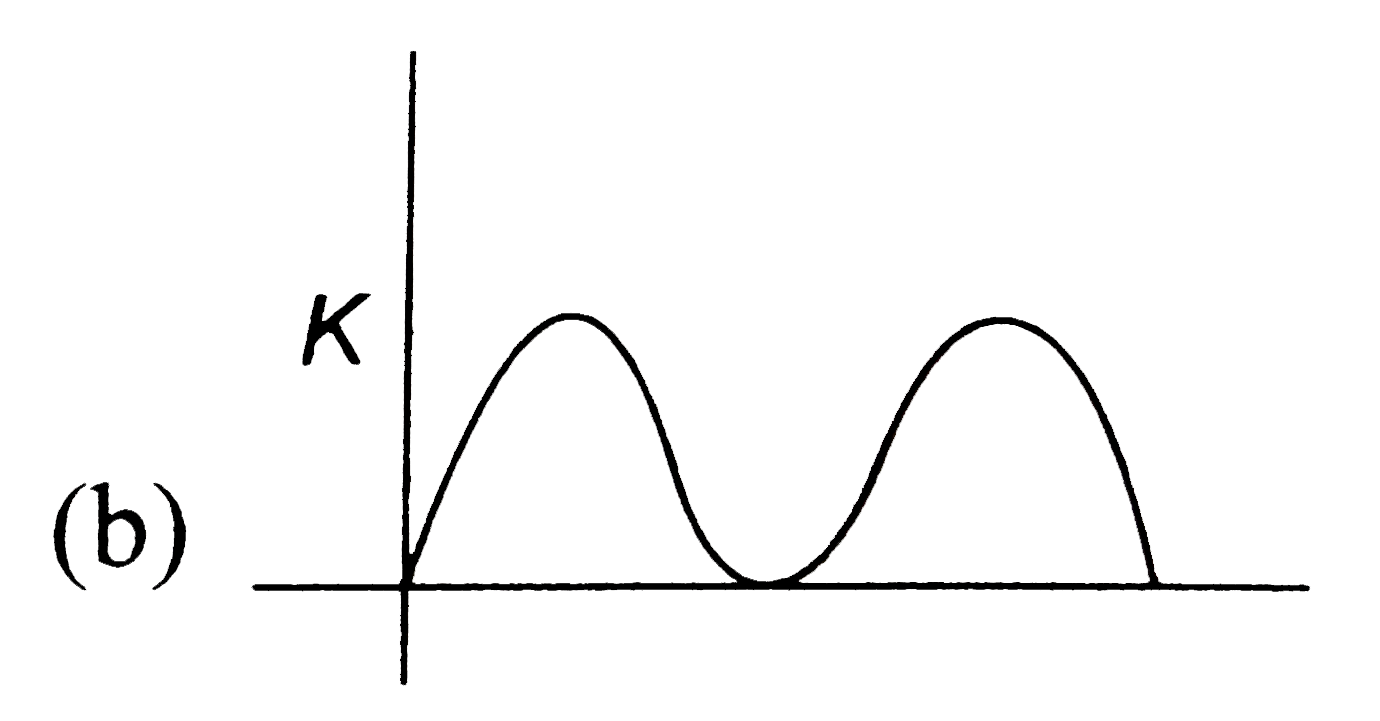
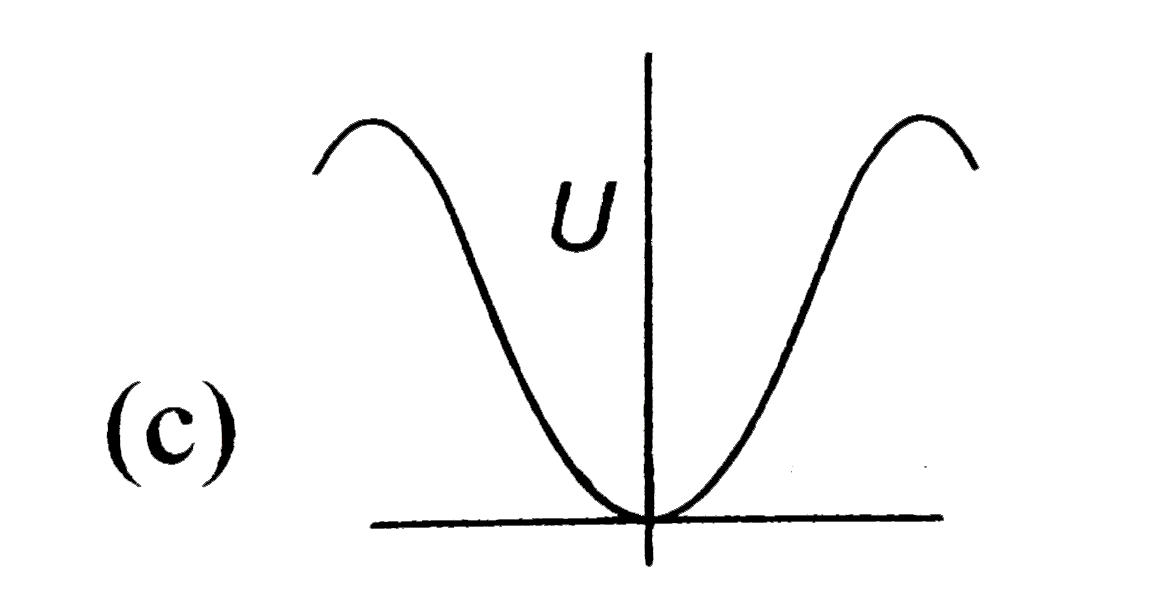
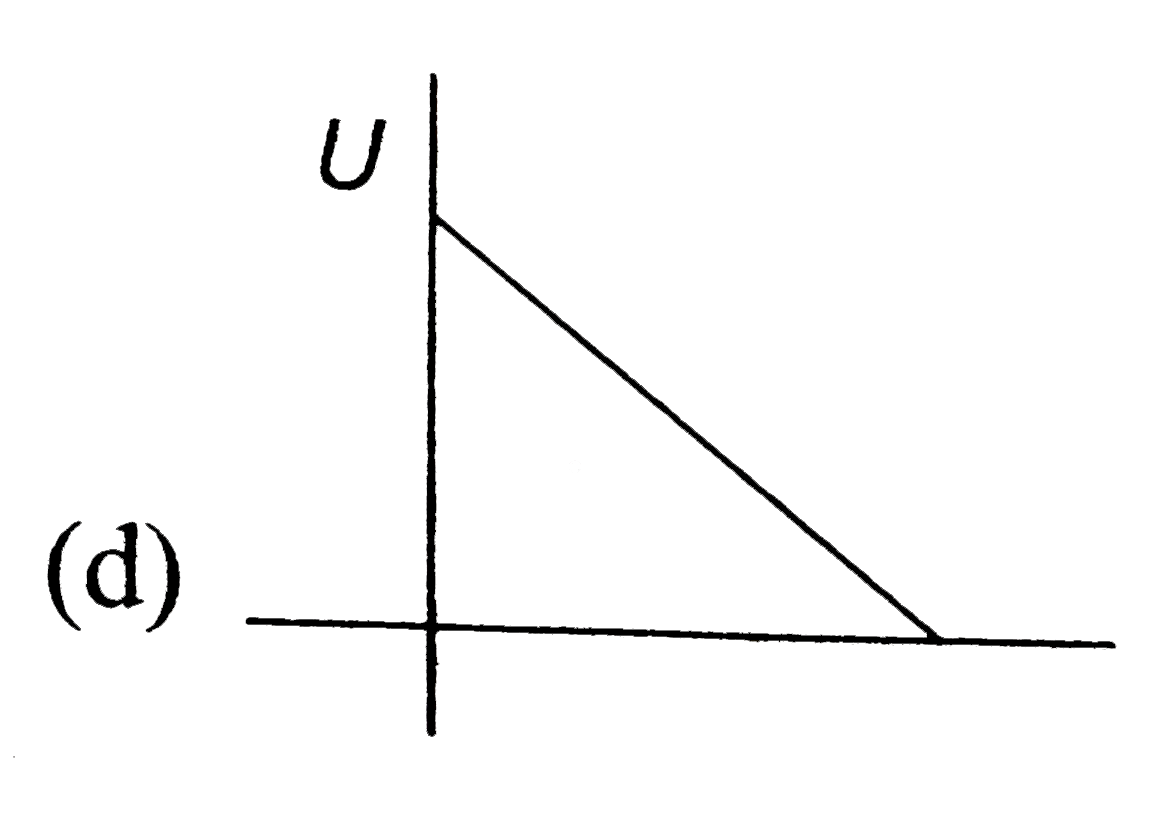
During SHM, A particle has displacement a from mean position If acceleration Kinetic energy and excess potential repressented by a K and U respectively then chose the appropriate graph |
|
Answer»
`K = (1)/(2) m,(A^(2) - x^(2)) Omega^(2)` it mean curve between `K` and `x` will be parabole Hence option `(a)` and `(b)` incorrect The `PE` of a particle is given by `U = (1)/(2) m omega^(2)x^(2)` But acceleration `a = omega^(2)x`. At mean position, if wil be equal to zero and maximum at extreme position. Hence, option `(x)` is correct The sun of `PE` and `KE` is always constant it is equal is `(1)/(2) mA^(2)omega^(2)` hence `U + R = (1)/(2) m omega^(2) k^(2) M` `U = -K + (1)/(2) m omega^(2) A^(2)` If mean curve between `U` and `K` will be stranght line having position intercept on `y` axis and NEGATIVE SLOP. Hence option `(d)` is correct |
|
| 42. |
A block of mass M is tied to one end of a massless rope. The other end of the rope is in the hands of a man of mass 2M as shown in Fig. The block and the man art resting on a rough wedge of mass M. The whole system is resting on a smooth horizontal surface. The man starts walking towards right while holding the rope in his hands. Pulley is massless and frictionless. Find the displacement of the wedge when the block meets the pulley. Assume wedge is sufficiently long so that man does not fall down. |
|
Answer» `1/2 m` towards right `(l_(1)+z-x)+(l_(2)+y-x)=l_(1)+l_(2)` `implies z+y=2x`…………i 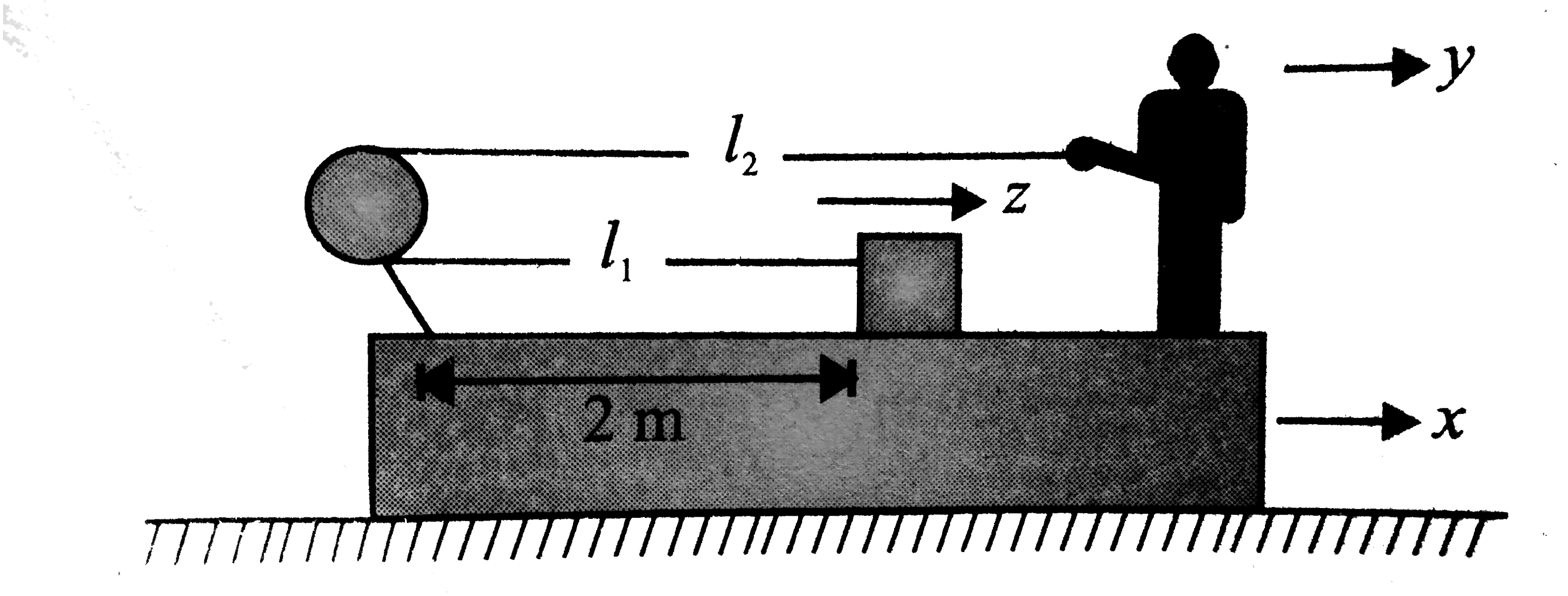 Also if the pulley and the blcok met, then we can WRITE `x=z+2` ..............ii `/_\x_(cm)=0implies(Mx+2My+Mz)/(4M)=0` `implies x+2y+z=0`.............iii From eqn i, ii and iii `x=(-1)/2M,y=3/2m,z=(-5)/2m` |
|
| 43. |
There are two displacement vectors , one of magnitude 3m and other of 4m . How should the two vecotrs be added so that the resultant vector be7 m , |
|
Answer» SOLUTION :As`R = sqrt(A^(2) + B^(2) + 2AB cos theta)` For 7 m both the VECTORS should be parallel i.e., angle between them should be zero. |
|
| 44. |
A 2kg block is placed over a 4kg block and both are placed on a smooth horizontal surface. The coefficient of friction between the blocks is 0.20. The acceleration of the two blocks if a horizontal force of 12N is applied to the lower block is (g= 10 ms^(-2)) |
|
Answer» `2 ms ^(-2), 2M s^(-2)` |
|
| 45. |
A sphere cannot roll on |
|
Answer» a SMOOTH HORIZONTAL SURFACE |
|
| 46. |
A tank with a square base of area 1.0 m^2 is divided by a vertical position in the middle. The bottom of the partition hasa small hinged door of area 20 cm^2 The tank is filled with water in one compartment, and an acid (of relative density 1.7) in the other. both to the height of 4.0 cm compute the force necessary to keep the door close. |
| Answer» Solution :55 N (note the BASE area does not affect the answer) | |
| 47. |
Passage -II The figure shows the variation of potential energy of a particle as a function of x, the X-coordinate of the region. It has been assumed that potential energy depends only on X. For all other values of x, U is zro, i.e. for x lt -10 and x gt15,U=0. If the particle is isolated and its total mechanical energy is 60 J, then |
|
Answer» the PARTICLE can be FOUND anywhere from `-ooltxltoo` |
|
| 48. |
Name the working substance used in (i) Camot engine, (ii) Steam engine, (iii) Petrol engine, and (iv) diesel engine. |
| Answer» Solution :(i) IDEAL gas (it) water substance, (III) AIR and (IV) air. | |
| 49. |
(A) : Coefficient of viscosity for gasses increases with increase in temperature. (R ) : As temperature of gases is increased the between molecules increases. |
|
Answer» Both (A) and (R ) are TRUE and (R ) is the correct EXPLANATION of (A) |
|
| 50. |
Passage -II The figure shows the variation of potential energy of a particle as a function of x, the X-coordinate of the region. It has been assumed that potential energy depends only on X. For all other values of x, U is zro, i.e. for x lt -10 and x gt15,U=0. If total mechanical energy of the particle is -40J, then it can be found in region |
|
Answer» `xlt-10` and `xgt15` |
|