

Saved Bookmarks
This section includes 7 InterviewSolutions, each offering curated multiple-choice questions to sharpen your Current Affairs knowledge and support exam preparation. Choose a topic below to get started.
| 2. |
The calcium contained in a solution of 1.048 gm of the substance being analysed was precipitated with 25 ml of H_(2)C_(2)O_(4). The excess of C_(2)O_(4)^(2-) in one fourth of the filtrate was back titrated with 5 ml of 0.1025 N KMnO_(4) solution. To determine the concentration of the H_(2)C_(2)O_(4)solution taken , it was diluted four fold , the titration of 25 ml of the dilute solution used up 24.1ml of KMnO_(4) solution . What is percentage of CaO in the substance being analysed . |
|
Answer» |
|
| 3. |
The calcium contained in a solution of 1.048 gm of the substance being analysed was precipitated with 25ml of H_(2) C_(2) O_(4). The excess of C_(2) O_(4)^(2-) in one fourth of the filtrate was back titrated with 5ml of 0.1025 N KMnO_(4) solution. To determine the concentration of the H_(2) C_(2) O_(4) solution taken, it was diluted four fold, the titration of 25ml of the dilute solution used up 24.1 ml of KMnO_(4) solution. What is percentage of CaO in the substance being analysed. |
|
Answer» Solution :EQUIVALENTS of `KMnO_(4)` used up with one fourth of the filtrate containing EXCESS `H_(2)C_(2) O_(4) = ( 5 xx 0.1025)/( 1000) = 5.125 xx 10^(-4)` `:.` Excess EQUIVALENT of `H_(2) C_(2) O_(4) = 5.125 xx 10^(-4) xx 4 = 2.05 xx 10^(-3)` Equivalent of `KMnO_(4)` reacting in the second titration `= ( 24.1 )/( 1000) xx 0.1025 = 2.47 xx 10^(-3)` `:.` Equivalent `H_(2) C_(2) O_(4)`consumed by `CaO = 9.88 xx 10^(-3) - 2.05 xx 10^(-3) = 7.83 xx 10^(-3)` `:.` Equivalents of `CaO = 7.83 xx 10^(-3)` Moles of `CaO = ( 7.83 xx 10^(-3))/(2)= 3.915 xx 10^(-3)` Mass of CaO `= 3.915 xx 10^(-3) xx 56 = 0.22 ` gm % CaO = `( 0.22 )/( 1.048) xx 100 = 20.99 %` |
|
| 4. |
The calcium salt of the final oxidation product of ethanol on dry distillation gives : |
|
Answer» Formaldehyde |
|
| 5. |
The C^(14) " to " C^(12) ratio in a wooden article is 13% that of the fresh wood. Calculate the age of the wooden article. Given that the half-life of C^(14) is 5770 years |
|
Answer» 16989 years Taking LOG `rArr "log" (13)/(100) = (T)/(5770) log 1//2 rArr 16989 yrs` |
|
| 6. |
The Ca^(2+) and F ions are located in CaF_( 2)crystal, respectively at face centred cubic lattice points and in |
|
Answer» TETRAHEDRAL VOIDS |
|
| 7. |
The C_4H_10O(alcohols) produces immediateterbidity with Lucas reagent the alcohol is |
|
Answer» `CH_3-CH_2-CH_2 -CH_2-OH` |
|
| 8. |
The C-X bond energy order for carbon tetrahalides is : |
|
Answer» `CF_4gtC Cl_4gtCBr_4gtCI_4` |
|
| 9. |
The C-O-C bond angle in dimethyl ether is |
|
Answer» `110^(@)` |
|
| 10. |
The C-O-C angle in ether is about |
|
Answer» `180^(@)` |
|
| 11. |
The C-O bond length in C -= O ….. (decreases or increases or remains unchanged) when metal carbonyls are formed. |
| Answer» SOLUTION :INCREASES | |
| 12. |
The C-Mg bond in CH_(3)CH_(2)MgBr is |
|
Answer» ionic |
|
| 13. |
The C-O bond is much shorter in phenol than in ethanol. Given season. |
| Answer» SOLUTION :`sp^(2)`, which RESULT in partial DOUBLE bond character due to conjugation UNSHARED ELECTRON pair of oxygen with aromatic ring. Because C-O in phenol is attached with C=C while in ethanol C-O is attached `(sp^(3))` with C-C. | |
| 14. |
The C-Mg bond in CH_3CH_2MgBr is : |
|
Answer» IONIC |
|
| 15. |
The C-H bond length is minimum in the bond formed by |
|
Answer» sp-s overlapping (as in ALKYNES) |
|
| 17. |
The C-H bond distance is longest in |
|
Answer» `C_(2)H_(2)`<BR>`C_(2)H_(4)` |
|
| 18. |
The C-Cl bond length in chlorobenzene is shorter than C-Cl bond length in CH_(3)-Cl. |
|
Answer» Solution :Chlorobenzene can be regarded as a resonance hybrid of FIVE structure. As a RESULT C-CL bond in chlorobenzene has some double bond CHARACTER and hence shorter (169 pm) than C-Cl bond in `CH_(3)-Cl` (177 pm) which has pure single bond character. Alternately, in `CH_(3)-Cl,Cl` is attached to a `sp^(3)`-hybridized carbon while in chlorobenzene it is attached to a `sp^(2)`-hybridized carbon. since a `sp^(2)`-hybridized orbital is smaller in size as compared to a `sp^(3)`-hybridized 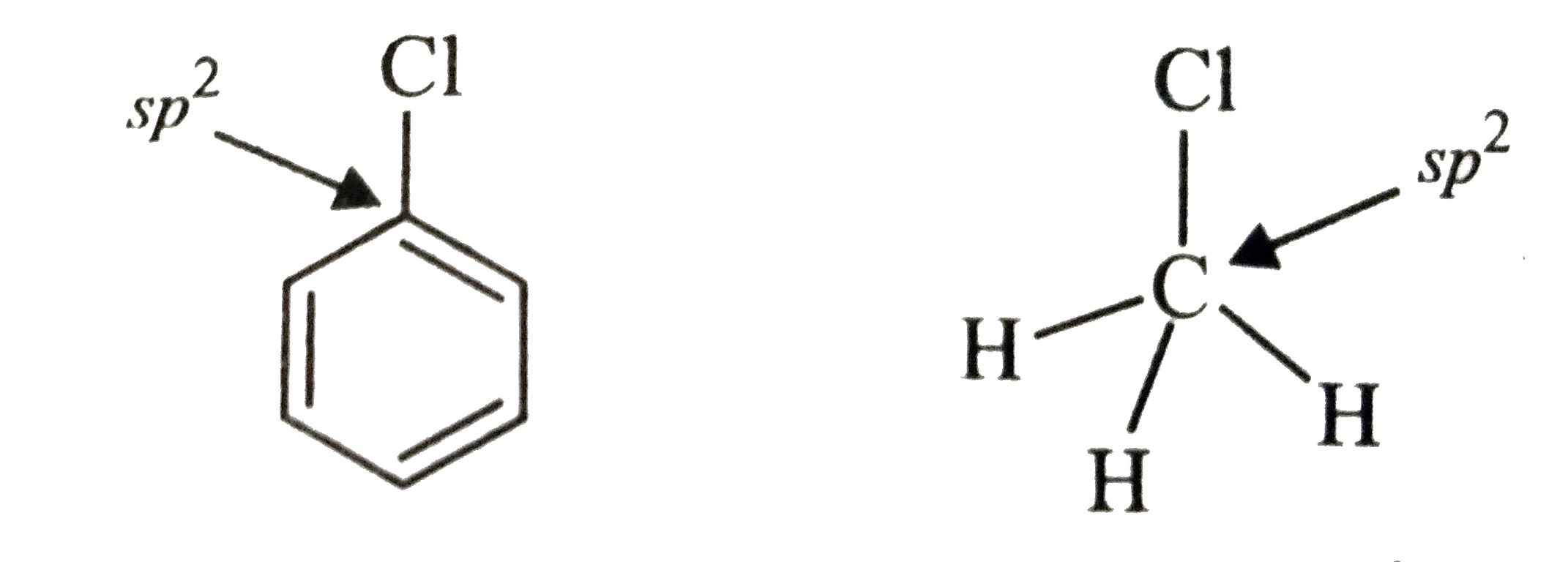 ltBrgt orbital of carbon, THEREFORE, `C_Cl` bond in chlorobenzene is shorter (169 pm) than C-Cl bond length in `CH_(3)-Cl` (177 pm). ltBrgt orbital of carbon, THEREFORE, `C_Cl` bond in chlorobenzene is shorter (169 pm) than C-Cl bond length in `CH_(3)-Cl` (177 pm).
|
|
| 19. |
The C-H bond and C- C bond in ethane are formed by which of the following types of overlap ? |
|
Answer» `SP^(3)-s and sp^(3)-sp^(3)` |
|
| 20. |
The C-C bond length of the following molecules is in the order |
|
Answer» `C_(2) H_(6) gt C_(2)H_(4) gt C_(6) H_(6) gt C_(2) H_(2)` `C_(2) H_(2) lt C_(2) H_(4) lt C_(6) H_(6) lt C_(2) H_(6)` |
|
| 21. |
The C-C bond length of the following molecules is in the order: |
|
Answer» `C_2H_4 GT C_2H_6gtC_2H_2 ` |
|
| 22. |
The C - Cl bond in Ethyl chloride is formed by ........ overlaping |
|
Answer» `sp^3-s` |
|
| 23. |
The C - Cl bond in Ethyl chloride is formed by ......... overlaping |
|
Answer» <P>`sp^3-s` |
|
| 24. |
The C - C bond energy from the following data will be (i)C(s)rarr C(g), Delta H=170.9 kcal(ii) (1)/(2)H_(2)(g)rarr H(g), Delta H=52.1 kcal(iii) Heat of formation of ethane = -20.3 kcal(iv)C - H bond energy = 99.0 kcal |
|
Answer» 80.7 KCAL Also, `Delta H = -[1 BE_(C-C)+6BE_(C-H)]+[2{C(s)rarr C(g)}+3BF_(H-H)]` `-20.3=-[BE_(C-C)+6xx99]+[2xx170.9+3xx(2xx52.1)]` `therefore BE_(C-C)=-594+341.8+312.6+20.3` C - C bond energy = 80.7 kcal |
|
| 25. |
The % by volume of C_(4)H_(10) in a gaseous mixture of C_(4)H_(10), CH_(4) and CO_(2) is 40. When 200 ml of this mixture is burnt completely in excess of O_(2) and then pass through aq. KOH then volume contraction will be - |
|
Answer» 220 ml `C_(4)H_(10) = 0.4 xx 200 = 80 ml` `CH_(4) = x ml` `CO_(2) = (120 - x) ml` `C_(4)H_(10) + (13)/(2) O_(2) rarr 4CO_(2) + 5H_(2)O` `{:(80 ml,,"320 ml",),(CH_(4) + 2O_(2),rarr,CO_(2) + 2H_(2)O,),(x ml,,x ml,):}` Total `CO_(2) = 320 + x + 120 - x` `= 440 ml` |
|
| 27. |
The by-product obtained in the preparation of fluorobenzene from benzene diazonium chloride using HBF_(4) is ____________. |
|
Answer» |
|
| 28. |
The by-product in Dow's process ……. |
|
Answer» Ketone |
|
| 29. |
The button cell used in watches function as follows Zn(s)+Ag_(2)O(s)+H_(2)O(l) iff 2Ag(s)+Zn^(2+)(aq)+2OH^(-)(aq) the half cell potentials are Ag_(2)O(s)+H_(2)O(l)+2e^(-) rarr 2Ag(s)+2OH^(-)(aq) E^(o)=0.34V. The cell potential will be |
|
Answer» 0.84V |
|
| 30. |
The button cell used in watches function as follows Zn_a + Ag_(2)O(s) + H_2O_((l)) |
|
Answer» 0.84 V `(E_("ox")^@) = 0.76V ` cathodic reduction `:. E_("CELL")^(@) = (E_("ox")^@) + (E_("RED")^(@)) = 0.76 + 0.34=1.1V `. |
|
| 31. |
The butanol can be obtained by the reaction of methyl magnesium iodide with.. |
|
Answer»
|
|
| 32. |
The burning of hydrogen is called |
|
Answer» REDUCTION |
|
| 33. |
The burning of coal represented by the equation, C(s)+O_2(g)rarrCO_2(g) .Therate of this reaction is increased by : |
|
Answer» DECREASE in the CONCENTRATION of oxygen |
|
| 34. |
The building unit of all proteins are |
|
Answer» MONOSACCHARIDES |
|
| 35. |
The buffer system which helps to maintain the pH of blood between 7.26 to 7.42 is |
|
Answer» `H_(2)CO_(3)//HCO_(3)^(-)` |
|
| 36. |
The buffer solution contains equal concentration of X^(-) and HX. The K_(b) for X^(-) is 10^(-10). The pH of the buffer solution is : |
|
Answer» 4 |
|
| 37. |
What is buffer solution ? |
|
Answer» |
|
| 38. |
The buffer action of acidic buffer is maximum when its pH is equal to: |
|
Answer» 5 |
|
| 39. |
The buffer present in human blood is |
|
Answer» `CH_3 COOH+CH_3 COONA` |
|
| 40. |
The Brownian movement of colloidal particles is because of: |
|
Answer» Convection currents in the fluid |
|
| 41. |
The Brownian motion is due to |
|
Answer» temperature fluctuation within the liquid phase |
|
| 42. |
The Brownian motion is due to , |
|
Answer» Temperature fluctuation withing the liquid phase |
|
| 43. |
The brown ring test is performed for the qualitative detection of: |
|
Answer» BROMIDES |
|
| 44. |
The Brownian motion is due to : |
|
Answer» temperature fluctuation WITHIN the liquid phase |
|
| 45. |
The brown yellow colour often shown by nitric acid can be removed by: |
|
Answer» BUBBLING AIR through the WARM acid |
|
| 46. |
The brown ring test for NO_(2)^(-) and NO_(3)^(-) is due to the formation of complex ion with formula : |
|
Answer» `[Fe(H_2O)_6]^(2+)` |
|
| 47. |
The brown ring test for nitrites and nitrates is due to the formation of complex of iron with the formula. |
|
Answer» `[Fe(H_(2)O]_(5) NO]^(2+)` |
|
| 48. |
The brown ring rest test for nitrates depends upon : |
|
Answer» REDUCTION of NITRATE to nitric acid |
|
| 49. |
The brown ring test for nitrates depends on |
|
Answer» the reduction of nitrate to nitric oxide `NO_(3(aq))^(-)+3Fe_((aq))^(2+)+4H_((aq))^(+)to NO_((g))+3F_((aq))^(3+)+2H_(2)O_((l))` `underset("pentaaquanitrosonium iron (I) (Brown complex)")(Fe_((aq))^(2+)+NO_((g))+5H_(2)O_((l))to [Fe(H_(2)O)_(5)NO^(+)]^(2_((aq))^(+))` |
|

