Saved Bookmarks
This section includes 7 InterviewSolutions, each offering curated multiple-choice questions to sharpen your Current Affairs knowledge and support exam preparation. Choose a topic below to get started.
| 1. |
In AB_(4)L_(x), Molecule is non polar then value of x is : L = Lone pair, A, B = Type of atom |
|
Answer» 0 |
|
| 2. |
In a zero order reactionn 47.5% of the reactant remains at the end of 2.5 hours. The amount of reactant consumed in one hour is |
|
Answer» 0.105 |
|
| 3. |
In A^(=)B^(-) ionic compound radii of A^(=) and B^(-) ions are 180 pmand 187 pm respectively .The crystal structure of this compound will be |
|
Answer» `NaCI` type |
|
| 4. |
In a zero order reaction, for every 10^(@) rise of temperaure, reaction rate is doubled. If the temperature 10^(@)C to 100^(@)C, the reaction rate will become: |
|
Answer» 256 times `(r_(100^(@))C)/(r_(10^(@))C) = 2^((100-10))/(10) = 2^(9)=512` times. |
|
| 5. |
In a zero order reaction, the time taken to reduce the concentration of reactant from 50% to 25% is 30 minutes. What is the time required to reduce the concentration from 25% to 12.5%? |
| Answer» SOLUTION :15 MINUTES | |
| 6. |
In a zero order reaction, A toProducts, starting with 0.5 mol L^(-1), if 0.4 mol L^(-1) are present after 10 min., the rate constant of the reaction will be |
|
Answer» `0.05 MOL L^(-1) mi n^(-1)` `k = 1/t[[A]_0-[A]]= 1/(10min)[0.5 - 0.4] mol L^(-1)` `= 10^(-2) mol L^(-1) mi n^(-1)` |
|
| 7. |
In a zero-order reaction for every 10^(@) rise of temperature, the rate is doubled. If the temperature is increased from 10^(@)C to 100^(@)C . The rate of the reaction will become |
|
Answer» `64` TIMES |
|
| 8. |
In which of these processes platinum is used as a catalyst ? |
|
Answer» OXIDATION of ammonia to form `HNO_(3)` |
|
| 9. |
In a voltaic cell, ar 298K if activity of both electrolyte is unify then according to Nernst'sequation |
|
Answer» `E=E^(0)` |
|
| 10. |
In a vessel, two equilibrium are simultaneously established at the same temperature as follows: N_(2)(g) + 3H_(2) (g)hArr2 NH_(3) (g) ...(1) N_(2)(g) + 2H_(2) (g)hArrN_(2)H_(4) (g) ...(2) Initially the vessel contains N_(2) and H_(2 )in the molar ratio of 9 : 13. The equilibrium pressure is 7P_(0) , in which pressure due to ammonia is P_(0) and due to hydrogen is 2P_(0). Find the values of equilibrium constants (K_(P)’s) for both the reactions |
| Answer» SOLUTION :`K_(P_(1))=1/(20O_(0)^(2)),K_(P_(2))=3/(20P_(0)^(2))` | |
| 11. |
In a vessel containing SO_3, SO_2 and O_2 at equilibrium,some helium gas is introduced os that the total pressure increases while temperature and volume remain constant. According to Le chatelier's principle the dissociation of SO_3 : |
|
Answer» Increases |
|
| 12. |
In a vessel containing SO_(3),SO_(2)and O_(2) at equlibrium, some helium gas is introduced so that the total pressure increases while temperature and volume remain constnat. According to Le-Chatelier principle the dossociation of SO_(3) |
|
Answer» Increases |
|
| 13. |
In a vessel containing SO_(3) , SO_(2) and O_(2) at equilibrium , some He gas is introduced so that total pressure increases while temperature and volume remain constant . According to Le Chatelier's principle , the dissociation of SO_3 : |
|
Answer» increases |
|
| 14. |
In a vessel 2 g of O_2 2g Of H_2 and 2 g of N_2 are present. Which has the largest no of atoms? |
|
Answer» `O_2` |
|
| 15. |
In a tyre of "Ferrari" car of Mr. Obama, a tube having a volume of 12.3 litres is filled with air at a pressure of 4 atm at 300 K.Due to travelling, the temperature of the tube and air inside it raised to 360 K and pressure reduced to 3.6 atm in 20 minutes. If the porosity (number of pores per unit area) of the tube material is 5xx10^3 pores/cm^2 and each pore can transfer air from inside to outside of the tube with the rate of 6.023xx10^8 molecules per minute.Calculate the total surface area (m^2) of the tube.(R=0.082 Lt-atm/mole-K) Give your answer divide by 100. |
|
Answer» moles of air after 20 minutes`=(3.6xx12.3)/(0.082xx360)=1.5` `:.` moles of air leaked in 20 minutes =2-1.5=0.5 `:.` MOLECULES of air leaked in 20 minutes `=0.5 N_A` Let the total surface AREA of tube =`A cm^2` Total molecules ESCAPED in 20 minutes`=(5xx10^6)A xx 6.023xx10^(8)xx20=0.5 N_A` `:. A=(0.5xx6.023xx10^23)/(5xx10^5xx6.023xx10^8xx20)=5xx10^7 cm^2 =5000 m^2` |
|
| 16. |
In a transition series, with the increase in atomic number, the paramagnetism |
|
Answer» increases gradually |
|
| 17. |
In a transition series, as the atomic number increase paramagnetism: |
|
Answer» INCREASE gradually |
|
| 18. |
In a tetrahedral crystal field, the d-orbitals split into …… orbitals collectively called …… and …… orbitals collectively called ….. . |
| Answer» Solution :`d_(X^(2)-y^(2))` and `d_(z^(2)), E and d_(XY), d_(YZ) and d_(xz), t_(2)` | |
| 19. |
In a test-tube, there is 18 g of glucose (C_(6)H_(12)O_(6)) 0.08 mole of glucose is taken out. Glucose left in the test tube is |
|
Answer» 0.10 G 18 g glucose = 0.10 mol Moles of glucose LEFT = 0.10-0.08 = 0.02 mol Mass of glucose = `(0.02 mol)XX(180 g mol^(-1)) = 360G` |
|
| 20. |
In a tetragonal unit cell: |
|
Answer» a = b = c, `ALPHA = BETA = gamma NE 90^(@)` |
|
| 21. |
In a Tetragonal unit cell : |
|
Answer» a = b = c, `ALPHA = beta = GAMMA ne 90^(@)` |
|
| 22. |
In a system A(s) hArr 2B(g) +3C (g) if the conc. Of C at equilibrium is increased by a factor of 2, it will cause the equilibrium concentration of B to change to |
|
Answer» TWO times the original value Let, X and y be the concentrations of B and C at equilibrium respectively. `therefore K_c =X^2Y^3` …………..(1) Now, the concentration of C is changed from y to y. such that `y.=2y`. If x. is thenew concentration of B `therefore K_c=(X.)^2(y.)^3=(x.)^2(2y)^3`........... (2) From Eqs. (1) and (2) `(x.)^2(8y^3)=x^2y^3` `therefore x.=sqrt((x^2)/8)=x/(2sqrt2)` `therefore` Equilibrium concentration of B changes to `1/(2sqrt2)` times the original value . |
|
| 23. |
In a system A(s) hArr 2B (g) +3C(g) if the conc. Of C at equilibrium is increased by a factor of , it will cause the equilbrium concentration of B to change to |
|
Answer» two times the original VALUE |
|
| 24. |
In a system : A(s) hArr 2B(g) + 3C(g) If the concentration of C at equillibrium is increased by factor 2 then predict the equillibrium concentration of B in terms of original val,ue . |
|
Answer» Two TIMES of its original value |
|
| 25. |
In a successive radioactive disintegration underset(N_(1))(A)overset(lamda_(1))tounderset(N_(2))(B)overset(lamda_(2))toC …. No. of nuclides after time t. in which the parent has a longer but not much longer half-life than the daughter. Which of the following expressions is correct? |
|
Answer» `(N_(1))/(N_(2))=lamda_(2)/lamda_(1)` |
|
| 26. |
In a study of the reaction 2A + 2BhArr3C + D, A and B are mixed in a vessel at t^(@)C. The initial conc. of A is twice the initial conc. of B. After equilibrium is reached, the conc of C is three times the conc. of B. Calculate the equilibrium constant K_(C) in terms of P/Q and report P + Q. |
|
Answer» |
|
| 27. |
In a system A(g) rarr 4B (g) + 3C(g) If the conc. of C at equilibrium is increased by a factor of 2, it will cause the equilibrium concentration of B to change to |
|
Answer» TWO times the original VALUE |
|
| 28. |
In a study of equilibrium: H_(2)(g) + I_(2)(g) |
|
Answer» `(1-x/2) + 2-x/2 (3-x/2) -x/2, x+x` `rArr 4-x, 3-x, 2x rArr K=(4x^(2))/(3-x)^(2)` `therefore` From (1) and (2) x=1.5 `therefore` From (2) `K=(4(1.5)(1.5))/(3-1.5)^(2) rArr K=4` |
|
| 29. |
In a standard hydrogen electrode, the pressure of hydrogen gas and H^(+)concentration respectively are |
|
Answer» 1 ATM, 1 M `H^(+)` |
|
| 30. |
In a standard hydrogen electrode , the concentration of H^(+) is : |
|
Answer» 0.1 M |
|
| 31. |
In a square planar complex of the type [Mabex], the number of geometrical isomers can be : |
|
Answer» No GEOMETRICAL ISOMERS |
|
| 32. |
In a spontaneouse process, the system suffers |
|
Answer» INCREASE in INTERNAL ENERGY |
|
| 33. |
In a spontaneouse irreversible process, the total entropy of the system and surroundings: |
|
Answer» REMAINS constant |
|
| 34. |
In a spontaneous process, the entropy of the system and its surroundings |
|
Answer» EQUALS zero |
|
| 35. |
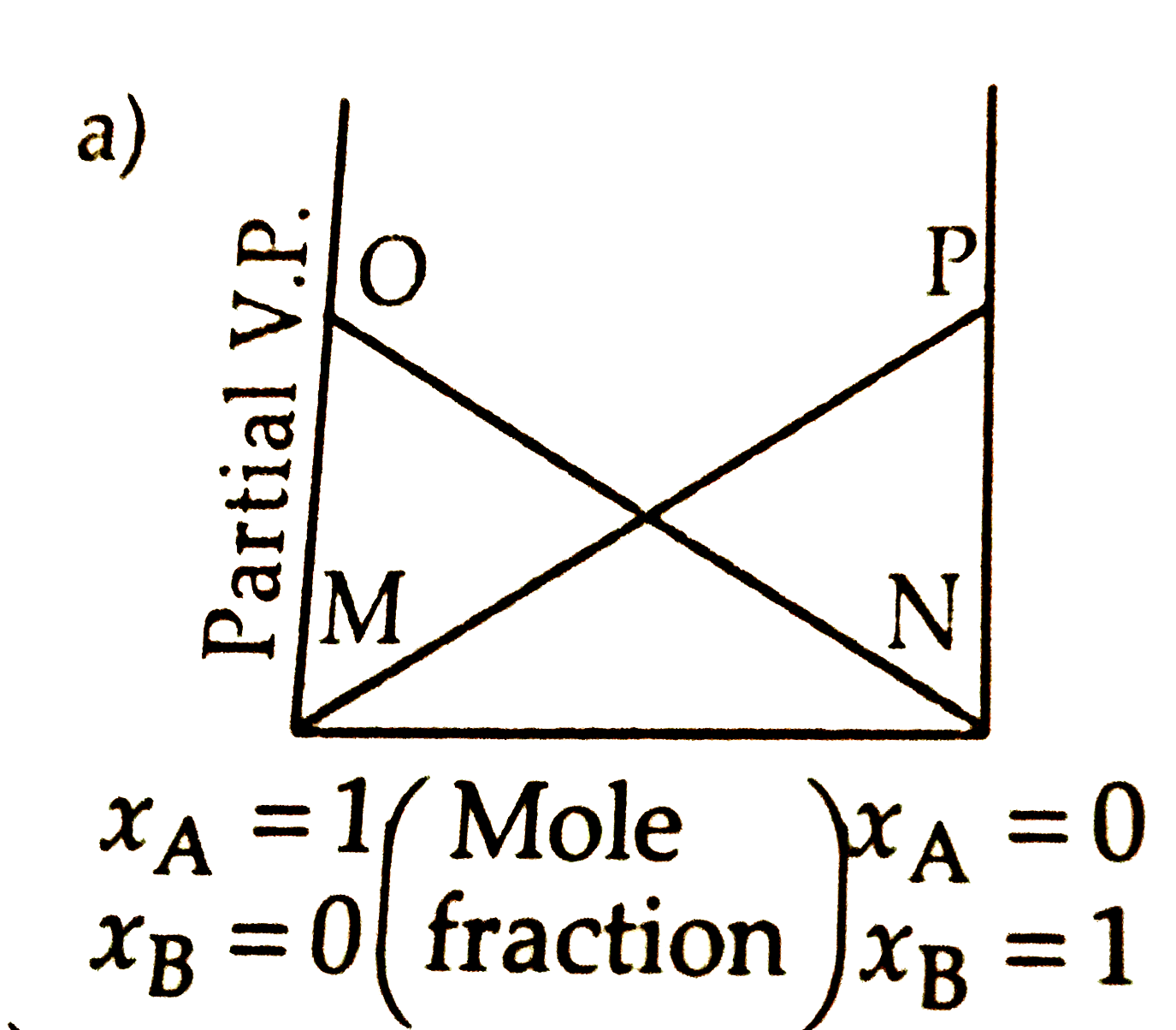
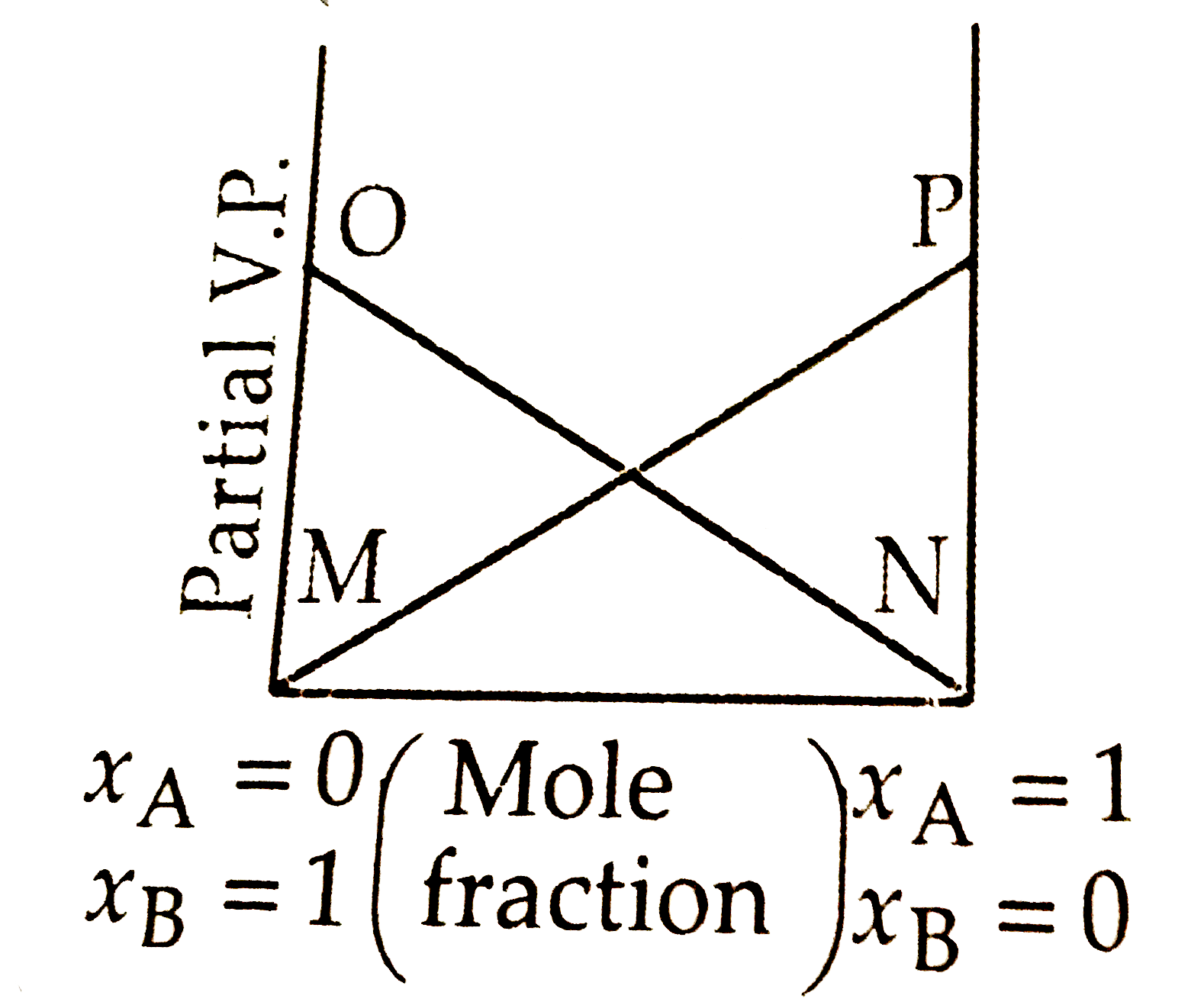
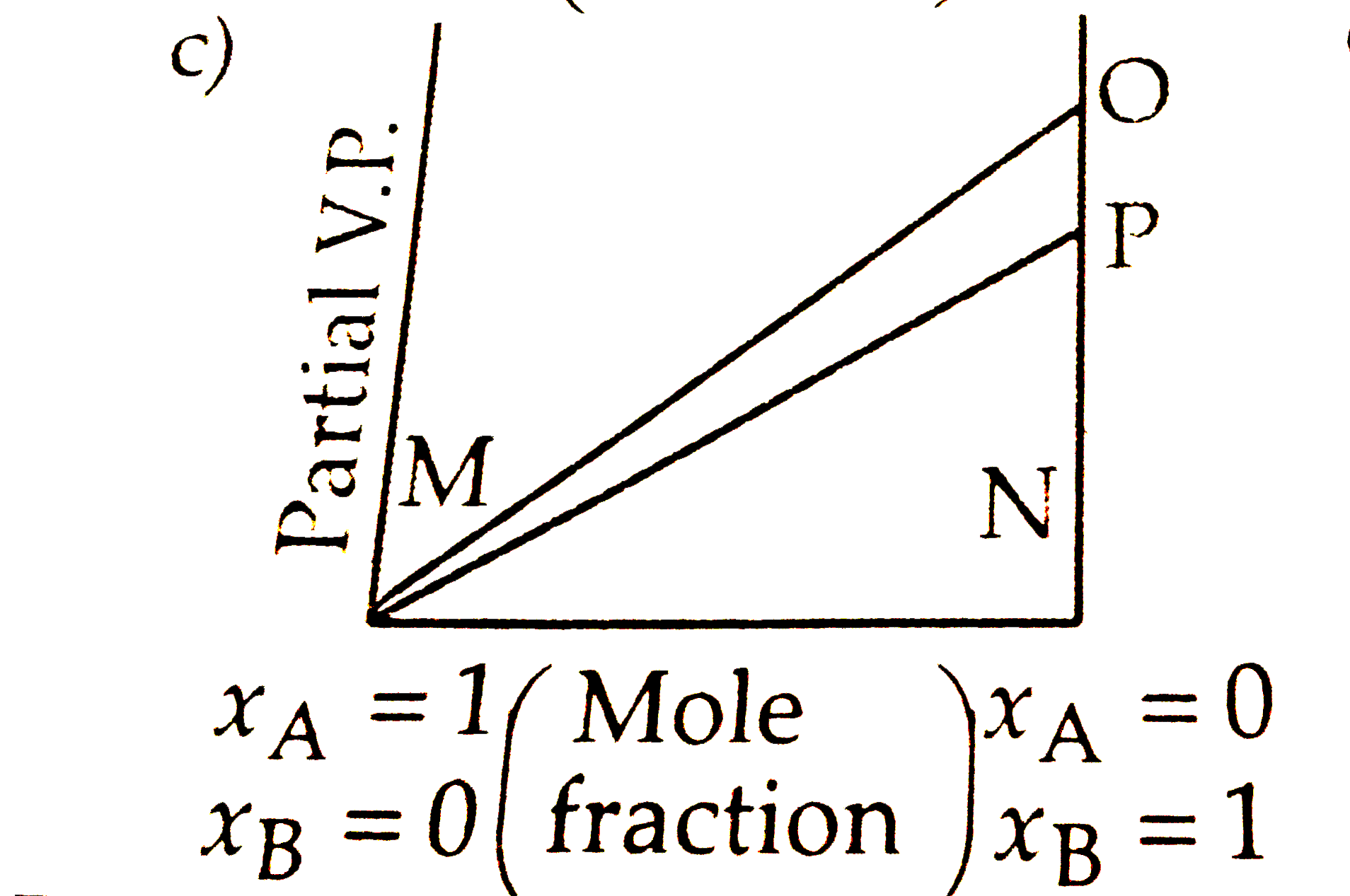
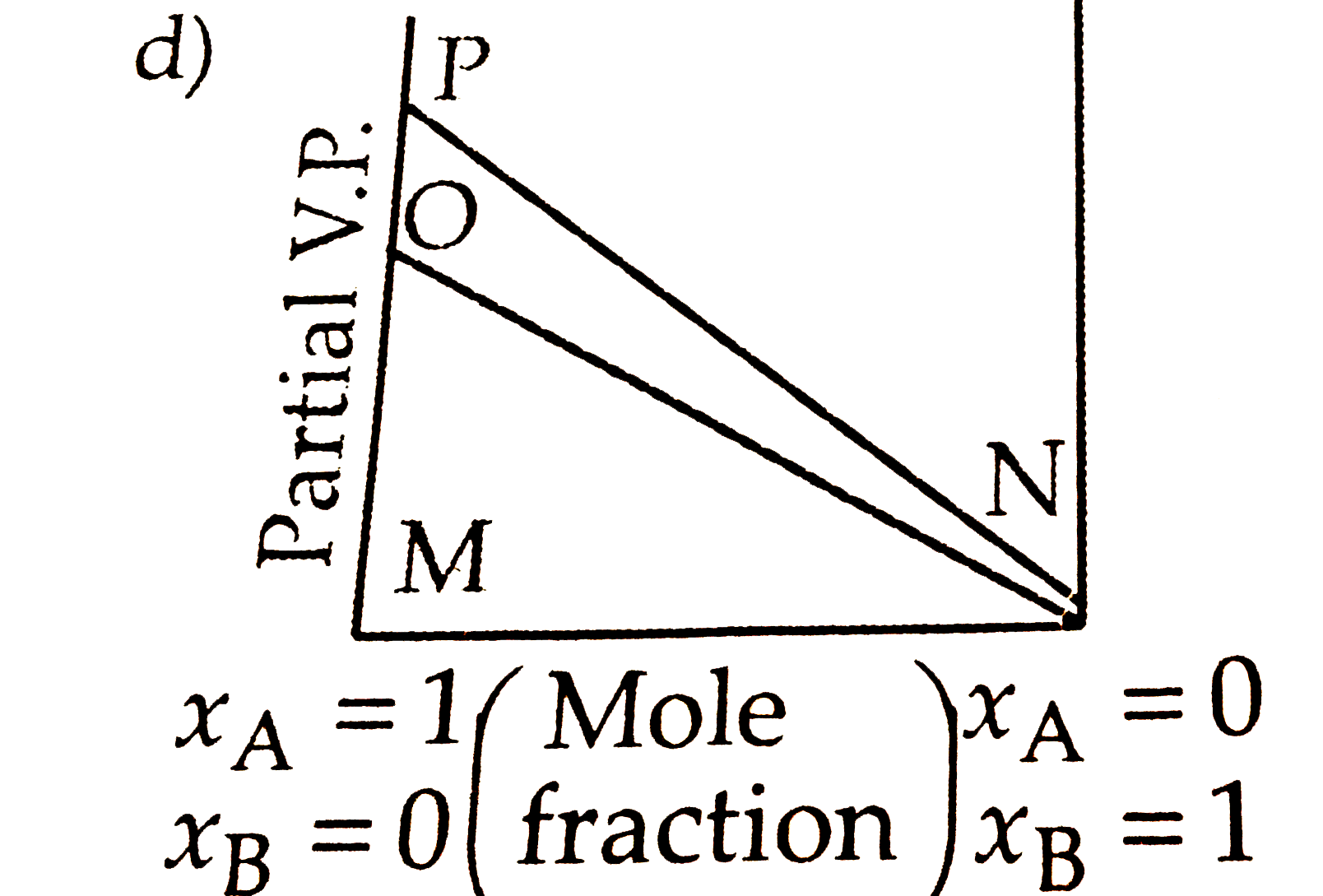
In a solution of the miscible volatile liquids A and B, the plots of their partical V.P. V_(s) their mole fractions is given by (Assume, V.P. of pure Agt V.P. of pure B) |
|
Answer»
Partial V.P.(P) of a component in a solution =V.P. of pure component` (P) xx `its mole fraction(X) in the solution i.e.`P_(S)=P_(O) xx x.` This is an EQUATION of a straight line. Hence if `P_(O)` is plotted against x a straight line passing through the origin and with positive slope is obtained. Hence OPTIONS (c) and (d) are incorrect. Now in option (a) and (B), points O and P represent V.P. of pure A and B respectively, and as V.P. of pure A gt V.P. of pure B. The correct option is (a) . |
|
| 36. |
In a solution of acid H^(+) concentration is 10^(-10)M. The pH of this solution will be |
|
Answer» 8 |
|
| 37. |
In a solution of pH = 5, more acid is added in order to reduce the pH = 2. The increase in hydrogen ion concentration is |
|
Answer» 100 times THUS INCREASE in `[H^(+)] = (10^(-2))/(10^(-5)) = 1000` times. |
|
| 38. |
In a solution of acetic acid, sodium acetate is added, then its pH value |
|
Answer» Decreases |
|
| 39. |
In a solution of 7.8 g benzene (C_6H_6) and 46.0 g toluene (C_6H_5CH_3) the mole fraction of benzene is: |
|
Answer» 1/6 |
|
| 40. |
In a solution of 7.8 gm benzene C_(6)H_(6) and 46.0 gm toluene (C_(6)H_(5)CH_(3)), the mole fraction of benzene in this solution is |
|
Answer» `1//6` |
|
| 41. |
In a solution of 7.8 g benzene (C_(6)H_(6)) and 46.0 g toluene (C_(6)H_(5)CH_(3)) the mole fraction of benzene is : |
|
Answer» `1//6` |
|
| 42. |
In a solution if the amount of solvent is doubled, keeping the amount of solutes same, the share of solute in the solution |
|
Answer» become half |
|
| 43. |
In a solution containing 1 mol of ethyl alcohol and 4 mol of water, the mole fraction of water is : |
|
Answer» 0.25 |
|
| 44. |
In a solution , 0.02 M acetic acid is 4% dissociation . The [OH^(-)] in the solution is |
|
Answer» `8 xx 10^(-4)` `[H^(+)][OH^(-)]=10^(-14)` `:. [OH^(-)]=(10^(-14))/(8xx10^(-4))=1.25xx10^(-11)M` |
|
| 45. |
In a solid, oxide ions are arranged in CCP. Cations A occupy one-sixth of the tetrahedral voids and cations B occupy one-third of the octahedral voids. The formula of the compound is - |
|
Answer» `ABO_(3)` |
|
| 46. |
In a solid lattice the cation has left a lattice site and is located at an interstitial position. The lattice defect is known as - |
|
Answer» INTERSTITIAL DEFECT |
|
| 47. |
In a solid lattice the cation has left a lattice site and is located at an interstitial position, the lattice defect is |
|
Answer» metal EXCESS DEFECT |
|
| 48. |
In a solid, atom M occupies ccp lattice and (1/3)^(rd) of tetrahedral voids are occupied by atom N. The formula of compound is ......... |
|
Answer» `M_3N_2` Total number of TETRAHEDRAL voids = 8 Total number of N-atoms = `(8 xx 1/3) = 3` RATIO of M-atoms to N-atoms = `M:N = 4:8/3` ` =3 :2`. |
|
| 49. |
In a solid lattice the cation and anion both have left a lattive site. The lattice defect is known as |
|
Answer» intestitial DEFECT |
|
| 50. |
In a solid atom M occupies ccp lattice and ((1)/(3)) of tetrahedral voids = 2n Given that ((1)/(3))rd of tetrahedral voids are occupied i.e., ((1)/(3))xx2n are occupied by6 N atoms therefore M:NrArr n:((2)/(3)) 1:((2)/(3))3:2 rArr M_(3)N_(2) |
|
Answer» MN Given that `((1)/(3))`rd of tetrahedral voids are occupied i.e., `((1)/(3))xx2n` are occupied by N atoms. `therefore M:N RARR n:((2)/(3))` `1:((2)/(3))3:2 rArr M_(3)N_(2)` |
|