

Saved Bookmarks
This section includes 7 InterviewSolutions, each offering curated multiple-choice questions to sharpen your Current Affairs knowledge and support exam preparation. Choose a topic below to get started.
| 1. |
Distinguish between the terms homopolymer and copolymer and give an example of each. |
|
Answer» Solution :Homopolyers: Polymers whose repeating structural UNITS are dervied from only one type of monomer units are called homopolymers. For example, polythene, PVC, PAN etc. Copolymers: Polymers whose repeating units are DERIVED from two or more types of monomer molecules are called co-polymers. For example, Buna - S, Buna - N, Nylon 6, 6 etc. |
|
| 2. |
Distinguish between the terms homopolymer and coplymer and given an example of each. |
|
Answer» Solution :Homopolymer : Polymers whose repeating structural units are DERIVED form only ONE type of monomer units are called homopolymers. For example , polythene , PVC, PAN , teflon, polystyrene , nylon 6, etc. Copolymers : Polymers whose repeating structural units are derived from two or more types of monomer molecules are copolymers. For example , BUNA- S, nylon 6,6 , polyester , BAKELITE, metmac etc. |
|
| 3. |
Distinguish between the term homopolymer and copolymer and give one example of each type. |
|
Answer» Solution :Polymers FORMED by the linking of a large number of one type of MONOMERS are called homopolymer. Example`underset ("Ethene")(nCH_(2)) = CH_(2) tounderset("Polythene (Homopolmer)")((-CH_(2)-CH_(2)-)_(n)` Ethene Polythene (Homopolymer) Polymers formed by the linking of a large number of two or more types of monomers are called COPOLYMERS. Example `nH_(2)N(CH_(2))_(6)NH_(2)+ nHOOC(CH_(2))_(4)COOH to [-NHunderset("Nylon 6,6 (corpolymer)")(NHCO(CH_(2))_(4)CO-)]_(n) + nH_(2)O` |
|
| 4. |
Distinguish between the meaning of the terms adsorption and absorption. Give one example of each. |
| Answer» Solution :Adsorption is a PHENOMENON in which there is higher concentration of another substance on the surface than in the bulk. Absorption is a phenomenon in which the molecules of a substance are uniformly DISTRIBUTED THROUGHOUT the body of the other substance. For example, silica gel adsorbs water vapour while anhydrous calcium chloride absorbs water. | |
| 5. |
Distinguish between the meaning of the terms adsorption and absorption. Give one example each. |
Answer» SOLUTION :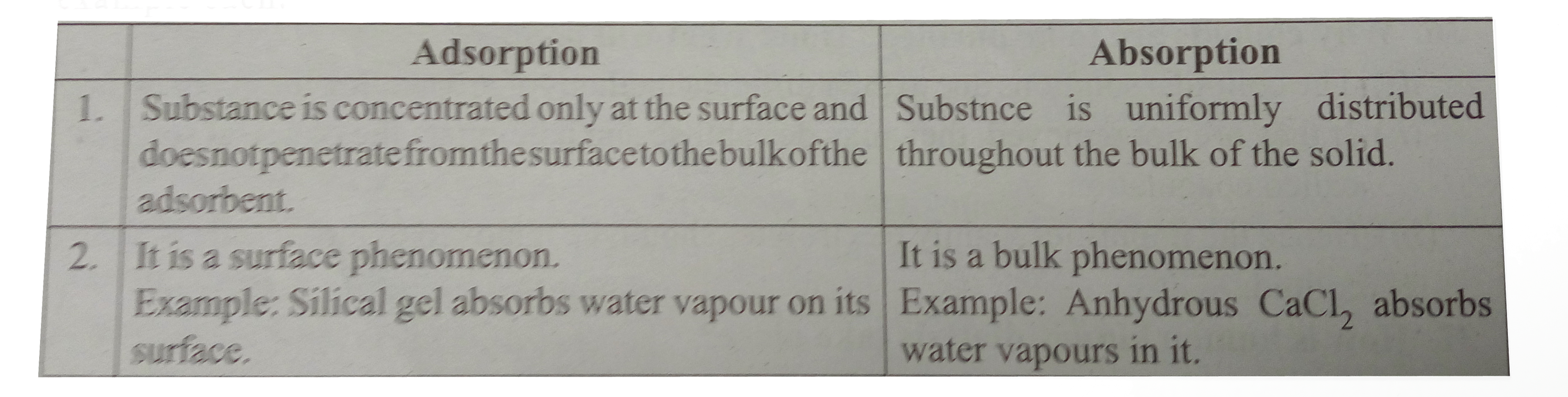
|
|
| 6. |
Distinguish between the following pairs: (i) Urea and ammonium acetate (ii) Ethanoic acid and ethanoyl chloride (iii) Ethyl ethanoate and ethanamide (iv) Ethanoic anhydride and methyl ethanoate ( v) Salt and ester (vi) Acetamide and urea (vii) Kerosene oil and vegetable oil |
|
Answer» Solution :(i) When urea is heated gently, it forms biuret which gives VIOLET colouration with NaOH and a drop of copper sulphate. Ammonium acetate does not give this test (ii) Ethanoic ACID on treatment with `AgNO_(3)`, fonm, a white precipitate of `CH_(3)COOAg`, which is soluble in `HNO_(3)` Ethanoic acid also gives effervescence with `NaHCO_(3)`. While ETHANOYL chloride on hydrolysis with water releases `Cl^(-)` which with `AgNO_(3)` gives white precipitate of AGCL insoluble in `HNO_(3)` (iii) Ethyl ethanoate saponifies with NaOH to give `C_(2)H_(5)OH` and `CH_(3)COONA` and also it has a fruity odour, whereas ethanamide on heating with aqueous NaOH gives a smell of `NH_(3)`. (iv) Ethanoic anhydride is hydrolysed to ethanoic acid on warming with water and gives acid test with litmus paper, whereas under these conditions, methyl ethanoate is not hydrolysed. Methyl ethanoate on hydrolysis in presence of acids or alkalies gives `CH_(3)COOH` and `CH_(3)OH`. On warming `CH_(3)OH` with salicylic acid in presence of conc. `H_(2)SO_(4)` gives a fragrant smell of oil of winter green (methyl salicylate). (v) See section 12.23 (vi) See section 12.24 (vii) See section 12.25 |
|
| 7. |
Distinguish between the following : (a) CH_(3) COCH_(2) CH_(3) and CH_(3) CH_(2) CH_(2) CHO (b ) Ethanal and ethanoic acid |
|
Answer» Solution :DISTINGUISH between (a) `CH_(3) COCH_(2) CH_(3)` and `CH_(3) CH_(2) CH_(2) CHO :` `CH_(3) COCH_(2) CH_(3)` will GIVE a yellow precipitate of `CHI_(3)` when treated with NaOI `( I_(2) //NAOH )` `CH_(3) COCH_(2) CH_(3) overset( NaOI) (rarr) underset("Iodoform")(CH_(3) CH_(2) COONa) + CHI_(3)` (b) ETHANAL and ethanoic acid `:` Ethanoic acid will give an effervescence of `CO_(2)`when treated with a solution of `NaHCO_(3)` Ethanal will not. `CH_(3) COOH + NaHCO_(3) rarr CH_(3) COONa + CO_(2) + H_(2) O` |
|
| 8. |
Distinguish between propanal and propanone. |
Answer» Solution :Propanal being an ALDELYDE reduces Tollen's reagent to DEPOSIT silver but being a ketone, PROPANONE does not REDUCE Tollen's reagent. 
|
|
| 9. |
Distinguish between primary and secondary cells used as batteries. |
|
Answer» |
|
| 10. |
Distinguish between primary, secondary and tertiary amines. |
|
Answer» Solution :REACTION of an amine with nitrous acid(HO - N =O)is the DISTINGUISHING test between primary, secondary and tertiary amines as they react differently with nitrous acid. Nitrous acid is unstable, hence prepared instantly by the action of cold, dilute, HYDROCHLORIC acid on sodium NITRITE. `underset("Sodium nitrite")(NaNO_(2)) + HCI overset("cold")underset("dil.")to NaCI + underset(" nitrous acid")(HNO_(2))` (1) Action of nitrous acid on primary amine : All primary amines, except methly amine react withnitrous acid in cold to give alcohol and liberate nitrogen gas. For example, ethyl amine on reaction with nitrous acid in cold, forms ethyl alcohol and nitrogent gas. `underset("ethylamine")(C_2H_5 -NH_2)+underset("nitrous acid")(HO-N=O) overset(NaNO_(2)+ " dill. HCI")underset("cold")to underset("ethyl alcohol")(C_(2)H_(5)-OH)H_(2)O+underset("nitrogen gas")(N_(2))` (2) Action of nitrousacid on secondary amines : Tertiary amine on reaction with nitrous acid forms N-nitrosoamine which is a pale yellow oil. Forexample, diethyl amine on reaction with nitrous acid in cold froms pale yellow oily N-nitrosodiethylamine. `underset("diethylamine")((C_(2)H_(5))_(2)NH)+H-O-H=O overset(NaNO_(2)+ " dil.HCI") underset("cold")to underset("N-nitrosodiethylamine")((C_(2)H_(5))_(2)N-N=O + H_(2))O` (3) Action of nitrous acid on tertiary amines , Tertiary amine on reaction with nitrous acid forms water - soluble nitrite salt. As no visible change , is observed , it is SAID that there is no reaction. For example, triethylamine reacts with nitrous acid in cold and forms water soluble triethyl ammonium nitrite salt. `underset("triethyaminenitrous acid")((C_(2)H_(5))_(3)N+HO-N=O) overset(NaNO_(2)+ " dil. HCI")underset("cold")to underset("triethyl ammonium nitrite")([(c_(2)H_(5))_(3)NH^(+)]NO_(2)^(-))` |
|
| 11. |
Distinguish between primary and secondary amines. |
| Answer» SOLUTION :Primary AMINES GIVE carbyl amines REACTION but secondary amines does not. | |
| 12. |
Distinguish between nucleosides and nucleotides. |
Answer» SOLUTION :
|
|
| 13. |
Distinguish between multimolecular , macromolecular and associated colloids with the help of one example of each . |
|
Answer» Solution :(i) Multimolecular colloids FORMED by aggregation of small atoms or molecules. Example, gold sol, SULPHUR sol. (ii) Macromolecular colloids FORMEDBY dispersing MACROMOLECULES having colloidalsize in proper dispersion medium. Example , protein, starch colloid. (iii) ASSOCIATED colloids are formed by aggregation of particles at higher concentration to colloidal range. Example, micelles. |
|
| 14. |
Distinguish between multimolecular, macromolecular and associated colloids. Give one example of each. |
|
Answer» Solution :Multimolecular colloids : When a large number of atoms or smaller molecules of a solute aggregate to form species having size in the colloidal range, such colloids are called multimolecular colloids. A gold SOL may contain particles of various sizes having many atoms. Sulphur sol consists of particles containing a thousand or more of `S_8` sulphur molecules. Macromolecular colloids : CERTAIN polymers or macromolecules dissolve in certain solvents to form solution in which the dispersed phase has colloidal size. Such colloidal systems form macromolecular colloids. Examples, of naturally occurring macromolecular colloids are starch, cellulose, proteins and enzymes. Examples, of synthetic macromolecular colloids are polythene, nylon, synthetic rubber. Associated colloids : Some substances at low concentration in a solvent behave as normal strong electrolytes but at higher concentration show colloidal BEHAVIOUR. These are known as associated colloids. The associated particles are called micelles. FORMATION of micelles takes place only above a particular temperature called KRAFT temperature Tk and above a particular concentration called critical micelle concentration (CMC). Soaps and synthetic detergents belong to this class. |
|
| 15. |
Distinguish between mineral and ore. |
|
Answer» Solution :Minerals : The combined states of the metals which occur in the earth.s crust along with earthly and ROCKY impurities (i.e. gangue or matrix) are CALLED minerals. Ores: All the minerals of a METAL cannot be used for the purpose of extraction of metal . In somecases the process of extraction is tedious and in some other CASES It is not economialand profitable. |
|
| 16. |
Distinguish between Leclanche cell and Lead strorage battery. |
Answer» SOLUTION :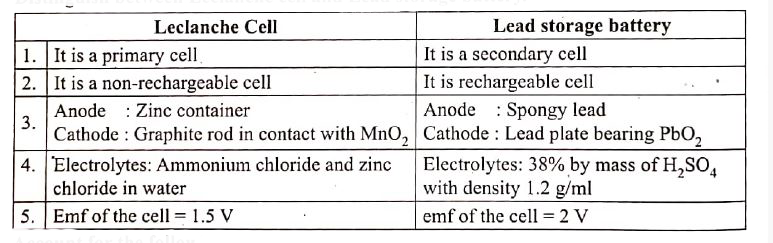
|
|
| 17. |
Distinguish between : (ii) C_(6)H_(5)COCH_(3) and C_(6)H_(5)CH_(2)CHO. |
| Answer» SOLUTION :ACETOPHENONE will give yellow PPT. of iodoform while `C_(6)H_(5)CH_(2)CHO` will not. | |
| 18. |
Distinguish between isotropy and anisotropy ? |
| Answer» SOLUTION :`{:("S.no","Isotropy","Anisotropy"),(1.,"Isotropy MEANS uiformity","Anisotropy means non-uniformity"),(,"in all directions.","in all directions."),(2.,"Isotropy means having identical","Anisotropy is the property which depends on the"),(,"values of physical properites such","direction of measurement. They SHOW different"),(,"as refractive index, electrical","values of physical properties when measured"),(,"conductance in all directions.","along different directions."),(3.,"Isotropy is the property of","Anisotropy is the properly of crystalline solids."),(,"amorphous solids.",):}` | |
| 19. |
Distinguish between : (i) Methyl amine and dimethyl amine, (ii) Aniline and N-methyl aniline. |
Answer» Solution :(i) 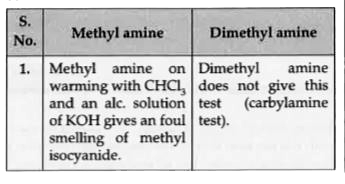 `RNH_(2)+CHCI_(2)+underset("Alcoholic")(3KOH)rarrunderset("CARBYLAMINE")(RNC)+3KCI+3H_(2)O` (II) 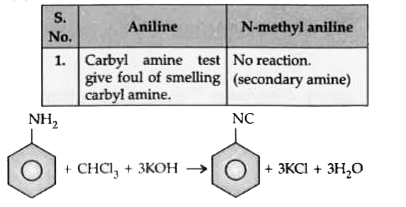
|
|
| 20. |
Distinguish between (i) Hexagonal and monoclinic unit cells. (ii) Face-centred and end-centred unit cells. |
|
Answer» Solution :(i) For hexagonal UNIT cell, `a=bnec, alpha=beta=90^(@), gamma=120^(@)`. For MONOCLINIC unit cell, `anebnec, alpha=gamma=90^(@), beta=120^(@)`. (ii) FACE-centred unit cell has particles located at the CORNERS and at the centre of each face. End-face centred unit cell has particles located at the corners and at the centre of any two opposite faces (instead of six faces in face-centred unit cell). |
|
| 21. |
Distinguish between (i) Hexagonal and monoclinic unit cells (ii) Face-centred and end-centred unit cells. |
|
Answer» SOLUTION :(i) In hexagonal unit CELLS, two sides are equal and the two angles are perpendicular and third angle is `120^@`. i.e., `a = b ne c, alpha = BETA = 90^@, gamma = 120^@`. In monoclinic unit cells, the edges are unequal and two angles are right angle. `a ne b nec, alpha = gamma = 90^@, B ne 90^@`. (ii) In face-centred unit cell, the lattice points are located at corners as well as at the centre of every face. While in end-centred unit cell, the lattice points are at corners as well as centre of two alternate faces. The NUMBER of atoms per unit cell in FCC are 4 while in end-centred there are two atoms per unit cell. |
|
| 22. |
Distinguish between : (i) C_(6) H_(5) - COCH_(5) and C_(6) H_(5) - CHO (ii) CH_(3) COOHand HCOOH |
|
Answer» Solution :(b)(i) `C_(6)H_(5)-COCH_(3)` and `C_(6) H_(5) = CHO` On treatment with NaOH and `I_(2), C_(6) H_(5) COCH_(3)` gives a yellow precipitate of iodoform `C_(6)H_(5) CHO` does not give this test. (ii) `CH_(3) COOH` and `HCOOH` HCOOH gives Tollen.s REAGENT test on treatment with AMMONICAL silver nitrate. A shining silver MIRROR is obtained `HCOOH + Ag_(2)O RARR CO_(2) + H_(2) O + underset( "silver mirror")(2Agdarr)` `CH_(3) COOH` does not give this test. |
|
| 23. |
Distinguish between : (i) C_(2)H_(5)OH and CH_(3)CHO. |
| Answer» SOLUTION :`C_(2)H_(5)OH` evolves `H_2` GAS with `Na,CH_3 CHO` not. | |
| 24. |
Distinguish between homopolymers and copolymers with an example of each. |
|
Answer» Solution : Homopolymers : POLYMERS whose repeating structural UNITS are derived from only one type of MONOMER units are called homopolymers. For EXAMPLE, Polythene. Copolymers : Polymers whose repeating structural units are derived from two or more types of monomer units are called copolymers. For example, Nylon-6, 6. |
|
| 25. |
Distinguish between the terms homopolymer and copolymer. Give one example of each. |
| Answer» Solution :HOMOPOLYMERS are OBTAINED from only ONE type of monomers e.g. polythene , POLYSTYRENE , copolymers are formed from two or more types of monomers e.g.Buna-S-Terylene | |
| 26. |
Distinguish between hexagonal close packing and cubic close packing. |
Answer» SOLUTION : 
|
|
| 27. |
Distinguish between : Hexagonal and monoclinic unit cells |
|
Answer» Solution :For HEXAGONAL unit cell, `a=B ne c, alpha=beta=90^@, gamma=120^@` For monoclinic unit cell, `a ne b ne c, alpha=gamma=90^@, beta ne 90^@` |
|
| 28. |
Distinguish between galvanic cell and electrolytic cell. |
Answer» SOLUTION :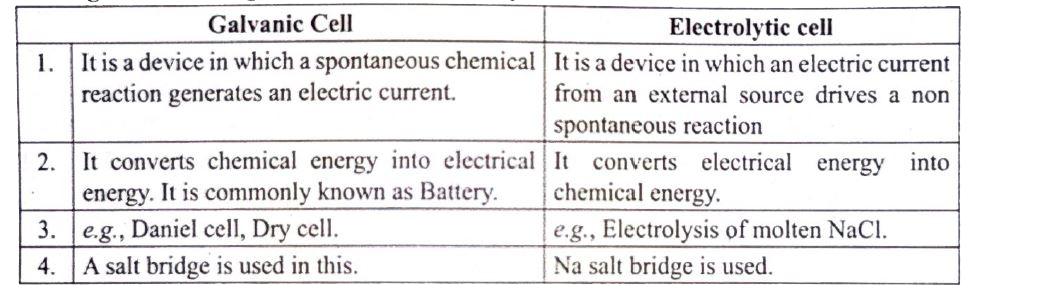
|
|
| 29. |
Distinguish between flux and slag ? |
Answer» Solution :FLUX combines with INFUSIBLE impurity to form FUSIBLE SLAG. 
|
|
| 30. |
Distinguish between fibrous and globular proteins. |
Answer» SOLUTION :
|
|
| 31. |
Distinguish between : face- centred and end centred unit cells |
|
Answer» Solution :A UNIT cell CONTAINING one constituent particle at the centre of each face in addition to the particles at the CORNERS is called a face centred unit cell END entred unit cell contain one constituent particle each at the CENTRES of two opposite faces in addition to the particles at the corners. |
|
| 32. |
Distinguish between ethylamine , diethlamine and triethyl amine . |
|
Answer» Solution :Reaction of an amine with NITROUS acid(HO - N =O)is the DISTINGUISHING test between primary, secondary and tertiary amines as they react differently with nitrous acid. Nitrous acid is unstable, hence prepared instantly by the action of cold, dilute, hydrochloric acid on sodium nitrite. `underset("Sodium nitrite")(NaNO_(2)) + HCI overset("cold")underset("dil.")to NaCI + underset(" nitrous acid")(HNO_(2))` (1) Action of nitrous acid on primary amine : All primary amines, except methly amine react withnitrous acid in cold to give alcohol and liberate nitrogen gas. For example, ethyl amine on reaction with nitrous acid in cold, forms ethyl alcohol and nitrogent gas. `underset("ethylamine")(C_2H_5 -NH_2)+underset("nitrous acid")(HO-N=O) overset(NaNO_(2)+ " dill. HCI")underset("cold")to underset("ethyl alcohol")(C_(2)H_(5)-OH)H_(2)O+underset("nitrogen gas")(N_(2))` (2) Action of nitrousacid on secondary amines : Tertiary amine on reaction with nitrous acid forms N-nitrosoamine which is a pale yellow OIL. Forexample, diethyl amine on reaction with nitrous acid in cold FROMS pale yellow oily N-nitrosodiethylamine. `underset("diethylamine")((C_(2)H_(5))_(2)NH)+H-O-H=O overset(NaNO_(2)+ " dil.HCI") underset("cold")to underset("N-nitrosodiethylamine")((C_(2)H_(5))_(2)N-N=O + H_(2))O` (3) Action of nitrous acid on tertiary amines , Tertiary amine on reaction with nitrous acid forms water - soluble nitrite salt. As no visible change , is observed , it is said that there is no reaction. For example, triethylamine reacts with nitrous acid in cold and forms water soluble triethyl ammonium nitrite salt. `underset("triethyaminenitrous acid")((C_(2)H_(5))_(3)N+HO-N=O) overset(NaNO_(2)+ " dil. HCI")underset("cold")to underset("triethyl ammonium nitrite")([(c_(2)H_(5))_(3)NH^(+)]NO_(2)^(-))` |
|
| 33. |
Distinguish between fat soluble and water soluble vitamins. |
Answer» SOLUTION :
|
|
| 34. |
Distinguish between Endothermic reaction and Exothermic reactions. |
Answer» SOLUTION :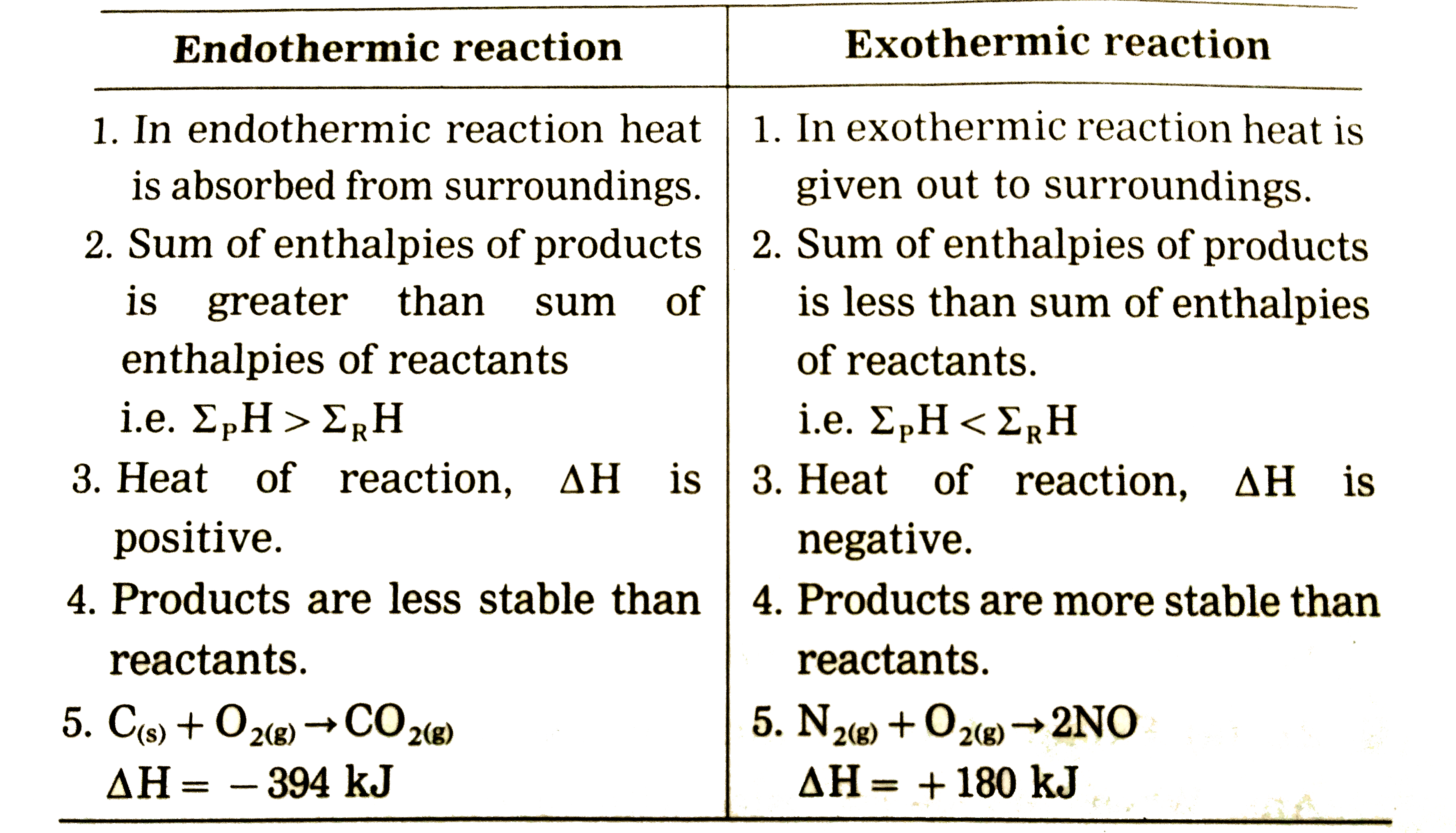
|
|
| 35. |
Distinguish between enantiomers and diastereomers. |
Answer» Solution :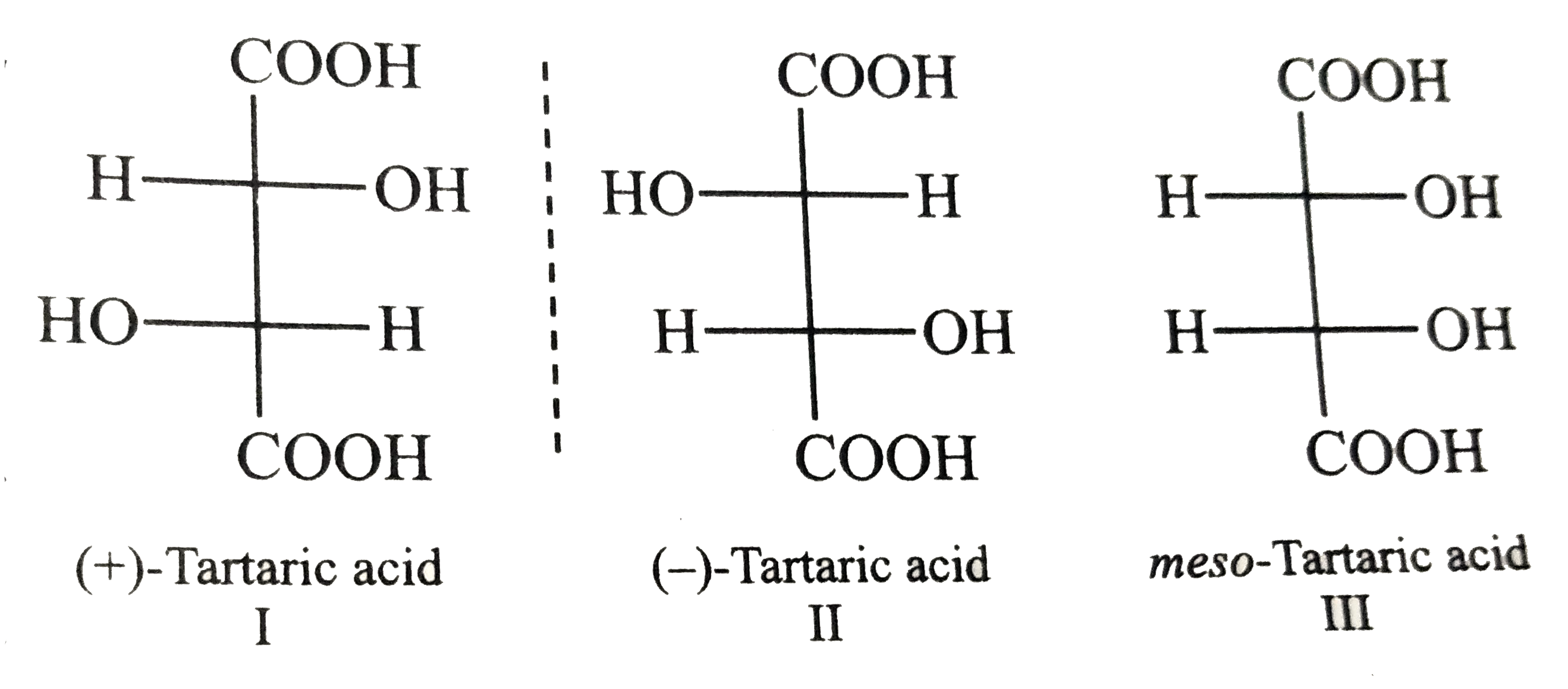 Stereoisomers which are non-superimposable MIRROR IMAGES of each other are called enantiomers while stereoisomers which are not mirror images of each other are called diastereomers. For example, TARTARIC acid EXISTS inthree stereosiomeric forms I, II and III STRUCTURES I and II are non-superimposable mirror images of each other and hence are enentiomers. but structures I and III (or II and III) are not mirror images and hence are diastereomers. |
|
| 36. |
Distinguish between double salt and complex salt |
Answer» SOLUTION :
|
|
| 37. |
Distinguish between diffusion and osmosis. |
Answer» Solution :Although both DIFFUSTION and osmosis involve the movement of the MOLECULES, still they DIFFER in the FOLLOWING RESPECTS: 
|
|
| 38. |
Distinguish between diamond and graphite. |
Answer» SOLUTION :
|
|
| 39. |
Distinguish between cubic and hexagonal unit cells. |
Answer» SOLUTION :
|
|
| 40. |
Distinguish between crystalline and amorphous solids in terms of (a) Cleavage property (b) Heat of fusion. |
Answer» SOLUTION :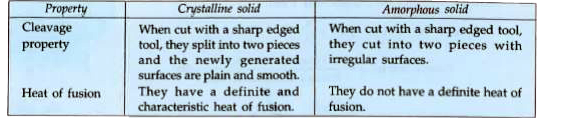
|
|
| 41. |
Distinguish between crystal lattice and unit cell. |
|
Answer» Solution :CRYSTAL lattice : It is the difinite THREE DIMENSIONAL geometrical arrangement of constituent particles in a crystal Unit cell: It is the smallest repeating portion which when repeated again and again in all the three DIMENSIONS results in the FORMATION of a crystal. Crystal lattice is made up of unit cells. |
|
| 42. |
Distinguish between 'chain growth polymerisation' and 'step growth polymerisation' and give one example of each process. |
| Answer» Solution :Chain growth polymerisation takes place in UNSATURATED monomers and involves free radical addition polymerisation. It is ALSO called addition polymerisation. POLYTHENE is formed by chain growth polymerisation STEP growth polymerisation involves condensation between monomers having multifunctional groups. It is also known as condensation polymerisation Nylon 6, 6 is obtained by step growth polymerisation. | |
| 43. |
Distinguish between 'chain growth polymerisation and step growth polymerisation' and give one example of each. |
Answer» SOLUTION :
|
|
| 44. |
Distinguish between buta-1,3-dieneand but-1-yne ? |
|
Answer» Solution :But-1-yne `(CH_3CH_2C-=CH)` REACTS with AMMONIACAL CUPROUS chloride solution OT give a red precipitate.Buta-1,3-diene , however does not respond to this test. `CH_3CH_2C-=Choverset(Cu_2Cl_2)underset(NH_4OH)to CH_3CH_2C-=C""Cudarr("red")` |
|
| 45. |
Distinguish between benzaldehyde and acetaldehyde. |
|
Answer» Solution :Benzaldehyde does not undergo iodoform REACTION WHEREAS ACETALDEHYDE EXHIBITS iodoform reaction. `CH_3CHO+3I_2+4NaOHrarrCHI_3+3NaI+HCOONa+3H_2O` |
|
| 46. |
Distinguish between Antiseptic and Disinfectants. |
|
Answer» Solution : (i) Antiseptic: They are the drugs used to stop (or) SLOW down the growth of micro organism and they are applied to living tissue (body). Example: `H_(2)O_(2)`. (ii) DISINFECTANT: They are the drugs used to stop or slow the growth of micro organism and they are applied on inanimate objects (non living SURFACES). Example: CHLORINE compounds. |
|
| 47. |
Distinguish between Aniline and Benzyl amine by suitable chemical test. |
|
Answer» |
|
| 48. |
Distinguish between anisotropy and isotropy. |
|
Answer» Solution :(i)ANISOTROPY is a property of crystalline solids by virtue of which their physical properties like REFRACTIVE index, condutivity ETC. have DIFFERENT values in different directions. (ii) Isotropy is a property of amorphous solids by virtue of which their physical properties like refractive index,CONDUCTIVITY etc. have same values in all directions. |
|
| 49. |
Distinguish between additionpolymers and condensation polymersand give one exampleof each class. |
| Answer» Solution :Addition POLYMERS are those which are formed from unsaturated monomers without loss of simple MOLECULES LIKE `H_(2)O` , `NH_(3)`, etc., for example, POLYTHENE. Condensation polymers are those which are formed from monomers having multi-functional groups with the loss of simple molecules like `H_(2)O,NH_(3)` , etc., for example, Nylon 6, 6. | |