

Saved Bookmarks
This section includes 7 InterviewSolutions, each offering curated multiple-choice questions to sharpen your Current Affairs knowledge and support exam preparation. Choose a topic below to get started.
| 1. |
An inorganic compound (A) gives the following reactions : (i) Produces a violet flame when burnt. (ii) When heated with manganese dioxide, it produces oxygen. (iii) When treated with iodine, it produces chlorine and a compound (B). (iv) When heated alone, it produces compounds (C) and (D). Identify compounds (A-D) and explain the reactions at steps (ii) to (iv). |
|
Answer» Solution :(i) Since compound (A), when burnt produces violet FLAME, therefore, compound (A) is a potassium salt. (ii) Since compound (A), when heated with `MnO_(2)` produces `O_(2)`, therefore, compound (A) must be potassium chlorate `(KCIO_(3))` `UNDERSET("Pot. chlorate")(2KCIO_(3))OVERSET(MnO_(2),Delta)rarr 2KCI + 3O_(2)`. (iii) When treated with `I_(2)`, it produces `CI_(2)` and potassium iodate `(KIO_(3))`. Therefore, compound (B) is `KIO_(3)` `underset("Pot. chlorate")(2KCIO_(3))+I_(2)overset(Delta)rarr underset("Pot. iodate (A)")(2KIO_(3))+CI_(2)` In this reaction, `I_(2)` acts as a reducing agent and hence decreases the oxidation state of CI from + 5 in `KCIO_(3)` to 0 in `CI_(2)` while that of I increase from 0 in `I_(2)` to + 5 in `KIO_(3)`. (iv) When heated alone, `KCIO_(3)` undergoes disproportionation reaction to give `KCIO_(4)`(C) and KCI (D) `underset("Pot. chlorate (A)")overset(+ 5)(4KCIO_(3)) overset(Delta)rarr underset("Pot. PERCHLORATE (B)")overset(+7)(3KCIO_(4))+underset("Pot. chloride (D)")overset(-1)(KCI)` The reason why `KCIO_(3)` undergoes disproportionation reaction is that it can be simultaneously oxidised (oxidation state of Cl increases from + 5 in `KCIO_(3)` to + 7 in `KCIO_(4)`) as well as reduced (oxidation state of Cl decreases from + 5 in `KCIO_(3)` to - 1 in KCI). |
|
| 2. |
An inhibitor is essentially |
|
Answer» a negative CATALYST |
|
| 3. |
An inert gas is added to the following equilibrium, A(s)+2B(g)hArr3C(g) at constant pressure. The equilibrium |
|
Answer» is not affected |
|
| 4. |
An industrial method of preparation of methanol is |
|
Answer» Catalytic reduction of carbon monoxide in presence of `ZnO-Cr_2O_3` |
|
| 5. |
An industrial method for preparation of methanol is: |
|
Answer» CATALYTIC reduction of CARBON monoxide in the presence of `ZnO-Cr_(2)O_(3)`. |
|
| 6. |
An increase in the concentration of adsorbate at the surface relative to its concentration in bulk phase is called |
|
Answer» Adsorption |
|
| 7. |
An increase in temprature on the reaction N_2 + O_2 ⇌ 2NO, DeltaH = 43.2 kcal will : |
|
Answer» INCREASE the yield of NO |
|
| 8. |
An increase in the charge of the positive ions that occupy lattice positions brings in a/an…… in methallic bonding. |
|
Answer» INCREASE |
|
| 9. |
An increase in temperatureby 10^(@) , canincrease the numberof collisions only by 2% , but therateof reactionincreases by 100%. Why? |
|
Answer» Solution :Temperature is directly proportional to kinetic energy. NUMBER of collisions is proportional to velocity or square root of temperature. However, in the Arrhenius rate expression, rate increases expone-ntionally but not linearly, with a change in temperature. The number of molecules exceeding the ACTIVATION energy approximately doubles by a `10^(@)` rise in temperature. HENCE rate increases by `100%`. |
|
| 10. |
An increase in equivalent conductance of a strong electrolyte with dilution is mainly due to |
|
Answer» INCREASE in number of ions |
|
| 11. |
An increase in equivalent conductance of a strong electrolyte with dilution is mainly due to: |
|
Answer» INCREASE in number of ions. |
|
| 12. |
An increase in equivalent conductance of a strong electrolyte with dilution is mainly due to ……………. . |
|
Answer» INCREASE in both the number of ions and ionic MOBILITY of ions |
|
| 13. |
An increase in both atomic and ionic radii with atomic number occurs in any group of the perioidc table and in accordance with this, the ionic radii of Ti (IV) and Zr (IV) ionc are 0.68 A^(@) and 0.74A^(@) respectively, but for Hf (IV) ion the ionic radius of 0.75A^(@), which is almost the same as that for Zr (IV) ion. This is due to |
|
Answer» greater degree of covalency in compounds of `Hf^(4+)` |
|
| 14. |
An incorrect statement with respect to S_(N) 1 and S_(N)2 mechanisms for alkyl halide is |
|
Answer» A strong nucleophile in an aprotic SOLVENT increases the rate or FAVOURS `S_(N)2` reaction |
|
| 15. |
An inaccurate ammeter and silvercoulmeter is connected in seriesin an electriccircuitthroug which a constant directcurrentflowsif ammeter reads0.6 ampere throughout one hourthe silverdeposited on coulometer was found to be 2.16 g whast % erroris in the readingof ammetr [Assume100% currentefficiency ] |
|
Answer» 0.01 `(2.16 )/(108)=(ixx60xx60)/(96500) RARR I = 0.54 A` Errorinreadingof ammeter=0.60 -0.54 = 0.06 A % ERROR `=(0.06)/(0.60) xx100=10%` |
|
| 16. |
An improbable configuration is |
|
Answer» A) `[Ar]3d^(10)4S^(1)` |
|
| 17. |
An impure sample of CaCO_(3) contains 38% of Ca. The percentage of impurity present in the sample is : |
| Answer» ANSWER :A | |
| 18. |
An impure sample ( having 60 % purity ) of KClO_(3) contains 30 gm of pure KClO_(3) .Find weight of impure sample. |
|
Answer» 50 GM |
|
| 19. |
An important reaction of acetone is autocondensation in presence of concentrated sulphuric acid to give the aromatic compound |
|
Answer» mesithylene 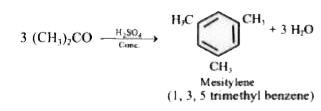
|
|
| 21. |
An important postulate of Dalton's atomic theory is |
|
Answer» an atom CONTAINS electrons, protons and NEUTRONS |
|
| 22. |
An important method of fixation of atmospheric N_2 is: |
|
Answer» FISCHER- Tropsch.s PROCESS |
|
| 23. |
An important method for fixing of atmospheric N_(2) is : |
|
Answer» FISCHE Tropsch process |
|
| 24. |
An important insecticide is obtained by the action of chloral on chlorobenzene. It is |
|
Answer» BHC |
|
| 25. |
An important chemical method to resolve a racemic mixture makes use of the formation of |
|
Answer» a MESO compound |
|
| 26. |
An important chlorinated organic insecticide is prepared from the given reaction. The structure of A is (AAK_MCP_35_NEET_CHE_E35_018_Q01) |
|
Answer» `(AAK_MCP_35_NEET_CHE_E35_018_A01)` |
|
| 27. |
An important characteristic property of metals is: |
|
Answer» Their hardness |
|
| 28. |
An importanti-knocking compoundis : |
| Answer» Answer :A | |
| 29. |
An ideal solution was prepared by dissolving some amount of can sugar (non-volatile) in 0.9 moles of water.The solution was then cooled just below its freezing temperature (271 K) where some ice get separated out.The remaining aqueous solution registered a vapour pressure of 700 torr at 373K.Calculate the mass of ice separated out, if the molar heat of fusion of water is 6 kJ. |
|
Answer» Solution :`K_f=(RT_f^2)/(DeltaH_("fusion"))M`(M=mol. WT. `T_f` =normalfreezing pt) `K_f=(8.314xx(273)^2xx18)/(1000xx6xx10^3)` `:. K_f ~~1.86K.kg mol^(-1)` Now `DeltaT_f=K_fxxm`(m=molality) `:.m=(DeltaT_f)/K_f=((273-271))/1.86=1.07` MOLES/kg But `m=("moles of solutes")/("weight of solvent (in Kg)")` n=moles of solute =`1.075xx((0.9xx18)/1000)=1.74xx10^(-2)` ALSO `X_("solute")=(760-700)/760=0.079` (where X=mole fraction) `:. "Total moles"=(1.74xx10^(-2))/0.079=0.22` Moles of solvent `(H_2O)=0.2026` `:.` Mass of ice SEPARATED out =(0.9-0.2026)x18=12 gm |
|
| 30. |
An imperfect complex of a complex compound is 100% ionised, the compound is called: |
|
Answer» DOUBLE SALT |
|
| 31. |
An ideal solution was obtained by mixing methanol and ethanol. If the partial vapour pressure of methanol and ethanol are 2.619 KP_a and 4.556 KP_a respectively, the composition of vapour ( in terms of mole fraction) will be: |
|
Answer» 0.625 MeOH,0.365 EtOH |
|
| 32. |
An ideal solution of two liquids is a solution in which each component obeys Raoult's which states that the vapour pressure of any component in the solution depends on the mole fraction of that component in the solution and the vapour pressure of that component in the pure state. However, there are many solution which do not obey Raoult's law. In other words, they show deviations from ideal behaviour which may be positive or negative. However, in either case, corresponding to a particular composition, they form a constant boiling mixtures called azeotropes. A solution has a 1:4 mole ratio of pentane to hexane. The vapour presssures of the pure hydrocarbons at 20^(@)C are 440 mm of Hg for pentane and 120 mm of Hg for hexane. The mole fraction at pentane in the vapour phase would be |
|
Answer» 0.2 `p_("pentane")=0.2xx"440 mm = 88 mm"` `p_("hexane")=0.8xx"120 mm = 96 mm"` `therefore"Mole fraction of pentane in VAPOUR PHASE "` `=(88)/(88+96)=0.478` |
|
| 33. |
An ideal solution ois formed by mixing two volatile liquids A and B. X_(A) and X_(B) are the molefractions of A and B respectively in the solution and Y_(A) and Y_(B) are the molre fractions of A and B respectively in the vapour phase. A plot of 1//Y_(A) along y-axis against 1//X_(A) along x-axis gives a straight line. What is the slope of the straight line? (where p_(A)^(@) and p_(B)^(@) are the vapour pressures of the pure components A and B respectively) |
|
Answer» `p_(B)^(@)//p_(A)^(@)` `(1)/(y_(A))=(p_(B)^(@))/(p_(A)^(@))=(1)/(x_(A))+(p_(A)^(@)-p_(B)^(@))/(p_(A)^(@))""(y=mx+c)` Hence, plot of `1//y_(A)` along y-axis versus `1//x_(A)`along x-axis will be straight LINE with slope `=p_(B)^(@)//p_(A)^(@)`. |
|
| 34. |
An ideal solution of two liquids is a solution in which each component obeys Raoult's which states that the vapour pressure of any component in the solution depends on the mole fraction of that component in the solution and the vapour pressure of that component in the pure state. However, there are many solution which do not obey Raoult's law. In other words, they show deviations from ideal behaviour which may be positive or negative. However, in either case, corresponding to a particular composition, they form a constant boiling mixtures called azeotropes. An azetropic solution of two liquids has boiling point lower than either of the two liquids when it |
|
Answer» shows no deviations from Raoult's law |
|
| 35. |
An ideal solution of two liquids is a solution in which each component obeys Raoult's which states that the vapour pressure of any component in the solution depends on the mole fraction of that component in the solution and the vapour pressure of that component in the pure state. However, there are many solution which do not obey Raoult's law. In other words, they show deviations from ideal behaviour which may be positive or negative. However, in either case, corresponding to a particular composition, they form a constant boiling mixtures called azeotropes. Which of the following mixture do you expect will bo show positive deviation from Raoult's law ? |
|
Answer» Benzene - Chloroform |
|
| 36. |
An ideal solution contains two volatile liquids A (A^(0)=100"torr") and B(P^(0)=200"torr"). If mixturecontain 1 mole of A and 4 mole of B then total vapourpressure of the distillate is : |
|
Answer» 150 |
|
| 37. |
An idealgass istaken fromstate A (Pressuer P, VolumeV) to the state B ( PressureP/2, Volume 2V)alonga strightline pathin PVdiagramas shown in the adjacentfigure . Selectthe correctstatement (s) amongthe following . |
|
Answer» <P>The WORKDONEBY gasin theprocessA to Bexceedsthe workthat ` P = - ((1P_(0))/(2V_(0))) V +(3P_(0))/(2)` 
|
|
| 38. |
An ideal gaseous sample at initial state I (P_0, V_0, T_0) is allowed to expand to volume 2V_0 using two different process, in the first process the equation of process is PV_2=K_1 and in second process the equation of the process is PV=K_2.Then |
|
Answer» Work done in first process will be greater than work in a second process (MAGNITUDE wise) 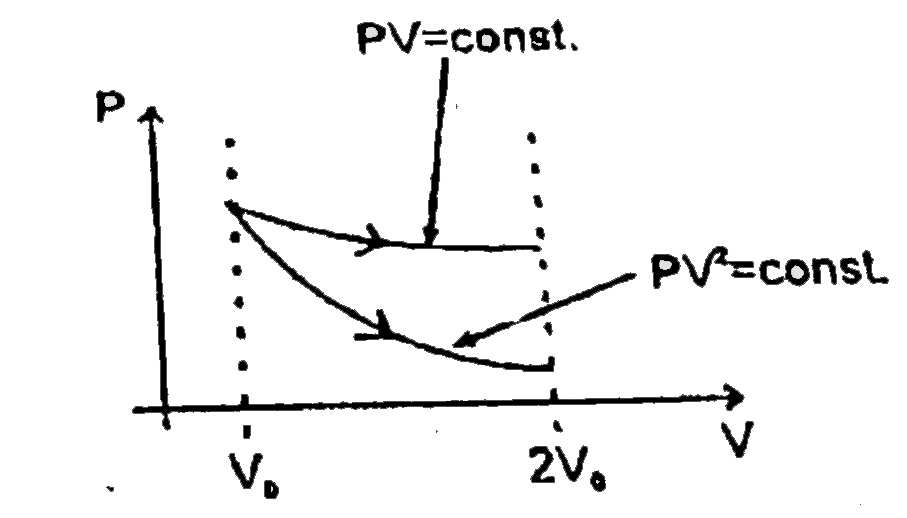
|
|
| 39. |
An ideal gaseous mixture of ethane (C_(2)H_(4)) and (C_(2)H_(4)) occupies 28 litre at 1 atm , O_(0)C. The mixture reacts completely with 128 gm O_(2) to produce CO_(2) and H_(2)O .Mole fraction of C_(2)H_(6) in the mixture is |
|
Answer» 0.6 |
|
| 40. |
An ideal gas with density of 3.0 g/L has pressure of 675 mmHg at 25^@C . What is the rms speed of the molecules of this gas? |
| Answer» SOLUTION :`3.0 XX 10^2 m//s` | |
| 41. |
An ideal gas with density 6 gm//L has a pressure of 38 torr at room temperature, then calculate the value of root mean square speed (in m/sec) of molecules of this gas. [Take 1 atm = 10^(5) Pascal] [Divide your answer by 10] |
|
Answer» `U_("rms") = (100)/(2) = 50 m//sec` `= (50)/(10) = 5` |
|
| 42. |
An ideal gas will have maximum density when |
|
Answer» <P>`P = 0.5 atm , T = 600 K` |
|
| 43. |
An ideal gas undergoing expansion in vacuum shows: |
|
Answer» `triangleU=0` |
|
| 45. |
An ideal gas obeying kinetic gas equation can be liquefied if |
|
Answer» <P>Its TEMPERATURE is more than critical temperature |
|
| 46. |
An ideal gas is taken from the same initial pressure P_(1) to the same final pressure P_(2) by four different process. If it is known that point 3 corresponds to a reversible adiabatic, point 4 corresponds to a single step adiabatic and point 2 corresponds to reversible isothermal. Select the incorrect option (s). |
|
Answer» POINT 5 may be ACHIEVED by two step adiabatic process |
|
| 47. |
An ideal gas is taken from the same initial pressure P_(1) to the same final pressure P_(2) by three different processes. If it is known that point 1 corresponds to a reversible adiabatic and point 2 corrresponds to a single stage adiabatic then: |
|
Answer» Point 3 MAY be a two stage adiabatic |
|
| 48. |
An idealgas istakenaroundthe cycle ABCD A asshownin figure . Thenetwork doneduringthe cycleisequalto : |
|
Answer» zero Sincethe area of both triangle is EQUAL . ALSO workdone in one ispositive whilein other is negative . |
|
| 49. |
An ideal gas is subjected to two different process in which it is heated to same final temperature from same initial state (A) as shown in diagram, then : |
|
Answer» heat absorbed by the SYSTEM will be more in AB process. |
|
| 50. |
An ideal gas is expanded from (p_(1),V_(1),T_(1)) to (p_(2),V_2,T_(2)) under different conditions. The correct statement(s) among the following is (are). |
|
Answer» The work done on the gas is maximum when it is compressed irreversibly from `(p_(2)V_(2))` to `(p_(1),V_(1))` against constant pressure `p_(1)` 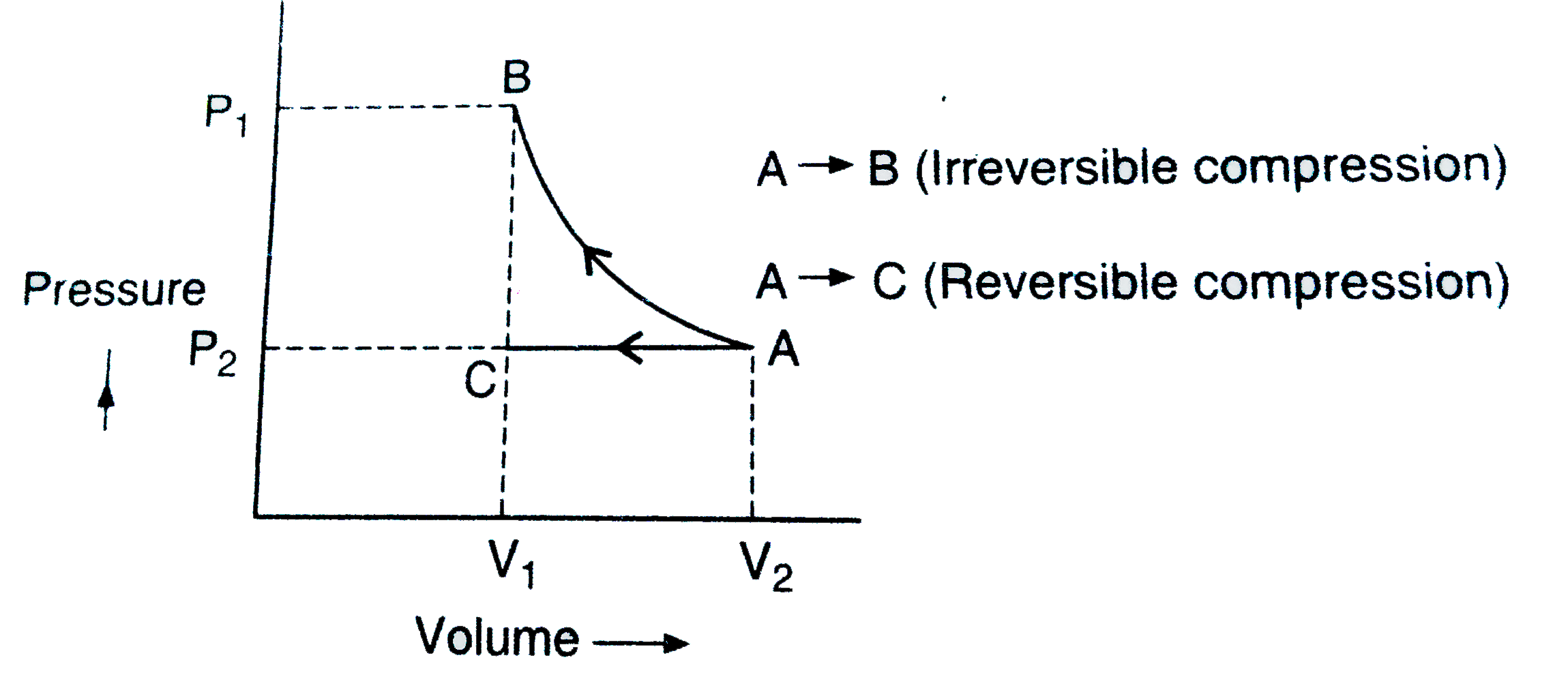 Work done=Area under the curve `thereforew_(REV) LT w_(irr)` 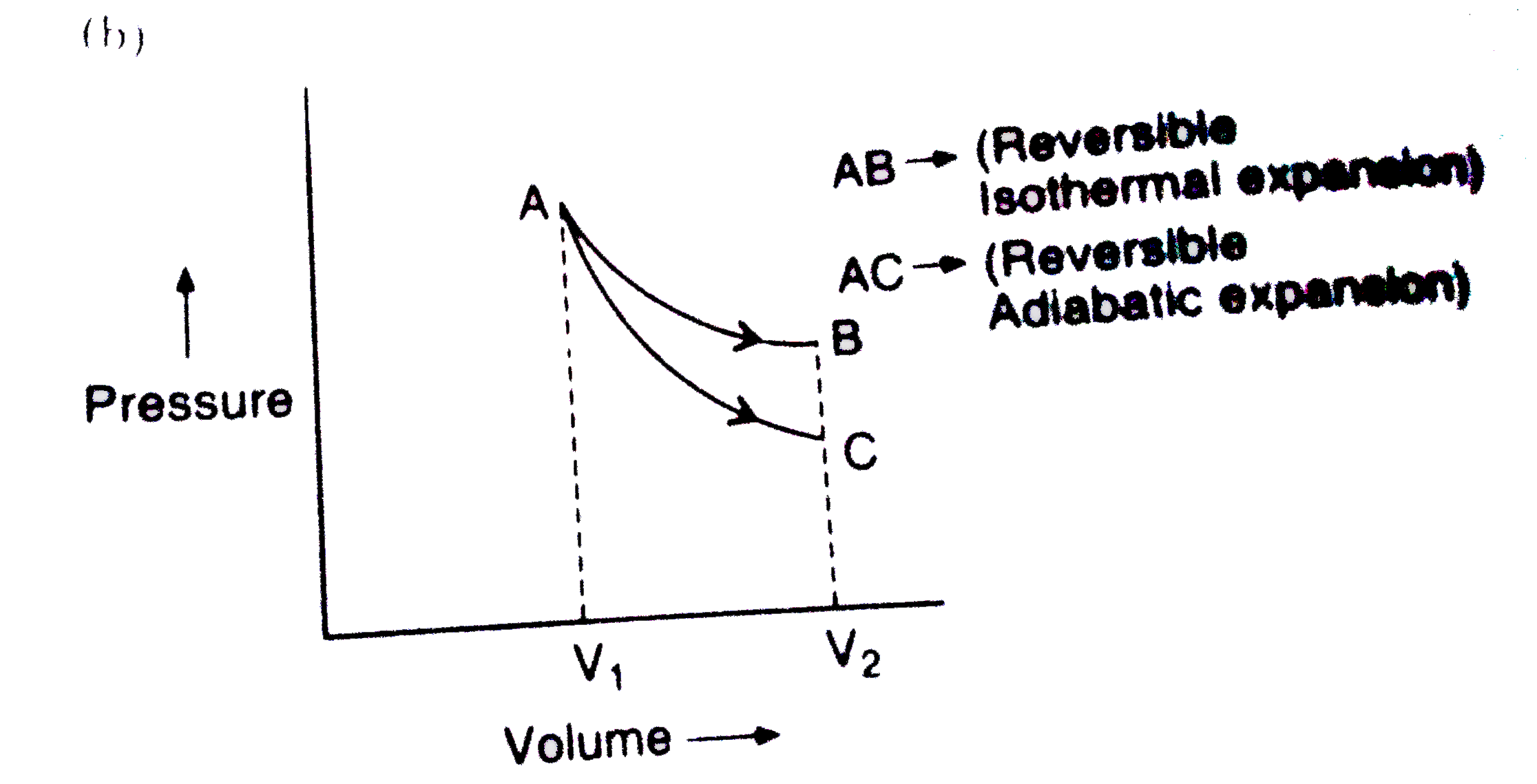 `w_(AtoB) gt w_(AtoC)` (d) For free expansion w=0 (free expansion) For adiabatic process q=0 (Adiabatic) `therefore` From first law `DeltaU=q+w` `DeltaU=0` i.e., `DeltaT=0` (Isothermal) |
|