

Saved Bookmarks
This section includes 7 InterviewSolutions, each offering curated multiple-choice questions to sharpen your Current Affairs knowledge and support exam preparation. Choose a topic below to get started.
| 1. |
Amongst the compounds given, the one that would form a brilliant colored dye on treatment with NaNO_2 in dil. HCI followed by addition to an alkaline solution of beta-naphthol is |
|
Answer»
|
|
| 2. |
Amongst the compounds given, the one that would form a brilliant colored dye on treatment with NaNO_(2) in dil. HCl followed by addition to an alkaline solution of beta-naphthol is |
|
Answer»
|
|
| 3. |
Amongst T_(2)F_(6)^(2-), CoF_(6)^(2-), Cu_(2)Cl_(2) and NiCl_(4)^(2-) [Atomic number of Ti, Co, Ni and Cu are 22,27,28 and 29 respectively), the colourless species are |
|
Answer» `CoF_(6)^(2-)` and `NiCl_(4)^(2-)` |
|
| 4. |
Amongst peracids of halogens, the strongest oxidising agent is............ . |
| Answer» SOLUTION :`HBrO_(4)` | |
| 5. |
Amongst the C-X bond ( where X = Cl, Br, I), the correct bond energy order is |
|
Answer» `C - CL GT C - BR gt C - I` |
|
| 6. |
Amongst sodium halides, NaF has the highest m.p. because it has |
|
Answer» highest OXIDIZING POWER.... . |
|
| 7. |
Amongst NO_(3)^(-), AsO_(3)^(3-), CO_(3)^(2-),ClO_(3)^(-),SO_(3)^(2-) and BO_(3)^(2-), the non-planar species are : |
|
Answer» `CO_(3)^(2-), SO_(3)^(2-) and BO_(3)^(2-)` |
|
| 8. |
Amongst NO_3^(-), AsO_3^(3-), CO_3^(2-), ClO_3^(-), SO_3^(2-) and BO_3^(3-) the non-planar species are |
|
Answer» `CO_3^(2-), SO_3^(2-) and BO_3^(3-)` 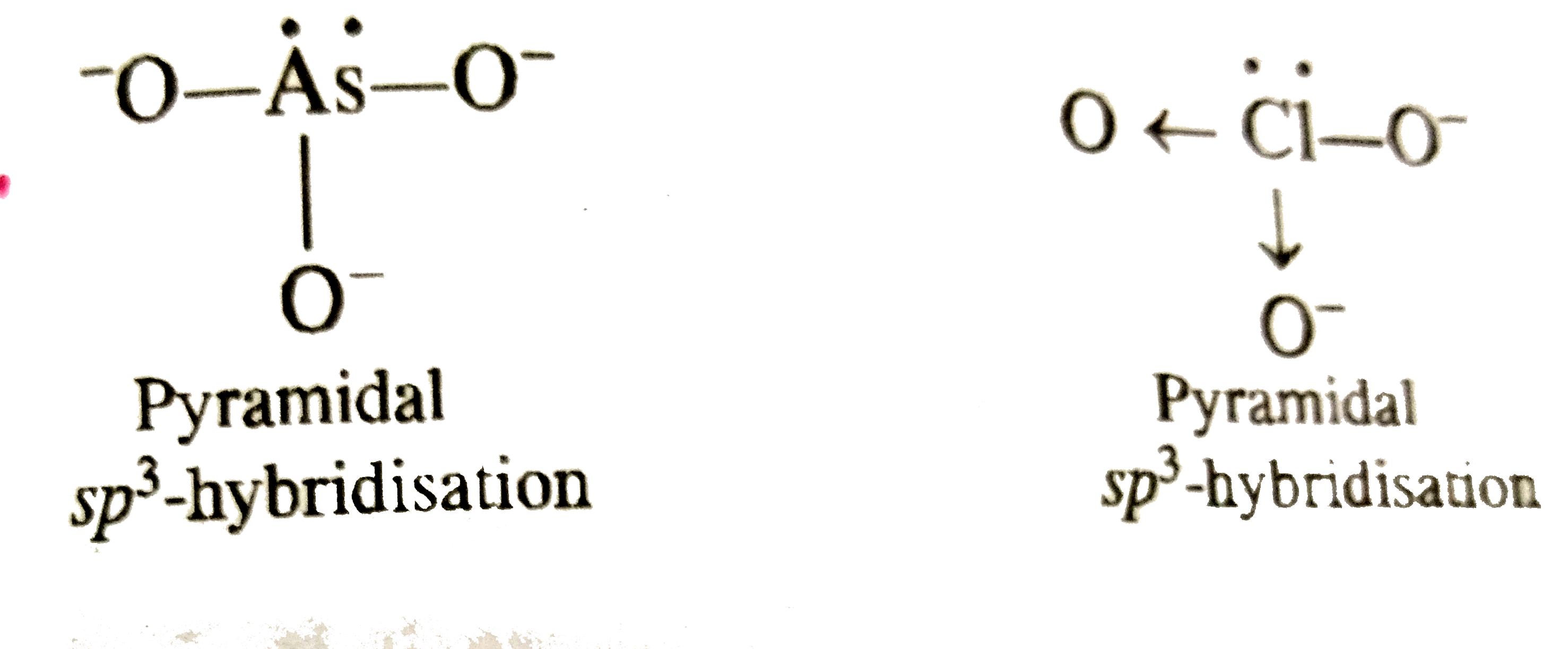 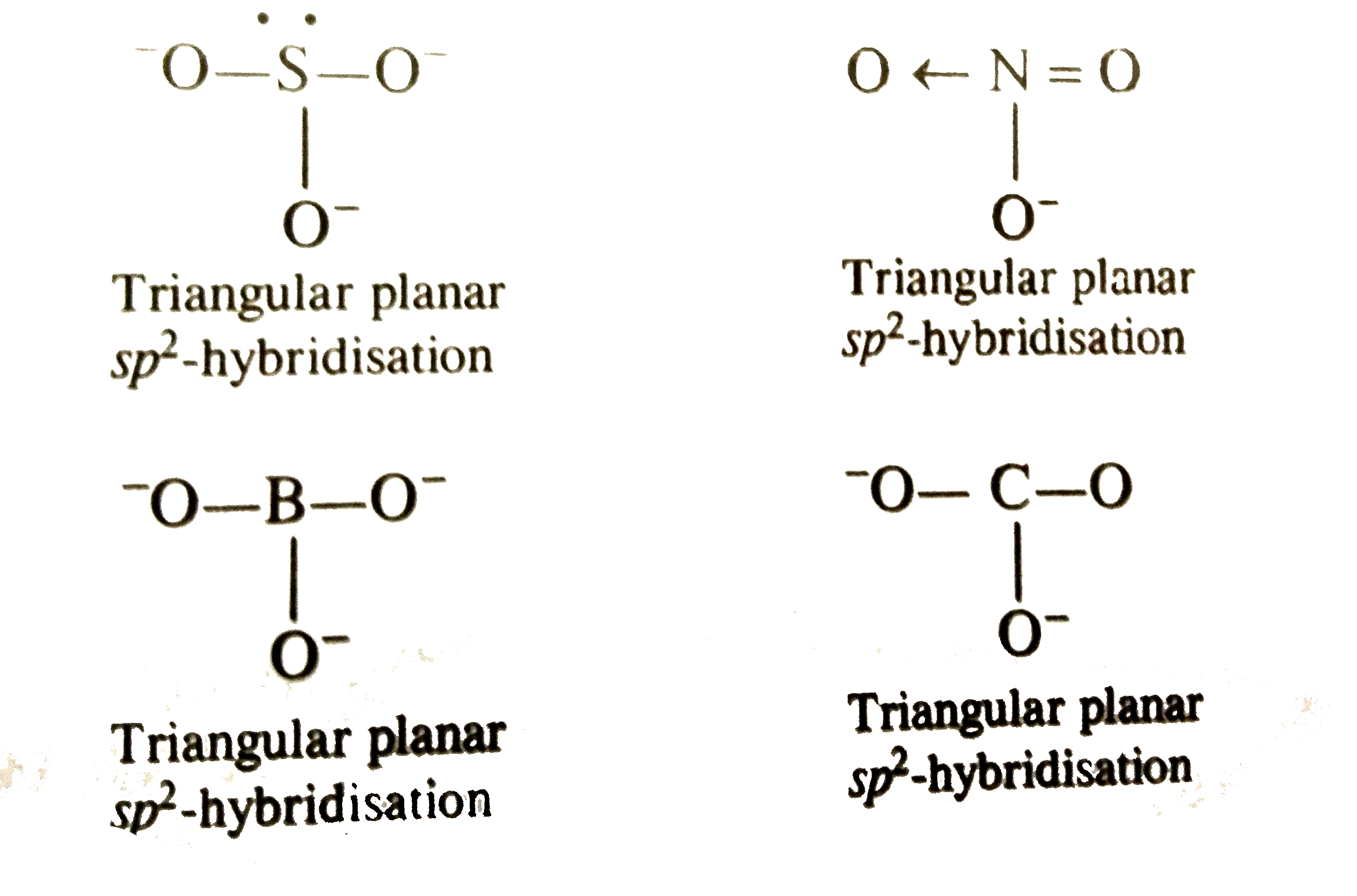
|
|
| 9. |
Amongst Ni(CO)_(4), [Ni(CN)_(4)]^(2-), NiCl_(4)^(2-) : |
|
Answer» `Ni(CO)_(4)` and `NiCl_(4)^(2-)` are diamagnetic and `[Ni(CN)_(4)]^(2-)` is PARAMAGNETIC. |
|
| 10. |
Amongst Ni(CO)_(4), [Ni(CN)_(4)]^(2-) and [NiCl_(4)]^(2-) : |
|
Answer» `Ni(CO)_(4) and NiCl_(4)^(2-)` are diamagnetic and `[Ni(CN)_(4)]^(2-)`is PARAMAGNETIC. |
|
| 11. |
Amongst Ni(CO)_(4), [Ni(CN)_(4)]^(2-) and [NiCl_(4)]^(2-) |
|
Answer» `NI(CO)_(4) and [Ni(CN)_(4)]^(2-)` are diamagnetic and `[Ni(CN)_(4)]^(2-)` is PARAMAGNETIC |
|
| 12. |
Amongst [NiCl_(4)]^(2-), [Ni(H_(2)O)_(6)]^(2+), [Ni("PP"h_(3))_(2)Cl_(2)], [Ni(CO)_(4)] and [Ni(CNO_(4))]^(2-) the paramagnetic species are |
|
Answer» `[NiCl_(4)]^(2-),[NI(H_(2)O)_(6)]^(2+), [Ni("PP"h_(3))_(2)Cl_(2)]` (i) `[NiCl_(4)]^(2-)toCl^(-)` is weak ligand (spectrochemical sereis), so no pairing POSSIBLE. CFSE < pariring energy. (ii) `[Ni(H_(2)O)_(6)]^(2+)toH_(2)O` is weak field ligand. So,no pairing possible. CFSE < Pairing energy. (iii) `[Ni("PP"h_(3))_(2)Cl_(2)]to` Although `"PP"h_(3)` had d- acceptance but presence of Cl makes complex tetrahedral. |
|
| 13. |
Amongst LiCl, RbCl, BeCl_2 and MgCl_2, the compounds whith the greatrest and the least ionic character respecitely are : |
|
Answer» `LiCl,MgCl_(2)` |
|
| 14. |
Amongst I=[Co(Ox)_(3)]^(3-),II=[CoF_(6)]^(3-),III=[Co(NH_(3))_(6)]^(+3) |
|
Answer» I, II are para, and III is dia II) `[CoF_(7)]^(3-):` F acts as WFC 4, un in paired electron present, paramagnetic. III. `[Co(NH_(3))_(6)]^(3+):NH_(3)` acts as SFL, all paired electron diamagnetic |
|
| 15. |
Amongst LiCl, RbCl, BeCl_(2) and MgCl_(2), the compounds with the greatest and the least ionic character respectively are : |
|
Answer» `LiCl, RBCL` |
|
| 16. |
Amongst hexahalides of sulphur, SF_6 is exceptionally stable due to |
|
Answer» SEE- SAW geometry |
|
| 17. |
Amongst H_(2)OH_(2)S,H_(2) Seand H_(2)Tethe one with thehighest boiling point is |
|
Answer» `H_(2)O` because of HYDROGEN bonding |
|
| 18. |
Amongst H_(2)O, H_(2)S, H_(2) Se and H_(2) Te, the one with the highest boiling point is |
|
Answer» `H_2O` because of HYDROGEN BONDING |
|
| 19. |
Amongst H_(2)O,H_(2)S, H_(2)Se and H_(2)Te the one with the highest boiling point is |
|
Answer» `H_(2)O` because of hydrogen BONDING |
|
| 20. |
Amongst H_(2)O, H_(2)Se and H_(2)Te, the one with highest boiling point is |
|
Answer» `H_(2)O` because of hydrogen BONDING |
|
| 21. |
Amongst given polymers, how many of them are addition polymer. (i) Melmac (ii) ABS rubber (iii) Plexiglass (iv) Orlon(v) Teflon(vi) Kevlar (vii) Dextron (viii) Polyurethanes |
|
Answer» |
|
| 22. |
Amongst fluorides of alkali metals, the lowest solubility of LiF in water is dur to |
|
Answer» IONIC NATURE of LITHIUM fluoride |
|
| 23. |
Amongst CuF_(2),CuCl_(2) and CuBr_(2) |
|
Answer» only `CuF_(2)` is IONIC |
|
| 24. |
Amongst CuF_(2), CuCl_(2) and CuBr_(2) |
|
Answer» only `CuF_(2)` is IONIC |
|
| 25. |
Amongst Cd, Hg, Ag, Au The I.P. Vlaue order will be |
|
Answer» `Ag LT Cd lt AU lt Hg ` |
|
| 26. |
Amongst all noble gases only xenon is known to form compounds with oxygen and flruorine. Give reasons. |
| Answer» Solution :Amongst all the noble gases (except Rn), Xe has the LARGEST size and lowest ionization ENTHALPY. Further, since `F_(2) and O_(2)` are the most ELECTRONEGATIVE elements known, THEREFORE, amongst all the noble gases only XENON forms compounds with `O_(2) and F_(2)`. | |
| 27. |
Amongst CuF_2 ,CuCl_2 and CuBr_2 |
|
Answer» only `CuF_2` is IONIC |
|
| 28. |
Amongs the following identify the criterion for a process to be at equilibrium- |
|
Answer» `DELTA G lt 0` |
|
| 29. |
Amongest the following , the total number of elastromers is : polythene , polypropylene, natural rubber , vulcanized rubber, nylon 6 , Buna -S, Buna - N , neoprene , polyvinyl chloride , polystyrene. |
|
Answer» |
|
| 30. |
Amongest the following . The total number of thermoplastics is : Polyester , bakelite , polythene, PVC , teflon , PAN , PMMA , nylon 6 , melamine formaldehyde. |
|
Answer» |
|
| 31. |
Amongest the following , total number of essentail amino acids are , : valine , glycine, phenylalanine , lysine , leucine, isoleucine , methionine , alanine , threonine. |
|
Answer» |
|
| 32. |
Amongest the following, the total number of compounds whose aqueous solution turns red litmus paper into blue is- NaCl,Na_(2)SO_(4),CH_(3)COONa,(NH_(4))_(2)C_(2)O_(4),H_(2)SO_(4),Na_(3)PO_(4),K_(2)CO_(3),Zn(NO_(3))_(2) |
|
Answer» Solution :Aqueous solution which are BASIC in NATURE- `CH_(3)COOna, Na_(3)PO_(4),NaOH,K_(2)CO_(3)` |
|
| 33. |
Amongest the following, the total number of compounds whose aqueous solution turns red litmus paper blue. KCN, K_2 SO_4,(NH_4)_2 C_2 O_4, NaCl Zn(NO_3)_2, FeCl_3, K_2 CO_3, NH_4 NO_3, LiCN. |
| Answer» | |
| 34. |
Amongest the following the maximum number of alkenes which shows geometrical isomers are 1-pentene, 2-butene, 2-pentene, 1-butene ,propne, 2,3-dimethyl-2-butene, 3-hexene, 1-hexene |
|
Answer» |
|
| 35. |
Amongest the following the most basic compounds is- |
|
Answer» p-nitro aniline |
|
| 36. |
Amongest the following ions which one has the highest magnetic value ? [Zn(H_(2)O)_(6)]^(2+),[Fe(H_(2)O)_(6)]^(2+),[Cr(H_(2)O)_(6)]^(3+) |
|
Answer» Solution :The oxidation states and the number of unpaired electrons in the given octahedral complexes are shown below : Electronic configuration of `FE^(2+)=3d^(6)`, No. of unpaired electrons = 4 (`H_(2)O` is weak ligand and HENCE OUTER orbital complex is formed, `sp^(3)d^(2)` HYBRIDISATION occurs ) |
|
| 37. |
Amongest the following, HBr reacts fastest with |
|
Answer» Propane-1-ol |
|
| 38. |
Among the following hydroxides, one which has the lowest value of K_sp is: |
| Answer» Answer :D | |
| 39. |
Amongest the following compounds, the one which would not form a white precipitate with ammonical silver nitrate solution is |
|
Answer» `HC -= CH` |
|
| 40. |
Amongest Be, B, Mg and Al the second ionization potential is maximum for |
|
Answer» B In second ionization POTENTIAL electron has to be REMOVED from 2s. It is quite high ENERGETIC. |
|
| 41. |
Amongest the bivalent ions of 3d-elements, Mn(II) shows maximum paramagnetic character, Substantiate. |
|
Answer» |
|
| 42. |
Among XeO_(2),XeO_(2)F_(2)" and "XeF_(6), the molecules having same number of lone pairs on Xe are |
|
Answer» `XeF_(6)" and "XeO_(2)F_(2)` |
|
| 43. |
Among V(Z=23), Cr(Z=24), Mn(Z=25) which will have the highest magnetic moment? |
|
Answer» V |
|
| 44. |
Among Valine, Leucine, Isoleucine, Lysine and phenyl alanine, odd member is |
|
Answer» LEUCINE since OTHERS are acidic . |
|
| 45. |
Among various alkyl halide which one is the most reaction towards S_(N)1 reaction. |
|
Answer» |
|
| 46. |
Among TiF_(6)^(2-), CoF_(6)^(3-), Cu_(2)Cl_(2)" and "NiCl_(4)^(2-) the colourless species are : |
|
Answer» `CoF_(6)^(3-)" and "NiCl_(4)^(2-)` |
|
| 47. |
Among trihalide of nitrogen,which one is least basic?NF_3,NCl_3,NBr_3,NI_3. |
|
Answer» `NF_3` |
|
| 48. |
Among TiF_(6)^(2-) , CoF_(6)^(3-), Cu_(2)Cl_(2) and NiCl_(4)^(2-) (At, No Ti=22, Co =27, Cu =29, Ni=28) The colourless species are |
|
Answer» `CoF_(6)^(3-)` and `NiCl_(4)^(2-)` `"Ti in "TiF_(6)^(2-)=+4" i.e., "Ti^(4+)rarr3d^(0)` `"Co in "CoF_(6)^(3-)=+3" i.e., "Co^(3+) RARR 3D^(6)` `"Ni in "NiCl_(4)^(2-)=+2" i.e., "Ni^(2+)rarr3d^(8)` `"CU in "Cu_(2)Cl_(2)=+1" i.e., "Cu^(+)rarr3d^(10)` Colour of salts is a property of party filled d - orbitals. Since `TiF_(6)^(2-)` has completely empty d - subshell and `Cu_(2)Cl_(2)` involves completely filled d - subshell, hence these are COLOURLESS salts. |
|
| 49. |
Among thr following elements, the most electronegativity is : |
|
Answer» Oxygen |
|


