

Saved Bookmarks
This section includes 7 InterviewSolutions, each offering curated multiple-choice questions to sharpen your Current Affairs knowledge and support exam preparation. Choose a topic below to get started.
| 1. |
Ammonia water is a good cleaning agent because it: |
|
Answer» is WEAKLY basic |
|
| 2. |
Ammonia was first prepared by: |
|
Answer» Lavoisier |
|
| 3. |
Ammonia reacts with oxygen according to the equation : 4NH_(3)(g)+5O_(2)(g)rarr4NO(g)+6H_(2)O(l) In an experiment in which the rate of change of nitric oxide is found to be 1.10"M=-min"^(-1), what is the rate of change of oxygen gas? |
|
Answer» `-1.38 "M.min"^(-1)` |
|
| 4. |
Ammonia reacts with Nessler's reagent to a brown ppt known as Millon's base. This base is believed to have the structure |
|
Answer»

|
|
| 5. |
Ammonia reacts with excess of chlorine to give |
|
Answer» `NH_(4)Cl` |
|
| 6. |
Ammonia reacts with excess of chlorine to form: |
|
Answer» `N_2` and `NH_4Cl` |
|
| 7. |
Ammonia reacs with ____ to form urotropine. |
| Answer» SOLUTION :FORMALDEHYDE. | |
| 8. |
Ammonia reacts with excess of chlorine to form |
|
Answer» `N_(2) and HCL` |
|
| 9. |
Ammonia prepared by treating ammonium sulphate with calcium hydroxide is completely used NiCl_2.6H_2O to form a stable coordination compound. Assume that both the reactions are 100% complete. If 1584 g of ammonium sulphate and 952 g of NiCl_2.6H_2O are used in the preparation, the combined weight (in grams) of gypsum and the nickel - ammonia coordination compound thus produced is _____. (Atomic weights in g mol^(-1) : H=1,N=14,O=16 , S=32, Cl=35.5 , Ca=40 , Ni=59) |
|
Answer» |
|
| 10. |
Ammonia on reaction with hypochlorite anion can form |
|
Answer» `NO` 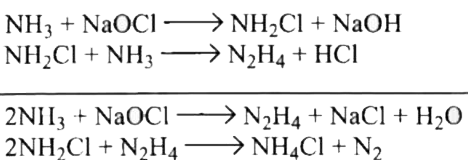 CHLORAMINE is FORMED in the REACTION which DECOMPOSES HYDRAZINE to `NH_4CI` |
|
| 11. |
Ammonia , on reaction with excess of chlorine, gives |
|
Answer» `NCl_(3)` and HCl |
|
| 12. |
Ammonia on heating with carbon dioxide under pressure gives: |
|
Answer» `NH_4HCO_3` |
|
| 13. |
Ammonia on heating with hypochlorite anion can form |
|
Answer» NO |
|
| 14. |
Ammonia (NH_(3)) when treated with 'Nessler's reagent in the presence of an alkali gives a brown precipitate of |
|
Answer» `NH_4Hgl_4` |
|
| 15. |
Ammonia (NH_(3)) obttained from different sources always has same proportion of Nitrogen and Hydrogen. It proves the vakidity of low of : |
|
Answer» RECIPROCAL proportion |
|
| 16. |
Ammonia molecule is: |
|
Answer» A nucleophile |
|
| 17. |
Aniline is less basic than ammonia |
|
Answer» |
|
| 18. |
Ammonia is generally manufactured for fertilizers by the reaction: |
|
Answer» `2NH_4Cl + Ca(OH)_2 RARR CaCl_2 + 2H_2O + 2NH_3` |
|
| 19. |
Ammonia is always added in this reaction. Which of the following must be incorrect |
|
Answer» `NH_(3)` combines with `Ag^(+)` to form a complex |
|
| 20. |
Ammonia is always added in this reaction. Which of the following must be incorrect? |
|
Answer» `NH_(3)` combines with `Ag^(+) ` to from a complex . The potential difference developed between metal electrode and the solution of its ions of unity molarity ( 1 M) at `25^(@)` C is called standard electrode potential. . The standard reduction potential of an electrode means that reduction reaction is taking PLACE at the electrode. |
|
| 21. |
Ammonia is a weak base that reacts with water according to the equation: NH_3(aq) +H_2O(I) |
|
Answer» ADDITION of HCI |
|
| 22. |
Ammonia is: |
|
Answer» POLAR solvent |
|
| 23. |
Ammonia gas when passed through Nessler's reagent , forms a brown precipitate which corresponds to : |
|
Answer» `K_2[HgI_4]` |
|
| 24. |
Ammoniagasdoesnot evolvefromthe complexFeCl_(2).4NH_(3)Butitgiveswhite precipitate withaqueoussolutionof AgNO_(3). Coordinationnumberofcentralnameof thecomplexwillbe . |
|
Answer» Ammonium trichloro triamineiron(III ) `[Fe(NH_(3))_(4)Cl_(2)]Cl` |
|
| 26. |
Ammonia gas dissolves in water to give NH_(4)OH. In this reaction water acts as |
|
Answer» An acid |
|
| 27. |
Ammonia gas dissolves in water to give NH_4OH In this reaction water act as : |
|
Answer» a base |
|
| 28. |
The complex ion [Cu(NH_(3))_(4)]^(2+) has : |
|
Answer» In ACIDIC solutions hydration protects copper ions |
|
| 29. |
Ammonia forms the complex ion [Cu(NH_3)_4]^(2+)with copper ions in alkaline solutions but not in acidic solutions. The reason is |
|
Answer» In acidic SOLUTIONS hydration protects copper ions |
|
| 30. |
Ammonia forms the complex ion, [Cu(NH_(3))_(4)]^(2+) with copper ions alkaline solutions but not in acidic solution. This is because |
|
Answer» in acidic solutions, protons COORDINATE with ammonia molecules forming `NH_(4)^(+)` IONS and `NH_(3)` molecules are THUS, not available |
|
| 31. |
Ammonia forms the complex [Cu(NH_3)_4]^(2+) with copper ions in alkaline solution but not in acid solution. The reasons for it is: |
|
Answer» In alkaline solution `Cu(OH)_(2)` is precipitated which is soluble in excess of alkali |
|
| 32. |
Ammonia forms the complex [Cu(NH_(3))_(4)]^(2+) with copper ions in alkaline solution but not in acid solution. The reason for it is : |
|
Answer» in alkaline solution `Cu(OH)_(2)` is precipitated which is soluble in EXCESS of alkali. |
|
| 33. |
Ammonia forms the complex [Cu(NH_(3))_(4)]^(2+) will copper ions in alkaline solution but not in acidic solution. The reason for this is |
|
Answer» In alkline solution `Cu(OH)_(2)` is precipitated which is soluble in exces of alkali `Cu^(2+)(aq)+4NH_(3) overset(OH^(+))hArr Cu^(2+)+4NH_(4)^(+)` (No complex formation) As `NH_(3)` combines with `H^(+)` of ACID and changes to `NH_(4)^(+)` which have no DONOR site. |
|
| 34. |
Ammonia form the complex ion[Cu(NH_(3))_(4)]^(2+) with copper ions inthe alkaline solution but not In acidic solution. What is the statement-2 for it? |
|
Answer» In acidic solution hydration PROTECT copper ions |
|
| 35. |
Ammonia contains 82.35% of nitrogen and 17.65% of hydrogen. Water contains 88.90% of oxygen and 11.10% of hydrogen. Nitrogen trioxide contains 63.15% of oxygen and 36.85% of nitrogen. Show that these data illustrate the law of receprocal proportions. |
|
Answer» Solution :In `NH_(3), 17.65` g of H combine with N = 82.35 g `therefore"1 g of H combine with N"=(82.35)/(17.65)g=4.67g` In `H_(2)O,11.10g` of H combine with O = 88.90 g `therefore" 1 g of H combine with O"=(88.90)/(11.10)g=8.01g` `therefore"Ratio of the masses of N and O which combine with FIXED mass(= 1 g) of H "=4.67:8.01=1:1.72` In `N_(2)O_(3)`, ratio of masses of N and O which combine with each other = `36.85:63.13=1:1.71` THUS, the two ratios are the same. HENCE, it illustrates the law of reciprocal proportions. |
|
| 36. |
Ammonia contains 82.32% of nitrogen and 17.65 % of hydrogen . Water contains 88.90% of oxygen and 11.10% of hydrogen . Nitrogen trioxide contains 63.15% of oxygen and 36.85% of nitrogen. Show that these data illustrate the law of reciprocal proportions. |
|
Answer» Solution :In `NH_(3), 17.65 g` of H combine with N=82.35 g `therefore` 1 g of H combine with H`=(82.35)/(17.65) g` =4.66 g In `H_(2)O, 11.10 g` of H combine with O=88.90 g `therefore` 1 g of H combine with `O=(88.90)/(11.10)` g =8.00 g` `therefore Ratio of the weight of N and O which combine with fixed weight (=1g) of H=4.66:8.00=1:1.7 In `N_(2)O_(3)` , ratio of weigths of N and O which combine with each other =36.85:63.15:1:1.7 THUS the two ratios are the same. Hence it illustrate the LAW of reciprocal protortions. |
|
| 37. |
Ammonia canot be dried by |
|
Answer» `H_(2)SO_(4)` |
|
| 38. |
Ammonia chloride when heated with caustic soda gives ammonia gas. What weight of NH_4Cl should be used to get 2460 Ml. NH_3 at 1 atm pressure 827^@ C . |
|
Answer» |
|
| 39. |
Ammonia cannot be dried over anhydrous calcium chloride. Why? |
|
Answer» Solution :When water is ABSORBED by calcium chloride, it undergoes HYDROLYSIS to GIVE HYDROCHLORIC acid. `CaCl_(2)+2H_(2)O to Ca(OH)_(2)+2HCl` Sinceammonia is basic, it is neutralisedby HCl to give salt. `NH_(3)+HCl to NH_(4)Cl`. Hence ammonia is dried over a basic oxide, quick lime. |
|
| 40. |
Ammonia and red hot CuO react to produce : |
|
Answer» `Cu_(2)O,N_(2),H_(2)` |
|
| 41. |
Ammonia at a pressure of 10atm and CO_(2) at a pressure of 20 atm are introduced into an evacuated chamber. If K_(p) for the reaction NH_(2)COONH_(4)(s)hArr2NH_(3)(g)+CO_(2)(g) is 2020 "atm"^(3), the total pressure after a long time is |
|
Answer» LESS than 30 atm |
|
| 42. |
Ammonia and oxygen react at high temperature as: 4NH_(3) (g) + 5O_(2)(g) rarr 4NO(g) + 6H_(2)O (g) In an experiment, the rate of formation of NO is 3.6 xx 10^(-3) Ms^(-1). Calculate (a) the rate of disappearance of ammonia and (b) the rate of formation of water. |
|
Answer» `(d[NO])/(DT) = 3.6 XX 10^(-3)molL ^(-1) s^(-1)` (a) `-(1)/(4) (d[NH_(3)])/(dt) =(1)/(4)(d[NO])/(dt)` `:.` Rateof disappearance of `NH_(3)` `=(-d[NH_(3)])/(dt) = (d[NO])/(dt)` `=3.6 xx 10^(-3)mol L^(-1) s^(-1)` `:.`Rateof formationof `H_(2)O` `=(d[H_(2)O])/(dt)=(6)/(4) (d[NO])/(dt)` `=(6)/(4) xx 3.6 xx10^(-3)` `=5.4 xx 10^(-3) molL^(-1) s^(-1)` |
|
| 43. |
Ammonia and Nitric acid are two industrially important compounds. Write any two uses of ammonia. |
| Answer» Solution :AMMONIA is USED for the manufacture of fertilizers such as urea. It is used for the - manufacture of NITRIC acid.- | |
| 44. |
Ammonia and Nitric acid are two industrially important compounds. Phosphorus forms a number of oxoacids.. Write the name or formulae of any two oxoacids. of phosphorus. |
| Answer» SOLUTION :Orthophosphorus ACID `(H_3PO_3)`is DIBASIC. | |
| 45. |
Ammonia and Nitric acid are two industrially important compounds. Complete the following equations. (Balancing is not required) NH_3+excess Cl_2to |
| Answer» SOLUTION :`NH_3+3Cl_2toNCl_3+3HCl` | |
| 46. |
Ammonia and Nitric acid are two industrially important compounds. Complete the following equations. (Balancing is not required) Zn+dil.HNO_3to |
| Answer» SOLUTION :`4Zn+10HNO_3to4Zn(NO_3)_2+N_2O+5H_2O` | |
| 47. |
Ammonia and Nitric acid are two industrially important compounds. Complete the following equations. (Balancing is not required) NH_3+o_2underset(500K,9"bar")overset(pt)to |
| Answer» SOLUTION :`4NH_3+5O_2underset(500K,9"BAR")OVERSET(PT)to4NO+6H_2O` | |
| 48. |
Ammonia and Nitric acid are two industrially important compounds. Complete the following equations. (Balancing is not required) Cu+con.HNO_3to |
| Answer» SOLUTION :`Cu+4HNO_3toCu(NO_3)_2+2NO_2+2H_2O` | |
| 49. |
Ammonia and Nitric acid are two industrially important compounds. Account for the following:PCl_5 fumes in moist air |
| Answer» Solution :`PCl_5` readily UNDERGOES hydrolysis with MOISTURE to FORM FUMING HYDROGEN "chloride gas `PCl_5+4H_2OtoH_3PO_4+5HCl` | |
| 50. |
Ammonia and Nitric acid are two industrially important compounds. Account for the following: NO_2 undergoes dimerisation. |
| Answer» Solution :`NO_2` is an odd electron molecule. Odd electrons PRESENT on TWO nitrogen ATOMS form covalent bond on dimerisation.. Thus it is CONVERTED to stable `N_2O_4` with even NUMBER of electrons. | |


