Saved Bookmarks
This section includes 7 InterviewSolutions, each offering curated multiple-choice questions to sharpen your Current Affairs knowledge and support exam preparation. Choose a topic below to get started.
| 1. |
Ce^(3+) can easily get oxidised to Ce^(4+). Give reason. |
| Answer» Solution :`CE^(3+)([Xe]4f^(1)5d^(0)6s^(0))`, can easily LOSE its 4f - electron and attains the NEAREST inert gas configuration of xenon. Hence, `Ce^(3+)` can easily form `Ce^(4+)`. | |
| 2. |
Ce (Z=588) andYb (Z= 70)exhibitsstable+4and +2oxidationstatesrespectively . Thisisbecause |
|
Answer» `Ce^(4+)` and `YB^(2+)` ACQUIRE `f^(7)` configuration |
|
| 3. |
Cellulose, starch and glycogen are the polysaccharides having ____ monosaccharide unit: |
|
Answer» Glucose |
|
| 4. |
Ce ^(4+) is used as oxidising agent because |
|
Answer» it has TENDENCY to ATTAIN `+2,` O.S. |
|
| 5. |
Cellulose in the form of plants is a food for cattles and sheeps but not for human beings. Explain. |
|
Answer» HUMAN body does not contain CELLULOSE hence cellulose cannot be broken into D - glucose |
|
| 6. |
CD:Fixed wall, EF:SPM, Fixed wall: allows the pressure transfer but no mass transfer. If 16 gm Helium present in ABCD chamber caluculate the length of this chamber in cm if no osmosis takes place through SPM EF. Assume 75% ionisation of K_4[Fe(CN)_6] |
|
Answer» `pi=4xx2xx0.0821xx300 , i=1+(5-1)0.75` For He PV=nRT , i=1+3 `piV=nRT` , i=4 2x 0.0821 x300 x 4 x100 x l x 10^(-3)=`16/4` x 0.0821 x300 `l=4/(8xx10^(-1))=40/8=5` cm |
|
| 7. |
Cellulose, polyester, silk. |
| Answer» SOLUTION :Polyester. It is a SYNTHETIC POLYMER WHEREAS others are natural polymer. | |
| 8. |
CdCl_2 added to AgCl crystal will introduce Schottky defect/Frenkel defect. |
| Answer» SOLUTION :SCHOTTKY DEFECT | |
| 9. |
Cellulose is soluble in |
|
Answer» AMMONICAL curpic HYDROXIDE solution |
|
| 10. |
Cd|Cd^(2+)||Fe^(3+)|Fe^(2+) reaction, on +ve electrode is |
|
Answer» `FE^(3+) +E^(-) to Fe^(2+)` |
|
| 11. |
Cellulose is |
|
Answer» HYDROGEN Bonding |
|
| 12. |
Cd|Cd^(+2)"||"Fe^(+3), Fe^(+2)|Pt which of the following reaction occurs at the +ve electrode ? |
|
Answer» `Fe^(+3)+e^(-) to Fe^(+2)` |
|
| 14. |
Cd^(2+) and Cu^(2+) are seprated by (a) ___formationusing (b) ___in which (c ) is more stable then (d ) ____ . On passing H_(2)S gas (e ) ____. Is precipitate. |
|
Answer» |
|
| 16. |
Cellulose is not digestible by human beings due to the absence of a cellulose hydrolysing enzyme called |
|
Answer» CELLULOSE |
|
| 17. |
CCl_4 is insoluble in water because : |
|
Answer» WATER is non-polar |
|
| 18. |
Cellulose is not digestible by human beings due to the absence of cellulose hydrolysing enzyme called |
|
Answer» CELLULOSE |
|
| 19. |
Cellulose is a polymer of |
|
Answer» glucose |
|
| 20. |
Cellulose is a polymer of ………………....... |
| Answer» Solution :Glucose | |
| 21. |
"CCl"_4 + 2HF overset(SbF_3)(to)the carbon compound formed will be |
|
Answer» TEFLON |
|
| 22. |
Cellulose is a natural polymer of |
|
Answer» `alpha` - D glucose |
|
| 23. |
C Cl_4 is insoluble in water because : |
|
Answer» `C Cl_4` is NON-POLAR and WATER is polar |
|
| 24. |
"CCl"_(3)-NO_(2) can be obtained by |
|
Answer» `CH_(3)-NO_(2)` reaction with `PCl_(5)` |
|
| 25. |
Cellulose is a linear polymer of : |
|
Answer» `ALPHA` glucose |
|
| 26. |
Cautions action of the acid to an anion in cold yields a transient, Pale-blue liquid with the evolution of brown furmes of a gas.Which of the following combination is correct for above statement. |
|
Answer» (I)(i)(R) `(2HNO_2toN_2O_3+H_2O)` Translent PALE BLUE liquid `3HNO_2 to HNO_3 + 2NO+H_2O` 2NO+`O_2tounderset("Reddish BROWN vapour of"NO_2)(2NO_2(uarr))` `2MnO_4^(-)+5NO_2^(-)+6H^(+)to2Mn^(+2)+3H_2O+5NO_3^(-)` |
|
| 27. |
Cellulose is a condensation polymer of: |
|
Answer» MALTOSE |
|
| 28. |
C—CI bond of chlorobenzene in comparison C—Cl bond of methyl chloride is |
|
Answer» LONGER and weaker |
|
| 29. |
Causticization is a process in which : |
|
Answer» NAOH is MANUFACTURED by treating sodium carbonate with lime |
|
| 31. |
Caustic soda is: |
|
Answer» Efflorescent |
|
| 32. |
Cause of diagonal relationship is |
|
Answer» SIMILAR electronic configuration of the ELEMENTS |
|
| 33. |
Cations move towards cathode and anions towards anode in both galvanic and electrolytic cells. |
|
Answer» |
|
| 34. |
Cations are present in the interstitial sites in |
|
Answer» FRENKEL defect |
|
| 35. |
Cations are classified into varius groupon the basis oftheir behaviour againstsomereagents .The groupreagentused for the classifactionof most common cationare HCI,H_(2)S,NH_(4)OH,(NH_(4))_(2)CO_(3). Classification is based on whether a cationreacts withthese reagents by theformationof precipitates ornot .An aqucous solution which is sightly acids contains cattions Fe^(2+),Zn^(2+) and Cu^(2+). THe rengent added in excess to this solutionwould identify the separate Fe^(2+) ion in one step is |
|
Answer» `2M HCI` `Cu^(2+) + 4NH_(3) rarr underset(("blue COLOUR soluble complex"))([Cu(NH_(3))_(4)]^(2+))` ` Zn^(2+) + 4NH_(3) rarr underset(("colourless soluble complex"))([Zn(NH_(3))_(4)]^(2+))` |
|
| 36. |
Cations are classified into varius groupon the basis oftheir behaviour againstsomereagents .The groupreagentused for the classifactionof most common cationare HCI,H_(2)S,NH_(4)OH,(NH_(4))_(2)CO_(3). Classification is based on whether a cationreacts withthese reagents by theformationof precipitates ornot . Which one amongthe following paires of ions cannot beseparated by H_(2)S in the presenceofdilute hydrochloric acid ? |
|
Answer» `Bi^(2+),CD^(2+)` |
|
| 37. |
Cations are classified into varius groupon the basis oftheir behaviour againstsomereagents .The groupreagentused for the classifactionof most common cationare HCI,H_(2)S,NH_(4)OH,(NH_(4))_(2)CO_(3) Classification is based on whether a cationreacts withthese reagents by theformationof precipitates ornot . An aqueous solutioncontain Hg^(2+),Hg_(2)^(2+),Pb^(2+).THe addition of 2M HCI will procipitate. |
|
Answer» `HgCI_(2)`only |
|
| 38. |
Cationic detergent salt |
|
Answer» quatermart AMMONIUM salt |
|
| 39. |
Cationic detergents have germicidal properties. |
|
Answer» |
|
| 40. |
Cationic detergent is used in |
|
Answer» TOOTH paste |
|
| 41. |
Cationic complex is |
|
Answer» POTASSIUM ferrocyanide |
|
| 42. |
Cation exchanger zeolite Na_(12)Al_(12)Si_(17)O_(58).27H_(2)O can exchange cation with which of the following in aqueous solution ? |
|
Answer» `Mg(HCO_(3))_(2)` |
|
| 43. |
Cathode is made of ......... in a mercury battery: |
|
Answer» ZN metal |
|
| 44. |
Catention properties of C, Si, Ge, Sn , Pb are in order |
|
Answer» `C GT gt Si gt GE ~~ Sn gt gt Pb` |
|
| 45. |
Cataylitc dehydrogention of methylcyclohexxane, obtained form petroleum, givesaliquid which on treatementwith chlorosulphonic acid at 370Kyileds a mixtureof two isomers(A) and (B), C_(7)H_(7)SO_(2) CL. The majorisomer (A) reacts withammonia to from (C), which on oxidationwith permangnategives compound (D) gives awell-knownsweet-ening agent. (E). The majorisomer (B) also reacts wtih ammonia to give a compound (F) which on treatment with NaClO//NaOH gives an antiseptic (G). Idntify (A) to (G). |
Answer» SOLUTION :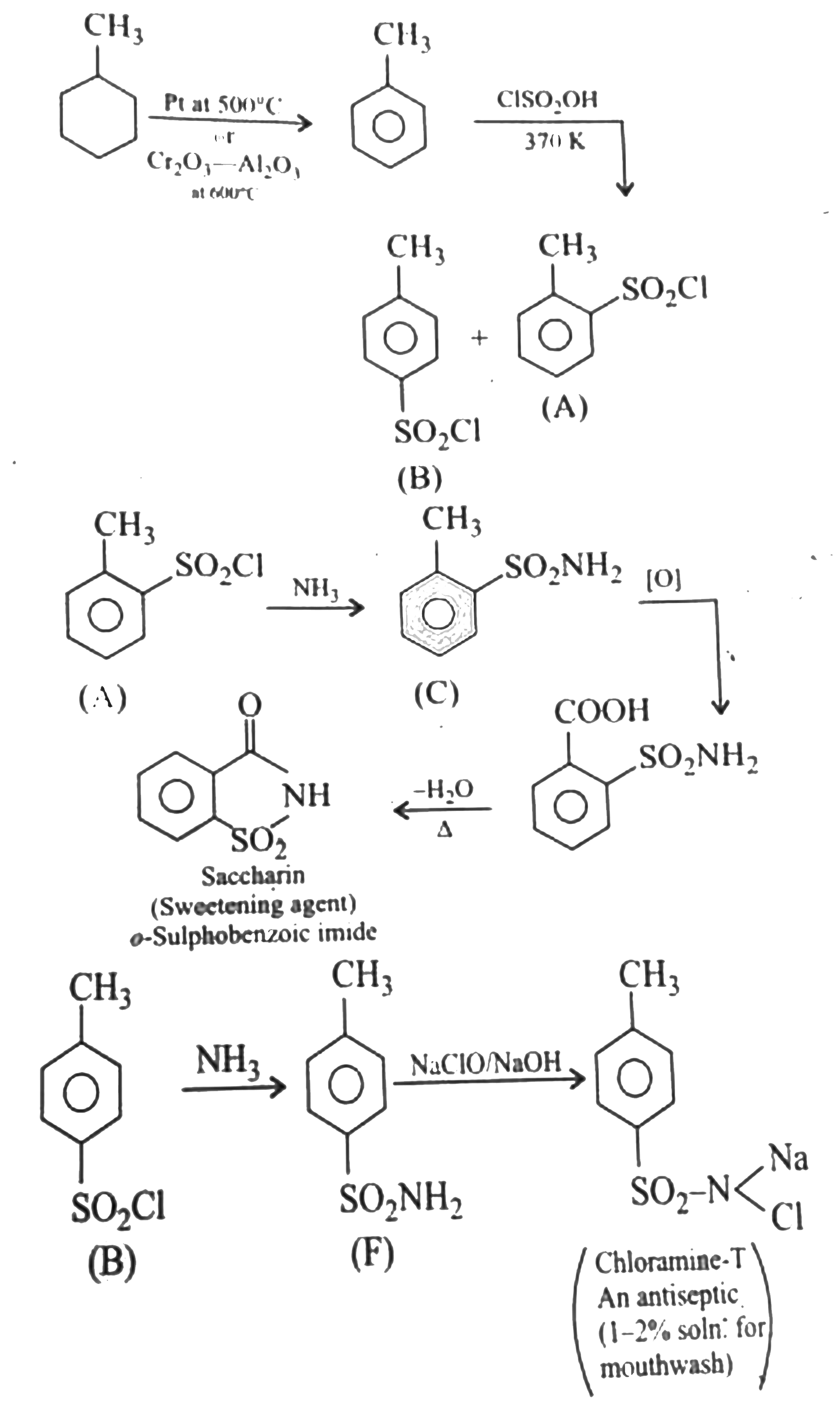
|
|
| 47. |
Catalytic reduction of isocyanides givesunderline(" primary amines"). |
| Answer» Solution :CATALYTIC REDUCTION of ISOCYANIDES gives secondary amines. | |
| 48. |
Catalytic poisoners are usually the same as: |
|
Answer» POISON for HUMAN body |
|
| 49. |
Catalytic poisoners act by : |
|
Answer» Coagulating the catalyst |
|
| 50. |
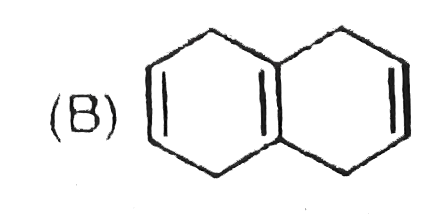
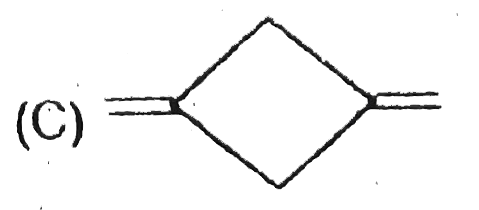
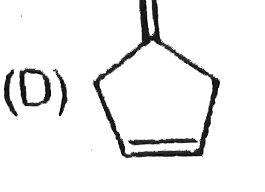
Catalytic hydrogenation of which of the following gives a product that further gives three photochemical monochlorination products (considering structural isomers only )? |
|
Answer»
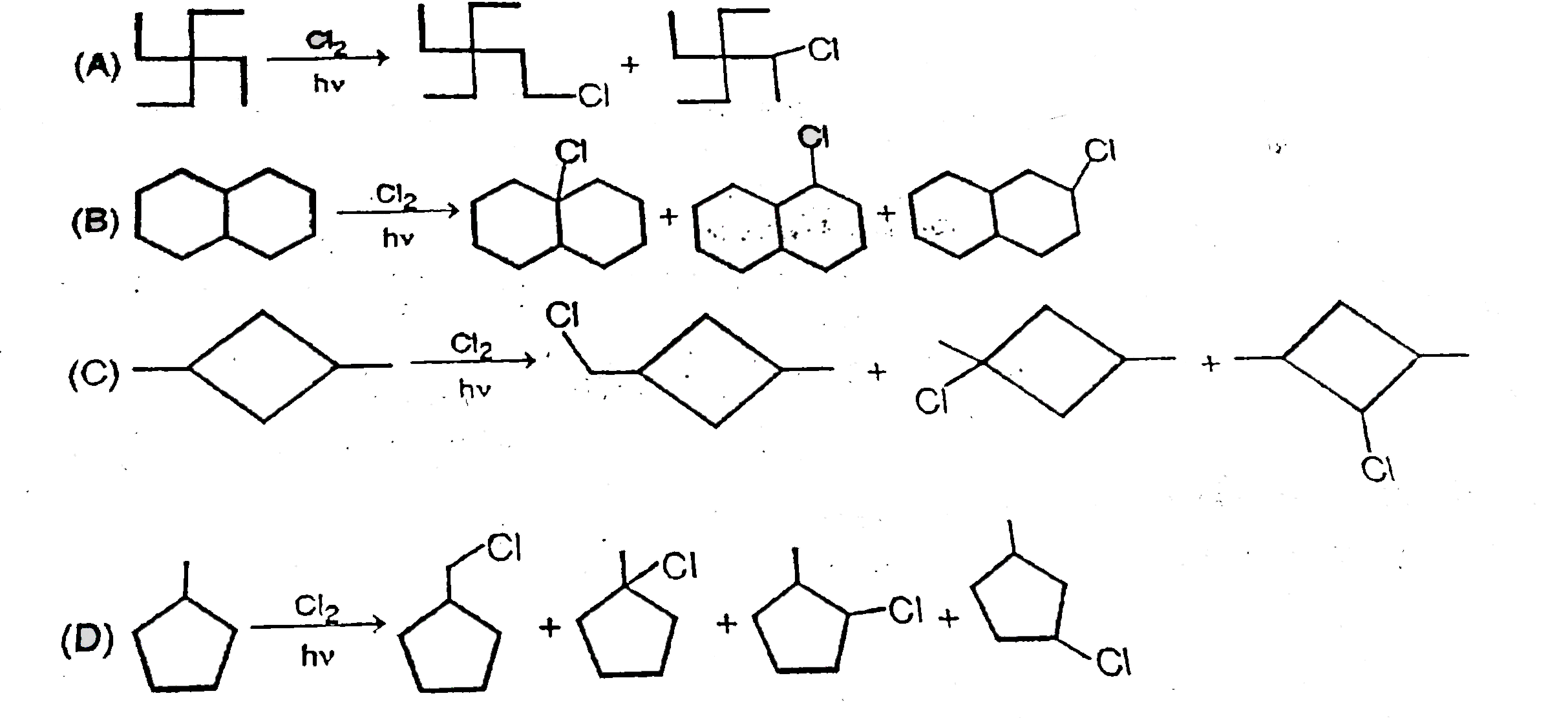
|
|