

Saved Bookmarks
This section includes 7 InterviewSolutions, each offering curated multiple-choice questions to sharpen your Current Affairs knowledge and support exam preparation. Choose a topic below to get started.
| 1. |
Assertion: 1,3 -Butadiene is monomer for natural Reason: Natural rubber is formed through anionic addition polymerization |
|
Answer» If both assertion and REASON are true and the reason is the correct explanation of the assertion. |
|
| 2. |
Assertion :""^(22)_(11)Na emits a position giving ""^(22)_(12)Mg Reason : In beta^+ emission neutron is transformed into proton. |
|
Answer» THUS this change involves a `beta`-particle EMISSION and not a positron. Also, proton emission converts proton into neutron as : `._(1)P^(1) rarr ._(0)n^(1) + ._(+1)beta^(0)` |
|
| 3. |
Assertion : 100% pure acetic acid is called glacial acetic acid Reason : Its called so as it forms ice like crystals when cooled. |
|
Answer» (A) and ( R) are true and ( R) is the correct EXPLANATION of (A) |
|
| 4. |
Assertion: 1 M solution of KCl has greater osmotic pressure than 1M solution of glucose at the same temperature Reason :In solution KCl dissociates to produce more number of particles . |
|
Answer» If both assertion and reason are TRUE and reason is the CORRECT EXPLANATION of assertion |
|
| 5. |
Assertion : 1.231 has three significant figures. Reason : All numbers right to the decimal point are significant. |
|
Answer» If both assertion and reason are true and the reason is the correct explanation of the assertion. |
|
| 6. |
Assertion: 1-butene on reaction with HBr in the presence of a peroxide produces 1-bromobutane. Reason:It involves the formation of a primary radical |
|
Answer» Both assertion and reason are correct and reason is the correct explanation of the assertion (i)(a)`(C_6H_5CO)_2 O_2 to 2C_6H_5COO^(.)` (b)`C_6H_5COO^(-)+HBr to C_6H_5COOH +Br^(.)` (II)`CH_3-CH_2-CH=CH_2+Br^(.)to CH_3-CH_2-Coverset(dot)H-CH_2Br` (iii)`CH_3-CH_2-overset(dot)CH-CH_2Br + H -Br to CH_3-CH_2 -CH_2 -CH_2Br+Br^(dot)` |
|
| 7. |
Assertion : [10]Annulene is not aromatic though it contains Huckel number of pi-electrons. Reason:Steric interaction between internal hydrogens makes it non-planar |
|
Answer» If both assertion and reason are true and the reason is the correct explanation of the assertion 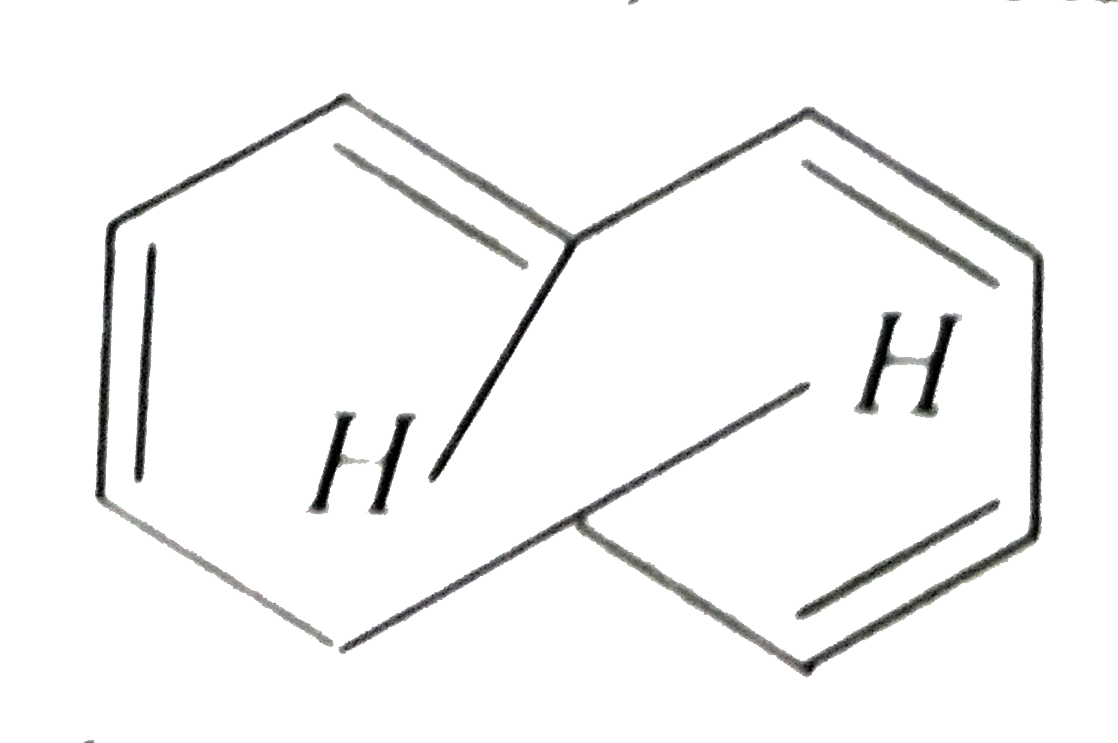 Due to SERVERE non-bonded interactions between the internal (as shown in FIGURE), the RING assumes non-planar geometry |
|
| 8. |
Assertion:1//4^(th) of the gas is expelled if air present in an open vessel is heated from 27^(@)C to 127^(@)C. Reason : Rate of diffusion of a gas is inversely proportional to the square root of its molecular mass. |
|
Answer» If both ASSERTION and reason are true and the reason is correct explanation of the assertion. |
|
| 9. |
Assertion : 0.2 M aqueous solution o flucose has higher lowering in freezing point temperature than 0.2 M (aqueous) urea solution. Reason K_(f) for both the solutions are different. |
|
Answer» If both assertion are REASON are correct and reason is correct explanation for assertion. Correct Reason. `K_(f)` is the same since SOLVENT remains the same. It is water. |
|
| 10. |
Assertion : 0.2 per cent solution of phenol is an antiseptic while its one percentsolution is disinfectant. Reason : Antiseptics are also called disinfectant . |
|
Answer» If both assertion and reason are trueand reason is the correct explanationof assertion . |
|
| 11. |
Assertion: 0.1M glucose, 0.1M urea solutions cause the same osmotic pressure in solution. Reason: Osmotic pressure is a measure of the number of particles present in the solution |
|
Answer» Both ASSERTION and REASON are TRUE and Reason is the CORRECT explanation of Assertion |
|
| 12. |
Assertion : 1 amu equals to 1.66xx10^(-24) g. Reason : 1.66xx10^(-24)g equals to 1/12 th of mass of a C^(12) atom. |
|
Answer» If both assertion and reason are true and the reason is the CORRECT EXPLANATION of the assertion. `:. 12/6.023xx10^(-23)=1.66xx10^(-24)`. |
|
| 13. |
Assertion. 0.1 M solution of glucose has higher increment in the freezing point than 0.1 M solution of urea. Reason. K_(f) for both has different values. |
|
Answer» If both ASSERTION and reason are true, and reason is the true explanation of the assertion. Correct R. Both being aqueous solution, i.e., solvent is same (water), `K_(f)` will be same for both. |
|
| 14. |
Assertin : the CaSO_(4).5H_(2)O_((s))hArrCaSO_(4).3H_(2)O_((s))+2H_(2)O_((g)) is K_(C)=([CaSO_(4).3H_(2)O][H_(2)O]^(2))/([CaSO_(4).5H_(2)O]) Reason: Equlibrium constnat is the ratio of the product of molar concentration ofhte substances produced to the product of the molar concentrations of reactants with each concentrations term raised to the power equal to the respective stoichiometric constant. |
|
Answer» If both assertion and reason are TRUE and the reason is the CORRECT EXPLANATION of the assertion. |
|
| 15. |
Assertin : Cu^(2+)is the onlyion (M^(2+)) whichhas positiveE^(@) red(M^(2+) //M) in 3dseries Reason : Cu haslowerhydrationenthalpyas comparisonto itsionisationenthalpyand Delta H atm. |
|
Answer» bothassertionand reasonare truereasonis thecorrectexplanationof THEASSERTION . |
|
| 16. |
Assertin: All Cr- O bondlengthinK_(2) Cr_(2) O_(7) are equal Resson: Boththe Cr are presentin dsp^(2) hybridstate. |
|
Answer» Bothassertinand reasonare trueandreasonis thecorrectexplanationof THEASSERTION |
|
| 17. |
Asserion (A): Ethanol is miscible in all proportions with water Reason (R): Hydrogen bond is formed between water and alcohol molecules. |
|
Answer» Both A and R are true and R is the correct EXPLANATION to A |
|
| 18. |
Asseriton : Hard Water is not fit for washing clothes. Reason : It contains Ca^(+2) & Mg^(+2) ion which can forms ppt with soap & detergents. |
|
Answer» If both Assertion & REASON are True & the Reason is a CORRECT EXPLANATION of the Assertion. |
|
| 19. |
Asseration : Salts like KCl,KNO_3 i.e., inert electrolytes are used in salt bridge. Reason : An inert electrolyte can easily be filled in the U-tube. |
|
Answer» |
|
| 20. |
Asseration : A small amount of acid or alkali is added before electrolysis of water. Reason : Pure water is weak electrolyte. |
|
Answer» |
|
| 21. |
Asprin is obtained by the reacation of (CH^(3)CO)^(2)O with |
|
Answer» BENZOIC ACID |
|
| 23. |
Aspirin on hydrolysis in the stomach gives _______which cause _______ |
|
Answer» |
|
| 24. |
Aspirin is widely used to prevent heart attack because of its |
|
Answer» ANTIPYRETIC property |
|
| 25. |
Aspirin is which type of drug ? |
|
Answer» Antibiotics |
|
| 26. |
Aspirin is used to cure Alzheimer's disease which is caused by |
| Answer» Answer :A | |
| 27. |
Aspirin is prepared by |
|
Answer» alkoxylation of salicylic acid |
|
| 28. |
Aspirin is prepared by the rection (CH_(3)CO)_(2)O with |
|
Answer» PHENOL |
|
| 29. |
Aspirin is pain relieving antipyretic drug but can be used to prevent heart attack. Explain. |
| Answer» Solution :Aspirin belongs to non-narcotic Aspirin inhibits the synthesis of CHEMICALS known as prostaglandins which stimulate inflammation in the tissue and cause pain these drugs are effective in relieving SKELETAL pain such as that due to arthritis. These drugs have many other effects such as reducing fever (ANTIPYRETIC) and prevents platelet coagulation Because of its anti BLOOD clotting action, aspirin finds use in PREVENTION of heart attack. | |
| 30. |
Aspirinis pain relieving antipyretic drug but can be used to prevent heart attack. Explain. |
|
Answer» Solution :Aspirin is 2-acetoxybenzoic acid. It is very effectivein reducing or ABOLISHING pain without causing impairment OC consciousness, mental confusion, incordination or paralysis or some othr disturbance or disorder of the nervous system. It REDUCES FEVER (antipyretics) and prevents platelet coagulation. Due to it has ANTI blood clotting action and, therefore it is widely used to prevent heart attack. |
|
| 31. |
Aspirin is obtained by the reaction of salicylic acid with |
|
Answer» Acetone 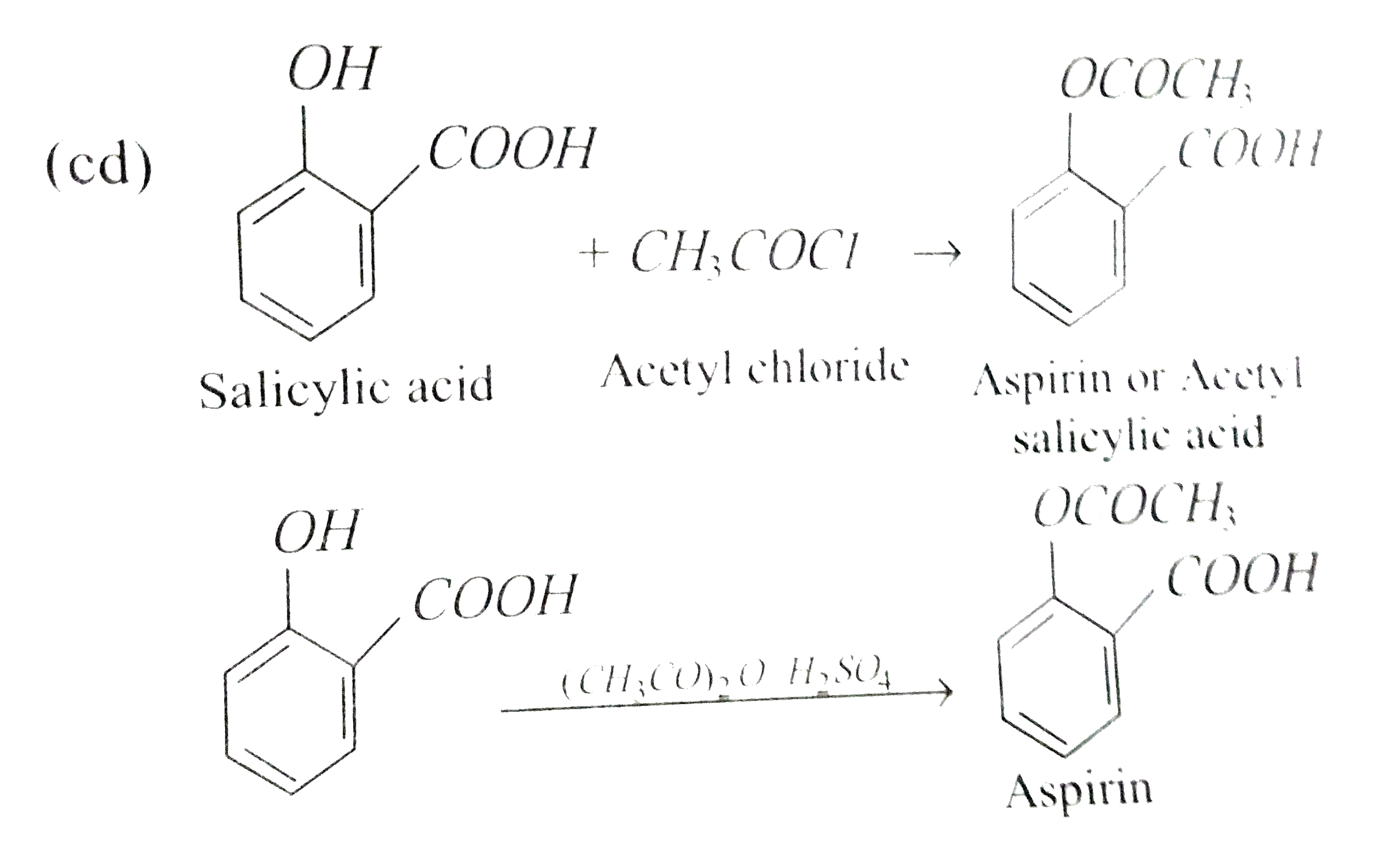 . .
|
|
| 32. |
Aspirin is obtained by the reaction of CH_3COClwith: |
|
Answer» BENZOIC ACID |
|
| 33. |
Aspirin is obtained by the reaction of CH_3COCl with : |
|
Answer» Phenol |
|
| 34. |
Aspirin is chemically named as |
|
Answer» methyl SALICYLATE |
|
| 35. |
Aspirin is an acetylation product of |
|
Answer» p-dihydroxybenzene 
|
|
| 36. |
Aspirin is an acetylation product of : |
|
Answer» <P>p - dihydroxy benzene |
|
| 37. |
Aspirin is an acctylation product of |
|
Answer» p-Dihydroxybenzene |
|
| 38. |
Aspirin is an |
|
Answer» antihistamine |
|
| 39. |
Aspirin is also known as |
|
Answer» METHYL SALICYLATE 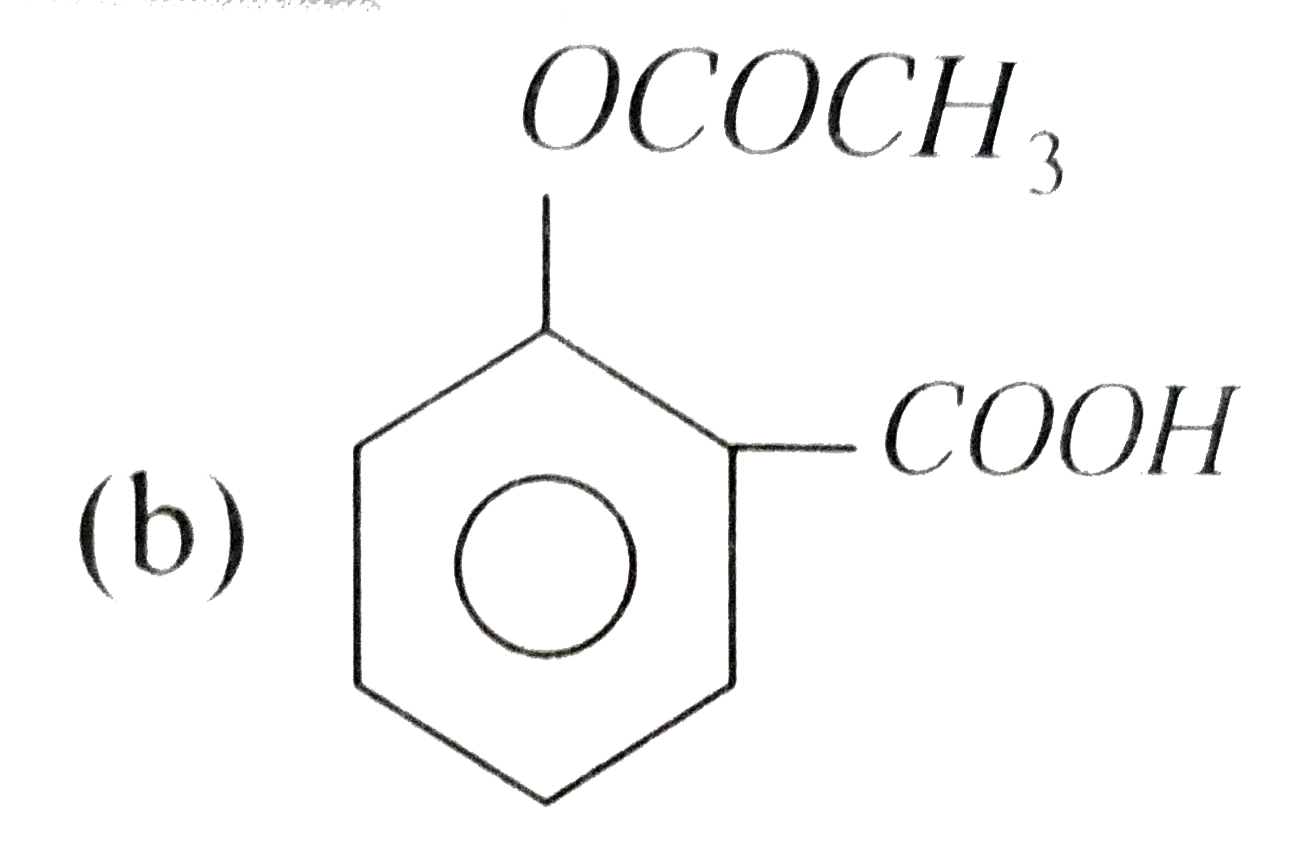 Aspirin or Acetyl salicylic acid. Aspirin or Acetyl salicylic acid. It is ALSO known as ACETOXY Banzoic acid. |
|
| 40. |
Aspirin is also known as: |
|
Answer» METHYL SALICYLIC acid |
|
| 41. |
Aspirin is acetyl salicylic acid, the pair of functional groups present in the compound is |
|
Answer» Hydroxyl, ester  is ASPRIN is ASPRIN
|
|
| 42. |
Aspirin is a pain relieving antipyretic drug but can be used to prevent heart attack. Explain. |
| Answer» SOLUTION :ASPIRIN prevents platlet COAGULATION and has antiblood-clotting ACTION. It can prevent BLOOD clotting in heart. | |
| 43. |
Aspirin is know as : |
|
Answer» ACETYL SALICYLIC ACID |
|
| 44. |
Aspirin is a/an |
|
Answer» ACETYLSALICYLIC ACID |
|
| 45. |
Aspirin is: |
|
Answer» BARBITURIC ACID |
|
| 46. |
Aspirin is ......... |
|
Answer» barbitiric ACID |
|
| 47. |
Aspirin is 2-aetoxybenzoic acid. |
|
Answer» |
|
| 48. |
Aspirin is : |
|
Answer» ANTIBIOTIC |
|
| 49. |
Aspirin inhibits the synthesis of _______which stimulate inflammation in the tissue and cause pain |
|
Answer» |
|
| 50. |
Aspirin can be prepard from salicylic acid (C_(7)H_(6)O_(3)) and acetic anhydride (C_(4)H_(6)O_(3)) according to the equation 2C_(7)H_(6)O_(3)+C_(4)H_(6)O_(3)rarr2C_(9)H_(8)O_(4)+H_(2)O This reaction gives a yield of 74%, provided that a 50% excess of acetic anhydride (the cheaper reagent) is used. If a chemist wants to prepare 20.0g of aspirin in the laboratory, what mass of the of acetic anhydride should be use ? |
|
Answer» `20.7g` If 100% YIELD 360g of Asprine required`=102g` of acetic anhydried 1G of Asprine required `=(102)/(360)g` of acetic anhydried 20g of Asprine required `=(102)/(360)xx20g` of acetic anhydried But for 74% yield acetic anhydride required is =7.657g But CHEMIST taking 50% exceeds, So `=7.65+7.65xx(500)/(100)=11.5g` |
|