

Saved Bookmarks
This section includes 7 InterviewSolutions, each offering curated multiple-choice questions to sharpen your Current Affairs knowledge and support exam preparation. Choose a topic below to get started.
| 1. |
Assertion (A) : All chemicals added to food items are called food preservatives. Reason (R) : All these chemicals increase the nutritive value of the food. |
|
Answer» Assertion and REASON both are CORRECT statement but reason does not explain assertion. |
|
| 2. |
Assertion (A) : Alkyl isocyanides in acidified water give alkyl formamides Reason (R) : In isocyanides, carbon first acts as a nucleophile and then as an electrophile. |
|
Answer» Both A and R are TRUE and R is the CORRECT EXPLANATION of A. |
|
| 3. |
Assertion (A) : Alkyl cyanides as well as alkyl isocyanides have much higher boiling points than corresponding alkyl halides. Reason (R) : Cyanides and isocyanides are much more polar than alkyl halides. |
|
Answer» Both A and R are TRUE and R is the CORRECT EXPLANATION of A. |
|
| 4. |
Assertion (A) : Aldehydes which do not have an alpha-hydrogen atom undergo self-oxidation and reduction on treatment with conc. KOH. Reason (R ) : Primary alcohols on oxidation with alkaline KMnO_(4) give aldehydes. |
|
Answer» Both Assertion (A) and REASON(R ) are correct statements, and Reason (R ) is the correct explanation of the Assertion (A). |
|
| 5. |
Assertion (A): Alkyl halides are prepared by electrophilic halogenation of alkanes. Reason (R) : DDT is a safe insecticide. |
|
Answer» Both Assertion (A) and Resort (R) are correct statements, QUID Reason (R) is the correct explanation of the Assertion (A). |
|
| 6. |
Assertion (A) : Alcohols have higher boiling points than hydrocarbons, ethers and haloakanes of comparable molecular masses. Reason (R) : Alcohol molecules from intermolecular bonding amongst one another. |
|
Answer» Both Assertion (A) and REASON (R) are correct statements, and Reason (R) is the correct EXPLANATION of the Assertion (A). |
|
| 7. |
Assertion (A) : Aldehydes are converted into aldols in the presence of concentrated alkali. Reason (R) : Tollen's reagent can distinguish between aldehydes and ketones but Fehling reagent cannot. |
|
Answer» Both Assertion (A) and REASON (R) are correct statements, and Reason (R) is the correct EXPLANATION of the Assertion (A). |
|
| 8. |
Assertion (A): Alcohols have higher boiling points than ethers of comparable molecular mass. Reason (R): Alcohols and ethers are functional isomes. |
|
Answer» (A) and (R) are true and (R) is the correct explanation of (A). |
|
| 9. |
Assertion (A) : Albumin is a globular protein. Reason (R ) : Polypeoplide chain coils around to give straight chain |
|
Answer» Both ASSERTION (A) and Reason (R ) are correct STATEMENTS, and Reason (R ) is the correct EXPLANATION of the Assertion (A). |
|
| 10. |
Assertion (A) : Addition reaction of water to but-1-ene in acidic medium yields butan-1-ol. Reason: Addition of water in acidic medium proceeds through the formation of primary carbocation. |
|
Answer» Assertion and REASON both are correct statements and reason explains the assertion. |
|
| 11. |
Assertion (A) : Air becomes dry in presence of silica gel. Reason (R) : Water molecules are absorbed on the surface of gel. |
|
Answer» Assertion (A) and REASON (R) both are TRUE. (R) is the PROPER explanation of (A). |
|
| 12. |
Assertion (A) : AgI//I^(-) is a negatively charged sol. Reason (R) : When a dilute solution of AgNO_3 is added to a dilute solution of KI, the precipitated Agl absorbs I^(-) ions from dispersion medium. |
|
Answer» Both ASSERTION (A) and Reason (R) are CORRECT statements, and Reason (R) is the correct EXPLANATION of the Assertion (A). |
|
| 13. |
Assertion (A) : Adsorption is a spontaneous process. Reason (R) : Adsorption is always accompanied by decrease in free energy. When molecules are adsorbed, there is always a decrease in randomness of the molecules. |
|
Answer» Both A and R are CORRECT and R is the correct EXPLANATION of A. |
|
| 14. |
Assertion (A) : Acidified K,_(2)CrO_(7) oxidises iodides to iodine. Reason (R) : Sodium dichromate is more soluble than potassium dichromate. |
|
Answer» Both Assertion (A) and REASON (R) are CORRECT STATEMENTS, and Reason (R) is the correct explanation of the Assertion (A). |
|
| 15. |
Assertion (A): Actinoids form relatively less stable complexes as compared to lanthanoids. Reason (R ): Actinoids can utilize their 5f orbitals along with 6d orbitals in bonding but lanthanoids do not use their 4f orbital for bonding. |
|
Answer» Both ASSERTION and reason are true and reason is the correct explanation of the assertion |
|
| 16. |
Assertion (A): Acid hydrolysis of ethylacetate by water to produce acetic acid and ethanol is an example of auto catalysis. Reason (R) : In acid hydrolysis of ester, the product acetic acid act as catalyst and this process is called autocatalysis. |
|
Answer» Both A and R are CORRECT and R is the correct EXPLANATION of A. |
|
| 17. |
Assertion (A) : AC current is used in wheatstone bridge arrangement to measure conductivity of ionic solution. Reason (R) : If DC current is used in wheatstone bridge arrangement, it will lead to electrolysis of the solution taken in the cell. So AC current is used to prevent electrolysis. |
|
Answer» Both A and R are CORRECT and R is the correct EXPLANATION of A |
|
| 18. |
Assertion (A) : Absorption is a bulk phenomenon. Reason (R): The absorbed molecules are distributed throughout the absorbent. |
|
Answer» Both A and R are CORRECT and R is the correct EXPLANATION of A. |
|
| 19. |
Assertion (A) : A variety of steel and stainless steel can be prepared by using Cr, V, W, Mo and Mn. Reason (R) : As the oxidation number of a metal increases, ionic character decreases. |
|
Answer» Both ASSERTION (A) and Reason (R) are correct statements, and Reason (R) is the correct explanation of the Assertion (A). |
|
| 20. |
Assertion (A): A racemic mixture is represented by fixing dl or (pm) before the name. Reason (R) : Aryl halides are extremely reactive towards nucleophilic substitutions. |
|
Answer» Both ASSERTION (A) and Resort (R) are correct statements, QUID REASON (R) is the correct EXPLANATION of the Assertion (A). |
|
| 21. |
Assertion (A): A low grade sulphide ore is concentrated using pine oil and frothing agent. Reason (R) : A number of drugs are used to kill germs by getting adsorbed on them. |
|
Answer» Both ASSERTION (A) and Reason (R) are correct statements, and Reason (R) is the correct explanation of the Assertion (A). |
|
| 22. |
Assertion (A): A mixture containing two enantiomers in equal proportions is called a racemic mixture. Reason (R) : Compounds of the type RMgX were discovered by Sandmeyer. |
|
Answer» Both Assertion (A) and RESORT (R) are CORRECT statements, quid Reason (R) is the correct explanation of the Assertion (A). |
|
| 23. |
Assertion (A): A half-cell can also be called redox couple. Reason (R) : According to IUPAC, standard reduction potentials are now called standard electrode potentials. |
|
Answer» Both ASSERTION (A) and REASON (R) are CORRECT statements, and Reason (R) is the correct explanation of the Assertion (A). |
|
| 24. |
Assertion (A): A given surface of an adsorbent does not show any preference for a particular gas as van der Waal's forces are universal. Reason (R) : The air becomes dry in the presence of silica gel because the water molecules get adsorbed on the surface of the gel. |
|
Answer» Both ASSERTION (A) and REASON (R) are correct statements, and Reason (R) is the correct explanation of the Assertion (A). |
|
| 25. |
Assertion (A) : 5Br_((aq))^(-)+BrO_(3_((aq)))^(-)+6H^(+) rarr3BR_(2(l))+3H_(2)O_((l))The overall order of the reaction is equal to 4 . Reason (R) : The experimental rate law is , Rate = K[Br^(-)][BRO_3^(-)][H^(+)]^2. So 1 + +1 + 2 = 4 order value is 4. |
|
Answer» Both A and R are CORRECT and R is the correct EXPLANATION of A |
|
| 26. |
Assertion (A) : 2 - nitro propane is more acidic than nitro methane. Reason (R) : when the number of alkyl group attached to a carbon increases, acidity decreases. due to +1 effect of alkyl groups. |
|
Answer» Both A and R are CORRECT but R is not the correct EXPLANATION of of A |
|
| 27. |
Assertion (A): 2- Bromobutane on reactionwith sodiumethoxid eihoxide in ethanol gives 1- butene as a majorproduct. Reason (R):i- Butene is more stable than 2- butene. |
|
Answer» Both `(A)` and `(R)` are true and `(R0` is the correct explanation of `(A)`. It GIVES but `-2-ene` gtbrgt Corrrect reason: But `-2-ene` is more stable than but `1-ene` |
|
| 28. |
Assertion (A)-2^(@) amines are more basic. Reason(R): Due to +I effect, steric effect and hydration effect cause 2^(@) amines are more basic. |
|
Answer» Both A and R are CORRECT and r is EXPLAINS A |
|
| 29. |
Assertion (A) : 2, 3, 4-Trichloropentane can exhibit optical isomerism. Reason (R ) : 2, 3, 4- Trichloropentane has three chiral C atom in its molecule. |
|
Answer» Both A and R are TRUE and R is the correct EXPLANATION of A |
|
| 30. |
Assertion (A) : 0.1 M urea solution is iso-osmotic with 0.1 M NaCl solution.Reason (R ) : Urea and NaCl had same concentration. |
|
Answer» Assertion and reason both are CORRECT statements and reason is correct EXPLANATION for assertion. |
|
| 31. |
Assertion (A ) : The degree of ionization of water is small at 25^(@)C , only aboutone of every 10^(7) molecules in pure water is ionized at any instant Reason (R ) : In pure water at 25^(@)Cthe molar concentration of water is essentially constant. |
|
Answer» Both A and R TRUE and R is the CORRECT explanation of A |
|
| 32. |
Assertion (A ) : Aryl halides undergo nucleophilic sunstitution reaction with ease. The carbon halogen bond in aryl halides has partial double bonds character. |
|
Answer» Both ASSERTION (a) And Reason (R )are correct Statement . And Reason (R )is the correct EXPLANATION of the Assertion (A) |
|
| 33. |
Assertion :4.58 mm and 0.0098^(@)C is known to be triple point of water. Reason : At this pressure and temperature all the three states i.e., water , ice and vapour exist simulataneously. |
|
Answer» If both ASSERTION and REASON are TRUE and the reason is CORRECT EXPLANATION of the assertion. |
|
| 34. |
Assertion : 3dtransitionmetal ions inparamagneticsolidsoftenhavea magneticdiplemomentscorrespondingto theh electricspincontribution . Reason: The magneticmomentof theionis mu = g sqrt(s(S+1) mu_(beta)) |
|
Answer» bothassertionand reasonare truereasonis thecorrectexplanationof THEASSERTION . |
|
| 35. |
Assertion : 2^(nd) period elements do not involve in excitation of electron. Reason : 2^(nd) period elements do not have vacant 2d-orbitals. |
|
Answer» If assertion is TRUE but the REASON is false |
|
| 36. |
Assertion: 2,2-Dimethylpropanal gives Cannizzaro reaction with concentrated NaOH. Reason: Cannizzaro is a disproportionation reaction. |
|
Answer» if both assertion and RESON are true, and reason is the true explanation of the assertion. |
|
| 37. |
Assertion : 2,2-dimethyl propanoic acid does not give HVZ reaction Reason : 2,2- dimethyl propanoic acid does not have -alpha hydrogen atom |
|
Answer» If both assertion and REASON are TRUE and reason in the CORRECT explanation assertion 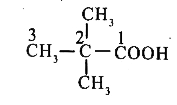
|
|
| 38. |
Assertion : 22.4 L of N_(2) at NTP and 5.6 L O_(2) at NTP contain equal number of molecules. Reason : Under similar conditions of temperature and pressure all gases contain equal number of molecules. |
|
Answer» If both assertion and reason are true and the reason is the correct explanation of the assertion. Now 22.4 L of `N_(2)=` volume OCCUPIED by one mole of `N_(2)=28` gm `=6.023xx10^(23)` molecules. Similarly, `O_(2)=2xx16=32 gm`, `32 gm=6.023xx10^(23)` molecules `=22.4 L` `:. 22.4 L =6.023xx10^(23) or 5.6 L =(6.023xx10^(23)xx5.6)/22.4` `=1/4xx6.023xx10^(23)` |
|
| 39. |
Assertion: 2-methyl-1,3-butadiene is the monomer of natural rubber Reason: Natural rubber is formed through anionic addition polymerisation. |
|
Answer» If both ASSERTION and REASON are true and reason is the correct explanation of assertion |
|
| 40. |
Assertion : 2-methyl-1,3-butadiene is the monomer of natural rubber Reason : Natural rubber is formed through anionic addition polymerisation. |
|
Answer» If both assertion and REASON are true and reason is the CORRECT EXPLANATION of assertion |
|
| 41. |
Assertion : 2-Methyl-1, 3-butadiene is the monomer of natural rubber. Reason : Natural rubber is formed through anionic addition polymerization. |
|
Answer» If both assertion and reason are TRUE and reason is the correct explanation of assertion. |
|
| 42. |
Assertion: 2-Butenal lacks enolisable H-atom, alpha-to carbonyl group, still it has sufficient acidic character. Reason: The conjugate base of 2-butenal is stabilised by resonance. |
|
Answer» if both assertion and RESON are true, and REASON is the true EXPLANATION of the assertion.  
|
|
| 43. |
Assertion : 2-Butanol on heating with H_2SO_4 gives 1-butenol on heating with H_2SO_4gives 1 - butaenol follows Sytzeff's rule. |
|
Answer» if both assertion and reason are true and reason is thr correct explanationof assertion In CASE of ` 2^@` and `3^@`alc. Saytzeff's rule is followend `H_3C-CH_2underset(OH)underset(|)CH-CH_3underset((1:1))OVERSET(H_2O_4)rarrH_3"CC"H=CH-CH_3+H_2O` |
|
| 44. |
Assertion: 2-Butanal lacks enolisable H-atom , alpha- to carbonyl group still it has cufficient acidic charater. Reason : The conjugate base of 2-butanal is stablised by resonance. |
|
Answer» If Both assertion and REASON are TRUE reason is the correct EXPLATION of the assertion. `[H-CH_(2)-CH_(2)-underset(2-"BUTENAL"))CH=CH-Ch=overset(OH^(-))underset(-H_(2)O)to` 
|
|
| 45. |
Assertion : 2-Bromobutane on reaction with sodium ethoxide in ethanol gives 2-butene as a major product. Reason : 2- Butene is more stable than 1-butene. |
|
Answer» If both assertion and reason are true and the reason is the correct explanation of the assertion 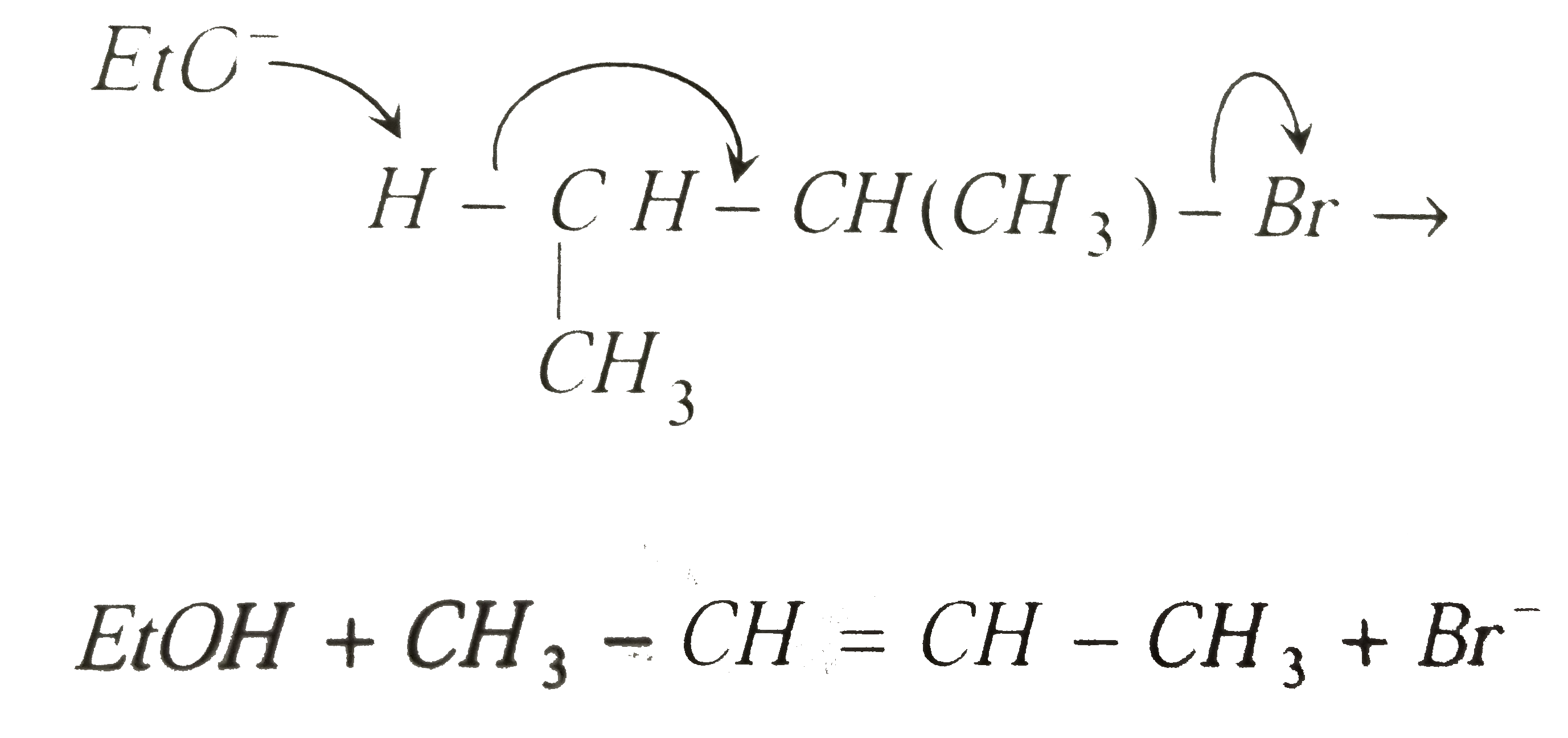 `ETOH +CH_3 -CH=CH-CH_3+Br^-` This is according to saytzeff's rule i.e., the predominant product is the most substituted alkene, i.e. are carrying the largest number of alkyl substituents of hydrogen is eliminated PREFERENTIALLY from the carbon atom joined to the LEAST number of hydrogen atoms. 2-butene is more stable than 1-butene due to presence of large number of hyperconjugating STRUCTURES in 2-butene. |
|
| 46. |
Assertion: 2-Bromobutane on reaction with sodium ethoxide in ethanol gives 1-butene as a major product. Reason: 1-butene is more stable than 2-butene. |
|
Answer» If both ASSERTIONN and reason are TRUE, and reason is the true explanation of the assertion. Correct reason: 2-Butene is more stable than 1-butene. |
|
| 47. |
Assertion: 2 ,2- dimethyl propanoicacid does not give HVZ reaction . Reason: 2 -2 ,dimethylpropanoicacid doesnot have- -hydrogen atom |
|
Answer» if bothassertion and reasonare TRUEAND reasonis the CORRECTEXPLANATION of ASSERTION . |
|
| 48. |
Assertion: ._(1)H^(1), ._(1)H^(2) and ._(1)H^(3) are isotopes of hydrogen. Reason : Nuclides of the same element of different mass numbers are called isotopes of that element |
|
Answer» If both assertion and reason are TRUE and the reason is the CORRECT explanation of the assertion |
|
| 49. |
Assertion. 1.575" g of "H_(2)C_(2)O_(4).2H_(2)O in 250 mL solution makes it 0.1 N. Reason. H_(2)C_(2)O_(4).2H_(2)O is a dihydrate organic acid. |
|
Answer» If both assertion and reason are TRUE, and reason is the true explanation of the assertion. `therefore"Noramality of the solution"` `=(1.575)/(63)XX(1)/(250)xx1000=0.1N` Hence, Assertion is true. CORRECT explanation. `H_(2)C_(2)O_(4).2H_(2)O` s a dibasic acid. |
|
| 50. |
Assertion: 1,3-Butadiene is the monomer for natural rubber. Reason : Natural rubber is formed through anionic addition polymerization. |
|
Answer» If both assertion and reason are true , and reason is the true explanation of the assertion. Correct reason : Natural rubber is formed through free RADICAL or cationic addition polymerisation. |
|