

Saved Bookmarks
This section includes 7 InterviewSolutions, each offering curated multiple-choice questions to sharpen your Current Affairs knowledge and support exam preparation. Choose a topic below to get started.
| 1. |
An aromatic compound 'A' (C_(7)H_(9)N) on reacting with NaNO_(2)//HCl at 0^(@)C forms benzyl alcohol and nitrogen gas. The number of isomer possible for the compound 'A' is |
|
Answer» 3 |
|
| 2. |
An aromatic compound A (C_(2)H_(6)O_(2)) liberates hydrogen with metallic sodium. Compound A when heated with anhydrous zinc chloride ultimately gives B (C_(2)H_(4)O) whereas, when heated with conc. Phosphoric acid gives C (C_(4)H_(10)O_(3)). A on oxidation with acidified K_(2)Cr_(2)O_(7) gives compound D (CH_(2)O_(2)). Identify A, B, C and D. Explain the reactions involved. |
|
Answer» Solution :(i) An organic compound A `(C_(2)H_(6)O_(2))` liberates hydrogen with metallic sodium. `underset("Ethylene glycol compound"(A))underset(CH_(2)OH)overset(CH_(2)OH)|overset(NA)underset(323K)to underset("MONOSODIUM glycolate")underset(CH_(2)OH)overset(CH_(2)ONa)|overset(Na)underset(433 K) to underset("disodium glycolate")underset(CH_(3)ONa)overset(CH_(3)ONa)|+H_(2)uarr` (ii) Compound A when heated with anhydrous zinc chloride ultimately gives B `(C_(2)H_(4)O)`.  (iii) Compound A when heated with conc. phosphoric acid gives `C (C_(4)H_(10)O_(3))`.  (iv) Compound A on OXIDATION with acidified `K_(2)Cr_(2)O_(7)` gives compound D `(CH_(2)O_(2))`. `underset(CH_(2)OH)overset(CH_(2)OH)|overset(3(O))underset("acidified " K_(2)Cr_(2)O_(7))to underset("HCOOH formic acid")overset(HCOOH)+ + H_(2)O` 
|
|
| 3. |
An aromatic compound (A), C_(7)H_(5)NO_(2)CI_(2) on reduction with Sn//HCI gives (G), which on reaction with NaNO_(2)//HCI gives (B). Compound (B) does not form a dye with beta-naphthol. However, (B) gives red colour with ceric ammonium nitrate and on oxidation gives an acid (D) of equivalent weight 191. Decarboxylation of (D) gives (E), which forms a mono nitro derivative (F) on nitrotion. Give the structures of (A) to (F) with proper reasoning. |
|
Answer» SOLUTION :`DU in (A) `= ((2n_(C) + 2) - (n_(H) + n_(X) - n_(N)))/(2)` `= (16-(5+2-1))/(2)=5^(@)` `5^(@)` DU is due benzene (4 DU) and ONE `(---NO_(2))` group (1 DU)`. 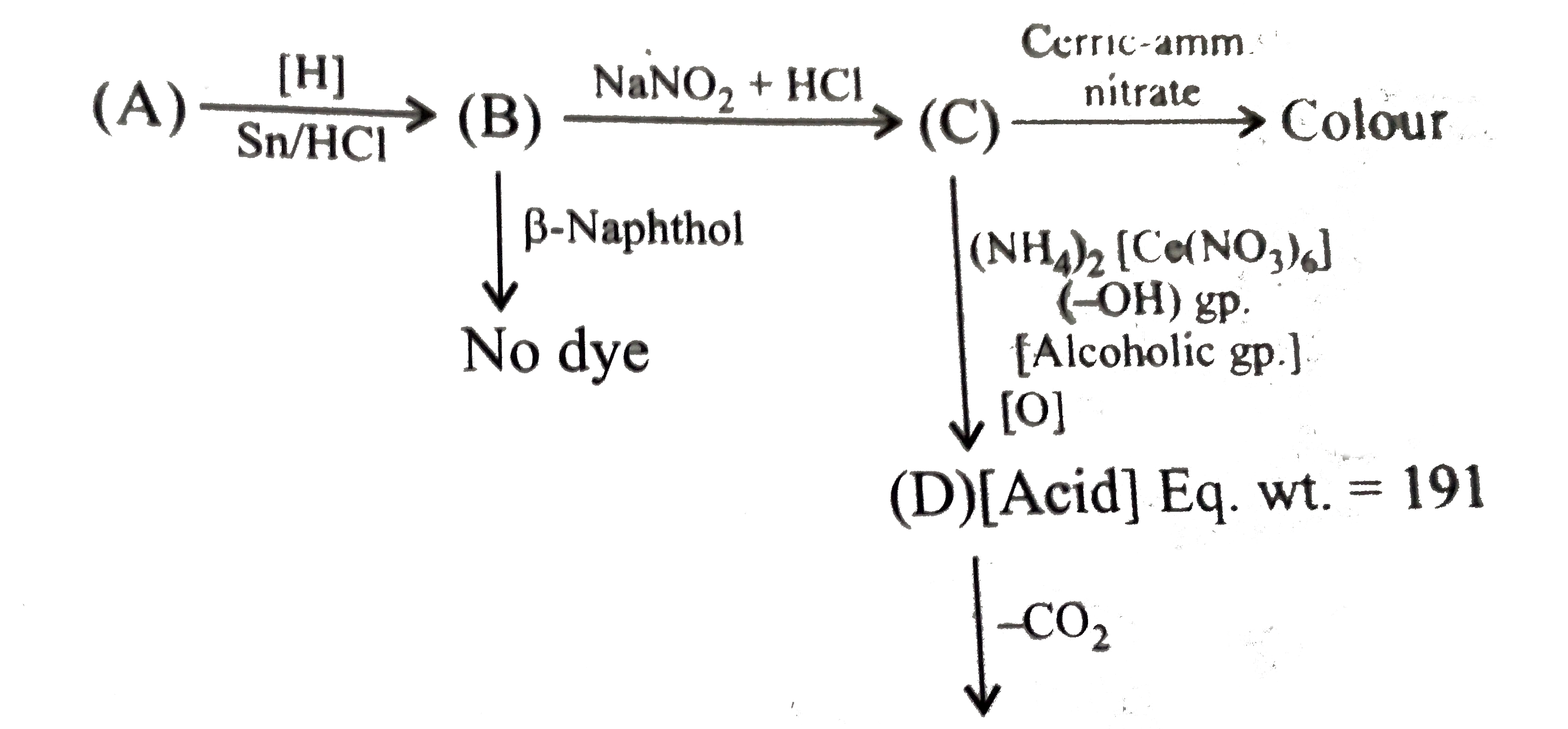 In (A), `(---NO_(2))` group cannot be with benzene ring, since reduction changes to `(---NH_(2))` ggroup, which on reaction with `(NaNO_(2) + HCI)` changes to alcohol. So it is in the side chain. 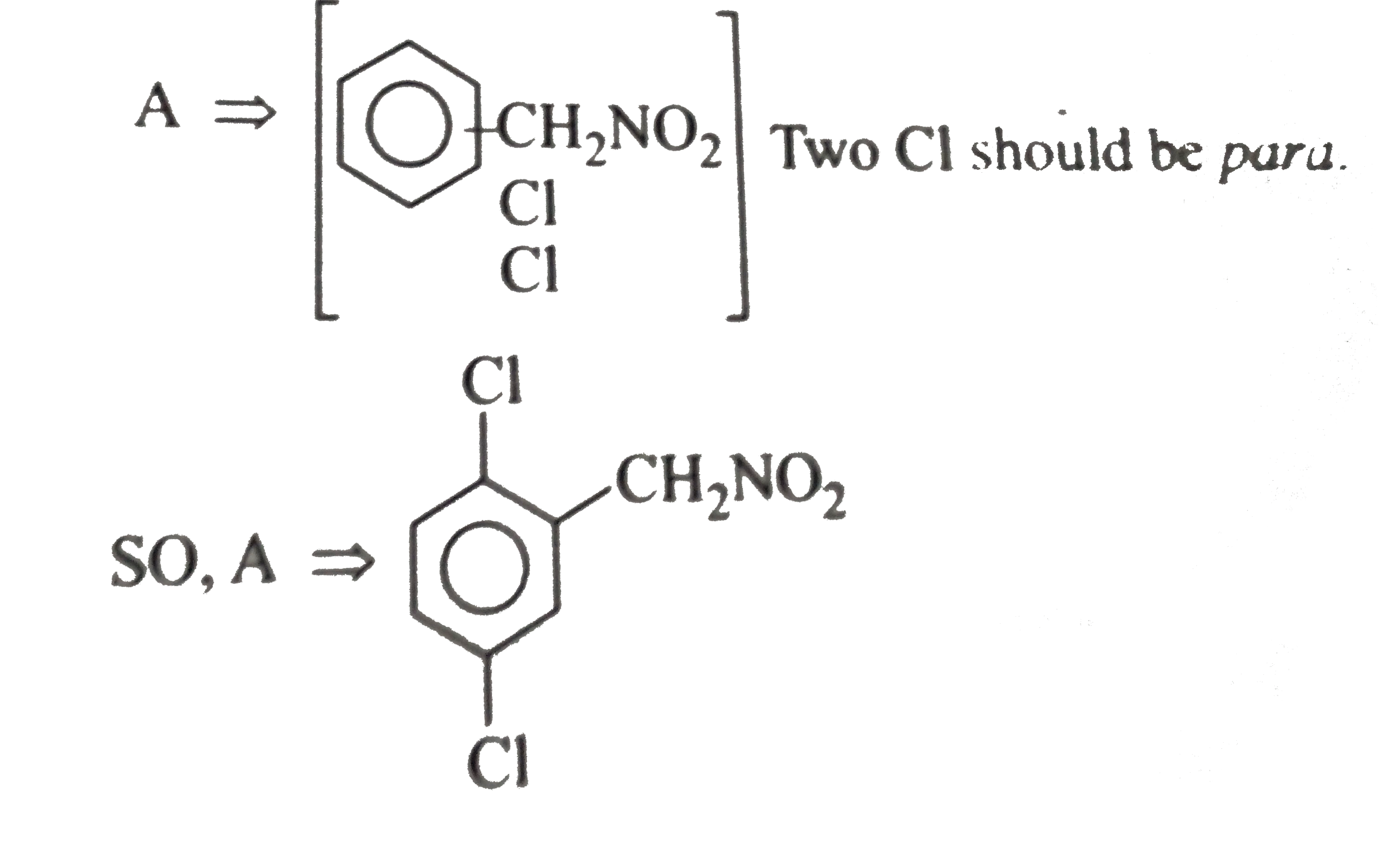 Reactions: 
|
|
| 4. |
An aromatic compound 'A'(C_7H_9N)on reacting with NaNO_2 // HClat 0^(@)C forms benzyl alcohol andnitrogen gas. The number of isomers possible for the compound 'A' is |
|
Answer» 5 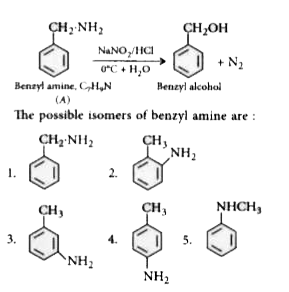
|
|
| 5. |
An organic amine (X) was treated with alcoholic potast and another compound (Y),a foul smelling gas ws formed with formula C_(6)H_(5)NC,(Y) was formed by reacting a compound (Z) with Cl_(2) in the presence of slaked lime. The compound (Z) is: |
| Answer» Answer :B | |
| 6. |
An aromatic among other things should have a pi-electron cloud containing electrons where n can't be |
| Answer» Solution :According to Huckel's rule, all aromatic compounds must have `(4n+2)PI` electrons where n is an integer,i.e., n = 0, 1, 2, 3,.... And possesses unusual STABILITY due to the complete DELOCALISATION of `pi`-electrons. | |
| 7. |
An aromatic aldehyde (A) of molecular C_7H_6Oreacts with acidified KMnO_4 to give (B) of molecular formula C_7H_6O_2 , calcium salt' of compound (B) on dry distillation gives (C) of molecular formula C_13H_10 O. Compound (C) on Clemmenson's reduction, gives (D) of formula C_13H_12O.Identify A,B,C,D and explain the reaction involved. |
Answer» Solution : (i)From the MOLECULAR FORMULA (A) is identified as Benzaldehyde `C_6H_5CHO` .Benzaldehyde on reaction with acidified `KMnO_4`undergoes oxidation to give BENZOIC acid as compound (B)
|
|
| 8. |
An aquesous solution of urea [6%w/v] is isotonic with NaCI solution then mass-volume percentage (%w/v) of NaCI solution then mass- volume precentage (%w/v) of NaCI solution will be :- |
|
Answer» `1.46%` `:.i_(1)c_(1)=i_(2)c_(2)` `1XX(6)/(60)xx10=2xx(W)/(58.5)xx10` `:.W=(58.5)(20)=2.925g` |
|
| 9. |
An arbitrary combound P_2Q decomposes according to reaction : 2P_2Q(g)hArr 2P_2(g)+Q_2(g) If one starts the decomposition reaction with 4 moles of P_2Q and value of equilibrium constant K_P is numerically equal to total pressure at equilibrium.Then which option is/are correct at equilibrium : |
|
Answer» mole of `.^nP_2Q=.^nQ_2` `K_p=(((4alpha)/(4+2alpha)XXP)^2((2alpha)/(4+2alpha)xxP))/(((4(1-alpha))/(4+2alpha)xxP)^2)=(2alpha^3)/((1-alpha)^2(4+2alpha))xxP` But `K_p=P` (given) `:. 2alpha^3=(1-alpha)^2(4+2alpha)` `:. -6alpha+4=0 "" alpha=(2//3)` Total moles at eq `=4+2alpha=(16//3)` `n_(P_2Q)=n_(Q_2)=(4//3),n_(P_2)=(8//3)` `:.` Total number of moles of products `=8/3+4/3=12/3=4` |
|
| 10. |
An aqueous which is 20% (w/w) in NaOH. What will be mass fraction of water in 30ml of such solution. |
|
Answer» Solution :100gm solution contain `w_(NAOH)=20gm` 100 ML solution contain `w_(NaOH)=30gm` 30 ml solution contain `w_(NaOH)=(30)/(100)xx30=9gm` 20 gm NaOH present in volume of solution `=(100)/(30)xx20ml` `d_("solution")=(100)/(100xx20)=(3)/(2)gm//ml=(w_("solution"))/(30ML)rArrw_("solution")=45gm` `w_(NaOH)=(9)/(45)=(1)/(5)=0.2` `w_(NaOH)=9gm` `x_(NaOH)=(9)/(45)=(1)/(5)=0.2` `x_(H_(2)O)=0.8` 0.8xx10=8 |
|
| 11. |
An aqueus soution of an organic compound containing 0.6 of it dissolved in 21.7 g of water, freezes at 272.187 K. If the value of K_(f) is 1.86 K mol^(-1) for water which freezes at 273 K, calculate the molecular mass of organic compund. |
|
Answer» SOLUTION :`M_(B)-(K_(f)xxW_(B))/(DeltaT_(f)xxW_(A))` Mass of compound`(W_(B))=0.6 g` Mass of water `(W_(A))=21.7 g= 0.0 217 KG` `(DeltaT_(f))=(273-272.187)=0.813 K` Molal depression constant `(K_(f))=1.86 K kg MOL^(-1))` ltbtgt `M_(B)=((1.86 K kg mol^(-1))xx(0.6 g))/((0.813 K)xx(0.0217 kg))=63.26 g mol^(-1)` |
|
| 12. |
An aqueous solution whose pH = 0 is |
|
Answer» Alkaline |
|
| 13. |
An aqueous solution of urea is found to boil at 100.52^(@)C. Given K_(b) for water is 0.52 K kg mol^(-1), the mole fraction of urea in the solution is |
|
Answer» 1 Hence, molality, `m=(DeltaT_(b))/(K_(b))=(0.52)/(0.52)=1` Molality = 1 means 1 mole of solute in 1000 G of solvent. But 1000 g of solvent (water) `=(1000)/(18)" moles "="55.55 moles"` `therefore"Mole fraction of urea"=(1)/(1+55.55)=0.018`. |
|
| 15. |
An aqueous solution of urea has freezingpoint of -0.604^(@)C &At 27^(@)C . The osmatic pressure of the same solution is ____________atm . (assume molality and molarity are same) |
|
Answer» |
|
| 16. |
An aqueous solution of urea had a freezing point of -0.52^(@)C. Predict the osmotic pressure of the same solution at 37^(@)C. Assume that the molar concentration and the molality are numerically equal. (K_(f)=1.86) |
|
Answer» Solution :MOLALITY `=(DeltaT_(F))/(K_(f))=(0.52)/(1.86)=` MOLARITY (given) Osmotic pressure `=CRT` `=(0.52)/(1.86)xx0.0821xx(273+37)` `=7.1` atm |
|
| 17. |
An aqueous solution of titanium chloride, when subjected to magnetic measurement, meaured zero magnetic moment. Assuming the octahedral complex in aqueous solution, the formulae of the complex is: |
|
Answer» `[TI(H_(2)O)_(6)]Cl_(2)` Coordination number 6`implies`octahedral complex Ti is in +4 oxidations state `implies`no unpaired ELECTRONS `implies`MAGNETIC moment=0 B.M. |
|
| 18. |
An aqueous solution of urea containing 6 g in 500 ml has a density equal to 1.05. If the molar mass of urea is 60, then the molality of the solution is : |
|
Answer» 0.193 M `=525g` Mass of solvent `=525-6=519g` Urea`=6g=6/60`MOLE MOLALITY `=(6xx1000)/(60xx519)=0.193`m . |
|
| 19. |
An aqueous solution of [Ti(H_2O)_6]^(+3) appears |
|
Answer» greenish-yellow in colour |
|
| 20. |
An aqueous solution of sucrose,C_(12) H_(2) O_(11) containing 34.2 g/L has an osmotic pressure of 2.38 atmospheres at 70^(o) C.for an aquesous solution of glucose, C_(6)H_(12)O_(6) to be istonic with this solution ,it would have : |
|
Answer» 34.2g/L `18 g L^(-1) "glucose" = 0.1 M` |
|
| 21. |
An aqueous solution of sodium chloride is marked 10% (w/w) on the bottle. The density of the solution is "1.071 g mL"^(-1). What is the molality and molarity? Also what is the mole fraction of each component in the solution? |
| Answer» SOLUTION :1.83 M, 1.90 m, X (NACL) = 0.03 , x `(H_(2)O)`= 0.97 | |
| 22. |
An aqueous solution of sodium carbonate is alkaline because sodium carbonate is a salt of |
|
Answer» Weak ACID and weak BASE |
|
| 23. |
An aqueous solution of sodium carbonate has a pH greater than 7 because |
|
Answer» It contains more CARBONATE ION than `H_(2)O` molecules It means contain more hydroxide ion than carbonate ions. |
|
| 24. |
An aqueous solution of salt 'R' when treated with dil. HCl, a colourless gas is given out. The gas so evolved when passed through acidified KMnO_(4) decolourisesKMnO_(4) solution. The salt 'R' is |
|
Answer» `Na_(2)CO_(3)` Since the gas decolourises acidified `KMnO_(4)` solution so it is `SO_(2)` and thus the anion present is `SO_(3)^(2-)` i.e., the salt .R. is `Na_(2)SO_(3)`. |
|
| 25. |
An aqueous solution of salt is alkaline. This show that the salt is made from as: |
|
Answer» STRONG acid and strong BASE |
|
| 26. |
An aqueous solution of salt gives white precipitate with AgNO_3 solution as well as with dil. H_2 SO_4. It may be |
|
Answer» `Pb(NO_(3))_(2)` `BaCl_(2)+H_(2)SO_(4) to underset("White ppt.")(BaSO_(4) darr)+2HCL` |
|
| 27. |
An aqueous solution of nitrous acid (HNO_(2)) , free of salts , can be obtained from the reaction |
|
Answer» `Ba(NO_(2))_(2)+H_(2)SO_(4) to ` |
|
| 28. |
An aqueous solution of NaCl on electrolysis gives H_(2)(g), Cl_(2)(g) and NaOH according to the reaction. 2Cl^(-)(aq) 2H_(2)O 2OH^(-) (aq) + H_(2) (g) + Cl_(2)(g) |
|
Answer» SOLUTION :At ANODE`2C1^(-) to C1_2+2e^(-)` At cathode `2H_2O+2e^(-) toH_2+2oH^(-)` ` 1kg Cl_2=100/35.5 ` equivalent of `Cl_2=28.17` equivalent `implies` Thereforeelectricity requiremnt `=28.17 F` Q EFFICENCY is only 62% `THEREFORE` Electricity requirement (experimental)`=(28.17xx10)/(62)=F=45.44f` `implies 45.44 xx96500=25t` (in second) `implies t=48.72 H` Also, gram equivalent of `HO^(-)` produced `=28.17` `implies` Molarity of `HO^(-)=28.17/20=1.4085 M` |
|
| 29. |
An aqueous solution of NaCL on electrolysis gives H_2(g),CL_2(g) and NaOH according to the equation 2Cl^(-)(aq)+2H_2O |
| Answer» Answer :A | |
| 30. |
An aqueous solution of NaCl on electrolysis gives H_2(g), Cl_2(g) and NaOH according to the reaction:2Cl^(-)(aq) + 2H_2O = 2OH^(-) (aq) + H_2(g) + Cl_2(g)A direct current of 25 amp with a current efficiency of 62% is passed through 20 litres of NaCl solution (20% by weight). Write down the reactions taking place at the anode and at the cathode. How long will it take to produce 1 kg of CI_2? What will be the molarity of the solution with respect to hydroxide ions? (Assume no loss due to evaporation.) |
| Answer» SOLUTION :49 H, 1.408 M | |
| 31. |
An aqueous solution of NaCl shall boil at |
|
Answer» `100^(@)C` |
|
| 32. |
An aqueoussolutionof NaCI on electrolysisgivesH_(2)(g),CI_(2)(g) and NaOH accordingto reaction 2CI^(-)(Aq)+2H_(2)O rarr 2OH^(-)(Aq)+H_(2)(g)+CI_(2)(g) A direct currentof 25 Awitha current efficiencyof 62% is passed through 20 L of NaCI solution(20%)by weight Howlong will it take to produce 1 kgof CI_(2) |
|
Answer» `30.20h` Given `w_(C 12)=10^(3) g` equivalent weight `w_(CI_(2))=35.5` and `i=(25xx62)/(100) =15.5 A` HENCE`t=(10^(3)xx93500)/(35.5 xx15.5)=175374.83 s=48.71 h` |
|
| 33. |
An aqueous solution of NaCl containing 5.85 g/L of NaCl was electrolysed by using platinum electrodes. Hydrogen and chlorine gases evolved at the cathode and anode respectively. Calculate the pH of the solution after electrolysis assuming complete electrolysis of NaCl. |
|
Answer» |
|
| 34. |
An aqueous solution of NaCI is marked 10% W/W on the borrle. The density of soution is 1.071 g mL^(-1). Calculate its molarity. |
|
Answer» `"Density of soluion "1.071" g ML"^(01)` `"VOLUME of 100 g of solution"= ("Mass of solution")/("Density of solution")=((100g))/((1.071" g mL"^(-1)))=93.37mL` `"Molarity of solution (M)"=("Mass of solute/Molar mass of solute")/("Volume of solution in litres")` `=((10G))/((58.5"g mol"^(-1))xx0.0934L)=1.83" mol L"^(-1) or 1.83 M` |
|
| 35. |
An aqueous solution of methanol on water has vapour pressure: |
|
Answer» EQUAL to that of WATER |
|
| 36. |
An aqueous solution of methanol in water has vapour pressure |
|
Answer» equal to that of water |
|
| 37. |
An aqueous solution of metal ion M_(1) reacts separately with reagents Q and R in excess to gie tetrahedral and sqaure planar complexes, respectively. An aqueous solution of another metal ion M_(2) always forms tetrahedral complexes with these reagents. Aqueous solution of M_(2) on reaction with reagent S gives white precipitate which dissolves in excess of S. The reaction are summarised in the scheme given below Scheme M_(1), Q and R, respectively are |
|
Answer» `Zn^(2+), KCN` and `HCl` |
|
| 38. |
An aqueous solution of metal ion M_(1) reacts separately with reagents Q and R in excess to gie tetrahedral and sqaure planar complexes, respectively. An aqueous solution of another metal ion M_(2) always forms tetrahedral complexes with these reagents. Aqueous solution of M_(2) on reaction with reagent S gives white precipitate which dissolves in excess of S. The reaction are summarised in the scheme given below Scheme Reagent S is |
| Answer» Answer :D | |
| 39. |
An aqueous solution of KI is 1.0 molal in KI. Which change will cause the vapour pressure of the solution to increases ? |
|
Answer» Addition of NaCI |
|
| 40. |
An aqueous solution of mannitol in water has a vapour pressure of 17.504 mm at 20^@C , at which temperature, the vapour pressure of pure water is 17.535 mm. What is the f.p. depression for this solution? K_f(H_2O) = 1.86. |
| Answer» SOLUTION :`0.183^@C` | |
| 41. |
An aqueous solution of KI does not give a precipitate with : |
|
Answer» `Mg^(2+)` |
|
| 42. |
An aqueous solution of KBr is treated with each of the following. In which case bromine will be liberated ? |
|
Answer» `Cl_(2)` `Cl_(2) + 2KBr RARR 2 KCl + Br_(2)`. |
|
| 43. |
An aqueous solution of hydrogen sulphide shows the equilibrium, H_2S ⇌H^+ + HS^- if dilute hydrochloric acid is added to an aqueous solution of hydrogensulphide without any change in temperature: |
|
Answer» The equilibrium CONSTANT will change |
|
| 44. |
An aqueous solution of hydrogen peroxide is: |
|
Answer» Alkaline |
|
| 45. |
an aqueous solution of HNO_2 (nitrous acid), free of salt can be obtained from the reaction |
|
Answer» `BA(NO_(2))_(2)+H_(2)SO_(4) to ` |
|
| 46. |
An aqueous solution of glucose containing 60 g glucose (C_(6)H_(12)O_(6)) per litre has an osmotic pressure of 5.2 bar at 300 K. The concentration of the glucose solution having osmotic pressure 0of 1.3 bar at the same temperature is : |
|
Answer» Solution :Osmotic PRESSURE `(PI)alphaM` `pi_(1)/pi_(2)=M_(1)/M_(2)` (for the same solution at the same temperature) `(5.2)/(1.3)=(1/3)/M_(2)or M_(2)=1/3xx1/4=1/12M` |
|
| 47. |
An aqueous solution of glucose boils at 100.01^(@)C. The molal elevationconstant for water is 0.5 K kg mol^(-1). What is the number of glucose molecules in the solution containing 100 g of water ? |
|
Answer» Solution :`Delta T_(B)=K_(b)XX m , 0.01 = 0.5 xx m` which gives m = 0.02. Thus, 1000 G of water contain glucose = 0.02 mole `therefore` 100 g of water contain glucose = 0.002 mole `= 0.002 xx 6.02xx10^(23)` MOLECULES `= 1.204xx10^(21)` molecules. |
|
| 48. |
An aqueous solution of gas (X) shows the following reactions :- On addition of FeCl_(3) solution a brown ppt. soluble in dilute nitric acid is obtained. Identify (X) and give equations for the reactions at step (ii) & (iii) |
|
Answer» Solution :`X - NH_(3)` `FE(OH)_(3)+3HNO_(3) underset("Soluble")(rarrFe(NO_(3))_(3))+3H_(2)O` |
|
| 49. |
An aqueous solution of gas (X) shows the following reactions : (i) It turns red litmus blue. (ii) When added in excess to a copper sulphate solution, a deep blue colour is obtained. (iii) On addition to a ferric chloride solution, a brown precipitate soluble in dilute nitric acid, is obtained. Identify (X) and give equations for the reactions at steps (ii) and (iii). |
|
Answer» Solution :(i) (a) SINCE gas (X) turns red litmus blue, it must be basic in nature. The only important gas which is basic in character is ammonia `(NH_(3))`. Thus, (X) may be ammonia. This is supported by the observation that it gives a deep blue colour with copper sulphate solution. (b) Having identified that the gas (X) is ammonia, the reactions at steps (ii) and (iii) may be explained as follows: (ii) With copper sulphate solution, it gives a deep blue colour due to the formation of tetrammine copper (II) COMPLEX. `CuSO_(4) + underset(underset((X))("Ammonia"))(4NH_(3)) rarrunderset(underset("(Deep blue colour)")("Tetramminecopper (II) sulphate"))([Cu(NH_(3))_(4)] SO_(4))` (iii) With FERRIC chloride solution, (X) gives a brown PPT. of ferric hydroxide which dissolves in dilute nitric acid to form ferric nitrate. `NH_(3) + H_(2)O rarr NH_(4)^(+) + OH^(-)` `FeCl_(3) + 3 OH^(-) rarr underset(underset(("Brown ppt."))("Ferric hydroxide"))(Fe(OH)_(3)) + 3 Cl^(-)` |
|