Saved Bookmarks
This section includes 7 InterviewSolutions, each offering curated multiple-choice questions to sharpen your Current Affairs knowledge and support exam preparation. Choose a topic below to get started.
| 1. |
Among LiCl , BeCl_2, Bcl_3 and C Cl_4 the covalent bond character follows the order : |
|
Answer» `LiClgtBeCl_2gtBCl_3gtC Cl_4` |
|
| 2. |
Among LiCl, BeCl_2, BCl_3 and C Cl_4, the covalent bond charater follows the order- |
|
Answer» `LICL LT BeCl_2 GT BCl_3 gt "CCl"_4` |
|
| 3. |
Among KO_(2),AlO_(2)^(-),BaO_(2)andNO_(2)^(+), unpaired electron is present in : |
|
Answer» `NO_(2)^(+)andBaO_(2)` |
|
| 4. |
Among KO_(2), AlO_(2)^(-),BaO_(2) and NO_(2)^(+) unpaired electron is present in |
|
Answer» `NO_(2)^(+)` and `BaO_(2)` |
|
| 5. |
Among isomeric o,m-and p-anisidines,_____is the weakest base. |
| Answer» SOLUTION :m-anisidine. | |
| 6. |
Among isomeric amines possible for molecular formula C_(3)H_(9)N, correct order of basic strength is given by I) propanamine-1 II) N-methyl ethanamine III) N,N-dimethyl methanamine |
|
Answer» III GT I gt II |
|
| 7. |
Among isomeric alkanes of molecular formula C_5H_12, identity the one that on photochemical chlorination yields 3 isomeric monochlorides |
Answer» SOLUTION :
|
|
| 8. |
Among HX. The maximum dipole moment is of : |
|
Answer» HF |
|
| 9. |
Among hypohalous acid the acid with highest Ka value is |
|
Answer» HIO |
|
| 11. |
Among hexahalides of VIA group, the stable halides are |
| Answer» Answer :D | |
| 12. |
Among HCI, HNO_(3) and H_(2)SO_(4) which is the suitable medium for KMnO_(4) in oxidising reaction? |
| Answer» SOLUTION :HCI and `HNO_(3)` cannot be used. HCl react with `KMnO_(4). HNO_(3)` is itself a good OXIDISING agent. HOWEVER, `H_(2)SO_(4)` is found to be most SUITABLE since it does not react with potassium permanganate. | |
| 13. |
Among halogens, the one which can oxidise water to oxygen is …… |
|
Answer» CHLORINE |
|
| 14. |
Among halogens maximum oxides are formed by |
|
Answer» Fluorine |
|
| 15. |
Among halogens, fluorine is least reactive. |
| Answer» Solution : Among HALOGENS. IODINE is LEAST REACTIVE. | |
| 16. |
Among halogens, F_(2) is the strongest oxidising agent. Or F_(2) is a strong oxidising agent in the 17th group. |
|
Answer» Solution :The standard electode potentials of halogens are : `F_(2) + 2 E^(-) rarr 2 F^(-), E^(@) = + 2.87 V and Cl_(2) + 2E^(-) rarr 2 Cl^(-), E^(@) = + 1.36 V` `Br_(2) 2e^(-) rarr 2 Br^(-), E^(@) = + 1.09 V and I_(2) + 2e^(-) rarr 2 I^(-), E^(@) = + 0.54 V` Since `E^(@)` for `F_(2)//F^(-)` ELECTRODE is the maximum, `F_(2)` is REDUCED most readily. In other words, `F_(2)` is the stongest oxidising AGENT. |
|
| 17. |
Among group 14 elements, name the most metallic element |
| Answer» SOLUTION :Lead (METALLIC CHARACTER increases on GOING down the group). | |
| 18. |
Among formic acid and acetic acid, which is more acidic ? Givereason. |
|
Answer» Solution :Formic ACID In ACETIC acid METHYL groupcauses + I EFFECT and DECREASES the acidity OR Other suitable explanation. |
|
| 19. |
Among formaldehyde, acetaldehyde, benzaldehyde and formic acid, which compounds undergo Cannzzaro reaction? Give reason. |
|
Answer» |
|
| 20. |
Among following statements on the nitration of aromatic compounds, the false one is |
|
Answer» the rate of NITRATION of benzene is almost the same as that of hexadeuterobenzene |
|
| 21. |
Among following statement, the incorrect one is |
|
Answer» calamine and SIDERITE are carbonates |
|
| 22. |
Among following cations which are more stabilized than |
|
Answer»
(b) is stabilise because of coplete octet. `3^(@)` cation is more stabilise than `1(@)` aromatic |
|
| 23. |
Among following molecules, N-Si bond length is minimum in : |
|
Answer» `NH(SiH_3)_2` 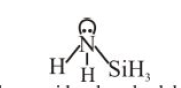 Because only ONE side where BACK bond possible . |
|
| 24. |
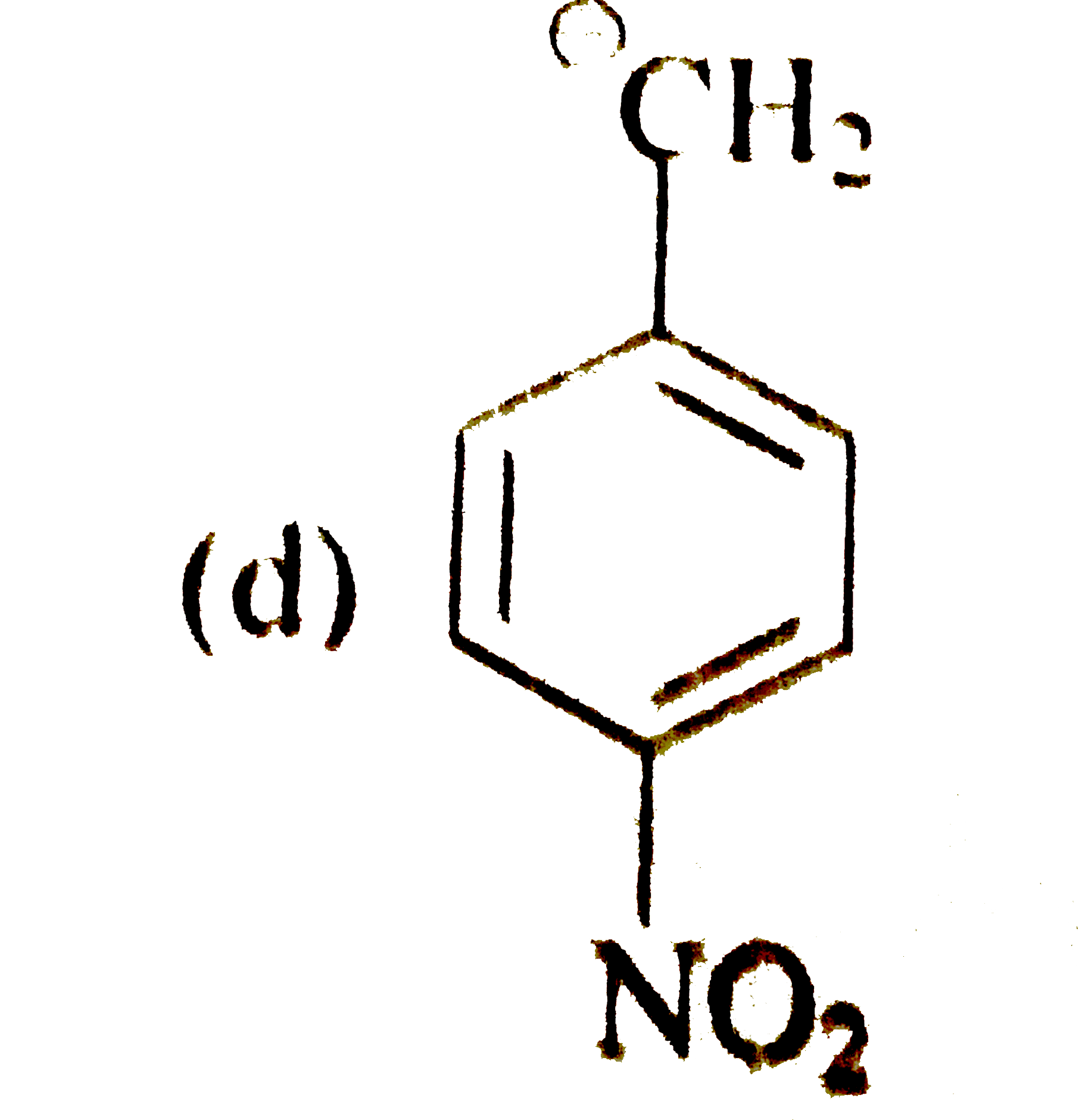
Among following anions which are more stable than |
|
Answer» `CH_(2)=CH-OVERSET(Ɵ)CH_(2)` 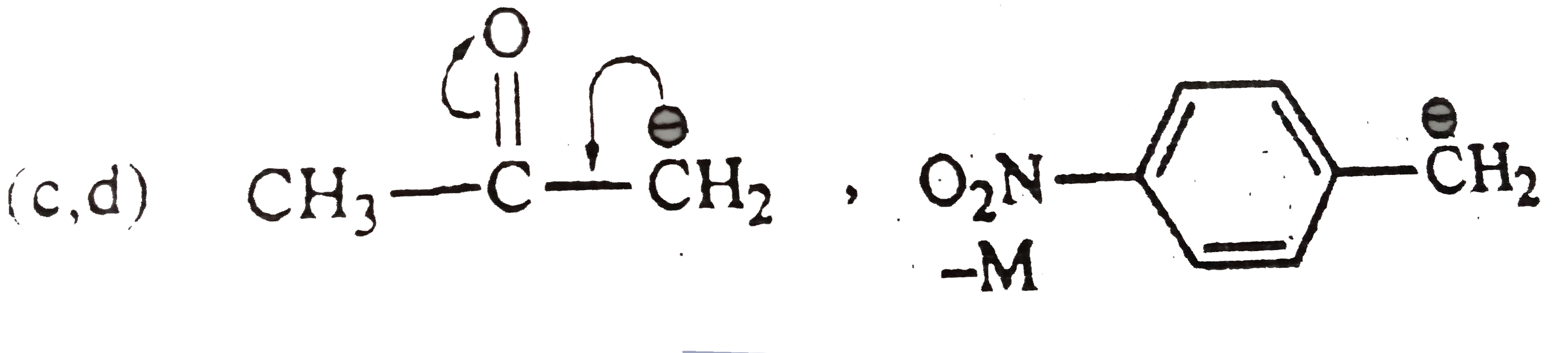
|
|
| 25. |
Among fluroine-fluorine bond andchlorie-chlorine bond, which is more stronger and why? |
| Answer» Solution :In C-Cl bond, a filled p-orbital of chlorine can overlap with a SUITABLE vacant d-orbital of adjacent chlorine THEREBY introducing some double bond CHARACTER. Thus the bond strength INCREASES. This is not POSSIBLE in fluorine as it has got no vacant d-orbital. | |
| 26. |
Among F_((g))^(-),Cl_((g))^(-0),Br_((g))^(-) and I_((g))^(-),which one requires the highest amount of energy to remove an electron. Why? |
| Answer» SOLUTION :`Cl_((G))^(-)` | |
| 27. |
Among ferrous and ferric ions, which one is more stable? Why? |
| Answer» Solution :Electroini configuration of Fe(26) `: [Ar] 4s^2 3d^6` Ferrous ION `Fe^(2+) : [Ar] 4s^0 3d^6` Ferric ion `Fe^(2+) : [Ar]4s^0 3d^6` Ferric ion ISMORE STABLE than ferrous ion. This is because ferric ion has HALF filled d-subshell stable electronic configuration . | |
| 29. |
Among ethanol (I) , Acetic acid (II), Phenol (III) and Benzoic acid (IV) , the corret order of increasing acid strength is |
|
Answer» I LT II lt III lt IV |
|
| 30. |
Among dimethylamine (I), aniline (II) and methylaniline (III), the increasing order of basic strength is |
|
Answer» `II lt III lt I` Methyl amine `(K_(b)=4.5 xx 10^(-4))` ANILINE `(K_(b)=4.2 xx 10^(-10))` `:.` Correct ORDER of basic strength is Aniline `lt` Methylamine `lt` Dimethylamine or `II lt III lt I` |
|
| 31. |
Among different aliphatic amines correct order of basic strengths in vapour state is |
|
Answer» ` 3^(@) GT 2^(@) gt 1^(@)` |
|
| 32. |
Among cuprous and cupric, which has more stable configuration? Why? |
|
Answer» Solution :Electronic configuration of `Cu^(+)` (cuprous) is `[Ar]3d^(10)` and of `Cu^(2+)` (cupric) is `[Ar]3d^(9)` Cuprous has more stable configuration. This isbecause `d^(10)` is COMPLETELY filled d-subshell. Due to SPHERICAL symmetry, it is more stable configuration: |
|
| 33. |
Among complexes [Fe(H_(2)O)_(6))]^(3+)", [Fe(CN)_(6)]^(3-). [Fe(C_(2)O_(4))]^(3-), more stability is shown by |
|
Answer» `[Fe(H_(2)O)_(6)]^(3+)` |
|
| 34. |
Among Cu, Ag, Zn and Cd which one is the biggest atom? why? |
|
Answer» Solution :At the end of any SERIES atomic radius increases. THUS in between Cu and Zn, Zn is W BIGGER atom in between AG and Cd, Cd is the bigger atom. In a GROUP from 3d- element to 4d- element atomic radius increase. Thus in between Zn and Cd, Cd is the bigger atom. So, among Cu, Ag, Zn and Cd, Cd is the biggest atom. |
|
| 35. |
Among ClO^(-), ClO_(2)^(-), ClO_(3)^(-), ClO_(4)^(-) which one cannot disproportionate and why ? |
|
Answer» Solution :`ClO_(4)^(-)` cannot DISPROPORTIONATE because in this oxonation chlorine is present in its highest OXIDATION state. Remainingthree oxoanions undergo disproportionation because in these chlorine is in intermediate oxidation state. `3overset((+1))(Cl)O^(-) overset(DELTA)rarr 2overset((+1))(Cl^(-)) + overset((+5))(Cl)O_(3)^(-), 6overset((+3))(Cl)O_(2)^(-) overset(h v)rarr 4overset((+5))(Cl)O_(3)^(-) + 2overset((-1))(Cl^(-)), 4overset((+5))(Cl)O_(3)^(-) rarr overset((-1))(Cl^(-)) + 3 overset((+7))(Cl)O_(4)^(-)` |
|
| 36. |
Among Cl^-, Br^-, I^-, the correct order for being oxidise to dihalogen is |
|
Answer» `I^(-) GT CL^(-) gt BR^(-)` |
|
| 37. |
Among CH_4, NH_(3), and H_2O , acidity of H_2O is maximum becaues, |
|
Answer» Oxygen contain two LONE pair of electrons |
|
| 38. |
Among cellulose , poly(vinyl chloride) , nylon and natural rubber , the polymer in which the intermolecular force of attraction is weakest is |
|
Answer» Nylon |
|
| 39. |
Among cellulose, polyvinyl chloride, nylon and natural rubber, the polymer in which the intermolecular force of attraction is weakest is |
|
Answer» nylon |
|
| 40. |
Among cellulose, poly (vinyl chloride), nylon and natural rubber, the polymer in which the intermolecular force of attraction is weakest is |
|
Answer» Nylon 2-nylon 6 is a polyamide copolymer of alanine . |
|
| 41. |
Among carbon and carbon monoxide which one is a better reducing agent for Fe_(2)O_(3),above 1000 K? |
| Answer» SOLUTION :Above 1000 K carbon is BETTER reducing AGENT for `Fe_(2)O_(3)`. | |
| 42. |
Among CaH_(2),BeH_(2),BaH_(2), the order of ionic character is |
|
Answer» `BeH_2ltBaH_2 LT CaH_2` |
|
| 43. |
Which of the following is a colligative property |
| Answer» SOLUTION :OSMOTIC PRESSURE is COLLIGATIVE property. The OTHERS are not colligative properties. | |
| 44. |
Among boron trifluoride, stannic chloride and stannous chloride, Lewis acid is represented by |
|
Answer» only stannic chloride |
|
| 45. |
Among benzene and toluene, which one will undergo nitration reactions easily and why ? |
|
Answer» Solution :(i) If electron desnity of the benzene right increases, then reactivity of the ring towards electrophillic SUBSTITUTION also increases. In TOLUENE, `-CH_(3)` group increases the electron density of the ring and as a result, reactivity of the ring also increases due `+1` and hyperconjugation effect of `-CH_(3)` group. So, nitration occurs more easily for toluene than unsubstituted benzene (ii) `{:(underset(A)(CH-=CNA) underset(1mol)overset(Na)larr CH-= CH underset(1% HgSO_(4), 80^(@)C)overset(dil H_(2)SO_(4))rarr underset(B)(CH_(3)CHO)),(underset("acetylide")("Monosodium") ""darrunderset(600^(@)C)("Red hot iron tune,") "Acetaldehyde"),(""underset(C)(""C_(6)H_(6)) overset(Fe//Cl_(2)(1 "mol"))rarr underset(D)(C_(6)H_(5)Cl)),("Benznechlorobenzene"):}` A: Monosodium acetylide `(CH -= CNa)` B: Acetaldehyde `(CH_(3)CHO)` C: Benzene `(C_(6)H_(6))`, D: Chlorobenzene `(C_(6)H_(5)Cl)` |
|
| 46. |
Among alpha-Nitroacetic acid (1) alpha-Fluoro Acetic Acid (2) , alpha-Fluoro Acetic Acid (2) , alpha- Bromoacetic acid (3) , alpha-Cyanoacetic acid (4) the correct order of increasing acid strength is |
|
Answer» `3 LT 2 lt 4 lt 1` |
|
| 47. |
Among alkali metal salts, the lithium salts are the poore conductors of electricity in aqueous solution because of |
|
Answer» easy diffusion of `LI^(+)` IONS |
|
| 48. |
Among Al_(2)O_(3), SiO_(2),P_(2)O_(3) and SO_(2), the correct order of acid strength is : |
|
Answer» `Al_(2)O_(3)ltSiO_(2)ltSOI_(2)ltP_(2)O_(3)` |
|
| 49. |
Among [Ag(NH_(3))_(2)]Cl, [Ni(CN)_(4))^(2-) and [CuCl_(4)]^(2-) which remains colourless in aqueous solutions and why ? |
|
Answer» SOLUTION :`[Ag(NH_(3))_(2)]Cl` remains colourless in aqueous solution because `Ag^(+)` has no UNPAIRED ELECTRON, therefore, it cannot undergo d-d transition. `[Ni(CN)_(4)]^(2-)` ALSO remains colourless as it does not have unpaired electrons. |
|
| 50. |
Among alcohols and phenols which one is more acidic ? And why ? |
| Answer» Solution :PHENOLS are more acidic than alcohols. This is because the phenoride ION FORMED from the ionisation of PHENOL is STABILISED by resonance. | |