

Saved Bookmarks
This section includes 7 InterviewSolutions, each offering curated multiple-choice questions to sharpen your Current Affairs knowledge and support exam preparation. Choose a topic below to get started.
| 1. |
Among the electrolytes Na _(2) SO_(4), CaCl_(2), Al_(2) (SO_(4)) _(3) and NH_(4)Cl, the most efective coagulating agent for Sb _(2) S_(3) sol is |
|
Answer» `Na _(2) SO_(4)` |
|
| 2. |
Among the electrolysis of Na_(2)SO_(4), CaCl_(2), Al_(2)(SO_(4))_(3) and NH_(4)Cl, the most effective coagulating agent for Sb_(2)S_(3) sol is |
|
Answer» `Na_(2)SO_(4)` |
|
| 3. |
Among the d-block elements, the highest melting point is shown by "…..............." |
|
Answer» |
|
| 4. |
Among The correct order of increasing acid strength is: |
|
Answer» IltIIIltIIlt IV |
|
| 5. |
Among the compounds of BF_(3), NCl_(3), H_(2)S, SF_(4) and BeCl_(2) identify the ones in which the central atoms has the same type of hybridisation. |
|
Answer» `BF_(3), NCl_(3)` and `H_(2)S` |
|
| 6. |
Among the complex ions [Co(NH_(2)CH_(2)CH_(2)NH_(2))_(2)Cl_(2)]^(+), [CrCl_(2)(C_(2)O_(4))_(2)]^(3-),[Fe(H_(2)O)_(4)(OH)_(2)]^(+), [Fe(NH_(3))_(2)(CN)_(4)]^(-) [Co(NH_(2)CH_(2)CH_(2)NH_(2))_(2)(NH_(3))Cl]^(2+)and[Co(NH_(3))_(4)(H_(2)O)Cl]^(+) the number of complex ion(s) that show (s) cis-trans isomerism is |
|
Answer» `[CrCl_(2)(C_(2)O_(4))_(2)]^(3-)=[MA_(2)(BB)_(2)] or [M(A A)_(2)B_(2)]rarr` shows cis-trans isomerism `[Fe(H_(2)O)_(4)(OH)_(2)]=[MA_(4)B_(2)]rarr` shows cis-trans isomerism `[Fe(NH_(3))_(2)(CN)_(4)]^(-)=[MA_(2)B_(4)]rarr` shows cis-trans isomerism `[Co(NH_(2)CH_(2)CH_(2)NH_(2))_(2)(NH_(3))Cl]^(2+)= [M(A A)_(2)BC]rarr` shows cis-trans isomerism `[Co(NH_(3))_(4)(H_(2)O)Cl]^(2+)=[MA_(4)BC]rarr` shows cis-trans isomerism 
|
|
| 7. |
Among the compounds as following which will react with CH_3-overset(O)overset(|)C-CH_3 to give product containing gt C = N - ? (i) C_(6)H_(5)NH_(2) (ii) (CH_(3))_(3)N (iii) C_(6)H_(5)NHC_(6)H_(5) (iv) C_(6)H_(5)NH_(2) and C_(6)H_(5)NHNH_(2) |
| Answer» Solution :`C_(6)H_(5)NHC_(6)` | |
| 8. |
Among the complex ions, [Co(en)_(2)CI_(2)]^(+) , [CrCI_(2)(C_(2)O_(4))_(2)]^(3-) , [Fe(H_(2)O)(OH_(2)]^(+) , [Fe(NH_(3))_(2) (CN)_(4)]^(-) [Cp(en)_(2)(NH_(3))CI]^(2+) and [Co(NH_(3))_(4)(H_(2)O)CI]^(2+) , the number of complex ion(s) that show (s) cis-trans isomerism is |
|
Answer» 5 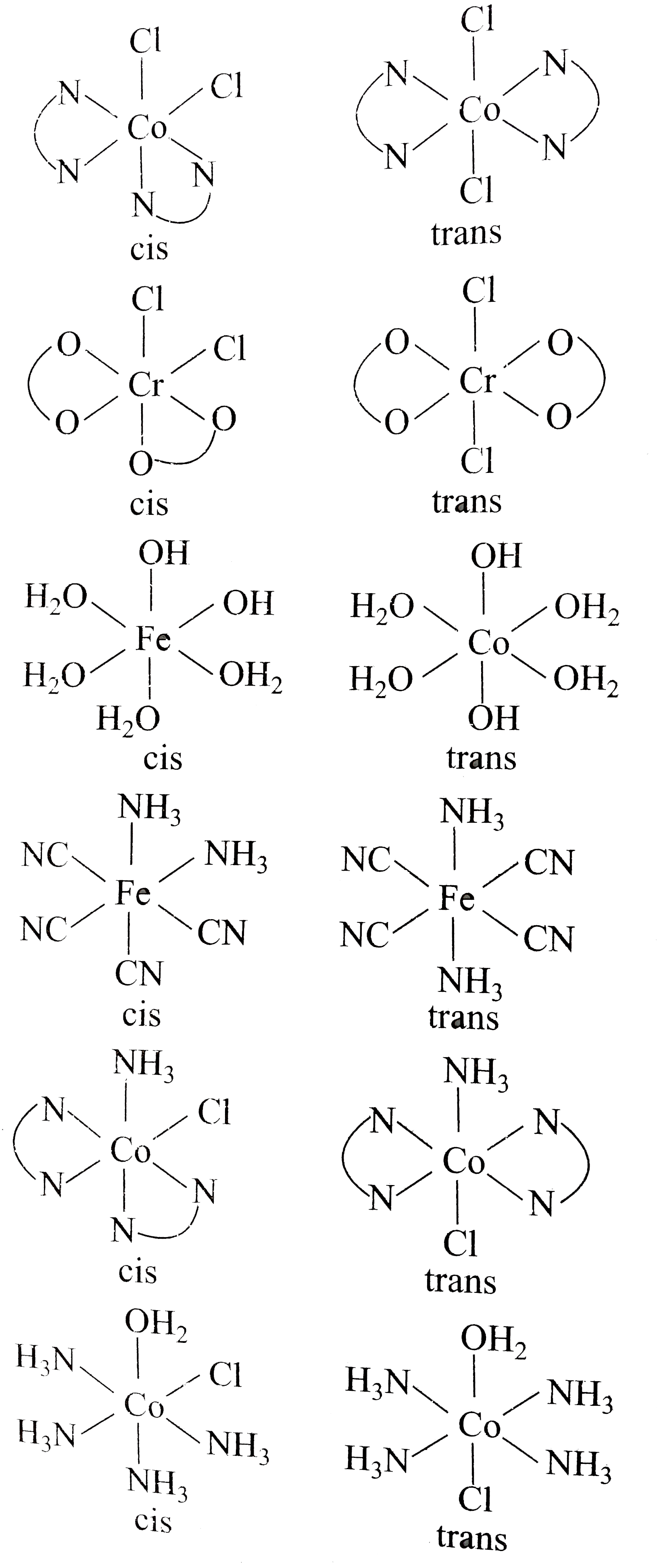
|
|
| 9. |
Among the complexes of Ni listed below, the following is the only correct statement : I-[Ni(CO)_(4)] II-[Ni(CN)_(4)]^(2-) III-[Ni(Cl_(4))]^(2-) |
|
Answer» All of them have tetrahedral geometry |
|
| 10. |
Among the butane conformers, which occur at energy minima on a graph of potential energy versus dihedral angle? |
|
Answer» GAUCHE only |
|
| 11. |
Among the C-X bond (where, X = Cl, Br, I) the correct bond energy is |
|
Answer» `C-ClgtC-BrRgtC-I` |
|
| 12. |
Arrange the following in increasing order of their basic strength. C_(2)H_(5)NH_(2),C_(6)H_(5)NH_(2), NH_(3),C_(6)H_(5)CH_(2)NH_(2)and(C_(2)H_(5))_(2)NH |
|
Answer» EgtAgtDgtCgtB |
|
| 13. |
Among the aromatic compound with molecular formula C_(7)H_(7)Cl, how many isomers are possible ? Which of these is maximum reactive in nature? |
Answer» Solution : four isomers are possible as shown below: Out of these, the cleavage of `C-Cl` bond can easily TAKE place in benzyl chloride to FORM a benzyl CARBOCATION that is resonance STABILISED. Therefore, benzyl chloride is maximum reactive in NATURE.  . .
|
|
| 14. |
Among the alkenes which one produces tertiary butyl alcohol on acid hydration? |
|
Answer» `(CH_3)_2C = CH_2` |
|
| 15. |
Among the alkaline earth metals, the element forming predominantly covalent compounds is |
|
Answer» Ba |
|
| 16. |
Among the alkaline earth metals, the element forming predominantly covalent compounds is : |
|
Answer» Ba |
|
| 17. |
Among the alkali metals cesium is the most reactive because |
|
Answer» its incomplete shell is nearest to the nucleus |
|
| 18. |
Among the aicd which have lowest pKa value . |
|
Answer» `CH_(3) COOH` |
|
| 19. |
Among the aicd (1) HC -= C - COOH (2) H_(2)C = CH - COOH (3) CH_(3) - CH_(2)- COOH The acidic strength follows the order |
| Answer» Answer :A | |
| 20. |
Among statements (a) – (d), the correct ones are :(a) Cryolite Na_(3)[AIF_(6)]lowers the melting point of Al_(2)O_(3)in Hall-Heroult process (b) The method of zone refining of metals is based on the principle of solubility of theimpurity in the molten state than in the solid state (c) Extraction of Pb is possible by carbon reduction method (d) In Hall-Heroult process, Aluminium is obtained at cathode andCO_(2)at anode |
|
Answer» (a), (B), (C ) and (d) |
|
| 21. |
Among the 15^(th) group elements, as we move from nitrogento bismuth, the pentavallency becomes less pronounced and trivalency becomes more pronounced due to |
|
Answer» Non metalliccharacter |
|
| 23. |
Among PbS,CuS,HgS ,MnS,AgS, NiS,CoS,Bi_(2)S_(3) and SnS_(2) the total number of BLACK coloured sulphides is |
|
Answer» |
|
| 24. |
Among physisorption or chemisorption which one has higher enthalpy of adsorption? |
| Answer» SOLUTION :Chemisorption/Chemical ADSORPTION. | |
| 25. |
Among phenol (I), o-nitrophenol (II), p-nitrophenol (III),m-nitrophenol (IV), the correct order of decreasing acid strength is |
|
Answer» IIIgtIIgtIVgtI |
|
| 26. |
Among paraffins, it is ganerally observed that with an increase in molecular weight- |
|
Answer» FREEZING POINT decreases |
|
| 27. |
Among (P) water (Q) ethanol and (R) mercury the correct order of vapour pressure at room temp is |
|
Answer» PgtQgtR |
|
| 28. |
Among p-diphenylamine (I) p-anisidine (II) and p-toluidine (III), the correct order of decreasing basic strength is |
|
Answer» `I gt II gt III`  In these SUBSTITUTED anlines the substituents are all electron RELEASING . `[CH_(3)-underset(CH_(3))underset(|)OVERSET(CH_(3))overset(|)(N)-CH_(2)CH_(3)]^(+) I^(-) underset("Elimination")overset(AgOH)(rarr) (CH_(3))_(3)N+CH_(2)=CH_(2)` |
|
| 29. |
Among of electrolytes N_(24)a_2 S_2 and NH_4O the most effective agent for Sb_(23)_S sol is: |
|
Answer» `N_2a_4S` |
|
| 30. |
Among of the following the most soluble in water is |
|
Answer» SUPERPHOSPHATE |
|
| 31. |
Among octahedral and tetrahedralcrystal fields, in which case the magnitude of crystal field splitting is larger ? |
| Answer» SOLUTION :It is larger in case of OCTAHEDRAL crystal FIELD `(Delta_(t)=4//9 Delta_(0) or Delta_(0) = 9//4 Delta_(t))`. | |
| 32. |
Among octahedral and tetrahedral crystal fields, in which case the magnitude of crystal field splitting is higher ? |
| Answer» SOLUTION :In octahedral field, the MAGNITUDE of crystal field SPLITTING is HIGHER. | |
| 34. |
Among [Ni(CO)_(4)],[NiCl_(4)]^(2-),[Co(NH_(3))_(4)Cl_(2)]ClNa_(3)[CoF_(6)],Na_(2)O_(2) and CsO_(2) the total number of paramagnetic compounds is |
|
Answer» 2 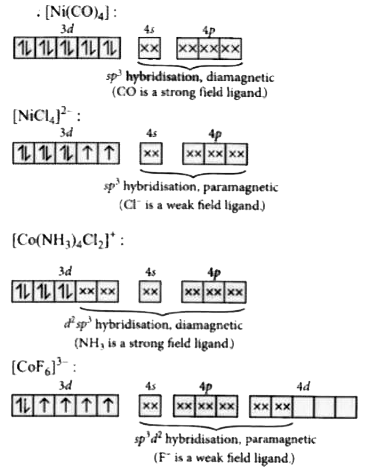 `Na_(2)O_(2)` contains `O_(2)^(2-)` (peroxide) which is DIAMAGNETIC. `CsO_(2)` contain `O_(2)^(-)` (superoxide ion) which is paramagnetic. |
|
| 35. |
Among [Ni(CO)_(4)], [Ni(CN)_(4)]^(2-), [NiCl_(4)]^(2-) species, the hybridisation states at the Ni atom are, respectively (Atomic numberof Ni = 28) |
|
Answer» `SP^(3), dsp^(2), dsp^(2)` `[NiCl_(4)]^(2-)rarrsp^(3)`hybridisation `RARR` tetrahedral. |
|
| 36. |
Among [Ni(CO)_4], [Ni(CN)_4]^(-2)and [NiCl_4]^(-2)species the hybridisation state of the Ni atom are respectively? |
|
Answer» `sp^3,dsp^2` and `dsp^2` |
|
| 37. |
Among [Ni(CN)_(4)]^(4-), [Ni(PPh_(3))_(3)Br] and [Ni(dmg)_(2)] species, the hybridisation states of the Ni-atoms are respectively : |
|
Answer» `dsp^(2), dsp^(2), SP^(3)` |
|
| 38. |
Among [Ni(CO)_(4)], [NiCl_(4)]^(2-), [Co(NH_(3))_(4)Cl_(2)]Cl, Na_(3)[CoF_(6)], Na_(2)O_(2) and CsO_(2), the total number of paramagnetic compounds is |
|
Answer» 2 |
|
| 39. |
Among [Ni(CN)_4]^(2-), [NiCl_4]^(2-) and [Ni(CO)_4]: |
|
Answer» `[NI(CN)_4]^(2-)` is SQUARE PLANAR and `[NiCl_4]^(2-)` and `Ni(CO)_4` are tetrahedral |
|
| 40. |
Among NH_3, PH_3, AsH_3, SbH_3, BiH_3, which one is the best reducing agent ? |
| Answer» SOLUTION :`BiH_3` is the best reducing AGENT (when reducing nature increases down the group `NH_3 to BiH_3`, as in case of other HYDRIDES of Group IVA, VIA and VIIA). | |
| 41. |
Among NCl_(3), PCl_(3), AsCl_(3), the decreasing order of bond angle is : |
|
Answer» `NCl_(3), PCl_(3), AsCl_(3)` |
|
| 42. |
Among Na,Hg ,S,Pt and graphite which can be used as electrodes in electrolytic cells having aqueous solutions: |
| Answer» Answer :D | |
| 43. |
Among NaF, NaCl, BaBr and Nal,the naF has highest melting point because |
|
Answer» It has MAXIMUM ionic character |
|
| 44. |
Among N_(2)O, SO_(2), I_(3)^(+) and I_(3)^(-) the linear species are ............. . |
| Answer» SOLUTION :`N_(2)O and I_(3)^(-)` while `SO_(2) and I_(3)^(+)` are BENT molecules | |
| 45. |
Among Na^(+) Na, Mg and Mg^(2+), the largest particle |
|
Answer» `Mg^(2+)` The ionic radii of a cation is always LESS than the atomic radii of that very atom. `underset(1.54 Å)(Na) underset(0.95A)( Na^(+)) underset(1.36A)(Mg) underset(0.65A)(Mg^(2+))` |
|
| 46. |
Among MgCl_(2) , RbCl, BeCl_(2) and LiCl. The compounds with highest and lowest % of ionic characters are :- |
|
Answer» `RBCL and BeCl_(2)` |
|
| 47. |
Among Me_(3)N, C_(5)H_(5)N and MeCN (Me = methyl group). the electroncgativity ofN is in the order |
|
Answer» `MeCN gt C_(5)H_(5)N gt Me_(3)N` 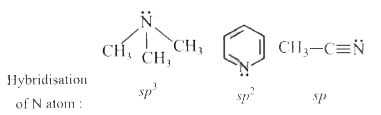 As the % s-character increases, electronegativity increases. `:.` Electronegativity order is : `sp gt sp^(2) gt sp^(3) implies MeCN gt C_5 H_(5) N gt Me_3N` |
|
| 48. |
Among methonic acid and ethanoic acid which is more acidic and why? |
| Answer» SOLUTION :Methanoic acid. Ethanoic acid contain `E^(-N)` donating group. | |
| 49. |
Among LiI, NaI, KI the one which is more ionic and more soluble in water : |
| Answer» Solution :Larger cation `(K^(+))` DEVELOPS less POLARISATION in anion and thus KI has more ionic NATURE and more soluble in water. | |