

Saved Bookmarks
This section includes InterviewSolutions, each offering curated multiple-choice questions to sharpen your knowledge and support exam preparation. Choose a topic below to get started.
| 43751. |
An EM wave of intensity I falls on a surface kept in vacuum and exerts radiation pressure p on it. Which of the following are true ? |
|
Answer» Radiation pressure is `(I)/(c )` if the wave is totally absorbed. Change in momentum per unit area in unit time, `P=("Intensity")/("Wave speed")=(I)/(c )` Change in momentum per unit area per unit time. `Delta p =(Delta I)/(c )` (Radiation pressure p) Change in momentum per uunit time per unit area `=(I)/(c )` When wave is completely absorbed by surface then momentum of reflected wave in unit time per unit area = 0 (ZERO) Radiation pressure, P = Change in momentum per unit area PERUNIT time `=(Delta I)/(c )=(I)/(c )-0=(I)/(c )` When wave is completely reflected then momentum of wave per unit area per unit time`=-(I)/(c )` `therefore` Radiation pressure `P=(I)/(c )-(-(I)/(c ))=(2I)/(c )` Here P is between `(I)/(c )` and `(2I)/(c )`. HENCE, option (A, C, D) are CORRECT. |
|
| 43752. |
What is a Rectification? |
| Answer» SOLUTION :Rectification is the process of CONVERTING alterating CURRENT into DIRECT current is called rectification | |
| 43753. |
Use the mirror equation to deduce that: (a) an object placed between f and 2f of a concave mirror produces a real image beyond 2f. (b) a convex mirror always produces a virtual image independent of the location of the object. (c) the virtual image produced by a convex mirror is always diminished in size and is located between the focus and the pole. (d) an object placed between the pole and focus of a concave mirror produces a virtual and enlarged image. |
|
Answer» Solution :MIRROR formula, `1/f = 1/u + 1/v` `therefore 1/v = 1/f - 1/u`...... (1) Now, for CONCAVE mirror, `f lt 0` (negative) and as objective is in left to mirror `u lt 0` `therefore 2 f lt u lt f` .. ... (1) Now, for concave mirror `f lt 0` (negative) and as object is in leftto mirror , `u lt 0` `therefore 2 f lt u lt f` `therefore 1/ (2f) gt (1)/(u) gt (1)/(f)` `therefore (1)/f - (1)/(2f) lt (1)/(f) - (1)/(u) lt (1)/(f) - (1)/(f)` [ By adding 1/f in each term] `therefore 1/(2f) lt (1)/(v) lt 0[ therefore ` from equation (1)] This represent that `v lt 0,` hence REAL image is obtained in left of mirror. `2 f gt 0` `therefore| 2f | gt | v| [ because 2f` and v are negative ] Hence, real image is obtained beyond 2f. For convex lens, ` f gt 0` and object is in left , hence, `u lt 0` `therefore`From mirror equation , `1/v = 1/f - 1/u` Now,` f lt 0` and `u lt 0` and it REPRESENTS |
|
| 43754. |
Why constantan and manganin are used to make standaed resistance? |
| Answer» Solution :Their RESISTANCE does not vary appreciably with temperature.(Both of them has NEARLY ZERO temperature COEFFICIENT of resistance). | |
| 43755. |
Relative permeability of medium of refractive index 1.5 and dielectric constant 2 is ……. TmA^(-1). (mu_(0)=4pi xx10^(-7)TmA^(-1)) |
|
Answer» (A) `0.45pi xx10^(-7)` `therefore (2.25)/(K)=mu_(r )=(mu)/(mu_(0))` `therefore (mu)/(mu_(0))=(2.25)/(K)` `rArr mu=(2.25xx4pi xx 10^(-7))/(2)` `therefore mu=4.5 pi xx 10^(-7)TMA^(-1)` |
|
| 43756. |
A 6Omega resistance is connected in the left gap of a meter bridge. In the second gap 3Omega and 6Omega are joined in parallel. The balance point of the bridge is at _______ |
|
Answer» 75 cm |
|
| 43757. |
The minimum time taken by a spring block system (having time period T) to travel a distance equal to amplitude of motion is equal to |
|
Answer» `T/4` |
|
| 43758. |
How it is transmitted ? |
| Answer» Solution :The transmitting antennas radiate electromagnetic WAVES which TRAVEL OUTWARD in all DIRECTIONS with a VELOCITY of `3xx10^8 ms^-1`. | |
| 43759. |
A projectile is projected with a kinetic energy K. Its range is R. It will have the minimum kinetic energy after covering the distance equal to : |
|
Answer» 0.25R |
|
| 43760. |
As radioactive substances undergo continuous decay, number of nuclei in a sample goes on decreasing. The time interval in which number of nuclei in a sample is reduced to half of its initial value is the half-life of the sample. The half-life is related to the decay constant by the relation. T_(1//2) = (0.693)/lambda The average life of a sample is expressed by the relation tau = 1/lambdaIf the half-life of a radioactive sample is 138.6 days, then mean life of the sample is |
|
Answer» 199.58 DAYS |
|
| 43761. |
As radioactive substances undergo continuous decay, number of nuclei in a sample goes on decreasing. The time interval in which number of nuclei in a sample is reduced to half of its initial value is the half-life of the sample. The half-life is related to the decay constant by the relation. T_(1//2) = (0.693)/lambda The average life of a sample is expressed by the relation tau = 1/lambdaThe half-life of radioactive samples can be |
|
Answer» only between 10 s and 100 s |
|
| 43762. |
A battery of emf 10 V and internal resistance 3Omegais connected to a resistor. If the current in thecircuit is 0.5 A, what is the resistance of the resistor ? What is the terminal voltage of the batterywhen the circuit is closed ? |
|
Answer» Solution :Here `epsi = 10 V,R= 3Omega`and I = 0.5 A As `I = (epsi)/((R + r))`,hence external resistance R = `epsi/I - r= (10)/(0.5)- 3 = 20 - 3 = 17 OMEGA` and the terminal VOLTAGE of battery `V = epsi-Ir = 10-0.5xx3 = 10-1.5 = 8.5 V` |
|
| 43763. |
Find the magnetic induction at a distance of 20 cm on the equatorial line of a short bar magnet with a magnetic moment 60Am^(2). |
| Answer» SOLUTION :`0.75 XX 10^(-3)T` | |
| 43764. |
In YDSE, if the slits are of unequal width : |
|
Answer» FRINGES will not be formed |
|
| 43765. |
निम्न में असत्य कथन है |
|
Answer» `sin THETA =-1/5` |
|
| 43766. |
In Young's double-slit experiment, 12 fringes are observed to be formed in a certain segment of the screen when light of wavelength 600 nm is used. If the wavelength of light is changed to 400 nm, number of fringes observed in the same segment of the screen is given by |
|
Answer» 12 |
|
| 43767. |
An 8.00 g ice cube at its melting point is added to 130 cm^(3) of tea (water ) initially at 90.0^(@)C in a well-insulated container. When equilibriu is reached, what has been the decrease in the tea's temperature ? |
|
Answer» |
|
| 43768. |
The ratio oftime constant during current growth and current decay of the circuit shown in Figure is |
|
Answer» `1:1` |
|
| 43769. |
If the solenoid in is free to turn about the vertical direction and a uniform horizontal magnetic field of 0.25T is applied , what is the magnitude of torque on the solenoid when its axis makes an angle of 30^@ with the direction of applied field ? Given magnetic moment 0.6 JT−1 . |
|
Answer» SOLUTION :B = 0.25 T , `theta =30^@` `taumB sin theta=0.6xx0.25xxsin30=0.6xx0.25xx1/2=0.075Nm ` (or J) |
|
| 43770. |
A thermos bottle containing coffee is vigorously shaken. Consider coffee as a system: Does its temperature rise ? |
| Answer» SOLUTION :YES, the TEMPERATURE ofcoffee RISES. | |
| 43771. |
Two redioactive nuclei A and B have disintegration constants lamda_(A)andlamda_(B) and initially N_(A)andN_(B) number of nuclei of them are taken, then the time after which their undisintegrated nuclei are same is |
|
Answer» `(lambda_Alambda_B)/((lambda_A-lambda_B))"In"(N_B/N_A)` or `e(lambda_B-lambda_A)t=(N_B//N_A)` `THEREFORE t=1/((lambda_B-lambda_A))"In"(N_B/N_A)` |
|
| 43772. |
A Proton moves in a iniform magnetic field of strength 0.500 T magnetic field is directed along the x-axis . At initial time, t = 0 s, the proton has velocity vec(v) = (1.95 xx 10^(5) hat(i) + 2.00 xx 10^(5) hat(k) ) ms^(-1). Find (a) At initial time, what is the acceleration of the proton (b) is the path circular or helical , calculate the radius of helical trajectory and also calculate the pitch of the helix (Note: Pitch of the helix is the distance travelled along the helix axis per revolution ). |
|
Answer» Solution :Magnetic field `vec(B) = 0.500 hat(i) ` T Velocity of the particle `vec(v) = (1.95 xx 10^(5) hat(i) + 2.00 xx 10^(5) hat(K) ) mas^(-1)` Charge of the proton q = 1.60 `xx 10^(-19)` C MASS of the proton m = `1.67 xx 10^(-27) `kg (a) the force experienced by the proton is `vec(F) q (vec(v) xx vec(B) )` = ` 1.60 xx 10^(-19) xx ((1.95 xx 10^(5) hat(i) + 2.00 xx 10^(5) hat(k)) xx (0.500 hat(i)) ) ` Therefore, from Newton.s second law, `vec(a) = (l)/(m) vec(F) = (l)/(1.67 xx 10^(-27)) (1.60 xx 10^(-14)) ` = 9.58 `xx 10^(12) ms^(-2)` (b) Trajectory is helical Radius of helical path is `R = (mv_(z))/(|q|B) = (1.67 xx 10^(-27) xx 2.00 xx 10^(5) )/(1.60 xx 10^(-19) xx 0.500) = 4.175 xx 13^(-3) m = 4.18` mm PITCH of the helix is the distance travelled ALONG x-axis in a time T, which is P = `v_(x)` T But time, `T = (2pi)/(omega) = (2pi m)/(|q|B ) = (2xx3.14 xx 1.67 xx 10^(-27) )/(1.60 xx 10^(-19) xx 0.500) = 13.1 xx 10^(-8) `s hence , pitch of the helix is `P = v_(x) T = (1.95 xx 10^(4)) (13.1 xx 10^(-8)) = 25.5 xx 10^(-3) m = 25.5 `mm The proton experiences appreciable acceleration in the magnetic field, hence the pitch of the helix is almost six times greater than the radius of the helix. |
|
| 43773. |
As radioactive substances undergo continuous decay, number of nuclei in a sample goes on decreasing. The time interval in which number of nuclei in a sample is reduced to half of its initial value is the half-life of the sample. The half-life is related to the decay constant by the relation. T_(1//2) = (0.693)/lambda The average life of a sample is expressed by the relation tau = 1/lambdaThe decay constant of a radioactive substance having half-life 2 minutes is |
|
Answer» `0.3465 MIN^(-1)` |
|
| 43774. |
The heat produced per unit time, on passing electric current through a conductor at a given temperature is directly proportional to the ..... |
|
Answer» <P>ELECTRIC current W = Vlt `(W)/(t) `= VI P = VI ` THEREFORE P = IR xx I = I^(2)` R `therefore ` PRODUCED heat : P =H = `I^(2) ` R Here R is constant`therefore H prop I^(2)` |
|
| 43775. |
Two identical samples of a gas are allowed to expand: (i) isothermally and (ii) adiabatically, the amount of work done is : |
|
Answer» equal in both, the cases `therefore` AREA under adiabatic graph is LESS than area under isothermal graph. 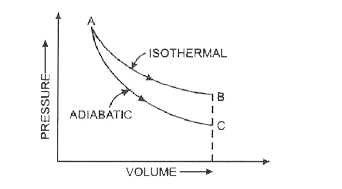 Thus work is more in case isothermal process than adiabatic process. Thus, CORRECT choice is (C). |
|
| 43776. |
A person with a defective sighi is using a lens-having a power of +2D. The lens he is using is |
|
Answer» CONCAVE LENS of FOCAL LENGTH 0.5 m |
|
| 43777. |
A charged particle of charge q and mass menters perpendicularly in a magnetic field vecB . Kinetic energy of the particle is E, then frequency of rotation is |
|
Answer» `(QB)/(MPI)` |
|
| 43778. |
The amplitude modulated signal consists of two sinusoidal waves of frequencies, (omega_c→angular frequency of carrier wave) (omega_m→angular frequency of modulating signal) |
|
Answer» `omega_c/2,omega_m/2` |
|
| 43779. |
When current is passed through gas or vapour stored at low pressure radiation of definite ...... is produced which is called radiation spectrum. |
|
Answer» FREQUENCY |
|
| 43780. |
(a) Give one use of electromagnetic rediations obtained in nuclear disintegrations.(b) Give one example each to illustrate the situations where there is (i) displacement currentbut no conduction current and (ii) only conduction current but no displacement current. |
|
Answer» SOLUTION :(a) Gamma Rays , USE : Treatment of cancer tumours. (b) (i) Displacement current but no conduction current : Displacement current exists whenever there is a change of ELECTRIC flux since electric CHARGES do not flow through the insulation from one plate of a capacitor to other . So , there is no current inside the capacitor . (ii) Conduction current but no displacement current :It is a current which arises due to flow of electronsin conductors .When a capacitor is connected to a battery , it starts storing charge due to conduction current . Hence , there is no displacement current in the wires OUTSIDE the capacitors. 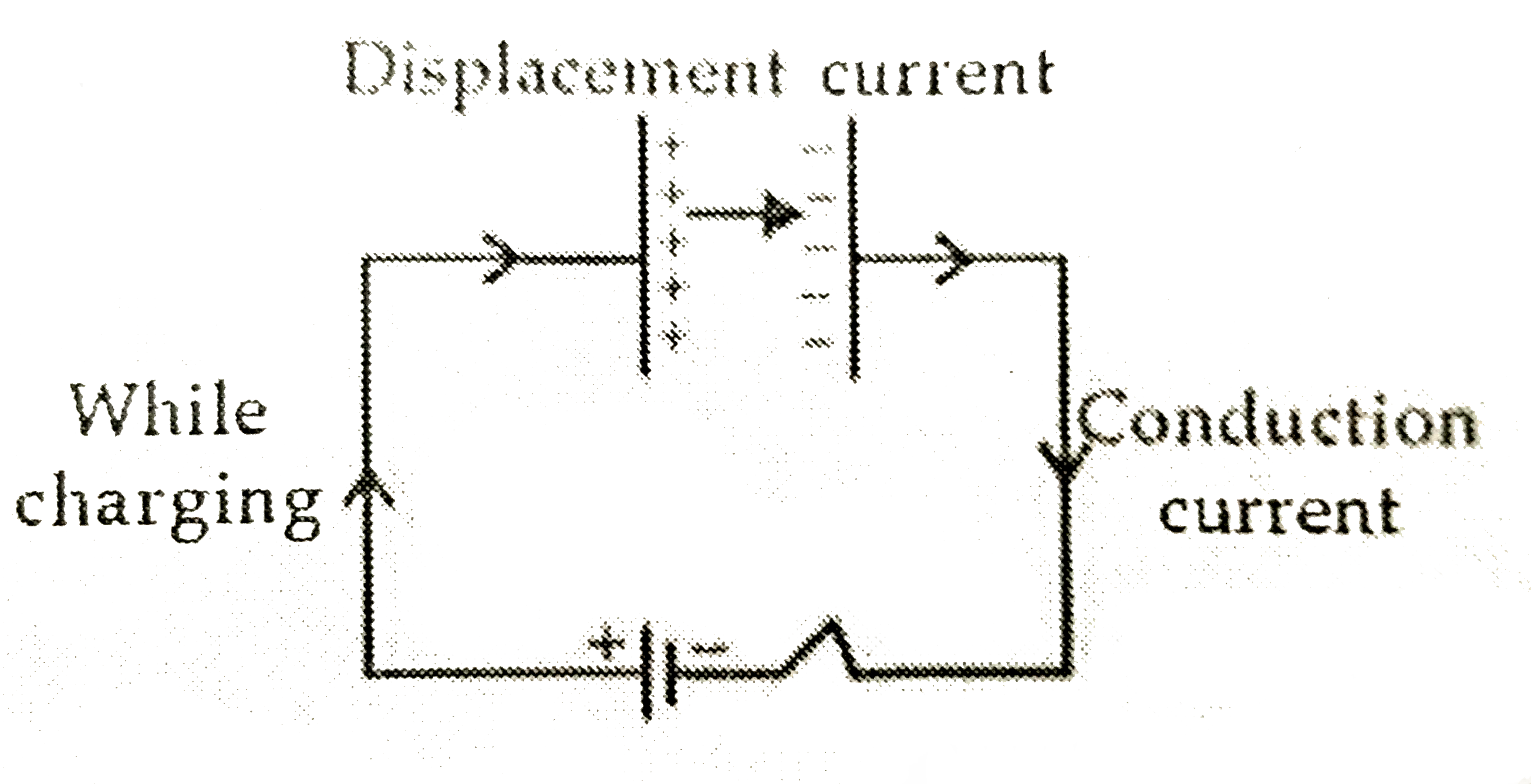
|
|
| 43781. |
सभी प्राणी किससे बनते हैं? |
|
Answer» कणों से |
|
| 43782. |
(i) Draw the graphs showing variation of inductive reactance and capacitive reactance with frequency of applied a.c. source.(ii) Can the voltage drop across the inductor or the capacitor in a series LCR circuit be greater than the applied voltage of the a.c. source ? Justify your answer. |
|
Answer» Solution :(i) N/A (ii) YES, voltage drop across the inductor or the capacitor in a series LCR circuit can be greater than the applied voltage of the a.c. SOURCE. It is because applied voltage is equal to phasor SUM (as obtained by use of a phasor diagram) of `V_(R), V_(L)` and `V_( c)` i.e. `V = I sqrt(R^(2) + (X_(L) -X_(C))^(2))` whereas `V_(L) = IX_(L)` and `V_(C) = IX_( C)` THUS, it is SELF -evident that `V_(L)` or `V_( c)` may be greater than V. |
|
| 43783. |
Electron and proton of equal momentum enter a uniform magnetic field normal to the lines of force. If the radii of curvature of circular paths be r_(e ) and r_(p) respectively, then |
|
Answer» `(r_(e ))/(r_(p))= (1)/(1)` As the momentum of `p_(m) and p_(e )` are equal and MAGNITUDE of charge of electron and proton are equal ALONG with same magnetic field `r_(p) = r_(e) or r_(p)//r_(e)= 1//1` |
|
| 43784. |
The amplitude of wave distance propagating in the positive X-direction is given by y = (1)/((1 + x)^(2)) at time t = 0 and y = (1)/(1 + (x - 1)^(2)) at t = 1 seconds here x and y are in metre. The shape of wave disturbance does not change during propagation. The velocity of wave is : |
|
Answer» `2 ms^(-1)` att = 0 SEC `"" y = (1)/(1 + x^(2))` Att = 2 sec. `"" y = (1)/(1 + (x - 2V)^(2)) ` comparing this with`y = (1)/(1 + (x - 1)^(2))` We have 2v = 1 `rArr "" v = 0.5 ms^(-1)`. correct CHOICE is d. |
|
| 43785. |
Two bodies have their moments of inertia l and 2l respectively about their axis of rotation. If their kinetic energies of rotation are equal, their angular velocity will be in the ratio |
|
Answer» SOLUTION :K.E. =`1/2Iomega^(2)` `therefore1/2Iomega_(1)^(2)=1/2.2Iomega_(2)^(2)` `(omega_(1)^(2))/(omega_(2)^(2))=2/1rArr(omega_(1))/(omega_(2))=(sqrt2)/1` 
|
|
| 43786. |
On a capacitor of capacitance C_0with the two plates separated by distance d. and air filling the space between the two plates following steps are performed in the order as given in column I. a) Capacitor is charged by connecting it across a battery of emf epsilon_0 b)Dielectwie of dielectric constant K and thickness d is inserted c) Capacitor is disconnected from battery d) Separation between platas in doubled. |
|
Answer» <P> |
|
| 43787. |
In a plane electromagnetic wave, the electric field oscillates sinusoidally at a frequency of 2.0 xx 10^(10) Hz and amplitude 48 V m^(–1). (a) What is the wavelength of the wave? (b) What is the amplitude of the oscillating magnetic field? (c) Show that the average energy density of the E field equals the average energy density of the B field. [c = 3 xx 10^(8) m s^(-1).] |
|
Answer» SOLUTION :(a) `lamda =(c//v) =1.5 xx10^(-2) m` (b) `B_(0)=(E_(0)//c)=1.6 xx10^(-7) T` (c ) Energy density in E field: `u_(E) =(1//2)epsi_(0) E^(2)` Using `E= cB, and c=(1)/(SQRT(mu_(0) epsi_(0)), u_(E)=u_(B)` |
|
| 43788. |
Power of plane mirror is ...... |
|
Answer» `infty` |
|
| 43789. |
A conducting sphere of radius R having charge Q is placed in a uniform external field E. O is the centre of the sphere and A is a point on the sphere of the sphere such that AO makes an angle of theta_(0)=60^(@) with the opposite direction fo external field. calculate the potential at point A due to charge on the sphere only. |
|
Answer» |
|
| 43790. |
Explain refraction of plane wave with a thin prism. |
Answer» Solution : The figure shows the PARALLEL beam is incident on a prism at a instant and its correspondingplane wavefront `A_(1)B_(1). A_(1)B_(1)` is NORMAL to rays and emergent beam is shown by `A_(2)B_(2)`. Here the length of the path from `B_(1)` to `B_(2)` is greater then the length of the path from `A_(1)` to `A_(2)` In fact, the path from `A_(1)`to `A_(2)`in prism is larger than the path from `B._(2)` to `B._(2)` The VELOCITY of light in prism is less than the velocity in air hence it takes longer time for the light to go from `A_(1)` to `A_(2)` As a result, `A_(2)` is LAGGING behind point `B_(2)`. So the emergent wavefront is slightly tilted. |
|
| 43791. |
Particle A and particle B are held together with a compressed spring between them. When they are released, the spring pushes them apart, and they then fly off in opposite directions, free of the spring. The mass of A is 2.00 times the mass of B, and the energy stored in the spring was 80 J. Assume that the spring has negligible mass and that all its stored energy is transferred to the particles. Once that transfer is complete, what are the kinetic energies of (a) particle A and (b) particle B? |
|
Answer» |
|
| 43792. |
A thin circular loop carryinga current has a radius 100 mm and magnetic induction at its centre is 6.0 mutthen magnetic moment ofthe loop is |
|
Answer» `15 ma -m^(2)` `(because IpiR^(2)=M)` `THEREFORE B=30 mA -m^(2)` |
|
| 43793. |
(A): Energies associated with nuclear processes are about a million times larger than chemical process. (R): In the mass number range A = 30 to 170, the B.E per nucleon is nearly constant about 8Mev/nucleon. |
|
Answer» Both .A. and .R. are true and .R. is the CORRECT explanation of .A. |
|
| 43794. |
The refractive index of denser medium with respect to rarer medium is 1.125. The difference between the velocities of light in the two media is 0.25 xx 10^8 m//s. Find the velocities of light in the two media. (c = 3 xx 10^8 m//s). |
| Answer» SOLUTION :`2 XX 10^8 m//s ,2.25 xx 10^8 m//s` | |
| 43795. |
(A) : Wires of the transmission lines carrying A.C. are made of multiple strands. (R): A.C flows on surface of the conductor |
|
Answer» Both 'A' and 'R' are TRUE and 'R' is the CORRECT EXPLANATION of 'A'. |
|
| 43796. |
Electric potential V in space as a function of cartesian co-ordinates is given by V=(1)/(x)+(1)/(y) +(1)/(z). Then find electric field intensity at (1, 1, 1) |
|
Answer» `(HAT(i) + hat(j) + hat(k))` |
|
| 43797. |
The group of limited number of lines of force forming a tube like structure in air medium is: |
|
Answer» TUBE of FORCE |
|
| 43798. |
(i) Which mode of propagation is used by shortwave broadcast services having frequency range from a few MHz upto MHz ? Explain diagrammatically how long distance communication can be achieved by this mode. (ii) Why is there an upper limit to frequency of waves used in this mode ? |
|
Answer» Solution :`(i)` This mode is called Sky WAVE propagation. `(ii)` There is an upper limit because for FREQUENCIES above `30 MHz` radio waves penetrate through ionsphere and escape. |
|
| 43799. |
A projectile is givenan initial velocity of (hat(i) + 2hat(j)) ms^(-1) , when hat(i) is alongground and hat(j) is alongthe vertical . If g = 10 ms^(-2) find the equation of trajectory. |
| Answer» SOLUTION :`y = 2X - 5X^(2)` | |
| 43800. |
Three resistance 4Omega , 6 Omegaand 10 Omegaare connected in series and a p.d. of 20V is applied across the terminals of combination. The p.d. across6 Omega resistance is |
| Answer» Answer :B | |