

Saved Bookmarks
This section includes InterviewSolutions, each offering curated multiple-choice questions to sharpen your knowledge and support exam preparation. Choose a topic below to get started.
| 1551. |
An object is projected with a velocity u at angle of 30^@ with the horizontal. The vertical velocity of the project i/e at the highest point is |
| Answer» Answer :D | |
| 1552. |
Two charges 9 mu C and 1mu C are placed at a distance of 30cm. The position of third charge from 9 mu C between them so that it does not experience any force. |
|
Answer» 7.5cm |
|
| 1553. |
Identify the correct statements. |
|
Answer» Both the ` 4mu F ` CAPACITOR carry equal charges in oppositesense |
|
| 1554. |
A guillotine was ____________________ |
|
Answer» A device CONSISTING of two POLES and a blade with which a PERSON was beheaded |
|
| 1555. |
A man standing on a turntable raises his hands suddenly. What happens ? |
| Answer» Solution :By raising his hands, the moment of inertia of the SYSTEM increases and HENCE the ANGULAR velocity `OMEGA` decreases. | |
| 1556. |
Describe n-p-n transistor as an amplifier. Also define current gain and power gain |
|
Answer» Solution :Concept of an AMPLIFIER. It is a device by which we can increase the amplitude of variation of alternating voltage and current. Circuit for n-p-n common base amlifier is as shown in the diagram. Forward biasing is applied to E-B and reverse biasing is applied to B-C circuit. Input is fed at a and b while ouput is taken from c and d.  Working and amplification action. When input a.c. signal is zero and emitter base circuit is closed, the currents `I_(e)`, `I_(b)` and `I_(c)` flow as the emitter, base and collector current. From Kirchhoff.s first law , `I_(e)=I_(b)+I_(c)` If `I_(b)=5%`, `I_(e)=0.05I_(e)` and `I_(c)=0.95I_(e)` The collector voltage `V_(c)` is given by `V_(c)=V_(cb)-I_(c)R_(L)`............`(i)` When signal is fed to `E-B` circuit, there is a change in forward bias resulting in change of `I_(e)`, `I_(c)` and consequenctly, `V_(c)` which appears as amplified output. Phase relationship between input and output voltage. When positive half of signal (a.c.) is fed to E-B circuit, it decreases forward bias which in turn decreases `I_(e)` and `I_(c)`. Decrease in `I_(c)` means an increase of `V_(c)` [Eq. `(i)`]. Thus during positive half cycle of input a.c. signal voltage, the output signal voltage at collector also varies through positive half cycle. When negative half cycle of input a.c. signal voltage is fed, it supports forward biasing of the emitter base circuit. The results in increase in `I_(e)` and hence `I_(c)`. From equation `(i)`, `V_(c)` decreases i.e. it becomes lesser positive or more negative. Thus during negative half cycle of input a.c.signal voltage the output signal voltage at the collector also varies through negative half of the cycle. Thus in common base amlifier output is in phase with input. Advantage of common base amplifier over common emitter amplifier. The only advantgae ofcommon base or common emitter is that input and output are in phase otherwise in all other respects common emitter amplifier is preferred. Current aimplification factor (or current gain) a is DEFINED as the RATIO of collector current to the emitter current at constant collector voltage. i.e. `a=((I_(c))/(I_(e)))_(E_(cb))` Voltage gain `(A_(v))`. The ratio of change of output voltage to the change in input voltage iscalled voltage gain. Hence `A_(v)=(DeltaV_(0))/(DeltaV_(i))=(I_(c)R_(L))/(I_(e)R_(i))=alpha(R_(L))/(R_(i))` So `A_(v)=alpha` (Resistance gain) Since `R_(L) gt gt R_(i)` so `A_(v)` is quite high although `alpha lt 1`. to the change in input power is called power gain. `P=(DeltaP_(0))/(DeltaP_(i))=(I_(c)DeltaV_(0))/(I_(e)Deltav_(i))=alphaA_(v)` |
|
| 1557. |
An earthware vessel loses 1 g of water per second due ot evaporation. The water equivalent of the vessel is 0.5 kg and the vessel contains 9.5 kg of water. Find the time required for the water in the vessel to cool to 28^(@)C from 30^(@)C. Neglect radiation losses. Latent heat of vaporisation of water in this range of temperature is 540 cal/g. |
|
Answer» |
|
| 1558. |
a. Is there any difference between fluorescence and phosphorescence ? b. If so, what is the difference ? |
|
Answer» Solution :a. YES b.Fluorescence is the process in which a substance absorbs energy of radiation and emits it in a different wavelength from those of ABSORBED . If the process CONTINUES even after the exciting radiation is REMOVED, then the process is called PHOSPHORESCENCE. |
|
| 1559. |
The relative permeability of a paramagnetic material is |
| Answer» Answer :A | |
| 1560. |
The co-efficient of reflection, coefficient of absorption and coefficient of transmission are related by the equation… |
|
Answer» `R + a + t = 1` |
|
| 1561. |
In the circuit shown in the Figure ABCD is a rect- angular and vertical frame of conducting wires having three capacitors. EFGH is in horizontal plane having two capacitors. The two rectangular frames are connected at P and Q only.Find equivalent capacitance between A and G if each capacitor has capacitance C. |
|
Answer» |
|
| 1562. |
If the maximum load voltage of 40 V is to be obtained from the bridge rectifier, the value of rms from the secondary is approximately ……… |
|
Answer» 0 V rms voltage of output `(V_(0))_("rms")=(V_(m))/(sqrt(2))` `=(40)/(sqrt(2))=28.8V ~~28.3V` |
|
| 1563. |
A magnet N-S is suspended from a spring and while at oscillates, the magnet moves in and out of the coil C. The coil is connected to a galvanometer G. Then, as the magnet oscillates, |
|
Answer» G shows DEFLECTION to the left and RIGHT with constant amplitude |
|
| 1564. |
The phase difference between the alternating current and emf is pi//2. Which of the following combination are used |
| Answer» Answer :B | |
| 1565. |
A motorist drives north for 35.0 minutes at 85.0 km/h and then stops for 15.0 minutes.He next continues north,travelling 130 km in 2.00 hours .What is his total displacement |
|
Answer» 85 km |
|
| 1566. |
"_______________" is the basis for the electron microscope |
|
Answer» MATTER waves |
|
| 1567. |
Draw the transfer characteristic curve of a base biased transistor in CE configuration. Explain clearly how the active region of the V_0 versus V_F curve in a transistor is used as an amplifier. |
Answer» SOLUTION : In the active region, a (SMALL) increase of `V_i` results in a large, ALMOST LINEAR) increase in` I_c` This results in an increase in the voltage DROP across `R_c` |
|
| 1568. |
A: Electric force is the reason for electron to remain in a atom. R : According to Coulomb's law, the electron in a atom can remain stable in nucleus only if the centripetal force is equal to its centrifugal force. |
|
Answer» Both assertion and REASON are true and the reason is correct explanation of the assertion. |
|
| 1569. |
On which points the electric field intensity of the dipole is parallel to the line joining the two charges of the electric dipole ? |
|
Answer» On charge -q |
|
| 1570. |
दो अनंत समतल समांतर चादरों में जिनके बीच की दुरी d है, समान तथा विपरीत एकसमान आवेश घनत्व sigma है। चादरों के बीच विद्युत - क्षेत्र का मान होगा |
|
Answer» शून्य |
|
| 1571. |
A soldier with a machine gun, falling from an airplane gets detached from his parachute. He is able to resist the downward acceleration if the shoots 40 bullets a second at the speed of 500 m/s. If the weight of a bullet is 49 gm, what is the weight of the man with the gun ? Ignore resistance due to air and assume the acceleration due to gravity g = 9.8 ms^(-2) - |
|
Answer» 50 kg |
|
| 1572. |
In orderto stopa varin shortestdistanceon a horizontal road, ne should |
|
Answer» applythe breaksvery hardso that the wheels stoprotatng |
|
| 1573. |
The current gain in common-emitter configuration of a transistor is 80. If the change in base current is 250muA , the change in collector current is |
|
Answer» `10mu A ` |
|
| 1574. |
The diagram 12.03 shows the path of four a-particles of the same energy being scattered by the nucleus of a gold atom, of atomic number z, simultaneously. Which of these is/are not physically possible ? |
|
Answer» 3 and 4 |
|
| 1575. |
We have a disc of neglligible thickness and whose surface mass density varies as radial disance from centre as sigma=sigma_(0)(1+r/R), where R is the radius of the disc. Specific heat of the material of the disc isC. Disc is given an angular velocity omega_(0) and placed on a horizontal rough surface such that the plane of the disc is parallel to the surface. Coefficient of friction between disc and suface is mu. The temperature of the disc is T_(0). Answer the following question on the base of information provided in the above paragraph Magnitude of angular acceleration of disc is |
|
Answer» `alpha=(7mug)/(27R)` `M=int_(0)^(R)dm=2pisigma_(0)((R^(2))/2+(R^(2))/3)(5pisigma_(0)R^(3))/3` `dl-dmr^(2)=2pisigma_(0)int_(0)^(R)(r^(3)+(r^(4))/R)dr=2pisigma_(0)((R^(4))/4+(R^(4))/5)=9/10pisigma_(0)R^(4)` `d tau=2pisigma_(0)mug int_(0)^(R)(r^(2)+(r^(3))/R)dr=2pi sigma_(0)gR^(3)=9/10pisigma_(0)R^(4)alpha` `=alpha=(35mug)/(27R)` 
|
|
| 1576. |
A particle of mass m is at rest at the origin at time t = 0.It is subjected to a force F(t)=F_(0)e^(-bt) in the x direction. Its speed v(t) is depicted by which of the following curves ? |
|
Answer»
`(dv)/(dt)=(F_(0))/(m)e^(-bt)` `underset(0)overset(v)INT dv=(F_(0))/(m)underset(0)overset(t)int e^(-bt)dt=(F_(0))/(m)((e^(-bt))/(-B))_(0)^(t)` `v=(F_(0))/(mb)(1-e^(-bt))` So, CORRECT choice is (d). |
|
| 1578. |
Consider the arrangement shown in figure. The distance D is large compared to the searated d between the slits. a. Find the minimum value of d so that there is a dark fringe at O. b. Suppose d has this value. Find the distance x at which the next bright firnnge is formed. c.Find teh fringe width. |
|
Answer» Path differene `=(AB+BO)-(AC+CO)` `=2(AB-AC)` [Since AB=BO and AC=CO]` `=2(sqrt(D^2+d^2D))` For DARK FRINGE path difference should be odd multiple of `lamda/2` `So, 2(sqrt(D^2+d^2-D))=(2n+1)lamda/2` `rarrsqrtD^2+d^2=D+(2n+1)lamda/4` `rarr D^2+d^2=D^2+(2n+1)^2lamda^2/16+(2n+1)(lamdaD)/2` Neglecting `(2n+1)^2lamda^2/16` as it is very small we get `d=(sqrt2n+1)(lamdaD)/2` for minimum d PUTTING n=0 `rarr d_(min)=sqrt(((lamdaD)/2))` |
|
| 1579. |
The work done in placing a charge of 8xx10^-18Con condenser of capacity.100 muF is : |
|
Answer» `16xx10^-32J` |
|
| 1580. |
Two wires with currents 2 A and 1 A are enclosed in a circular in circular loop. Another wire with current 3 A is situated outside the loop as shown. The oint vec B. vec (dl) around the loop is |
|
Answer» a. `mu_(0)` |
|
| 1581. |
A capillary tube (A) is dipped in water. Another identical tube (B) is dipped in a soap-water solution. Which of the following shows the relative nature of the liquid columns in the two tubes ? |
|
Answer»
`H=(2Tcostheta)/(rpg)` The surface tension (T) of soap solution is less than water. Therefore, rise of soap solution in the capillary TUBE is less as compared to water. As in the case of water the meniscus shap of soap solution is concave upwards. So CORRECT CHOICE is c. |
|
| 1582. |
An 80 kg stuntman jumps out of a window that's 45m above the ground Q. He lands on a large, air-filled target, coming to rest in 1.5 s. what average force does he feel while coming to rest? |
|
Answer» Solution :USING `overline(F)=Deltap//DELTAT`, we FIND that `overline(F)=(Deltap)/(Deltat)=(p_(f)-p_(i))/(Deltat)=(0-mv_(i))/(Deltat)=(-(80kg)(30m//s))/(1.5s)=-1,600N IMPLIES overline(F)=1,600N` |
|
| 1583. |
An eye-piece consists of a concave lens of focal length 2f and a convex lens of focal length 3f separted by a distance (f)/(2). They are of the same material. Examine whether the eye-piece formed is free from spherical and chromatic aberration. Is it suitable for use of cross-wire? [Hint : An eye-piece is suitable for cross-wire when it is a positive one. See example 6] |
|
Answer» |
|
| 1584. |
A double inclined plane as shown in th figure has fixed horizontal base and smooth faces with the same angle of inclination of 30^@ . A block of mass 300 g is on one face and is connected by a cord passing over a fictionless pulley to a second blocks of mass 200 g kept on another face. The acceleration with which the system of the blocks moves is .... % of acceleration due gravity. |
|
Answer» 5 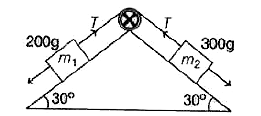 From free body diagram `T-m_1 G SIN THETA =m_1 a……..(i)` and `m_2 g sin theta - T =m_(2)a…….(ii)` Addings EQS (i) and (ii), we get `(m_2-m_1)g sin theta = (m_1 + m_2)a` `rArra=((300-200)g sin 30^(@))/(3000+200)` `rArra=1/10 g` `thereforea=10% of g ` |
|
| 1585. |
The three coloured bands on a carbon resistor are red, green and yellow respectively. Write the value of its resistance. |
| Answer» SOLUTION :VALUE of GIVEN resistance is ` [25 xx 10^4 PM 20%] Omega` . | |
| 1586. |
The equation of stationary wave is y=3sinpix/20cospit (cm). The distance between antidote and next node is : |
|
Answer» 40cm |
|
| 1587. |
A square loop of wireof side 5 cm is lying on a horizontal table. Anelectromagnet above and to one side of the loop is turned on, causing a uniform magnetic field downwards at an angle of 60^@ to the vertical as shown in figure. The magnetic induction is 0.50 T. The average induced emf in the loop, if the field increases from zero to its final value in 0.2 s is |
|
Answer» `5.4xx10^(-3)` V `epsilon=(dphi)/(dt)=((NBA cos theta - 0))/t` `=(1xx0.5xx25xx10^(-4) cos 60^@-0)/0.2` or `epsilon= 3.12xx10^(-3)` V |
|
| 1588. |
The far point of a myopic person is 80 cm in front of his eyes. The power of the lens required to see very distant object is |
|
Answer» - 1.25 D |
|
| 1589. |
A circular platform is free to rotate in a horizontal plane about a vertical axis passing through its center. A tortoise is sitting at the edge of the platform. Now, the platform is given an angular velocity c.o0. When the tortoise moves along the diameter of the platform with a constant velocity (with respect to the platform), the angular velocity of the platform omega(t) will vary with time t as |
|
Answer»
`I_(i)W_(i) = I_(F)omega_(F)`, hence `OMEGA` increases. Once the tortoise reaches the centre `omega` becomes MAXIMUM (since moment of inertia is minimum). Then the moment of inertia again starts increasing (as tortoise MOVES away from the centre). |
|
| 1590. |
Two idential speakers emit sound waves of frequency 660Hz uniformly in all directions. The audio output of each speaker is lmW and the speed of sound in air. A point P is a distance 2m from one speaker and 3m frorr the other. If they are driven coherently but out of phase by 180°. the intensity at the point .P. is: |
|
Answer» `55.3 MU W//m^(2)` |
|
| 1591. |
Physical quantity x and y arerelated as y=4tanx .If at x=(pi)/(4) radian error in measurement of x is 2% then find % error in measurement of y at x=(pi)/(4) |
|
Answer» `2%` |
|
| 1592. |
For a transistor a = 0.98 and emitter current I_(E) = 2.5 mA. Calculate collector current and base current |
| Answer» SOLUTION :2.45 mA, 50 `MU` A | |
| 1593. |
The path difference between two identical waves arriving at a point 100.5lambda. If the path difference is 44mum then wavelength of light, will be : |
|
Answer» 4378 |
|
| 1594. |
A wire of length 1 m carrying current 1A is bent in the from of a circle .The magnitude of magnetic moment is : |
|
Answer» `pi/2` |
|
| 1595. |
What is the expression for Biot-Savart law in vector form ? |
| Answer» SOLUTION :`[oversetto(DB)=mu_@/(4PI)(Idlxxr)/r^3]` | |
| 1596. |
Two capacitors of unknown capacitances C_1 and C_2 are connected first in series and then in parallel across a battery of 100 V . If the energy stored in the two combinations is 0.045 J and 0.25 J respectively , determine the value of C_1 and C_2 . Also calculate the charge on each capacitor in parallel combination . |
|
Answer» <P> Solution :When CAPACITORS , `C_1` and `C_2` are joined in series then the equivalent capacitance `C_(s) = (C_(1) C_2)/(C_(1) + C_(2))` and in parallel arrangement the equivalent capacitance `C_(p) = ( C_(1) + C_(2))` . As voltage V = 100 V , energy stored by series combination `U_(s) = 0.045` J and energy stored by parallel combination `U_(p) = 0.25 J` , hence we have`U_(s)= (1)/(2) C_(s) V^(2) = (1)/(2) XX ((C_(1) C_(2))/(C_(1) + C_(2)))xx (100)^(2) = 0.045"" ..... (i)` and `U_(p) = (1)/(2) C_(p) V^(2) = (1)/(2) xx (C_(1) + C_(2)) xx (100)^(2) = 0.25 "" ..... (ii)` On solving EQUATIONS (i) and (ii) , we get : `C_(1) = 38.2 mu F` and `C_(2) = 11.8 mu F` In parallel combination voltage ACROSS each capacitor is same at V = 100 V `therefore` Charge on 1st capacitor `Q_(1)= C_(1) V = 38.2 xx 100 mu C = 3.82 mC` and charge on 2nd capacitor `Q_(2) = C_(2) V = 11.8 xx 100 mu C = 1.18 m C ` |
|
| 1597. |
A proton and alpha particle are accelerated through the same accelerating potential. Which one of the two has (a) greater value of de-broglie wavelength associated with it, and(b) less kinetic energy?justify your answer. |
|
Answer» SOLUTION :(a) de Broglie WAVELENGTH `lambda=h/p=h/SQRT(2mqV)` For same V, `1=alpha 1/sqrt(mq)` `therefore (lambdad)/(lambdaalpha)=sqrt((malphaqalpha)/(m_dq_d))=sqrt((2m_dxx2q_d)/(m_dq_d))=2/1` `therefore lambda_alpha > K_alpha` (b) Kinetic ENERGY, K = qV So, `qalpha > K_d` For same V , we have `K alpha > K_d` |
|
| 1598. |
lim_(Nrarroo)[(1-2sin theta)^nsum_(r=0)^n .^nC_r((sin 2 theta+sin thetasin2theta)/(2(costheta-sin2theta)))^r]^(1/theta) is equal to (where n in N) |
|
Answer» `e^(3n)` `lim_(thetararr0) [sum_(r=0)^n.^nC_r (sintheta+ sin^2theta)(1-2sin theta)^(n-r)]^(1/theta) ` `lim_(thetararr0) [(1-2 sintheta+sin theta+ sin^2 theta)^n]^(1/theta)` `elim_(thetararr0) [-sin theta + sin^2theta]n/theta` `elim_(thetararr0) (sin theta-1)n` `e^(-n)` |
|
| 1599. |
What is the (i) speed (ii) Momentum (iii) de- Broglie wavelength of an electron having kinetic energy of 120 eV ? |
|
Answer» SOLUTION :`(a) 6.5 xx 10^6 m//s` (b) `5.92 xx 10^(-24) KG m//s` (C ) 0.112 NM. |
|
| 1600. |
A common flashlight bulb is rated 0.30A and 2.7V (the values of the current and voltage under operating conditions.) If the resistance of the tungsten bulb filament at room temperature 20^(@)C is 1.0Omega and its temperature coefficient of resistivity is 4.0 xx 10^(-3)C^(-1), then find the temperature in centigrade of the filament when the bulb is on. (Consider the variation of resistance to be linear with temperature.) |
|
Answer» |
|


