

Saved Bookmarks
This section includes 7 InterviewSolutions, each offering curated multiple-choice questions to sharpen your Current Affairs knowledge and support exam preparation. Choose a topic below to get started.
| 1. |
A prism has a prism angle 60^(@). A light ray incident at an angle of 45^(@) deviates by an angle 40^(@). Calculate the angle between emergent ray and prism surface. |
| Answer» SOLUTION :`55^(@)` | |
| 2. |
A specially designed diode which emits light energy when forward biased is called ? |
|
Answer» |
|
| 3. |
One end of a steel wire of area of cross section 3mm^2 is attached to the ceiling of an elevator moving up with an acceleration of 2.2m/s^2 . What is the stress developed in the wire if a load of 8kg is attached at it's free end. |
|
Answer» Solution :Tension in the wire (T) `= m (g+a) = 8 [9.8 + 2.2] = 96 N ` `THEREFORE stress = F//A = T//A = (96N)/(3 xx 10^(-6) m^2) = 32 xx 10^6 N/m^2` |
|
| 4. |
A rod of a magnetic material move with very small velocity v as shown in Figure below , through a uniform magnetic field . Drawn how the magnetic lines of force take shape, if the magnetic material is (i) Ferromagnetic (ii) Paramagnetic and (iii) Diamagnetic. |
Answer» SOLUTION :
|
|
| 5. |
Figure shows a charge rod, bent in the from of an arc of a circle. The charge distribution on the rod is shown in figuire. The assembly is kept in a uniform electric field. (a) Find the dipole moment of the rod. (b) For small angular displacement the system find the time period of oscillation of the system. |
|
Answer» |
|
| 6. |
The refractive indices of crown glass prism for C, D and F lines are 1.527, 1.530 and I.535 respectively. The dispersive power of the crown glass prism is |
|
Answer» 0.01509 |
|
| 7. |
Heat is produced at a rate given by H in a resistor when it is connected across a supply of voltage V. If now the resistance of the resistor is doubled and the supply voltage is made V//3 then the production of heat in the resistor will be |
|
Answer» Solution :`H=(V^(2))/(R )""…(i)` When R is doubled and V becomes `(V)/(3)`, then `H.=((V//3)^(2))/(2R)=(1)/(18)(V^(2))/(R)=(H)/(18)` (USING (i)) |
|
| 8. |
In the above question the potential of the point B and D are |
|
Answer» `V_B = 8V` |
|
| 9. |
A TV tower is 120 m high. How much more height is to be added to it its coverage range is to become double? Or, Draw a neat diagram of Amplitude Modulated Wave. Write down the formula of 'Modulation Index'. |
|
Answer» Solution :Coverage range, d = `sqrt(2hR),`where h = height of the TV TOWER As R = radius of the earth = constant, d `prop sqrt(h)`, So d becomes DOUBLE when h becomes 4 times. `THEREFORE` New height of the tower = `4 xx 120` = 480 m `therefore` Increases in height = ( 480 -120) = 360 m |
|
| 10. |
The equation of a plane progressive wave is y=50sin2pi(4t-5x). Where y and x are in an and t in seconds. Calculate the amplitude, frequency, wavelength and velocity of the wave. |
| Answer» | |
| 11. |
For a circular coil of radius R and N turns carrying current. Prove that the magnitude of the magnetic field at a point on its axis at a distance X from its centre is given by B=(mu_0IR^2N)/(2(x^2+R^2)^(3//2)) |
|
Answer» Solution :(a) We have, `B=(mu_(0)NIR^(2))/(2(x^(2)+R^(2))^(3/2))` For finding MAGNETIC field on the centre of above circular coil we should take x = 0 and then, `B_("centre")=(mu_(0)NIR^(2))/(2R^(3))=(mu_(0)NI)/(2R)` Above is also the magnetic field at the centre of current carrying extremely thin circular ring. (b)  (1) Above is the figure as per the statement. (2) Here, `PP_(1)=PP_(2)=DeltaxltltltltR` (3) At point `P_(1)`, MAGNITUDE field due to coil-1 is, `B_(1)=(mu_(0)NIR^(2))/(2(x_(1)^(2)+R^(2))^(3/2))` `thereforeB_(1)=(mu_(0)NIR^(2))/(2{(R/2-Deltax)^(2)+R^(2)}^(3/2))""...(1)` `B_(1)=(mu_(0)NIR^(2))/(2{R^(2)/4+(Deltax)R+(Deltax)^(2)+R^(2)}^(3/2))` (4) Now, since `Deltax` is very small, neglecting `(Deltax)Rand(Deltax)^(2)` we get, `B_(1)~~(mu_(0)NIR^(2))/(2(5/4R^(2))^(3/2))=(mu_(0)NI)/(2(5/4)^(3/2)R)""...(2)` (5) At point `P_(1)`, magnetic field due to coil-2 is, `B_(2)=(mu_(0)NIR^(2))/(2(x_(2)^(2)+R^(2))^(3/2))` `thereforeB_(2)=(mu_(0)NIR^(2))/(2{(R/2+Deltax)^(2)+R^(2)}^(3/2))""...(3)` `thereforeB_(2)=(mu_(0)NIR^(2))/(2{R^(2)/4+(Deltax)R+(Deltax)^(2)+R^(2)}^(3/2))` (6) Now since `Deltax` is very small, neglecting `(Deltax)Rand(Deltax)^(2)` we get, `B_(2)~~(mu_(0)NIR^(2))/(2(5/4R^(2))^(3/2))=(mu_(0)NI)/(2(5/4)^(3/2)R)""...(4)` (7) Now, since `vecB_(1)||vecB_(2)`, resultant magnetic field at point `P_(1)` will be, `B=B_(1)+B_(2)` = `(mu_(0)NI)/((5/4)^(3/2)R)` = `(4/5)^(3/2)(mu_(0)NI)/R` = `=0.715(mu_(0)NI)/R` `thereforeB~~0.72((mu_(0)NI)/R)""...(5)` (8) Similarly if we find out resultant magnetic field at point `P_(2)`, in above figure, we get it same as given be equation (5). THUS in above situation in the length `P_(1)P_(2)=2(Deltax)` along the common axis around centre point P, magnetic field remains uniform whose constant magnitude is equal to `0.72((mu_(0)NI)/R)`. Such a PAIR of coil (shown in the diagram) is called "Helmholtz coils". |
|
| 12. |
A convex lens forms the image of the sun at a distance of 10 cm. Where will be the image whenanother lens of same power but double the aperture is used ? |
| Answer» SOLUTION :Since aperture does not AFFECT f therefore the IMAGE WOULD still be formed at a DISTANCE of 10 cm. | |
| 13. |
For an electronic value the plate current I_p and the plate voltage V_p in the space charge limited region are related as : |
|
Answer» `I_p PROP (V_p)^(3/2)` |
|
| 14. |
If the two particles performing S.H.M. with same amplitude and initial phase angle, then the initial phase angle of resultant motion depends on |
|
Answer» initial PHASE angle only |
|
| 15. |
Magnetic field intensity due to a dipole at a point is B = mu_0/(4pi) xx_____ |
| Answer» SOLUTION :`M/r^2 SQRT(3cos^2 THETA + 1)` | |
| 16. |
The mass of block A is 100 kg and that of block B is 200 kg. The coefficient of friction between A and B is 0.2 and that between B and ground level is 0.3. The minimum force which will make the block B move, will be: |
|
Answer» 900 N |
|
| 17. |
A body is projected at an angle such that K.E. at the highest point is reduced to half the energy at point of projection. The angle of projection is |
| Answer» Answer :B | |
| 18. |
In Fig 27-50, epsi=24.0 V, R_(1)=2000 Omega, R_(2)=3000 Omega and R_(3)=4000 Omega. What are the potential differences (a) V_(A)-V_(B) (b) V_(B)-V_(C) (c) V_(C)-V_(D) and (d) V_(A)-V_(C)? |
|
Answer» |
|
| 19. |
Match the measurements given in List I with the number of significant figures given in List II. The correct answer is |
|
Answer» `{:("A","B","C","D"),("IV","II","III","I"):}` In 0.029 number of significant figures = 2 In 0.002407 number significant figures = 4 In `2.47xx10^(7)` number of significant figures = 3 |
|
| 20. |
What is work function ? |
| Answer» SOLUTION :It is the minimum ENERGY required to LIBERATE an electron from METAL SURFACE. | |
| 21. |
Under space charge limited conditions , the plate current in a diode is 10 mA at place potential of 100 V, If the plate potential is changed to 400 V, what is the plate current ? |
|
Answer» 100 mA `i propV^(3/2),i_1/i_2=((V_1)/V_2)^(3/2)" or "i_1=10xx((400)/100)^(3/2)` or `i_1=10xx8=80` mA |
|
| 22. |
The period of oscillation of a particle moving with S.H.M. with maximum acceleration α and maximum velocity β will be |
|
Answer» `2PI β//α` |
|
| 23. |
(a) How does an unpolarised light incident on a polaroid get polarised ? Describe briefly, with the help of a necessary diagram, the polarisation of light by reflection from a transparent medium. (b) Two polaroids 'A' and 'B' are kept in crossed position. How should a third polaroid 'C' be placed between them so that the intensity of polarised light transmitted by polaroid B reduces to 1/8 th of the intensity of unpolarised light incident on A? |
|
Answer» Solution :The third polaroid, C, should be placed at an angle of `45^@` with pass axis of POLARISER A, therefore, `I_A = I_0 cos^2 45^@` (Intensity of LIGHT coming from A). `I_A = (I_0)/2` `I_C = (I_0)/2 cos^2 45^@` (Intensity of light coming from polaroid) `=(I_0)/2 (1/(sqrt2))^2 = (I_0)/4` `I_B = (I_0)/4 cos^2 45^@` (Intensity of light coming from polaroid B) `= (I_0)/4 (1/(sqrt2))^(2) = (I_0)/8` Hence, the polaroid C should be at an angle of `45^@` with polaroid A. |
|
| 24. |
Unpolarized light of intensity I passes through an ideal polarizer A. Another identical polarizer B is placed behind A. The intensity of light beyond B is found to be (1)/(2) . Now another identical polarizer C is placed between A and B. The intensity beyond B is now found to be (1)/(8). The angle between polarizer A and C is ...... |
|
Answer» `0^(@)`  The intensity of light coming from plate A `(1)/(2)` is Which is also the intensity of light coming from C (intensity before B) is `(1)/(2)` `:.` The intensity of light coming from C, `:.(I)/(8)=(I)/(2) cos^(2) THETA` `:.(I)/(4)=cos^(2) theta` `:. (I)/(2)= cos^(2) theta` `:. theta=6^(@)` |
|
| 25. |
The velocities of sound at the same temperature in two monoatomic gases of densities rho_(2) and rho_(2) are v_(1) and v_(2) respectively. If rho_(2)//rho_(2) = 4 , then value of v_(1)//v_(2) is : |
|
Answer» 1/4 `(v_(1))/(v_(2)) = (1)/(2)` . CORRECT CHOICE is (c) . |
|
| 26. |
Assume that the silicon diode in the circui shown in fig. requires a minimum current of 1mA to be above the knee point (0.7V) of its I-V characteristics. Aslo assume that the voltage across the diode is independent of current above the knee point. (a) If V_(B)=5V, what should be the maximum value of R so that the voltage is above the knee point? (b) If V_(B)=5V, what should be the value of R to estabilish the current of 5mA in the circuit? (c) What is the power dissipated in the resistance R and in the diode, when a current of 5mA flows in the circuit at V_(B)=6V? (d) If R=1kOmega, what is the minimum voltage V_(B) required to keep the diode above the knee point? |
|
Answer» |
|
| 27. |
A place large aluminium sheet is connected to a bettery of emf epsi=12V The sheet develops surface density of charge sigma =0.9 nC//m^(2) Calculate the potential at apoint distant x=2 along the normal to the sheet At what distance potential is zero ? |
|
Answer» |
|
| 28. |
A copper wire of non-uniform area of cross-section is connected to a d.c. battery. The physical quantity which remains constant along the wire is |
|
Answer» |
|
| 29. |
The first diffraction minimum due to a single slit Fraunhoffer diffraction is at the angle of diffraction 30^(@) for a light of wavelength 5460A^(@). The width of the slit is |
|
Answer» `1.082 XX 10^(-4) cm` |
|
| 30. |
The equation of trajectory in case of projectitle fired horizontally from certain height is given by x^2 = (-) and the path is _____. |
|
Answer» |
|
| 31. |
A moving coil galvonometer of resistance R_G gives a full scale deflection for current I_g. Use the suitable circuit diagram convert it into an ammeter of range 0 to I (I > I_g). Deduce the expression for the shunt required for this conversion. Hence, write the expression for the resistance of the ammeter thus obtained. |
|
Answer» Solution :Let a MOVING coil galvonometer of resistance `R_G`, gives FULL scale DEFLECTION for a current `I_g`. To convert it into an ammeter of range I, we join a shunt resistance of suitable value `r_s` so that out of total current I only a part `I_g` passes through the galva-nometer and rest of the current is passed through the shunt. It means that `I_g = (r_s)/(r_s + r_G) cdot I` `implies r_s = R_G cdot (I_g)/(I - I_g) = (R_G)/(((I)/(I_g) - 1)) = (R_G)/(N-1) "[ where " n = I/(I_g)]` As in an ammeter resistance of galvanometer `R_G` and shunt resistance `r_s` are joined in parallel , the net resistance of the ammeter `(r_A)` is given by `r_A = (R_G cdot r_s)/((R_G + r_s)) `, which is even LESS than the shunt resistance `r_s`. 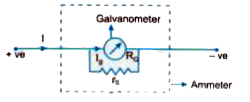
|
|
| 32. |
The separation between the plates of a parallel plate capacitor , connected to a battery (zero resistance) of constant EMF is increased with constant (very slow) speed by external forces . During the process, w is the work done dy external forces. DeltaU is the change in potential energy of the capacitor , w_b is work done by the battery and H is the heat loss in the circuit . Then |
|
Answer» `w+w_b=DeltaU` |
|
| 33. |
Give the symbolic representation of alpha decay, beta decay and gamma decay. |
|
Answer» Solution :Alpha decay : The alpha decay process symbolically in the following way `""_(Z)^(A)"X"""_(Z-2)^(A-4)"Y" + ""_(2)^(4)"He"` Beta decay : `beta` decay is reprsented by `""_(Z)^(A)"X" to ""_(Z-1)^(A)"Y" + E^(+) + v` Gamma decay : The gamma decay is GIVEN by `""_(Z)^(A)"X"^(*) to ""_(Z)^(A)"X" +` gamma `(gamma)` RAYS |
|
| 34. |
In case of pulling & pushing minimum forces required are (w sin alpha)/(cos(theta-alpha)_(r )) & (w sin alpha)/(cos(theta+alpha)) then accelerations are |
|
Answer» `a=G, a=g//mu` |
|
| 35. |
Determine the equivalent resistance of networks shown in figure. |
Answer» Solution : EQUIVALENT resistance of one loop (parallel connection of 2 `Omega and 4 Omega `) `R. = (2 xx 4)/(2 + 4) = (8)/(6) = (4)/(3) Omega` Now, given network can be SHOWN as follow, `rArr ` Equivalent resistance of given network will be  R = 4 R. = `4 xx (4)/(3)` `= (16)/(3) Omega = 5.3 Omega` (ii) Here FIVE resistances each ofR `Omega` are connected in series and so that equivatent resistance would be, `R_(S) = R + R + R ` + R +R `THEREFORE R_(S) = 5 R Omega` |
|
| 36. |
The density of the photosphere assessed with the aid of optical methods is 2 x 10^(-4)4 kg//m^3. Find the average gas pressure in the photosphere and the mean free path of hydrogen atoms. |
|
Answer» |
|
| 37. |
Only a prisoner, confined for long behind high walls, can understand the |
|
Answer» PSYCHOLOGICAL VALUE |
|
| 38. |
Determine the focal length of the lens made up of a material of refractive index 1.52 as shown in the diagram. ( PointsC_(1) and C_(2) are the centers of curvature of the first and second surface). |
|
Answer» Solution :This lens is called convexo - concave lens Give: `n = 1.52, R_(1) = 10 CM and R_(2) = 20` Lens makers formula. `(1)/(F) = (n-1)((1)/(R_(1))-(1)/(R_(2)))` Substituting the values. `(1)/(f)=(1.52-1)((1)/(10)-(1)/(20))` `(1)/(f)=(0.52)((2-1)/(20))=(0.52)((1)/(20))=(0.52)/(20)` `f = (20)/(0.52) = 38.46 cm` 
|
|
| 39. |
If density (D), acceleration (a) and forcc (F) are taken as basic quantities, then Time period has dimensions |
|
Answer» `(1)/(6)` in F |
|
| 40. |
Data signal, communicated through internet is a ______ signal. |
|
Answer» |
|
| 41. |
An alpha-particle having energy 10MeV collides with a nucleus of atomic number 50. Then distance of closest approach will be |
|
Answer» `14.4xx10^(-16)` m |
|
| 42. |
A plane electromagnetic wave travels in vacuum along z-direction. What can you say about the direction of electric and magnetic field vectors ? |
| Answer» Solution :If a plane electromagnetic wave TRAVELS in vacuum along z-DIRECTION, then direction of electric field VECTOR is along x-direction and that of MAGNETIC field along y-direction or vice versa. | |
| 43. |
(A) : In series LCR circuit, the resonance occurs at one frequency only. (R): At resonance the inductive reactance is equal and opposite to the capacitive reactance. |
|
Answer» Both 'A' and 'R' are TRUE and 'R' is the correct explanation of 'A'. |
|
| 44. |
The rest mass of photon is : |
|
Answer» 0 |
|
| 45. |
The total charge, induced in a onducting loop when it is moved in magnetic field depend on |
|
Answer» the rate of CHANGE of magnetic flux Hence total charge induced in the conducting loop depend upon the total change in magnetic flux. As the emf of iR depends on rate of change of `phi`, charge induced depends on change of flux. |
|
| 46. |
The ratio of the velocity of electron in 3rd and 5th orbit of hydrogen atom is |
|
Answer» `5:3` |
|
| 47. |
A Young.s double slit experiment uses a monochromatic source. The shape of the interference fringes formed on a screen |
|
Answer» STRAIGHT line |
|
| 48. |
A 10 V cell of negligible internal resistance is connected in parallelacross a battery of emf 200 V and internal resistance 38 Omegaas shownin the Fig. Find the value of current in the circuit. |
|
Answer» Solution :Net VOLTAGE in the circuit V= (200 – 10) V= 190 V and net resistance `R = 38 Omega` ` therefore ` VALUE of CURRENT in the circuit `I= V/R = 190/38 = 5A` |
|
| 49. |
Which of the following electromagnetic radiations have the smallest wavelength ? |
|
Answer» X-rays |
|
| 50. |
The equation of projectile is y=sqrt(3)-g/2x^(2) , the angle of its projection is : |
|
Answer» `pi/2` `y=xtantheta -(G/(2u^(2)cos^(2)theta)).x^(2)`compairing this with `y=sqrt(3x)-g x^(2)/2` we have `tantheta=sqrt(3)` |
|