

Saved Bookmarks
This section includes 7 InterviewSolutions, each offering curated multiple-choice questions to sharpen your Current Affairs knowledge and support exam preparation. Choose a topic below to get started.
| 1. |
In the experiment of calibration of a voltmeter, a 1.1 V standard cell gets balanced at 440 cm length of wire. The balancing length corresponding to a potential difference between the ends of a resistance comes out to be 190 cm. A voltmeter shows 0.5 V for this potential difference. The error in the reading of voltmeter will be |
|
Answer» `0:025 V` |
|
| 2. |
A heat engine works on a carnot cycle with a heat sink of 27^(@)C. The efficiency is 10%. The temperature of source is |
|
Answer» 270K `(300)/(T_(1))=0.9` `T_(1)=(3000)/(9)=333K` `t_(1)=333-273` `=60^(@)C`. |
|
| 3. |
A person standing on an insulated tool, touches a charged insulated conductor. Is the conductor discharged completely ? |
| Answer» SOLUTION :The CONDUCTOR is not discharged completely. The charge is shared between the conductor and the man TILL they both ACQUIRE the same POTENTIAL. | |
| 4. |
The work done in splitting a drop of water of 1 mm radius into 64identical droplets is (S.T. of water is 72xx10^(-3) j//m^2) |
|
Answer» `2.0xx10^(-6)`J |
|
| 5. |
Arrange in increasing order of solubility of AgBr in solutions given (i)0.1 M NH_(3)(ii)0.1 MAgNo_(3)(iii)0.2 M NaBr (iv)pure water |
|
Answer» `(III)lt(ii)lt(iv)lt(i)` `rarr "in" 0.1 M AgNO_(3) "(Solubilty downarrow)"` `rarr "in" 0.2 MNaBr "(Solubility downarrowmore)"` `rarr "in pure water (Normal DISSOLUTION)"` (iii),`"lt"(ii),"lt"(iv),"lt"(i)` |
|
| 6. |
What is the gravitational potential energy of a particle of mass m kept at a distance x from the centre of a disc of mass M on its axis ? The radius of the disc is R. |
|
Answer» |
|
| 7. |
Plot a graph to show the variation of the angle of deviation as a function of angle of incidence for light rays passing through a prism. Write the relation for the refractive index of the prism in terms of the angle of minimum deviation and the angle of the prism. |
Answer» Solution :A graph showing the variation of the angle of DEVIATION (8) as a function of angle of incidence (`delta`) for light rays passing through a prism is SHOWN in Fig. 9.45. The relation for the refractive INDEX (n) of the prism is  `n=(SIN(A+ D_(m))/2)/(sin(A/2))` Here, A = angle of prism and `D_m` = angle of minimum deviation. |
|
| 8. |
State the sign convention for applying Kirchhoff's first rule. |
| Answer» SOLUTION :Rule follows from the law of COSERVATION of energy for an isolated system (The energy supplied by the emf sources is equal to the sum of the energy delivered to all RESISTORS). The PRODUCT of current and resistance is taken as positive when the direction of the current is followed. Suppose if the direction of current is OPPOSITE to the direction of the loop, then product of current and voltage across the resistor is negative. The efmis considered positive when proceeding from the negative to the positive terminal of the cell. | |
| 9. |
Having gone through a plank of thickness h, a bullet changed its velocity from v_0 to v. Find the time of motion of the bullet in the plank, assuming the resistance force to be proportional to the square of the velocity. |
|
Answer» Solution :ACCORDING to the problem `m(DV)/(dt)=-kv^2`or, `m(dv)/(v^2)=-kdt` Integrating, within the limits, `UNDERSET(v_0)overset(v)int(dv)/(v^2)=-k/m underset(0)overset(t)intdt` or, `t=m/k((v_0-v))/(v_0v)` (1) To FIND the value of k, rewrite `mv(dv)/(ds)=-kv^2`, or, `(dv)/(v)=-k/mds` On integrating `underset(v_0)overset(v)int(dv)/(v)=-k/m underset(0)overset(h)intds` So, `k=m/h1n(v_0)/(v)` (2) Putting the value of k from (2) and (1), we get `t=(h(v_0-v))/(v_0v1nv_0/v)` |
|
| 10. |
The gold numbers of protective colloids A,B,C and D are 0.04, 0.004 , 10 and 40 respectively. The protective powers of A,B,C and D are in the order: |
|
Answer» `AgtBgtCgtD` |
|
| 11. |
The current (i_(1))(in A ) flowing through 1 Omega resistor in the following circuit is: (a) 0.50 (b) 0.30 (c) 0.25 (d) 0.20 |
|
Answer» `0.50`  Equivalent resistance between C and D, `R_(1) = (1xx 1)/(1 + 1) = (1)/(2) Omega ` Equivalent resistance between B and E, `R_(2) = R_(1) + 2 = (1)/(2) = (1)/(2) + 2 = (5)/(2)` Now, equivalent resistance of `R_(2) and 2 Omega` of AF, `R_(3) =(R_(2) XX 2)/(R_(2) + 2) = ((5)/(2) xx 2 )/((5)/(2) + 2)= (5 xx 2)/(9) = (10)/(9) Omega` In given circuit, voltage of BE = Voltage of AF = 1 V `therefore ` Current flowing through BE= `(V)/(R_(2)) =(1)/((5)/(2)) = (2)/(5) `A Now, current flowing in B-C-O-E is same and itis `(2)/(5)` A `therefore `Current flowing through any resistorof `1 Omega`, `I = (1)/(2) xx (2)/(5)` `thereforeI = (1)/(5)"" therefore I = 0.20 `A |
|
| 12. |
For a given single-slit, the diffraction pattern is obtained on a fixed screen by using red light and then with blue light. In which case, will the central maxima, in observed diffraction pattern, have a larger angular width ? |
| Answer» SOLUTION :For blue LIGHT the angular WIDTH of central diffraction MAXIMUM is more than that for red light. | |
| 13. |
If a carrier wave of 1000 kHz is used to carry the signal, the length of transmitting antenna will be equal to : |
|
Answer» 3 |
|
| 14. |
Consider a metal exposed to light of wavelength 600nm.The maximum energyof the electron doubles when light of wavelength 400 nm is used .Find the work function in eV. |
|
Answer» Solution :Showing maximum kinetic energy `(1)/(2) mv_(MAX)^(2)` by symbol K,according to photoelectric equation , `hv=hv_(0)+k` `therefore (HC)/(lambda)=phi_(0)+k` (i)For `lambda_(1),(hc)/(lamba_(1))=phi_(0)+K_(1)` …….(1) (II) For `lambda_(2),(hc)/(lambda_(2))=phi_(0)+2K_(1)` ......(2) `(because K_(2)=2K_(1))` From equation (1) and (2) `(hc)/(lambda_(2))=phi_(0)+2((hc)/(lambda_(1))-phi_(0))` `therefore phi_(0)=hc((2)/(lambda_(1))-(1)/(lambda_(2)))` `therefore phi_(0)=6.625x10^(-34)xx3xx10^(8)` `xx((2)/(600xx10^(-9))-(1)/(400xx10^(-9)))` `therefore =(6.625xx10^(-34)xx3xx10^(8))((2)/(600)-(1)/(400))` `therefore phi_(0)=(6.625xx10^(-34)xx3xx10^(8))/(10^(-9))((200)/(600xx400))` `=(6.625xx10^(-34)xx3xx10^(8))/(10^(-9))xx(1)/(1200)` `=1.656xx10^(-9)J` `therefore phi_(0)=(1.656xx10^(-19))/(1.6xx10^(-19))eV=1.035 eV` |
|
| 15. |
Resistance of a wire is 8Omega. It is drawn in such away that it experiences a longitudinal strain of 400 %. The new resistance is |
|
Answer» `100Omega` |
|
| 16. |
The equations of motion of a particle of mass m in circular motion with constant angular speed omega " are " x=rcosomegat " and " y=rsinomegat. Write the expression for the force in the particle. |
| Answer» Solution :The PARTICLE is performing UCM with RADIUS vector `vecr=xhati+yhatj=r(cosomegathati+sinomegathatj). " SINCE " veca=-omega^2vecr`, the force on the particle is `vecF=mveca=-momega^2r(cosomegathati+sinomegathatj)`. | |
| 17. |
A disc of radius R rotates at an angular velocity omega about the axis perpendicular to its surface and passing through its centre. If the disc has a uniform surface charge density sigma, find the magnetic induction on the axis of rotation at a distance x from the centre. (Given R=3m, x=4m and mu_(0)sigmaomega=20Tesla//m.) |
|
Answer» Solution :Consider a ring of RADIUS `r` and width `dr`. `dq=(2pirdr)sigma` Current due to the ring is `DI=(omegadq)/(2pi)=sigmaomegardr` Magnetic field due to this ring at point `P` is, `dB=(mu_(0)dIr^(2))/(2(r^(2)+X^(2))^(3//2))` or `intdB=(mu_(0)sigmaomega)/(2)int_(0)^(R )(r^(3)dr)/((r^(2)+x^(2))^(3//2))` Substituting `r^(2)+x^(2)=t^(2)`, and `2rdr=2tdt` and integrating we have `B-(mu_(0)sigmaomega)/(2)[(R^(2)+2X^(2))/(sqrt(T^(2)+x^(2)))-2x]`. 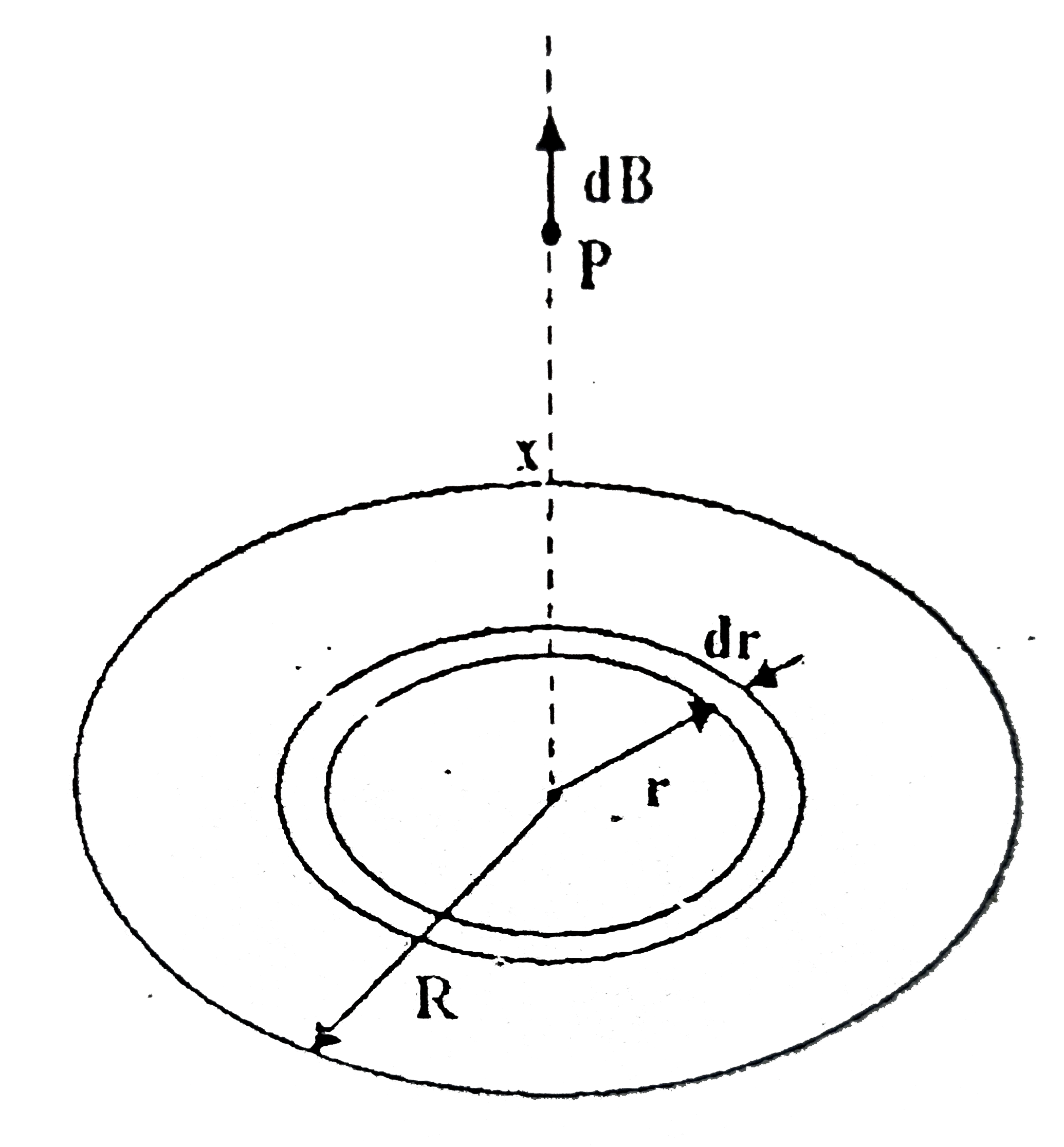
|
|
| 18. |
If a proton and an electron are confined to the same region.then uncertainty in momentum …….. |
|
Answer» for PROTON is more as COMPARED to the ELECTRON. |
|
| 19. |
The bob of a pendulum is released from a horizontal position. If the length of pendulum is 2 m, what is the speed with which the bob arrives at the lower most point. Assume that 10% of its energy is dissipated against air resistance. (Take g = 10 m s^(-2)) |
|
Answer» `8 MS^(-1)` |
|
| 20. |
The collector plate in an experiment on photoelectric effect is kept vertically above the emitter plate. Light source is put on and a saturation photo current is recorded. An electric field is switched on which has a vertically downward direction |
|
Answer» The PHOTO current will increase |
|
| 21. |
A rectangle loop of size l xx b carrying a steady current I is placed in a uniform magnetic field vecB. Prove that the torque vec(tau) acting on the loop is given by vec(tau) = vecm xx vecB, where vecm is the magnetic moment of the loop. |
Answer» Solution :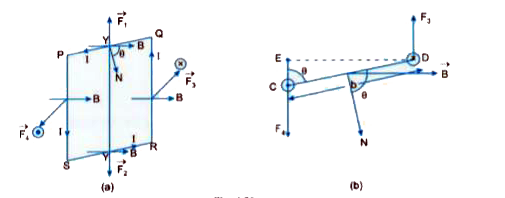 CONSIDER a rectangular coil PQRS of length l and breadth b, CARRYING current I, placed in a uniform magnetic field B such that a vectro normal to the plane of the coil subtends an angle `theta` from the direction of B. In this situation forces `F_1 and F_2` having magnitude `I b B sin theta` are acting on arms PQ and RS. The forces are equal, opposite nad collinear, hence they cancel out. Again forces `F_3 and F_4` having magnitude `I l B` are acting on each of the two arms QR and SP. These forces too are equal and opposite but these are non-collinear and form a couple whose TORQUE is given as : `tau = (I lB) XX b sin theta = I (lb) B sin theta = I A B sin theta` where `A = I b` = area of the loop. If instead of a single loop, we have a rectangular coil having N turns, then torque `tau = N I A B sin theta` In vector notation `vec(tau) = NI (vecA xx vecB) = (vecm xx vecB) `, where `vecm = N I vecA` = magnetic moment of current carrying coil. |
|
| 22. |
A condenser of capacity 6muF was originally charged to 10V. Now the RD. is made 20 V What is the increase in its potential energy : |
|
Answer» `2xx10^-4J` |
|
| 23. |
Surface tension of a liquid is 70 dyne/cm, in M.K.S. system it will be |
|
Answer» 70 N/m |
|
| 24. |
A man can walk on the shore at a speed v_1 = 6 km/hr & swim in still water with a speed V_2 = 5 km/hr. If the speed of water is V_3 = 4 km/hr, at what angle should he head in the river in order to reach the exactly opposite point of the other shore in "shortest time including his swimming & walking? |
|
Answer» Solution :Directly using the PREVIOUS result we obtain the angle of swimming `theta`-`SIN^(-1)(V_(MW))/(V+V_(w))` Putting v = `V_1` = 6 km/hr, `V_(mw)=V_(2)` = 5 km/hr `V_(w) - V_(3)` = 4 km/hr we obtain`theta `=` sin^(-1)(1/2) = 30^(@)` The man should head at an angle of a = `90^(@)` + 0 = `120^(@)` with the direction of flow of water. |
|
| 25. |
This problem is quite challenging in setting up but takes only a few of algebra to solve. We deal with not only uniformly circular motion but also a ramp. However we will not need a tilted coordinate system as with other ramps. Insttead we can take a freeze frame of the motion and work with simply horizontaly and vertical axes. As always in this chapter, the starting point will be to apply Newton's second law, but that will required us to identify the force component that is responsible for the uniform circular motion. Curved portions of highways. are always banked (tilted) to prevent cars from sliding off the highway. When a highway is dry, the frictional force between thetires and the road surface may be enough to prevent sliding. When the highway is wet, however, the frictional force may be neglifible, and baking is then essential. fig represents a car of mass m as it moves at a constant speed v to 20m/s around a banked circular track of radius R=190m. (It is a normal car, rather than a race car, which meas that any vertical force from the passing air is negligible). If the frictional force from the track is negligible, what bankangle theta prevents sliding? |
|
Answer» Solution :Here the track is banked so as to TILT the normal force `vecF_(N)` on the car toward the center of the circle. Thus `vecF_(N)`, now has a centripetal component of magnitude `F_(Nr)`,directed inward along a radiua axis r. We want to find the value off the bank ANGLE `theta` such that this centripetal component keeps the car onthe circular track witout need of friction. Radial calculation: As fig shows (and as you should verity), the angle that force `vecF_(N)` makes with the verical is equal to the bank angle `theta` of the track. Thus, the radial component `F_(Nr)` is equal to `F_(N)sin theta`. We can now write Newton.s second law for components along the r axis `(F_("net",r)=ma_(r))` is `-F_(N)-sin theta m(-(v^(2))/R)` We cannot solve this equation for the value of `theta` because it also contains the unknowns `F_(N)` and m. Vertical calculations: We NEXT consider the forces and acceleration along the y axis in fig. The vertical component of the normal force is `F_(Ny)=F_(N) cos theta`, the gravitational force `vecF_(g)` on the car has the magnitude mg and the acceleration of the car along the y axis is ZERO. Thus we ca write Newton.s second law for components along the y axis `(F_("net",y)=ma_(y))` as `F_(N)cos theta-mg=m(0)` From whcih `F_(N)cos theta=mg` Combining results: Equation also contains the unknowns `F_(N)` and m but note that dividing EQ. by eq neatly eliminates both those unknowns. Doing se replacing `(sin theta)//(cos theta)` with `tan theta`, and solving for `theta` then yield `theta=tan^(-1)(v^(2))/(gR)` `="tan"^(-1)((20m//s)^(2))/((9.8m//s^(2))(190m)=12^(2)` 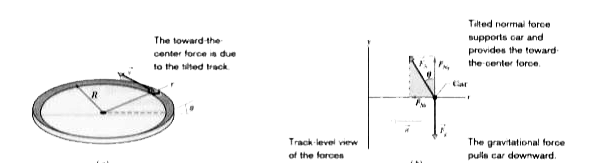
|
|
| 26. |
In column-I some situations are shown and in column-II information about their resulting motion is given. Select the correct answer using the codes given below the columns. |
|
Answer» `{:(,P,Q,R,S),((A),1,2,4,3):}` 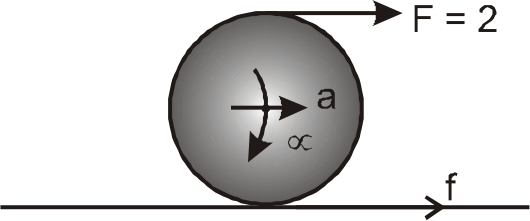 F+f=ma FR-fR=`2/5 MR^(2)ALPHA` `a=Ralpha` `f=6/7 N` `f_(L)=0.5 NrArr `friction is kinetic `(B) (##RES_DPP_PHY_06_E01_043_S02.png" width="80%"> 4-f=ma `4xx1/2+fxx1=2a` f=2N `f_(L)=3N` (C)  `a=(g sin theta)/(1+l/(mR^(2)))=(10xx1/2)/(1+1/2)=10/3 m//s^(2)` `mg sin theta-f =ma` `f=(mg)/2-ma=10-20/3 =10/3 N` `f_(L)=u_(s)N=2/5xx2xx10xx(sqrt(3))/2=4sqrt(3)` N static `(D) (##RES_DPP_PHY_06_E01_043_S04.png" width="80%"> `f_(L)=5N` f=10/3 N static `F-f=ma rArr 4-f =1a` `fxx1-4xx1/2=2xxa/R rArr f-2=2a, a=2//3 m//s^(2)` |
|
| 27. |
A water pump driven by petrol raises water at a rate of 0.5 m' min from a depth of 30 m. If the pump is 70% efficient, what power is developed by the engine? |
|
Answer» Solution :Here mass/MIN. `(dm)/(dt)=500 kg min^(-1)` =`(500)/(60)kg s^(-1)` Also `(70)/(100)xxP=(mgh)/(t)` or`P=(100)/(70).(mgh)/(t)` =`(100)/(70)xx(500)/(6)xx9.8xx30` =3500 W. |
|
| 28. |
A car moves with a constant tangential acceleration w_tau=0.62m//s^2 along a horizontal surface circumscribing a circle of wheels of the car and the surface is k=0.20. What distance will the car ride without sliding if at the initial moment of time its velocity is equal to zero? |
|
Answer» Solution :As initial velocity is ZERO thus `v^2=2w_ts` (1) As `w_tgt0` the speed of the car increases with time or distance. Till the MOMENT, sliding starts, the static friction provides the required centripetal acceleration to the car. Thus `f R =mw`, but `f r lekmg` So, `w^2lek^2g^2` or, `w_t^2+v^2/Rlek^2g^2` or, `v^2le(k^2g^2-w_t^2)R` HENCE `v_(max)=sqrt((k^2g^2-w_t^2)R)` so, from Eqn. (1), the sought distance `s=(v_(max)^2)/(2w_t)=1/2sqrt(((kg)/(w_t))^2-1)=60M`. |
|
| 29. |
A block is placed on roughfloorand ahorizontal forceF is applied on it . The forceof frictionf bythe flooron the blockismeasured for differentvalues of F and a graphis plotted between them (a) The graphis straight lineof slope45^(@) (b) Thegraphis straightlineparallel to the F - axis (c ) The graphis straightlineof slope45^(@)for smaalF and a straight line parallel to the F - axis for alrge F . (d )Thereis a smallkink on the graph |
|
Answer» a and C are TRUE |
|
| 30. |
In Fig 5.4 (b), the magnetic needle has magnetic moment 6.7 xx 10^(-2) Am^(2) and moment of inertia I=7.5 xx 10^(-6) Kg m^(-2). It performs 10 complete oscillation in 6.70s. What is the magnitude of the magnetic field? |
|
Answer» SOLUTION :The TIME period of OSCILLATION is, `T=(6.70)/(10)=0.67s` From EQ. (5.5) `B=(4PI^(2)g)/(m T)` `=(4 xx (3.14)^(2) xx 7.5 xx 10^(-6))/(6.7 xx 10^(-2) xx (0.67)^(2))` =0.01T |
|
| 31. |
The process of translating the information conta-ined by the low base band signal to high frequencies is called |
|
Answer» Detection |
|
| 32. |
A long straight wire in the horizontal plane carries a current of 50 A in north to south direction . Give the magnitude and direction of B at a point 2.5 m east of the wire . |
|
Answer» Solution :`I= 50 A, r = 2.5 m` `B = (mu_0 I)/(2 PI r) = (4pi xx10^(-7) xx 50)/(2 pi xx 2.5) = 4 xx 10^(-6) T` UPWARDS , (due to the WIRE ALONE) |
|
| 33. |
A prism has a refracting angle of 60^@. If it produces a minimum deviation of 30^@ , the angle of incidence is |
| Answer» ANSWER :C | |
| 34. |
A man weight 60 kg-wt at the earth's surface The radius of the earth is 6400 km. At what height above the earth's surface, his weight becomes 30 kg wt ? |
|
Answer» `0.2xx10^10erg` |
|
| 35. |
A beam of electrons is used in YDSE experiment.The slit width is d. When velocity of electron is increased, then |
|
Answer» no INTERFERENCE is observed The de- Brogile WAVE length `lambda = (h)/(mv)`, then decreases. Now `beta = lambda(D)/(d)` i.e. `beta INFTY lambda` |
|
| 36. |
What should be the maximum acceptance angle at the aircore interface of an optical fibre if n_(1) and n_(2) are the refractive indices of the core and the cladding, respectively |
|
Answer» `sin^(-1)(n_(2)//n_(1))` |
|
| 37. |
Lines of 6877 Å, 4989 Å and 4548 Å are observed in the visible range of the spectrum of a certain galaxy. To what substance do they belong? What can you say about the motion of this galaxy? |
|
Answer» `lamda/lamda_(0)=6877/6563=4980/4861=4548/4340=1.045` The red shift is DUE, obviously, to the motion of the galaxy away from us (the Doppler effect). We have `lamda=lamda_(0)sqrt((1+beta)/(1-beta)),"where "sqrt((1+beta)/(1-beta))=1.045` Solving this equation we find the speed at which the galaxy moves away from us. |
|
| 38. |
Potential barrier developed in a junction diode opposes |
|
Answer» MINORITY CARRIERS in both regions. |
|
| 39. |
Penetrating power of X-rays increase with the increase in its |
|
Answer» intensity |
|
| 40. |
The band of energies possessed by conduction electrons is known as_____. |
|
Answer» |
|
| 41. |
A cell of emf 1.5V is connected across an inductor of 2mH in series with a 2Omega resistor What is the rate of growth of current immediately after the cell is switched on. |
| Answer» SOLUTION :`750 As^(-1)` | |
| 42. |
A galvanometer can be converted into either an ammeter or a voltmeter. Before conversion, which of the following thing about the galvanometer you are required to know. i) Resistance of the galvanometer ii) The magnetic field in which the coil is rotating iii)Current for full scale deflection of galvanometer iv) Nature of its construction |
|
Answer» Only i is true |
|
| 43. |
A small particle of mass 1.8 xx 10^(-30)kg and charge -3.5 xx 10^(-19) C is dropped in a region of electric field of strength 2.8 xx 10^5 NC^(-1), directed in the upward direction. Calculate the time taken by the ball to cover a distance of 2 cm. |
| Answer» SOLUTION :`0.857xx10^(-9)` s | |
| 44. |
Obtain the expression for the half-life of a radioactive element. |
|
Answer» SOLUTION :It is defined as the time period during which half of the original atoms of the radiactive elementdisintegrate. LET `N_0` be the initial number of atoms of a radioactive sample. After a time INTERVAL EQUAL to the half life T , the number of atoms of the radioactive sample remaining will be `N_0/2`. Then `N=N_0/2` at `t=T_1//2` (A LUTTE bigger if possible not early visible ) w.k.t `N=N_0e^(-lambdat)` `cancelN_0/2=cancelN_0e^(-lambdaT_1//2) rArr 1//2=e^(-lambdaT_1//2) rArr 1/2=1/(e^(lambda)T_1//2) rArr 2=e^(lambda)T_1//2` `lambdaT_1//2=log_e^2 rArr T_1//2=2.303log_10^2=2.303xx0.3010`=0.693 `T_(1//2)=0.693/lambda` |
|
| 45. |
According to Einstein.s photoelectric equation, the plot of the KE of emitted photoelectrons from a metal and the frequency, of the incident radiation gives as straight line, whose slope |
|
Answer» depends both on the intensity of the radiation and the METAL used |
|
| 46. |
Two identical blocks A and B of mass M each are kept on each other on a smooth horizontal plane. There exists friction between A and B. A bullet of mass m hits the the lower block with a horizontal velocity v and goes embedded into it. Find the work done by friction between A and B. |
|
Answer» |
|
| 47. |
Two copper spheres A and B have equal radii. If sphere A has 100 electrons and sphere B has 400 protons then what will be the electric charge on each of them when they are brought in contact and separated ? |
|
Answer» `4.8 xx 10^(-17)` C `Q = n_(1)(-e) + n_(2)(e)` `=-100e + 400e = 300e` `=300 xx 1.6 xx 10^(-19) C = 4.8 xx 10^(-17) C` Equal charge will be distributed when they are separated. `THEREFORE` Total charge on each sphere `=(4.8 xx 10^(-17))/2` `=2.4 xx 10^(-17)` C |
|
| 48. |
number of identical equilateral prism are kept in contact as shown in figure ,If deviation through a single prism is delta. Then (n,m are integers) |
|
Answer» if N=2m, DEVIATION through n PRISMS is zero |
|
| 49. |
Frequency and wavelength of light in transparent material are 2xx10^(14) Hz and 5000 Å respectively, then its refractive index is |
|
Answer» `1.50` `v=2xx10^(14)xx5000xx10^(-10)` m `=10^8 MS^(-1)` `lambda=5000` Å `=5000xx10^(-10)` m Refractive INDEX `mu=c/v=(3xx10^8)/(10^8)` `therefore mu=3` |
|
| 50. |
(A) : Digital signals are preferred to analog signals for transmission of information. (R) : Analog signals require amplification and correction at suitable intervals. |
|
Answer» Both 'A' and 'R' are true and 'R' is the CORRECT explanation of 'A'. |
|