

Saved Bookmarks
This section includes 7 InterviewSolutions, each offering curated multiple-choice questions to sharpen your Current Affairs knowledge and support exam preparation. Choose a topic below to get started.
| 1. |
Astronunt in space shuttle at 400 km height from Earth surface is observing Earth. If diameter of retina of his eye is 5 mm and wavelength of light is 500 nm, then it will experience the resolution of range of ...... |
|
Answer» 0.5 m D=400 km = 400,000 m d=5 mm=`5xx10^(-3) m` `lambda=500 nm=500xx10^(-9)` m `therefore R=1.22xx(500xx10^(-9)xx4xx10^5)/(5xx10^(-3))` `=48.8` m `therefore R=50` m |
|
| 2. |
Entoptic halos. If someone looks at a bright outdoor lamp in otherwise dark surroundings, the lamp appears to be surrounded by bright and dark rings (hence halos) that are actually a circular diffraction pattern, with the central maximum overlapping the direct light from the lamp. The diffraction is produced by structures within the cornea or lens of the eye (hence entoptic). If the lamp is monochromatic at wavelength 550 nm and the first dark ring subtends angular diameter 2.0^(@) in the observer's view, what is the linear) diameter of the structure producing the diffraction? |
| Answer» SOLUTION :38 `MU m` | |
| 3. |
The Binding energy per nucleon of ""_(3)^(7)Li and ""_(2)^(4)Henuclei are 5.60 MeV and 7.06 MeV, respectively. In the nuclear reaction ""_(3)^(7)Li + ""_(1)^(1)Herarr H+ ""_(2)^(4)He + Q the value of energy released is |
|
Answer» `-2.4 ` MEV |
|
| 4. |
Two plane mirrors are making an angle of 60^(@) to each other. A light ray falls on one of the mirrors. The light ray is incident parallel to angular bisector of mirrors. How many reflection does the light ray undergo? |
|
Answer» |
|
| 5. |
Which of the following pairs of coils has zero coupling constant? |
|
Answer» |
|
| 6. |
Plot a graph showing the variation of stopping potential with the frequency of incident radiation for two different photosensitive having work functions W_1 and 1_2(W__1 gt W_2) . On what factors does the (i) slope and (ii) intercept of the lines depend ? |
|
Answer» Solution :The graph showing the variation of stopping POTENTIAL `(V_0)` with the frequency of incident radiation `(v_0) ` for TWO different photosensitive materials having work functions `W_1`and `W_2(W_1gt W_2)` is shown in FIG. (i) Slope of the line `=(Delta V)/(Deltav)=(h)/(e)`. `therefore ` Slope of the line depends on the Plank's constant h and the electronic CHARGE e. (ii) Intercept of graph A on the potential axis ` =("Work function (W))/("e")=-(hv_0)/(e)`. `therefore` Intercept of the line depends upon Planck's constant h, threshold frequency `(V_0)` and the electronic charge (e). 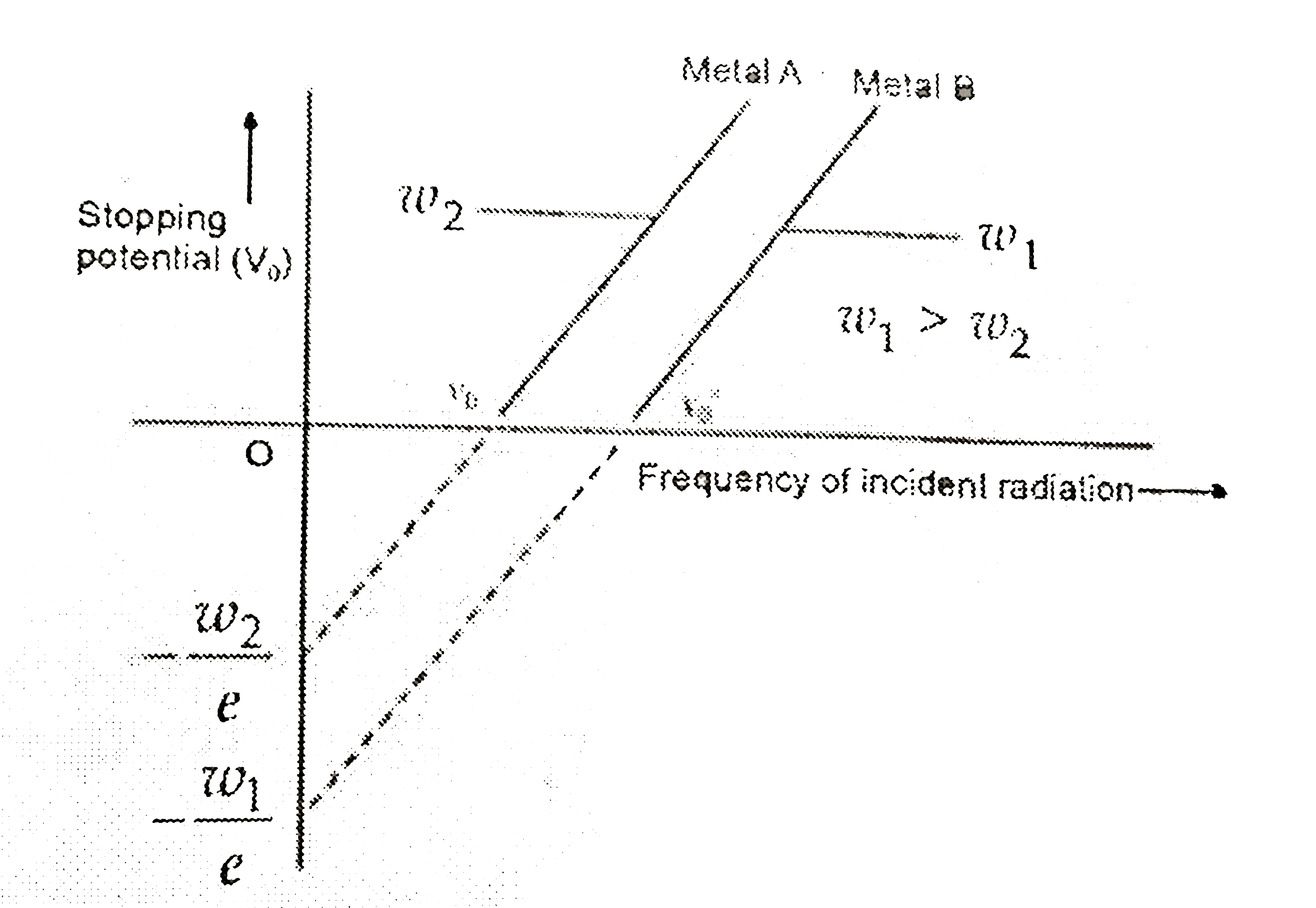
|
|
| 7. |
यदि A={1, 2, 3} तथा B={3, 4, 1} हो तो AuuB होगा |
|
Answer» `{1, 2, 3, 4, 5}` |
|
| 8. |
If a dc source of 7V is connected across AB, how much charge is drawn from the source and what is the energy stored in the network? |
|
Answer» SOLUTION :CALCULATION of CHARGE and energy stored Charge drawn from the source `Q=C_(eq)V`, `=6/7xx7muC=6muC` energy stored `=U=(Q^(2))/(2C)=(6xx6x10^(-12)xx7)/(2xx6xx10^(-6))J` `=6//7muF` |
|
| 9. |
Ifabs(vecA+vecB)=abs(vecA-vecB) find the angle between vecA and vecB. |
|
Answer» SOLUTION :Let `theta` be the angle between `vecA` and `vecB` Given `ABS(vecA+vecB)=abs(vecA+vecB)=abs(vecA-vecB)` `THEREFORE abs(vecA+vecB)^2=abs(vecA-vecB)^2` `vecAcdotvecA+vecBcdotvecB+2vecAcdotvecB=vecAcdotvecA+vecBcdotvecB-2vecAcdotvecB or `4vecAcdotvecB`=0 since A&B are non zero `costheta=0 or `theta=90^@` |
|
| 10. |
Solid cylinders of radii r_1,r_2 and r_3 roll down an inclined plane from the same place simultaneously. If r1 > r2 > r3 , which one would reach the bottom first? |
|
Answer» CYLINDER of RADIUS `r_1` |
|
| 11. |
A steel rule is calibrated at 22^(@)C against a standard so that the distance between numbered divisiions is 10.00 mm. a. What is the distance between these divisions when the rule is at -5^(@)C? (b) If a nominal length of 1 is measured with the rule at this lower temperature, what percent error is made? c. What absolute error is made for a 100 m length? [alpha_(st)=1.1xx10^(-5).^(@)C^(-1)] |
|
Answer» |
|
| 12. |
How does the change in temperature and application of electric field affect the behavior of materials and write the range of resistivity for each materials. |
|
Answer» Solution :(i) The gape is very large that electrons from valence band cannot move into conduction band even on the application of strong external ELECTRIC field or the increase in temperature. (II) The ELECTRICAL conduction is not possible as the free electrons are almost nil. (iii) Its resistivity is in the range of `10^(11)-10^(19)Omegam`. Metals (i)Condition become possible even at low temperatures. (ii) The application of electrical field provides sufficient energy to the electrons. to drift in a particular direction to constitute a current. (iii) The resistivity value lies between `10^(-2) and 10^(-8) Omegam` Semiconductors (i) At a finite temperature, THERMAL agitations in the SOLID can break the content bond between the atoms. (ii) This release some electrons from valence band to conduction band. (iii) Theresistivity value of semiconductor is from `10^(-5) " to " 10^(6)Omegam` (iv) When the temperature is increased further, more number of electrons is promoted to the construction band and increase the construction. (v) Thus, electronic conduction increase with the increase in temperature |
|
| 13. |
A railway flat car, whose mass together with the artillery gun is M, moves at a speed V. The gun barrel makes an angle with the horizontal. A shell of mass m leaves the barrel at a speed v, relative to the barrel. The speed of the flat car in order that it may stop after the firing is |
|
Answer» `(MV COS ALPHA)/(M - m)` |
|
| 14. |
A very long straight wire of radius r carries current I. Intensity of magnetic field B at point lying at a perpendicular distance 'a' from the axis is alpha ______ . (where altr) |
|
Answer» `a^(2)` |
|
| 15. |
In Young's double slit experiment, the distance between two slits is made three times then the fringe width will become ...... |
|
Answer» 9 TIMES `BETA=(lambdaD)/(d) and beta=(lambdaD)/(d)` Taking =3d Taking `d=3d` `beta=(lambdaD)/(3d)` Hence it will be `beta=(beta)/(3),(1)/(3)` times |
|
| 16. |
In context of Doppler.s effectin light , the term.red shift . signifies |
|
Answer» DECREASE in FREQUENCY |
|
| 17. |
When wheatstone's bridge is most sensitive ? |
|
Answer» <P> Solution :When all the four resistance P,Q,R and S are NEARLY of same magnitude. |
|
| 18. |
Which of the following is/are the limitations of amplitude modulation ? |
|
Answer» CLEAR reception |
|
| 19. |
An aluminium rod of length 90 cm is clamped at its midpoint and is set into longitudinal vibrations by stroking it with resined cloth. Assume that the rod vibrates in its fundamental mode of vibration . The density of aluminium is 2600 kg/m^(3)and its Young's modulus is 7.80 xx 10^(10) N//m^(2). speed of soundin air is 340 m/s. The speed of sound in aluminium is : |
|
Answer» 548 m/s so correct CHOICE is (B) . |
|
| 20. |
An aluminium rod of length 90 cm is clamped at its midpoint and is set into longitudinal vibrations by stroking it with resined cloth. Assume that the rod vibrates in its fundamental mode of vibration . The density of aluminium is 2600 kg/m^(3)and its Young's modulus is 7.80 xx 10^(10) N//m^(2). speed of soundin air is 340 m/s. The wavelength of sound produced in the rod is : |
|
Answer» Solution :`(LAMBDA)/(2) = l rArr lambda = 2L = 2 xx 90 = 180 ` cm so correct choice is (d). |
|
| 21. |
The instantaneous current and voltage of an a.c. circuit are given by 1 = 10 sin 300 t A and V = 200 sin 300 t V.What is the power dissipation in the circuit ? |
|
Answer» SOLUTION : It is clear that current and voltage are in same phase, hence, power factor `cos phi =1`. `therefore` Power `=V_(rms) I_(rms) = 1/2 V_(m)I_(m) =1/2 xx 200 xx 10= 1000 `W. |
|
| 22. |
An aluminium rod of length 90 cm is clamped at its midpoint and is set into longitudinal vibrations by stroking it with resined cloth. Assume that the rod vibrates in its fundamental mode of vibration . The density of aluminium is 2600 kg/m^(3)and its Young's modulus is 7.80 xx 10^(10) N//m^(2). speed of soundin air is 340 m/s. the frequency of the sound produced in air is : |
|
Answer» 3050 HZ so correct choice is (a) . |
|
| 23. |
A 1.0 kg block moving at 8.0 m/s strikes a spring fixed at one end to a wall and compresses the spring by 0.40 m, where its speed gets reduced to 2.0 m/s. After this event, the spring is mounted upright by fixing its bottom end to afloor, and a stone of mass 2.0 kg is placed on it, the spring is now compressed by 0.50 m from its rest length. The system is then released. How far above the rest-length point does the stone rise ? |
|
Answer» |
|
| 24. |
An aluminium rod of length 90 cm is clamped at its midpoint and is set into longitudinal vibrations by stroking it with resined cloth. Assume that the rod vibrates in its fundamental mode of vibration . The density of aluminium is 2600 kg/m^(3)and its Young's modulus is 7.80 xx 10^(10) N//m^(2). speed of soundin air is 340 m/s. The wavelength of sound produced in air is : |
|
Answer» 11.1 CM = 11.1`XX 10^(-2)` m = 11.1 cm So correct choice is (a). |
|
| 25. |
An ac source of angular frequency o is fed across a resistor R and a capacitor C in series. The current registered is l. If now the frequency of source is changed to c/3 (but maintaining the same voltage), the current in the circuit is found to be halved. The ratio of reactance to resistance at the original frequency o will be |
|
Answer» `sqrt(3/(5)` and`(1)/(2)=(V)/[[R^(2)+(3)//(Comega^(2))]^(1//2))` Idots(2), substituting the value of Ifrom equation (1) in (2),`4(R^(2)+(1)/(C^(2)omega^(2)))=R^(2)+(9)/(C^(2)omega^(2))`i.e.,`(1)/(C^(2)omega^(2))=(3)/(5)R^(2)` sothat`(X)/(R)=((1//Comega))/(R)=[(3//5)R^(2)]^(1//2)/(R)=sqrt(3)/(5)` |
|
| 26. |
When U-235 undergoes fission, 0.1% of its mass is converted into energy. Then amount of energy released during the fission of 1kg of uranium-235 will be |
|
Answer» `9xx10^13` J |
|
| 27. |
Dimensions of coefficient of self induction are: |
|
Answer» `[ML^2T^2A^-2]` |
|
| 28. |
The shunt resistance required to allow 4% of the main current through the galvanometer of resistance 48 Omega is |
|
Answer» `1 OMEGA` |
|
| 29. |
When forces F_(1), F_(2), F_(3) are acting on a particle of mass m such that F, and Fy are mutually perpendicular, then the particle remains stationary. If the force F, is now removed then the acceleration of the particle is : |
|
Answer» `F_(1)//m`  Thus `F_(1)=F =ma`or `a=(F)/(m)=(F_(1))/(m)` HENCE choice is (a). |
|
| 30. |
A current of 2A flows in a network containing two equilateral triangles of side Im as shown. The magnetic force acting on the frame is (magnetic field is 4T into the plane of paper) |
| Answer» Answer :A | |
| 31. |
Five plates are arranged as shown in the figure and connected across a battery of emf V. The separation between each plate is d and surface area of each plate is A. |
|
Answer» Equivalent capacity between A and B is `epsilon_0A//5d`. `(1)/(C_(eq)) = (1)/(C ) + (2)/(3C) = (5)/(3C)` Or `C_(eq) = (3C)/(5) = (3Aepsilon_(0))/(5d)` Alternative method 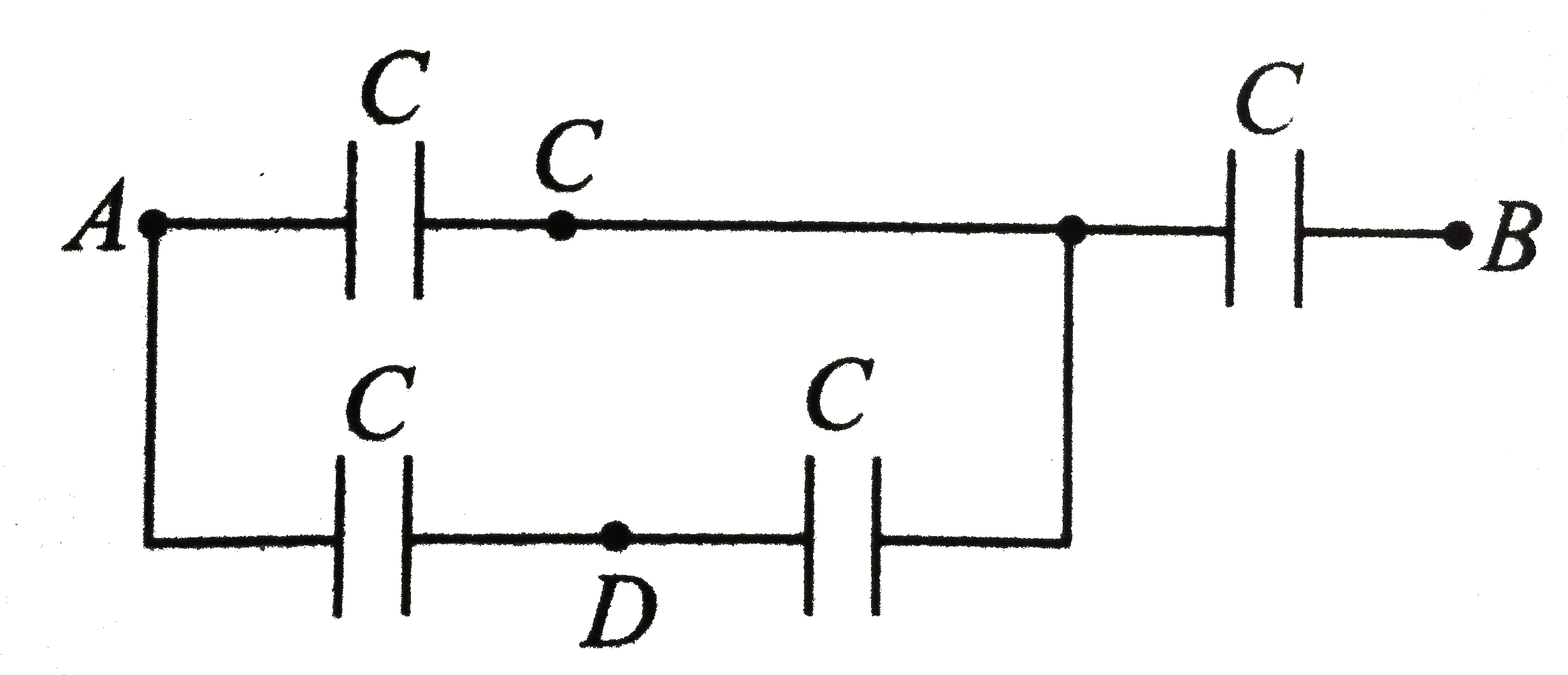 `C_(ED) = (O)/(V) = (x + y)/(V_(AB))` POTENTIAL of 1 and 4 is same `(y)/(Aepsilon_(0)) = (2x)/(Aepsilon_(0))` or ` y = 2x` `V = ((2 y + x)/(A epsilon_(0))) d,C_(eq) = ((x + 2x)A epsilon_(0))/((5x)d) = (3Aepsilon_(0))/(5d)` |
|
| 32. |
What is Q value ? |
|
Answer» Solution :It is the sharpness of RESONANCE and is defind as the RATIO of between resonant frequency to the BANDWIDTH of the circuit. BAND WIDTH - If `f_1` and `f_2` are two frequencies for which the current is `1/sqrt 2 I_max. where 1/sqrt 2` is the current at resonant frequency `f_0`, then `(f_1-f_2)` is band width and `Q= f_0/f_1-f_2` |
|
| 33. |
A magnetic needle lying parallel to a magnetic field requiresthe torqueneeded to maintain the needle inthis position will be |
|
Answer» `SQRT(3)` w |
|
| 34. |
Derive formula for induced charge and prove that it is independent of rate of change in flux. |
|
Answer» Solution :From Faraday.s law, we have learnt that the magnitude of the induced EMF is, `|EPSILON|=(DeltaPhi_B)/(Deltat)`…(1) However, `|epsilon|=Ir=(DeltaQ)/(Deltat)r`…(2) Here r is resistance of coil. Thus, from EQUATIONS (1) and (2) `(DeltaPhi_B)/(Deltat)=(DeltaQ)/(Deltat)r` `therefore DeltaPhi_B=DeltaQr` `therefore DeltaQ=(DeltaPhi_B)/r` So, induced charge is only DEPENDS on CHANGE in flux but it does not depend on rate of change of flux. |
|
| 35. |
A non-uniform electric field is represented by vecE = 5xhati Vm^(-1) . An electric dipole having moment. P = 20 xx 10^(-20) cm is placed at an angle of 60° with the field. The net force on the dipole is.........N. |
|
Answer» `10^(-19) hati` `=q(2A COS THETA) (dvecE)/(dx)` 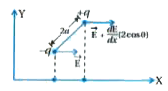 `=p costheta =(dvecE)/(dx)` `=20 xx 10^(-20) xx cos 60^(@) xx 5hati (therefore vecE = 5xhati)` `=5 xx 10^(-19) hati N` |
|
| 36. |
A sphere of radius R is charged uniformly with a volume charge density. It is disassembled and reassembled in two identical spheres kept far from each other. |
|
Answer» Positive work is DONE by EXTERNAL agent |
|
| 37. |
The thermal capacity of 40 gm of aluminium (specific heat = 0.2 cal/gm/@^C) is |
|
Answer» `160 CAL PER ^@ C` |
|
| 38. |
If the charge on a capacitor is doubled, the value of its capacitance will be |
|
Answer» doubled. |
|
| 39. |
The number of telephone conversation carried by a fibre with much less intensity loss, are |
|
Answer» 1800 |
|
| 40. |
A car accelerates from rest at a constant rate a for some time after which it retards at a constant rate to come to rest. If the time elapsed is t, maximum velocity reached is |
|
Answer» `V=t((ALPHA beta)/(alpha+beta))` `(V-0)/(alpha)+(0-V)/(-beta)=t implies(V)/(alpha)+(V)/(beta)=t` `V((1)/(alpha)+(1)/(beta))=t implies V=((alpha)/(alpha+beta))t` |
|
| 41. |
A ball of mass m moving with a speed u_(0) collides elastically with a rod of mass M suspended in the vertical plane by the hinge O. The rod is free to rotate in the vertical plane. Before and after the collision. |
|
Answer» LINEAR momentum of the ball and rod system is CONSERVED |
|
| 42. |
Figure shows the transfer characteristics of a base biased CE transistor. Which of the following statements are true? |
|
Answer» At `V_(i)=0.4V`, transistor is in active state. For `V_(i)=0.5V, I_(C )~~0rArr` transistor will be in CUT off state and so it will act like "off" condition of switch. Hence, option (C ) is correct. For `V_(i)=2.5V, I_(C )` becomes maximum and so transistor COMES in saturation state and so it cna be used as a switch in "on" condition of switch. Hence, option (D) is also correct. |
|
| 43. |
Can the potential barries across a p-n junction be measured by simply connecting a voltmeter across the junction? |
| Answer» Solution :No,the POTENTIAL brrries cannot be MEASURED using voltmeter across the junction.For this a voltmeter MUST have a high resistance as compared to the junction resistance. | |
| 44. |
What is the position of the object for a simple microscope ? What is the maximum magnification of a simple microscope for a realistic focal length? |
|
Answer» Solution :When an object is placed between principal FOCUS and optical centre of a convex lens, a virtual and erect image will be formed on the same side of the object. Magnifying power : It is defined as the RATIO of the angle subtended a the eye by the image to the angle subtended by the object at the eye. `m=(alpha)/(BETA)~=(Tan alpha)/(Tan beta)` From figure `OJ=IJ',angleIO'G= alpha and angleIO'J'=beta` Magnifying power `(m)=(alpha)/(beta)` `=(Tan alpha)/(Tan beta)` for small angles `=("IG/IO'")/("IJ'/IO'")` `m=("IG")/("IJ'")=("IG")/("OJ")=(therefore" IJ' = OJ")` `Delta^("le")"IGO' and "Delta^("le")" OJO' are similar"` `("IG")/("OJ")=("IO'")/("OO'")=(-D)/(-u)` `m=(D)/(u)"...........................................(1)"` The above equation can be written as `m=1+(D)/(f)"..................................(2)"` This shows that smaller the FOCAL length of the lens, greater will be the magnifying power of microscope. 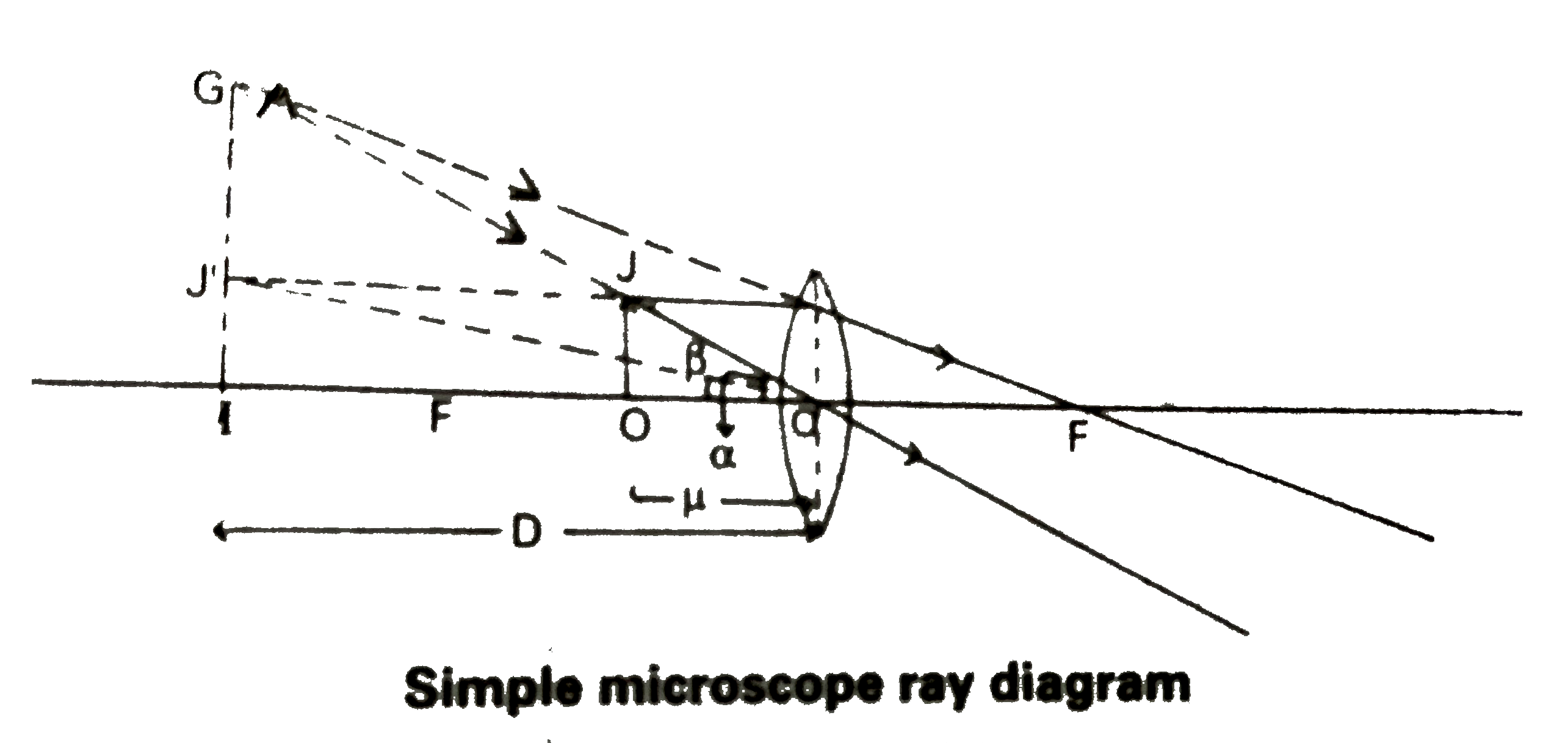
|
|
| 46. |
In the following questions a statement of assertion (A) is followed by a statement of reason ( R). A : In the case of ground to ground projection of a projectile from ground the angle of projection with horizontal is theta =30^(@) . There is no point on its path such that instantaneous velocity is normal to the initial velocity . R : Maximum deviation of the projectile is 2theta = 60^(@) . |
|
Answer» If both Assertion & REASON are true and the reason is the correct explanation of the assertion then mark (1) . |
|
| 47. |
A convex lens forms the image of the sun at a distance of 10 cm. Where will be the image when Another lens of same aperture but double the power is used? |
| Answer» Solution :When power is doubled, FOCAL length is halved. So, image WOULD be formed at a distance of 5 CM | |
| 48. |
The charges on two spheres are + 7 much and -5mucrespectively. They experience a force F. If each of them is given an additional charge of -2muc,the new forceof attraction will be : |
|
Answer» F |
|
| 49. |
A man with normal near point (25 cm) reads a book with small print using a magnifying glass, a thin con vex lens of focal length 5 cm. (a) What is the closest and farthest distance at which he can read the book when viewing through the magnifying glass? (b) What is the maximum and minimum magnifying power possible using the above simple microscope? |
|
Answer» Solution :(a) As for normal eye FAR and near points are `oo` and 25 cm respectively, so for magnifier `v_(max)=-ooandv_(min)=-25cm` However, for a lens as `1/v-1/u=1/f` i.e., `u=f/((f//v)-1)`, So u will be MINIMUM when v = min = -25 cm i.e., `(u)_(min)=5/(-(5//25)-1)=(-25)/6=-4.17cm` and u will be maximum when v = max = `oo` i.e., `(u)_(max)=5/((5//oo)-1)=-5cm` So the closest and FARTHEST distances of the book from the magnifier (or eye) for CLEAR viewing are 4.17 cm and 5cm respectively. (b) As in case of simple magnifier MP = (D/u). So MP will be minimum when u= max = 5 cm i.e., `(MP)_(min)=(-25)/(-5)=5" "[=D/f]` And MP will be maximum when u = min = (25/6)cm `(MP)_(min)=(-25)/(-(25//6))=6" "[=1+D/f]` |
|
| 50. |
A domain in a ferromagnetic substance is in the form of a cube of side length 1mum . If it contains 8 xx10^(10) atoms and each atomic dipole has a dipole moment of 9xx10^(-24) Am^2 , then the magnetization of the domain is |
|
Answer» A) `7.2xx10^(5) Am^(-1)` |
|


