

Saved Bookmarks
This section includes 7 InterviewSolutions, each offering curated multiple-choice questions to sharpen your Current Affairs knowledge and support exam preparation. Choose a topic below to get started.
| 1. |
If two charged particles each of charge q mass m are connected to the ends of a rigid massless rod and is rotated about an axis passing through the centre and bot to length. Then find the ratio of magnetic moment to angular momentum |
|
Answer» SOLUTION :`M=niA=2xxq/Tpi(l/2)^(2)` `=2xx(qomega)/(2pi)(pil^(2))/4=(qomegal^(2))/4` `L=2(MR^(2)OMEGA)=2(m(l^(2))/4OMEGA)=(ml^(2)omega)/2, M/L=q/(2M)` |
|
| 2. |
Relate the following compounds |
|
Answer» identical |
|
| 3. |
Define electric flux. Write its SI unit. "Gauss 'law in electrostatic is true for any closed surface, no matter what its shape or size is" Justify this statement with the help of a suitable example. |
|
Answer» Solution :For electric flux and its SI UNIT , see To Justify the STATEMENT that Gauss. law is true for any closed SURFACE irrespective of its shape or size ,let us consider two spherical surface of RADII `r_1 and r_2` respectively with a charge q at its centre. Now electric field at the surface of 1ST sphere `E_1 =(1)/( 4 pi in _0).(q)/( r_1^(2)) ` normally outward and flux over this surface. ` phi_1 =int oversetto (E) .oversetto (ds)= E_1 s_1 = ( (1)/( 4 pi in _0) .(q)/( r_1^(2)) ) xx (4 pi r_1^(2)) =(q)/( in_0) ` Again electric field at the surface of 2nd sphere `E_2 =(1)/( 4 pi in _0) .(q)/( r_2^(2))` normallyoutward and flux over this surface. ` "" phi_2 int oversetto (E) . oversetto (ds)=E_2s_2 = ((1)/( 4 pi in _0) .(q)/(r_2^(2))) xx (4 pi r_2^(2)) = (q)/( in_0) ` Thus, it is clear that `phi_1 =phi_2 ` i.e., electric flux is same for both the closed surfaces. 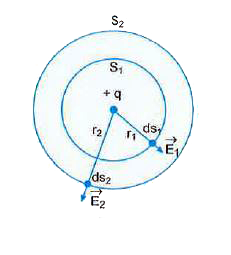
|
|
| 4. |
The velocity-time plot for a particle moving on a straight line is shown in figure. |
|
Answer» The PARTICLE has a constant acceleration. The average speed in the interval of 0 to 10 s is the same as the average speed in the interval of 10 s to 20 s beccause distance covered in both time interval is same. |
|
| 5. |
Which of the following is not a characteristic of electric field lines ? (a) Field lines are continuous curves. (b) Two field lines never intersect each other. (c) Field lines form closed loops. (d) Field lines start from positive charge and end to negative charge. |
|
Answer» FIELD LINES are continuous curves. |
|
| 6. |
The maximum distance between the transmitting and receiving TV towers is 65km . If the ratio of the heights of the TV transmitting tower to receiving tower is 36:49, the heights of the transmitting and receiving towers respectively are (radius of earth = 6400km) |
|
Answer» 51.2 m,80m 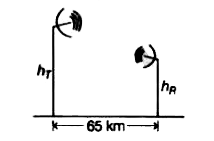 ` d_("MAXIMUM")= sqrt(2Rh_T)+sqrt(2h_R)` or `65= sqrt(2Rh_T)+ sqrt(2 Rh_R)`………(i) From Eqs. (i) and (ii) we get `h_(T)=70.3 m` and `h_(R)=95.7 m` |
|
| 7. |
When two plane mirrors are kept facing each other at angle theta and an object is placed in between what is the number of images formed ? |
| Answer» SOLUTION :`n=360/theta-1` | |
| 8. |
Artificial radioactivity was discovered by_____ |
|
Answer» Joliot and Irene curie |
|
| 9. |
There exists a uniform electric field E =4 xx 10^(5) Vm^(-3) directed along negative x-axis such that electric potential at origin is zero. A charge of - 200 muC is placed at origin and a charged of + 200 mu C is placed at a (3 m, 0) . The electrostatic potential energy of the system is |
| Answer» ANSWER :A | |
| 10. |
In case of superposition of waves (at x=0), y_(1) =4 sin(1026 pit) and y_(2) =2sin(1014 pit) |
|
Answer» the FREQUENCY of RESULTING WAVE is 510 Hz |
|
| 11. |
Using Ampere's circuital law, obtain an expression for the magnetic field along the aixs of a current carrying solenoid of length l and having N number of turns. |
|
Answer» Solution :Consider a long solenoid having n turns per unit length as shown in Fig. The upper view of dots in the figure is like a uniform current sheet coming out of the plane of the paper . From the right hand RULE, the field due to this is to the left at point Q (above) and to the right at point P (below). The lower row of crosses in the figure is like a uniform current sheet going into the plane of the paper. The field at any point above it (P as well as Q) is to the right. The two field reinforce each other at P and EXACTLY cancel at Q. Thus, a uniform magnetic field `vecB` is present along the axis of solenoid at any point inside the solenoid and the zero at any point outside the solenoid. Consider a rectangular Amperian loop abcd. Along cd the magnetic field is zero as explained is at right angle to bc or da. `:. oint vecB . vecdl = int_(a)^(b) vecB . vecdl + int_b^cvecB . vecdl + int_c^d vecB . vecdl + int_d^a vecB . vecdl` `= int_a^b vecB . vecdl = int_a^b B dl = B int_a^b dl = B. Delta L "[where " AB = Delta l `(SAY)] According to Ampere.s circuital law `oint vecB cdot vecdl = mu_0` (current enclosed in length `Delta l` ) `= mu_0 (n Delta l I) "" [ :. ` Number of turns = `n Delta l` ] Hence, we have `B Delta l = mu_0 n Delta l I` `implies B = mu_0 n l` The direction of the field is given by the right hand rule. If the solenoid has a total length l and total number of turnsN, then `B = (mu_0 N I)/(l)`. 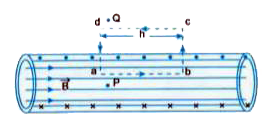
|
|
| 12. |
The orbital speed of geostationary satellite is around |
|
Answer» 3.07 km/s |
|
| 13. |
The flux in a closed circuit of resistance 20ohm varies with time according to the equation phi = 6t^2-5t+1. What is the induced current at time t= 0.25 second? |
|
Answer» SOLUTION :`phi = 6t^2-5t+1e = -(dphi)/DT = -[12t-5] ` at time t = 0.25s, E = `-[12xx0.25-5] = 2V ` `THEREFORE i = e/R = 2/20 = 0.1A` |
|
| 14. |
Two resistors of resistances 200 kOmega and 1 Momega respectively form a potential divider with outer junctions maintained at potentials of +3 V and -15 V. Then, the potential at the junction between the resistors is |
|
Answer» `0 V` `V_(P)-V_(B)=(18Vxx1xx10^(6)Omega)/((0.2+1)xx10^(6)Omega)` `=(18Vxx1xx10^(6)Omega)/(1.2xx10^(6)Omega)=15V`  `V_(B)=-15V` (Given) `therefore V_(P)-V_(B)=15V` or `V_(P)=15V+V_(B)=15V-15V=0V` Potential difference across `20kOmega` resistor is `V_(A)-V_(P)=(18Vxx0.2xx10^(6)Omega)/((0.2xx1)xx10^(6)Omega)=(18Vxx0.2xx10^(6)Omega)/(1.2xx10^(6)Omega)=3V` `V_(A)=+3V` (Given) `therefore V_(A)-V_(P)=3VorV_(P)=V_(A)-3V=+3V-3V=0V` |
|
| 15. |
A convex lens of focal length 12.5 cm is used as a simple microscope. When the image is formed at infinite, Magnification is ....... (Near point for the normal vision is 25 cm). |
|
Answer» 2.5 Here,D=25 cm,f=12.5 cm `therefore m =(25)/(12.5)=2` |
|
| 16. |
A car that weighs 1.30xx10^(4) N is initially moving at 35 km/h when the brakes are applied and the car is brought to a stop in 15m. Assuming the force that stops the car is constant, find (a) the magnitude of the force and (b) the time required for the car experiences the same force during the braking, by what factors are (c) the stopping distance and (d) the stopping time multiplied? (There could be a lesson here about the danger of driving at high speeds.) |
| Answer» SOLUTION :(a) `4.2xx10^(3)N,` (B) `3.1s,` ( C ) 4.0, (d) 2.0 | |
| 17. |
When barium is irradiated by a light of lamda=4000A all the photoelectrons emitted are bent in a circle of radius 50 cm by a magnetic field of flux density 5.26xx10^(-6) T acting perpendicular to plane of emission of photoelectron. Then, |
|
Answer» the kinetic energy of fastest photoelectrin is 0.6 eV DUE to MAGNETIC field, `(mv_(max)^(2))/(r)=BeV_(max)` `impliesv_(max)=(BER)/(m)` `=(5.26xx10^(-6)xx1.6xx10^(-19)xx0.5)/(9.1xx10^(-31))` `=0.46xx10^(6)ms^(-1)` `(KE)_(max)=(1)/(2)mv_(max)^(2)=(Bev_(max)r)/(2)` `=(5.26xx10^(-6)xx1.6xx10^(-19)xx0.46xx10^(6)xx0.5)/(2)` `=0.973xx10^(-19)J=0.6eV` Energy of PROTON, `E=(hc)/(lamda)=(1240eVnm)/(400nm)=3.1eV` Work function, `W=3.1 eV-0.6eV=2.5 eV` `(KE)_(max)=eV_0impliesV_0=0.6V` |
|
| 18. |
What we call the net oppositon offered by all the circuit elements (R,L,C ) in an a.c. circute ? |
| Answer» SOLUTION :IMPEDANCE | |
| 19. |
Define the term 'focal length ofa mirror. With the help of a ray diagram, obtain the relation between its focal length and radius of curvature. |
|
Answer» Solution :Distance between PRINCIPAL focus and pole of a mirror is called its focal length. Let C be the CENTRE of curvature of a spherical mirror. Consider a ray OM travelling parallel to the principal AXIS of mirror and incident at a point M. Obviously CM is normal at M. The reflected ray passes through the focus point. Let MD be the perpendicular drawn from M principal axis of mirror. If angle of incidence `angleOMC =theta,` then `angleCMF= angleMCF=theta` and `angleMFD = 2THETA`. For a mirror of small aperture `theta` = tan `theta` = and `2 theta` `= tan 2 theta = (MD)/(FD) ` `implies (MD)/(FD)= (2MD)/(CD) implies (1)/(FD)=(2)/(CD) implies FD = (CD)/(2)` For small aperture the point D is very close to pole P and so we have `FP = (CP)/(2) or F = (R )/(2) or R = 2f `. 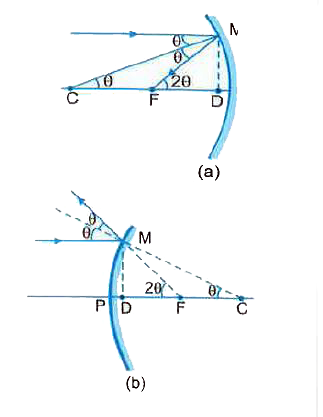
|
|
| 20. |
A coil of self inductance L is connected in series with a bulb and an A.C. source. Brightness of the bulb decreases when |
|
Answer» NUMBER of turns in the coil is REDUCED |
|
| 21. |
The correct differential equation of linear S.H.M. is |
|
Answer» `(d^2x)/(DT^2)-k/mx=0` |
|
| 22. |
Photon and electron are given same energy (10^(-20) J). Wavelengths associated with photon and electron are lamda_p and lamda epsilon, the correct statement will be : |
|
Answer» `lamda_pgt lamda_epsilon` |
|
| 23. |
What is Einstein's quantum theory ? |
| Answer» SOLUTION :LIGHT is TRANSMITTED as tiny BUNDLES of ENERGY called photons. | |
| 24. |
Two particles, each having a mass m are placed at a separation d in a uniform magnetic field B as shown in the figure. They have opposite charges of equal magnitude q. At time t = 0, the particles are projected towards each other, each with a speed v. Suppose the Coulomb force between the charges is switched off. (a) Find the maximum value v_(m) of the projection speed so that the two particles do not collide. (b) What would be the minimum and maximum separation between the particles if v = v_(m) //2 ? ( c) At what instant will a collision occur between the particles if v=2 v_(m) ? (d) Suppose v = 2 v_(m) and the collision between the particles is completely inelastic. Describe the motion after the collision. |
|
Answer» Solution :(a) `R_(max) = d//2, v = v_(m)` `(d)/(2) = (mv_(m))/(Bq) RARR v_(m) = (Bqd)/(2m)` (b) `v = v_(m)//2`i.e.`R = d//4` 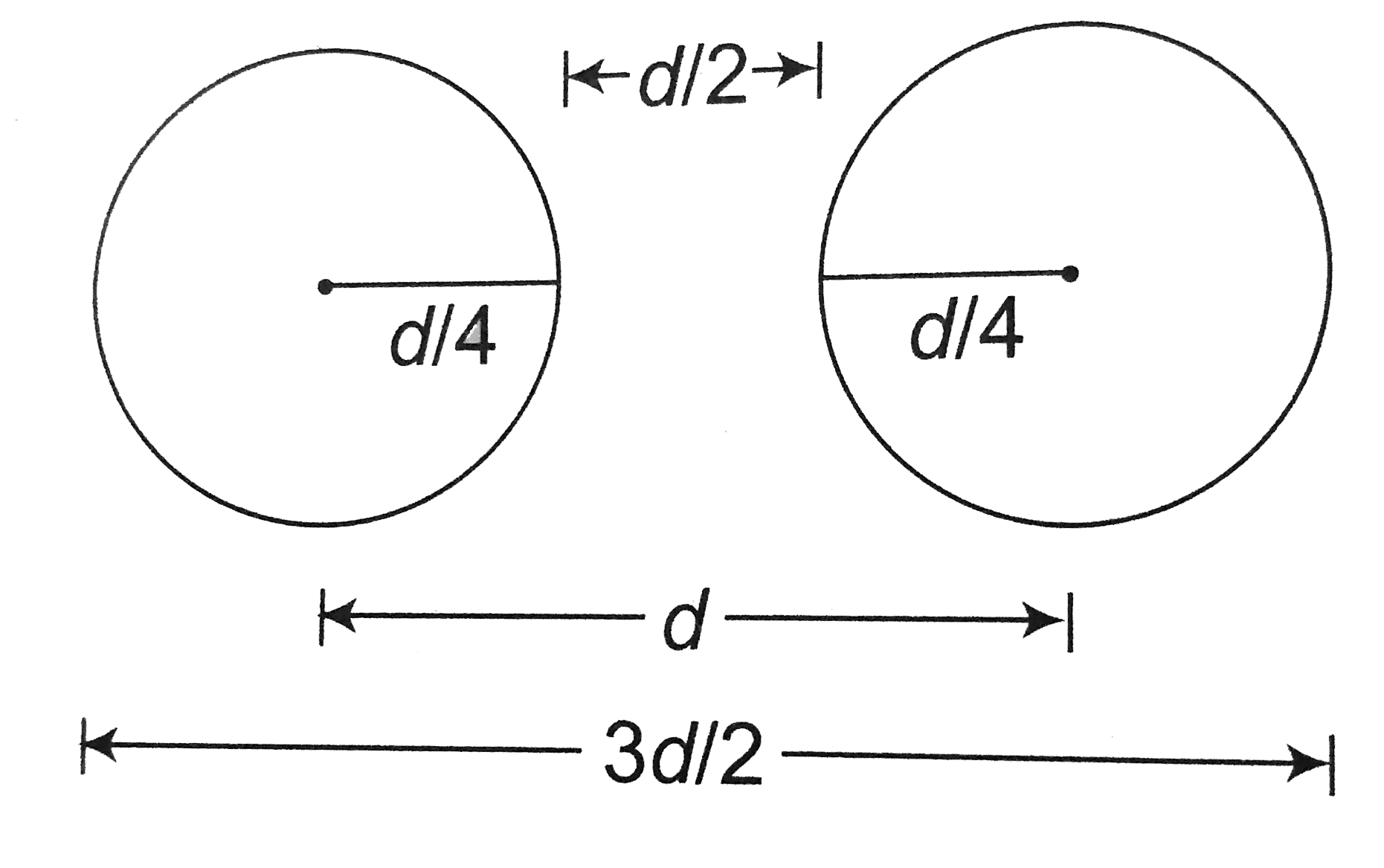 Minimum SEPARATION `= d//2` Maximum separation `= 3d//2` ( c) `v = 2v_(m)` i.e. `R = d`. The particle will collide in middle 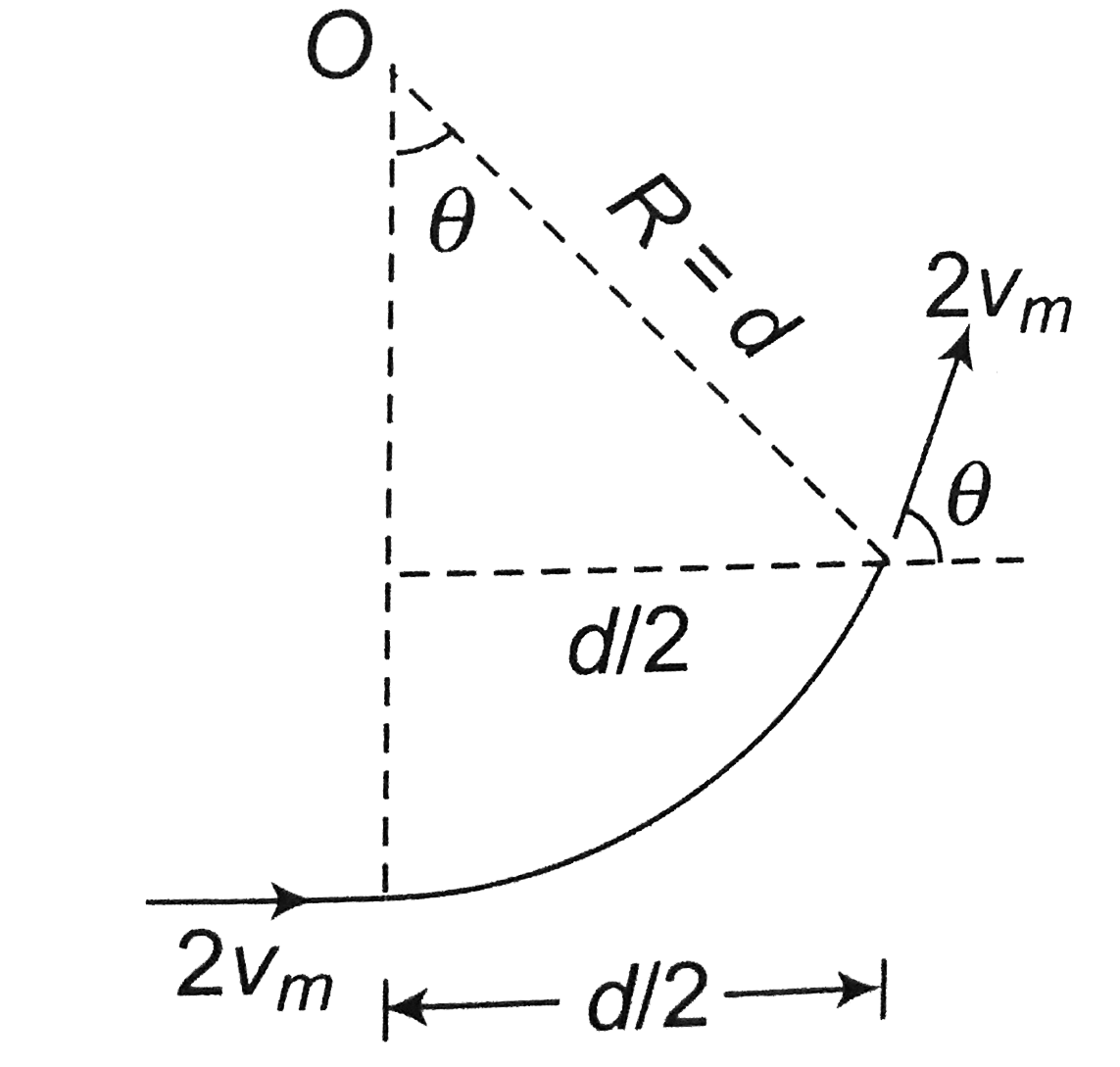 `sin theta = (d//2)/(R = d) = (1)/(2) rArr theta = pi//6` The particles will collide after time `t = (m theta)/(Bq) = (m pi)/(6 Bq)` (d) Before collision : 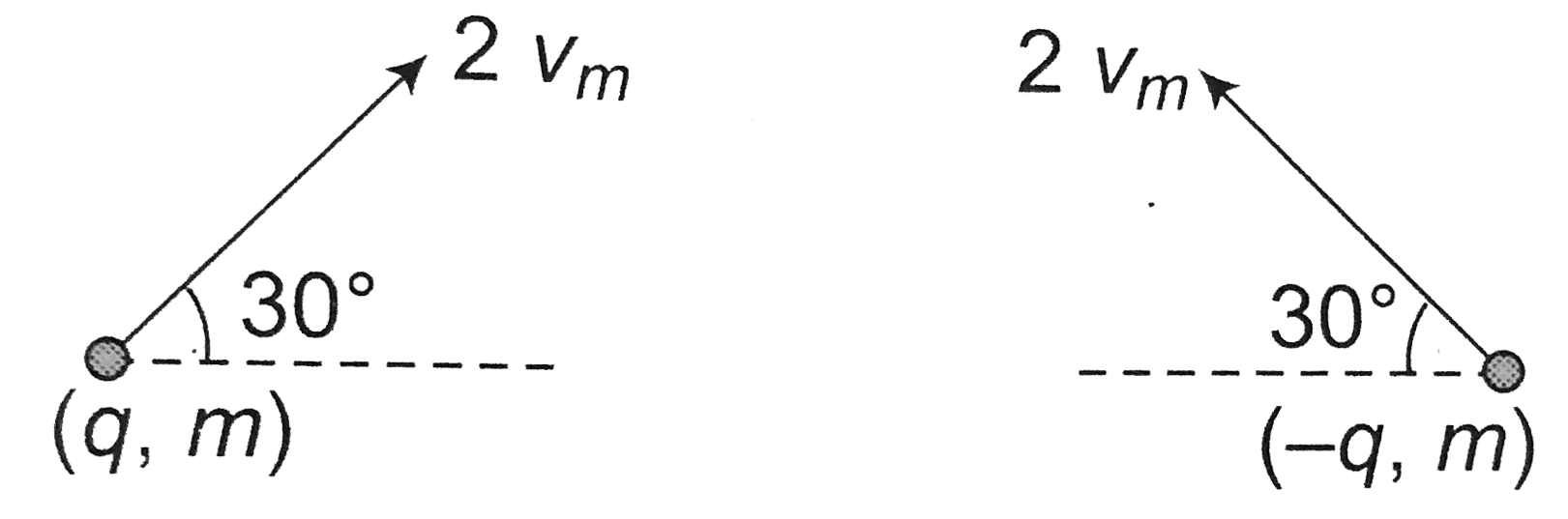 After collision: 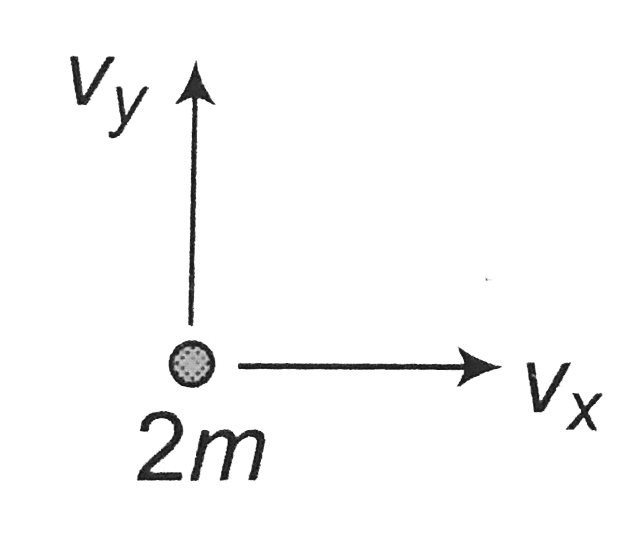 Momentum conservation: `x:v_(x) = 0` `y: m . 2v_(m) sin theta + m . 2v_(m) sin theta = (m + m) v_(y)` `q` will CANCEL `-q`, net charge `= 0` The combined mass will move in a straight line with speed `v_(m)`. |
|
| 25. |
A doped semiconductor has impurity levels 30meV below the conduction band. Is the material n-type or p- type? Find the maximum wavelength of ight so that an electron of impurity level is just able to jump to into conduction band. |
|
Answer» |
|
| 26. |
An electron and a proton moving with same speed enter the same magnetic field region at right angles to the direction of the field. For which of the two particles will the radius of the circular path be smaller? |
| Answer» Solution :`:.` Radius of circular path `R = (mv)/(Bq)`. For same speed V, the MASS of electron is much less than that of PROTON. Hence `r_e < < r_p`. | |
| 27. |
Themain scale of vernier callipers reads in millmetre and its vernier is divided into 8 divisions, which coincide with 5 divisions of main scale . Then When two jaws of instrument touch each other the zero of the vernier coincide with the zero of main scale . A rod is tightly placed along its length between both jaws, it is observed that the zero vernier scale lies just left to 36^("th") division of main scale and fourth division of vernier scale coincide with the main scale. Then the measured value is |
|
Answer» 3.66 CM |
|
| 28. |
i= 5 sin 314t. Which is the peak value of current? |
|
Answer» Solution :`i = i_m SIN OMEGA t and i = 5 sin 314 t ` ` THEREFORE `Peak VALUE of current, `i_m = 5A` |
|
| 29. |
A conductor is charged by a battery and then disconnected.How are the capacitance, potential difference and stored energy related to the capacitor affected if The distance between the plates is decreased. |
|
Answer» Solution :Capacitance of a PARALLEL plate capacitor, `C= (k in_0alpha)/(d)` If the distance between the plates is decreased, capacitance C of the capacitor will increase.Since the charge remains constant, due to increase of capacitance, the POTENTIAL difference between the plates `(V=(Q)/(C ))` and the ENERGY STORED in the capacitor `(U= (1)/(2) (Q^2)/(C ))` will decrease. |
|
| 30. |
Two glasses have dispersive powers in the ratio of 2 : 3 These glasses are used in the manufacture of an achromatic objective of focal length 0.2m. The focal lenghts of the two lenses of the objective are : |
|
Answer» 6.67 cm, - 10 cm `(f)/(f.)=(-OMEGA)/(omega)rArr(1)/(f.)=(-omega)/(omega.)xx(1)/(f)` Give `(omega)/(omega.) = (2)/(3)` `therefore "" (1)/(F), = (-2)/(3F)` `rArr "" (1)/(F) = (1)/(f) + (1)/(f.)` Given F = 20 cm `therefore "" f = 6.67cm and f. = - 10 cm.` |
|
| 31. |
what is interference ? Write the condition for path difference in case of constructive and destructive interference. |
|
Answer» SOLUTION : The MODIFICATION in the distribution of light ENERGY due to super POSTION of two or more waves of light is CALLED interfrenece oflight . In case of constructive interference Path difference : `delta=nlamda,` n = 0, 1, 2, 3, … , In case of destructive interference Path differcne : `sigma= (n+ (1)/(2))lamda`, n = 0, 1, 2, 3, ..... |
|
| 32. |
A wide jar is filled with water, in which a steel ball of radius 0.25cm has been dropped to measure the viscosity of water by using terminal velocity concept. |
|
Answer» This method is appropriate |
|
| 33. |
Two charges - q each are separated by distanc · 2d. A third charge + q is kept at mid point C Find potential energy of + q as a functionsmall distance x from O due to - q charges Sketch P.E. v/s x and convince yourself that the, charge at O is in an unstable equilibrium. |
|
Answer» Solution :Suppose + q charge is displaced TOWARDS - , and hence total potential energy or system `U= K[(-q^(2))/((d-X))+(-d^(2))/((d-x))]` ` = -KQ^(2)[(d+x+d-x)/(d^(2)-x^(2))]` `=-kq^(2)[(2d)/(d^(2)-x^(2))]` `:.` By differentiating U w.r.t.x `(dU)/(dx)=-kq^(2)xx2d((-2x)/((d^(2)-x^(2))^(2)))` If `(dU)/(dx)=0`then F =0 `:. 0 =(4kq^(2)dx)/((d^(2)-x^(2))^(2)):. x=0` Hence +q is in stable and unstable equilibrium . By differentiating again w.r.t.x `(d^(2)U)/(dx^(2))=[(-2dq^(2))/(4pi in_(0))][(2)/((d^(2)-x^(2))^(2))-(8x^(2))/((d^(2)-x^(2))^(3))]` `=((-2dq^2)/(4piin_(0)))-(1)/((d^(2)-x^(2))^(3))-[2(d^(2)-x^(2))-8x^(2)]` At x= 0 ` x lt lt d implies ` By neglecting x `(d^(2)U)/(dx^(2))=((-2dq^(2))/(4piin_(0)))((1)/(d^(6)))[2d^(2)]` `(d^(2)U)/(dx^(2))lt 0` Hence system is in unstable equilibrium . |
|
| 34. |
Mention three different modes of propagation used in communication system. Explain with the help of a diagram how long distance communication can be achieved by ionospheric reflection of radio waves. |
|
Answer» Solution :(i) Ground wave or surface wave propagation. (ii) SKY wave propagation or ionospheric propagation. (iii) Space wave propagation/Line of sight propagation.  When radio wave (frequency range 3 MHZ to 30 MHz), emitted from the TRANSMITTING antenna, reach the receiving antenna after reflection from the ionosphere which acts as a reflector for radio waves, the CORRESPONDING mode of propagation is known as sky wave propagation. |
|
| 35. |
A unit vector perpendicular to both the vectors 2hati-2hatj+hatk and 3hati+4hatj-5hatk, is |
|
Answer» `(1)/(sqrt(410))(6hati+13hatj+14hatk)` `:.` UNIT vector perpendicular to the given vectors is `(6i+13hatj+14hatk)/(sqrt(6^(2)+13^(2)+14^(2)))=(1)/(sqrt(401))(6hati+13hatj+14hatk)` |
|
| 36. |
How do you justify that the rest mass of photons is zero ? |
|
Answer» SOLUTION :The mass of a body moving with speed v is `m = m_0/SQRT(1-v^2/c^2)` REST mass`m_0 = m sqrt(1-v^2/c^2)` for a photon v= c, therefore `m_0=msqrt(1-c^2/c^2)=0` |
|
| 37. |
Two lenses of power 15 and - 3 dioptre are placed in contact. The focal length of the combination is |
| Answer» | |
| 38. |
A glass of refraction index 1.5 and radius-.1 m has a small bubbl inside at a distance of 0.01 m from the centre. Where will the mark appear to the observer when viewed along the diameter containing the bubble? |
|
Answer» Solution :`(n_(1))/(u ) + ( n_(2))/(V) = ( n_(1) -n_(2))/( R) ` or `( N)/( u ) + ( 1)/( v) = ( n+1)/( R )` `(1.5) /(0.09) + ( 1)/( v) = ( 1.5-1)/( 0.1)` `16.66 + ( 1)/( v) = 5` `(1)/( v) = 5-16.66 = - 11.66 v = -0.0857m` |
|
| 39. |
Name a semiconductor device which can be used as voltage regulator ? |
| Answer» SOLUTION :Zenor DIODE. | |
| 40. |
Can reflection result in plane polarised light if the light is incident on the interface from the side with higher refractive index ? |
Answer» Solution : Here, incident ray is in denser MEDIUM (medium-2) and REFRACTED ray is in rarer medium (medium-1). Hence, according to Brewster.s law, `tantheta_(P)=(n_(1))/(n_(2))""......(1)` ( Where `theta_(P)=` POLARISATION angle or Brewster angle) Here if critical angle of denser medium w.r.t. rarer medium is C then according to Snell.s law, `n_(2)sinC=n_(1)sin90^(@)` `:.sinC=(n_(1))/(n_(2))""......(2)` From equation(1) and (2), `tantheta_(P)=sinC` `:.(sintheta_(P))/(costheta_(P))=sinC` `:.sintheta_(P)=(costheta_(P))sinC` But here `0ltcostheta_(P)lt1` `impliessintheta_(P)ltsinC` `impliessintheta_(P)ltsinC` For a ray of light made incident on the surface of rarer medium with polarisation angle, SATISFYING above condition, reflected light will be completely plane polarised. |
|
| 41. |
A certain mass of Hydrogen is changed to Helium by the process of fussion. The mass defect in fussion reaction is 0.02866 u. the energy liberated per u is (given 1u=931 MeV) |
|
Answer» 12.67 MEV |
|
| 42. |
In ampitude modulation modulation index of a transmitted carrier wave is beta.The increase in power dissipation would be directly proportional to |
|
Answer» `BETA` |
|
| 43. |
In an electromagneticwavethe phase difference between electric field vecE and magnetic field vecB is ...... |
| Answer» SOLUTION :Zero | |
| 44. |
In the question number 30, the net power absorbed by the circuit in one complete cycle is |
|
Answer» 5 W In a PURE capacitance circuit, the phase difference between alternating VOLTAGE and CURRENT is `pi//2` . Hence `P = V_("rms")I_("rms")cos 90^(@) = 0`. |
|
| 45. |
Themain scale of vernier callipers reads in millmetre and its vernier is divided into 8 divisions, which coincide with 5 divisions of main scale . Then If when two jaws of instrument touchwith each other the 5 ^("th") division of vernier scale coincide with 3^("rd") division of main scale . Then error is |
|
Answer» Positive zero error of magnitude 1.25 mm |
|
| 46. |
The p.d. Between the ends of a wire of resistance 5 ohm, if 720 coulomb of charge passes through it per minute. |
|
Answer» 20 v |
|
| 47. |
A planoconvex lens of focal length 20cm has its plane side silvered. |
|
Answer» The radius of curvature of curved surface of GIVEN plano-convex lens is equal to half of radius of curvature of a surface of equiconvex lens of focal length 20cm For equiconvex lens `(1)/(f)=(mu-1)(2)/(R^('))` `R=(R)/(2)` [choice (a) is correct ] Let F be the focal length of silvered plano-convex lens `(1)/(F)=(2(mu-1))/(R)+(1)/(oo)=(2(mu-1))/(R)` Given `(1)/(f)=(1)/(20)=(mu-1)/(R)` `F=10cm` ( it acts on concave mirror) [choice (d) is correct] `(1)/(u)+(1)/(v)=(1)/(F)` If `u=-15cm, (1)/(v)=-(1)/(10)+(1)/(15)=(-3+2)/(30)=(1)/(-30)` `v=-30cm` [coice (b) is correct] If `u=-20cm, (1)/(v)=(1)/(-10)+(1)/(20)=(1)/(-20)rArrv=-20cm` [choice (c) is wrong] 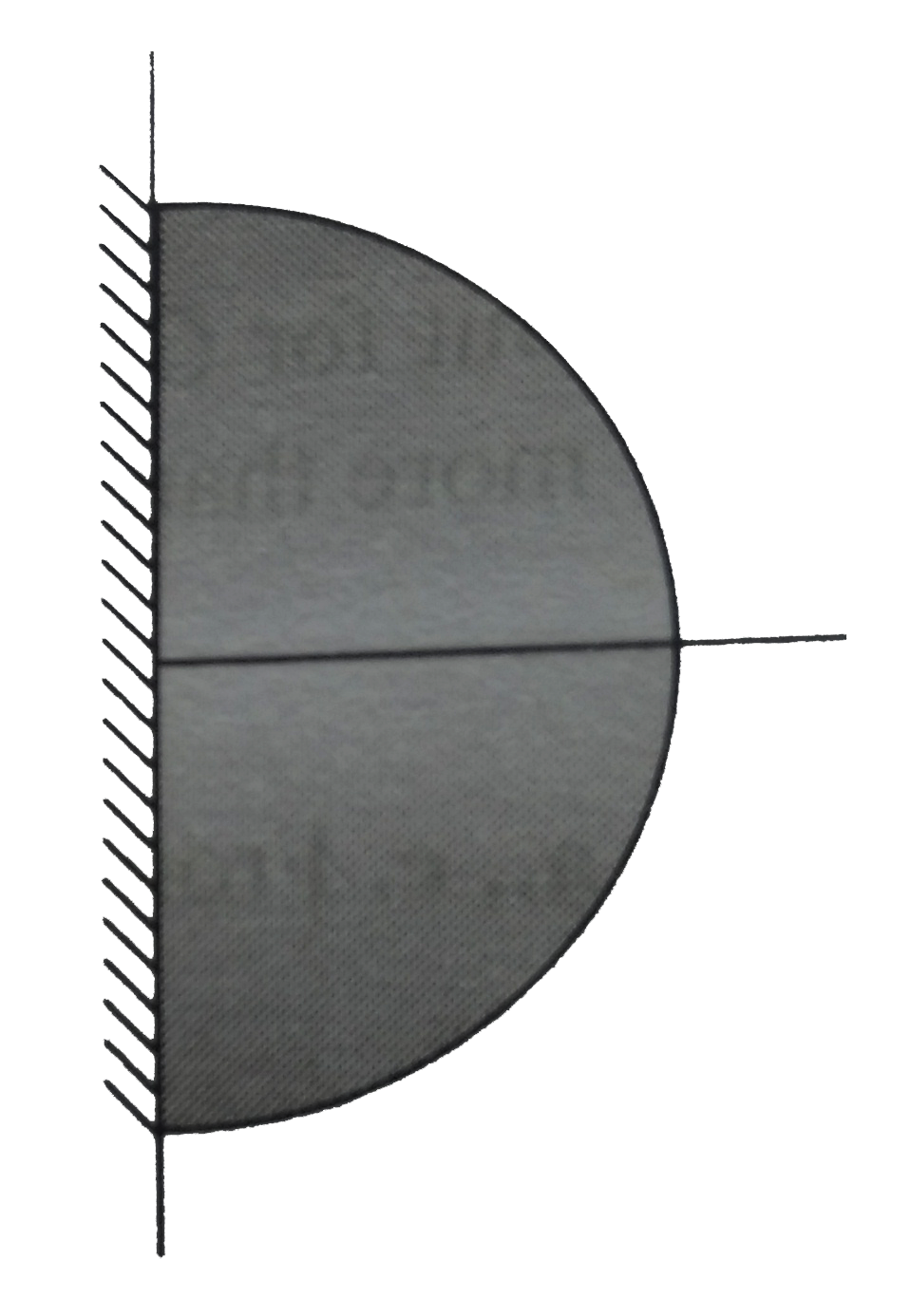
|
|
| 48. |
The angle between the dipole moment and electric field at any point on the equatorial plane is |
|
Answer» `45^(@)` 
|
|
| 49. |
When petrol drops from a vehicle fall over rain water on road surface colours are seen because of |
|
Answer» DISPERSION of light |
|
| 50. |
A point moving along the x-direction starts from rest at x=0 and comes to rest at x=1 after 1 s Its accelertion at any point is denoted by alpha Whichof following is not correct ? |
|
Answer» `alpha` MUST change sign during the motion . |
|