

Saved Bookmarks
This section includes 7 InterviewSolutions, each offering curated multiple-choice questions to sharpen your Current Affairs knowledge and support exam preparation. Choose a topic below to get started.
| 1. |
A carbon resister of 47 Omega is to be marked with rings of different colours for it's identification. Write the sequence of colours. |
| Answer» SOLUTION :COLOUR SEQUENCE is YELLOW, niolet, ORANGE. | |
| 2. |
In a LCR series a.c. circuit ……….. power is dissipated at resonance, as value of power factor is……………… |
| Answer» SOLUTION :MAXIMUM ,I | |
| 3. |
A radioactive substance decays at 1/32 of its initial activity in 25 days. Its half life is : |
|
Answer» Solution :`N/N_(0)=(1/2)t/T ["t=25 days"]` `1/(32)=(1/2) (25)/T` `(1/2)^(5)=(1/2)^((25)/T)` `5=(25)/T, "T=5days"` |
|
| 4. |
When two capacitors C_1 and C_2 at potentials v_1 and v_2 respectively share the charges the.loss of energy is _____. |
|
Answer» |
|
| 5. |
A constant electric field of intensity 36N/C exists along the z-axis. If P and be two points whose coordinates are (10 cm, 0, -20 cm) and (0, -10 cm, 30 cm) respectively, then find the potential difference V_(P)-V_(Q). |
|
Answer» |
|
| 6. |
A certain prism of refracting angle 60^(@) and of refractive index 2 is immersed in a liquid of refractive index sqrt(2) then the angle of minimum deviation will be |
|
Answer» `30^(@)` |
|
| 7. |
A typical dicotyledonous embryo consists of |
|
Answer» RADICLE only |
|
| 8. |
Kirchhoff's law is applicable only for ______ |
|
Answer» SIMPLE circuits |
|
| 9. |
Which filter circuit is better? |
| Answer» Answer :A | |
| 10. |
When a current of 5 mA is passed through a galvanometer of resistance 30 Omega ,it shows a full -scale deflection. To convert it into a voltmeter, which can read voltage up to 7V, it is connected to a resistance R in series . What is the value of R ? Also calculate the resistance of the voltmeter. |
| Answer» SOLUTION :`1,370Omega,1,400 OMEGA` | |
| 11. |
A charge 'q'is held at rest at a point. Another identical charge of mass 'm' is projected towards this charge from infinity with a velocity 'V'. What is the shortest distance between these charges. |
|
Answer» |
|
| 12. |
The true value of dip at a place is 60^(@). The apparent dip in a plane inclined at an angle of 30^(@) with magnetic meridian is |
|
Answer» `TAN^(1) (1/2)` `theta` = ANGLE made by vertical plane with magnetic MERIDIAN `tandelta= (tandelta)/(costheta)= (tan60^(@))/(COS30^(@))= (sqrt3xx2)/sqrt3=2` `delta. = tan^(-1)(2)` |
|
| 13. |
Under an extemal electric field electrons drift slowly inside the conductor. The velocity of drift is |
|
Answer» 1 mm/s |
|
| 14. |
An electron of mass m and a photon have same energy E.The ratio of de-Broglie wavelengths associated with them is (C being velocity of light0) Here C is speed of light |
|
Answer» <P>`((E )/(2m))^((1)/(2))` But `p=SQRT(2mE)` `THEREFORE lambda_(e)=(h)/(sqrt(2mE))` ……(1) `E=hf=(hc)/(lambda_(p))` `therefore lambda_(p)=(hc)/(E )` ……(2) `therefore (lambda_(e))/(lambda_(p))=(h)/(sqrt(2mE))xx(E )/(hc)` `therefore (lambda_(e))/(lambda_(p))=(1)/(c)sqrt(E )/(2m)` |
|
| 15. |
If a vector has zero magnitude,is it meaningful to call it a vector ? |
| Answer» SOLUTION :We know that SUM of TWO VECTORS is ALSO a vector. Thus, the sum of two vectors `vec A` and - `vec A` which has zero magnitude is also a vector and is called null vector. | |
| 16. |
Two charged spherical conductors of radii R_(1) and R_(2) are connected by a wire. Then the ratio of surface charge densitites of the spheres sigma_(1)//sigma_(2) is |
|
Answer» `R_(1)/R_(2)` |
|
| 17. |
In the caseof insulators, as the temperature decreases, resistivity ……………. . |
| Answer» SOLUTION :INCREASES | |
| 18. |
A particle is displaced from a position (2hati-hatj+hatk) to another position (3hati+2hatj-2hatk) under the action of the force (2hati+hatj-hatk). The work done by the force in arbitrary unit is : |
|
Answer» 8 |
|
| 19. |
Which of the following is/are correct. |
|
Answer» If quantum number is very large FREQUENCY of photon emitted when JUMPS from a orbit to next lower orbit is equal to the interger multiple of the frequency of revolution of electron in previous orbit Frequency of revolution of electron `= (me^(4)z^(2))/(4in_(0)^(2)h^(3)n^(3))` |
|
| 20. |
Conductivity of a given intrinsic semiconducting material solely depends on its _________. |
| Answer» SOLUTION :TEMPERATURE | |
| 21. |
Diameter of a plano-convex lens is 6 cm and thichness at the centre is 3 cm. If speed of light in material of lens is 2 xx 10^(8) m/s, the focal length of the lens is |
|
Answer» 15 cm |
|
| 22. |
Whencurrentsuppliedby a cellto a circuitis 0.3A, its terminalpotentialdifferenceis 0.9 V.Whenthe currentsuppliedbecomes 0.25 A, itsterminalpotentialdifferencebecomes 1.0 V. Theinternal resistanceof the cellis . |
|
Answer» ` 0.5 OMEGA` |
|
| 23. |
When a solar spectrum is viewed, we can see a number of dark lines. a. What are these dark lines called ? b. How are they formed ? c. What is their importance ? |
|
Answer» Solution :Fraunhoer LINES b. The central part of the sun is called photosphere, which is at an extermely high temperature of the order of `10^(7)`K it si surrounded by less donse LUMINOUS and highly compressed gases, and they form sun.s ATMOSPHERE. The photosphere emits RADIATIONS of all wavelengths. sorrounding the photosphere, There is another sphere of gases and vapours at a comparatively lower temperature (6000 K) called chromosphere. It contains certain terestrial element in the from of vapours. When continuous light of all wavelengths from the sun.s atmosphere passes through the chromosphere, certain wavelength are absorbed by the atmosphere passes through the chromosphere, certian wavelengths are absorbed by the elements in the chromosphere. this accounts for the presence of dark lines in the spectrum of the sun. These dark lines are called Fraunhofer lines. During a total solar eclipse, all the fraunhofer lines turn to bright lines. .c The study of Fraunhofer lines establishes the presence of light gases like hydrogen , helium, oxygen , iron, sodium, calcium etc. In the outer envelope of the sun. |
|
| 24. |
The resistance of a galvanometer is 50 ohm and the maximum current which can be passed throughit is 0.002 A. What resistance must be connected to it in order to convert it into an ammeter of range0 – 0.5 A? |
|
Answer» 0.02 ohm |
|
| 25. |
In vacuum tubes, the flow of electricity is due to theelectrons coming out of |
|
Answer» ions |
|
| 26. |
The spacing between field lines shows their |
|
Answer» Direction |
|
| 29. |
A 20 Omega resistor, 1.5 H inductor and 35 mu H capacitor are connected in series with a 220 V, 50 ac supply. Calculate the impedance of the circuit and also find the current through the circuit. |
|
Answer» Solution :`R = 20 Omega, L = 1.5 H, C = 35 xx 10^(-6)F, V = 220 V, v = 50 Hz, Z = ?, I = ?` We have, impedance , `Z = sqrt(R^(2) + (X_(L) - X_(C))^(2))` `X_(L) = omega L = 2PI VL = 2 xx 3.14 xx 50 xx 1.5` `X_(L) = 471 Omega` `X_(C) = (1)/(omega C) = (1)/(2pi v C) = (1)/(2 xx 3.14 xx 50 xx 1.5)` `X_(C) = 90.99 Omega` `Z = sqrt((20)^(2) + (471 - 90.99)^(2))` `Z = 380.27 Omega` `I = (V)/(Z) = (220)/(380.27) = 0.578 A` |
|
| 30. |
Who thought of improving (making better) the sound of the Pungi? |
|
Answer» a musician |
|
| 31. |
A working transistor with its three legs marked , P Q and R is tested using a multimeter . No conduction is found between P and Q . By connecting the common (negative ) terminal of the multimeter to R and the other (positive) terminal to P or Q. some resistance is seen on the multimeter. Which of the following is true for the transistor ? |
|
Answer» It is an npn TRANSISTOR with R as collector . `:.` It is npn transistor with R as base. |
|
| 32. |
The velocity - displacement (v-s) graph shows the motion of particle moving in a straight line. Velocity-displacement graph is a circle of radius 2 m and centre is at (2, 0) m. The value of acceleration for this particle at a point (2-sqrt2,sqrt2)m will be .............. ms^(-2). |
|
Answer» `sqrt2` `(s-2)^(2)+(v-0)^(2)=2^(2)` `(s-2)^(2)+v^(4)=4` Differentiating with respect to time, we get `2(s-2)(DS)/(dt)+2v(DV)/(dt)=0` `2(s-2)v+2v*a=0` At, `s=2-sqrt2andv=sqrt2` `2(2-sqrt2-2)xxsqrt2+2sqrt2a=0` `rArr-4+2sqrt2a=0rArra=4/(2sqrt2)=sqrt2ms^(-2)` |
|
| 33. |
A cylindrical region of radius R is filled with a uniform magnetic field B as shown in the figure. A metal wire (AB) of length L is placed inside the field such that its ends are symmetrically located with respect to the centre (O) of the circular cross section of the region. If the magnetic field is changed at a rate(dB)/(dt)the emf induced in the metal wire is e. Find change in value of epsilon if the wire is displaced by a small distance DeltaL parallel to its own length. Assume that the wire remains inside the field region. |
|
Answer» |
|
| 34. |
The forward bias characteristics of two diodes D_(1) and D_(2) are shown, the knee voltage for D_(1) and D_(2) are respectively (approx) |
|
Answer» `0.6 V, 0.7 V` |
|
| 35. |
In Fig. 5-9, is the magnitude of the normal force vec(F)_(N) greater than, less than, or equal to mg if the block and table are in an elevator moving upward (a) at constant speed and (b) at increasing speed? |
| Answer» Solution :(a) EQUAL, (B) greater, ( c ) less | |
| 36. |
In an a.c. circuit R and I are given by E=100sin100t(in V) and I=100sin(100t+pi/3) (in Ma). The power dissipated in the circuit is: |
|
Answer» 250W |
|
| 37. |
यदि आपतन कोण का मान 45 डिग्री हो तो परावर्तन कोण का मान कितना होगा ? |
|
Answer» 90 |
|
| 38. |
The wavelength of a certain light in air is 4000 overset@A. Its wave number in air will be: |
|
Answer» `2.5xx10^(-7)//m` |
|
| 39. |
The distance between two moving particles P and Q at any time is a . If v_r be their relative velocity and if u and v be the components of v_r, along and perpendicular to PQ. The closest distance between P and Q and time that elaspse before they arrive at their nearest distance is |
|
Answer» `(a(v + v_r))/(v), a (1 + (v_r)/(u))^2` |
|
| 40. |
Draw a ray diagram showing the image formation by a compound microscope. Hence, obtain expression for total magnification when the image is formed at infinity. |
|
Answer» SOLUTION :The ray diagram is given in FIG. 9.85. If `m_0` and me be the magnifications produced by the objective lens and eye-lens respectively, then total magnifying power of microscope `m=m_(0) xx m_( e)` If `u_(0)` be the distance of object AB from objective EVE lens and `v_(0)`be the distance of image A.B.formed by objective from itself, then  `m_(0)=-v_(0)/u_(0)` The magnifying power of eyepiece when the final image is formed at infinity (i.e., `u_e -f_e`), is `m_( c) =D/f_(e)` `m_(e) = D/f_(e)` As a first approximation, `u_(0)=f_(0)`and `v_(0)=L` = distance between objective and eyepiece (or LENGTH of microscope tube), then, we have: `m=-L/f_(0).D/f_(e)` To increase the magnifying power of microscope focal LENGTHS of objective as well as eyepiece should be small enough. |
|
| 41. |
Heat is supplied to a monoatomic gas which expands at constant pressure. The % of heat that goes into work done by the gas is |
|
Answer» 20 |
|
| 42. |
While ”^(238)Th decays to”^(224)_(88)Ra by a-emission, there are only alpha-groups of different energies (5.421 MeV, 5.338 MeV, 5.208 MeV and 5.137 MeV). During the emission of which alpha-particleslambda and rays will not be produced |
|
Answer» `ALPHA`-particle of KINETIC energy 5.137 MEV |
|
| 43. |
In a common-base amplifier, the phase difference between the input signal voltage and the output voltage (across collector and base) is |
|
Answer» 0 |
|
| 44. |
A copper wire is held at the two ends by rigid supports. At 60^@C , the wire is just taut with negligibletension. The speed of transverse waves in this wire at 10^@C is x xx 10^1m/s, what is the value of x.(y= 1.6 xx 10^11 N//m^2 , alpha = 1.8 xx 10^(-6)//""^@C " and " rho= 9 xx 10^3 kg//m^3) |
|
Answer» |
|
| 45. |
State the underlying principle of a potentiometer. Why is it necessary to (i) use a long wire, (ii) have uniform area of cross-section of the wire ? |
|
Answer» Solution :Principle of potentiometer: The potential drop across the length of a steady current carrying WIRE of UNIFORM cross section is proporational to the length of the wire. (i) We use a LONG wire to have a lower VALUE of potential gradient (i.e., a lower .least count. or greater sensitivity of the potentiometer. (ii) The ara of cross section has to be uniform to get a uniform Potential gradient. as per the principle of the potentiometer. |
|
| 46. |
The half life of radioactive element is 8 years. In what time 0.6 g of the substance will be reduced to 0.15 g by disintegration? |
|
Answer» |
|
| 47. |
Law of reciprocal proportion was given by. |
|
Answer» Richter |
|
| 48. |
A uniform wire of resistance 40SN is cut into four equal parts and they are connected in parallel. The effective resistance of the combination is |
|
Answer» 40Ω |
|
| 49. |
The number of photons falling per second on a completely darkened plate to produce force of 6.62xx10^(-5) N is n . If the wavelength of the light falling is 5xx10^(-7) m then n = ............ xx 10^(22). ( h = 6.62 xx10^(-34)J s ) |
|
Answer» 1 `FC=n/t*(hC)/lamda` `n/t=(Flamda)/h` `n/t=(6.62xx10^(-5)xx5xx10^(-7))/(6.62xx10^(-34))` = `5xx10^(22)` |
|
| 50. |
A train is moving with constant speed along a circular track. If length of the train is one fourth of length of circular track then which of the following is/are correct options (Assume that sound source is at engine and speed of engine is very less than speed of sound ): |
Answer» Solution :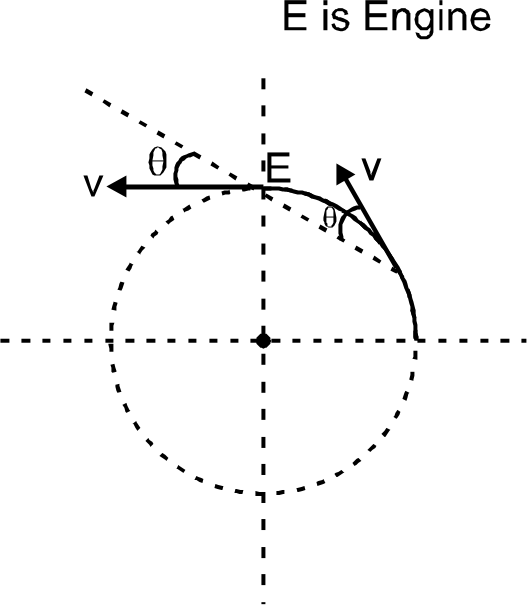 `f_(obs)=(f[v_s+v cos theta])/([v_s+v cos theta])=f` `lambda_(obs)=(v_s+v cos theta)/f` For any observer in TRAIN FREQUENCY observed is EQUAL to ORIGINAL frequency but observed wavelength is more. |
|