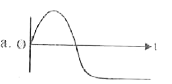
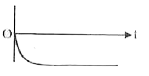
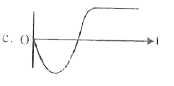
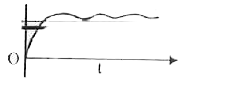
Saved Bookmarks
This section includes 7 InterviewSolutions, each offering curated multiple-choice questions to sharpen your Current Affairs knowledge and support exam preparation. Choose a topic below to get started.
| 1. |
A glass slab of thickness 4 cm contains the same number of waves as 5 cm of water when both are traversed by the same monochromatic light. If the refractive index of water is 4/3, then that of glass is |
|
Answer» `5//3` |
|
| 2. |
On increasing the resistance of the primary circuit of potentiometer, its potential gradient will |
|
Answer» become more |
|
| 4. |
In the circuit shown, what will be the reading of the voltmeter V_(3) and ammeter A? |
|
Answer» |
|
| 5. |
A body rotating with angular velocity omeg stops after rotating for 2 sec. The torque necessary for this is? |
|
Answer» `(IOMEGA)/2` |
|
| 6. |
In the nuclear reaction " "_(6)^(11)C to " "_(5)^(11)B + " "_(+1)^(0)e +X, what does X stand for |
|
Answer» an electron |
|
| 7. |
A mechanism of equalization of temperature of a body by thermal radiations, with that of its surroundings was proposed by |
|
Answer» Newton |
|
| 8. |
b.If this telescope is used to view the moon, what is the diameter of the image of the moon formed by the objective lens ? the diameter of the moon is 3.48 xx 10^(6) m , and the radius of lunar orbit is 3.8xx10^(8) m. |
|
Answer» SOLUTION :B. diameter of moon.s image = D `therefore (D)/(1500)= (3.48 xx 10^(6) xx 100)/(3.8 xx 10^(8) xx 100) "" therefore D = 13.7 `cm |
|
| 9. |
(a) Draw the ray diagram showing the geometry of formation of the image of a point object situated on the principal axis, and on the convex side, of a spherical of radius of curvature R . Taking the rays as incident from a medium of refractive index n_(1) to anothr of refractive index n_(2) show that (n_(2))/(v)-(n_(1))/(u)=(n_(2)-n_(1))/(R)where the symbols have their usual meaning. (b) Use this relation to obtain the (thin) lens maker's formula. |
|
Answer» Solution :Refraction of spherical surface : (a) Sign conventions : (i) All distances are measured from the pole of the spherical surface. (ii) Distances measured in the direction of incident light are taken positive. (iii) Distances measured in the opposite direction of incident light are negative. Assumptions : (i) The object is a point object placed on the principal axis. (ii) Aperture of the refracting surface is small. (iii) Angle of incidence and angle of refraction are small Figure `(a)` shows the geometry offormation of image `I` of an object `O` on the principal axis of a spherical surface with centre of curvature `C`, and radius of curvature `R`. The rays are incident from a medium of refractive index `n_(1)`, to another of refractive index `n_(2)`. As before, we take the aperture (or the lateral size) of the surface to be small compared to other distances involved, so that small angle approximation can be made. In PARTICULAR, `NM` will be taken to be nearly equal to the length of the perpendicular from the point `N` on the principal axis. We have, for small angles, `tan/_NOM=(MN)/(OM)` `tan/_NCM=(MN)/(MC)` `tan/_NLM=(MN)/(MI)` Now, for `DeltaNOC`, `I` is the EXTERIOR angle. Therefore, `i=/_NOM+/_NCM` `i=(MN)/(OM)+(MN)/(MC)` similarly `r=/_NCM-/_NLM` `i.e. r=(MN)/(MC)-(MN)/(MI)` Now, by Snell's law `n_(1) sin i=n_(2) sin r` or for small angles `n_(1)i=n_(2)r` Substituting `i` and `r` from Eqs we get `(n_(1))/(OM)+(n_(2))/(MI)=(m_(2)-n_(1))/(MC)` Here, `OM,MI` and and `MC` represent magnitudes of distances. Applying the cartesian convention, substuting sign convention, `OM=-mu, MI=+v, MC=+R` substituting these in Eq. we get, `(n_(2))/(v)-(n_(1))/(u)=(n_(2)-n_(1))/(R)` Equation gives us a relation between object image distance in terms of refractive index of the medium and the radius of cuvature of the curved spherical, It holds for any curved spherical surface. 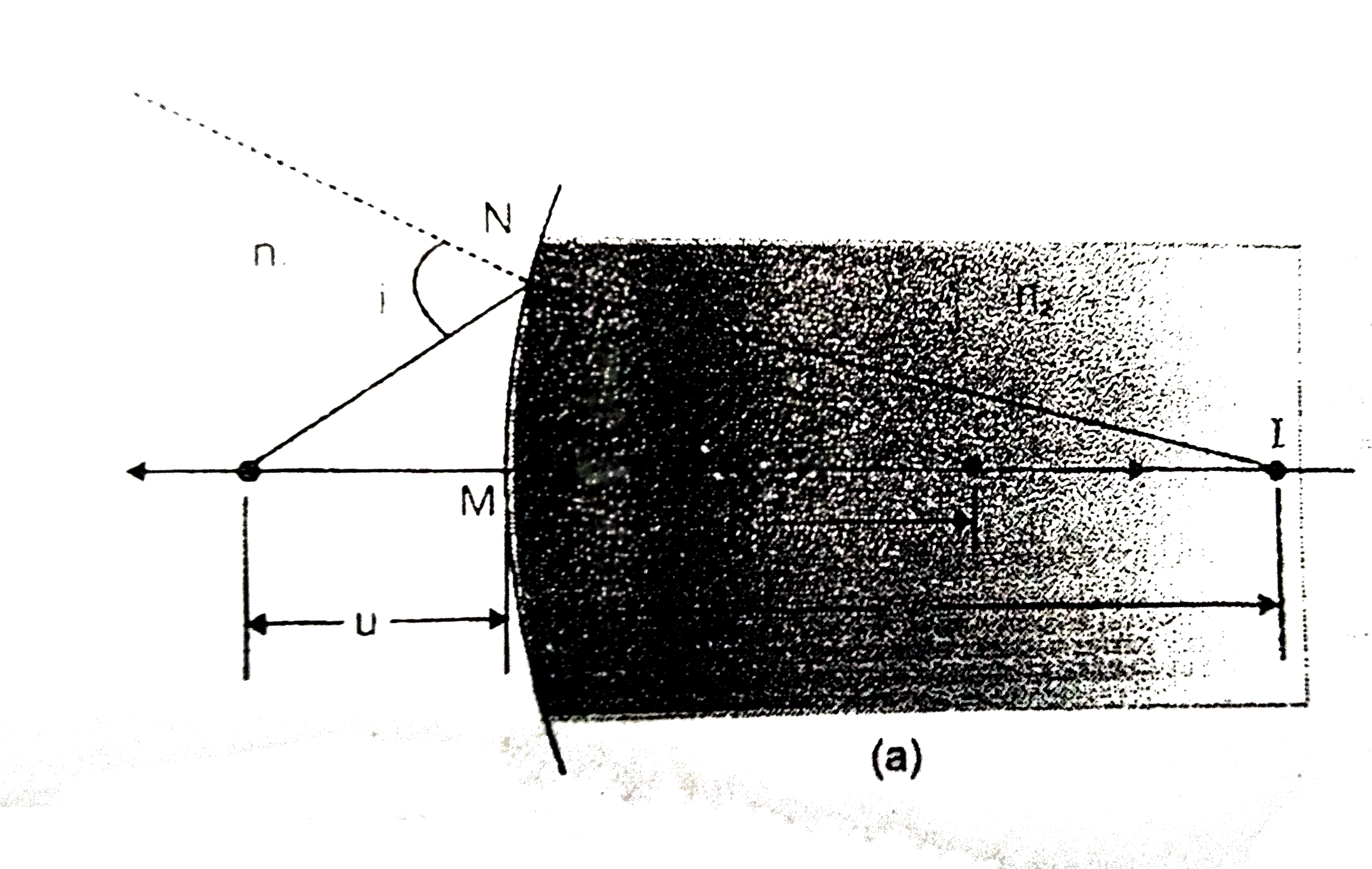 (B) Lens Maker's Formula : The first refractive surface forms the image `I_(1)` of object `O`. The image `I_(1)` acts as a virtual object for the second surface that forms the image at `I` [Fig.`(b)`]. Applying to the first interface `ABC`, we get `(n_(1))/(OB)+(n_(1))/(DI)=(n_(2)-n_(1))/(DC_(21))......(i)` A similar procedure applied to the second interface `ADC` gives, `-(n_(2))/(DI_(1))+(n_(1))/(DI)=(n_(2)-n_(1))/(DC_(2)) .........(ii)` For a thin lens, `BI_(1)=DI_(1)`. Adding Eqs. `(i)` and `(ii)`, we get `(n_(1))/(OB)+(n_(1))/(DI)=(n_(2))((1)/(BC_(1))+(1)/(DC_(2)))` Suppose the object is at infinity, `i.e.,OBrarrinfty` and `DI=f`, Eq. `(ii)` gives 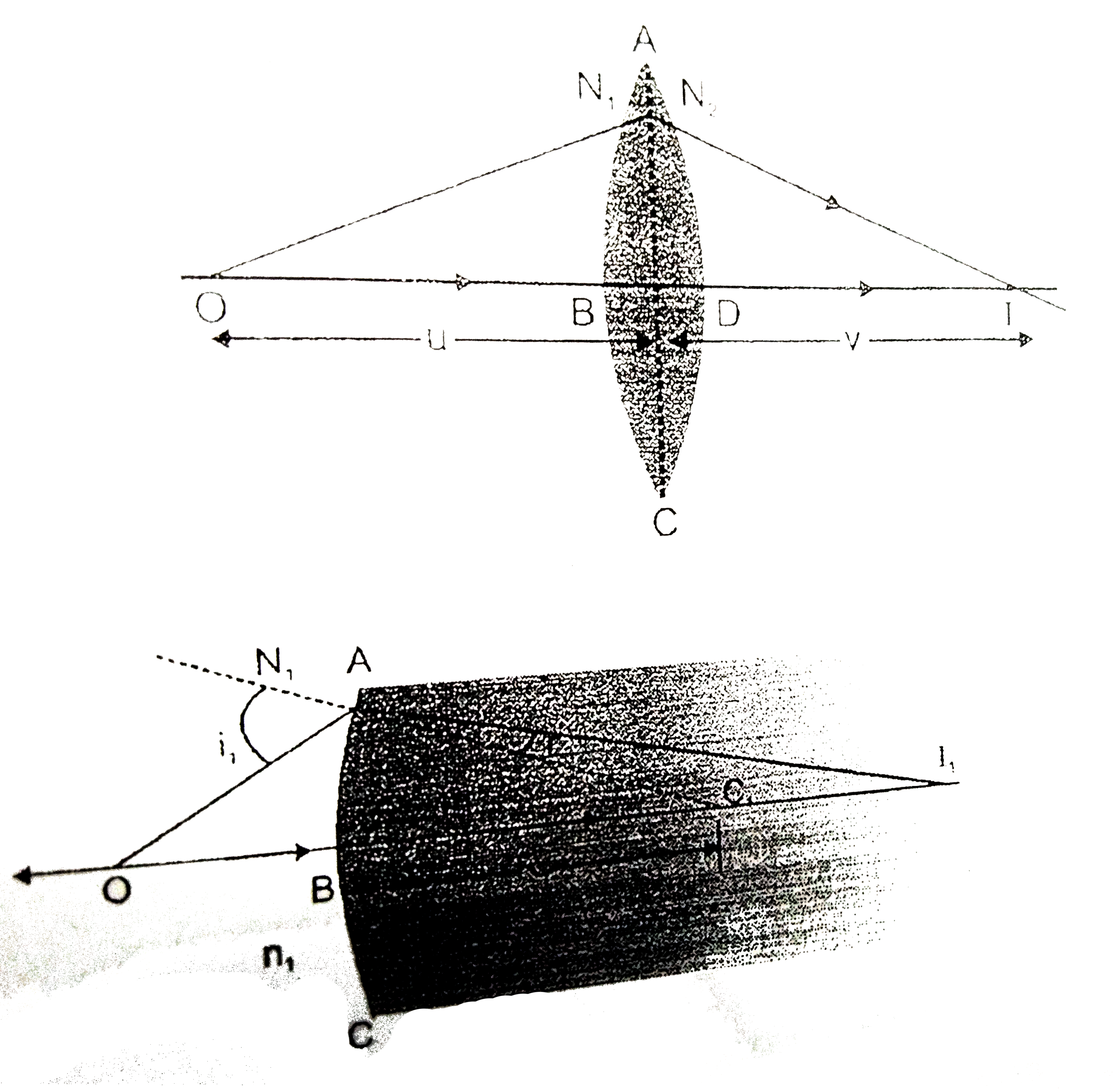 `(n_(1))/(f)=(n_(2)-n_(1))((1)/(BC_(1))+(1)/(DC_(2))).........(iii)` The point where image of an object placed at infinity is formula is called the focus `F`, of the lens and the distance `f` GIVEN its focal length. `A` lens has two foci, `F` and `F'`, on either side of it . By the sign convention, `BC_(1)=+R_(1)` `DC_(2)=-R_(2)` So Eq. `(iii)` can be written as `(1)/(f)=(n_(21)-1)((1)/(R_(1))-(1)/(R_(2))) ............(iv)``(n_(21)=(n_(2))/(n_(1)))` Equation `(iv)` is known as the lens maker's formula. It is useful to designlenses of desired focal length using surfaces of sutable radii of curvature. Note that the formula is true for a concave lens also. In that case `R_(1)` is negative, `R_(2)` positive and therefore, `f` is negative. 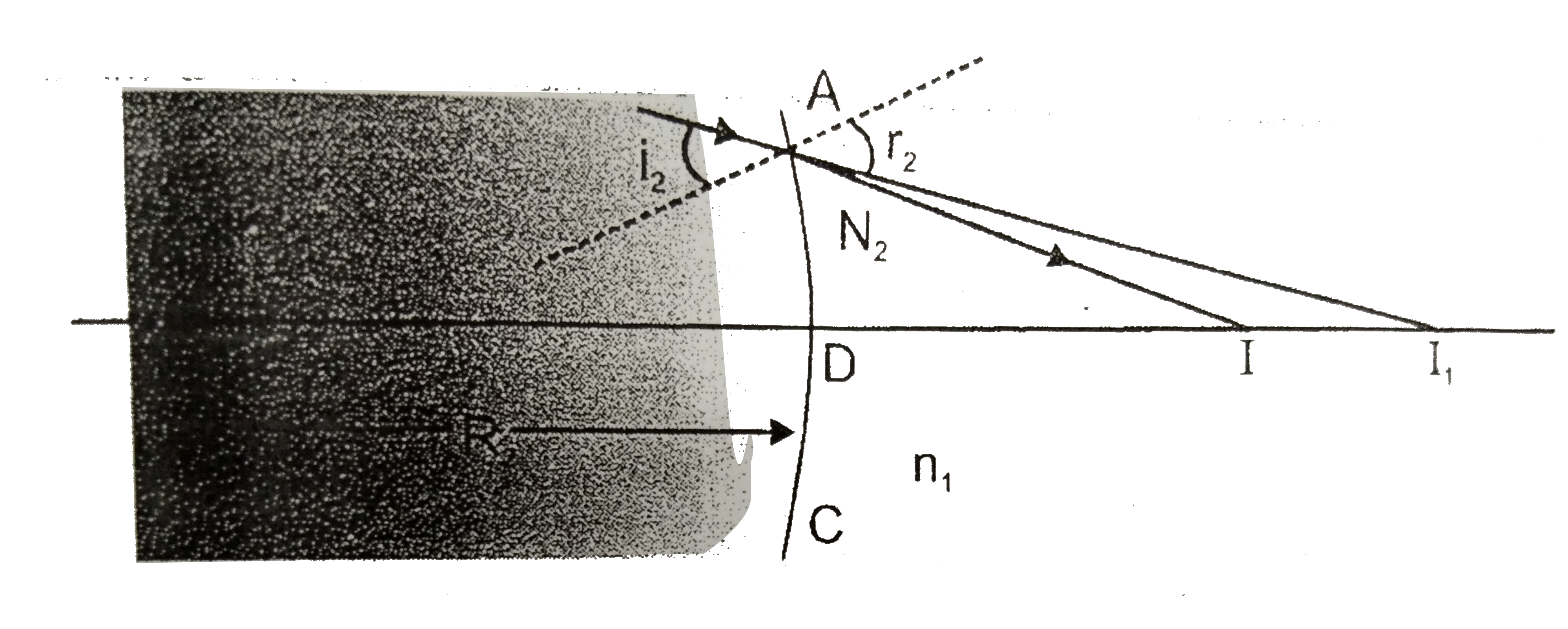
|
|
| 10. |
In an experiment with Foucault's apparatus, the various distances used are as follows : Distance between the rotating and the fixed mirror = 16 m Distance between the lens and the rotating mirror = 6 m, Distance between the source and the lens = 2 m. When the mirror is rotated at a speed of 356 revolutions per second, the image shifts by 0.7 mm. Calculate the speed of light from these data. |
|
Answer» R= distance between fixed and rotating mirror =16 m w=Angular speed = 356 rev/s `=356xx2pi rad/sec` b=distance between lens and rotating mirror 6M a=Distance between source and lens =2M s=shift in image `=0.7m=0.7xx10^3m` So speed of light is given by `c4R^2(WA)/(s(R+b))` `=(4x(16)^2xx356xx2pixx2)/((0.7)xx10^-3(16+6))` `=2.975xx10^8m/s` |
|
| 11. |
Two particles , each having a charge Q, are fixed at y = d//2 and y = -d//2. Where should a particle of charge q be placed on x-axis from origin so that it experiences maximum force and what is it equal to ? Sketch variation of electric force experienced by q v//s x. |
|
Answer» Solution :Force on `q` to each `Q` will be same in MAGNITUDE `F_(0) =(1)/( 4 PI in_(0)) (Qq)/(((d^(2))/(4) + x^(2))` Resultant force on `q`, `F = 2 F_(0) cos theta` `= 2. (1)/( 4 pi in_(0)) (Qq)/(((d^(2))/(4) +x^(2))) (x)/(((d^(2))/(4) + x^(2))^(1//2))` `= (Qq)/(2 pi in_(0)) (x)/((d^(2))/(4) +x^(2))^(3//2)` For `F` to be maximum, `(dF)/(dx) = 0` `(Qq)/(4 pi in_(0)) (((d^(2))/(4) + x^(2))^(3//2) . 1- x.(3)/(2)((d^(2))/(4) + x^(2))^(1//2) . 2X)/(((d^(2))/(4) + x^(2)))` `(d^(2))/(4) + x^(2) - 3x^(2) = 0` `x^(2) = (d^(2))/(8)` `x = +- (d)/( 2 sqrt(2))` `F_(max) = (Qq)/( 2pi in_(0)) (d)/(2 sqrt(2)) (1)/((d^(2))/(4) + (d^(2))/(8))^(3//2)` `= (Qq)/( 2 pi in_(0)) (d)/(2 sqrt(2)) (1)/((3D^(2))/(8) .(sqrt(3) d)/(2 sqrt(2)))` ` = (4 Qq)/( 3 sqrt(3) pi in_(0) d^(2))` `F v//s x` graph : when `q` is at right of `O` , force on it will be along ` + x` axis (assuming `+ve`) , graph will above x-axis. When `q` is the left of `O`, force will be along-x-axis (assuming `-ve`) , graph will be below x-axis. `x = 0 , F = 0` `x = +- (d)/(2 sqrt(2)) , F = F_(max)` `x rarr prop , F rarr 0` 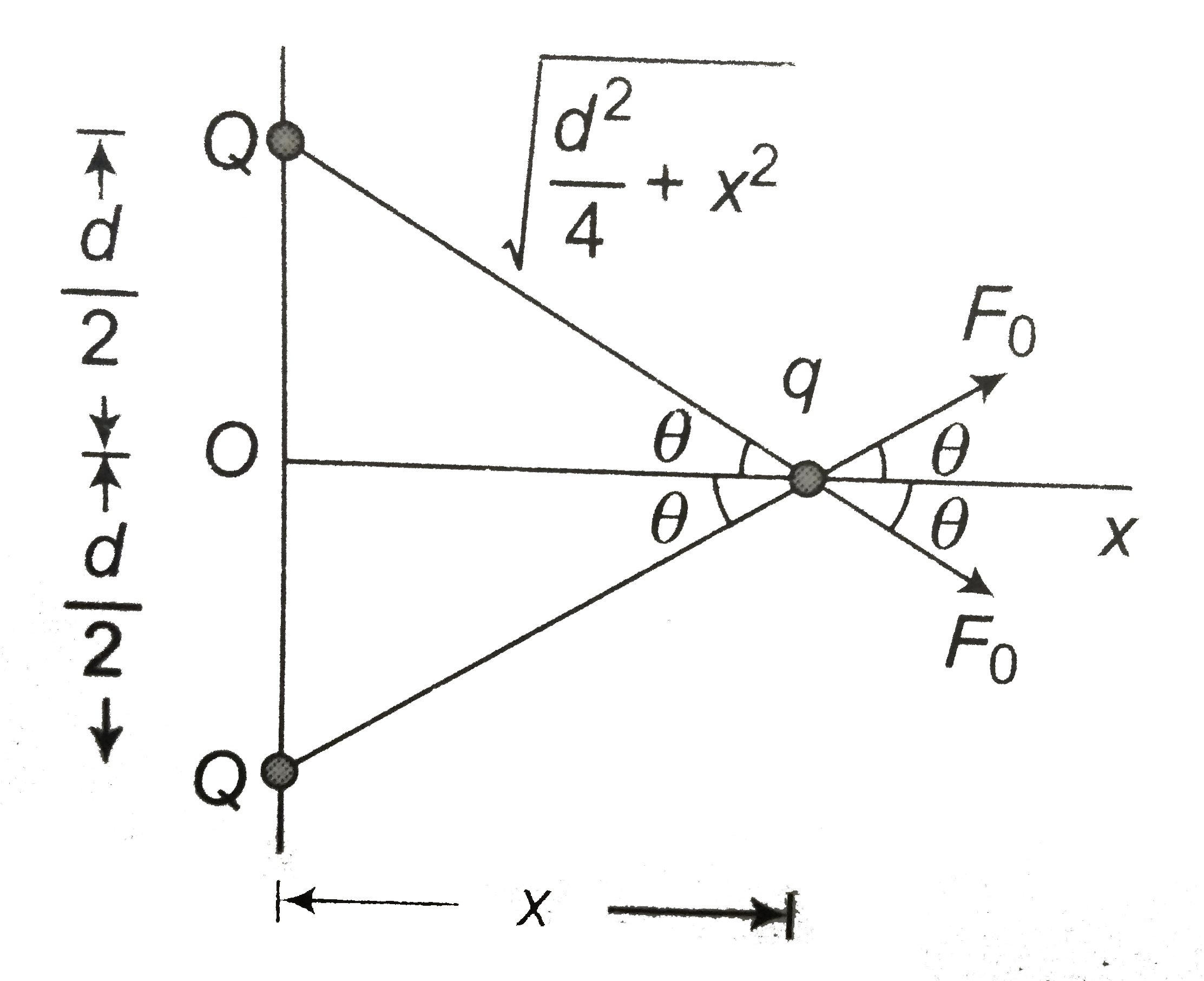 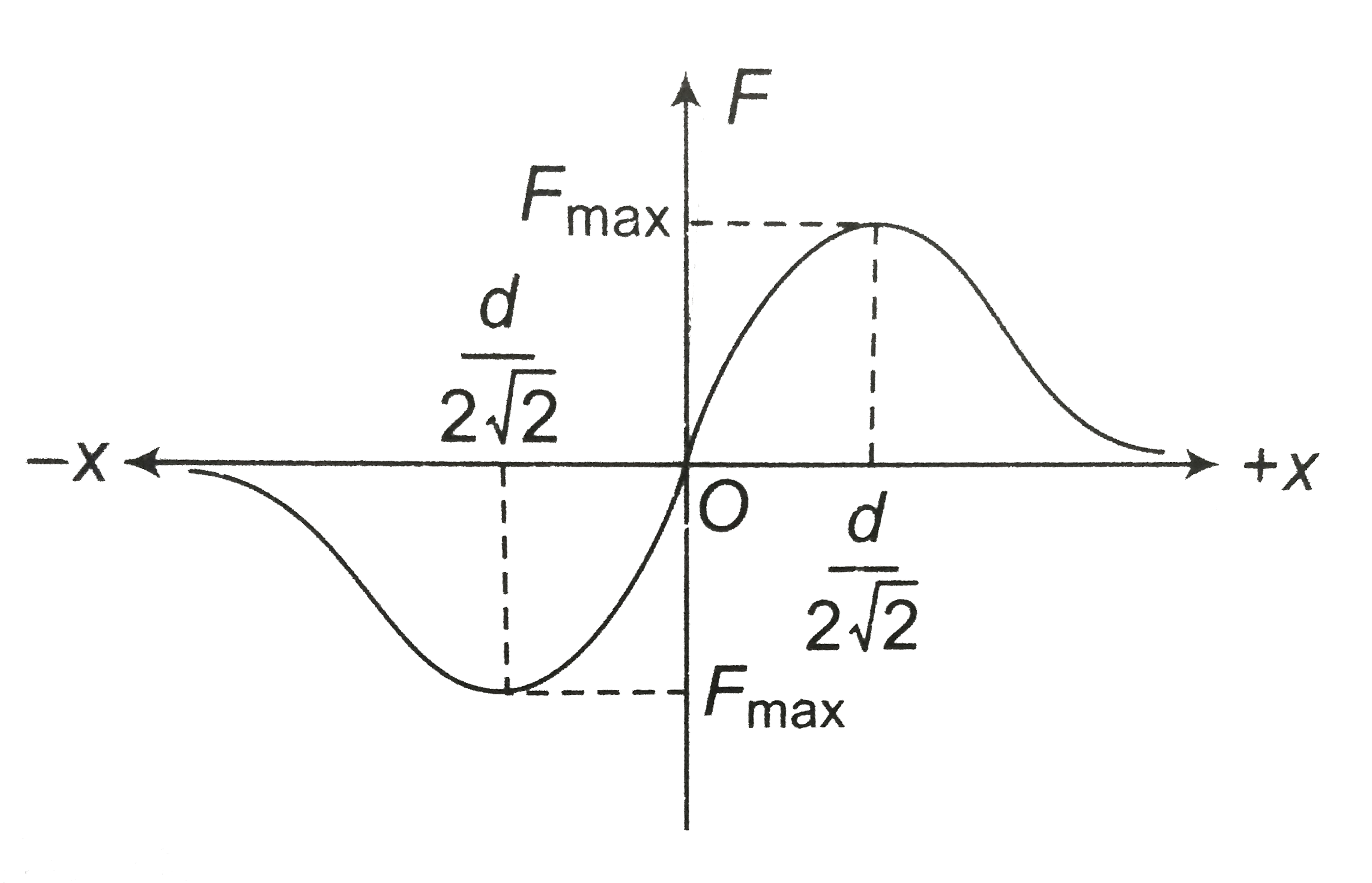
|
|
| 12. |
A circuit element is placed in a blackbox. At t=0, a switch is closed and the current flowing through the circuit element and the voltage across its terminals are recorded to have the wave shapes shown in the figure here. The type of element and its magnitude are: |
|
Answer» resistance of `2OMEGA` |
|
| 13. |
A current of 100 A flows in a conical copper with dimensions as shown in Fig 26.8. Find the current density and electric field intensity at the end faces of the conductor |
|
Answer» |
|
| 14. |
If F = 2x^(2) - 3x -2, then choose correct option:- |
|
Answer» `X=-(1)/(2)` is the position of stable equilibrium |
|
| 15. |
A body sliding on a smooth inclined plane requires 4 secs to reach the bottom after starting from rest at the 1/4top. How much time does it take to cover th the length of plane starting from the top ? |
|
Answer» 3 s |
|
| 16. |
A battery is made by joining m rows of identical cells in parallel. Each row consists of n cells joined in series. This battery sends a maximum current I in a given external resistor. Now the cells are so areaged that instead of m rows. N rows are joind in parallel and each row consists of m cells joined in series. Find the current through the same external resistor (Total number of cells which is equal to nm is connected ) |
|
Answer» |
|
| 17. |
In above problem rati of distance traveled in first second of upward motion to first second of downward motion is |
|
Answer» `1:7` |
|
| 18. |
In the formation of rainbow, the light from the sun on water droplets undergoes |
|
Answer» DISPERSION only |
|
| 19. |
What is meant by alternating current ? Derive the expression for a sinusoidal e.m.f. induced in a coil rotating with uniform angular speed in a uniform magnetic field. |
|
Answer» Solution :Current that changes in its direction once in every half cycle is called as alternating currect. Let Magnetic FLUX, `PHI =BAN cos omega t` `e=(-dPhi)/(dt)` `e=BAN omega SIN omega t`. i.e., `e=e_0 sin omega t , e/R=(e_0)/R sin omega t, i=i_0 sin omegat` The direction of .e. is`+ve for Phi =0^@ "to" 180^@ ` and the induced current flows from X to Y and for `Phi =180^@ "to" 360^@` , the induced current flows from Y to X. 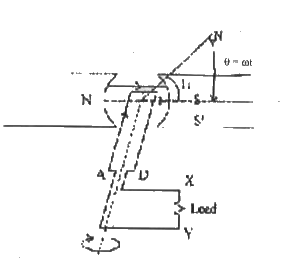 `e_(rms)=(e_(PEAK))/sqrt(2)` where `""e_(peak)=e_0=BAN omega` B - Magnetic flux density, A- Area of the conductor, N - No. of turns. `omega` - Angular frequency of rotation. |
|
| 20. |
At what temperature will oxygen molecules have the same root mean square speed as hydrogen molecules at 300 K ? |
|
Answer» 4800 K `THEREFORE sqrt((3RT_(0))/(M_(0)))=sqrt((3RT_(H))/(M_(H)))` `rArr T_(0) =T_(H) cdot (M_(0))/(M_(H))=300xx(32)/(2)=4800 k` Thus, correct choice is (a). |
|
| 21. |
Five resistors are connected in the configuration as shown in the figure. Calculate the equivalent resistance between the points a and b. |
Answer» Solution :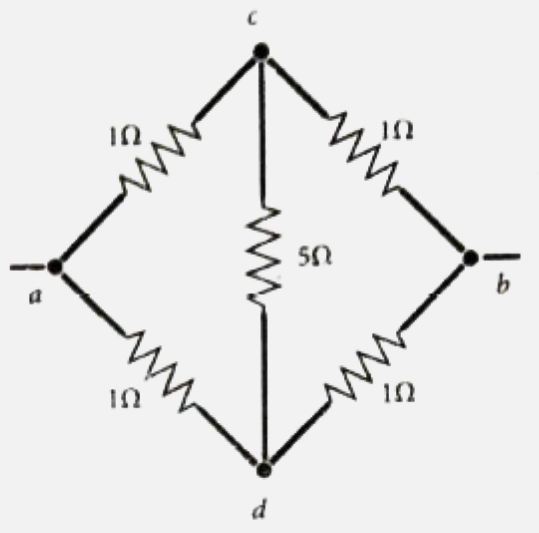 To FIND the equivalent resistance between the POINTS a and b, we ASSUME that current is entering the junction a, Since all the resistances in the outside loop are the same `(1Omega)`, the current in the branches ac and ad must be equal. So the ELECTRIC POTENTIAL at the point c and d is the same hence no current flows into `5Omega` resistance. It implies that the `5Omega` has no role in determining the equivalent resistance and it can be removed. So the circuit is simplifiedas shown in the figure.  The equivalent resistance of the circuit between a and b is `R_(eq)=1Omega`. |
|
| 22. |
The weights of two objects one lying at the equator and the other at latitude 45^(@) on earth and 100 N each. If the angular velocity of rotation of earth increases such that the object at the equator becomes weightless (zero N), the weight of the object at latitude 45^(@) will be |
|
Answer» 100 N `g_(phi)=g-(Romega_(1)^(2))/(2)` For weightlessness condition at the equation `omega_(1)=sqrt((g)/(R))` `g_(phi)=g-(R)/(2)=(g)/(2)` `W=mg_(phi)=(MG)/(2)=(100)/(2)=50N.` |
|
| 23. |
The V to I characteristic of a silicon diode is shown in the figure. Calculate the resistance of the diode at (a) I_(D)=15mA and (b) V_(D)=-10V. |
|
Answer» Solution :Considering the diode characteristics as a straight line betweenI = 10 mA to I = 20 mA passing through the origin, we can calculate the resistance USING Ohm.s law. (a) From the curve, at `I_(2)=20mA` for `V_(2)=0.8V, I_(1)=10mA` for `V_(1)=0.7V` `therefore` Resistance of forward bias, `r_(fb)=(DeltaV)/(DeltaI)` `therefore r_(fb)=(V_(2)-V_(1))/(I_(2)-I_(1))` `=(0.8-0.7)/((20-10)xx10^(-3))=(0.1XX10^(3))/(10)` `therefore r_(fb)=10Omega` (b) From the curve at `V=-10V, I=-1muA` `therefore` Resistance of reverse bias, `r_(rb)=(V)/(I)` `therefore r_(rb)=(-10)/(-1xx10^(-6))` `=1xx10^(7)Omega` |
|
| 24. |
Fig (a) and (b) show the field lines of a single positive and negative charges respectively . Give the sign of the potential energy difference of a small negative charge between the points Q and P , A and B . |
| Answer» Solution :POTENTIAL energy difference of a SMALL NEGATIVE CHARGE -q between the points Q and P will be -q `(V_(Q) - V_(P)) = q (V_(P) - V_(Q))` and it will be +ve . Again potential energy difference of this negative charge between the points A and B will be -q `(V_(A) - V_(B)) = q (V_(B) - V_(A))` and it will also be +ve . | |
| 25. |
Statement I. Gravitational potential at any point is equal to gravitational potential energyof a body of unit mass. Statement II. The gravitational potential of a body of mass m is U= -(GMm)/(r ), where symbols have their usualmeanings. |
|
Answer» Statement-I is TRUE, Statement-II is true and Statement-II is correct EXPLANATION for Statement-I. So correct CHOICE is a. |
|
| 26. |
Fig (a) and (b) show the field lines of a single positive and negative charges respectively . Give the signs of the potential difference : V_(P) - V_(Q) , V_(B) - V_(A) |
| Answer» Solution :As electric field lines give the direction of electric field , which in TURN is in the direction of FALLING POTENTIAL , hence it is clear that `V_(P) gt V_(Q)` or `(V_(P) 0 V_Q)` is +ve . Again `V_(B) gt V_(A)` or `(V_(B) - V_(A))` is POSITIVE . | |
| 27. |
Fig (a) and (b) show the field lines of a single positive and negative charges respectively . Givethe sign of the work done by an external agency in moving a small negative charge from B to A . |
| Answer» Solution :Work DONE by an external agency (against the electric FIELD ) in moving small -ve CHARGE from B to A = `- q (V_(A) - V_(B)) = q (V_(B) - V_(A))` and it has a + ve SIGN . | |
| 28. |
The equivalent capacitance between P and Q in the figure is (area of each plate is A and separation between two consecutive plates is d) |
|
Answer» `(Aepsilon_0)/(2D)` |
|
| 29. |
The contribution in the total current flowing through a semiconductor due to electrons and holes are 3/4 and 1/4 respectively . If the drift velocity of electrons is 5/2 times that of holes at this temperature, then the ratio of concentration of electrons and holes is |
|
Answer» `6:5` `IMPLIES J_e=n_eqv_e and n_hqv_h` `impliesJ_e/J_h=n_e/n_hxxv_e/v_h=(3//4)/(1//4)=n_e/n_hxx5/2impliesn_e/n_h=6/5 ` |
|
| 30. |
Fig (a) and (b) show the field lines of a single positive and negative charges respectively . Give the sign of the work done by the field in movinga small positive charge from Q to P . |
| Answer» Solution :Work DONE by the electric field in MOVING a SMALL +ve charge from Q to P= `q (V_(Q) - V_(P))` , which is obviously negative . | |
| 31. |
Find the electric field at point C of the given U shapedwire which is uniformly chargedwith linearchargedensity lambda. [C is the centre of the semi circularsection] |
|
Answer» Solution :The electricfields due to the threepartsof u shapedwireare shown in the above FIGURE. `barE_("net") =(Ex_(i) +Ex_(2))i+ (Ey_(1)+Ey_(2)+Ey_(3)) j` `barE_("net") =((K lambda)/( a)-(KLAMBDA)/( a))i+ ((2Klambda)/( a) -(Klambda)/(a) -(Klambda)/(a))j=0` Henceelectricfield due to GIVENARRANGEMENT at C = 0. |
|
| 32. |
An extended object of size 2 mm is placed on the principal axis of a converging lens of focal length 10 cm. It is found that when the object is placed perpendicular to the principal axis the image formed is 4mm is size. The size of image when it is placed along the principal axis is ........mm. |
|
Answer» |
|
| 33. |
Name the device used for producing microwaves. |
| Answer» SOLUTION :KLYSTRON VALVE and MAGNETRON valve | |
| 34. |
Two wires of the same material and having lengths in the ratio of 2:3 are connected inseries. The p.d.s across the wires are 4.2 V and 3.6 V respectively. Compare their radii. |
|
Answer» `1:7` |
|
| 35. |
A point charge of 2 C experiences a constant force of 1000 N when moved between two points separated by a distance of 2 cm in a uniform electric field. The potential difference between the two points is |
|
Answer» a. 12V |
|
| 36. |
Distinguish between average & rms value of an AC. |
Answer» SOLUTION :
|
|
| 37. |
When two uncharged, conducting spheres of radius 0.1mm each collide 7 electrons get transferred from one to the ther. The potential difference between the spheres will be about |
|
Answer» `4xx10^(-6)V` |
|
| 38. |
A toy chest and its contents have a combined weight of 200 N. The coefficient of static friction between toy chest and floor is 0.47. The child in Fig. 6-51 attempts to move the chest across the floor by pulling on an attached rope. (a) If theta is 42^(@) what is the magnitude of the force F that the child must exert on the rope to put the chest on the verge of moving? (b) Write an expression for the magnitude Frequired to put the chest on the verge of moving as a function of the angle theta. Determine (c) the value of thetafor which F is a minimum and (d) that minimum magnitude. |
| Answer» SOLUTION :`(a)=F89N,(b)F=(94N)/(COS THETA+(0.47) sin theta),(C) mu_(s)=25^(@), (d) F=85 N` | |
| 39. |
A charged particle is projected in a magnetic field of(5 hat I + 9 hat j ) m Tand its acceleration is found to be (9 hat I - x hat j ) xx 10^(-6) m//s^(2). What should be the value of x? |
|
Answer» Solution :We know that MAGNETIC force is always perpendicularto the magnetic field. So the acceleration VECTOR must also be PERPENDICULAR to the magnetic field. The dot product of two mutually perpendicular vectors should be zero hence we get the following: `VEC a * vec B = 0rArr(5 hat i + 9 hat j) * (9 hat i - X hat j) xx 10^(-6) xx 10^(-3) = 0 ` ` rArr45 - 9 x = 0 rArrx = 5` |
|
| 40. |
What we call the modification in the distribution of light energy due to superposition of two waves ? |
| Answer» SOLUTION :INTERFERENCE | |
| 41. |
A conducting square loop PQRS of side L and resistance R moves in its plane with a uniform velocity vcev perpendicular to one of its sides. A magnetic field vceB, constant in time and space, pointing perpendicular and out of the plane of loop exists everywhere. The current induced in the loop is |
|
Answer» `(BLV)/R` CLOCKWISE. |
|
| 42. |
The susceptibility of a magnetic material is - 2.6 xx 10^(-5).Identify the type of magnetic material and state its two properties. |
|
Answer» Solution :As susceptibility of given magnetic material is `-2.6 XX 10^(-5)` the material is a diamagnetic material. Two important properties of these materials are: (i) These are feebly repelled by a magnetic field and tend to move from stronger to WEAKER region of field. (ii) INDIVIDUAL atoms of diamagnetic material have zero magnetic DIPOLE moment. |
|
| 43. |
The ratio of rotational and translational kinetic energies of sphere is |
|
Answer» 2/9 |
|
| 44. |
The displacement of a particle of mass 2 g executing SHM is given by y=5sin(4t+pi/3). Here, y is in metres and t is in seconds. The kinetic energy of the particle, when t=T/4 is |
|
Answer» 0.4 J `omega=4and"so "T=(2pi)/4=pi/2s` `t=T/4=pi/8s` Velocity = `(DY)/(dt)=20cos(4t+pi/3)` Velocity at `t=pi/8s` is `v=20cos(4xxpi/8+pi/3)=20cos150^(@)` = `-20cos30^(@)=-(20sqrt3)/2MS^(-1)` KE of particle is `K=1/2mv^(2)=1/2xx2/1000xx100xx3=0.3J` |
|
| 45. |
A full - wave rectifier circuit with an ac input is shown. The output voltage across R_(L) is represented as |
|
Answer»
|
|
| 46. |
Which cold desert is relatively isolated from the rest of country? |
|
Answer» Leh |
|
| 47. |
Two wires of same material but of different diameters carry the same current I. If the ratio of their diameters is 2:1, then the corresponding ratio of their mean drift velocity will be: |
|
Answer» 4:1 |
|
| 48. |
Both object and convex lens are approaching each other along the principal axis as shown. Find the speed of image relative to object at the given instant as shown in the figure. |
| Answer» SOLUTION :12 cm/s, AWAY | |
| 49. |
An ammeter has range I and resistance G. What resistance should be connected in parallel to increase its range to n I? |
|
Answer» G/n |
|