

Saved Bookmarks
This section includes 7 InterviewSolutions, each offering curated multiple-choice questions to sharpen your Current Affairs knowledge and support exam preparation. Choose a topic below to get started.
| 1. |
At very low temperature, a semi-conductorbecomes |
| Answer» Answer :C | |
| 2. |
Show that 1 amu = 932 MeV. |
|
Answer» SOLUTION :(i) The difference between the rest mass of a nucleus and the sum of the masses of its constituents is called Nuclear-mass defect. (ii) The ratio of the Binding energy of a nucleus to the number of nucleons or Binding energy per nucleons, of a nucleus is called SPECIFIC binding energy. `E=mc^(2)` Taking `m=1 amu=1.66 xx 10^(-27) ` kg and `c=2.9979 xx 10^(8) MS^(-1)` AlsoMeV `=1.6 xx 10^(-13) ` J Arriving at ` amu `=931` MeV |
|
| 3. |
A receiver and a source of sonic oscillation of frequency n = 2000 Hz are located on the x - axis. The source swings harmonically along that axis with a circular frequency omega and an amplitude a = 50 cm. At what value of omega will the frequency band width registered by the stationary receiver be equal to Deltan = 200 Hz? The velocity of sound is equal to v = 340 m/s |
|
Answer» |
|
| 4. |
I - V characteristics of four devices are shown in Fig. Identify devices that can be used for modulation : |
|
Answer» `'I' and 'iii'` Thus , for modulation (ii) and some regionsof (iv) can be used . |
|
| 5. |
A long wire is first bent into a circular coil of one turn and then into a circular coil of smaller radius, having n identical turns. If the same current passes in both the cases, find the ratio of the magnetric fields produced at the centre in the two cases. |
|
Answer» Solution :Let a wire of length L is first bent in a single CIRCULAR loop of radius `R_1 = (L)/(2pi)` and a CURRENT I passes through it. Then the magnetic field at the centre of loop : `B_1= (mu_0 I)/(2 R_1) = (mu_0 I)/(2L) cdot 2pi "" ……..(i)` When the same wire is bent into a circular COIL of n turns then radius of coil `R_2 = L/(2 pi R)` . Now on passing same current I, the field at the centre point will be `B_2 = (mu_0 nI)/(2 R_2) = (mu_0 n I)/(2L) cdot 2 pi r = (mu_0 n^2 I)/(2L) cdot 2 pi "".............(ii)` `IMPLIES (B_1)/(B_2) = 1/(n^2) "or" B_2 = n^2B_1`. |
|
| 6. |
Which of the following material is used to make wire wound standard resistors? |
|
Answer» Manganin |
|
| 7. |
Name the device which is used as a voltage regulator. Draw the necessary circuit diagram and explain its working . |
| Answer» SOLUTION :A zener DIODE is USED as a voltage REGULATOR. For relevant circuit diagram and working of zener diode as a voltage regulator, SEE Short Answer Question Number 35. | |
| 8. |
Which of the following has metre kelvin as the unit ? |
|
Answer» RYDBERG constant |
|
| 9. |
A radioactive substance has 6.0 xx 10^(18)active nuclei initially . What time required for the active nuclei of the same substance to become 1.0 xx 10^(18)if it.s half-life is 40 s. |
|
Answer» Solution :The NUMBER of ACTIVE nuclei at any instant of time t , `N_0/N= e^(lamdat) "" log_(e)(N_0/N)= lamdat` `:.t= (log_e((N_0)/(N)))/lamda=(2.303 log_(10)(N_0/N))/lamda` In this problem , the INITIAL number of active nuclei, `N_(0) = 6.0 xx10^(18), N=1.0 xx10^(18), T = 40s` `lamda=(0.693)/T=(0.693)/40=1.733xx10^(-2)s^(-1)`. `t= (2.303log_(10)((6.0xx10^(18))/(1.0xx10^(18))))/(1.733xx10^(-2))` `= (2.303log_(10)(6))/(1.733xx10^(-2))=(2.303xx0.7782)/(1.733xx10^(-2))=103.4s.` |
|
| 10. |
Explain the following giving reason for each: (a) How does a polaroid work to produce a linearly polarised light from an unpolarised beam of light ? (b) Why is it that light waves can be polarised but sound waves cannot be ? (c) Why are sun goggles made of polaroids preferred over those using coloured glasses ? |
|
Answer» Solution :(a) A polaroid consists of long chain molecules aligned in a particular direction. Iff an unpolarised light is incident on such a polaroid, electric vectors of light waves along the direction of the aligned molecules get absorbed. Thus, in the emergent light there are electric vectors oscillating along a direction perpendicular to the aligned molecules and the light is therefore linearly polarised. (b) Sound waves cannot be polarised because sound waves are longitudinal waves and longitudinal waves cannot UNDERGO polarisation. light waves being TRANSVERSE waves can be polarised. (c) Sun goggles made of polaroids are preffered. when ORDINARY SUNLIGHT is incident on sun goggles, the transmitted light is plane polarised and its intensity is redused by half. sun goggles made of coloured glasses allow TOTAL light of a particular colour to pass. |
|
| 11. |
When radiation of the wavelength lamdais incident on a metallic surface ,the stopping potential is 4.8 V. If the same surface is illuminated with radiation of double the wavelength ,then the stopping potential becomes 1.6 V.Then the threshold wavelength for the surface is |
|
Answer» `2lamda` |
|
| 12. |
What focal length should the reading spectacles have for a person for whom the least distance of distinct vision is 50 cm? |
| Answer» Solution :The DISTNACE of normal vision is 25 cm. So if a book is at u = 25 cm, its image should be formed at V = - 50 cm . Therefore, the DESIRED FOCAL length is given by `(1)/(F) = (1)/(v) - (1)/(u) ` or `(1)/(f)= (1)/(-50) - (1)/(-25) = (1)/(50) ` or f = +50 cm (convex lens). | |
| 13. |
Which of the following statements is false? Centripetal force and centrifugal force |
|
Answer» are EQUAL in magnitude |
|
| 14. |
The frequency of the incident light falling on a photosensitive metal plate is doubled. The kinetic energy of the emitted photoelectron is : |
|
Answer» unchanged `:. (E_(k).)/(E_(k))=(2hv-phi_(0))/(hv-phi_(0))=(2((hv-phi_(0))/(2)))/(hv-phi_(0))s` Clearly `(E_(k).)/(E_(k)) GT 2` so `E_(k). gt 2E_(k)` |
|
| 15. |
A light ray travels from a denser medium to a rarer medium. If the critical angle of the denser medium with respect torarer medium is C, the maximum possible deviation of any ray will be |
| Answer» ANSWER :B | |
| 16. |
Find charge flown through battery and heat generated in the circuit after shifting switch from S_i "to" S_2 |
Answer» Solution :Initially 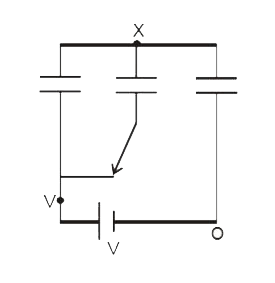 For node x ` (x- v) 2C+ (x-v) c+ (x+0) c=0 ` `rArr "" 4x =3v""rArr "" x= (3v)/( 4) ` 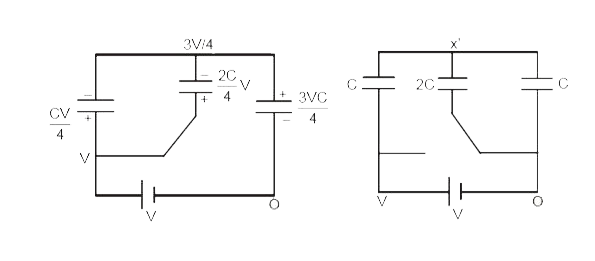 ` (x'-0)C+ (x'-0) 2C+ (x'-V) C+0` `rArr ""x' =(V)/(4) ` So now CHARGE on capacitor So charge FLOW from battery 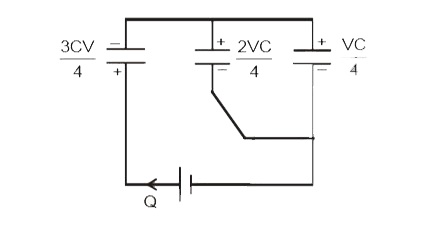 ` Q= ( (3CV)/(4) -(CV)/( 4) )=(CV)/(2) ` So heat generated ` Dellta H =QV -[ {(1)/(2) C((3V)/(4))^(2) +(1)/(2) (2C) ((V)/(4)) ^(2) +(1)/(2) xx C xx ((V)/(4) ) ^(2)} ` ` {(1)/(2) C((V)/(4))^(2)+ (1)/(2) (2C) ((V)/(4))^(2) +(1)/(2) xx Cxx ((3V)/(4))^(2) } ` |
|
| 17. |
A one metre long solenoid carrying current of 10 A has a radius of 1 cm. Calculate the magnitude of magnetic field inside the solenoid if it has 500 turns per metre. |
|
Answer» |
|
| 18. |
An extended object of size 2 mm is placed on the principal axis of a converging lens of focal length10 cm. It is found that when the object is placed perpendicular to the principal axis the image formed is 4mm in size. The size of image when it is placed along the principal axis is ....... mm. |
|
Answer» |
|
| 19. |
The colours on the resistor shown in Fig., are red orange, green and gold as read from left to right. What is the resistance of it according to colour code? |
| Answer» SOLUTION :`(2.3 PM 0.115)M OMEGA` | |
| 20. |
The total energy of the body is |
|
Answer» `-2.58xx10^(9)J` |
|
| 21. |
The length of a rectangular plate is measured as 10 cm by a vernier scale of least count 0.01 ch and its breadth as 5 cm by the same scale. The percentage error in area is |
|
Answer» `0.1%` |
|
| 22. |
In the previous question speed of sound at 0^(@)C is roughly . |
|
Answer» `324m//sec` |
|
| 23. |
The refractive index of the material of an equi-double convex lens is 1.5. What is its focal length ? (Radius of curvature = R). |
|
Answer» 3R |
|
| 24. |
The process of isolating a certain region of space from external field is called .................... . |
|
Answer» |
|
| 25. |
Derive an expression for the electric field at any point along the axial line of an electrical dipole. |
|
Answer» Solution :The electric field at a point P on axial line of dipole due to +q charge B. ` E_B =(1)/(4 pi in _0).(q)/((R-a)^(2)) ` along BP and electric field due to -q charge at A is ` "" E_A =(1)/(4 pi in _0).(q)/( (r+a) ^(2)) ` along PB ` therefore` Net electric field at point P is GIVEN by ` E= E_B -E_A =(q)/(4 pi in_0)[(1)/((r-a)^(2) )-( 1)/((r+a)^(2)) ]= (q. 4ar)/(4pi in _0(r^(2) -a^(2) )^(2)) ` `rArr "" E= (2pr)/(4 pi in _0(r^(2) -a^(2))^(2)) , `where p=q ,2a=dipole moment of given dipole. For a short dipole or if the point P is situated far away, then a `ltlt ` r and hence, ` ""E =(1)/(4piin _0) .(2p)/(r^(3)) `along ABP Vectorially ` oversetto E= (1)/(4 pi in _0).(oversetto 2p)/(r^(3)) ` 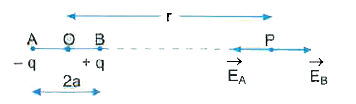
|
|
| 26. |
Find the charge on the four capacirtors of capacitances 1(mu)F,2(mu)F,3(mu)F,and 4(mu)F, shown in figure. |
|
Answer» Solution :At steady state no current flows through the capacitors . ` R_eq = (3xx6)/(3+6) = 2 Omega ` ` i= 6/2 = 3 ` Since current is DIVIDED in the inverse ratio of resistance in each branch, 2` Omega ` will pass through ` 1, 2 Omega branch and one through 3, `3Omega` branch . ` V_AB = 2 xx 1 ` ` = 2V ` ` Q on 1 = MU f capacitors ` ` = 2 xx 1muc ` ` =2 MUC ` ` V_BC = 2 xx 2 = 4V. ` ` Q on 2 = 2 mu f capacitor = CV ` ` = 2 xx 4 mu c ` ` = 8 mu c ` ` V_DE = 3 xx 1 = 3V ` ` Q on 4 = 4 mu f capacitor ` ` = 3 xx 4 mu c ` ` =12 mu c ` ` V_FE = 3 xx 1 = 3V ` ` Q across 3 = 3 mu f capacitor ` ` 3 xx 3 mu c ` ` = 9 mu c ` . |
|
| 27. |
(A): The binding energy per nucleon, for nuclei with atomic mass number A gt 100decreases with A. (R): The nuclear forces are weak for heavier nuclei. |
|
Answer» Both .A. and .R. are TRUE and .R. is the CORRECT explanation of .A. |
|
| 28. |
The work done by the force vec( F ) = 6 hat(i) + 2 hat(j) N in displacing an object from vec( r_(1)) = 3 hat(i) + 8 hat(j) to vec( r_(2)) = 5 hat( i) - 4 hat(j) m , is |
| Answer» ANSWER :D | |
| 29. |
A toroid has a core (non - ferromagnetic) of inner radius 25 cm and outer radius 26 cm, around which 3500 turns of a wire are wound. If the current in the wire is 11 A, what is the magnetic fields, outside the toroid, inside the core of the toroid and in the empty space surrounded by the toroid are |
|
Answer» `0,3XX10^(-2)T,0` |
|
| 30. |
In a metal wire of massm=24.1 mg can slide with negligiblefrictionon two horizontal parallel rails separated by distanced=2.56 cm . The track lies in a vertical uniform magnetic field of magnitude 56.3 m. At time t=0 , device G is connected to the rails . producing a constant current i=9.13 mA in the wire and rails (even as the wire moves). At t=61.1 ms , what are the wire's (a) speed and (b) direction of motion (left or right)? |
|
Answer» |
|
| 31. |
In the above question the value of stress is : |
|
Answer» `(Wl)/(2xA)` `T=W/(2costheta)` Now cos `theta=x/(sqrt(l^(2)+x^(2)))` `costheta=x/(l[1+(x^(2))/(2l^(2))])` If `(x^(2))/(2l^(2))` is neglected being small then cos `theta=x/lthereforeT=W/(2X)` stress`=T/A=(((Wl)/(2x)))/A(Wl)/((2x)/A)=(Wl)/(2Ax)` CORRECT CHOICE is (a). |
|
| 32. |
Two infinte plane sheets A and B are shown in the figure the surface charge densities on A and B are (2//pi) xx 10^(-9)C//m^(2)and (-1 //pi) xx 10 ^(-9)C//m^(2) rospectively .C,D, E are three points where electric fields (in N/C)are E_(C) , E_(D) and E_(E) repectively. |
|
Answer» `vecE_(C)= 18hati` |
|
| 33. |
Calculatethe energyrequired to excitehydrogenatom fromgroundstateto thesecond excitedstate |
|
Answer» Solution : Datasupplied ` m=9xx 10^(-31)Kg, C = 3 xx 10^8m//s, alpha=(1)/( 137 )` Forgroundstate`n_f= 3` energyrequired` =E_(3!) = E_3- E_1 = (mc ^2 alpha ^2)/(2)[ (1)/(I^2 ) - (1)/( 3 ^2) ] = (mc^2 alpha^2 )/(2)((8)/(9))` ` thereforeE_(31)= ( 9xx 10^(-31)xx(2 xx 10 ^8)^2xx 8) /( 2xx 137 xx 137xx 9)` joules ` E_(31)=( 9xx 9xx 8 xx 10^(-31) xx 10^(16) )/( 2xx9xx 137 xx 137 xx 1.6 xx 10 ^(-19)) eV= 11.98eV ` [ SINCE `, 1 eV= 1.6xx 10^(-19)J`] |
|
| 34. |
The eletrostaic force on a small sphere of charges 0.4mu Cdue to another small sphere of charge 0. 8 mu Cin air 0.2 N. What is the distance between the two spheres? (b)What is the force on the second sphere dueto the first? |
|
Answer» Solution :Here ` q_1 =0.4 muC= 4XX 10^(-7) C,q_2 =0.8 muC =-8xx10 ^(-7)C ` and ATTRACTIVE FORCE in air F =0.2 N (a)Fromthe relation `F= 9xx 10 ^(9) (q_1q_2)/( r^(2)) , `we have `r= [( (9xx 10 ^(9)) (q_1q_2))/( F) ]^(1//2)=[( 9xx10^(9)(4xx 10^(-7)XX(8xx10^(-7))))/(0.2)]^(1//2) = 0.12 m or 12 cm ` (b)`|oversetto (F_21) |=|oversetto (F_12) | =0.2 N` (attractive) |
|
| 35. |
A girl swinging on a swing in sitting position suddenly stands up. The period of swing then will be : |
|
Answer» increased Hence the CORRECT choice is (B). |
|
| 36. |
As the temperature increase , the value of susceptibility of the ferromagnetic substnce ........... . |
|
Answer» |
|
| 37. |
Twelve equal wires, each of resistance r ohm are connected so as to form a skeleton cube. Find the equivalent resistance between the diagonally opposite points 1 and 7. |
|
Answer» Solution :Connect a source between points 1 and 7. The network is symmetricals about the DIAGONAL 1 - 7. Therefore current in res istors are distributed symmetrically about the diagonal. The current distribution is SHOWN in figure Choose a close LOOP `1-2-3-7-9-10-1`, we have `-r(i)/(3)r(i)/(6)r(i)/(3)+V=0 (or) (V)/(i)=(5)/(6)r (or) R_(17)=(V)/(i)=(5)/(6)r` |
|
| 38. |
If the focal length of the eyepiece of a telescope is doubled, its magnifyingpower m will be |
| Answer» Answer :C | |
| 39. |
A long solenoid has 1000 turns per meter and carries a current of 1 A. It has a soft iron core of mu_(r) = 1000. The core is heated beyond the Curie temperature, T_(C). |
|
Answer» The H field in the solenoid is (nearly) unchanged but the B field decreases drastically. `H= nI""` (Where `n=` number of turns per meter of a solenoid) `therefore H= 1000 xx 1 = 1000` Am Hence, H is a constant, so it is nearly unchanged. `But, B= mu n I` `= mu_(r) mu_(0) nI` `= (mu_(0) nI) mu_(r) = (K=` constant `)mu_(r)` `therefore B prop mu_r` Hence, if `mu_r` changes, B also changes. Now for magnetisation in the core, when temperature of the iron core of a solenoid is RAISED beyond Curie temperature, then it behaves as a paramagnetic material where, `(chi_(x) )_("Fero") ~~ 10^(3)` `(chi_(m) )"(Para") ~~ 10^(-5) ` `((chi_(m) )_("Fero"))/( (chi_(m))_("Para") = (10^(3) )/( 10^(-5) ) = 10^(8)` Hence, magnetization of core decreases by `10^(8)` 7) times hence option (D) is correct. |
|
| 40. |
(a) An 11.0 kg salami is supported by a cord that runs to a spring scale, which is supported by a cord hung from the ceiling (Fig. 5-41a). What is the reading on the scale, which is marked in SI weight units? (This is a way to measure weight by a cord that runs around a pulley and to a scale.The opposite end of the scale? (This is the way by a physics major.) ( c ) In Fig. 5-41c the wall has been replaced with a second 11.0 kg salami, and the assembly is stationary. What is the reading on the scale? (This is the way by a deli owner who was once a physics major.) |
| Answer» SOLUTION :(a) 108 N, (B) 108 N, ( C ) 108 N | |
| 41. |
What is the refractive index of a medium, it a light wave of frequency 5 xx 10^14 Hz has a wavelength of 4 xx 10^-7 m in the medium ? |
|
Answer» 1.1 |
|
| 42. |
Explain construction and principle of moving coil galvanometer. |
Answer» Solution :1. MOVING COIL galvanometer is as shown in diagram.  2. The galvanometer consists of a coil with many turns, free to rotate about a fixed axis in a uniform radial magnetic field. 3. There is a cylindrical soft iron core which not only makes the field radial but also increases the strength of the magnetic field. 4. Magnetic field is uniform between space of two pole so it always be `90^(@)` between area of the coil and `vecB` (magnetic field) `therefore(theta=90)` So, torque on loop is, `tau=NBIAsintheta` which is maximum. So coil rotate. 5. A spring `S_(p)` provides a counter torque `K_(phi)` that BALANCES the magnetic torque, NIAB resulting in a steady angular deflection. 6. The deflection is indicated on the scale by a pointer attached to the spring which measure the value of electric CURRENT. 7. Principle : A current carrying coil placed in a magnetic field experience a current dependent torque which tends to rotate the coil and produces angular deflection. |
|
| 43. |
An electron-positron pair is produced when a gamma-ray photon of energy 2.36MeV passes close to a heavy nucleus. Find the kinetic energy carried by each particle produced, as well as the total energy with each. |
|
Answer» Solution :The REACTION is represented by `gamma to (._(-1)E^0)+(._(+)e^0)` , so that `E=m_0 C^2+K.E_"electron"+m_0C^2+K.E_"positron"` 2.36 MeV= `2m_0. C_2+ K.E_"(electron)" + K.E_"(positron)"` = 1.02 MeV+ `K.E_((e)) + K.E_((e))` `THEREFORE` Kinetic energy of `(e^-)= K.E_((e^+))=1/2(2.36-1.02)` MeV, (K.E. CARRIED each )=0.67 MeV (motional energy ) Total energy SHARED by each particle is obviously `m_0C^2`+K.E=0.51 MeV+0.67 MeV= 1.18 MeV |
|
| 44. |
B-H curve for a ferromagnetic material is called _____________ . |
| Answer» SOLUTION :HYSTERESIS | |
| 45. |
M_(1) and M_(2) are plane mirrors and kept parallel to each other. At point O, there will be a maxima for wavelength. Light from a monochromatic source S of wavelength lambda is not reaching directly on the screen. Then, lambda is |
|
Answer» `(3D^(2))/(D)` |
|
| 46. |
A constant force Facts on a body The power delivered by F will depend on position x as (velocity of body is zero at x = 0) |
|
Answer» `X^(2/3)` |
|
| 47. |
किसी आवेशित चालक के ठीक बाहर किसी बिन्दु पर विधयुत-क्षेत्र की तीव्रता आवेश के प्रष्ठ घनत्व की 1 //epsilon_0गुनी होती है, जहा epsilon_0मुक्त आकाश की परावेधुतता हैइस कथन को कहते है |
|
Answer» एम्पियर का नियम |
|
| 48. |
Geeta has dry hair. A comb ran through her dry hair attracts small bits of paper. She observes that Neeta with oily hair combs her hair, the combs could not attract small bits of paper. She consults her teacher for this and gets the answer. She then goes to the junior classes and shows this phenomenon as physics experiment to them. All the juniors feel very happy and tell her that they will also look for such interesting things in nature and try to find the answer. She succeeds in forming a science club in her school. Read the above passage and answer the following questions.(i) What according to you are the values displayed by Geeta? (ii) Explain the phenomenon involved. |
| Answer» Solution :The values DISPLAYED are CURIOSITY, LEADERSHIP and COMPASSION | |
| 49. |
(i) Iff =- 0.2 m for a glass lens, what is the power ofthe lens? (ii) The radii ofcurvature ofthe faces of a double convex lens are 15 cm and 12 cm. Its focal length is 15 cm. What is the refractive index of glass ? (iii) Refractive index and radii of curvature oftwo equal plana-convex lens are 1.5 and 20 cm respectively. They are placed in a vessel such that their convex surfaces are in contact at centre and oil ofrefractive index 1.7 is filled in them, then what will be the focal length of combination ? |
|
Answer» <P> Solution :P = + 5D , (II) n=1.5 (iii) `f_(EQ) = - 50 cm ` |
|
| 50. |
Suppose that the two waves have wavelength lambda= 610 nm in air. What multiple of lambda gives their phase difference when they emerge if (a) n_(1) = 1.50, n_(2) = 1.60, and L = 700 um, (b) n_(1)= 1.62, n_(2) = 1.72, and L = 700 um, and (c) n_(1) = 1.83, n_(2) = 1.59, and L = 2.16 um? (d) Suppose that in each of these three situations the waves arrive at a common point (with the same amplitude) after emerging, Rank the situations according to the brightness the waves produce at the common point. |
| Answer» SOLUTION :(a) 1.15, (B) 1.15, (C) 0.85, (d) all tie | |