

Saved Bookmarks
This section includes 7 InterviewSolutions, each offering curated multiple-choice questions to sharpen your Current Affairs knowledge and support exam preparation. Choose a topic below to get started.
| 1. |
To a germanium sample , pieces of gallium are added as an impurity . The resultant sample would behave like : |
|
Answer» a conductor |
|
| 2. |
Careful measurement of the electric field at the surface of a black box indicates that the net outward flux through the surface of the box is 8.0 xx 10^(3) Nm^(2)//C. a. What is the net charge inside the box? b. If the net outward flux through the surface of the box were zero, could you conclude that there were no charges inside the box? Why or why not? |
|
Answer» SOLUTION :`a. phi=q/epsi_(0)` `q=phi xx epsi_(0) =8 xx 10^(3) xx 8.85 xx 10^(-12) =0.07 muC` b. No, only that the net charge inside is ZERO. |
|
| 3. |
How much positive and negative charge is there in a water molecule ? |
|
Answer» SOLUTION : ` H_2O `has10 ELECTRONS(2ofhydrogenand8 OFOXYGEN ) TOTALCHARGE= 10E |
|
| 4. |
Figure shows a communication system. What is the output power when input is 1.01 mW? (Gain in dB=10"log"_(10)(P_(o))/(P_(i))) |
|
Answer» 90mW 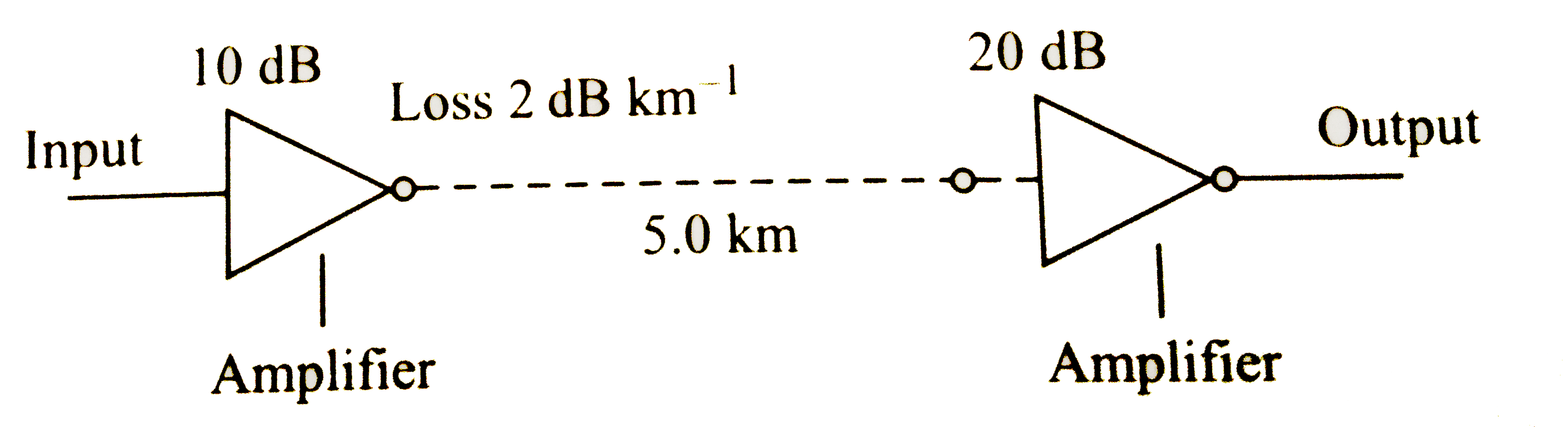 Here, transmission PATH =5km Loss SUFFERED in transmission path `=-2dB km^(-1)xx5km=-10dB` Total amplifier gain =10dB+20dB=3 0dB Overall gain of singal =30dB-10dB=20dB As, gain in `dB=10"log"_(10)((P_(0))/(P_(i))): THEREFORE 20=10"log"_(10)((P_(0))/(P_(i)))` or `"log"_(10)((P_(0))/(P_(i)))=(20)/(10)=2="log"_(10)100` or `(P_(0))/(P_(i))=100` or `P_(0)=P_(i)xx100=1.01 mWxx100=101mW` |
|
| 5. |
A steady current in a conductor cannot produce em waves . why ? |
| Answer» SOLUTION :A STEADY current GIVES RISE toa constant magnetic field. | |
| 6. |
Twocells ofemfs 1.5 Vand2.0v havinginternalresistance0.2Sigma and0.3 Sigma respectivelyareconnectedin parallel . Calculatethe emfandinternalresistanceof theequivalentcell . |
|
Answer» SOLUTION :`E_1 = 1.5 V, R2 = 0.2Omega` `E_2 = 2.0 V, r_2 =0.3Omega` EMF of equivalent cell’ `E=(E_1/r_1+E_2/r_2)/(1/r_1+1/r_2)=(E_1r_2+E_2r_1)/(r_1+r_2)` `=((1.5xx0.3+2xx0.2)/(0.2+0.3))=(0.45+0.40)/(0.5)V=1.7V` INTERNAL RESISTANCE of equivalent cell `1/r=1/r_1+1/r_2=(r_1r_2)/(r_1+r_2)` `=((0.2xx0.3)/(0.2xx0.3))Omega=(0.06)/(0.5)Omega=0.12Omega` |
|
| 7. |
If the temperature of a black body is increased by 50% then the amount of radiant energy given out : |
|
Answer» INCREASES by `50%` |
|
| 8. |
(i) In an isolated system (neither connected to the terminal of a battery nor to any other source of charge e.g each) net charge remains constant. (ii) From two terminal of a battery or from two plates of a capacitor equal and opposite charges enter or leave. Question : Two capacitors of capacity 6muFand 3muFare charged to 100 V and 50 V separatelly and connected as shown. Now all the three swiches S_(1)S_(2) and S_3are closed. Charges on both the capacititors in steady state will be : (on 6muF first) |
|
Answer» `400 muC, 400 muC` |
|
| 9. |
(i) In an isolated system (neither connected to the terminal of a battery nor to any other source of charge e.g each) net charge remains constant. (ii) From two terminal of a battery or from two plates of a capacitor equal and opposite charges enter or leave. Question : Two capacitors of capacity 6muFand 3muFare charged to 100 V and 50 V separatelly and connected as shown. Now all the three swiches S_(1)S_(2) and S_3are closed. Which plate (s) form an isolated system . |
|
Answer» plate 1 and plate 4 separately |
|
| 10. |
The K_(eq) values in HCN addition to following aldehydes are in the order - |
|
Answer» igtiigtiii |
|
| 11. |
A soda water bottle is falling freely. Will the bubbles of the gas rise in the water of the bottle? |
| Answer» Solution :The WATER in the freely falling BOTTLE is in the STATE of weightlessness. So the pressure in the water does not INCREASE bubbles. Hence, the bubbles will not rise in water. | |
| 12. |
What is the ratio of the nuclear densities of two nuclei having mass numbers in the ratio 1:3 ? |
| Answer» SOLUTION :REMAINS CONSTANT | |
| 13. |
Two blocks of ice join together where pressed. Which one of the following will appropriately account for this ? |
|
Answer» The melting point of ice DECREASES with INCREASE in pressure |
|
| 14. |
What are the thermal neutrons? Why are neutrons considered as ideal projectile for nuclear fission? |
| Answer» Solution :Thermal neutrons are LOW energy neutrons (Energy = 0.025 eV). Neutrons are ideal because they are NEUTRAL and do not SUFFER a coulomb repulsion from a nucleus. | |
| 15. |
Which set does not show correct matching according to Modern periodic table : |
|
Answer» `CR=[Ar]3D^(5)4s^(1),` elementbelongs to `6^(th)` group. As last electron enters in `d-` subshell so it belongs to `d-` subshell and thus the group number `=2+2=3` . Element belong to `3^(RD)` group of MODERN periodic table, not zero group. |
|
| 16. |
Four point charge of +10^(-7)C, -10^(-7)C, -2 xx 10^(-7)C and +2 xx 10^(-7)C are placed respectively at the corners A, B, C, D of a 0.05m square. Find the magnitude of the resultant force on the charge at D. |
|
Answer» 0.2 dyne |
|
| 17. |
Galileo writes that for angles of projection of a projectile at angles (45^(@)+theta) and (45^(@) -theta), the horizontal ranges described by the projectile are in the ratio of (if theta le 45^(@)) |
|
Answer» `2:1` |
|
| 18. |
If a unit positive charge is taken from one point to another over an equipotential surface, then |
|
Answer» work is done on the charge. |
|
| 19. |
The displacement of two interfering light waves are y_(1)=4 sin omega t and y_(2) =3 cos omega.The amplitude of the resultant waves is (y_(1)and y_(2) " are in CGS system") |
| Answer» Answer :A | |
| 20. |
A magnetised wire is bent into an arc of a circle subtending an angle 60^(@) at its centre. Then its magnetic moment is X. If the same wire is bent into an are of a circle subtending an angle 90^(@) at its centre then its magnetic moment will be |
|
Answer» `(xsqrt2)/3` |
|
| 21. |
The number density of electron is 7xx10^(12)m^(-3) and number density of hole is 7xx10^(12)m^(-3). This semiconductorwill be ….. Type. |
|
Answer» p In intrinsic SEMICONDUCTOR number DENSITY of electron and hole is EQUAL, `n_(e )=n_(h)=7xx10^(12)m^(-3)` |
|
| 22. |
In the above problem, find the distances of fourth maxima from 'O'. |
|
Answer» `+3.6 MM, -2.4 mm` |
|
| 23. |
if the intensity of the principal maximum in the single slit Fraunhoffer diffraction pattern, then the intensity when the slit width is double will be ..... |
|
Answer» `I_(0)` `I_(theta)=I_(0)=(sin^(2) alpha)/(alpha) "" [ "where" alpha=(pi d sin theta)/(lambda)]` `:.` For central maximum `alpha=(pi(2d)sin theta^(0))/(lambda)` `alpha=0` `:. I_(theta)=I_(0)=(lim_(alpha to 0)(sin alpha)/(alpha))^(2)` `=I_(0)"" [ :. lim_(alpha to 0)(sin alpha)/(alpha)=1]` Short method : Maximum intensity depend on source of light. Here source is unchanged hence maximum intensity ALSO cannot CHANGED. |
|
| 24. |
A student records the following data for the magnitudes (B) of the magnetic field at axial points at different distances x from the centre of a circular coil of radius 'a' carrying a current I. Verify (for any two) that these observations are in good agreement with the expected theoretical variation of B with x. |
| Answer» Solution :MAGNETIC field (B) is GIVEN`B = (mu_0)/(4PI) = (2M)/(x^2)` | |
| 25. |
Making use of the Clausius inequality, demonstrate that all cycles having the same maximum temperature T_(max) and the same minimum temperature T_(min) are less efficient compared to the Carnot cycle with the same T_(max) and T_(min). |
|
Answer» Solution :We WRITE Claussius inequality in the form `int(₫_1 Q)/(T) - int (₫ Q)/(T) le 0` where `₫ Q` is the HEAT transferred to the system but `₫_2 Q` is heat rejected by the system, both are `+ve` and this axplains the minus sign before `₫_2 Q`, In this inequality `T_(max) gt T gt T_(min)` and we can wire `int (₫ _1 Q)/(T_(max)) - int (₫ _2 Q)/(T_(min)) lt 0` Thus `(Q_1)/(T_(max)) lt (Q'_2)/(T_(min))` or `(T_(min))/(T_(max)) lt (Q'_2)/(Q_1)` `eta = 1 -(Q'_2)/(Q_1) lt 1 -(T_(min))/(T_(max)) = eta_(carnol)`. |
|
| 26. |
If the equivalent capacitance between points P and Q of the combination of the capacitors show in figure below us 30 muF, the capacitor C is |
|
Answer» `60 MUF` |
|
| 27. |
if the wavelength is chaged to 4000A, then stopping potential will become |
|
Answer» 1.36 V Then, `(E)/(E')=(lamda')/(lamda)` or `(E)/(1.23)=(10000)/(4000)` `E=1.23xx2.5=3.075eV` But `hupsilon-hupsilon_0=eV_S` `V_S=1.975V` |
|
| 28. |
A : Two rings of equal mass and radius made of different materials, will have same moment of inertia.R : Moment of inertia depends on mass as well as distribution of mass in the object. |
|
Answer» If both Assertion & REASON are true and the reason is the CORRECT EXPLANATION of the assertion, |
|
| 29. |
A pendulum makes perfectly elastic collision with block of m lying on a frictionless surface attached to a spring of force constant k. Pendulum is slightly displaced and released. Time period of oscillation of the system is |
|
Answer» `2PI [sqrt((l)/(g)) + sqrt((m)/(k))]` |
|
| 30. |
A thick spherical shell has inner radius a and outer b. The material has resistivity rho . When a potential difference is applied between the inner and outer surfaces, its resistance is |
|
Answer» `(rho)/(4PI)(AB)/((b-a))` |
|
| 31. |
A sphere of radius r, density d and specific heat S is heated to temperature T and is allowed to cool in an enclosure at temperature T_(0). The rate of fall of temperature is proportional to : |
|
Answer» `1/(RDS)` |
|
| 32. |
Two concentric circular loops of radius 1 cm and 20 cm are placed coaxially. (i) Find mutual inductance of the arrangement (ii) If the current passed through the outer loop is changed at a rate of 5 A/ms, find the emf induced in the inner loop. Assume the magnetic field on the inner loop to be uniform. |
|
Answer» Solution :(i) Let there be two concentric circular coils of radii r and R respectively. Where R`gtgt`r. If a current `I_(1)` , flows through the outer coil, then magnetic field developed at its centre is `B = (mu_(0)I_(1))/(2 R)` As r is very small, magnetic field on the INNER loop MAY be assumed to be UNIFORM at `B = (mu_(0)I_(1))/(2R)` `:. ` Magnetic flux linked with inner loop `phi_(2) = B(pir^(2))= (mu_(0)I_(1)pir^(2))/(2R) ` `because phi_(2)=MI_(1)` 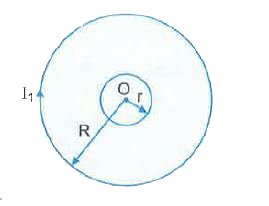 `:. ` Mutual inductance of the given pair of coils M=` (phi_(2))/(I_(1))=(mu_(0)pir^(2))/(2R)` As per question R =20 cm = 0.2 m and r =1 cm = 0.01 m `:. M =((4pixx10^(-7))xxpixx(0.01)^(2))/(2xx0.2)=9.87xx10^(10)` H (ii) If rate of change of current in outer loop i.e., `(dI_(1))/(dt) = 5 A //ms = 5xx10^(3) A s^(-1)` then magnitude of induced emf in the inner loop is `epsilon_(2) =M (dI_(1))/(dt) = (9.87xx10^(-10))xx(5xx10^(-3))= 4.935 xx10^(-6) V =4.9 mu V` |
|
| 33. |
A cell of e.m. E and internal resistance r is connected across a resistancer. The potential difference between the terminals of the cell must be |
|
Answer» E |
|
| 34. |
An isotropic popint source emits light with wavelength 589 nm. The radiation power of the source is P = 10 W. (a) Find the number of photons passing through unit area per second at a distance of 2 m from the source (b) Also calculate the distance between the source and the point at which the mean concentration of the photons is 100//cm^(3) . |
|
Answer» Solution :(a) `P =n_(0) (hc)/(lambda)` `n_(0) =(P lambda)/(hc)` , where `n_(0)`: number of photons/sec, 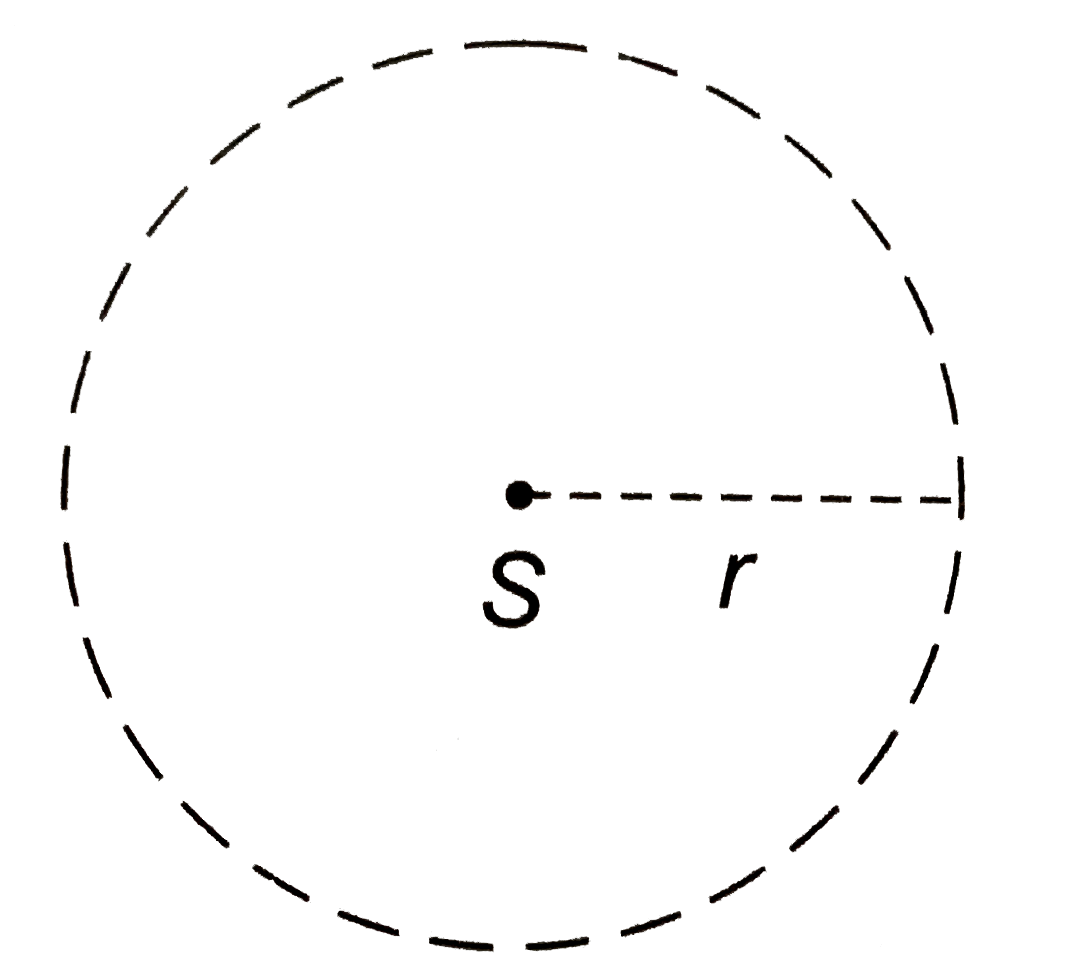 At distance r from POINT source, number of photons / area / TIME `n' =(n_(0))/(4pi r^(2)) = (P lambda)/(hc.4pi r^(2))` `=(10xx589xx10^(-9))/(6.6xx10^(-34)xx3xx10^(8)xx4pixx(2)^(2))` `=5.92xx10^(18)//m^(2)`. sec (b) Consider a SPHERICAL shell of RADIUS r and thickness DR 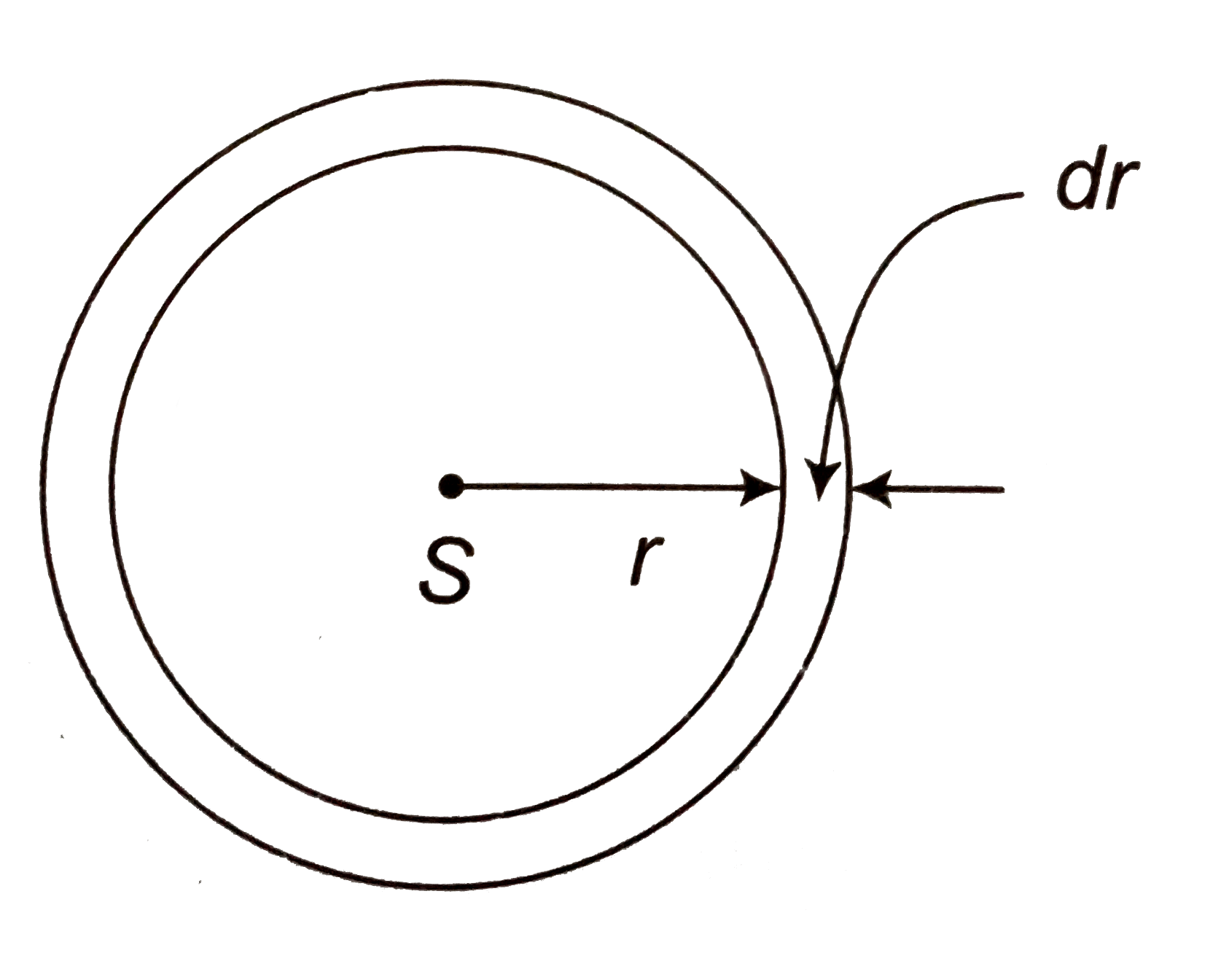 Volume of this shell `dV =4pi r^(2)dr` If n: number of photons/volume Number of photons crossing this shell per unit time `n_(0) =n(4pi r^(2)(dr)/(dt))` `[where(dr)/(dt) =c]` `n =(n_(0))/(4pi r^(2)c) =(P lambda//hc)/(4pi r^(2)c)` `r=sqrt((P lambda)/(4pi hc^(2)n)` `=sqrt((10xx589xx10^(-9))/(4xx3.14xx6.6xx10^(-34)xx(3xx10^(8))xx100xx10^(6)))` `=8.88m` |
|
| 35. |
The magnetic field of a beam emerging from a filter facing a floodlight is given by B=12xx10^(-8)sin (1.20xx10^(7)z-3.60xx10^(15)t) T. What is the average intensity of the beam ? |
|
Answer» Solution :Comparing `B=12xx10^(-8)sin(1.20xx10^(7)z-3.60xx10^(15)t)` with equation `B = B_(0)sin omega t` `B_(0)=12xx10^(-8)T` AVERAGE INTENSITY of beam. `I_("average")=(B_(0)^(2))/(2mu_(0))C` `=(1)/(2)xx((12xx10^(-8))^(2)xx3xx10^(8))/(4xx3.14xx10^(-7))` `therefore I_("average")=1.71 W//m^(2)` |
|
| 36. |
A boy blows a soap bubble of radius r meter. If S.T. of soap solution in water is T joule/m^2, the total energy equal to |
|
Answer» `4pir^2T` JOULE is SPENT by the BOY |
|
| 37. |
Express the de Broglie wavelength in terms of the accelerating potential for the relativistic and the nonrelativistic cases. |
|
Answer» |
|
| 38. |
निम्न फलनों के मान ज्ञात कीजिए -int_0^(pi/2) cosxdx |
|
Answer» 1 |
|
| 39. |
A column of air and a tuning fork give 4 beats per second the fork giving lower frequency note at 15^(@) C. When the temperature falls to 10^(@) C the number of beats per second is reduced by one. What is the frequency of fork ? |
| Answer» Answer :C | |
| 40. |
A : The gravitational force between the gasmoleculesisineffectiveduetoextremelysmall size and very high speed. R:Noforceofinteractionactsbetweenmoleculesof an ideal gas. |
|
Answer» If bothAssertion & Reason are true and the reason is the CORRECT explanation of the assertion, then Mark (1) |
|
| 41. |
A string of mass per unit length mu is clamped at both ends. Such that one end of the string is at x = 0 and the other is at x = l. When string vibrates in fundamental mode amplitude of the mid-point O of the string is a, and tension in the string is T. The total oscillation energy stored in the string is (pi^2 a^2 T)/(Nl) . Then N |
|
Answer» |
|
| 42. |
1A current is passed through a parallel combination of 8Omega resistance of galvanometer and 2Omega resistance of shunt. Then current passing through shunt is _______ |
|
Answer» 0.25 A  We have, `I_(S)=(I/(G+S))G` `thereforeI_(S)=(1/(8+2))8` `thereforeI_(S)=0.8A` |
|
| 43. |
Resistivity R is given by ________ and its dimension is ________ |
| Answer» SOLUTION :`[rhol/A,M^1L^2T^(-3)A^(-2)]` | |
| 44. |
Find the resultant deviation. |
|
Answer» |
|
| 45. |
n a parallel beam of white light is incident on a converging lens, the colour which is brought to focus nearest to the lens is |
|
Answer» Violet |
|
| 46. |
An electric dipole is held in a uniform electricfield . (i)Show that the net force acting on it is zero.(ii)The dipole is aligned parallel to the field . Find the work done in rotating it throught theangle of 180^(@) |
|
Answer» <P> Solution :`vecF_(1)=+qvecEandvecF_(2)=-qvecE``vecF_("net")=vecF_(1)+vecF_(2)` `thereforeF_("net")=0` ALTERNATIVELY,  `thereforeF_("net")=0` (II)Where p is the electric DIPOLE moment. W=2pE |
|
| 47. |
A500 muC charge is at the centre of a square of side 10 cm. Find the work done in moving a charge of 10 muC between two diagonally opposite points on the square. |
| Answer» Solution :Work DONE is ZERO because ELECTROSTATIC potential energy of the system for charge `Q. = 10 MUC` at two diagonally opposite points (say A and C) isexactly the same. | |
| 48. |
What is a polaroid ? How is plane polarised light obtained with its help ? Mention two devices which use polarised light. |
|
Answer» Solution :Polaroids Tourmaline crystal is a natural polarising material and is a semi-precious gem and also not available in large size. Polaroids are artificially made large sheets or plates and capable of producing a strong beam of polarised light. In 1852, W.B. Herpath observed that small needle- shaped crystals of quinine iodosulphate now called Herpathite have the property of polarising light. But the size of these crystals is so small that they cannot be used for large scale polarisation of light. In 1932, E.H. Land invented the TECHNIQUE of aligning the herpathite crystals as long chains parallel to each other. He arranged a large number of these crystals with their axis parallel to one another and placed in between the sheets of plastic. Such sheets act even more efficiently than the tourmaline crystals and are called SHEET polarisers or polaroids. Polaroids can also be obtained from a sheet of polyvinyl by stretching these sheets, the molecules become parallel to the direction of stress. The sheet is impregnated with iodine. This is called H-polaroid. On heating H-polaroids in the presence of a dehydrating agent, it becomes strongly dichoric. This is called K- polaroid. The polaroid sheets have a characteristic plane called transmission plane. When the axis of these two planes are parallel to one another, the light transmitted by first is also transmitted by second fig. (a), but if the planes are perpendicular to each other, then light transmitted by first is blocked by second fig. (b) and no light COMES out. 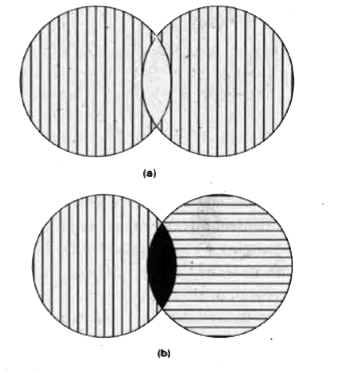 Uses. Following are two practical uses of polaroids : 1. In sun glasses. Sun glasses fitted with polaroids instead of coloured glasses are more efficient in protecting the eyes from glare due to reflected light without obscuring details even in shadows. 2. Wind shield of automobiles. Wind screen fitted with polaroid as well as head lights of automobiles protect the eyes of the drivers of the automobile from the dazzling light of APPROACHING vehicles. The transmission axes of the polaroids both in the head lights as well as the wind screen are oriented say at `45^(@)` with the vertical. |
|
| 49. |
The value of hat(i)xx(hat(i)xxa)+hat(j)xx(hat(j)xxa)+hat(k)xx(hat(k)xxa)is |
|
Answer» a Now, `(hat(i)XXA)=a_(2)hat(k)-a_(3)hat(j)` Now`hat(i)XX(hat(i)xxa)=-a_(2)hat(j)-a_(3)hat(k)` SIMILARLY, `hat(i)xx(hat(j)xxhat(a))=-a_(1)hat(i)-a_(3)hat(k)` and `hat(k)xx(hat(j)xxa)=-a_(1)hat(i)-a_(2)hat(j)` `:.hat(i)(hat(i)xxa)+hat(j)(hat(j)xxa)+hat(k)(hat(k)xxa)=-2a` |
|
| 50. |
A force of 100 gm wt. is required to pull a body weighing 1 kg over ice. The coefficient of friction is |
|
Answer» 0.01 |
|