

Saved Bookmarks
This section includes 7 InterviewSolutions, each offering curated multiple-choice questions to sharpen your Current Affairs knowledge and support exam preparation. Choose a topic below to get started.
| 1. |
Two polaroids are crossed to each other. Now, one of them is rotated through 60^(@). The percentage of incident unpolarised light that passes through the system will be |
| Answer» ANSWER :B | |
| 2. |
A particle moves in a circular path such that its speed v varies with distance as v= alpha sqrt(s) where alpha is a positive constant. Find the acceleration of particle after trafversing a distance S? |
|
Answer» `ALPHA SQRT(1/4 - (S^2)/(R^2))` |
|
| 3. |
The author admits that quick travel does not give the traveller the real....of travel |
|
Answer» pains |
|
| 4. |
A series LCR circuit contains a pure inductor of inductance 5.0H, a capacitor of capacitance 20mu F and a resistor 40Omega. Find the resonant frequency of the circuit. Calculate the quality factor (Q- factor ) of the circuit. What is the impedance at resonant condition? |
|
Answer» Solution :`L= 5H, C= 20 XX 10^(6)F, R= 40 Omega` Resonant FREQUENCY `f_(0)= (1)/(2pi sqrt(LC))` `f_(0)= (1)/(2 xx 3.14 sqrt(5 xx 20 xx 10^(-6)))` `f_(0)= 15.91 Hz or 16Hz` `Q= (1)/(R )sqrt((L)/(C ))= (1)/(40) sqrt((5)/(20 xx 10^(-6))) = 12.5` Impedance at resonant Z= R `Z= 40Omega` |
|
| 5. |
Explain Mass defect and Binding energy and establish a relation between them. |
|
Answer» The difference between the sum of the masses of nucleons constituting it and the rest mass of the nucleus is called mass defect. Let `M_(N)=` mass of neutrons `Z=` number of protons `A=` TOTAL number of nucleons `:.` The mass defect, `Deltam=ZM_(p)+(Z-A)M_(n)-M_("nucleus")` Binding ENERGY. The binding energy of a nucleus may be defined as the energy required to break up a nucleus into its constituent protons and neutrons at infinite distance apart. |
|
| 6. |
An audio signal of 3.2 KHz modulates a carrier of frequency 84 MHz and produces a deviatino of 96 KHz. Findfrequency range of the frequency modulated wave. |
|
Answer» SOLUTION :Here `f_m =3.2 KHZ` `f_c=84 MHz=84xx10^3KHz` frequency DEVIATION `DELTA = 96KHz` Frequency range of the modulated wave =`f+-f_m=84xx10^3+-3.2KHz` |
|
| 7. |
An audio signal of 3.2 KHz modulates a carrier of frequency 84 MHz and produces a deviatino of 96 KHz. Findfrequency modulation index |
|
Answer» SOLUTION :Here `f_m =3.2 KHZ` `f_c=84 MHz=84xx10^3KHz` frequency deviation DELTA = 96KHz` Now frequency MODULATION INDEX `m_f=delta/f_m=96/3.2=30` |
|
| 8. |
Force acting on a magnetic pole of 7xx 10^(-2) Am is 31.5N. Magnetic field at that point is … |
|
Answer» `4 xx 10^(-2) T` Pole strength `p=7 xx 10^(-2) "Am", F= 31.5 N` `therefore overset(to)(B) = (overset(to)(F))/( p) = (3.15)/(7 xx 10^(2) ) = 4.5 xx 10^(-2) `T |
|
| 9. |
अन्तः केंद्रित इकाई कोशिका में संकुलन दक्षता होती है |
|
Answer» 52.4 % |
|
| 10. |
An electron revolving in a stationary orbit ..... |
|
Answer» EMITS energy ACCORDING to quantum theory |
|
| 11. |
In the LCR circuit shown in figure unknown resistance and alternating voltage source are connected.When swith S is closed then there is a phase difference of pi/4 between current and applied voltage and voltage across resister is 100/sqrt2 V.When switch is open current and applied voltage are in same phase.Neglecting resistance of connecting wire answer the following questions : Average power consumption in the circuit when S is open: |
|
Answer» `2500 W` `V_(rms(applied))=100` volts `V_(peak(applied))=100sqrt2` When switch is open `f=1/(2pisqrt(1/(25pi)xx1/(100pi)))=50/2=25 HZ` Resistance `R=X_(L)=X_(C)=2pifL=2Omega` Average POWER consumption =`(100/2)^(2)2=10000/2=5000 W` 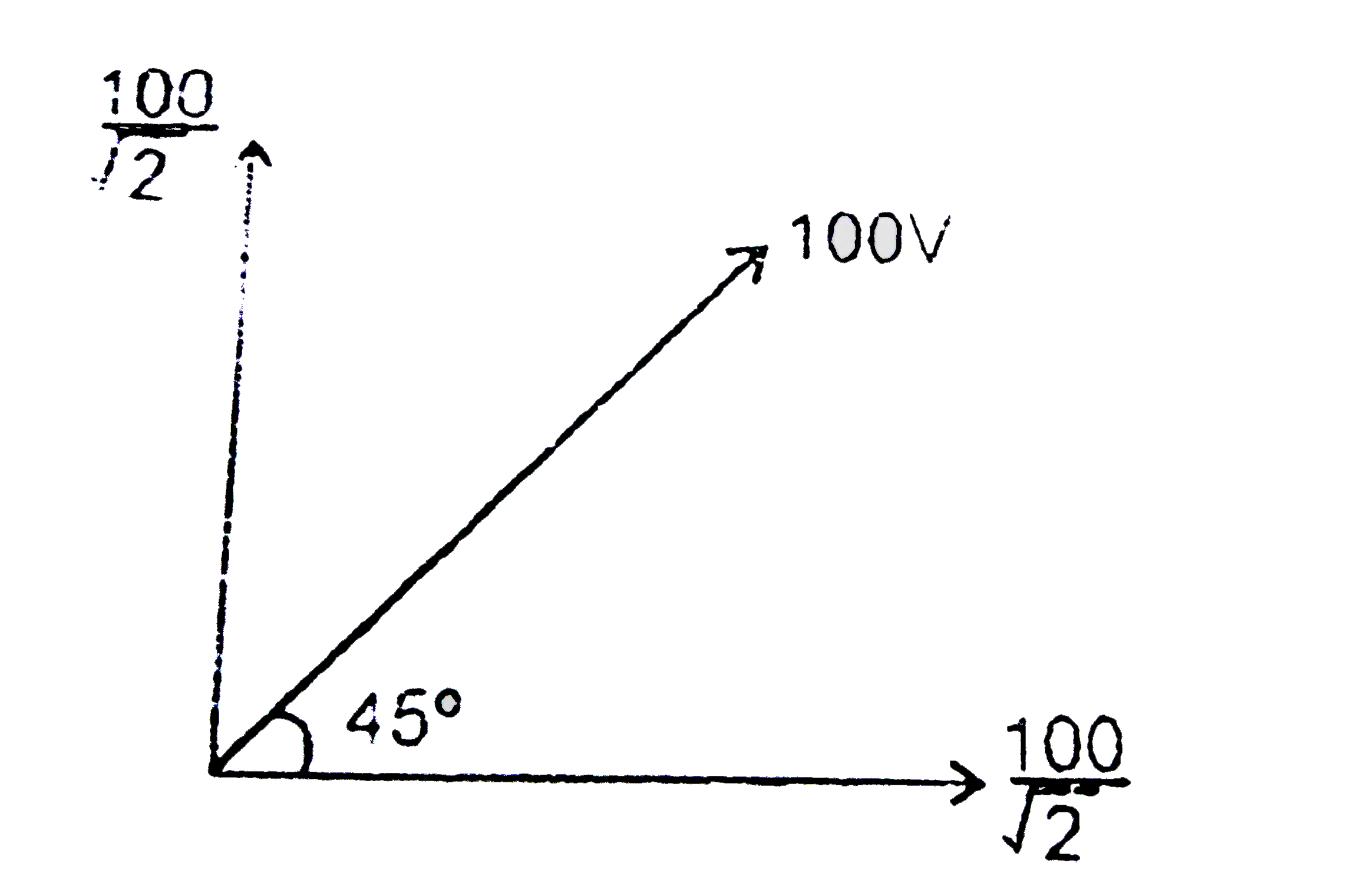
|
|
| 12. |
Dimensions of (1)/(mu_(0) epsilon_(0)), where symbols have their usual meanings, are : |
|
Answer» `[L^(-1) T]` `=[M^(0) LT^(-1)]^(2)=L^(2)T^(-2)`. |
|
| 13. |
When two resistances connected in series and parallel their equivalent resistances are 15Omega and (56)/(15)Omega respectively. Find the individual resistances. |
|
Answer» <P> Solution :`R_(s)=R_(1)+R_(2)=15Omega "" …(1)``R_(p)=(R_(1)R_(2))/(R_(1)+R_(2))=(56)/(15)Omega""…(2)` From equation (1) substituting for `R_(1)+R_(2)` in equation (2) `(R_(1)R_(2))/(15)=(56)/(15)Omega "" therefore R_(1)R_(2)=56` `R_(2)=(56)/(15)Omega ""...(3)` Substituting for `R_(2)` in equation (1) from equation (3) `R_(1)+(56)/(15)=15`then, `(R_(1)^(2)+56)/(R_(1))=15` `R_(1)^(2)+56=15R_(1) RARR R_(1)^(2)-15R_(1)+56=0` The above equation can be SOLVED USING factorisation. `R_(1)^(2)-8R_(1)-7R_(1)+56=0` `R_(1)(R_(1)-8)-7(R_(1)-8)=0 rArr (R_(1)-8) (R_(1)-7)=0` If `(R_(1)=8Omega)`, using in equation (1) `8+R_(2)=15 rArr R_(2)=15-8=7Omega` `R_(2)=7Omega` i.e, (when `R_(1)=8Omega, R_(2)=7Omega`) If `(R_(1)=7Omega)`, substituting in equation (1) `7+R_(2)=15 rArr R_(2)=8Omega`, i.e, (when `R_(1)=8Omega, R_(2)=7Omega`) |
|
| 14. |
How much positive and negative charge is there in a 100 g water ? (Molar mass of water is 18). |
|
Answer» |
|
| 15. |
(i) For the wave on a string described in previous problem do all the points on the string oscillate with the same(a)frequency, (b) phase, ( c ) amplitude ? Explain your answers. (ii) What is the amplitudeof a point 0.375m away from one end ? |
|
Answer» Solution :(i) All the points on the string (a) have the same FREQUENCY except at the nodes( wherefrequency is `costheta `) (b) have the same PHASE every where in one loop exceptat the nodes. (c ) however, the amplitudeof VIBRATION at different points is different. (ii)From y ( x,t) `0.06sin ((2pi)/(3) x )cos ( 120 pit )` The amplitude at `x = 0.375m` is `0.06 sin .( 2pi)/( 3) xx1= 0.06xxsin. ( 2pi)/(3) XX 0.375` `= 0.06 sin.(PI)/(4)=( 0.06)/(sqrt(2)) = 0.042 M` |
|
| 16. |
The primary of a transformer when connected to a dc battery of 10 volt draws a current of 1 mA. The number of turns of the primary and secondary windings are 50 and 100 respectively.The voltage in the secondary and the current drawn by the circuit in the secondary are respectively |
|
Answer» 20 V and 0.5 mA |
|
| 17. |
The silver lining surrounding the profile of a mountain just before sunrise is due to |
|
Answer» interference |
|
| 18. |
What is the significance of BE inside the nucleus. |
| Answer» Solution :It hold the NUCLEOUS TOGETHER INSIDE the nucleus. | |
| 19. |
Inamplitude modulation |
|
Answer» Amplitude remains constant but FREQUENCY change |
|
| 20. |
The electric field can be studied in terms of electric field intensity. a. What is an electric field? Define electric field strength. Given its unit and dimensional formula. c. Who introduced the concept of electric field? d. Is electric field a scalar quantity or a vector quantity? |
|
Answer» SOLUTION :a. Electric field referes to the region SURROUNDING a charge where its influence is felt. The space where charges or charged bodies electrically interact is called elctric field. b. Intensity of electric frield or electric field STRENGTH at any point is defined as the electric force per unit positive charge placed at that point. Unit `NC^(-1)" Dimension "[M^(-1) L^(-1) T^(-3) A^(-1)]` C. Micheal Faraday d. A vector QUANTITY. |
|
| 21. |
A stream of electrons moving with 3xx10^(7)ms^(-1) gets deflected by electric field of 18 V/ cm normal to their path. What is its transverse deflection in travelling through a horizontal distance of 10 cm in the field ?(m_(e)=9xx10^(-31)kg): |
|
Answer» 0.177 cm `a=(X*e)/(m)=(1800xx1*6xx10^(-19))/(9xx10^(-31))=32xx10^(13)` `x=(10)/(100)=3XX10^(7)x t or t=(1)/(3xx10^(8))` SEC. `y=(1)/(2) at^(2)=(1*6)/(9)=0*177 cm` |
|
| 22. |
In the given arrangement of parallel plates area A and distance btween two consecutive plates is d. Equivalent capacitanceof the structure between MN is n times of (in_0A)/d then the value of n is |
|
Answer» |
|
| 23. |
Two wires 1 and 2 of the same cross sectional area A=10mm^2 and the same length but made of different materials are welded together and their ends are rigidly clamped between two walls, as shown in figure. The respective young.s moduli and coefficient of linear exansions are y,_(1) = 10^(9) N//m^(2), y_(2) =2 xx 10^9 N//m^2, y_2 =2xx 10^9 N//m^2 alpha_(1) = 6 xx 10^(-4) ""^(0)C^(-1), alpha_(2) = 3 xx 10^(-4) ""^(0)C^(-1), Iftempertature of system reduced by 20^(@) C then Find the displacement of the joint |
|
Answer» 0 |
|
| 24. |
Two wires 1 and 2 of the same cross sectional area A=10mm^2 and the same length but made of different materials are welded together and their ends are rigidly clamped between two walls, as shown in figure. The respective young.s moduli and coefficient of linear exansions are y,_(1) = 10^(9) N//m^(2), y_(2) =2 xx 10^9 N//m^2, y_2 =2xx 10^9 N//m^2 alpha_(1) = 6 xx 10^(-4) ""^(0)C^(-1), alpha_(2) = 3 xx 10^(-4) ""^(0)C^(-1), Iftempertature of system reduced by 20^(@) C then Find tension in each wire |
|
Answer» 80 |
|
| 25. |
At a given place the horizontal component of earth's field is 0.2 xx 10^(-4) Tesla . If a vertical wire carries a current of 30 A upward , what is the magnitude and direction of the force on 1m of wire ? |
|
Answer» 6 East to WEST |
|
| 26. |
Two wires 1 and 2 of the same cross sectional area A=10mm^2 and the same length but made of different materials are welded together and their ends are rigidly clamped between two walls, as shown in figure. The respective young.s moduli and coefficient of linear exansions are y,_(1) = 10^(9) N//m^(2), y_(2) =2 xx 10^9 N//m^2, y_2 =2xx 10^9 N//m^2 alpha_(1) = 6 xx 10^(-4) ""^(0)C^(-1), alpha_(2) = 3 xx 10^(-4) ""^(0)C^(-1), Iftempertature of system reduced by 20^(@) C then Find the first overtone frequency of the system if joint is a node and mass per unit length of the wires are mu_(1) = 0.3 kg//m and mu_(2) = 0.075 kg//k, I_(0) =1 m |
| Answer» ANSWER :B | |
| 27. |
A and B are isotopes. B and C are isobars. All three are radioactive. Which one of the following is true. |
|
Answer» A, B and C must belong to the same element |
|
| 28. |
In nuclear reaction ""_1^1Hto""_0^1n+""_Q^Px find P, Q and hence identify x. |
|
Answer» SOLUTION :P=0 , Q=1 X is `""_1e^0` a POSITRON. |
|
| 29. |
Two identical magnetic dipoles of magnetic moments 1.0 Am^(2) each placed at separation of 2 m with their axes perpendicualrto each otherfield at a pointmidway between the dipoles is |
|
Answer» `5xx10^(-7) T` `therefore B_(1)=(mu_(0))/(4pi)(2M)/(d^(3))` 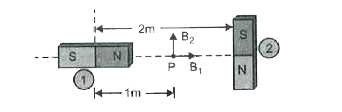 with respect to `2^(nd)` p lies in broad side on position `therefore B_(2)=(mu_(0))/(4pi)` `B_(1)=10^(-7)xx(2xx1)/(1)=2xx10^(-7)TB_(2)=(B_(1))/(2)=10^(-7)T` As `B_(1)` and `B_(2)` are mutually perpendicular hencetheresultant magnet field `B_(R )=sqrt(B_(1)^(2)+B_(2)^(2))` `sqrt((2xx10^(7))^(2)+(10^(-7))^(2)=sqrt(5)xx10^(-7)T` |
|
| 30. |
We have two wires A and B of same mass and same material. The diameter of wire A is half ofthat of B. If the resistance of the wire A is 24 Omega , then the resistance of the wire B will be |
|
Answer» `12 Omega ` ` therefore A_1 = (rhol_1)/(A_1) = 24Omega " and " R = (RHO l_2)/(A_2) = (rho ( (l_1)/(4)) )/(4 A_1) = 1/16 . (rho l_1)/(A_1) = (R_1)/(16) = 24/16 = 1.5 Omega` |
|
| 31. |
In a transformer, the number of turns in primary coil and secondary coil are 5 and 4 |
| Answer» Solution :`(N_(s))/(N_(p))=(i_(p))/(i_(s))IMPLIES(i_(p))/(i_(s))=(4)/(5)` | |
| 32. |
A beam of light consisting of two wavelengths 500 nm and 400 nm is used to obtain interference fringes in Young's double slit experiment. The distance between the slits is 0.3 mm and the distance between the slits and the screen is 1.5 m. Compute the least distance of the point from the central maximum, where the bright fringes due to both the wavelengths coincide. |
|
Answer» Solution :`lambda_(1)=500nm` `lambda_(2)=400nm` `d=0.3mm` `D=1.5m` Here `Xn_(1)=Xn_(2)` `(n_(1)lambda_(1)D)/(d)=(n_(2)lambda_(2)D)/(d)` `n_(1)xx500=n_(2)xx400` `(n_(1))/(n_(2))=(4)/(5)` Hence `n_(1)=4` Now `Xn_(1)=(n_(1)lambda_(1)D)/(d)` `=(4xx500xx10^(-9)xx1.5)/(0.3xx10^(-3))` `=0.01m` |
|
| 33. |
(A) If the impact parameter is large in Rutherford experiment the deviation of the alpha -particle is small. (R) Impact parameter is the initial per- pendicular distance between the velocity direction and nucleus |
|
Answer» Both 'A' and 'R' are TRUE and 'R' is the CORRECT explanation of 'A'. |
|
| 34. |
In Young.s double couble slit experiment the intensity of light at a point on the screen where path difference is lambda is I. If intensity at another point is I/4 ,then possible path differences at this point are |
|
Answer» `lambda/2,lambda/3` |
|
| 36. |
Does photoelectric effect violate the law of conservation of energy? |
| Answer» Solution :No, photoelectric effect does not VIOLATE the law of conservation of ENERGY. In photoelectric effect, LIGHT is CONVERTED to electrical energy. | |
| 37. |
Consider the diffraction pattern for a small pinhole. As the size of the hole is increased a) the size of the image decrease b) the intensity of the image increases c) the size of the image increases d) the intensity decrease |
|
Answer» only ..a.. and ..B.. are correct |
|
| 38. |
The energy of electron in the first orbit of hydrogen atom is _____. |
| Answer» SOLUTION :`-13.6 EV` | |
| 39. |
A mass M is suspended from a spring of negligible mass. The spring is pulled a little and then released so that the mass executes simple harmonic oscillations with a time period T. If the mass is increased by m, the time period becomes (5T//4). The ratio m//M is : |
|
Answer» `9//16` |
|
| 40. |
Two points P and Q are maintained at the potentials of 10 V and - 4V, respectively. The work done in moving 100 electrons from P to Q is |
|
Answer» `9.60 xx 10^(-17)J ` |
|
| 41. |
What is nuclear force ? Mention few properties of it, |
|
Answer» Solution :Nuclear force is a force which binds the nucleons together and is responsible for the stability of the nucleons together and is responsible for the stability of the nucleus. Nuclear force has the CHARACTERISTICS such as (i)SHORT range (ii) ATTRACTIVE (iii) CHARGE independence (iv) spin independence (v) NON - central |
|
| 42. |
A cubic encloses a charge of 1C. What is the electric flux through the surface of the cube ? |
|
Answer» SOLUTION :GIVEN : q=1C `phi=q/epsilon_0=1/(8.854xx10^(-12))=0.1129xx10^12` `phi=0.113xx10^12 Nm^2 C^(-1)` |
|
| 43. |
An electron is accelerated through a potential difference of 100 volts. What is the de-Broglie wavelength associated with it? To which part of the electromagnetic spectrum does this value of wavelength correspond ? |
|
Answer» SOLUTION :`LAMBDA=(h)/(SQRT(2meV))` or `lambda=(12.27)/(sqrtV)` Å `lambda=(12.27)/(sqrt100)Å=1.227Å` This wavelength corresponds to the X-rays. |
|
| 44. |
A carbon resistance has colour bands in order yellow, brown, red. Its resistance is |
|
Answer» `42Omega` |
|
| 45. |
An open pipe of sufficient length is dipping in water with a speed y vertically. If at any instant 1 is length of tube above water then the rate at which fundamental frequency of pipe changes, is (speed of sound = c) |
|
Answer» `cv//2l^2` |
|
| 46. |
Here are three sets of values for the spring constant, damping constant, and mass for the damped oscillator of Fig. 15.17. Rank the sets according to the time required for the mechanical energy to decrease to one-fourth of its initial value, greatest first. {:(bar("Set 1" 2k_(0)" " b_(0)" " m_(0))),("Set 2 " k_(0) " " 6b_(0) " " 4m_(0)),(ul("Set 3" 3k_(0) " " 3b_(0)" " m_(0))):} |
| Answer» Solution :SET 1, Set 2, Set 3, (the RATIO of m/b matters, k does not) | |
| 47. |
The speeds of light is 299, 792, 458 ms^-1 |
|
Answer» with respect to the earth |
|
| 48. |
An analyser is inclined to a polariserat an angle of 30^(@) . The intensity of light emergingfrom onepolariser is 1/n that is incident on the polariser .Then n is equal to |
|
Answer» `10^(-4)` JOULE |
|
| 49. |
If a loop of chain is spunat high speed, it will roll like a hoop without collapsing. Consider a chain oflinear mass density p thatmu is rollingwithoutslipping at a high speed v_(0) (a) Show that the tension in the chain is F = muv_(0)^(2) (b) If the chain rolls over a small hump, a transverse wave pulse will be generated in the chain. At whatspeedwill it travel alongthe chain ?(c)How far around the loop (in degrees) will a transverse pulse travelin the time the hoop rolls through one complete revolution ? |
|
Answer» |
|