

Saved Bookmarks
This section includes 7 InterviewSolutions, each offering curated multiple-choice questions to sharpen your Current Affairs knowledge and support exam preparation. Choose a topic below to get started.
| 1. |
A potentiometer wire of length 1 m has a resistance of 100Omega. It is connected toa 6V battery in series with a resistance of 5Omega. Determine the emf of the primary cell which gives a balance point at 40cm. |
|
Answer» SOLUTION :Here , l=1m `R_1=10 Omega , V=6V , R_2=5Omega` Current flowing in potentiometer wire, `I=V/(R_1+R_2)=6/(10+5)=6/15`=0.4 A Potential drop across the potentiometer wire V = IR = 0.4 × 10 = 4V Potential gradient, `K=(V')/1=4/1`=4V/m EMF of the primary cell = KI = 4 × 0.4 = 1.6 V |
|
| 2. |
A rocket of mass 5000 kg is to be projected vertically.The gases are exhausted with a velocity 1000 ms-w.rt. to the rocket vertically downwards what will be the minimum rate of burning the fuel against gravity ? |
| Answer» Answer :A | |
| 3. |
At which place, Earth's magnetism becomes horizontal. |
|
Answer» MAGNETIC pole |
|
| 4. |
If the liquid ismercury (drop ) then |
|
Answer» `T_(2)ltT_(1)` |
|
| 5. |
Two parallel plate capacitors X and Y have the same area of plates and same separation between them , X has air between the plates while Y contains a dielectric medium of epsi_(r) = 4. Calculate the potential difference between the plates of X and Y. |
|
Answer» Solution :LET potential difference between the PLATES be `V_X` and `V_Y` RESPECTIVELY , then `(V_(X))/(V_(Y)) = (C_(Y))/(C_(X)) = 4` and `V_(X) + V_(Y) = 15 V implies V_(X) = 12 V and V_(Y) = 3 V ` |
|
| 6. |
Two parallel plate capacitors X and Y have the same area of plates and same separation between them , X has air between the plates while Y contains a dielectric medium of epsi_(r) = 4. Estimate the ratio of electrostatic energy stored in X and Y . |
|
Answer» Solution :LET ELECTROSTATIC energy STORED in X and Y be `U_(X)` and `U_Y` respectively , then `(U_(X))/(U_(Y)) = ((1)/(2) C_(X) V_(X)^(2))/((1)/(2) C_(Y) V_(Y)^(2)) = (C_(X) V_(X)^(2))/(C_(Y) V_(Y)^(2)) = ((5 mu F)/(20 mu F)) xx ((12 V)/(3V))^(2) = 4 :1` |
|
| 7. |
What is the de-Broglie wavelength of a nitrogen molecule in air at 300 K? Assume the molecule is moving with the root-mean-square speed of molecules at this temperature. [Atomic mass of nitrogen=14.0076 u]. |
|
Answer» Solution :We know that `1u=1.66xx10^(-27)kg` and nitrogen is DIATOMIC gas. `THEREFORE` MASS of nitrogen molecule`=2xx14.0076xx1.66xx10^(-27)kg=4.649xx10^(-26)kg` Temperature of nitrogen molecule `T=300K` `therefore rms` speed of `N_(2)` molecule `v_(rms)=sqrt((3k_(B)T)/(m))` `therefore` de-Broglie wavelength `lamda=(h)/(mv_(rms))=(h)/(sqrt(3mk_(B)T))=(6.63xx10^(-34))/(sqrt(3xx4.649xx10^(-26)xx1.38xx10^(-23)xx300))` `=2.8xx10^(-11) m or 0.028nm`. |
|
| 8. |
An elastic string has a force constant k and mass m. the string hangs vertically, and a block of an unknown mass is attached to its bottom end. It is known that the mass of the blocks is much greater than that of the string. The hanging block stretches the string to twice its relaxed length. how long (t) would it t take for a low-amplitude transwerse pulse to travel the length of the string stretched by the hanging block ? m=1 kg, k=1/2 N//m. |
|
Answer» `SQRT((2M)/(K))` |
|
| 9. |
Consider a copper cylinder of volume x, resistivity f, resistance across its length is r. If diameter of cylindrical conductor is ((16fx)/(pi^(2)r))^(1//k) , then find the value of k. |
|
Answer» |
|
| 10. |
What is end error in a metre bridge ? How is it overcome ? The resistances in the two arms of the metre bridge are R=5Omegaand S respectively. When the resistance S is shunted with an equal resistance, the new balance length found to be 1.5l_1, where l_1is the initial balancing length. Calculate the value of S. |
| Answer» SOLUTION :`10 OMEGA` | |
| 11. |
A metallic sphere is placed in a uniform electric field. The lines of force follow the path shown in the figures as |
|
Answer» 1 |
|
| 12. |
Derive Eq. (6.4c), making use of theBoltzmann distribution. From Eq.(6.4c) obtain the expression for molar vibration heat capacity C_("V vib") of diatomic gas. Calculate C_("V vib") for cl_(2) gas at the temperature 300K. The natural vibration frequency of these molecules is equal to 1,064.10^(14)s^(-1). |
|
Answer» Solution :by DEFINATION `lt E gt =(Sigma ^(E_(V)e^(-E_(v)//kT)))/(Sigma exp(-E_(v)//kT))= ((del)/(delbeta)Sigma_(v=0)^(OO)e^(betaE_(v)))/(Sigma_(v=0)^(oo)e^(-betaE_(v)))` `=-(del)/(del beta) In Sigma_(v=0)^(oo)e^(-beta(v+1//2)ħomega), beta=(1)/(KT)` `=-(del)/(delbeta) In e^(-1//2beta ħ omega)(1)/(1-e^(-beta ħomega))` `= (del)/(del beta)[-(1)/(2) ħomegabeta-In(1-e^(-beta ħ onrga))]` `(1)/(2) ħ omega+( ħ omega)/(e^( ħ oega//kT)-1)` Thus for one GM mole of diatomic gas `C_("vvib")=N(dellt E gt)/(delT)=(R((ħ omega)/(KT))^(2)e^(ħ omega//kT))/((e^(ħ omega//kT)-1)^(2))` where `R=Nk` is the gas constant. In the present case `(ħomega)/(KT)= 2.7088` and `C_("V 1 VIB")= 0.56R` |
|
| 13. |
The direction of propagation of an electromagnetic wave is that of |
|
Answer» `barB.BARE` |
|
| 14. |
Three blocks A,B and C of mass m,m/2 and m of different densilties and dimensions are placed over each other as shown in the figure. The cofficients of friction are shown. Blocks placed in a vertical line are mae to over towards right with same velcity at the same instant. Find the time (in sec) taken by the upper block A to topple from the middle blcok B. Assume that blocks B and C don't stop sliding before A topples from B. (given L=36m,mu=0.4 and g=10 m//s^(2)) |
|
Answer» `:.f=(mu)/4mg` `:.a_(A)=(mug)/4` leftward 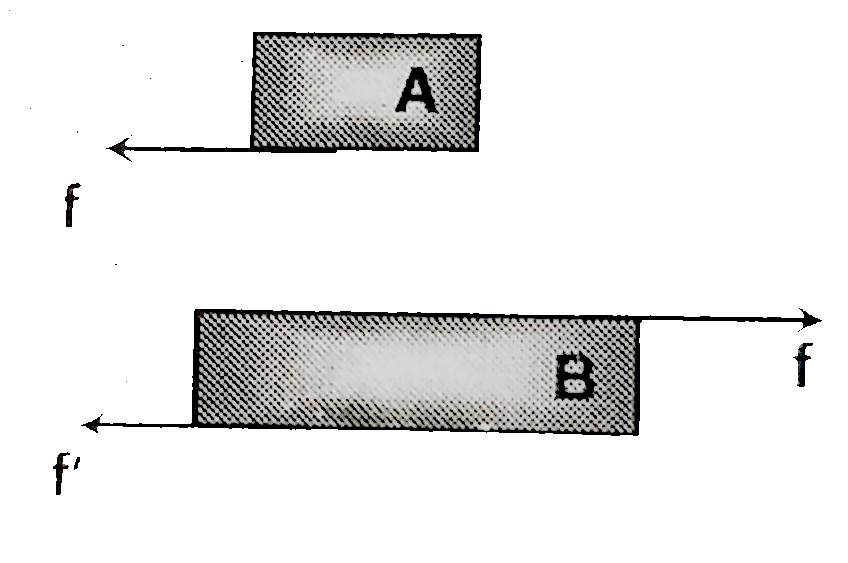 `f^(')=(mu)/2(m+m/2)g=3/4mumg` `:.a_(B)=mug` (leftward) ltbgt `:.a_(A//B)=3/4 mug` (rightward) For sliding down the block `B, A` has to move a distance `(3L)/8` relative to block `B`. `(3L)/8= 1/2 3/4 mu"gt"^(2)` `:.t=sqrt(l/(mug))=3` SEC |
|
| 15. |
The magnetic susceptibility of a paramagnetic substance at -73^(@) is 0.0050. Calculate magnetic susceptibility at -173^(@)C. |
|
Answer» `0.010` `therefore chi_(m) prop (1)/(T)`. `therefore (chi_(m_(2) ) )/( chi_(m_(1) ) )= (T_1)/( T_2)` `therefore (chi_(m_2) ) /( 0.005) = (273 - 73)/( 273-173) = (200)/( 100)` `therefore chi_(m_2) = 2 xx 0.005 therefore chi_(m_2) = 0.010` |
|
| 16. |
How are the magnitudes of the electric and magnetic fields related to the velocity of the electromagnetic wave? |
| Answer» SOLUTION :`E_(0)=cB_(0) or c=(E_(0))/(B_(0))` | |
| 18. |
In the circuit below C_(1)= 20 mu"F," C_(2) = 40 mu F and C_(3) = 50 mu F . If no capacitor can sustain more than 50 V, then maximum potential difference between X and y is |
| Answer» ANSWER :A | |
| 19. |
At a certain place the angle of dip is 30^(@)and horizontalcompontent of earth's fieldis 0.5 oersted the earth 's total magnetic field in oersted is |
|
Answer» `sqrt(3)` Now B COS `delta` =Hor B= `(H)/(cos delta),B=(0.5)/(cos 30^(@))` `=1/2xx(2)/sqrt(3)=(1)/sqrt(3)` oersted |
|
| 20. |
What is rectification ? Explain the working of a full wave rectifier. |
|
Answer» Solution :Rectification `:` The process of converting on alternating currentintoa direct current is called rectification. The device used for this purpose is called RECTIFIER. 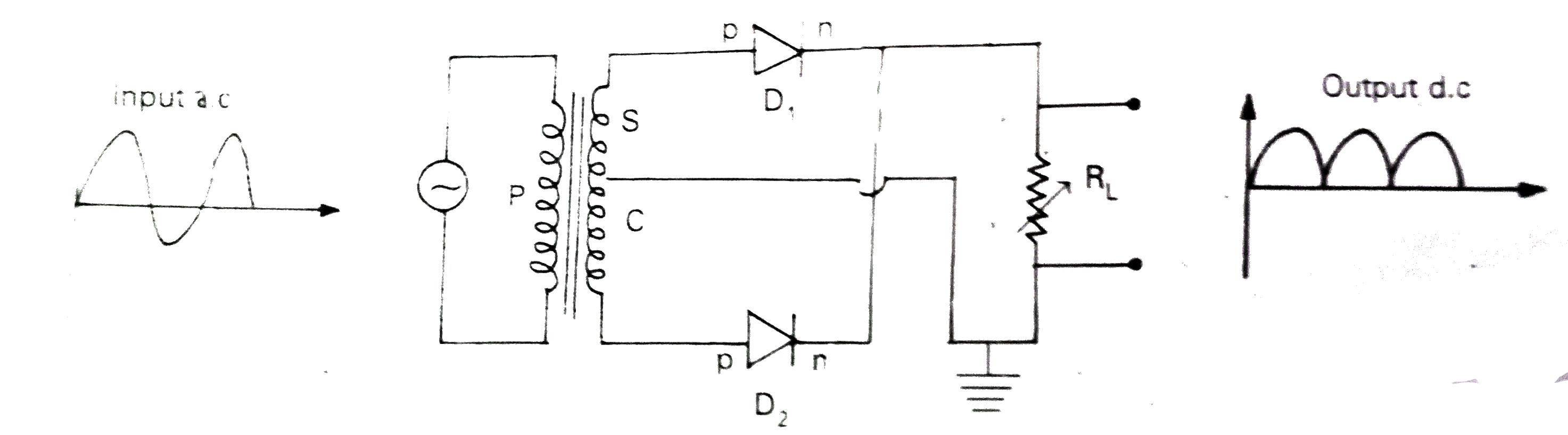 (i) A full wave rectifier can be constructed with the help of two diodes `D_(1)` and `D_(2)`. (ii) The secondary transformer is centre tapped at C and its ends are connected to the p regions oftwo diods `D_(1)` & `D_(2)`. (iii) The OUTPUT voltage is measured across the load resistance `R_(L)`. (iv) During positive half CYCLES of ac, the diode `D_(1)` is forward biased and current flows through the load resistance `R_(L)`. At this time`D_(2)` will be reverse biasedand will be in switch off position. (v) During NEGATIVE half cyclesof ac, the diode`D_(2)` is forwardbiased and the current flows through `R_(L)`.At this time `D_(1)` will be reverse biased and will be in switch off position. (VI) Hence positive output is obtainedfor all the input ac signals. (viii)The efficiency of a rectifier is defined as the ratio between the output dc power to theinput ac power. `eta = ( P_(dc))/(P_(ac))= ( 0.812R_(L))/( r_(f) + R_(L))` The maximumefficiencyof a full wave rectifier is `81.2%` |
|
| 21. |
In a modified YDSE, monochromatic uniform and parallel beam of light of wavelength 6000 A^(@) and intensity ((10)/(pi)) W//m^(2) is incident normally on two circular apertures A and B of radii 1 mm and 2 mm respectively. Find the ratio of the intensity of the sources [(I_(B))/(I_(A))] ? |
|
Answer» |
|
| 22. |
In above question the rocket goes up and get down on the following parts respectively:- |
|
Answer» OA and AB |
|
| 23. |
A 50 mH coil carries a current of 2 ampere, The energy stored in joules is |
|
Answer» 1 |
|
| 24. |
A beam o monochromatic light of wavelength lambda is reflected from air into water to refractive index 4/3. The wavelength of light beam inside water will be |
|
Answer» `9/16xxlambda` |
|
| 25. |
The position vectors of the head and tail of radius vector are 2hati+hatj+hatk and 2hati-3hatj+hatk. The linear mementium is 2hati+3hatj+hatk. The angular momentum is : |
|
Answer» `4hati-8hatk` |
|
| 26. |
Which one of the following particles can be used for the disintegration of a radioactive nucleus ? |
|
Answer» Proton |
|
| 27. |
A circle passes through the points of intersection of the parabola y+1=(x–4)^2 and x-axis.Then the length of tangent from origin to the circle is |
|
Answer» 8 Put y =0 `(x-4)^2=1` x-4=1 (OR) x-4=-1 x=5 (OR) x=3  `OT^2=OA.OB` `OT^2=3xx5` `RARR OT=sqrt15` |
|
| 28. |
Classify the following into conductors , insulators and semi conductors . GaAs , InP , Ni, Calcite , Graphite |
|
Answer» Solution :Conductors - Graphite , NI INSULATORS - CALCITE Semiconductors - GAAS , InP |
|
| 29. |
According to Bohr's atomic model, the circumference of the electron orbit is always an multiple of de-Broglie wavelength. |
|
Answer» |
|
| 30. |
An aeroplane, in which the distance between the tips of wings is 50 m, is flying with a speed of 360 km h^(-1) over a place where the vertical component of earth's magnetic field is 2.0 xx 10^(-4)T. The potential difference between the tips of wings would be |
|
Answer» 0.1V `V=(2.0 xx 10^(-4)) xx 50 xx 100=1.0V` |
|
| 31. |
The focal lengths of the objective and eyepiece of a compound microscope are 5 cm and 10 cm, respectively. The final image of object placed at a distance of 7 cm from the objective lens is formed at near point. Determine the magnifying power and tube length of the compound microscope. |
| Answer» SOLUTION :24.64 CN, 8.75 | |
| 32. |
A capacitor C, a variable resistance R and a bulb are connected in series to a.c. mains in the circuit as shown. The bulb glows with some brightness. How the glow of the bulb change if. A dielectric slab is introduced between the plates of the capacitor. |
| Answer» SOLUTION :The brightness of bulb INCREASES (When DIELECTRIC slab is introduced, capacitance increases hence capacitive reactance DECREASES, then bulb glows with more brightness.) | |
| 33. |
A block slides down a frictionless, inclined plane that makes a 30^(@) angle with the horizontal. Find the acceleration of this block. |
|
Answer» Solution :Let m be the MASS of the BLOCK, so the force that pulls the block down the incline is `mg sin theta`, and the block's acceleration down the plane is `a= (F)/(m)=(mg sin theta)/(m)= g sin theta= g sin 30^(@)=(10)xx(0.5)=5 m//s^(2)` |
|
| 34. |
Explain the phenomenon of Dispersion. Red and blue light rays are incident on a given prism. Explain which will have greater value of minimum deviation. |
|
Answer» Solution :Dispersion of Light The phenomenon of splitting of white light into its constituent colours, on PASSING through a PRISM is called Dispersion of light. The band of colours so obtained is called a spectrum. White light e.g. light from the sun, when seen through a prism, appears coloured. 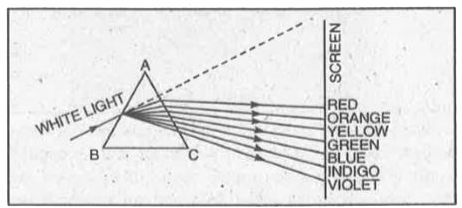 Thus white light splits into different colours, on passing through a prism. The colours in the order of decreasing deviation are Violet, Indigo, Blue, Green, Yellow, Orange and Red (Fig.). Obviously, the deviation is maximum for violet colour and minimum for red colour, Cause of Dispersion The wavelength of red light (in the visible spectrum) is much larger than that of violet light and the wavelength of orange, yellow, green, blue and indigo colours lying in between red and violet light GRADUALLY decreases in the above order. According to Cauchy.s FORMULA, `mu=a+(b)/(lambda^(2))+(c)/(lambda^(4))`, where `lambda` is the wavelength of light and `mu` is the refractive INDEX for the particular wavelength i.e. velocity of light is different for different wavelengths. As the wavelength of blue light is smaller than that of red light, the refractive index for blue light is greater than that for red light. i.e. since `lambda_(b) lt lambda_(r)` `:. mu_(b) gt mu_(r)` We know that, the deviation `delta` for a small angled prism is given by `delta=(mu-1)A` So `lambda_(b) gt lambda_(r)` |
|
| 35. |
Which of the energy band diagrams shown in the figure corresponds to that of a semiconductor ? |
|
Answer»
|
|
| 36. |
The variation of magnetic susceptibility chi_(m) with temperature for a paramagnetic substance is best represented by figure … |
|
Answer»
`chi_(m) = C (mu_0)/( T) RARR chi_(m) PROP (1)/( T)` From eqn. `chi_(m)` and T are inversely proportional. So graph A is correct. |
|
| 38. |
(A) :For transmitting a signal, the antenna should have a size comparable to wave length of the signal at least lamda//4 in dimension (R) : The antenna properly senses the time variation of the signal |
|
Answer» Both 'A' and 'R' are true and 'R' is the CORRECT explanation of 'A'. |
|
| 39. |
Assertion (A) : The earth without its atmosphere would be inhospitably cold. Reason (R ) : All heat would escape in the absence of atmosphere. |
|
Answer» If both assertion and rason are TRUE and the reason is the correct explanation of the assertion. |
|
| 40. |
Calculate the shortest wavelength of the spectral lines emitted in Balmer series. [Given Rydberg constant R = 10^(7) m^(-1)]. |
|
Answer» Solution : WAVELENGTHS of spectral lines of Balmer series are given by the relation: `(1)/(LAMBDA) = R [(1)/((2)^(2)) - (1)/(n^(2))] ` , where n = 3,4,5,……… . For shortest wavelength`n = oo`and it is given that`R = 10^(7) m^(-1)` `therefore""(1)/(lambda_("MIN")) = 10^(7) [(1)/((2)^(2)) - (1)/((oo)^(2))] =(1)/(4) xx 10^(7) RARR "" lambda_("min") = 4 xx 10^(-7) m` |
|
| 41. |
Derive an expression for the impedance of a series LCR circuit connected to an a.c. supply of variable frequency. Plot a graph showing variation of current with the frequency of the applied voltage. Explain briefly how the phenomenon of resonance in the circuit can be used in the tuning mechanism of a radio or TV set. |
Answer» Solution :Graph showing variation of current with frequency of the applied voltage is shown in Fig. 7.44. Phenomenon of resonance plays an important role in the tuning mechanism of a radio or a TV set. The antenna of a radio accepts signals from various broadcasting stations. The signals picked up in the antenna acts as a source in the tuning circuit of the radio and so the circuit can be driven at many FREQUENCIES. HOWEVER, to hear one PARTICULAR radio station at one time we tune the radio. In tuning we vary the capacitance of a capacitor in the tuning circuit so that the resonant frequency of the circuit becomes almost EQUAL to the frequency of the radio signal of a particular station. When this happens, the amplitude of the current with the frequency of the signal of particular radio station in the circuit is maximum and that programme is clearly Fig. 7.44 received.
|
|
| 42. |
A slab of glass, of thickness 6 cm and refractive index 1.5, is placed in front of a concave mirror, the faces of the slab being perpendicular to the principal axis of the mirror. If the radius of curvature of the mirror is 40 cm and the reflected image coincides with the object, then the distance of the object from the mirror is |
|
Answer» 30 cm |
|
| 43. |
From the dimensional consideration, which of the following equations is correct? |
|
Answer» `T=2pisqrt(R^(3))/(GM)` `Thus, LHS=RHS for `T=2pisqrt(R^(3)/(GM))` |
|
| 44. |
What is the role played by the moderator in a nuclear reactor ? |
|
Answer» |
|
| 45. |
Two particles are performing SHM with same amplitude and time period. At an instant two particles are having velocity 1m//s but one is on the right and the other is on left of their mean positiion. When the particles have same position there speed is sqrt(3)m//s. Find the maximum speed (in m/s) of particles during SHM. |
|
Answer» |
|
| 46. |
Find the gratest possible angle through which a deutron is scattered as a result of elastic collision with an initially stationary proton. |
|
Answer» Solution :From CONSERVATION of momentum `sqrt(2MT)hat(i)=vec(p)_(d)+vec(P)_(p)` or `P_(p)^(2)= 2MT+p_(d)^(2)-2sqrt(2MT)p_(d) COS THETA` From energy conservation `T=(p_(d)^(2))/(2M)+(p_(p)^(2))/(2m)`  `(M=` MASS of denteron, `m=` mass of proton) So `P_(p)^(2)= 2mT-(m)/(M)p_(d)^(2)` Hence `p_(d)^(2)(1+(m)/(M))-2 sqrt(2MT) p_(d) cos theta+2(M-m)T=0` For real roots `4(2MT) cos^(2) theta-4xx2(M-m)T(1+(m)/(M)) ge0` `cos^(2) theta ge(1-(m^(2))/(M^(2)))` Hence `sin^(2)theta le(m^(2))/(M^(2))` i.e., `theta le"sin"^(-1)(m)/(M)` For deuteron-proton scalterting `theta_(max)= 30^(@)`. |
|
| 47. |
A power transmission line feeds input power at 3300V to a step down transformer with its primary windings having 2000 turns. What should be the number of turns in the secondary in order to get output power at 330V. |
|
Answer» 400 |
|
| 48. |
Match the following: Moment of inertia of body (in kg-m^(2)) (shown in column -1) about the axis (shown in column -2) |
|
Answer» (I)(i)(S) |
|
| 49. |
Discuss what happens if a satellite is projected with a horizontal speed (1) less than the critical orbital speed (2) equal to the critical orbital speed (3) more than the critical orbital speed but less than the escape speed (4) greater than or equal to the escape speed. |
|
Answer» Solution :To put a satellite in an orbit around the Earth, it is raised to some altidue beyond the Earth's atmosphere and then PROJECTED horizontally with a speed v. The path of the satellite depends on the value of v relative to the CRITICAL orbital speed `(v_(e))` and the escape speed `v_(e).` (1) `v lt v_(e):` The satellite follows an elliptical path withe centre of the Earth at one focus. It may strike the Earth or just miss the Earth's surface and enter into an elliptical orbit with the point of projection as the apogee and the opposite point as the perigee. Even for low-Earth orbits, the perigee must lie above the thermosphere as otherwise the satellite will lose ENERGY due to ATMOSPHERIC drag and gradually spiral down into denser atmosphere and burn out. (2) `v=v_(e):` The satellite enters into a circular orbit around the Earth and its motion is a UCM. (3) `v_(e) lt v lt v_(e):` The satellite moves in an elliptical orbit with the centre of the Earth one focus. (4) ` v ge v_(e):` The path of the satellite is no longer a closed curve and it escapes the Earth's gravitational influence. For `v=v_(e)` (total energy zero), the path is parabolic for `vgtv_(e)` (total energy positive), the path is HYPERBOLIC. |
|


