

Saved Bookmarks
This section includes 7 InterviewSolutions, each offering curated multiple-choice questions to sharpen your Current Affairs knowledge and support exam preparation. Choose a topic below to get started.
| 1. |
M_(p) denotes the mass of the proton and M_(n) denotes mass of a neutron. A given nucleus of binding energy B, contains Z protons and N neutrons. The mass M(N, Z) of the nucleus is given by (where c is the speed of light) |
|
Answer» <P>`M(N ,Z) = NM_(n) + ZM_(p) - BC^(2)` |
|
| 2. |
A ray of light incident on face AB of an equilateral glass prism, shows minimum deviation of 30@ .Calculate the speed of light through the prism. |
|
Answer» Solution :Calculation of SPEED of LIGHT. `mu=(SIN((A+deltam)/2))/(sin(A/2))=(sin((60^(@)+30^(@))/2))/(sin((60^(@))/2))=sqrt(2)` Also `mu=c/vimpliesv=(3xx10^(8))/(sqrt(2))m//s` `=2.122xx10^(8)m//s` |
|
| 3. |
What is the main feature of Rutherford's atom model? |
| Answer» Solution :Rutherford.s atom is an electrically neutral SPHERE consisting of a very small, massive and positively charged nucleus at the CENTRE surrounded by revolving electrons in their respective orbits. The electrostatic force PROVIDES the REQUISITE CENTRIPETAL force. | |
| 4. |
Find the mean radiation power of an electorn performing harmonic oscillations with amplitude a = 0.10 nm and frequency omega = 6.5.10^(14)s^(-1) |
|
Answer» Solution :`P = (1)/(4piepsilon_(0)) (2(dotoversetrarr(p))^(2))/(3c^(3))` `|dotoversetrarr(p)|^(2) = (e omega^(2)a)^(2) cos^(2) omegat` Thus `lt PGT= (1)/(4PI epsilon_(0)) (2)/(3c^(2)) (e omega^(2)a)^(2) xx (1)/(2) = (e^(2)omega^(4)a^(2))/(12pi epsilon_(0)C^(3)) = 5.1 xx 10^(-15)W`. |
|
| 5. |
A single electron orbits around a stationary nucleus of charge +Ze, where Z is a constant and e is the magnitude of the electronic charge. It requires 47.2eV to excite the electron from second Bohr orbit to the third bar Bohr orbit. Find : (a) the value of Z, (b) the energy required to excite the electron from n=3 to n=4. |
|
Answer» Solution :(a) Transition is `n_(1) =2 to n_(2) =3, E= 47.2eV`. we have `DELTA E = 13.6Z^(2) ((1)/(n_(1)^(2))-(1)/(n_(2)^(2)))EV` `rArr 47.2 =13.6Z^(2) ((1)/(2^2)-(1)/(3^2)) rArr Z=5`. (B) transition is `n_(1) =3 to n_(2) =4, E =?` we have `Delta E =13.6Z^(2) ((1)/(n_(1)^(2))-(1)/(n_(2)^(2)))eV` `Delta E =13.6 xx (5^2)((1)/(3^2)-(1)/(4^2))=16.53eV`. |
|
| 6. |
(a) State the principle of working of a galvanometer. (b) Agalvanometer of resistance G is converted into avoltmeter to measure up to V volts by connecting a resistance R_(1) , in series with the coil. If a resistance R_(2)is connected in series with it, then it can measure up to V/2 volts. Find the resistance, in terms of R_(1)"and R_(2), required to be connected to convert it into a voltmeter that can read up to 2 V. Also find the resistance G of the galvanometer in terms of R_(1)" and " R_(2). |
|
Answer» Solution :(b) Ist case `I_(g)` = MAXIMUM CURRENT through galvanometer `R_(1) = V/I_(g) - G `….(i) `2^(nd) "case "` `R_(2) = V/(2I_(g)) - G `….(ii) `3^(rd) ` case ` R = (2V)/I_(g) - G ` ….(iii) From eq. (i) and (ii) `R_(1) - R_(2) = V/I_(g) - G - V/(2I_(g)) + G = V/(2I_(g))` `2(R_(1) - R_(2)) = V/I_(g)` Putting the value of `V/I_(g)` in (i) we GET `R_(1) = 2(R_(1) - R_(2)) - G` ` R_(1) = 2R_(1) - 2R_(2) - G` ` G = 2R_(1) - 2R_(2) - R_(1)` ` = R_(1) - 2R_(2)` Putting the value of `V/I_(g)` and G in eq. (iii) we get : `R = 2[2(R_(1) - R_(2))] - (R_(1) - 2R_(2))` ` = 4R_(1) - 4R_(2) - R_(1) + 2R_(2)` ` = 3R_(1) - 2R_(2)` |
|
| 7. |
Draw a graph showing variation of de-Broglie wavelength with the momentum of an electron. |
Answer» SOLUTION :The GRAPH is SHOWN in FIGURE. 
|
|
| 8. |
The energy band gap is maximum in ……. |
|
Answer» metals SINCE forbidden gap in insulator is maximum MEANS more than 3 eV. While the WIDTH of semiconductor is less than 3 eV and in metal and superconductor this width does not exist. |
|
| 9. |
In above question. What wlll be the flux through the same square if the plane of the square makes an angle of 300 with the x-axis ? |
|
Answer» `30 NC^(-1)m^(2)1` |
|
| 10. |
A person suffering from defect which cannot focus all lines of an object in one plane is a single image plane is called? |
| Answer» SOLUTION :ASTIGMATISM | |
| 11. |
Compare the electrostatic and gravitattional force between a proton and an electron separated by same distance .[ Use standard data ] |
|
Answer» Solution :DATA supplied Mass of an electron `m_1 =9.1 xx 10 ^(-31) kg. "" ` Mass of a PROTON ` m_2 =1.67 xx10 ^(27) kg .` Chargesof an electron `=|q_1| =1.6xx10 ^(19) C .""` Charges of a proton `=|q_2| =1.6 xx10 ^(19) C ` Distance between a proton and an electron =r ( say) `(1)/( 4piin _0)= 9 xx 10 ^(9) Nm^(2) C^(-2)"" G=6.67 xx10 ^(-11) Nm^(2) kg^(-2) ` Electrostatic force =` F_2 =(1)/( 4piin _0) (q_1q_2)/( r^(2)) to ( 1) ` GRAVITATIONAL force =`F_g =(Gm_1m_2)/( r^(2)) to (2) ` ` ((1)/(2)) (F_e)/( F_(g))=(q_1q_2)/( 4pi in _0 G m_1m_2 ) = ( ( 1.6xx 10 ^(-19))^(2) xx 9xx 10 ^(9))/( 6.67xx 10^(-11) xx 9.1 xx 10 ^(-11) xx 1. 67 xx 10 ^( -27)) = 2.273xx 10 ^(19) ` |
|
| 12. |
If the charger is placed at the centre of one side, flux through the cube is (q)/(n epsilon_(0)) where .n. is |
|
Answer» |
|
| 13. |
A 100 Omega resistance and a capacitor of 100 Omega reactance are connected in series across a 220 V source.When the capacitor is 50% charged, the peak value of the displacement current is: (a) 4.4A (b) 11sqrt(2) A (c) 2.2A (d) 11 A |
|
Answer» `4.4 A` `= 220xx sqrt(2)V` `|Z|=sqrt(R^(2)+X_(C )^(2))=sqrt((100)^(2)+(100)^(2))` `|Z|=sqrt(2+(100)^(2))` `|Z|=100 sqrt(2)Omega` `THEREFORE`Maximum value of displacement current `I_(D)=(E_(0))/(|Z|)` `therefore I_(d)=(220sqrt(2))/(100sqrt(2)) "" therefore I_(d)=2.2 A` |
|
| 14. |
Which one of them is used to produce a propagating electromanetic wave? |
|
Answer» an accelearatingcharge |
|
| 15. |
Two electric +q and +4q are placed at a distance 6a apart on a horizontal plane. Find the position of the point on the line joining the two charges where the electric field is zero. |
|
Answer» 2A from +q |
|
| 16. |
A bomb moving with velocity 40 hat(i)+50hat(j)+25hat(k) m/s explodes into pieces of mass ratio 1 : 4. If the small piece goes out with velocity 200hat(i)+70 hat(j)-15hat(k)m//s, find the velocity of larger piece after explosion. |
|
Answer» Solution :LET 5M be MASS of bomb. The LARGEST piece will have mass 4m. Using principle of momentum conservation, `5m(40hat(i)+50hat(j)-25hat(k))=m(200hat(i)+70hat(j)-15hat(k))+4m vec(v)` Which gives `vec(v)=(180hat(j)+140hat(k))/(4)=(45hat(j)+35hat(k))` |
|
| 17. |
In terms of Bohr radius a_(0), the radius of the second Bohr orbit of hydrogen atom is given by |
|
Answer» `4a_(0)` `r_(2) = a_(0)(2)^(2) = 4a_(0)` |
|
| 18. |
He^(+) ions are excited to respective first excited states. Subsequently, H-atoms transfer their total excitation Energy to Het jons collisions). Assume that the Bohr model of atom is exactly valid. The quantum number n of the state finally populated in He+ ions is |
|
Answer» 2 Let `He^(+)` IONS go to nth STATE. So energy required `triangleE_(He)=13.6 xx 4 (1/4-1/n^(2))eV` `n_(1)=4` |
|
| 19. |
Five conducting parallel plates having area A and separation between them d, are placed as shown in the fig. Plate number 2 and 4 are connected with a conducting wire and between point A and B a cell of emf..epsilon.is connected . The change flows through the cell is |
|
Answer» `3/4(epsilon_0Aepsilon)/(d)` |
|
| 20. |
He^(+) ions are excited to respective first excited states. Subsequently, H-atoms transfer their total excitation Energy to Het jons collisions). Assume that the Bohr model of atom is exactly valid. The wavelength of light emitted in the visible region by He^(+) ions after collisions with H atoms is |
|
Answer» `6.5 xx 10^(-7)m` of `lambda=(E_(4)-E_(3))/(hc)` Substitute the required values to GET `lambda=4.8 xx 10^(7) m`. It can be seen that the transition n=4 to n=3 gives light of visible region. |
|
| 21. |
Discuss the motion of a charged particle in a uniform magnetic field with initial velocity perpendicular to the magnetic field. |
|
Answer» Solution :1. When a charged particle having charge q and velocity `vecV` enters a magnetic FIELD `vecB`, it experiences a force, `vecF=q(vecVxxvecB)` This force is centripetal or which circulate this particle to uniform circular motion. 2. (i) When `vecVandvecB` both are perpendicular to each other then only it can perform uniform circular motion which is shown in figure.  3. Magnetic force Bqv provides by the centripetal force. `therefore` For uniform circular motion, Centripetal force = Magnetic force `(mv^(2))/r=Bqv` `thereforer=(mv)/(Bq)""...(1)` but substitute p = mv, `thereforer=p/(Bq)` which indicate that as momentum increase radius of circle also increase. 4. We know that linear velocity `v=omegar` `thereforev/omega=(mv)/(Bq)" "(because"Substituting "r=v/omega"in equ. (1)")` `thereforeomega=(Bq)/m""...(2)` where `omega` is angular FREQUENCY. but `omega=2piv` where v is frequency. `thereforev=omega/(2pi)=(Bq)/(2pim)` which is also known as cyclotron frequency. Thus, frequency of charge doesn.t depend on linear velocity or energy which is very USEFUL in construction principle of cyclotron. 5. Time period of it is, `T=1/v` `thereforeT=(2pim)/(Bq)""...(3)` (ii) If velocity particle makes angle `theta` with magnetic field then two perpendicular components of velocity have to be considered : (a) parallel or antiparallel to field (b) perpendicular to field.  6. If there is a component of the velocity parallel to the magnetic field ir will make the particle move along the field and the path of the particle would be a helical one as shown in figure. 7. The distance moved along the magnetic field in one ROTATION is called pitch (P). `therefore` Pitch p = `v_(||)T` (where `v_(||)` is parallel component of velocity) `thereforep=vcosthetaxx(2pim)/(Bq)` `thereforep=(2pimvcostheta)/(Bq)orp=(2pimv_(||))/(Bq)` 8. The radius of the circular component of motion is called the radius of the helix. |
|
| 22. |
He^(+) ions are excited to respective first excited states. Subsequently, H-atoms transfer their total excitation Energy to Het jons collisions). Assume that the Bohr model of atom is exactly valid. The ratio of the kinetic energy of the n= 2 electron for the H atom to that of He^(+) ion is |
|
Answer» `1/4` `(KE_(H))/(KE_(He))=((Z_(H))/(2) "/" (Z_(He))/(2))^(2)=1/4` |
|
| 23. |
An electron and a proton enter a magnetic field perpendicularly. Both have same K.E. Which of the following is true? |
|
Answer» Both MOVE on straight path |
|
| 24. |
A fat hose pipe is held horizontally by a fireman. It delivers water through a constricting nozzle at 1 litre/sec. If by increasing the pressure, the water is delivered at 2 litre/sec, fireman now has to |
|
Answer» PUSH forward twice as HARD |
|
| 25. |
The radius of n^(th) Bohr's orbit of H-atom is given by: |
|
Answer» `(epsilon_0n^2h^2)/(pime^4)` |
|
| 26. |
A particle moves in a plane under the action of a force which is always perpendicular to the particle's velocity and depends on a distance to a certain point on the plane as 1//r^eta, where eta is a constant. At what value of eta will the motion of the particle along the circle be steady? |
|
Answer» Solution :This is not central FORCE problem unless the path is a circle about the said point. Rather here `F_t` (TANGENTIAL force) VANISHES. Thus equation of motion becomes, `v_t=v_0=const ant` and, `(mv_0^2)/(r)=(A)/(r^2)` for `r=r_0` We can consider the latter equation as the equilibrium under two forces. When the motion is perturbed, we write `r=r_0+x` and the net force acting on the particle is, `-(A)/((r_0+x)^n)+(mv_0^2)/(r_0+x)=(-A)/(r_0^n)(1-(nx)/(r_0))+(mv_0^2)/(r_0)(1-(x)/(r_0))=-(mv_0^2)/(r_0^2)(1-n)x` This is OPPOSITE to the displacement x, if `n lt 1`. (`(mv_0^2)/(r)` is an outward DIRECTED centrifugul force while `(-A)/(r^n)` is the inward directed external force). |
|
| 27. |
The (tau - theta) graph for a current carrying coil placed in a uniform magnetic field is |
|
Answer»
|
|
| 28. |
A certain atom has three electrons (s,p and d) in addition to filled shells, and is in a state with the greatest possible total mechanical moment for a given configuraion. In the corresponding vector model of the atom find the angle between the spin momentum and the total anular momentum of the given atom |
|
Answer» <P> Solution :The total angular momentum is greatest when `L,S` are both greatest and add to form `J`. Now for triplet of `s,p,d` electronsMaximum SPIN `RARR S=(3)/(2)` corresponding to `M_(s)ħsqrt((3)/(2).(5)/(2))=(ħsqrt(15))/(2)` Maximum ORBITAL angular momentum `rarr` `L=3` corresponding to `M_(L)=ħsqrt((3)/(2).(5)/(2))=(ħsqrt(15))/(2)` Maximum total angular momentum `J=(9)/(2)` corresponding to `M=(ħ)/(2)sqrt(99)` In vector model `vec(L)=vec(J)-vec(S)` or in magnitude squared `L(L+1)ħ^(2)=J(J+1)ħ^(2)+S(S+1)ħ^(2)-2vec(J).vec(S)` Thus `cos( lt vec(J),vec(S))=(J(J+1)+S(S+1)-L(L+1))/(2sqrt(J(J+1)sqrt(S(S+1))))` Substitution GIVES `lt (vec(J),vec(S))=31.1^(@)`. |
|
| 29. |
A body slides down a rough inclined plane and then over a rough plane surface. It starts at A and stops at D. The coefficient of friction is : |
Answer» Solution :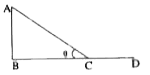 `V=sqrt(2G(sin THETA-MU COS theta)AC)` `THEREFORE CD = (V^(2))/(2mu g)` `CD=(cancel(2)cancel(g)(sin theta - mu cos theta)AC)/(cancel(2) mu cancel(g))` `mu CD=((AB)/(AC)-(mu BC)/(AC))AC` `mu CD = AB-mu BCtherefore mu = (AB)/(BD)` |
|
| 30. |
STATEMENT-1 The formula connecting u,v and f for a spherical mirrors whose sizes are very small compared to their radii of curvature. STATEMENT-2 Laws of reflection are strictly valid for plane surfaces, but not for large spherical surfaces. |
|
Answer» Statement-`1` is TRUE, Statement-`2` is True, Statement-`2` is a correct explanation for Statement -`1` So statement `(2)` is INCORRECT. |
|
| 31. |
Fig showthe fieldliinesof a singlepositive and negative charge respectively. (a) Give the signs of potential difference (V_(p) - V_(Q)) and (V_(B) - V_(A)). (b) Give the sign of potential energy difference of a small negativecharge betweenthe points Q adn P , A and B. (c) Give the sign of the work doen by the field in movinga small positivechargefrom Q to P. (d) Give the sign of the workdone by externalagency in movinga small negativecharge from B to A. (e) Does the Kineticenergy of a smallnegativechargeincreaseor decrease in goingfrom b and A ? |
|
Answer» Solution :As `V prop (1)/( r):. V_(p) gt v_(Q) or (V_(P) - V_(Q))` is positive Also `V_(B)` is less negativethan `V_(A)` (`:'`distancefo B is more than distance of A) Thus, `V_(B) gt V_(A) :. (V_(B) - V_(A))` is positive. (b) A negativechargeheld at Q would move towards P. As charge moves from higherpotentialenergyto LOWER potential energy `:.(P.E)_(Q) gt (P.E)_(P)` Therefore, sign of potential energydifferenceof a smallnegativecharge betweenQ and P is positive. SIMILARLY , `(P.E)_(A) gt (P.E)_(B)` Sign of potential energy difference is positive. (c) In movinga small positive charge from Q to P, WORKHAS to be done by US againstthe electric filed. Therefore, work has to be doneby the fieldis negative. (d) In movinga smallnegative charge from B to A, work done by externalagencyis positive. (e) Due to force of repulsion on the negative charge, velocity DECREASES and henceK.E. decreases in goingfrom B to A. |
|
| 32. |
A shunt of 6Omega is connected across a galvanometer of resistance 294Omega. Find the fraction of the total current passing through the galvanometer. |
|
Answer» |
|
| 33. |
The Q value of a nuclear reaction A + b toC + d is defined by Q = [m_A + m_b – m_C – m_d]c^2 where the masses refer to the respective nuclei. Determine from the given data the Q-value of the following reactions and state whether the reactions are exothermic or endothermic. (i) ""_(1)^(1)H + ""_(1)^(3)H to _(1)^(2)H + _(1)^(2)H (ii) ""_(6)^(12)C + ""_(6)^(12)C to ""_(10)^(20)Ne + ""_(2)^(4)He Atomic masses are given to be m (""_(1)^(2)H)= 2.014102 u m (""_(1)^(3)H) = 3.016049 u m (""_(6)^(12)C ) = 12.000000 u m (""_(10)^(20)Ne ) = 19.992439 u . |
|
Answer» SOLUTION :(i) Q = –4.03 MeV, endothermic (II) Q = 4.62 MeV, EXOTHERMIC |
|
| 34. |
CH_4 +2O_2rarrCO_2+.........H_2O |
|
Answer» 2 |
|
| 35. |
Two rods R and Q of same metal and same cross-section have length in the ratio 1:2 One end of each rod is at 0^(@)C and temperatures of other are 30^(@)C and 40^(@)C respectively. Which of the rod will have higher flow of heat ? |
|
Answer» Rod P `rArrQ_(1)prop(30)/(l)` and `Q_(2)prop(40)/(2l)` `:.(Q_(1))/(Q_(2))=(30)/(40)XX(2l)/(l)=(3)/(2)` `rArrQ_(1)gtQ_(2)`. HENCE correct choice is (a). |
|
| 36. |
A proton and an electron travelling along parallel paths enter a region of uniform |
|
Answer» SOLUTION :Electron (No explanation NEED to be GIVEN if a student only writes the FORMULA for of charged particle ` (or v_c(q)/( m) ) `AWARD |
|
| 37. |
Distinguish between sky waveand space wave modes of communication. What is the main limitation of space wave mode? Writethe expression for the optimum separation between the transmitting and receiving antenna for effective reception of signals in this mode of communication. |
|
Answer» Solution :The ratio wavesare reflectedback to the earth by the ionosphere are known as sky waves and the mode in which sky waves travel is CALLED sky wave propagation. High frequency waves above 40Hz called space waves can be transmittedfrom transmitting antenna to receiving antaena and the mode of travelling of these wave through space is called space wave propagation. Space wave propagation cannot cover global transmission DUE to inability of installation of repeaters ( LOS is obstructed) as mountains and oceans STOPS LOS communication. If `h_(1)` is the height of antaena (transmitting ) and hr height of receiving antaena the MAXIMUM LOS distance `d_(1)= d_(1) + d_(2) = sqrt(2hR) + sqrt(2Rh_(r))`. |
|
| 38. |
A galvanometer of resistance50 Omegagives a full scale deflection for a current5xx10^(-4) A.A. The resistancethat should be connected in series with the galvanometer to read 3 V is |
|
Answer» `5950Omega` |
|
| 39. |
In a device called electronmagnetic pump for transferring molten metals ,a rectangular pipe is placed in a uniform magneitc field B perpendicular to its axis and one of the sides of the section and a strong current I in then passed perpendicular to both B and the axes of the pipe . The molten metal is then passed through the pipe . Whatis the guage pressure produced by the pump ? |
|
Answer» <P> |
|
| 40. |
A nuclear power reactor generates electric power of 100 MW. How many number of fissions occur per second if nuclear fuel used in the reactor is uranium ? |
|
Answer» Solution :Power of a reactor using uranium is `P=(n/t)xx200xx10^6xx1.6xx10^(-19)J` `100xx10^6=(n/t)xx200xx1.6 xx10^(-13)( :. P = 100 MW)` `n/t=(100xx10^6)/(200xx1.6xx10^(-13))=3.125xx10^(18)//s` |
|
| 41. |
List-IList-II a) extra-ordinary raye) obeys snell.s law b) oridnary rayf) R.I. of medium c) Brewster.s angleg) does not obey Snell.s law d) polaroidsh) selective absorption |
|
Answer» `A-G, B-H, C-F, D-E` |
|
| 42. |
A substance of mass 49.53 g occupies 1.5 cm^(3) of volume. The density of the substance (in g cm^(-3)) with correct number of significant figures is |
|
Answer» `3.302` Volume `(V) = 1.5 cm^(3)` We know that `d=(m)/(V)` `d=(49.53)/(1.5)` `d=33.02` `d=33.0` |
|
| 43. |
An automobile travelling with a speed of 60 km/h, can brake to stop within a distance of 20 m. If the car is moving twice as fast i.e. 120 km/h, the stopping distance will be |
|
Answer» 20 m `(20)/(s_2)=(60xx60)/(120xx120)=1/4` or`s_2=80 m`. |
|
| 44. |
(a) In Young's double-slit experiments, deduce the conditions for obtaining constructive and desctructive interference fringes. Hence deduce the expression for the fringe width. (b) Show that the fringe pattern on the screen is actually a superposition of single slit diffraction from each slit. (c ) What should be the width of each slit to obtain 10 maxima of the double-slit pattern within the central maximum of the single slit pattern, for green light of wavelength 500 nm, if the separation between two slits is 1 mm? |
|
Answer» SOLUTION :(c ) `d = 1 mm = 10^(-3) m` `BETA = (2 lambda D)/(a)` `10 (lambda D)/(d) = (2 lambda D)/a` `a = d/5 = (10^(-3))/5 = 0.2 XX 10^(-3) m`. |
|
| 45. |
The capacitance of a pure capacitor is 1 farad. In DC circuit, the effective resistance will be |
|
Answer» ZERO |
|
| 46. |
A triangular loop of side l carries a current I. It is placed in a magnetic field B such that the plane of the loop is in the direction of B. The torque on the loop is |
|
Answer» Zero |
|
| 47. |
Two radioactive material A and B have decay constants 10 lambda and lambda, respectively. If initially they have a the same number of nuclei, then the ratio of the number of nuclei of A to that of B will be 1//e after a time 1/(n lambda), where n is ___________ |
|
Answer» `N_(B) = N_(0)e^(-lambda t)` To find t when `N_(A)/N_(B) = 1/e` `rArr e^(-10 lambdat)/(e^(-lambda t)) = 1/e rArr e^(-9 lambda t)= e^(-1) rArr 9lambda t =1 rArr t=1/(9 lambda)` |
|
| 48. |
Wave Optics Explain the use of wavefront to understan wave propagation. |
|
Answer» Solution :Principle : Every point or particle of a wavefror behave as an independent secondary SOURCE an emits by itself secondary spherical waves. After very small time interval the surface tangential t all such secondary spherical wavelets give th position and shape of new wavefront. BASICALLY the Huygen.s principle is a geometri construction. SUPPOSE, that `F_(1),F_(2)` represents a part of spherica wavefront at t = 0 which is a wave propagating outwards.  According to Huygen.s principle all points of this wavefront `(F_(1)F_(2))` (A, B, C, ...) behave as secondary sources and velocity of wave is v, then distance covered in time `tua` is `vtau`. To determine the shape of wavefront at `t=tau`, draw SPHERES of RADIUS `vtau`from each point on the spherical wavefront and draw a common tangent to all these sphere then at time t after `tau` time gives the position and shape of new wavefront which is `G_(1)G_(2)`in the forward direction. This is a spherical wavefront with centre O and `D_(1)D_(2)` spherical wavefront is found backward. The points A., B., C. on `G_(1)G_(2)` act as secondary source. |
|
| 49. |
In the given figure the steady state current is |
|
Answer» ZERO |
|
| 50. |
Suppose India had a target of producing by 2020 AD, 200,000 MW of electric power, ten per cent of which was to be obtained from nuclear power plants. Suppose we are given that, on an average, the efficiency of utilisation (i.e, conversion to electric energy) of thermal energy produced in a reactor was 25%. How much amount of fissionable uranium would our country need per year by 2020 ? Take the heat energy per fission of""^(235)U to be about 200 MeV. |
|
Answer» Solution :Target of power production by 2020 AD=`2 xx 10^(5) MW =2xx10^(11)`W Power from nuclear plants = 10% of `2 xx 10^(11) W =2xx10^(10)`W which when converted into electric energy in one year, will be equivalent to `E =2xx10^(10)Wxx1 year =2 xx 10^(10) W xx 3.154 xx 10^(7) s = 6.308 xx 10^(17) `J Energy RELEASED in one act of fission = 200 MeV Energy available to ACTUALLY produce electrical power per act of fission = 25% of 200 MeV= 50 MeV =`50xx 1.6xx 10^(-13)J =8.0xx10^(-12)`J Number of `" "^(235)U` fissions required in one year=`("Total energy needed")/("Energy available per act of fission")= (6.308 xx 10^(17))/( 8.0 xx 10^(-12))= 7.885 xx 10^(28)` `therefore` Number of MOLES of `" "^(235)U` required per year `= (7.889 xx10^(28))/(6.023 xx 10^(23))=1.31xx10^(5)` mole `therefore` Mass of `" "^(235)U` required per year = number of moles `xx` mass number` = 1.31 xx 10^(5) xx 235 g = 3.078 xx 10^(7) g = 3.078 xx 10^(4) KG`. |
|


